

You’re house hunting on a Sunday afternoon. You find a beautiful home online — perfect backyard, ideal location, good price. You get excited, call the listing agent… and find out it was sold two weeks ago.
Frustrating, right?
That’s exactly the kind of problem Redfin was built to solve.
Redfin gives you access to near real-time home listings, instant price updates, immersive 3D virtual tours, and the ability to schedule tours directly from the app. No outdated information. No endless back-and-forth. Just a smarter, faster way to buy or sell property.
How Redfin Started and Why It Matters
Redfin launched in 2004 in Seattle with a bold idea: use technology to make real estate more transparent and affordable. Traditional brokerages relied heavily on high commissions and limited data access. Redfin flipped the model by building its own tech-powered brokerage supported by salaried agents.
Instead of acting only as a listings website, Redfin became a full-service real estate platform. It combines property search tools, in-house agents, mortgage services, rental listings, and home value tracking — all inside one digital ecosystem.
Today, millions of buyers and sellers use Redfin every month, making it one of the most recognized real estate platforms in the United States.
What You’ll Learn in This Guide
By the end of this guide, you’ll clearly understand what Redfin is, how Redfin works for buyers and sellers, how its business model generates revenue, what features make it successful, the technology behind it, and how businesses can build a similar Redfin-like platform with Miracuves.
What Is Redfin? The Simple Explanation
What Is Redfin ?
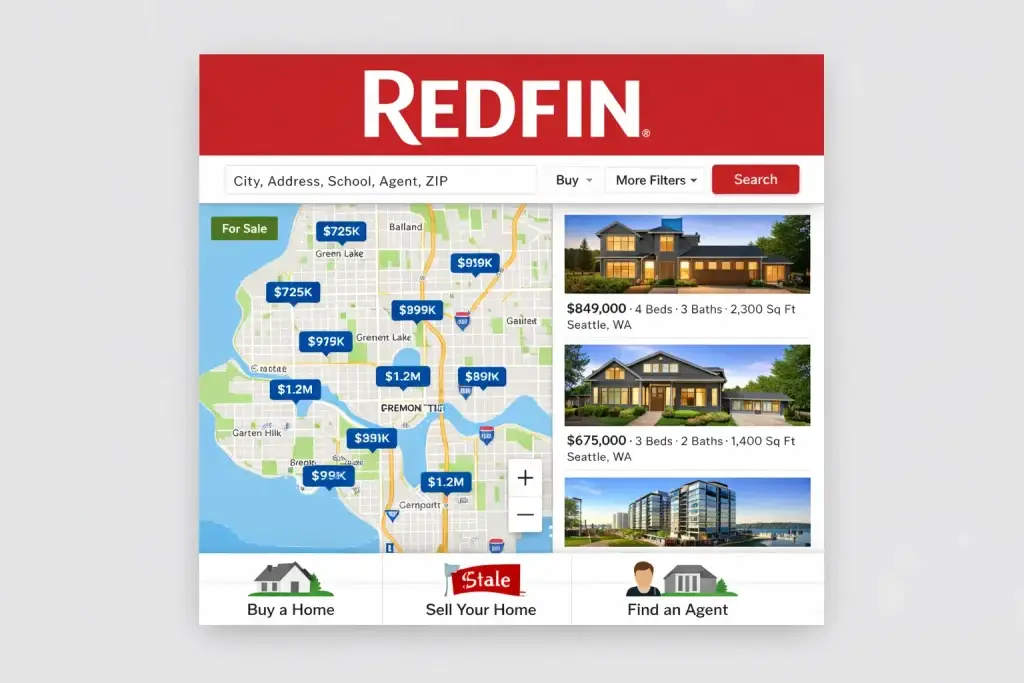
Redfin is a technology-powered real estate brokerage platform that helps people buy, sell, and rent homes through its website and mobile app. Unlike traditional real estate companies, Redfin combines advanced home-search technology with in-house agents and lower commission fees, making the entire property transaction process more transparent, efficient, and affordable.
The Core Problem Redfin Solves
Buying or selling a home has traditionally been slow, expensive, and confusing. Listings were often outdated. Commission fees were high. Communication between buyers, sellers, and agents was inefficient. Redfin solves these issues by offering near real-time MLS updates, direct tour scheduling, transparent pricing data, and salaried agents who are focused on customer satisfaction rather than just commissions.
In simple terms, Redfin reduces friction in real estate transactions.
Who Uses Redfin?
Redfin serves multiple types of users:
Home buyers searching for accurate listings, price history, neighborhood insights, and virtual tours.
Home sellers looking to list properties with lower commission fees compared to traditional brokerages.
Renters browsing rental properties in major U.S. cities.
Investors tracking market trends, home values, and property appreciation data.
Because it combines marketplace technology with brokerage services, Redfin appeals to tech-savvy millennials, first-time home buyers, seasoned investors, and homeowners looking to save on selling costs.
Redfin’s Current Market Position
Redfin is one of the most visited real estate platforms in the United States, competing directly with Zillow, Realtor.com, and Homes.com. The platform attracts tens of millions of monthly users across web and mobile.
Redfin operates in more than 100 U.S. markets and also has a presence in parts of Canada. The company is publicly traded and has built a strong brand reputation around lower listing fees and technology innovation.
Why Did Redfin Become So Successful?
Redfin’s success comes from combining three powerful elements:
Technology-first approach
Lower commission structure
Full-service brokerage model
Instead of acting only as a listing aggregator, Redfin built its own agent network. That gave it control over customer experience while still leveraging technology for scalability. The result is a hybrid real estate model that feels modern, efficient, and data-driven.
What Makes Redfin Different from Traditional Real Estate Sites?
Traditional sites mainly generate leads and pass them to independent agents. Redfin, however, employs many of its agents directly. This allows for better service consistency and competitive commission rates.
It also offers features like instant tour booking, home value estimates, market heat maps, and advanced filtering options that feel more like a tech product than a brokerage website.
How Does Redfin Work? Step-by-Step Breakdown
Let’s break this down in the simplest way possible. Redfin works like a smart digital bridge between buyers, sellers, and real estate agents — all powered by technology.
How Redfin Works for Home Buyers
Account Creation Process
Getting started is simple. Users download the Redfin app or visit the website and create a free account using email, Google, or Apple login. Once inside, they can save searches, set alerts, favorite homes, and track price changes.
The more you interact with the platform, the smarter your recommendations become.
Searching for Homes
Buyers can filter properties by:
Price range
Bedrooms and bathrooms
School ratings
Property type
Open houses
Commute time
HOA fees
New listings
Price drops
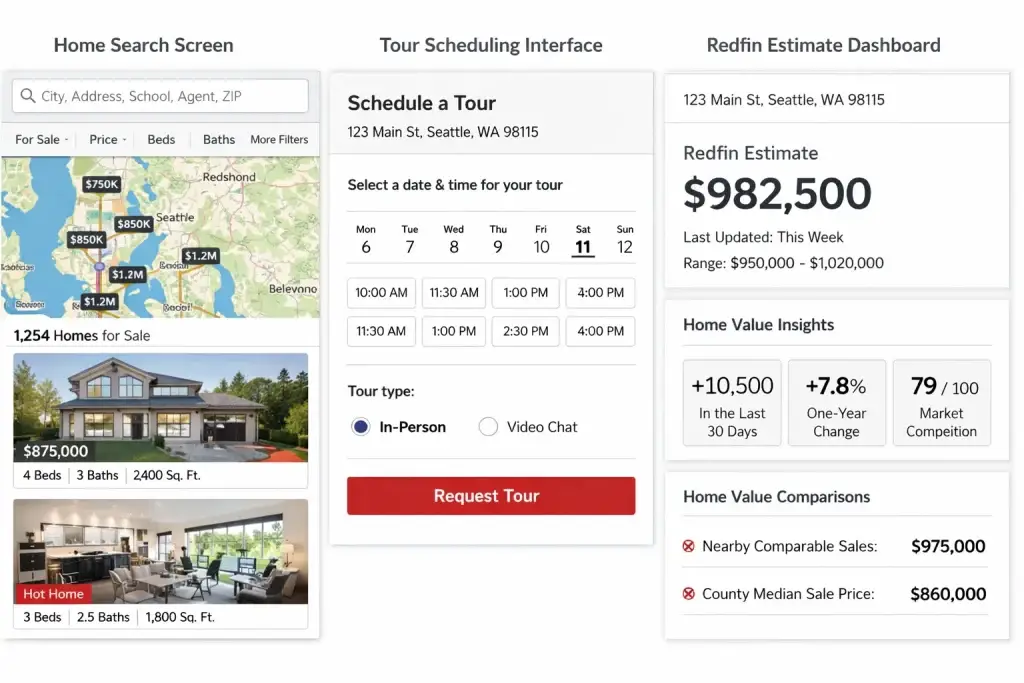
Listings are pulled directly from MLS databases, which means they’re frequently updated. Each property page shows detailed photos, 3D walkthroughs (when available), property tax history, price change history, neighborhood data, and estimated monthly payments.
Scheduling a Tour
This is where Redfin stands out.
Instead of calling an agent and waiting, users can click “Schedule Tour” directly inside the app. They choose a time slot, and a Redfin agent confirms it. This removes friction from the process and speeds up decision-making.
Making an Offer
When ready, buyers work with a Redfin agent to submit offers digitally. The platform supports electronic document signing, offer tracking, and real-time communication.
Redfin agents are salaried (with performance bonuses), which means they’re incentivized by customer satisfaction rather than only commission.
Example User Journey
Let’s say Sarah is looking for a $600,000 home in Austin.
She creates an account, sets filters, and saves her search. She receives instant alerts when a new home hits the market. She finds one she likes, books a tour for Saturday morning, views it in person, and submits an offer through her Redfin agent — all within a few days.
Everything happens inside one connected ecosystem.
How Redfin Works for Home Sellers
Onboarding Process
Sellers can request a home valuation directly through Redfin. A local Redfin agent contacts them, evaluates the property, and proposes a listing strategy.
Redfin offers professional photography, online marketing, yard signs, and MLS listing exposure.
Listing the Property
Once listed, the home appears on Redfin’s platform and other major listing networks. Sellers can track views, favorites, and activity in real time through their dashboard.
Commission Structure
One of Redfin’s biggest selling points is lower listing fees compared to traditional brokerages. Instead of the typical 2.5%–3% listing agent commission, Redfin offers reduced listing fees (often around 1%–1.5% depending on services and market conditions).
Buyers’ agent commission still applies, but sellers can save significantly on the listing side.
Technical Overview (Explained Simply)
Redfin operates as a real estate marketplace layered on top of MLS data systems.
Here’s how it works technically without heavy jargon:
Redfin integrates directly with Multiple Listing Services (MLS) databases across different regions.
Its backend systems constantly sync listing updates.
The mobile and web apps display this data through user-friendly dashboards.
Built-in scheduling tools connect users to agents in real time.
Secure cloud infrastructure handles transactions, document storage, and communications.
The system connects four key components:
Users
Agents
Property databases
Transaction management tools
Everything flows through Redfin’s centralized technology platform.
In short, Redfin blends marketplace technology with a full-service brokerage model, making it more integrated than simple listing websites.
Redfin’s Business Model Explained
Redfin isn’t just a home-search website. It’s a multi-revenue real estate ecosystem. Let’s break down exactly how Redfin makes money and why its model is different from traditional brokerages.
How Redfin Makes Money
Redfin generates revenue through several key streams:
Listing fees from home sellers
Buyer-side commissions
Mortgage services
Title and closing services
Rental advertising
Referral fees in markets where Redfin agents aren’t available
Unlike platforms that only generate advertising revenue, Redfin earns directly from completed real estate transactions.
Listing Fees
Redfin’s biggest competitive advantage is its lower listing commission. Traditional real estate brokerages typically charge around 2.5% to 3% for the listing agent alone.
Redfin often offers listing services starting around 1%–1.5%, depending on the market and service package. Sellers still usually pay the buyer’s agent commission (commonly around 2%–3%), but they can save significantly on the listing side.
That pricing difference attracts cost-conscious homeowners.
Buyer-Side Commissions
When Redfin represents a buyer, it earns a commission from the seller’s side of the transaction. This typically aligns with standard market rates (often 2%–3%), though industry commission structures have been evolving in recent years due to regulatory changes.
Redfin agents are salaried employees with performance bonuses, rather than purely commission-based contractors. This shifts the incentive model toward customer satisfaction and efficiency.
Redfin Mortgage and Title Services
Redfin also operates Redfin Mortgage and title services in select markets. This allows the company to capture additional revenue per transaction by offering integrated home loans and closing services.
By bundling brokerage, mortgage, and title, Redfin increases revenue per customer while simplifying the buying process.
Rental and Advertising Revenue
Redfin includes rental listings and advertising placements. Property managers and landlords can promote listings, generating additional revenue streams.
This diversifies income beyond just buying and selling homes.
Market Size and Growth
The U.S. residential real estate market is valued in the trillions of dollars annually. Even small commission percentages translate into massive revenue potential.
Redfin processes billions of dollars in home transaction volume each year and serves millions of active users across web and mobile platforms. Despite housing market fluctuations, digital-first real estate platforms continue gaining market share as consumers prefer tech-driven experiences.
Profit Margins and Business Strategy
Real estate brokerage traditionally operates on thin margins. Redfin invests heavily in technology, marketing, and agent salaries, which impacts short-term profitability but strengthens long-term scalability.
Its strategy focuses on:
High transaction volume
Lower fees
Operational efficiency through tech automation
Cross-selling mortgage and title services
This hybrid of tech company + brokerage is what differentiates Redfin from traditional agencies.
Revenue Model Breakdown
| Revenue Stream | How It Works | Why It Matters |
|---|---|---|
| Listing Fees | Reduced % charged to home sellers | Attracts sellers with cost savings |
| Buyer Commissions | Commission earned when representing buyers | Major transaction revenue source |
| Mortgage Services | Home loan origination fees | Increases revenue per deal |
| Title & Closing Services | Fees from settlement services | Expands transaction ecosystem |
| Rentals & Ads | Rental listings & promotional placements | Diversifies income streams |
Redfin’s business model is built around owning more parts of the transaction journey rather than acting as just a lead generator.
Read More :- Business Model for Real Estate App
Key Features That Make Redfin Successful
Redfin’s success isn’t accidental. It’s driven by a combination of smart user-focused features and strong backend technology. Let’s break down the top features that make Redfin stand out in the competitive real estate market.
1. Real-Time MLS Listing Updates
Redfin syncs directly with Multiple Listing Services (MLS) to provide near real-time updates on home availability and pricing.
Why It Matters: Buyers avoid wasting time on already-sold homes and get faster access to new listings.
Technical Innovation: Automated MLS data synchronization pipelines and cloud-based data refresh systems ensure constant updates across regions.
2. Advanced Search Filters
Users can filter homes by price, location, school ratings, commute time, HOA fees, open houses, and more.
Why It Matters: It simplifies decision-making and narrows down relevant options quickly.
Technical Innovation: Intelligent filtering algorithms and geospatial search indexing improve speed and accuracy.
3. Instant Tour Scheduling
Buyers can schedule property tours directly inside the app without calling agents.
Why It Matters: Reduces friction and accelerates the buying process.
Technical Innovation: Real-time calendar integrations and automated agent assignment systems streamline booking.
4. Redfin Estimate (Home Value Tool)
Redfin provides automated home value estimates based on market data.
Why It Matters: Buyers and sellers gain transparency before making pricing decisions.
Technical Innovation: Data modeling powered by property history, comparable sales, and predictive analytics.
5. 3D Virtual Tours and Interactive Maps
Many listings include immersive 3D walkthroughs and map-based browsing.
Why It Matters: Buyers can evaluate homes remotely, saving time and travel.
Technical Innovation: Integration with 3D imaging providers and interactive map APIs.
6. Price Drop and New Listing Alerts
Users receive instant notifications when homes drop in price or match their saved criteria.
Why It Matters: In competitive markets, speed gives buyers an advantage.
Technical Innovation: Event-triggered notification engines powered by user behavior tracking.
7. Salaried Agent Model
Redfin employs agents with salaries and performance bonuses instead of commission-only compensation.
Why It Matters: Encourages service quality rather than high-pressure sales tactics.
Technical Innovation: Performance tracking dashboards and CRM systems that measure customer satisfaction metrics.
8. Integrated Mortgage Services
Redfin offers mortgage pre-approval and loan services within the platform.
Why It Matters: Buyers can manage financing and home search in one ecosystem.
Technical Innovation: Secure fintech integrations and automated underwriting workflows.
9. Market Insights and Data Visualizations
Redfin provides neighborhood heat maps, pricing trends, and market competitiveness scores.
Why It Matters: Users make data-driven decisions instead of emotional ones.
Technical Innovation: Big data analytics engines processing regional sales data and behavioral insights.
10. Mobile-First User Experience
Redfin’s mobile app offers smooth navigation, alerts, and digital paperwork handling.
Why It Matters: Most users search for homes on mobile devices.
Technical Innovation: Cross-platform mobile frameworks with cloud synchronization and secure document management.
Recent Updates and AI Integrations
Redfin continues improving its AI-driven recommendations, predictive pricing models, and automated customer support systems. Machine learning models analyze user search behavior to suggest relevant properties and forecast pricing trends more accurately.
AI is also used to enhance listing descriptions, optimize property photo tagging, and improve fraud detection systems.
What Truly Sets Redfin Apart
The real differentiator is integration. Redfin doesn’t just show listings. It combines search, agents, scheduling, financing, and closing services inside one connected platform.
The Technology Behind Redfin
Redfin may look simple on the surface, but behind that clean interface is a powerful technology ecosystem designed to handle millions of users, massive property databases, and real-time transaction workflows.
Let’s break it down in plain English.
Tech Stack Overview Simplified
Redfin operates as a cloud-based real estate platform. Its system connects property databases, user accounts, agents, mortgage services, and transaction workflows into one integrated infrastructure.
At a high level, the platform includes:
Frontend applications for web and mobile
Backend servers managing listings, users, and transactions
Database systems storing property and customer data
Cloud infrastructure for scalability
APIs connecting MLS systems and third-party services
The mobile apps are built for iOS and Android, while the web platform supports desktop users with the same synchronized experience.
Real-Time Data Synchronization
One of Redfin’s biggest technical strengths is real-time MLS syncing.
MLS systems across different states update property listings continuously. Redfin integrates directly with these feeds, processes updates, and reflects changes on its platform quickly.
This requires:
Automated data ingestion pipelines
Data validation layers
High-speed caching systems
Distributed cloud servers
That’s why users often see listing updates faster compared to some competitors.
AI and Machine Learning Systems
Redfin uses machine learning in several areas:
Predictive home value estimation
Personalized property recommendations
Market trend forecasting
Smart pricing insights for sellers
Fraud detection and risk analysis
AI analyzes historical sales, neighborhood trends, user behavior, and pricing patterns to generate accurate insights.
This helps users make smarter decisions backed by data rather than guesswork.
Data Handling and Privacy
Because real estate transactions involve sensitive financial information, security is critical.
Redfin uses:
Encrypted data transmission (HTTPS protocols)
Secure cloud storage
User authentication systems
Role-based access controls
Compliance with U.S. data privacy regulations
Financial details, mortgage applications, and signed documents are stored securely within protected systems.
Scalability Approach
Real estate demand fluctuates heavily based on market conditions and interest rates. Redfin’s infrastructure is designed to scale up or down depending on traffic spikes.
Cloud hosting allows:
Elastic server capacity
Load balancing
Geographically distributed data centers
Disaster recovery systems
This ensures performance remains stable even during high-traffic seasons.
Mobile App vs Web Platform
Redfin follows a mobile-first approach. Many users browse homes on smartphones, especially during open house searches or commute times.
The mobile app supports:
Push notifications
GPS-based home discovery
Instant tour booking
Saved searches and alerts
The web platform offers:
Expanded dashboards
Market analytics
Seller tools
Mortgage management
Both are synchronized through cloud-based user accounts.
API Integrations
Redfin integrates with multiple external systems, including:
MLS databases
Mortgage processing systems
Mapping services
3D tour providers
Electronic signature platforms
Credit and financial verification services
These APIs allow Redfin to operate as a fully connected real estate ecosystem rather than just a listings website.
Also Read :- How to Develop a Real Estate App
Why This Technology Matters for Business
Technology gives Redfin three major business advantages:
Speed
Accuracy
Cost efficiency
Automation reduces manual processes. AI improves pricing accuracy. Cloud infrastructure lowers operational overhead compared to traditional brokerages.
This tech-first strategy is what enables Redfin to offer lower listing fees while still operating at scale.
Redfin’s Impact & Market Opportunity
Redfin didn’t just enter the real estate market — it changed how people interact with it. By blending technology with brokerage services, it reshaped expectations around transparency, speed, and cost.
How Redfin Disrupted the Real Estate Industry
For decades, real estate operated on opaque pricing, slow communication, and high commission structures. Redfin challenged that model by introducing:
Lower listing fees
Real-time online listings
Digital tour scheduling
Data-driven pricing tools
Salaried agents instead of commission-only salespeople
This tech-first approach forced traditional brokerages to rethink how they deliver value. Today, digital tools are no longer optional in real estate — they’re expected.
Market Size and Growth Potential
The U.S. residential real estate market processes trillions of dollars in transaction volume annually. Even small shifts toward digital brokerage models represent enormous revenue opportunities.
Online real estate search now dominates the home-buying journey. The majority of buyers start their search online, and mobile apps have become the primary discovery channel.
Platforms like Redfin benefit from:
Increasing digital adoption
Remote home shopping trends
Virtual tour demand
Data-driven buyer behavior
Growing investor interest in property tech
Despite housing market fluctuations, PropTech (property technology) continues to attract strong investment and innovation.
User Demographics and Behavior
Redfin’s user base largely includes:
Millennials entering peak home-buying years
Tech-savvy urban professionals
First-time home buyers
Real estate investors
Cost-conscious sellers
Younger buyers especially prefer platforms that offer transparency, speed, and digital control over traditional in-person processes.
Users also expect:
Instant notifications
Mobile-first interfaces
Accurate price estimates
Online document signing
Integrated mortgage solutions
Redfin aligns closely with these expectations.
Geographic Presence
Redfin operates in more than 100 major metropolitan markets across the United States, with additional presence in parts of Canada.
Its strongest markets include high-volume housing areas such as:
California
Texas
Washington
Florida
Illinois
Arizona
These regions provide large transaction volumes and high user engagement.
Future Projections
The future of real estate is increasingly digital. Key growth drivers include:
AI-powered pricing models
Automated transaction workflows
Remote closings
Integrated fintech solutions
Data-driven investment tools
As more buyers demand faster and more transparent experiences, tech-enabled brokerages like Redfin are positioned to expand market share.
The opportunity isn’t just in brokerage fees. It’s in owning the entire transaction lifecycle — from discovery to financing to closing.
Opportunities for Entrepreneurs
The demand for digital real estate platforms continues to grow. Localized platforms, niche property marketplaces, rental-focused apps, and hybrid brokerage models all present strong business potential.
With rising property transactions and growing online adoption, entrepreneurs can enter this space with innovative, region-specific, or feature-enhanced platforms.
This massive success is why many entrepreneurs want to create similar platforms that combine marketplace technology with integrated services.
Building Your Own Redfin-Like Platform
Now that you understand how Redfin works and why it’s successful, the next logical question is — can you build something similar?
The answer is yes. And many entrepreneurs already are.
Why Businesses Want a Redfin Clone
Real estate is one of the largest transaction-based industries in the world. Even capturing a small percentage of local market share can generate substantial revenue.
Entrepreneurs are attracted to Redfin-like platforms because they offer:
Recurring transaction-based income
High-value commissions
Scalable marketplace models
Strong mobile engagement
Opportunities to integrate mortgage, rentals, and property management
Instead of relying only on traditional brokerage models, a digital-first platform gives you automation, data ownership, and operational efficiency.
Key Considerations Before Development
Before building a Redfin-like app, you need clarity on:
Target market (city, state, or national level)
Revenue model (commission, subscription, ads, hybrid)
Agent onboarding structure
MLS integration access
Legal and compliance requirements
Mortgage and title service partnerships
The real estate space is regulated, so compliance and proper licensing are essential.
Essential Features to Include
If you’re planning to launch a Redfin-style platform, these features are non-negotiable:
User account creation
Advanced property search filters
MLS or property database integration
Real-time listing updates
Tour scheduling system
Agent dashboards
Offer submission workflow
Mortgage calculator integration
Push notifications
Admin control panel
Optional but powerful additions include:
AI-powered price estimation
Market trend dashboards
3D virtual tours
Chat support
CRM integration for agents
Cost Factors & Pricing Breakdown
Redfin (USA)–Like Real Estate Platform Development
| Development Level | Inclusions | Estimated Market Price (USD) |
|---|---|---|
| 1. Basic Real Estate Listings MVP | Core web platform for property listings, user registration & login, listing search with basic filters (city, price, beds), property detail pages, save/favorite listings, lead/contact inquiry form, basic admin panel for managing listings, basic analytics | $60,000 |
| 2. Mid-Level Real Estate Marketplace Platform | Advanced filters (property type, amenities, map view), agent/broker profiles, listing verification workflows, lead routing, inquiry dashboard, alerts/notifications, saved searches, area guides/content pages, richer analytics, mobile-responsive experience | $140,000 |
| 3. Advanced Realtor.com-Level Property Ecosystem | Large-scale multi-region real estate platform, advanced geo-search + maps, personalization/recommendations, agent pipelines/CRM-like tools, featured listings/ads placement, fraud checks, enterprise analytics, multi-language support, cloud-native scalable architecture | $250,000+ |
Redfin-Style Real Estate Platform Development
The prices above reflect the global market cost of developing a Redfin/Realtor.com-like real estate listings and marketplace platform — typically ranging from $60,000 to over $250,000+, with a delivery timeline of around 4–12 months for a full, from-scratch build. This usually includes scalable listings architecture, map-based search, lead routing, optional third-party feed integrations, analytics, security, and production-grade infrastructure for high traffic.
Miracuves Pricing for a Redfin (USA)–Like Custom Platform
Miracuves Price: The cost depends on the tech stack and the features you need. A Redfin-style listings platform on our PHP stack typically costs $2,499 to $4,899. On a JavaScript stack it starts at $3,999 and rises with scope.
This is positioned for a feature-rich, JS-based Redfin-style real estate platform that can include:
- Property listing management (admin/agent workflows)
- Search, filters, map view, property detail pages, favorites, and saved searches
- Lead capture and inquiry routing for agents/brokers
- Alerts and notifications for matching properties
- Analytics dashboards for listings and lead performance
- Modern web interface plus optional companion mobile apps
From this foundation, the platform can be extended into deeper geo-search, recommendations/personalization, featured listings, richer agent tools, and advanced integrations as your real estate business scales.
Note: This includes full non-encrypted source code, complete deployment support, backend setup, admin panel configuration, and publishing on the Google Play Store and Apple App Store—ensuring you receive a fully operational ecosystem ready for launch and future expansion.
Our closest ready-made product is a real estate listing platform, from $4,299 and delivered in 6 days. It is not a copy of Redfin. It covers listings, search and enquiries rather than a brokerage model, and map-based search tuned to your market or agent tooling is added as custom work.
Delivery Timeline for a Redfin (USA)–Like Platform with Miracuves
The ready-made listing platform is delivered in 6 days, and app store approval is handled by Google and Apple and takes additional time. For a Redfin-style custom build, the typical delivery timeline with Miracuves is 15-30 days, extending to 45-60 days for larger scope, depending on:
- Depth of listings, search, and map/geo workflows
- Number and complexity of third-party integrations (maps, feeds, CRM tools)
- Complexity of lead routing, agent dashboards, and admin controls
- Scope of web portal, mobile apps, branding, and scalability targets
Tech Stack
We preferably will be using JavaScript for building the entire solution (Node.js / Nest.js / Next.js for the web backend + frontend) and Flutter / React Native for mobile apps, considering speed, scalability, and the benefit of one codebase serving multiple platforms.
Other technology stacks can be discussed and developed upon request when you contact our team, ensuring they align with your internal preferences, compliance needs, and infrastructure choices.
Read More :- How to Market a Real Estate App Successfully After Launch
Conclusion
Redfin shows what happens when technology meets a traditional industry ready for change. By combining real-time data, smart automation, and a customer-first brokerage model, it transformed how millions of people buy and sell homes. It proves that even industries as established as real estate can be reshaped through transparency, efficiency, and digital innovation.
For entrepreneurs and businesses, the bigger lesson isn’t just about real estate — it’s about platform thinking. When you build a system that connects users, service providers, and transactions seamlessly, you create long-term value. And as digital adoption continues to grow, the opportunity to launch smarter, tech-enabled marketplaces has never been stronger.
FAQs :-
What is Redfin?
Redfin is a technology-powered real estate brokerage platform that helps users buy, sell, and rent homes through its website and mobile app. It combines property search tools with in-house agents, mortgage services, and digital transaction management.
How does Redfin make money?
Redfin makes money through listing fees charged to home sellers, buyer-side commissions, mortgage origination fees, title and closing services, and rental advertising. Its primary revenue comes from completed real estate transactions.
Is Redfin available in my country?
Redfin primarily operates in the United States and has limited operations in Canada. It is not a global marketplace like Airbnb or Uber, so availability depends on specific metro areas within these countries.
How much does Redfin charge users?
For sellers, Redfin typically offers listing fees lower than traditional brokerages, often around 1%–1.5% depending on the market and service level. Buyers generally do not pay Redfin directly, as commissions are typically covered within the transaction structure.
What’s the commission for service providers (agents)?
Redfin agents are salaried employees with performance-based bonuses rather than independent commission-only agents. However, buyer-side commission rates in transactions typically align with market standards.
How does Redfin ensure safety?
Redfin uses secure encrypted systems to protect user data and financial information. It also verifies listings through MLS integrations and employs licensed real estate professionals to manage transactions.
Can I build something similar to Redfin?
Yes. Entrepreneurs can build a Redfin-like platform by integrating property listings, agent management systems, tour scheduling tools, and transaction workflows. Using a ready-made clone solution can significantly reduce development time and cost.
What makes Redfin different from competitors?
Redfin stands out because it combines a real estate marketplace with its own salaried agents, offers reduced listing fees, integrates mortgage services, and provides real-time MLS updates. This hybrid model differentiates it from platforms that only generate leads.
How many users does Redfin have?
Redfin attracts millions of monthly users across its web and mobile platforms, making it one of the most visited real estate marketplaces in the United States.
What technology does Redfin use?
Redfin uses cloud-based infrastructure, MLS data integrations, AI-powered pricing models, mobile applications for iOS and Android, secure document management systems, and API integrations with mortgage and mapping services.
How can I create an app like Redfin?
To create an app like Redfin, you need a scalable real estate marketplace architecture, MLS integration, user dashboards, agent onboarding systems, secure transaction workflows, and mobile app development. Partnering with an experienced development company like Miracuves can help you launch faster with customizable clone solutions and expert guidance.
Related Articles :-
Miracuves is an independent software development company. We are not affiliated with, connected to, sponsored by, or endorsed by any company or product named in this article.
Terms such as “X Clone” are used descriptively. It is how the software industry refers to building a platform with functionality comparable to a known service, and how clients search for it.
The entire design and codebase of our products is built by our own team. Our products contain no code, design, graphics, or content originating from any third-party website or applications.
All third-party names and marks referenced in this article are the property of their respective owners, referenced solely to identify the services discussed.