




You’ve heard the horror stories about data breaches, stolen user information, leaked payment details, and platforms getting shut down overnight due to non-compliance. For marketplace apps like Thumbtack, where real service providers, customers, locations, and payments are involved, security is not optional — it is the foundation of trust.
In 2025, cyber-attacks on service marketplaces and on-demand platforms have increased sharply due to the rise of AI-driven fraud, API attacks, payment exploits, and identity theft. A single vulnerability in your white-label Thumbtack app can expose you to massive financial loss, lawsuits, regulatory penalties, and irreparable brand damage.
This guide gives you an honest, technical, and business-focused assessment of how safe a white-label Thumbtack app really is, what risks you must watch for, and exactly how to secure your platform properly. We will also show how Miracuves approaches security as a first-principle engineering responsibility — not as an afterthought.
Understanding White-Label Thumbtack App Security Landscape
What “white-label security” actually means
White-label security does not mean “shared security” or “weaker protection.” It means your app is built on a pre-engineered codebase that already includes security layers like encryption, authentication systems, secure APIs, and compliance frameworks. However, the final security level depends entirely on how the provider customizes, deploys, and maintains that system. A poorly implemented white-label app can be highly vulnerable, while a professionally engineered one can meet enterprise-grade security standards.
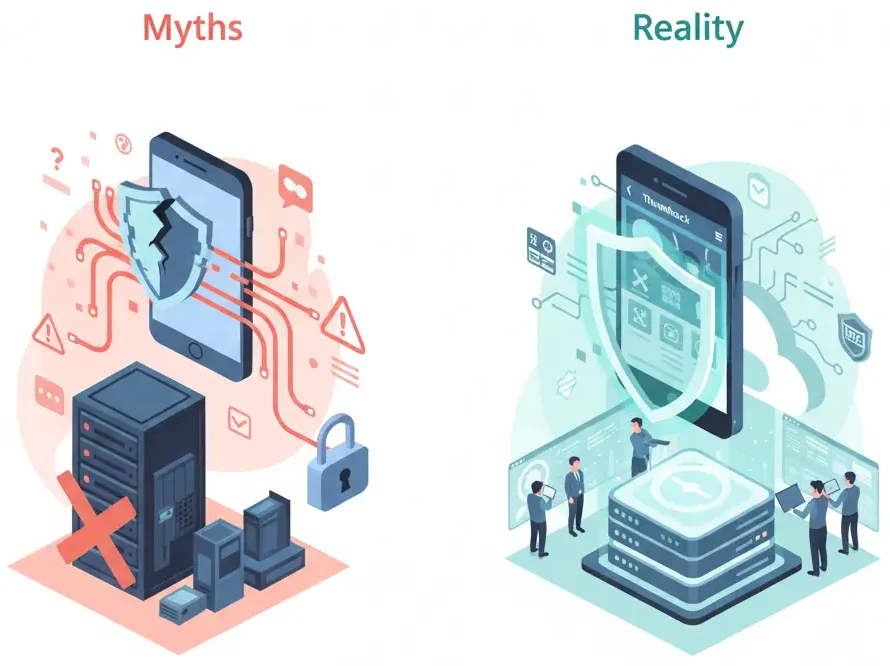
These fears are valid — but they are caused by unsafe providers, not by the white-label model itself.
Current threat landscape for Thumbtack-type platforms in 2025
Service marketplaces face some of the most complex threat vectors today:
- Account takeovers through credential stuffing
- Fake service provider profiles using AI-generated identities
- Payment fraud and refund abuse
- API scraping of user and provider data
- Location data exploitation
- Ransomware targeting cloud servers
According to global cybersecurity reports from 2024–2025, service and gig-economy platforms saw over a 38% increase in API-based attacks and a 41% rise in payment fraud attempts year over year.
Security standards in 2025
Modern Thumbtack-style platforms are expected to follow:
- Zero-trust security architecture
- Privacy-by-design development
- Continuous vulnerability scanning
- Encrypted data at rest and in transit
- Automated breach detection systems
- Region-specific data residency compliance
Real-world statistics on app security incidents
- Over 60% of mobile app breaches in 2024 originated from insecure APIs
- 1 in 3 marketplaces experienced at least one attempted data breach
- Average cost of a service marketplace breach crossed $4.6 million globally
- Regulatory penalties for GDPR violations reached record levels in Europe
These numbers show one truth clearly: white-label Thumbtack app security is not a feature — it is a survival requirement.
Key Security Risks & How to Identify Them
A white-label Thumbtack app handles real identities, live locations, service bookings, and financial transactions. That combination makes it a high-value target. Understanding the exact risk zones helps you prevent disasters before they happen.
High-risk area 1: Data protection & privacy
User and provider data is the most valuable asset on your platform and the most exploited by attackers.
- User personal information: Names, phone numbers, emails, addresses, and identity documents are prime targets for identity theft.
- Payment data security: Card information, UPI details, transaction logs, and wallet balances attract financial fraud.
- Location tracking concerns: Real-time service locations can be exploited for stalking, physical crimes, or profiling.
- GDPR and CCPA compliance: Improper consent handling, data storage, or deletion policies can trigger massive compliance penalties.
If your provider cannot clearly explain how each of these is protected, that is already a red flag.
High-risk area 2: Technical vulnerabilities
Most successful attacks today happen through technical misconfigurations rather than direct hacking.
- Code quality issues: Unvalidated inputs, hardcoded credentials, and insecure data storage open entry points.
- Server security gaps: Weak firewall rules, open ports, and improper cloud access permissions are common breach causes.
- API vulnerabilities: Insecure REST APIs allow attackers to extract user data, manipulate bookings, or bypass payments.
- Third-party integrations: Payment gateways, SMS, maps, and chat services all introduce external security dependencies.
One compromised API key can expose your entire Thumbtack app ecosystem.
High-risk area 3: Business risks
Security failures do not remain technical problems. They become business crises.
- Legal liability: You are legally responsible for user data, even if your vendor caused the breach.
- Reputation damage: A single public breach can destroy marketplace trust permanently.
- Financial losses: Chargebacks, lawsuits, regulatory fines, and compensation claims add up fast.
- Regulatory penalties: Non-compliance with GDPR, PCI DSS, or national IT laws can trigger shutdown orders.

If even three of these are missing, the platform is operating in a high-risk zone.
Read more : – Thumbtack Features Breakdown for Startup Founders
Security Standards Your White-Label Thumbtack App Must Meet
Security in 2025 is no longer based on promises or marketing claims. It is judged by verifiable certifications, technical safeguards, and continuous audits. A serious white-label Thumbtack app must meet the following standards without exceptions.
Essential certifications
- ISO 27001 compliance: Confirms that the provider follows a structured information security management system for protecting data across the entire organization.
- SOC 2 Type II: Verifies long-term controls for security, availability, confidentiality, and privacy, especially important for SaaS-based marketplaces.
- GDPR compliance: Mandatory if you serve users in the EU or handle EU citizen data. Covers consent, data storage, deletion rights, and breach disclosure.
- HIPAA (if applicable): Required only if your Thumbtack-style app handles healthcare services or medical data.
- PCI DSS for payments: Mandatory for handling card payments, wallets, and recurring billing securely.
Without at least ISO 27001 and PCI DSS, your app is not considered enterprise-ready from a security perspective.
Technical security requirements
Your white-label Thumbtack app must include these as default, not as paid add-ons:
- End-to-end encryption: All data must be encrypted both in transit (TLS/SSL) and at rest (AES-256 or higher).
- Secure authentication: OAuth 2.0, token-based authentication, and mandatory two-factor authentication for users, providers, and admins.
- Regular security audits: Quarterly internal audits and annual third-party audits to catch new vulnerabilities.
- Penetration testing: Ethical hacking simulations to test real-world attack resistance.
- SSL certificates: Strong TLS certificates across all web, admin, and API endpoints.
- Secure API design: Rate limiting, IP whitelisting, token expiration, and strict access scopes.
If any of these are “optional” with a provider, that indicates a weak security culture.
Security standards comparison table
| Security Area | Minimum Required Standard | What Unsafe Providers Offer |
|---|---|---|
| Data encryption | AES-256 at rest, TLS 1.2+ in transit | Basic or partial encryption |
| Payment security | Full PCI DSS compliance | Third-party gateway only |
| Authentication | OAuth + 2FA + token security | Password-only login |
| Server security | Hardened cloud with WAF | Shared unmanaged hosting |
| API protection | Rate limits + access controls | Public, weakly protected APIs |
| Audits | Annual third-party + internal scans | No documented audits |
| Compliance | ISO 27001, GDPR verified | Verbal or template compliance |
This table alone can help you eliminate over 60% of unsafe white-label Thumbtack app vendors during vendor screening.
Red Flags – How to Spot Unsafe White-Label Providers
Most security failures in white-label Thumbtack apps do not come from advanced hacking. They come from choosing the wrong development partner. Unsafe providers usually show clear warning signs before any breach happens — founders just miss them.
Warning signs you must never ignore
- No security documentation: If a provider cannot show written security architecture, audit reports, or data protection policies, walk away immediately.
- Cheap pricing without explanation: Extremely low prices often mean no security audits, no proper infrastructure, and reused vulnerable code.
- No compliance certifications: Absence of ISO 27001, PCI DSS, or GDPR verification is a major risk indicator.
- Outdated technology stack: Old frameworks, unsupported libraries, and unpatched servers invite automatic exploits.
- Poor code quality: Lack of input validation, exposed APIs, and hardcoded credentials signal insecure coding practices.
- No security updates policy: If they don’t define how often patches and updates are released, vulnerabilities will accumulate fast.
- Lack of data backup systems: No encrypted backups means total data loss during ransomware or server crashes.
- No insurance coverage: A provider without cyber liability insurance exposes you to full financial damage during breaches.
Even one of these signs should trigger deeper investigation. Multiple signs mean immediate rejection.
Evaluation checklist before selecting a provider
Use this checklist during vendor discussions:
- Questions to ask providers
- How is user data encrypted at rest and in transit?
- How often are penetration tests performed?
- What is your breach response time guarantee?
- Who is responsible for security patch deployment?
- How is admin access logged and monitored?
- Documents to request
- ISO 27001 or equivalent certification
- PCI DSS compliance proof
- Data protection and privacy policy
- Incident response and disaster recovery plan
- Third-party security audit reports
- Testing procedures
- Perform independent vulnerability scans
- API security testing
- Authentication brute-force resistance testing
- Payment flow penetration tests
- Due diligence steps
- Verify past security incidents transparently
- Speak to live clients
- Review real deployment architecture
- Confirm cloud provider security controls
Skipping this evaluation is the single biggest cause of long-term white-label Thumbtack app security failures.
Best Practices for Secure White-Label Thumbtack App Implementation
Security is not something you switch on after launch. It must be engineered into the platform from day one and continuously reinforced after deployment. A secure white-label Thumbtack app follows a strict pre-launch and post-launch security lifecycle.
Pre-launch security
Before your app goes live, these steps are mandatory:
- Security audit process: A full audit of source code, APIs, databases, servers, and cloud configurations must be completed before production release.
- Code review requirements: Independent security engineers should review critical modules such as authentication, payments, chat, and location tracking.
- Infrastructure hardening: Servers must be configured with firewalls, intrusion detection systems, secure access controls, and multi-layer network segmentation.
- Compliance verification: GDPR, PCI DSS, and regional IT law compliance must be legally validated, not assumed.
- Staff training programs: Admins and internal teams must be trained on access control, social engineering risks, data handling procedures, and incident reporting.
Skipping any of these steps exposes the platform to vulnerabilities even before the first user signs up.
Post-launch monitoring
Security does not end at launch. Continuous monitoring is what prevents small issues from becoming full-scale breaches.
- Continuous security monitoring: Real-time monitoring of traffic, login attempts, API usage, and unusual behavior using automated threat detection systems.
- Regular updates and patches: Monthly or urgent hotfix updates to address newly discovered vulnerabilities in frameworks and libraries.
- Incident response planning: A defined response playbook that includes detection, isolation, notification, and recovery steps.
- User data management: Controlled data access, scheduled data purging, consent tracking, and encrypted archival storage.
- Backup and recovery systems: Automated encrypted backups with off-site redundancy and routine recovery testing.
A marketplace without active post-launch monitoring is operating in a permanently exposed state.
Security implementation timeline
A safe Thumbtack app implementation typically follows this structure:
- Week 1: Security architecture design, threat modeling, and compliance mapping
- Week 2: Code security audit, API protection setup, and penetration testing
- Week 3: Infrastructure hardening, encryption verification, and admin access control
- Week 4: Final compliance validation, backup testing, and live security monitoring activation
This structured timeline ensures your platform launches with enterprise-grade protection rather than reactive defense.
Legal & Compliance Considerations
Security in a white-label Thumbtack app is not only a technical responsibility — it is also a legal obligation. In 2025, regulatory authorities worldwide actively monitor digital marketplaces, and non-compliance can result in heavy penalties, forced shutdowns, and personal liability for founders.
Regulatory requirements
Your legal obligations depend on where your users and service providers are located, not just where your company is registered.
- Data protection laws by region
- European Union: GDPR mandates strict consent, data minimization, breach notification within 72 hours, and the right to erasure.
- United States: CCPA and CPRA require transparent data usage, opt-out mechanisms, and data access rights for consumers.
- India: Digital Personal Data Protection Act (DPDP Act) governs consent, cross-border data transfers, and breach reporting.
- Middle East and APAC: Local data residency and consumer protection laws increasingly mirror GDPR standards.
- Industry-specific regulations
- If your Thumbtack app lists healthcare, legal, or financial service professionals, additional regulatory layers apply.
- Background verification, licensing validation, and professional liability disclosures may be mandatory.
- User consent management
- Explicit consent for data collection, payment processing, location access, and marketing communication must be recorded and auditable.
- Consent logs must be stored securely for regulatory review.
- Privacy policy requirements
- Your privacy policy must clearly disclose what data is collected, why it is collected, how long it is stored, and who it is shared with.
- Any misleading or copied privacy policy can trigger regulatory investigations.
- Terms of service essentials
- User responsibility clauses
- Platform liability boundaries
- Dispute resolution mechanisms
- Service provider verification disclaimers
- Jurisdiction and governing law statements
Without legally reviewed policies, even a technically secure app can fail compliance audits.
Liability protection
Legal compliance alone does not protect you from lawsuits. You also need structured liability management.
- Insurance requirements
- Cyber liability insurance to cover breach-related losses
- Professional indemnity insurance for service marketplace risks
- Data breach response insurance for forensic and legal costs
- Legal disclaimers
- Clear limitations of liability for platform-mediated transactions
- Force majeure and service interruption clauses
- Third-party service responsibility disclaimers
- User agreements
- Separate agreements for customers, service providers, and administrators
- Digital acceptance with verifiable logs
- Enforceable termination and suspension policies
- Incident reporting protocols
- Mandatory internal escalation timelines
- User notification flows
- Regulatory reporting workflows
- Evidence preservation systems for investigations
- Regulatory compliance monitoring
- Continuous monitoring of legal changes across regions
- Periodic policy updates
- Annual external legal compliance audits
Without these legal safeguards, a single breach incident can escalate into multi-country litigation exposure.
Compliance checklist by region
- Global operations: Cyber insurance, professional indemnity, legal audit trails
- European Union: GDPR registration, data processing agreements, breach notification system
- United States: CCPA disclosures, opt-out tools, consumer data access portal
- India: DPDP consent management, data localization where applicable
- Middle East: Local hosting and cross-border transfer approvals where required
Read more : – Reasons startup choose our Thumbtack clone over custom development
Why Miracuves White-Label Thumbtack App Is Your Safest Choice
Miracuves approaches security as a core engineering discipline, not a feature add-on. Every white-label Thumbtack app is built on a security-first architecture designed to meet modern regulatory, technical, and business risk requirements from day one.
Miracuves security advantages
- Enterprise-grade security architecture with hardened cloud infrastructure
- Regular internal and third-party security audits
- GDPR, CCPA, and regional data protection compliance built in by default
- 24/7 security monitoring with real-time threat detection
- Encrypted data transmission and encrypted storage for all user and transaction data
- Secure payment processing aligned with PCI DSS standards
- Scheduled security updates and rapid vulnerability patching
- Cyber liability and professional indemnity insurance coverage included
Unlike low-cost vendors that rely on outdated or reused insecure code, Miracuves follows continuous security validation across the full platform lifecycle — from development to deployment and post-launch operations. This ensures your Thumbtack-style marketplace remains compliant, resilient, and trustworthy as it scales.
Don’t compromise on security. Miracuves white-label Thumbtack app solutions come with enterprise-grade security built in. Our 600+ successful projects have maintained zero major security breaches. Get a free security assessment and see why businesses trust Miracuves for safe, compliant platforms.
Conclusion
A white-label Thumbtack app can be just as secure as a custom-built platform — but only when security is treated as a core foundation, not a shortcut. The real risk is never the white-label model itself, it is choosing a provider that cuts corners on protection, compliance, and monitoring.
With the right security standards, legal safeguards, and continuous oversight, your marketplace can scale with confidence, trust, and long-term stability.
FAQs
1. How secure is a white-label Thumbtack app vs custom development?
Security depends on implementation, not the model. A professionally built white-label app with audits can be more secure than rushed custom builds.
2. What happens if there’s a security breach?
Immediate isolation, forensic investigation, user notification, regulatory reporting, and recovery through backups and insurance.
3. Who is responsible for security updates?
Both the provider and the app owner. The provider maintains core security; the owner must ensure updates are applied on time.
4. How is user data protected?
Through end-to-end encryption, secure databases, strict access controls, and continuous monitoring.
5. What compliance certifications should I look for?
ISO 27001, PCI DSS, GDPR, SOC 2 Type II, and regional data protection laws.
6. Can white-label apps meet enterprise security standards?
Yes, when built with proper audits, hardened infrastructure, and certified compliance.
7. How often should security audits be conducted?
Internally every quarter and externally at least once a year.
8. What’s included in the Miracuves security package?
Encrypted infrastructure, GDPR/CCPA compliance, PCI-aligned payments, monitoring, audits, and insurance coverage.
9. How is security handled across different countries?
Data localization, regional compliance mapping, and jurisdiction-specific consent and reporting systems.
10. What insurance is needed for app security?
Cyber liability insurance, professional indemnity insurance, and data breach response coverage.
Related Articles: