
Key Takeaways
What You’ll Learn
- Thumbtack’s growth model depends on balancing two audiences — service providers and customers — with separate acquisition and onboarding strategies.
- Local SEO is one of the strongest growth drivers because service discovery is highly location-based and trust-driven.
- City-first launch strategy works better than going broad too early, helping the platform build liquidity and refine user experience faster.
- Provider acquisition needs its own incentives such as visibility, lower early commissions, and onboarding support.
- Reviews and reputation signals directly influence growth because local-service users rely heavily on peer trust before hiring.
- A Thumbtack-like marketing strategy works best when product convenience, local visibility, and trust signals grow together.
Stats That Matter
- The biggest marketing challenge is balancing two audiences at once — clients and providers — which requires separate growth flows.
- Local SEO is positioned as a major conversion channel because it brings high-intent, location-based traffic.
- Launching in one city first is recommended so the platform can build density before expanding.
- Early provider acquisition can be improved with zero commission periods, “founding provider” status, and exclusive perks.
- App store reviews are treated as highly important because users depend on social proof in local-service apps.
- Marketplace growth works better when acquisition is supported by onboarding, trust, and repeat usage loops.
Real Insights
- The strongest local-services platforms do not market to everyone at once; they win one city, niche, or category before scaling.
- SEO works especially well for service marketplaces because users often search with urgent, location-specific intent.
- Provider-side marketing is just as important as customer acquisition because supply quality shapes the entire user experience.
- Trust-building is a growth tactic, not just a UX feature, especially through reviews, ratings, and verified profiles.
- Promotions may drive first-time usage, but reliability and quality are what bring repeat bookings.
- The smartest Thumbtack-style strategy combines local SEO, provider incentives, strong trust signals, and focused city-by-city expansion.
Ever tried to find a plumber at 9 PM or a wedding photographer two weeks before your big day? If yes, you’ve probably stumbled upon Thumbtack—or wished something like it existed. Thumbtack didn’t just solve a problem; it created a platform where handymen, DJs, house cleaners, and tutors could get booked without cold-calling or classified ads.
If you’re building a Thumbtack clone using TechCrunch like marketing strategy or any kind of local service marketplace, you’ve got one half of the puzzle solved: supply and demand. The tricky part? Getting noticed. Marketing a service-based app like Thumbtack means targeting homeowners and hustlers at the same time—and doing it smarter, not louder.
This post walks you through how Thumbtack cracked the code, and how you can market your local services app like a pro. (Spoiler alert: if you’re still building the app, Miracuves can make sure your clone doesn’t just work—it wins.)
Breaking Down Thumbtack’s Winning Formula
Thumbtack didn’t start out with billion-dollar backing or viral buzz. It grew with smart, strategic marketing that hit people where they live—literally.
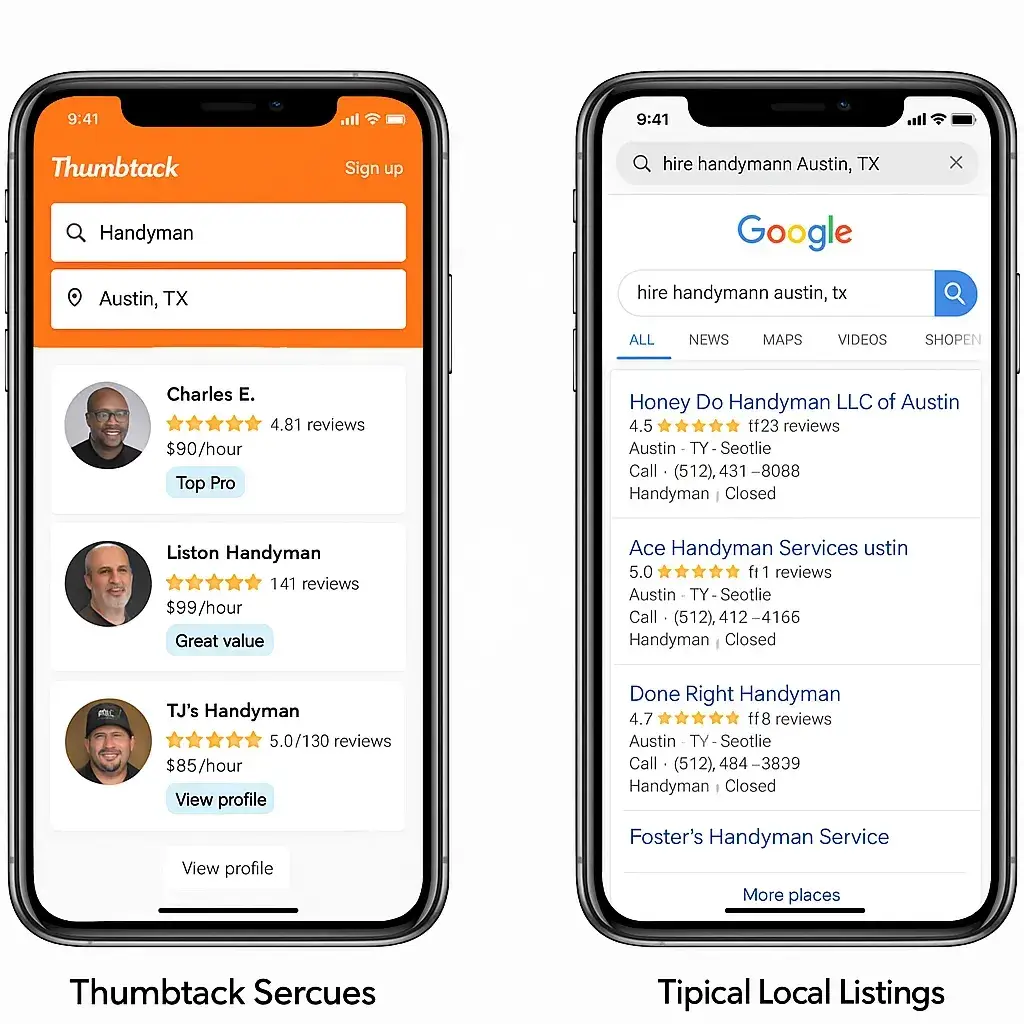
1. Hyperlocal SEO at Scale
Thumbtack’s biggest weapon? Landing pages. Lots of them.
- “Affordable electricians in Austin”
- “Top-rated piano teachers in Chicago”
- “Best house cleaners near me”
These long-tail local keywords drove free, high-conversion traffic to the app, and Google loved it.
2. Early Google Ads with a Local Twist
Thumbtack didn’t just run broad search ads—they focused on buyer-ready intent:
- “Hire a handyman fast”
- “Same-day plumber service”
- “Backyard wedding DJ”
They knew that when someone’s searching for these, they’re ready to book. Not browse.
Learn More: Build an App Like Thumbtack: Developer Guide for PHP & Node.js
Who You’re Actually Marketing To (Hint: It’s Two Tribes)
Like any two-sided marketplace, your app needs to attract both service providers and service seekers—and their priorities couldn’t be more different.
Service Providers (Pros)
- Goals: Consistent work, better-paying clients, reviews
- Pain Points: Job droughts, undercutting competition, flaky leads
- Hangouts: Facebook Groups, LinkedIn, trade forums, YouTube DIY channels
Service Seekers (Clients)
- Goals: Speed, affordability, reliability
- Pain Points: No-shows, poor communication, hidden fees
- Hangouts: Google search, Instagram, Reddit, Nextdoor
Pre-Launch: Set the Stage Like a Pro
Before the app is even live, you should be planting seeds of curiosity and trust.
1. Build a Local Waitlist
Create geo-specific landing pages like “Be the first to join [YourApp] in Atlanta.” Offer early-bird perks, priority listing, or fee waivers.
2. Leverage Facebook and Nextdoor
Use community groups to soft-pitch your platform. Start conversations like “What’s the biggest pain when hiring a local pro?”
3. Partner With Local Influencers
Find real estate agents, food bloggers, and local event planners—they’re trusted voices with built-in audiences.
Post-Launch: Let the Flywheel Turn
1. Empower Providers to Promote
Give every pro a shareable profile link and a “Book me on [App]” badge for their site, Instagram bio, or business card.
2. Ratings + Response Times = Trust
Gamify service providers: the fastest responders and highest-rated get spotlight placement.3.
3. Automate Push Alerts
“Someone nearby just requested your service.” Instant dopamine hit. Service providers will engage.
4. Retarget & Remind
Use retargeting ads for job seekers who browsed but didn’t book:
“Still need a gardener? Top-rated pros available now.”
Go Hyperlocal or Go Home
National visibility sounds sexy. But Thumbtack started local, nailed it, and then scaled.
Hyperlocal Playbook Features:
- Add city and neighborhood filters
- Enable GPS-based auto-suggestions
- Create local landing pages with user reviews
- Push out seasonal gig content: “Hire snow removal near me” in January
Learn More: Thumbtack Features Breakdown for Startup Founders
Monetization + Marketing = Growth Fuel
Thumbtack’s Revenue Strategy
- Lead fees (pros pay to bid)
- Subscription packages
- Pay-per-click listing boosts
Add-On Tactics You Can Try
- Featured vendor spots in app banners
- Badges like “Verified,” “Top Choice,” or “Fast Response”
- Automated review requests post-service
ASO (App Store Optimization) for Local Success
App Title Example:
“QuickFix – Find & Book Local Pros Instantly”
Keywords to Bake In:
- home services app
- local handymen booking
- nearby house cleaner
- Thumbtack alternative
Don’t forget your screenshots: show the booking flow, pro profiles, and review features.
How to Build Your Own Thumbtack App with Miracuves.
Global Cost Factors & Pricing Breakdown
These values reflect global development cost estimates for a Thumbtack-like services marketplace platform. The Miracuves row shows our own custom-build pricing.
Miracuves Thumbtack-Like App Solution Cost and Tech Stack
Miracuves Pricing for a Thumbtack-Like App Solution developed in PHP/Laravel with Flutter Apps for $2,799 USD (One-Time Price) in just 6 days
Get a fully developed, deployment-ready platform modeled after Thumbtack. Built on a reliable PHP/Laravel backend with Flutter mobile apps, this complete solution helps you launch and scale a local services marketplace quickly and efficiently.
- Core Workflows: Service discovery, provider matching, quote requests, bookings, and customer-provider communication.
- Built-in Operations: Pricing logic, commission setup, lead management, and payment flow handling.
- Management Hub: Centralized admin panel to manage customers, service providers, job requests, transactions, and platform activity.
- Launch-Ready: Fully prepared for your branding, configuration, and immediate go-to-market execution.
Why is it so affordable?
Most modern service marketplaces are built using complex architectures like Node.js or microservices. While powerful, these approaches require large engineering teams, longer timelines, and significantly higher development costs.
We took a smarter and more practical approach:
- You Aren’t Paying for Ground-Up Development: Our marketplace engine is already developed, tested, and ready to deploy. You skip months of development time and avoid the high costs of building from scratch.
- The Power of PHP / Laravel: Built on one of the most trusted and widely used frameworks globally, this solution keeps upfront costs low while ensuring long-term flexibility. With a large developer ecosystem, it becomes easier and more cost-effective to maintain, scale, and customize your platform.
- Built for Practical Growth: You get a strong, market-ready services marketplace with essential features like provider discovery, booking workflows, and lead management—without the complexity and expense of enterprise-level builds.
You get a scalable, production-ready platform without paying inflated development costs.
Note: This cost is for the solution, re-branding, deployment, and source code only.
Conclusion
Launching a local services app like Thumbtack is about more than features—it’s about fit. Fit for your users’ lifestyle, fit for their pain points, and fit for how they discover and hire. Market where it matters: locally, authentically, and with tools that turn everyday users into brand evangelists.
At Miracuves, we help innovators launch high-performance app clones that are fast, scalable, and monetization-ready. Ready to turn your idea into reality? Let’s build together.
FAQs
What’s the biggest marketing challenge for a Thumbtack-style app?
Balancing two audiences—providers and clients—at once. You’ll need separate acquisition strategies and onboarding flows.
Is SEO really that important for local apps?
Absolutely. Local SEO is Thumbtack’s secret sauce. It’s free, high-conversion, and builds trust with location-based content.
Should I launch nationally or start in one city?
Start narrow. Launching in one city helps you build liquidity and refine your experience. Then scale.
How can I get service providers to join early?
Offer zero commission for the first 90 days, highlight them as “Founding Providers,” and give them exclusive perks.
Are app store reviews important for growth?
Very. Especially in local service apps, people rely heavily on peer reviews. Incentivize happy users to leave them.
Can Miracuves help with building AND marketing strategy?
Yes. Miracuves specializes in clone app development that’s built to scale—and we infuse growth strategy from the ground up.
Related Articles:
Miracuves is an independent software development company. We are not affiliated with, connected to, sponsored by, or endorsed by any company or product named in this article.
Terms such as “X Clone” are used descriptively. It is how the software industry refers to building a platform with functionality comparable to a known service, and how clients search for it.
The entire design and codebase of our products is built by our own team. Our products contain no code, design, graphics, or content originating from any third-party website or applications.
All third-party names and marks referenced in this article are the property of their respective owners, referenced solely to identify the services discussed.