


























Key Takeaways
- A Cross-border payment platform connects senders, recipients, multi-currency accounts, FX conversion, transfer processing, payouts, compliance, and transaction tracking within one system.
- Core features include user onboarding, KYC, beneficiary management, exchange-rate calculation, transfer fees, payment collection, currency conversion, payout routing, and transaction history.
- Reliable international money movement depends on transparent FX rates, accurate fees, secure payment rails, compliance checks, payout partners, and real-time transfer status updates.
Transfer & FX Signals
- Multi-currency transfers begin when users select sending and receiving currencies, enter beneficiary details, review exchange rates and fees, and fund the transaction.
- FX workflows should manage live or configured exchange rates, spreads, conversion calculations, rate expiry, currency availability, and transparent customer pricing.
- Transfer orchestration connects payment methods, compliance screening, currency conversion, banking rails, local payment networks, transaction monitoring, and status updates across different markets.
Payout & Operations Insights
- Payout workflows route converted funds to recipient bank accounts, wallets, or supported local payment methods while tracking processing, completion, rejection, and return statuses.
- Operators need KYC and AML controls, beneficiary verification, transaction limits, reconciliation, audit logs, failed-transfer handling, refunds, reporting, and liquidity visibility.
- Miracuves develops customizable cross-border payment platforms with multi-currency transfers, FX management, beneficiary workflows, payouts, compliance controls, transaction tracking, analytics, and admin management.
Sending money across borders looks simple from the user side. A sender enters an amount, chooses a recipient, checks the exchange rate, confirms the transfer, and waits for the money to arrive.
Behind that simple flow is a complete cross-border payment platform.
A modern platform needs user onboarding, identity checks, currency conversion, transfer pricing, recipient validation, payout routing, transaction monitoring, settlement, reconciliation, notifications, and admin control. This is why international money transfer products are not just payment screens. They are financial operating systems built around trust, speed, transparency, and corridor economics.
For users, the main question is usually, “How does a Wise-style money transfer app work?” For founders, the deeper question is, “What product layers are required to launch a reliable cross-border payment platform for a specific market, currency corridor, or business payout use case?”
What Is a Cross-Border Payment Platform?
A cross-border payment platform is a digital system that helps people or businesses move money between countries, currencies, payment methods, and recipient accounts.
It may support personal remittances, freelancer payments, business payouts, supplier payments, payroll, invoices, payment requests, multi-currency balances, or partner-led payment flows.
A strong platform usually includes:
- User registration and identity verification
- Multi-currency wallet or account balances
- Send-money flow
- Recipient management
- FX rate calculation
- Transfer fee display
- Payout rail selection
- Payment status tracking
- Transaction history
- Notifications and receipts
- Admin dashboard
- KYC, KYB, AML, and fraud workflow support
- Reconciliation and reporting
The user sees a simple interface. The operator manages a much deeper system behind the scenes.
Why Cross-Border Payments Are More Complex Than Local Payments
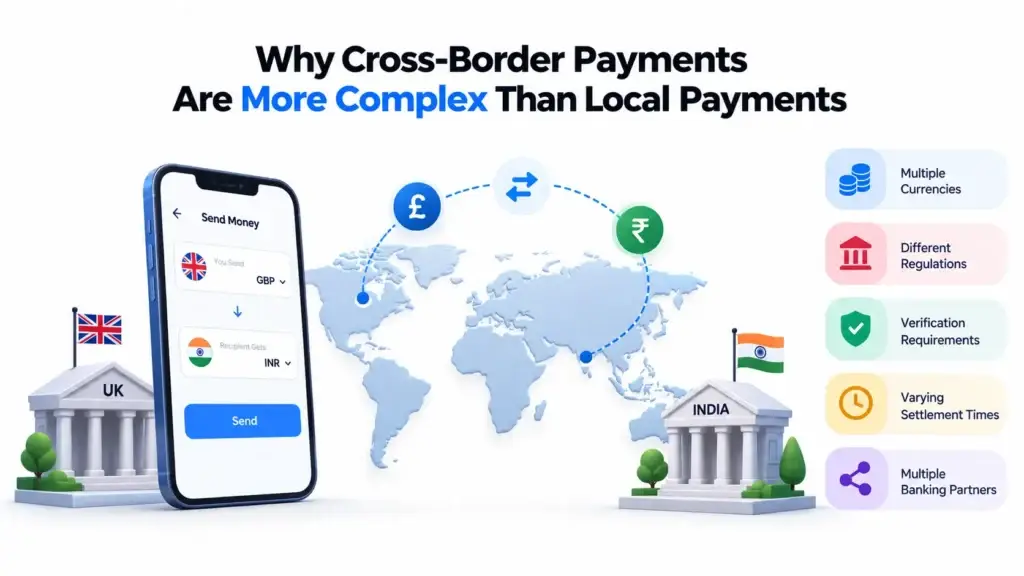
A local payment usually happens within one country, one currency, and one regulatory environment. A cross-border payment may involve different countries, currencies, banking partners, payout rules, verification requirements, settlement timelines, and fee structures.
That makes every payment corridor important.
A payment corridor is the route between the sending market and receiving market. For example, a business may start with one focused corridor such as the UK to India, UAE to India, US to Philippines, or Europe to Africa.
Each corridor can have different:
- Sending currency
- Receiving currency
- Exchange-rate logic
- Transfer fee model
- Payout partner
- Processing time
- Verification rule
- Risk profile
- Settlement process
- Support requirement
- Local compliance expectation
This is why founders should not think only in terms of “global transfers.” A better starting point is: Which corridor will we serve first, and what operational controls does that route need?
How Multi-Currency Transfers Work Step by Step
A multi-currency transfer starts when a sender wants to move money from one currency to another. The platform must calculate the transfer amount, apply the exchange rate, show fees, validate the recipient, process the payment, and track the payout.
Multi-Currency Transfer Flow
| Step | What the User Sees | What the Platform Handles |
|---|---|---|
| Account setup | User creates an account and adds basic details | Profile creation, account status, risk signals, and onboarding records |
| Verification | User submits identity or business documents | KYC or KYB workflow, review status, audit logs, and approval rules |
| Currency selection | User chooses send currency and receive currency | Currency pair validation, corridor rules, limits, and FX availability |
| FX quote | User sees exchange rate, fee, and expected recipient amount | FX rate engine, spread logic, fee calculation, and quote expiry |
| Recipient setup | User enters bank, wallet, or payout details | Recipient validation, saved beneficiary records, and payout compatibility |
| Payment confirmation | User confirms the transfer | Transaction creation, payment collection, screening, and routing logic |
| Payout tracking | User sees transfer status and notifications | Status updates, payout logs, settlement checks, refunds, and reconciliation |
The strongest transfer experience is transparent. Users should know the exchange rate, platform fee, estimated arrival amount, recipient details, and transfer status before they commit.
What Is an FX Engine in a Payment Platform?
An FX engine is the platform layer that calculates currency conversion. It determines how much the sender pays, which exchange rate is shown, what margin or spread is applied, and how much the recipient is expected to receive.
For founders, FX is both a trust layer and a revenue layer.
A poor FX experience can create confusion if users see one amount before confirmation and another amount later. A strong FX experience shows the rate before the user commits, explains the fee clearly, and keeps the transfer logic visible.
An FX engine may need to support:
- Currency pairs
- Rate source configuration
- Operator-set spread
- Quote expiry
- Corridor-specific pricing
- Transfer fee logic
- Rounding rules
- Transaction limits
- Refund calculations
- Reporting by currency and corridor
The important point is that FX should not be hardcoded. If the operator cannot adjust fees, spreads, or corridor logic from the admin layer, every pricing change becomes a technical dependency.
How Payouts Work Behind the Scenes
The payout is the final movement of funds to the recipient. It may happen through a bank account, wallet, card, local payment method, or partner network depending on the corridor and platform setup.
A payout flow usually involves:
- Confirming the sender payment
- Screening the transaction
- Selecting the payout route
- Sending the payout instruction
- Receiving partner or rail status updates
- Updating the user-facing transaction status
- Handling delays, failed transfers, or returns
- Reconciling the transaction internally
- Creating reports and receipts
If your platform needs secure payment collection, payout routing, wallet funding, or gateway integrations, Miracuves’ payment gateway development service can support the transaction layer behind the product.
For the user, payout status should be easy to understand. For the operator, payout visibility is critical because support teams need to know what happened, where the money is, and whether action is required.
This is where transaction logs, admin notes, payment partner references, refund records, and reconciliation reports become important.
Why KYC, KYB, AML, and Fraud Monitoring Matter
Cross-border payment platforms handle money movement, identity data, payment records, and sensitive transaction workflows. That means trust and control must be part of the product foundation.
Important verification and risk layers include:
- KYC workflows for individual users
- KYB workflows for businesses
- AML workflow support
- Sanctions-screening integration support
- Transaction monitoring
- Suspicious activity flags
- Fraud risk scoring
- Transfer limit rules
- Role-based admin access
- Audit logs
- Compliance review queues
- Manual intervention for flagged transfers
Final compliance depends on jurisdiction, legal review, licensed partners, integrations, payment corridors, and the operating model. The platform should provide a compliance-ready foundation, but founders still need legal and regulatory guidance for their target markets.
User App, Web App, Admin Dashboard, and API Layer
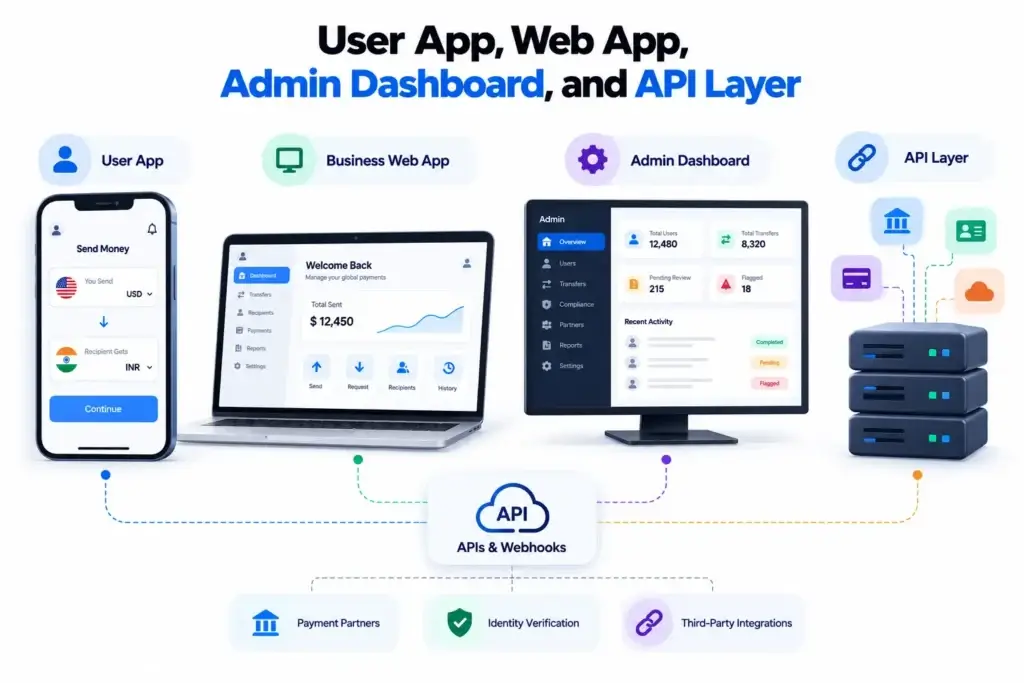
A cross-border payment platform is not one screen. It is usually made of multiple product surfaces.
User App
The user app helps customers register, verify identity, manage balances, add recipients, send money, check exchange rates, view fees, track transfers, download receipts, and manage account settings.
The interface must feel simple because users are dealing with money. Confusion creates support tickets and reduces trust.
Business Web App
A web dashboard is useful for businesses, freelancers, agencies, and finance teams that need invoices, payment requests, supplier payouts, payroll, statements, account roles, and bulk transfer workflows.
Business users usually need deeper records and approvals than personal senders.
Admin Dashboard
The admin dashboard is the operator’s control center. It should help the business manage users, documents, transfers, fees, exchange-rate settings, risk flags, refunds, reports, payment partners, and support workflows.
Without admin control, the founder may need developer help for everyday operational changes.
Founders planning wallets, FX quotes, recipient management, payout tracking, and operator controls can review the cross-border payment platform features to understand the core modules needed for a scalable remittance product.
For a deeper feature-level breakdown, this guide on money transfer app features explains the user, admin, wallet, transfer, and compliance workflows founders should consider.
API and Webhook Layer
APIs and webhooks help connect the payment platform with identity verification providers, payment gateways, banking partners, accounting tools, business systems, notification tools, and partner platforms.
This layer becomes especially important for embedded finance, business payouts, payroll, marketplace payouts, and partner-led fintech models.
Revenue Models for Cross-Border Payment Platforms
Cross-border payment platforms can earn through more than one revenue line. The right model depends on the audience, corridor, transaction frequency, and business use case.
Common revenue models include:
| Revenue Model | How It Works | Best Fit |
|---|---|---|
| Transfer fees | Charge a fixed or percentage-based fee per transfer | Consumer remittance and small business transfers |
| FX spread | Add a transparent margin on currency conversion | Currency exchange and international transfer platforms |
| Business accounts | Offer paid tools for companies, freelancers, and teams | B2B finance platforms |
| Payment links | Enable users to request or collect payments | Freelancer and service businesses |
| Bulk payouts | Charge for payroll, supplier payouts, or mass payments | Businesses, marketplaces, and agencies |
| API access | Monetize partner or embedded-finance access | SaaS platforms and fintech partnerships |
| Premium reporting | Offer advanced transaction reports and analytics | Finance teams and operators |
To compare transfer fees, FX spread, business accounts, payment links, payroll, API access, and reporting-based revenue streams, review the cross-border payment platform business model before finalizing your monetization strategy.
A consumer remittance platform may begin with transfer fees and FX margin. A freelancer payment platform may focus on payment requests, invoicing, and payout tracking. A business payout platform may monetize approval workflows, bulk transfers, API access, and reporting.
Founder Decision Signals Before Building a Cross-Border Payment Platform
Corridor Focus
Start with the sending and receiving markets where you understand user demand, partner availability, payout rules, and support requirements.
FX Transparency
Users should see the rate, fee, and expected recipient amount before confirming. Hidden pricing can damage trust quickly.
Operational Control
Admin teams need control over users, documents, rates, fees, limits, refunds, reports, risk flags, and transfer status.
Compliance Readiness
KYC, KYB, AML workflow support, transaction monitoring, audit logs, and role-based access should be planned before launch.
Common Mistakes Founders Should Avoid
Trying to Support Too Many Corridors at Launch
Each corridor has its own pricing, partners, payout methods, compliance expectations, and support risks. Start focused and expand after the first route works reliably.
Hardcoding FX and Fee Logic
Exchange rates, spreads, and transfer fees should be configurable. If pricing changes require code changes, the platform becomes slow to operate.
Ignoring Reconciliation
Sending money is only part of the flow. Operators must match user payments, payout confirmations, refunds, failed transfers, partner references, and internal records.
Treating Compliance as a Final Step
KYC, KYB, AML support, fraud monitoring, audit logs, and admin permissions should be part of early planning. Retrofitting these controls later can create product and operational risk.
Founders can also review these mistakes fintech founders should avoid before planning corridors, compliance workflows, FX logic, and payout operations.
How Miracuves Helps Founders Launch Cross-Border Payment Platforms
Miracuves helps founders, fintech startups, agencies, and payment businesses launch branded cross-border payment platforms with ready-made workflows, white-label branding, source-code ownership, admin dashboards, and customization support.
The goal is not to copy a well-known payment app blindly. The stronger strategy is to identify a real money movement problem and build around a focused use case such as:
- Remittances for one high-demand corridor
- Freelancer payments
- Business payouts
- Multi-currency accounts
- Payroll and bulk transfers
- Payment requests and invoicing
- Regional FX and transfer services
- Partner-led payment workflows
For founders who want to review a launch-ready fintech foundation, Miracuves’ cross-border remittance platform can help evaluate multi-currency wallets, FX transfer workflows, payout logic, admin visibility, and compliance-ready controls.
Businesses exploring broader money transfer, wallet, and international payout models can also review Miracuves’ remittance app solutions for related fintech launch paths.
When the ready-made scope fits the rollout requirement, Miracuves can support 6-day solution delivery, helping founders move faster without building every wallet, transfer, FX, admin, and reporting workflow from zero.
Final Thoughts: Cross-Border Payments Are About Trust, Corridors, and Control
A cross-border payment platform is more than a money transfer screen. It is a system that connects onboarding, verification, FX, payment collection, payout routing, monitoring, reconciliation, reporting, and admin control.
For users, the product must feel simple, transparent, and reliable.
For founders, the business must be built around clear corridors, configurable fees, trustworthy FX display, payout visibility, risk controls, and scalable operations.
Once the platform foundation is clear, founders should also plan acquisition, trust-building, launch campaigns, and retention. This guide on fintech launch marketing strategy can help structure promotion before and after release.
The strongest approach is to start with a focused corridor, solve a real transfer problem, measure transaction behavior, and expand only when the platform has enough operational confidence to support more currencies, users, partners, and payout flows.
If you are comparing budget, delivery scope, and technical planning, review Miracuves’ guide on cross-border payment platform development cost before finalizing your project roadmap.
For vendor evaluation, this page on choosing a fintech development partner can help you understand what to check before selecting a development team.
FAQs
What is a cross-border payment platform?
A cross-border payment platform is a digital system that helps users or businesses send, receive, hold, and convert money across countries and currencies. It usually includes onboarding, verification, FX calculation, recipient setup, payment processing, payout routing, tracking, and admin control.
How do multi-currency transfers work?
A multi-currency transfer allows a sender to pay in one currency while the recipient receives another. The platform calculates the exchange rate, applies fees or spread, validates the recipient, processes the payment, routes the payout, and tracks the transaction status.
What is FX in a payment platform?
FX means foreign exchange. In a payment platform, the FX engine calculates conversion between currencies, applies corridor-specific pricing rules, shows the rate to the user, and helps the operator manage currency-based revenue and reporting.
What are payout rails?
Payout rails are the methods or networks used to deliver money to the recipient. Depending on the market, this may involve bank transfers, local payment systems, wallet payouts, cards, or partner payment networks.
Why is KYC important in cross-border payments?
KYC helps verify individual users before they move money. For business users, KYB may also be required. These workflows support trust, fraud prevention, AML review, and compliance readiness.
How do cross-border payment platforms make money?
They can earn through transfer fees, FX spread, business accounts, payment links, bulk payout tools, API access, card or wallet usage, and premium reporting. The right model depends on the corridor and customer segment.
What should founders build first in a cross-border payment platform?
Founders should start with a focused corridor, user onboarding, verification, recipient setup, FX quote, transfer confirmation, payout tracking, admin dashboard, transaction monitoring, and reporting. Advanced modules can be added after validating demand.
Can Miracuves help launch a cross-border payment platform?
Yes. Miracuves helps founders launch ready-made and white-label fintech platforms with multi-currency wallet workflows, transfer logic, admin control, source-code ownership, and compliance-ready foundations. A 6-day launch may apply when the ready-made scope matches the project requirement.
Miracuves is an independent software development company. We are not affiliated with, connected to, sponsored by, or endorsed by any company or product named in this article.
Terms such as “X Clone” are used descriptively. It is how the software industry refers to building a platform with functionality comparable to a known service, and how clients search for it.
The entire design and codebase of our products is built by our own team. Our products contain no code, design, graphics, or content originating from any third-party website or applications.
All third-party names and marks referenced in this article are the property of their respective owners, referenced solely to identify the services discussed.