Key Takeaways
- Cross-Border Payment Platform Features should connect multi-currency accounts, FX conversion, international transfers, business payments, compliance workflows, and admin controls within one financial ecosystem.
- Core user features include currency balances, exchange-rate quotes, beneficiary management, transfer tracking, transaction history, payment notifications, limits, and secure account access.
- A complete platform should support both individual and business payment journeys while giving operators visibility into transactions, fees, compliance, settlements, risks, and platform activity.
Core Feature Signals
- Multi-currency accounts can support holding balances, receiving funds, currency conversion, transaction records, account details, and transfers across supported currencies.
- FX and transfer features should manage live or quoted exchange rates, conversion fees, recipient amounts, beneficiaries, payment routing, transfer status, refunds, and reconciliation.
- Business payment tools can include team access, batch payments, supplier payouts, invoices, approval workflows, transaction exports, payment references, and business account reporting.
Business & Admin Insights
- Admin controls should cover users, business accounts, transactions, FX margins, fees, transfer limits, compliance reviews, payouts, disputes, refunds, permissions, and audit history.
- KYC, KYB, AML screening, sanctions checks, transaction monitoring, fraud controls, role-based access, reconciliation, and reporting help operators manage financial and regulatory risk.
- Miracuves develops customizable cross-border payment platforms with multi-currency accounts, FX, international transfers, business payments, compliance workflows, reconciliation, analytics, security, and admin controls.
Cross-border payment platforms need more than a simple send-money interface. A complete product has to connect customer accounts, multiple currencies, exchange-rate handling, international transfers, beneficiaries, business payment workflows, verification, transaction monitoring and operational controls within one consistent financial experience.
The right feature scope depends heavily on the users and payment corridors being served. A consumer remittance product may prioritize fast onboarding, transparent transfer pricing and saved recipients, while a platform serving freelancers or businesses may need local receiving options, payment requests, bulk payouts, approval workflows, team permissions and detailed reporting.
Feature planning should therefore begin with the financial activity the platform needs to support rather than with the longest possible feature list. Founders who understand how the major feature groups work together can define a more focused first release, reduce unnecessary complexity and create a clearer roadmap for expansion.
Think in Feature Layers Rather Than Individual Screens
A cross-border payment product becomes easier to plan when features are grouped according to the financial job they perform. Customer-facing functions cover account access, balances, beneficiaries, FX quotes, transfers and transaction history. Business functions extend those workflows into collections, bulk payments, team access and approval processes. Operational functions give administrators, compliance teams and support staff the visibility required to monitor and manage the platform.
These groups are connected. A customer initiating an international transfer may depend on identity verification, a supported currency account, an FX quote, a valid beneficiary, transaction limits, a payment or wallet balance, risk checks and a payout provider before the transfer reaches its final state. Treating those capabilities as isolated screens can create gaps between the customer experience and the financial operations behind it.
Founders should therefore evaluate features as a connected product system. The objective is not to include every possible fintech function in the first release, but to make sure the features required for the chosen customer segment and payment corridor work together without forcing manual work into areas that should be controlled by the platform.
Multi-Currency Accounts Form the Core Financial Experience
Multi-currency accounts allow customers to view and manage balances across supported currencies from a single financial product. Their usefulness extends beyond displaying separate currency amounts because they can support receiving funds, holding balances, converting currencies and using those balances for future transfers.
The customer experience should clearly distinguish each currency balance while providing an understandable record of deposits, conversions, outgoing transfers, refunds and other activity. Where the business model requires it, the platform may also need to differentiate available funds from amounts that are pending, reserved or temporarily restricted.
Readers who want a broader understanding of the product model before comparing individual capabilities can first review how cross-border payment platforms work, including multi-currency accounts, international transfers, currency conversion, recipients, and payment flows.
The number of currencies offered at launch should follow actual corridor demand and financial-partner readiness. Supporting a focused set of currencies properly can be more valuable than presenting a large currency catalogue without the necessary payment, payout, compliance and liquidity support behind each one.
For deeper planning around currencies, balances and transfer infrastructure, founders can review Miracuves’ multi-currency payment platform guide.
Local Receiving Capabilities Can Extend the Platform Beyond Remittance
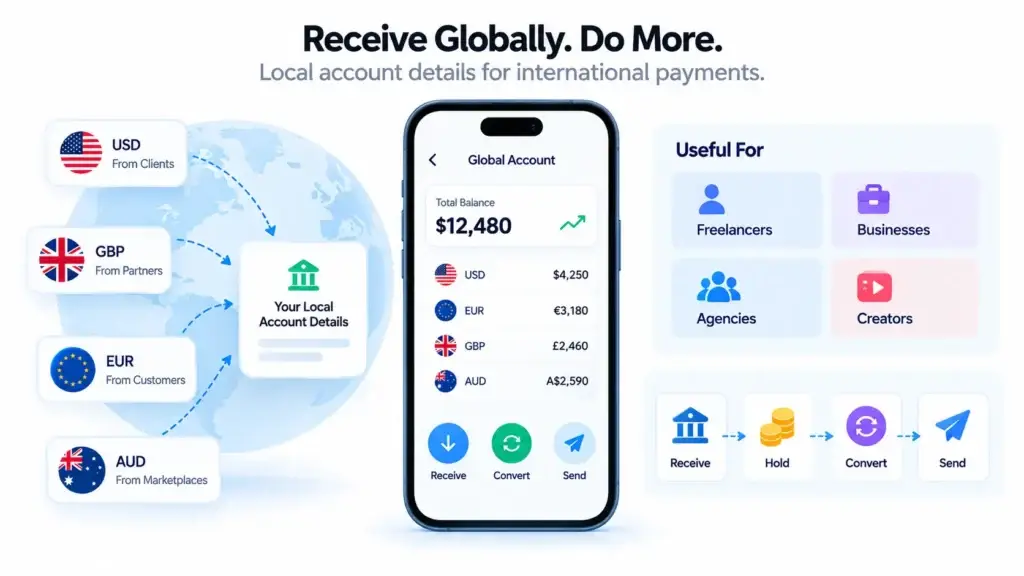
Some cross-border payment products allow eligible customers to receive money through local-style account details or connected collection methods in supported markets. This can make the platform more useful for freelancers, agencies, exporters, creators and businesses that regularly receive payments from customers or partners in another country.
The feature becomes more valuable when incoming funds remain connected to the multi-currency account. A customer may receive money in one currency, retain part of the balance, convert another portion and later transfer funds to a beneficiary without leaving the platform.
The operational requirements differ between countries and financial partners, so local receiving capabilities should be treated as corridor-specific functionality rather than a universal feature. Availability, account structures, collection methods, settlement processes and verification requirements need to be defined according to the markets being served.
FX Features Should Make Conversion Easy to Understand
Currency conversion is one of the most visible parts of an international payment experience because the customer wants to know how much money will leave the source account and how much the recipient is expected to receive. The platform should present the relevant exchange rate, applicable fee and destination amount clearly before confirmation.
The FX experience should also maintain consistency between the quote the user sees and the transaction record created after confirmation. Where rates can expire or change, the interface should communicate that behaviour without making the customer discover a different price late in the transfer flow.
From a founder’s perspective, FX functionality connects customer trust with commercial logic. Exchange-rate configuration and transfer fees may contribute to revenue, but the platform still needs transparent pricing and reliable records so customers and operations teams can understand how each conversion was calculated.
Founders who want to study the underlying rate and transaction logic separately can use Miracuves’ cross-border payment architecture guide for a more technical view of accounts, FX, transfers, compliance and payouts.
International Transfers Need More Than a Send Button
International money transfer functionality should provide a structured path from selecting the source and destination currencies through beneficiary selection, quote confirmation, funding and transaction tracking. The customer needs enough information to understand what is being sent, which recipient will receive it, what fees apply and how the transfer is progressing.
Beneficiary management becomes particularly important for repeat usage. Saving validated recipient information can reduce friction for customers who regularly send money to family members, suppliers, contractors or other business recipients. Recipient requirements can vary between destinations, so the product should be capable of collecting the appropriate bank, account, routing or payout information for each supported route.
Transfer tracking should continue after confirmation. Customers benefit from clear status information and transaction records, while support and operations teams need sufficient internal visibility to investigate delays, failed payouts, cancellations, refunds and other exceptions without reconstructing the transaction manually.
Transaction History and Notifications Improve Financial Visibility
Transaction history gives customers a reliable record of transfers, conversions, incoming funds and other account activity. A useful history view should make it easy to identify the transaction type, amount, currency, recipient or counterparty, applicable fee, date and current status.
Notifications complement that record by informing customers when important financial events occur. Transfer submission, verification requirements, payment receipt, payout completion, failures and other significant status changes can be communicated through the channels supported by the product.
These features may appear secondary compared with wallets or transfers, but they contribute directly to trust and support efficiency. Customers who can understand what happened inside the product are less dependent on support teams for routine transaction updates.
Beneficiary Management Should Reflect Corridor Requirements
Recipient management needs enough flexibility to support the different information required across payment corridors. Some destinations may depend on account numbers and bank identifiers, while others can involve local routing information, payout methods, recipient addresses or additional transfer-purpose data.
The product should validate the necessary beneficiary information before the transfer moves too far into the payment flow. This helps reduce avoidable failures and makes repeat transfers more efficient because previously validated recipients can be reused where appropriate.
Changes to sensitive recipient information also deserve appropriate controls. The platform should maintain enough transaction and account history to help support or risk teams understand which recipient was used for a transfer and whether important details changed before money was sent.
Business Accounts Require a Different Feature Layer
A cross-border payment platform serving companies needs functionality that extends beyond individual transfers. Businesses may need to receive client payments, pay multiple vendors, manage team members, review financial activity and control which employees can initiate or approve transactions.
Features such as bulk payments, batch payouts, payment requests, invoicing support, approval workflows, team permissions and downloadable financial records can turn a consumer-focused transfer product into a broader business payment platform. These functions are particularly relevant for agencies, exporters, remote companies, marketplaces and businesses managing international contractors or suppliers.
The business feature set should be prioritized according to the target market. A platform serving small exporters may place greater emphasis on receivables and vendor payments, while a product serving distributed teams may prioritize batch payouts, approvals and employee permissions.
For founders assessing how these functions connect with monetization, Miracuves’ cross-border payment business model provides a separate view of transfer fees, FX revenue, business services and related commercial models.
Team Roles and Approval Workflows Matter for Business Payments
Business payment platforms need to distinguish between the person who owns the account and the employees who operate it. Team access allows multiple users to work inside the same business account without sharing credentials or receiving unrestricted financial permissions.
Role-based controls can define who is allowed to view balances, create recipients, prepare payments, approve transactions, download reports or change account settings. Approval workflows can then require higher-value or sensitive payments to pass through an authorized reviewer before money is released.
These controls become more important as transaction values and organization size increase. They allow the product to support business governance without forcing every financial action through a single account owner.
Payment Requests and Collection Features Expand the Use Case
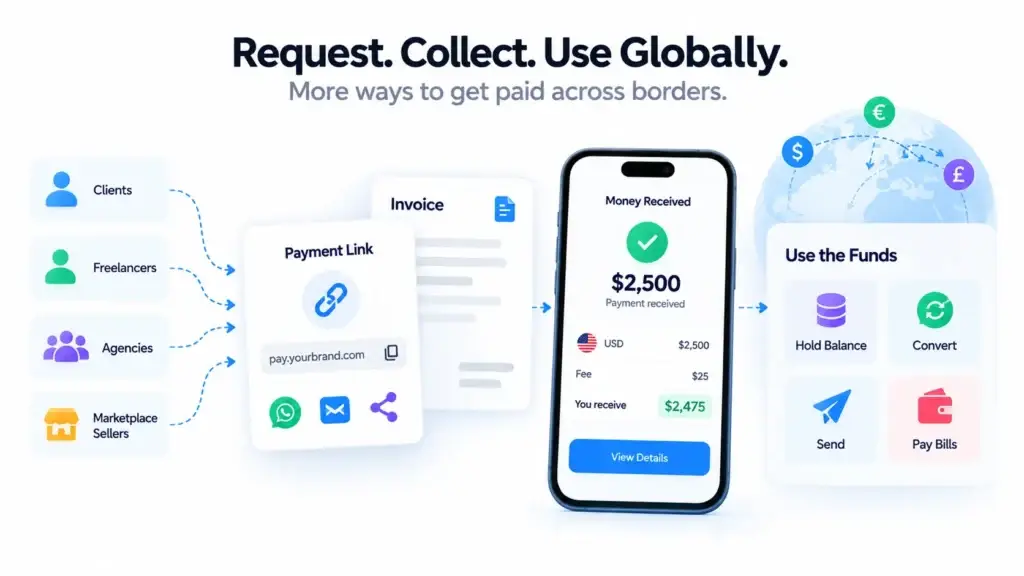
A platform focused only on outgoing transfers solves one side of cross-border money movement. Payment requests, payment links, invoicing or other collection workflows can allow businesses and independent professionals to request money from customers rather than relying only on externally initiated deposits.
These features work best when collections connect naturally with the account and transaction system. Once money is received, the user should be able to see the payment record, understand the currency and fee treatment, hold or convert the balance and use the funds for future transfers where the operating model permits it.
Collection functionality can be especially useful when the product is positioned around freelancers, agencies, international services, marketplace sellers or business receivables rather than consumer remittance alone.
KYC and KYB Workflows Control Access to Financial Features
Identity and business verification should be connected to the features a customer is allowed to use. The platform may need to verify individuals before enabling transfers or higher transaction limits, while business customers can require a separate KYB process covering organization information and authorized representatives.
Verification status should remain visible to the appropriate operational teams so incomplete submissions, rejected documents and cases requiring additional review can be handled without depending entirely on external systems.
The software can provide structured workflows for verification and review, but regulatory obligations remain dependent on jurisdiction, licensing, financial partners, legal advice and the operating model. For that reason, compliance functionality should be described as a product-control layer rather than as an automatic guarantee of regulatory approval.
Transaction Monitoring and Risk Controls Support Safer Operations
Cross-border platforms need a way to identify transactions that require additional attention. Transaction monitoring can examine activity against configured limits, customer status, corridor rules, behavioural signals and other risk criteria before or during financial processing.
The feature becomes more useful when suspicious or unusual activity enters a structured review process. Compliance or risk personnel should be able to inspect the relevant customer, transfer and account information, record a decision and preserve an audit trail of important actions.
The purpose is not to add unnecessary friction to every payment. It is to give the business a controlled method of handling transactions that should not move through the same path as routine low-risk activity.
Admin Controls Turn Customer Features Into an Operable Business
Customer-facing features determine what users can do, while administrative controls determine whether the business can operate those features effectively. The admin environment should provide appropriate visibility into customers, accounts, transactions, verification, transfers, fees, limits, disputes, reports and platform configuration.
Operational access should be separated according to responsibility. Customer-support staff may need transaction visibility without being allowed to change financial configuration, while compliance personnel may require review and case-management functions that ordinary administrators should not use casually.
A well-designed admin layer reduces unnecessary dependency on developers for everyday operations and gives the business a clearer view of what is happening across the platform. Founders who want to examine the commercial product scope separately can review Miracuves’ cross-border payment platform features.
| Feature Group | Customer or Business Value | Operational Importance |
|---|---|---|
| Multi-Currency Accounts | Hold and manage supported currencies within one account experience | Connects balances, conversions and transfer activity |
| FX & Fee Display | Shows conversion pricing and expected recipient amount clearly | Supports pricing control, transaction records and customer trust |
| International Transfers | Moves money between supported customers, banks or payout routes | Requires transfer status, routing and exception visibility |
| Beneficiary Management | Makes repeat payments easier and faster | Needs corridor-specific validation and controlled changes |
| Business Payments | Supports vendors, contractors, collections and team finance | Adds approvals, permissions and business reporting |
| Compliance Controls | Supports verification and safer access to financial functions | Provides KYC, KYB, monitoring and review workflows |
| Admin Controls | Gives the operator visibility and control | Supports daily financial, support and compliance operations |
Reporting and Reconciliation Support Financial Operations
Reporting becomes increasingly important as the platform handles more customers, currencies and transactions. Operators need useful information about transfer volume, fees, conversion activity, failed transactions, customer activity and other financial events without relying on manual database queries.
Reconciliation adds another operational layer by helping internal records line up with information received from payment, banking or payout partners. When a transfer appears different internally and externally, operations teams need enough references and transaction history to investigate the discrepancy.
These capabilities may not influence the first impression of the customer application, but they have a significant effect on how confidently the business can operate at scale.
APIs and Webhooks Become More Important as the Product Expands
APIs allow the platform to connect with banking partners, payment providers, identity services, accounting tools or external business systems. They can also support partner-led or embedded-finance use cases when another application needs controlled access to payment functionality.
Webhooks allow important events to flow in the opposite direction by notifying the platform when an external provider changes the state of a payment, verification case or payout. These events should connect cleanly with the product’s transaction and administrative records so the customer and operator see consistent information.
Founders do not need to expose every function through a public API at launch, but the platform should avoid architecture choices that make future integrations unnecessarily difficult.
Feature Priorities Should Follow the Target Customer
A consumer remittance platform, freelancer payment product and B2B financial operations platform can all use the same underlying cross-border payment foundation while requiring different feature priorities. Consumer products may emphasize simple transfers and saved recipients, whereas freelancers may value receiving accounts, payment requests and transaction records. Businesses can require approvals, bulk payments, reporting and team permissions.
This makes audience definition one of the most important feature-planning decisions. Instead of launching every available module at once, founders can build the first release around the financial tasks their primary customer performs most frequently and expand after real usage clarifies which additional capabilities provide meaningful value.
Businesses focused specifically on international money transfer use cases can also explore Miracuves’ remittance platform solutions to understand how different product foundations can support those workflows.
Founder Decision Signals
Consumer Remittance
Prioritize simple onboarding, transparent FX, beneficiary management, transfer tracking and dependable customer notifications.
Freelancer Payments
Receiving options, payment requests, multi-currency balances, conversion visibility and downloadable records become more important.
Business Payments
Bulk transfers, approval workflows, team permissions, vendor management and financial reporting should move higher in the roadmap.
Operational Scale
Strong admin controls, monitoring, reconciliation, reporting and integration visibility become critical as transaction volume increases.
Avoid Building the Roadmap Around Feature Quantity
A larger feature list does not automatically create a stronger cross-border payment product. Every additional currency, payment rail, user role, business workflow or compliance rule can introduce more testing, integrations, operational responsibilities and support requirements.
The better roadmap begins with the financial journey the target customer needs to complete reliably. Once onboarding, accounts, FX, beneficiaries, transfers, monitoring and operational control work effectively for the first use case, additional business functions and payment capabilities can be introduced according to actual demand.
This approach also makes development scope easier to understand. Founders evaluating investment requirements can separately review the factors behind cross-border payment platform development cost once the required features, integrations and corridors have been defined.
Choosing Features Before Defining the Customer
Consumer remittance, freelancer payments and business finance have different priorities. The target customer should determine which features belong in the first release.
Treating Every Currency as Equal Scope
Different currencies and corridors can depend on different financial partners, payout methods, verification requirements and operational rules.
Focusing Only on Customer Screens
Transfers, wallets and business payments need matching administrative, compliance, reporting and support controls behind the user experience.
Adding Advanced Business Functions Too Early
Bulk payouts, complex approvals and extensive reporting are valuable when the target market needs them, but they can unnecessarily expand the first release when the initial product is focused on consumer transfers.
Assuming Compliance Is One Feature
Verification, transaction monitoring, permissions, risk review and audit history affect different parts of the product and should be planned as connected controls.
How Miracuves Helps Founders Move From Feature Planning to Product Scope
Feature planning becomes more useful once the target customer, first currency corridors, payment methods, compliance responsibilities and business workflows are defined. At that stage, founders can distinguish between functionality that must be available in the first release and capabilities that can be introduced as transaction volume or market coverage grows.
Miracuves provides a white-label cross-border payment platform that gives founders an existing product foundation for multi-currency workflows, transfers, business payments, administrative operations and compliance-ready controls. For suitable ready-made scopes, Miracuves supports a six-day standard solution delivery, while licensing, financial-partner onboarding, jurisdiction-specific requirements and specialized integrations should be planned separately.
Founders with requirements that extend beyond the existing product scope can also explore Miracuves’ app development services for more specialized payment, integration and financial-workflow requirements.
Final Thoughts: Build the Feature Set Around the Payment Use Case
A strong cross-border payment platform combines customer-facing financial tools with the operational controls required to manage those tools reliably. Multi-currency accounts, FX conversion, transfers, beneficiary management and transaction history form the core customer experience, while business payments, verification, monitoring, reporting and administrative controls extend the platform into a more complete financial product.
The appropriate feature mix depends on the audience, target corridors and operating model. Founders serving consumer remittance customers will make different product decisions from teams building freelancer payment services or business payout platforms. Defining those priorities before development helps control scope and gives the product a clearer reason to exist in its target market.
A focused first release can also create a stronger foundation for future expansion. Once the essential payment journey is working reliably, additional currencies, business workflows, financial integrations and operational capabilities can be introduced around demonstrated customer demand rather than an unnecessarily large initial feature list.
For teams comparing implementation providers, selecting the right cross-border payment development partner should include evaluating source-code ownership, fintech experience, financial integrations, compliance workflows, deployment responsibilities, and post-launch support.
FAQs
What are the essential features of a cross-border payment platform?
A strong foundation normally includes customer onboarding, multi-currency accounts, beneficiary management, FX-rate and fee visibility, international transfers, transaction tracking, verification workflows and administrative controls. The exact feature scope should depend on the target market and transfer corridors.
Why are multi-currency accounts important?
Multi-currency accounts allow customers to manage supported currency balances within one product. They can support receiving funds, holding balances, currency conversion and international transfers without requiring a completely separate user experience for each currency.
What should an FX feature show customers?
The customer should be able to understand the source amount, destination currency, applicable exchange rate, fees and expected recipient amount before confirming the transaction. The product should also preserve enough transaction information to explain the applied conversion later.
Which features are important for business payments?
Business-focused platforms can require team access, role-based permissions, approval workflows, bulk or batch payments, vendor management, payment requests, statements and reporting. The required combination depends on how the target businesses move and manage money.
Why are admin controls important in a payment platform?
Admin controls allow the operator to manage users, transactions, verification, limits, risk reviews, disputes, reports and platform settings. Without an effective operational layer, customer-facing payment features become harder to monitor and support as transaction volume grows.
What compliance features should be considered?
Cross-border platforms may need KYC, KYB, transaction monitoring, risk review, role-based access and audit history. These features can support regulated operations, but final compliance depends on the jurisdiction, licences, financial partners, legal advice and operating model.
Should every feature be included at launch?
No. The first release should prioritize the workflows needed by the primary customer and initial payment corridors. Additional business tools, payment methods, currencies and integrations can be introduced after the core product has been validated.
Can Miracuves deliver a cross-border payment platform in six days?
Miracuves supports a six-day standard delivery approach for applicable ready-made solution scopes. Licensing, legal requirements, banking or payout-provider onboarding, specialized integrations and other regulated launch requirements can require separate timelines.
Miracuves is an independent software development company. We are not affiliated with, connected to, sponsored by, or endorsed by any company or product named in this article.
Terms such as “X Clone” are used descriptively. It is how the software industry refers to building a platform with functionality comparable to a known service, and how clients search for it.
The entire design and codebase of our products is built by our own team. Our products contain no code, design, graphics, or content originating from any third-party website or applications.
All third-party names and marks referenced in this article are the property of their respective owners, referenced solely to identify the services discussed.