



Trucking is the backbone of freight in the U.S., but the traditional process is messy: dozens of phone calls, manual rate negotiations, inconsistent pricing, limited visibility, and too many empty miles. Shippers want reliable, on-time capacity. Carriers want fair rates and less wasted time on the road.
Convoy set out to fix exactly that.
Convoy is a digital freight network that connects shippers with carriers through a technology-first platform. Instead of relying on old-school brokerage, Convoy uses apps, automation, and data to match loads with the right trucks, optimize routes, reduce empty miles, and give both sides real-time visibility and predictable pricing.
For carriers, Convoy offers an app to:
- Find and book loads
- Access bundled trips and “automatic reloads”
- Reduce deadhead miles
- Upload documents and get paid faster
For shippers, Convoy provides:
- Reliable contract and spot capacity
- Real-time tracking and analytics
- Optimized routes and network insights
- Lower costs driven by efficiency and automation
In this guide, you’ll learn:
- What Convoy actually is (and how it differs from a simple load board)
- How Convoy works for carriers, fleets, and shippers
- Its business model and revenue streams
- The key features and technology behind its digital freight network
- Market impact and why many startups want to build Convoy-style platforms
What Is Convoy? – The Simple Explanation
Convoy is a digital freight network that connects shippers with trucking carriers using automation, machine learning, and real-time data instead of manual broker calls. It streamlines the entire freight-moving process by enabling shippers to post loads and carriers to book them instantly through a mobile app or online dashboard.
In simple words:
Convoy is a smarter, tech-driven version of a freight broker that reduces costs, improves efficiency, and eliminates empty miles for carriers.
Core Problem It Solves
Trucking traditionally suffers from:
- Inefficient load matching
- High broker fees
- Manual paperwork and communication
- Unpredictable pricing
- Too many empty miles
Convoy solves these with automation, digital workflows, and optimized routing to make freight movement more efficient and sustainable.
Who Uses Convoy?
| User Type | How They Benefit |
|---|---|
| Carriers & Owner-Operators | Access quality loads, reduce empty miles, get paid faster |
| Small & Mid-Size Fleets | Manage drivers, assign loads, optimize trip planning |
| Enterprise Shippers | Gain real-time tracking, lower costs, and better reliability |
| Dispatchers | Bundle loads, monitor routes, and streamline operations |
Why Convoy Became Successful
- Focus on reducing empty miles through smart routing
- Upfront pricing and instant booking
- Strong sustainability mission (fuel and carbon savings)
- High-quality enterprise shipper base
- Automated paperwork and fast payments
Convoy positioned itself as a data-driven, eco-friendly alternative to traditional freight brokers.
Market Position (2025)
Convoy is recognized as one of the leading digital freight networks in the U.S., competing directly with platforms like Uber Freight, Loadsmart, and legacy logistics companies. Its technology-driven approach—especially automatic reloads and optimized routing—sets it apart from basic load boards.
How Convoy Works – Step-by-Step Breakdown
For Carriers (Owner-Operators, Fleets, Drivers)
Account Creation
Carriers sign up in the Convoy app or website by providing:
- MC/DOT authority
- Insurance documents
- Equipment type (dry van, reefer, flatbed, etc.)
- Driver profile details
Once approved, they can immediately start booking loads.
Finding Loads
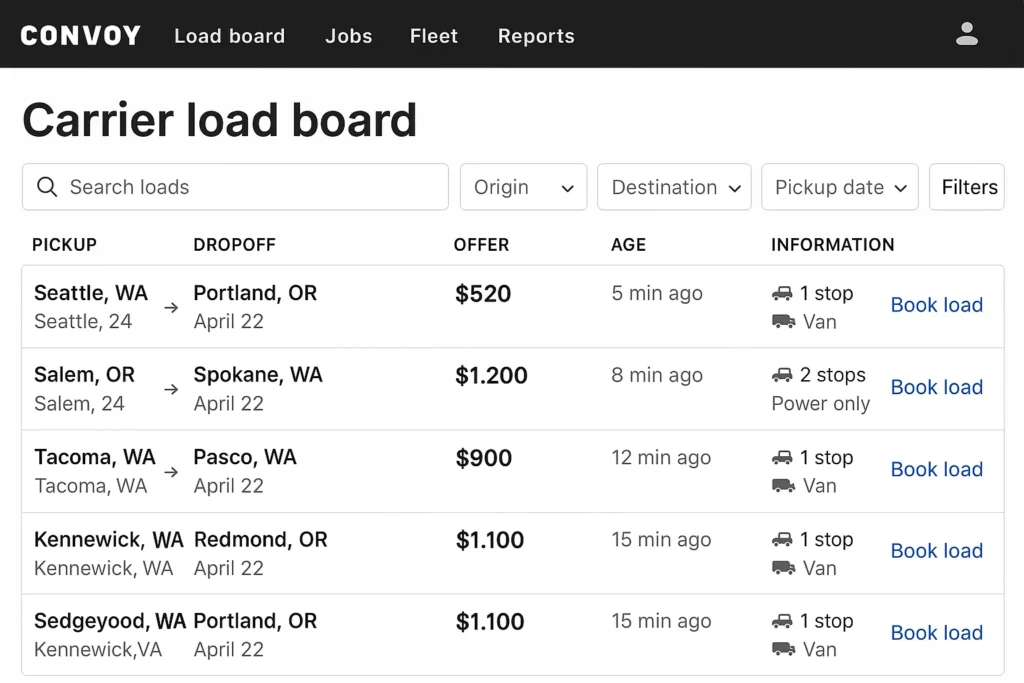
The Convoy load board displays:
- Recommended loads based on location
- Upfront rates (no negotiation needed)
- Deadhead distance
- Pickup and drop-off times
- “Green loads” with sustainable routing benefits
Carriers can filter loads by rate, distance, equipment, or preferred lanes.
Booking a Load
Convoy allows instant digital booking:
- No broker calls
- No rate haggling
- All terms shown upfront
Once booked, load details are added to the driver’s schedule automatically.
Running the Shipment
Drivers get:
- Turn-by-turn navigation
- Pickup instructions
- Loading/unloading info
- One-tap status updates (Arrived, Loaded, Delivered)
The app auto-shares location with the shipper for real-time visibility.
Document Upload
Drivers upload:
- Proof of Delivery (POD)
- Bill of Lading (BOL)
- Receipts (detention, lumper, etc.)
Documents sync instantly to billing, reducing delays.
Fast Payment
Convoy offers:
- Standard pay
- Quick Pay (faster payouts)
Carrier payments start immediately after POD verification.
For Shippers
Posting Loads
Shippers enter shipment details:
- Origin & destination
- Equipment needed
- Pickup windows
- Shipment weight
Convoy’s system instantly provides a transparent rate.
Smart Carrier Matching
Convoy’s algorithm matches loads with the best available carrier based on:
- Proximity
- Equipment type
- Driver history
- Preferred lanes
- On-time performance
Shippers get reliable coverage without manual carrier outreach.
Real-Time Tracking
Shippers see:
- Live GPS updates
- ETA predictions
- Delay alerts
- Shipment milestones
This reduces manual check calls and improves visibility.
Analytics Dashboard
Convoy gives shippers insights on:
- Lane performance
- Cost benchmarks
- On-time delivery rates
- Sustainability metrics (CO₂ savings)
Technical Overview (Simple Explanation)
Convoy works like a digital freight engine that connects shippers and carriers using automation:
- Machine learning predicts prices, chooses carriers, and bundles loads
- Routing algorithms reduce empty miles
- Tracking technology provides live shipment updates
- Automated document workflows speed up payments
- Cloud-based infrastructure ensures fast load searches and bookings
Convoy is designed to move freight with the least friction possible.
Convoy’s Business Model Explained
How Convoy Makes Money
Convoy operates as a digital freight broker, earning money every time it successfully matches a shipper’s load with a carrier. Instead of purely manual brokering, Convoy uses automation, data, and software to reduce overhead and improve margins at scale.
Brokerage Margin on Each Load
Shippers pay Convoy a freight rate to move their goods. Convoy then pays the carrier a portion of that rate and keeps the difference as brokerage margin.
This margin depends on:
- Lane demand and supply
- Shipment complexity
- Contract vs spot freight
- Seasonality and capacity conditions
As Convoy grows its network and shipment volume, this brokerage-based revenue scales up naturally.
Contract Freight and Enterprise Deals
Beyond one-off spot loads, Convoy works with large shippers on contract freight, where volumes and lanes are agreed in advance.
Convoy earns by:
- Locking in long-term shipper relationships
- Providing consistent capacity at agreed pricing
- Optimizing these lanes using data and automation
Contract freight creates more predictable revenue and strengthens Convoy’s position as a long-term logistics partner.
Technology-Enabled Services for Shippers
Convoy also provides value-added services to shippers such as:
- Real-time visibility tools
- Network optimization insights
- Lane performance analytics
- CO₂ and sustainability reporting
These technology services help Convoy justify stronger, longer-term enterprise relationships and premium positioning compared to traditional brokers.
Carrier Services and Optional Programs
Convoy can also introduce revenue opportunities or cost-sharing via:
- Quick Pay / faster payment options for a fee
- Access to bundled or “automatic reloads” that reduce empty miles
- Partner programs (fuel, maintenance, financing) via third parties
These services deepen engagement with carriers and make Convoy’s network more attractive and sticky.
Why This Business Model Works
Convoy’s business model works because it:
- Uses software and automation to lower the cost of brokering freight
- Improves asset utilization for carriers, which encourages loyalty
- Provides shippers with data, transparency, and reliability, leading to repeat business
- Scales with volume while keeping operations lean compared to traditional brokerages
In short, Convoy monetizes the flow of freight and information between shippers and carriers, using technology to do the job of a traditional broker more efficiently.
Key Features That Make Convoy Successful
Instant Booking with Upfront Pricing
Convoy shows all-in rates upfront so carriers and owner-operators know exactly what they’ll earn before they accept a load. No haggling, no guessing.
Why it matters: Drivers can make faster decisions and keep their trucks moving.
Benefit for users: Less time on the phone, more time hauling and earning.
Tech behind it: Pricing is generated by algorithms that use lane history, capacity, and market conditions.
Smart Load Recommendations
Convoy recommends loads based on a carrier’s location, preferences, equipment, and past behavior. The app surfaces the most relevant and profitable options first.
Why it matters: Carriers don’t have to scroll endlessly through listings.
Benefit for users: Better trip planning, less stress, higher utilization.
Tech behind it: Machine learning models analyze patterns and suggest loads that fit the carrier’s profile.
Automatic Reloads & Bundled Trips
One of Convoy’s signature features is automatic reloads—it strings together multiple loads into a sequence so trucks stay full more often and reduce empty miles.
Why it matters: Empty miles destroy profit margins.
Benefit for users: Better revenue per day and per mile, more predictable schedules.
Tech behind it: Route optimization algorithms look at geography, timing, and equipment to bundle trips efficiently.
Real-Time Shipment Tracking
Convoy offers live tracking from pickup to delivery using driver location sharing and telematics. Shippers see where their freight is at any time.
Why it matters: Visibility reduces “where’s my load?” calls and improves trust.
Benefit for users: Shippers get confidence and control; carriers spend less time handling check calls.
Tech behind it: GPS, mobile data, and event-based triggers (Arrived, Loaded, Delivered) feed into a live tracking dashboard.
Digital Document Management
Drivers use the app to scan and upload POD, BOL, lumper, and detention documents immediately after delivery.
Why it matters: No lost paper, no waiting to get back to the office.
Benefit for users: Faster invoicing and quicker payments.
Tech behind it: In-app camera capture, image processing, and document workflows tied directly to billing.
Fast, Predictable Payments
Convoy focuses on reliable payment timelines, with options for standard pay and faster “Quick Pay” for a small fee.
Why it matters: Cash flow is critical for small carriers and owner-operators.
Benefit for users: Less uncertainty, fewer cash crunches for fuel, maintenance, and payroll.
Tech behind it: Integrated payment processors and automated invoice–document matching.
Sustainability-Focused Scheduling
Convoy’s network is designed to reduce empty miles, which cuts fuel usage and emissions. Some loads are even marked as more efficient or “green” based on routing.
Why it matters: Shippers increasingly care about CO₂ impact and ESG metrics.
Benefit for users: Carriers can win business from sustainability-focused shippers, while saving fuel.
Tech behind it: Optimization models that minimize empty legs and calculate CO₂ reductions.
Quality & Compliance Controls
Convoy monitors carrier performance, safety, and compliance over time, using this data to help shippers get reliable, high-performing carriers.
Why it matters: Better carriers mean fewer delays, claims, and service failures.
Benefit for users: Good carriers get more load opportunities; shippers get higher service levels.
Tech behind it: Scoring systems that combine on-time performance, service incidents, safety metrics, and feedback.
Shipper Analytics & Network Insights
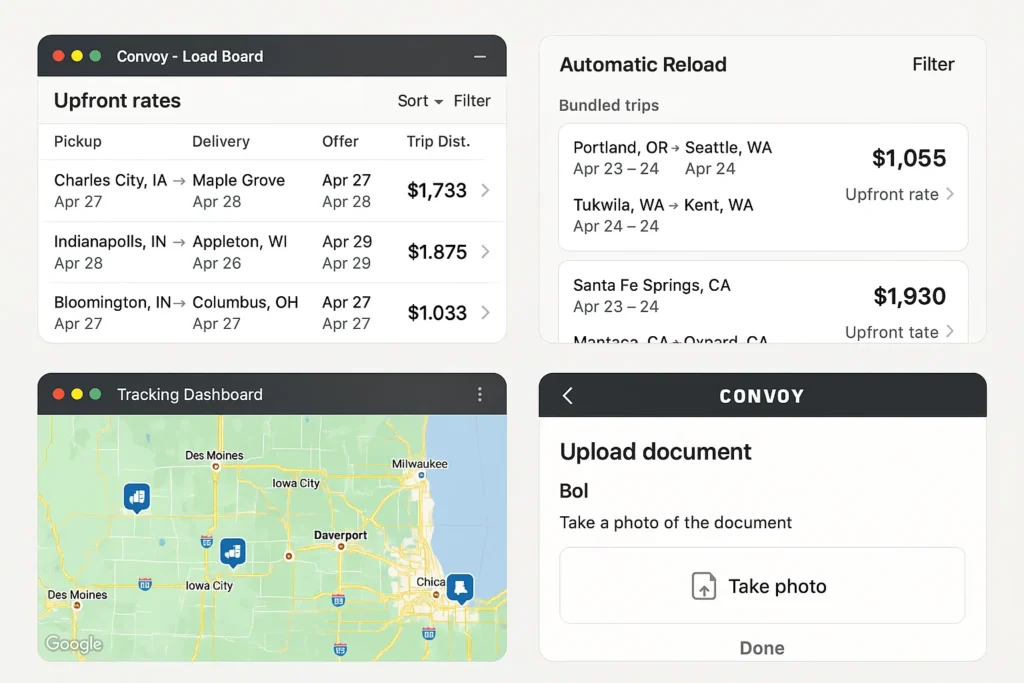
Shippers using Convoy get dashboards with:
- Lane performance
- Cost trends
- On-time delivery metrics
- Carrier reliability
- Network optimization suggestions
Why it matters: Data-driven decisions cut logistics costs and improve service.
Benefit for users: Shippers can rebalance lanes, adjust contracts, and use insights to negotiate better.
Tech behind it: Data warehouses, BI dashboards, and analytics models that aggregate thousands of loads.
Mobile-First Experience for Drivers
The Convoy app is built specifically for drivers on the road: simple UI, clear steps, and minimal typing. Everything—search, booking, navigation, status, documents, and payments—lives in one place.
Why it matters: Drivers don’t have time for complex systems while working.
Benefit for users: Faster workflows, fewer mistakes, and a smoother day on the job.
Tech behind it: Native mobile apps, push notifications, offline-tolerant flows, and optimized UX for one-hand use.
The Technology Behind Convoy
Digital Freight Marketplace Engine
Convoy’s core technology is a real-time freight marketplace that connects shipper demand with carrier capacity. It constantly evaluates:
- Load requirements
- Carrier availability
- Equipment type
- Location and timing
- Market demand
This engine automates what traditional brokers do manually, making matching faster and more accurate.
Machine Learning for Pricing & Matching
Convoy uses advanced ML models to:
- Predict lane rates
- Suggest optimal prices for shippers
- Recommend the best loads for carriers
- Identify patterns that lead to delays or service failures
This pricing intelligence helps keep rates competitive while improving margin efficiency.
Routing & Load Bundling Algorithms
One of Convoy’s standout innovations is automatic reloads — technology that bundles multiple loads into a seamless route. Algorithms analyze:
- Geography
- Pickup and delivery timing
- Driver availability
- Carrier preferences
The result is fewer empty miles and higher earnings for carriers.
Real-Time Tracking & Visibility Systems
Convoy integrates:
- Driver GPS
- Mobile app location services
- Telematics from ELD devices
This powers: - Live shipment tracking
- ETA predictions
- Delay alerts
- Automated status updates
Shippers gain full visibility without manual check calls.
Automated Document Processing
Convoy’s app includes a digital workflow for:
- Proof of Delivery (POD)
- Bill of Lading (BOL)
- Lumper and detention receipts
Images are processed, verified, and linked to the load automatically.
This allows payments to be triggered instantly after delivery.
Cloud-Native Infrastructure
Convoy runs on a scalable cloud backend enabling:
- Millions of load searches
- High-frequency carrier updates
- Real-time analytics
- Secure data storage
- Fast load posting and booking
This infrastructure is built to support national-scale freight operations.
API Integrations for Shippers
Convoy connects easily with shipper systems such as:
- TMS (Transportation Management Systems)
- ERP platforms
- Inventory and warehouse systems
This allows seamless tendering, tracking, and reporting inside enterprise workflows.
Performance, Safety & Compliance Automation
Convoy tracks carrier metrics like:
- On-time delivery rates
- Safety scores
- Claim rates
- Equipment verification
Machine-driven scoring helps shippers receive consistent quality.
Why This Technology Matters
- Carriers get fewer empty miles and faster payments
- Shippers get reliability, transparency, and cost savings
- Convoy reduces the friction and waste of traditional freight brokerage
- The entire network benefits from automation-driven optimization
Convoy’s technology proves that logistics can be smarter, cleaner, and more efficient when powered by data and automation.
Convoy’s Impact & Market Opportunity
Transforming the Freight Brokerage Model
Convoy disrupted traditional freight brokerage by replacing phone calls, manual negotiations, and opaque pricing with automation and real-time data.
Instead of relying on brokers working load by load, Convoy’s technology automates matching, routing, pricing, and visibility — fundamentally changing how freight can be moved.
Impact on Carriers
Convoy improved life for drivers and fleets by offering:
- Instant booking without negotiation
- Better load recommendations
- Automatic reload trip bundles
- Fewer empty miles
- Faster payments
These improvements have helped many small carriers grow revenue and operate more efficiently.
Impact on Shippers
For shippers, Convoy delivers:
- Reliable capacity coverage
- Transparent, predictable pricing
- Real-time visibility and analytics
- Fewer service failures
- Sustainability reporting (fuel & CO₂ reduction)
Its digital approach gives shippers a modern logistics experience typically lacking in traditional brokerage.
Sustainability Movement & Empty Miles Reduction
Convoy is known for its sustainability leadership. By minimizing empty miles and using smarter routing, the platform has saved millions of gallons of fuel and significantly reduced carbon emissions.
This has positioned Convoy as a pioneer in “green logistics.”
Industry Influence & Competitive Differentiation
Convoy pushed major competitors — including Uber Freight, Loadsmart, and traditional carriers — to adopt more transparency, automation, and data-driven practices.
Many freight startups today follow the same model Convoy introduced: automated booking, real-time tracking, and pricing intelligence.
Market Growth & Digital Freight Demand
The digital freight market is rapidly accelerating due to:
- E-commerce expansion
- Driver shortages
- Increased need for visibility
- Higher supply chain volatility
- Demand for sustainability
These trends create long-term growth for platforms like Convoy.
Opportunity for Entrepreneurs
Convoy’s success shows that the market still needs:
- Regional freight networks
- Niche platforms for flatbed, reefer, drayage, etc.
- Cross-border-focused apps
- SME-focused dispatching + load marketplace hybrids
- AI-driven pricing and routing models
- Platforms for emerging markets outside the U.S.
This massive opportunity is why many founders want to build Convoy-style freight platforms tailored to their geography or industry vertical.
Building Your Own Convoy-Like Platform
Why Businesses Want a Convoy-Style Platform
Convoy’s digital freight network model has proven that technology can radically improve logistics. Companies and entrepreneurs want similar platforms because they offer:
- Automated load matching
- Real-time visibility
- Lower operational costs
- Higher carrier utilization
- Predictable pricing
- Paperless workflows
- Smarter routing and reduced empty miles
A Convoy-like solution creates value for both sides — shippers and carriers — while reducing inefficiencies that have long plagued the trucking industry.
Cost Factors & Pricing Breakdown
Convoy-Like App Development — Market Price
| Development Level | Inclusions | Estimated Market Price (USD) |
|---|---|---|
| Basic Load Board MVP | Core web platform for posting and browsing loads, carrier and shipper/broker registration & login, basic lane search, simple load posting, contact / expression-of-interest flow, basic availability management, standard admin panel | $40,000 |
| Mid-Level Freight Matching Platform | Advanced search & filters (lane, equipment type, weight, dates), real-time load and truck postings, rating & feedback system, notifications & alerts, basic pricing tools, document upload (POD, rate confirmations), richer analytics dashboard, mobile-ready experience | $100,000 |
| Advanced Convoy-Level Load Board Ecosystem | Large-scale multi-region load board and freight marketplace, dynamic pricing tools, multi-user company accounts, advanced capacity & lane analytics, integrations with TMS/ELD/telematics, in-app messaging, dispute workflows, multi-currency & multi-language support, native mobile apps, cloud-native scalable backend | $200,000+ |
Convoy-Style Platform Development
The prices above reflect the global market cost of developing a Convoy-style freight matching and trucking marketplace — typically ranging from $40,000 to over $200,000, with a delivery timeline of approximately 4–12 months for a full, from-scratch build. This usually covers platform architecture, complex search and matching logic, integrations (TMS/telematics/payments), security, and extensive testing for real-world logistics operations.
Miracuves Pricing for a Convoy-Like Platform
Miracuves Price: Starts at $12,999
This follows Miracuves’ official Load Board (MXlLoader) solution positioning and should be kept consistent with your other load board blogs (DAT, Truckstop, 123Loadboard, Uber Freight, Navisphere Carrier, etc.). At this price point, you get a feature-rich Convoy-style freight marketplace that covers core workflows such as load posting, carrier and shipper/broker onboarding, search & match flows, notifications, basic document handling, analytics, and modern web + mobile apps—while leaving room to extend into more advanced analytics, integrations, and automation as your logistics business scales.
Note: This includes full non-encrypted source code (complete ownership), complete deployment support, backend & API setup, admin panel configuration, and assistance with publishing on the Google Play Store and Apple App Store—ensuring you receive a fully operational load board ecosystem ready for launch and future expansion.
Delivery Timeline for a Convoy-Like Platform with Miracuves
Because this is treated as a readymade Load Board solution, the typical delivery timeline with Miracuves is 3–9 days, depending on:
- Depth of load board features (search, filters, matching logic, analytics, etc.)
- Number and complexity of third-party integrations (TMS, telematics/ELD providers, payment gateways, mapping/route APIs)
- Complexity of company accounts, role-based access, and compliance workflows
- Scope of mobile apps, branding requirements, and long-term scalability targets
Tech Stack
We preferably will be using JavaScript for building the entire solution (Node.js/Nest.js/Next.js for the web backend + frontend) and Flutter / React Native for mobile apps, considering speed, scalability, and the benefit of one codebase serving multiple platforms.
Other technology stacks can be discussed and arranged upon request when you contact our team, ensuring they align with your internal preferences, compliance needs, and infrastructure choices.
Key Considerations Before Development
Identify Your Audience
Decide who your primary users will be:
- Long-haul carriers
- Regional carriers
- Flatbed, reefer, LTL, or drayage specialists
- Enterprise shippers
- SMEs needing logistics support
Understanding user needs shapes your platform’s feature set.
Define Core Capabilities
A Convoy-style system should include:
- Load posting + real-time load search
- Instant digital booking
- Upfront pricing
- Driver mobile app
- GPS tracking and ETA prediction
- Document capture (POD, BOL)
- Carrier compliance verification
- Billing and payment workflows
- Dispatcher dashboard
- Analytics for shippers and carriers
Optimize the Marketplace Engine
Your load-matching system must consider:
- Location
- Equipment type
- Preferred lanes
- Driver hours/timing
- Carrier performance
This is the backbone of any competitive freight platform.
Build a Strong Tech Infrastructure
You will need:
- Scalable cloud backend
- Real-time GPS integrations
- Machine learning pricing engine
- Notification & messaging systems
- Payment gateway integration
- Secure document storage
Compliance & Safety Systems
Include tools to manage:
- MC/DOT authority validation
- Insurance checks
- On-time performance scoring
- Safety ratings
These features improve trust for shippers and reduce risk.
Development Roadmap (Simplified)
Phase 1 — Carrier/Shipper Onboarding
- Registration
- Verification
- Fleet setup
- Shipper profile creation
Phase 2 — Load Marketplace
- Load posting
- Load search
- Smart recommendations
- Instant booking
Phase 3 — Tracking & Communication
- GPS-based tracking
- ETA predictions
- Driver status updates
- In-app messaging
Phase 4 — Documents & Payments
- POD/BOL uploads
- Automated invoicing
- Payment status tracking
- Optional QuickPay module
Phase 5 — Analytics & Integrations
- Lane heatmaps
- Cost analysis
- Performance metrics
- Shipper/ERP/API integrations
Conclusion
Convoy proved that the freight industry doesn’t need to rely on outdated processes, constant phone calls, and unpredictable pricing. By combining automation, data intelligence, and a driver-friendly app experience, Convoy transformed trucking into a faster, more transparent, and more sustainable ecosystem. It showed the world how technology can minimize empty miles, reduce costs, increase reliability, and create a more efficient logistics network.
For entrepreneurs and logistics innovators, Convoy’s journey highlights a massive opportunity. Digital freight platforms are still in early stages globally. Many regions lack modern load-matching tools, and niche segments like flatbed, reefer, drayage, and cross-border freight are ripe for disruption. Building a Convoy-style solution tailored to local needs can create enormous impact — both operationally and financially.
As supply chains continue to evolve and the demand for real-time flexibility grows, platforms inspired by Convoy will become essential infrastructure in the logistics world.
FAQs :-
What is Convoy?
Convoy is a digital freight network that connects shippers with carriers using automation, machine learning, and real-time data to streamline trucking operations and reduce empty miles.
How does Convoy work for carriers?
Carriers use the Convoy app to find loads, see upfront rates, instantly book freight, upload documents, track payments, and receive bundled trips that minimize empty miles.
How does Convoy work for shippers?
Shippers post loads, get real-time pricing, track shipments live, view analytics, and secure reliable capacity through Convoy’s automated freight-matching technology.
What makes Convoy different from a load board?
Unlike a traditional load board, Convoy offers:
Instant booking
Smart load recommendations
Automatic reloads
Real-time visibility
Digital documents and payments
It operates like a tech-powered freight broker, not a listings site.
How does Convoy make money?
Convoy earns through brokerage margins on loads, enterprise logistics services, sustainability-based offerings, and optional programs like Quick Pay for carriers.
Does Convoy help reduce empty miles?
Yes. Convoy’s routing algorithms bundle loads and plan round trips, significantly reducing empty miles and improving fuel efficiency.
Is Convoy available nationwide?
Convoy operates extensively across the United States, with strong coverage on major freight lanes and partnerships with large enterprise shippers.
How do carriers get paid through Convoy?
Carriers upload delivery documents in the app and receive payment via standard timelines or Quick Pay options for faster processing.
What technology powers Convoy?
Convoy uses machine learning, automated pricing models, real-time GPS tracking, document processing systems, and a cloud-based logistics engine.
Can I build an app like Convoy?
Yes. You can build a platform with load posting, instant booking, smart matching, tracking, payments, and document automation.
Miracuves offers complete Convoy-style platforms delivered in 3-9 days, including apps, dashboards, admin panels, and source code.