

Key Takeaways
- An online load board connects shippers, freight brokers, and carriers by giving them a shared digital space to post loads, search capacity, compare opportunities, and coordinate freight movement.
- Shippers and brokers can publish shipment requirements, while carriers search available loads using lanes, equipment types, pickup dates, rates, distance, and other matching criteria.
- The platform becomes more useful when load discovery is supported by alerts, carrier verification, messaging, document exchange, tracking, ratings, and administrative controls.
Matching & Workflow Signals
- Load postings can include origin, destination, pickup and delivery dates, freight type, equipment requirements, weight, dimensions, rate information, and special handling instructions.
- Carriers can create truck availability, preferred lanes, equipment profiles, operating regions, and capacity details so the platform can surface more relevant freight opportunities.
- Search filters, saved lanes, matching rules, notifications, direct communication, rate negotiation, and booking workflows help reduce manual coordination between market participants.
Freight Network Insights
- Verification, carrier profiles, operating authority details, ratings, document records, and activity history can help shippers and brokers evaluate potential transportation partners.
- Operators should monitor active loads, available trucks, search activity, carrier responses, match rates, lane demand, booking conversion, repeat usage, and user engagement across the network.
- Miracuves develops customizable online load board platforms with load posting, truck availability, carrier matching, search, alerts, communication, verification, tracking, analytics, and admin controls.
An online load board connects the three most important sides of freight movement: shippers who need goods transported, brokers who coordinate freight coverage, and carriers who have trucks available for the right lanes. Instead of relying only on phone calls, scattered messages, spreadsheets, and manual relationship networks, a digital load board turns freight demand and truck capacity into searchable marketplace data.
For logistics founders, this matters because the strength of a freight marketplace is not just the number of listings. It is the quality of connection between the shipper, broker, carrier, dispatcher, documents, rates, route data, and admin control layer. If you are already evaluating a product path, Miracuves also offers a launch-ready freight marketplace platform that helps founders move from planning to execution faster with white-label branding, source-code ownership, and 6-day solution delivery where the ready-made scope fits.
A well-built online load board helps shippers post freight, brokers improve load coverage, carriers find better opportunities, and platform operators manage the entire ecosystem with more visibility. For founders exploring freight marketplace software, this blog explains how the connection works and where a launch-ready solution from Miracuves can reduce development time.
What Is an Online Load Board?
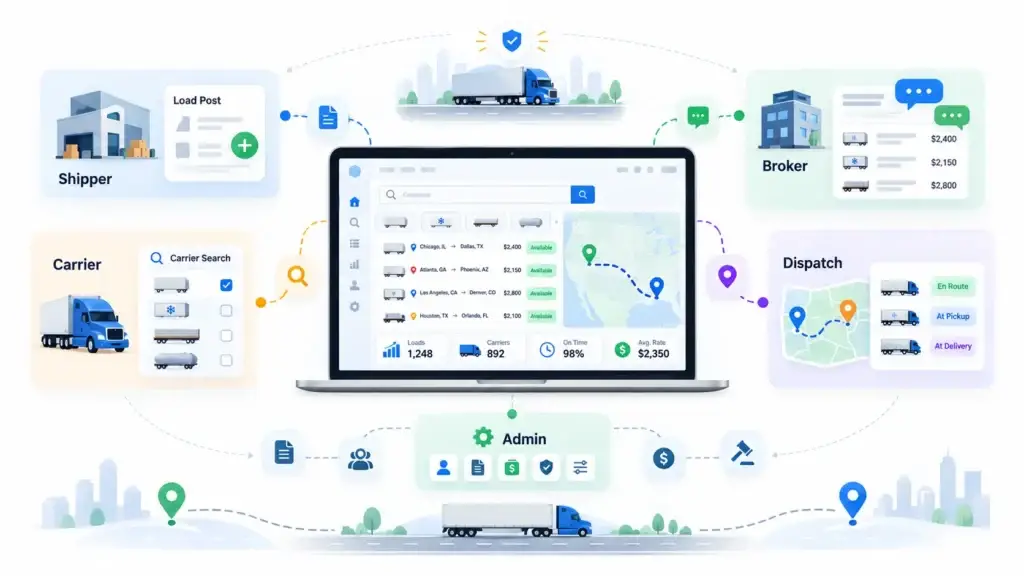
An online load board is a digital freight matching platform where businesses can post available shipments and carriers can find loads that match their trucks, routes, schedules, and rate expectations.
In a traditional freight environment, opportunities often move through direct broker relationships, phone calls, closed carrier lists, and manual dispatching. That model can work, but it becomes difficult to scale when the number of loads, carriers, lanes, documents, and rate conversations increases.
An online load board brings that activity into one controlled system.
At a basic level, the platform allows:
- Shippers to post freight requirements
- Brokers to manage load coverage and carrier communication
- Carriers to search suitable freight opportunities
- Dispatchers to plan trucks and routes
- Admin teams to manage users, listings, subscriptions, disputes, documents, and marketplace rules
The result is a digital freight marketplace where users are not just browsing listings. They are making operational decisions based on location, equipment type, lane preference, availability, trust signals, pricing, and timing.
These workflows usually depend on multiple product modules working together, including load posting, carrier discovery, broker management, document handling, notifications, tracking, and admin controls. You can explore the full set of freight marketplace feature modules if you want to see how these moving parts are structured inside a launch-ready platform.
Why the Shipper-Broker-Carrier Connection Matters
Freight movement depends on coordination. A shipper may have goods ready for transport, but that does not always mean the right truck is available at the right time.
A carrier may have an empty truck, but finding the next profitable shipment can still be difficult without access to reliable load information. Similarly, a broker may have freight to cover, but manual outreach through calls, emails, and scattered messages can slow down the entire process.
An online load board solves this coordination gap by giving each role a clear digital workflow.
For shippers, the platform creates better visibility. They can publish freight details, manage responses, and understand whether their loads are receiving attention from the right carriers or brokers.
For brokers, the platform improves reach and speed. They can connect with a larger carrier network, manage negotiations, compare responses, and cover loads faster.
For carriers, the platform improves discovery. They can search for loads by lane, rate, pickup location, delivery location, equipment type, and schedule instead of waiting for direct calls or limited broker relationships.
For the platform owner, the value is operational control. The admin dashboard becomes the central place to manage users, listings, rules, revenue, verification, documents, disputes, and marketplace quality signals.
This is why a load board is not just a digital classified page. It is a marketplace workflow that connects supply, demand, trust, communication, and freight movement in one system.
How an Online Load Board Connects Shippers, Brokers, and Carriers Step by Step
1. Users Join the Platform Based on Their Freight Role
The first connection happens during onboarding. Each user enters the platform with a different purpose.
A shipper joins because they need to move goods. A broker joins because they need reliable carrier coverage. A carrier joins because they need consistent freight opportunities. A dispatcher may join to manage trucks, drivers, routes, and daily load planning.
The platform should support role-based onboarding so every user sees the right dashboard, permissions, forms, and workflows. This is important because a shipper does not need the same tools as a carrier, and a broker does not operate like an admin.
A strong onboarding flow may include:
- Business profile setup
- Contact and billing details
- Operating regions
- Equipment or freight categories
- Insurance or compliance documents
- User role assignment
- Verification status
- Notification preferences
This is the first layer of marketplace trust. If onboarding is weak, the platform may attract duplicate accounts, incomplete profiles, fake listings, unreliable carriers, or poor-quality load data.
2. Shippers Post Freight Demand in a Structured Format
Once onboarded, shippers can post loads with the information carriers and brokers need to make fast decisions.
A good load post should include:
- Pickup location
- Delivery location
- Pickup date and time
- Delivery deadline
- Equipment type
- Load weight
- Commodity type
- Special handling needs
- Rate or pricing preference
- Contact rules
- Reference numbers
- Required documents
Structured load data matters because matching depends on detail. A vague post creates back-and-forth communication. A clear post helps carriers quickly decide whether the load fits their route, equipment, timing, and revenue goals.
For example, “truck needed tomorrow” is not useful enough. A better load post includes origin, destination, equipment type, pickup window, delivery deadline, weight, rate range, and handling requirements.
That level of detail makes the marketplace more searchable and more reliable.
3. Brokers Use the Platform to Improve Load Coverage
Freight brokers often sit between shippers and carriers. Their job is to help move loads by finding suitable capacity, negotiating rates, confirming details, and coordinating communication.
Inside an online load board, brokers can:
- Post available loads
- Search available trucks
- Review carrier profiles
- Compare carrier responses
- Manage rate discussions
- Track load coverage status
- Save trusted carriers
- Monitor documents and shipment updates
For brokers, speed is a major business advantage. The faster a broker can find the right carrier, the faster they can cover the load and protect the shipper relationship.
A freight marketplace also gives brokers better operational visibility. Instead of managing every conversation through disconnected calls and messages, the broker can keep load details, communication history, carrier responses, documents, and status updates closer to the same system.
4. Carriers Search for Freight That Matches Their Trucks
Carriers and owner-operators use load boards to keep trucks moving and reduce empty miles. The platform becomes valuable when it helps them find freight that matches their real operating needs.
Carriers may search by:
- Origin and destination
- Pickup radius
- Delivery region
- Equipment type
- Trailer type
- Load weight
- Rate per mile
- Total payout
- Trip length
- Deadhead distance
- Pickup date
- Broker rating
- Preferred lanes
If the platform supports different trailer types, freight categories, and vehicle requirements, the search experience needs to go beyond basic origin and destination filters. A multi-equipment freight marketplace structure helps carriers discover relevant loads based on dry vans, reefers, flatbeds, tankers, box trucks, and other equipment needs.
A carrier finishing a delivery in one city may want a return load instead of driving empty. An online load board helps that carrier search nearby freight, compare route options, and contact the right broker or shipper faster.
This is where the platform creates practical value. It does not only display freight. It helps carriers decide which freight is worth pursuing.
The Matching Layer: Where the Marketplace Becomes Useful
The matching layer is the engine behind a successful online load board. It connects load requirements with carrier availability and preferences.
A basic platform may rely on manual filters. A stronger platform can add saved searches, alerts, route preferences, suggested loads, and smarter ranking logic.
The matching system may consider:
| Matching Factor | Why It Matters |
|---|---|
| Pickup location | Helps carriers find freight near their current or upcoming location. |
| Delivery lane | Matches loads with preferred operating routes. |
| Equipment type | Prevents irrelevant loads from appearing in carrier searches. |
| Pickup date | Ensures availability lines up with shipment timing. |
| Deadhead distance | Helps carriers avoid unprofitable empty travel before pickup. |
| Rate expectation | Helps users compare load economics faster. |
| Carrier profile | Supports trust, qualification, and better broker decisions. |
| Saved lanes | Improves repeat usage by remembering preferred routes. |
| Load urgency | Helps urgent shipments get faster visibility. |
For founders, matching quality is one of the most important product decisions. A platform with weak matching becomes a listing directory. A platform with strong matching becomes a daily workflow tool.
For deeper insight into intelligent freight matching, you can also read Miracuves’ guide on AI load matching in a digital freight marketplace.
How Communication Turns Listings Into Real Freight Movement
A load listing is only the beginning. The real marketplace value appears when users can act on the listing quickly.
Once a carrier finds a relevant load, the platform should support fast communication between the carrier, broker, and shipper. Depending on the business model, this may include:
- In-app messaging
- Click-to-call
- Quote request
- Bid submission
- Counter-offer history
- Contact sharing rules
- Booking confirmation
- Load notes
- Status notifications
This layer matters because many freight opportunities are time-sensitive. If a carrier has to wait too long for a response, they may move to another opportunity. If a broker cannot track who responded, negotiation becomes messy. If a shipper has no visibility, confidence drops.
A well-designed online load board reduces that friction by keeping communication tied to the load record.
The Role of Documents, Tracking, and Load Status
Once a load is accepted, the workflow moves from discovery to execution. This is where many simple listing platforms fall short.
A stronger freight marketplace should support the operational steps that happen after the match:
- Rate confirmation
- Pickup confirmation
- Driver or vehicle assignment
- Document upload
- Proof of delivery
- Invoice upload
- Status updates
- Issue reporting
- Payment tracking
- Admin review
This helps the platform move beyond “find a load” and toward “manage a load.”
Tracking and geofencing can also improve visibility from pickup to delivery. For example, location updates can help shippers, brokers, and platform operators understand whether a shipment is moving as expected. To explore this layer further, read Miracuves’ guide on GPS tracking and geofencing in a digital freight marketplace.
Core User Panels in an Online Load Board
A successful load board needs different panels because each user has a different job inside the marketplace.
| User Panel | Core Function | Business Value |
|---|---|---|
| Shipper Panel | Post loads, manage shipment details, review responses, track documents, view status updates. | Helps freight owners publish demand and coordinate movement with better visibility. |
| Broker Panel | Post loads, find carriers, manage negotiations, review carrier details, monitor load coverage. | Helps brokers cover freight faster and manage more relationships in one place. |
| Carrier Panel | Search loads, post truck availability, compare rates, respond to opportunities, upload documents. | Helps carriers find better freight and reduce empty miles. |
| Dispatcher Panel | Manage multiple trucks, drivers, routes, availability, and assigned loads. | Helps fleet teams plan daily operations with better control. |
| Admin Panel | Manage users, listings, verification, payments, subscriptions, documents, disputes, and reports. | Gives the platform owner control over marketplace quality, revenue, and operations. |
The admin panel is especially important for founders. Without a strong control layer, the business owner may struggle to manage trust, pricing, abuse reports, featured listings, user permissions, and growth decisions.
What Data Connects Shippers, Brokers, and Carriers?
The platform connection depends on clean freight data. Every load, user profile, truck, route, document, and message should be structured enough for the system to search, filter, rank, and report.
Important data entities include:
- Load records
- User roles
- Company profiles
- Carrier verification status
- Truck and trailer details
- Equipment categories
- Pickup and delivery locations
- Lane preferences
- Rates and bid history
- Load documents
- Shipment status
- Messages and notifications
- Reviews and ratings
- Payment or subscription records
- Admin activity logs
For founders, the lesson is simple: marketplace data quality decides marketplace quality. If data is incomplete, matching becomes weak. If matching is weak, users stop trusting the platform.
Revenue Opportunities for an Online Load Board
An online load board can monetize in different ways depending on the audience, geography, freight niche, and platform depth.
Before choosing a monetization model, founders should understand whether their platform will work as a subscription-based listing board, a broker-focused load coverage tool, a carrier discovery platform, or a deeper transaction marketplace. This is where studying the freight marketplace business model becomes useful because revenue planning should match how users actually interact with the platform.
| Revenue Model | How It Works | Best For |
|---|---|---|
| Subscription Plans | Carriers, brokers, or shippers pay monthly or yearly for access. | Platforms with recurring professional usage. |
| Featured Listings | Users pay to promote urgent or high-priority loads. | Competitive freight lanes with time-sensitive demand. |
| Premium Search Tools | Carriers pay for advanced filters, saved lanes, alerts, or analytics. | Owner-operators, dispatchers, and small fleets. |
| Broker Team Plans | Brokers pay for multi-user access, load management, and reporting. | Freight brokerages and logistics teams. |
| Booking Fees | The platform charges when a load is successfully booked. | Marketplaces that control the transaction flow. |
| Analytics Access | Users pay for lane trends, rate insights, or operational dashboards. | Mature platforms with strong marketplace data. |
| Integration Fees | Businesses pay to connect with TMS, payment, tracking, or fleet systems. | Enterprise or high-volume logistics networks. |
The best model depends on how much control the platform has over the freight transaction. A simple listing board may start with subscriptions, while a deeper marketplace can later add booking workflows, analytics, integrations, and premium tools. For a more detailed breakdown, this guide on pricing strategy for freight marketplace founders explains how pricing models can affect adoption, retention, and revenue quality.
Founder Decision Signals Before Building an Online Load Board
Speed
If your logistics network already has shippers, brokers, or carriers waiting, speed matters. A ready-made foundation can help you launch faster than building every workflow from zero.
Trust
Freight marketplaces depend on verified users, accurate listings, document control, and clear communication history. Weak trust systems can damage retention early.
Liquidity
A marketplace becomes valuable when users find relevant loads or available capacity consistently. Start with a focused region, lane, niche, or carrier network before expanding too broadly.
Control
The admin dashboard should let the platform owner manage listings, subscriptions, documents, disputes, user roles, featured placements, and marketplace rules without depending on developers for every small change.
Common Mistakes Founders Should Avoid
Building a Broad Marketplace Too Early
Many founders want to launch across every route, vehicle type, and freight category from day one. That usually makes liquidity harder. A focused launch around a region, lane, carrier niche, or freight type can create better early traction.
Treating the Platform Like a Simple Listing Website
A freight marketplace needs more than post-and-search functionality. It also needs verification, communication, document handling, saved preferences, notifications, reporting, admin controls, and monetization logic.
Ignoring Carrier Experience
If carriers cannot quickly find relevant loads, compare rates, check pickup distance, and contact the right person, they will not return often. Carrier experience directly affects marketplace activity.
Overcomplicating Monetization Before Validation
Subscriptions, featured listings, booking fees, analytics, and integrations can all work, but not every model should be launched at once. The first version should match user behavior and market maturity.
Weak Admin Visibility
Without admin control, the platform owner cannot manage disputes, fake listings, low-quality users, document issues, or pricing experiments effectively. The admin layer is where the marketplace becomes manageable as a business.
Ready-Made vs Custom Build: Which Path Makes Sense?
Founders usually have two routes when building an online load board: custom development or a ready-made freight marketplace foundation.
| Build Path | What It Means | Best For | Tradeoff |
|---|---|---|---|
| Custom Development | Build the platform from the ground up based on a custom roadmap. | Large logistics companies with complex internal workflows and longer timelines. | High flexibility, but slower planning, development, testing, and launch cycles. |
| Ready-Made Foundation | Start with existing core modules and customize branding, workflows, and business rules. | Founders who want faster market validation and a functional launch path. | Faster launch, but the scope should be checked against your exact business model. |
| Hybrid Approach | Start with a ready-made foundation, then customize deeper modules after validation. | Logistics startups that need speed now and flexibility later. | Requires smart prioritization of must-have versus future features. |
If you are still comparing whether to build from scratch or start with a ready-made foundation, this breakdown of the ready-made versus custom freight marketplace route can help you understand the tradeoffs around flexibility, timeline, validation speed, ownership, and long-term customization.
For founders who want to move quickly, Miracuves offers a launch-ready freight marketplace solution that can be adapted with branding, admin control, shipper workflows, broker workflows, carrier tools, and source-code ownership. Before finalizing scope, it is also useful to review the main freight marketplace development cost factors, because pricing depends on modules, integrations, tracking depth, document workflows, and customization requirements. Where the ready-made scope fits, Miracuves can support 6-day solution delivery so founders can validate the market faster instead of waiting months for the first usable version.
What Makes an Online Load Board Scalable?
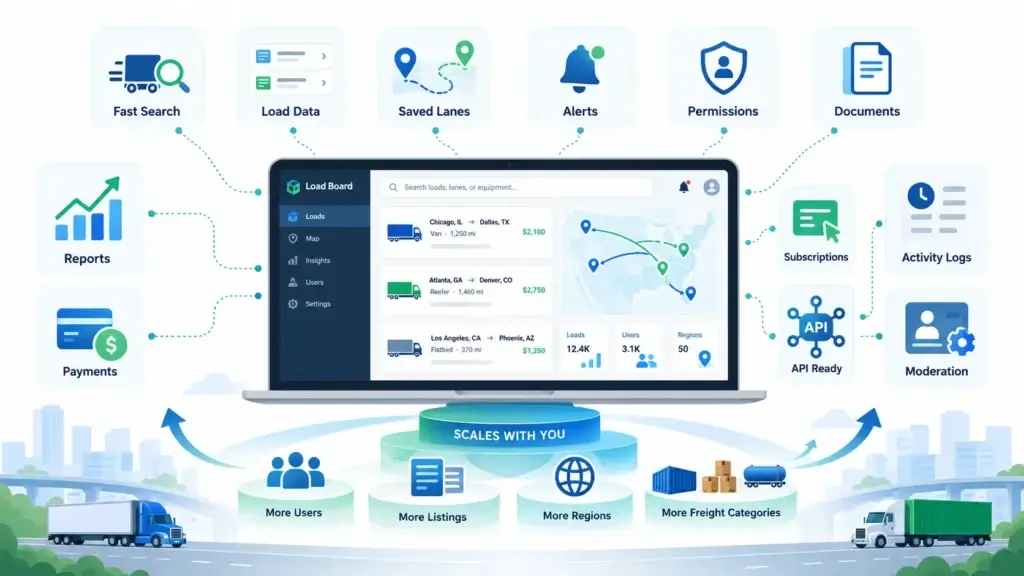
Scalability is not only about handling more users. A freight marketplace must handle more listings, searches, filters, alerts, messages, documents, and marketplace rules without slowing down the user experience.
Important scalability layers include:
- Fast search performance
- Structured load and truck data
- Clean database design
- Saved lane logic
- Notification queues
- Role-based permissions
- Secure document handling
- Admin reporting
- Subscription management
- Payment and invoice workflows
- API-ready architecture
- Activity logs
- Marketplace moderation tools
A founder does not need every advanced module on day one. But the product foundation should be flexible enough to support growth when more users, regions, and freight categories are added.
When Should a Founder Build an Online Load Board?
An online load board makes sense when there is a real coordination gap between freight demand and available capacity.
It may be a strong opportunity if:
- A shipper network needs better carrier access
- A broker network wants faster load coverage
- A carrier group needs better freight discovery
- A regional logistics market is underserved
- A niche freight category lacks a dedicated platform
- A logistics business wants to digitize manual operations
- A founder already has access to one side of the marketplace
At this stage, the next decision is not only whether the idea is valid, but who should help convert it into a working product. Choosing the right freight marketplace development partner can help founders define launch scope, prioritize the right panels, avoid unnecessary features, and prepare the platform for faster market testing.
The strongest starting point is usually not “build for everyone.” It is “build for a specific freight problem and expand once liquidity improves.”
Miracuves Perspective: Build the Connection Layer First
The strongest freight marketplaces are not built around listings alone. They are built around the connection layer between shippers, brokers, and carriers.
That connection layer includes onboarding, verification, load posting, truck availability, search, matching, messaging, documents, status updates, admin rules, and monetization. When these pieces work together, the platform becomes more than a directory. It becomes a repeat-use logistics tool.
Miracuves helps founders build freight marketplace platforms with white-label branding, source-code ownership, admin dashboards, and faster deployment. If you are exploring the product path, the Miracuves ready-made load board platform can help you understand what a launch-ready version includes before committing to a long custom build.
Final Thoughts
An online load board connects shippers, brokers, and carriers by turning freight demand and truck availability into searchable, actionable marketplace data. But the real value is not only in posting loads. It is in building trust, improving match quality, speeding up communication, managing documents, and giving the platform operator enough control to run the marketplace as a business.
For founders, the smarter decision is to start with the connection layer that matters most: who posts freight, who finds capacity, how users communicate, how trust is managed, and how the platform earns revenue. Once that foundation works, the marketplace can expand into smarter matching, tracking, analytics, integrations, and automation.
FAQs
What is an online load board?
An online load board is a digital freight platform where shippers or brokers post available loads and carriers search for freight opportunities that match their equipment, routes, schedules, and pricing preferences.
How does an online load board connect shippers, brokers, and carriers?
It connects them through structured load posting, carrier search, truck availability, matching filters, communication tools, booking workflows, document uploads, status updates, and admin controls.
Who uses an online load board?
Online load boards are used by shippers, freight brokers, carriers, owner-operators, dispatchers, fleet managers, and logistics companies that need a faster way to match freight with available capacity.
What features should a freight matching platform include?
A freight matching platform should include user onboarding, role-based dashboards, load posting, truck posting, advanced search, saved lanes, alerts, messaging, bid or quote management, document handling, tracking, subscriptions, and admin reporting.
How do carriers benefit from a load board platform?
Carriers benefit by finding freight faster, reducing empty miles, comparing lanes, checking pickup distance, reviewing rates, responding to brokers, and managing documents from one platform.
How do brokers benefit from an online load board?
Brokers benefit by reaching more carriers, covering loads faster, managing responses, tracking negotiation history, reviewing carrier details, and improving visibility across active freight opportunities.
How can an online load board make money?
An online load board can make money through subscriptions, featured listings, premium search tools, broker team plans, booking fees, analytics access, and integrations with logistics systems.
Should founders build a load board from scratch or use a ready-made platform?
The decision depends on budget, timeline, technical complexity, and validation needs. A from-scratch build offers deeper custom control but usually takes longer. A ready-made foundation can help founders launch faster, test demand, and customize after learning from real users.
Miracuves is an independent software development company. We are not affiliated with, connected to, sponsored by, or endorsed by any company or product named in this article.
Terms such as “X Clone” are used descriptively. It is how the software industry refers to building a platform with functionality comparable to a known service, and how clients search for it.
The entire design and codebase of our products is built by our own team. Our products contain no code, design, graphics, or content originating from any third-party website or applications.
All third-party names and marks referenced in this article are the property of their respective owners, referenced solely to identify the services discussed.