


Imagine you want to lease a retail store, buy an apartment building, or find warehouse space in a growing U.S. market. Instead of calling multiple brokers, checking scattered listing sites, and chasing incomplete property details, you want one place where you can search listings, compare opportunities, and reach the right people fast.
That’s exactly where Crexi comes in.
Crexi is built for commercial real estate, not general home search. It brings listings, brokers, buyers, tenants, and investors into one digital platform where users can explore properties for sale or lease across categories like retail, office, industrial, land, and multifamily. Crexi describes itself as a platform built to help users market, evaluate, and close commercial real estate deals.
How Crexi Started and Why It Matters
Crexi, short for Commercial Real Estate Exchange, was founded to bring a much more digital workflow to an industry that historically depended on fragmented data, offline relationships, and slow manual processes. On Crexi’s leadership page, founder and CEO Mike DeGiorgio says he launched the company in 2015 after seeing that commercial real estate needed to be brought into the digital age.
What makes Crexi important today is that it is no longer just a listing site. It combines marketplace visibility with marketing tools, lead tracking, leasing and transaction support, analytics, and research products like Crexi Intelligence. That broader mix makes it useful not only for people searching for properties, but also for brokers and investors trying to run deals more efficiently.
What You’ll Learn in This Guide
By the end of this guide, you’ll understand what Crexi is, how Crexi works for buyers, tenants, brokers, and investors, how its business model functions, which features make it successful, what technology powers the platform, and why many entrepreneurs want to build similar commercial real estate marketplaces.
What Is Crexi? The Simple Explanation
What Is Crexi ?
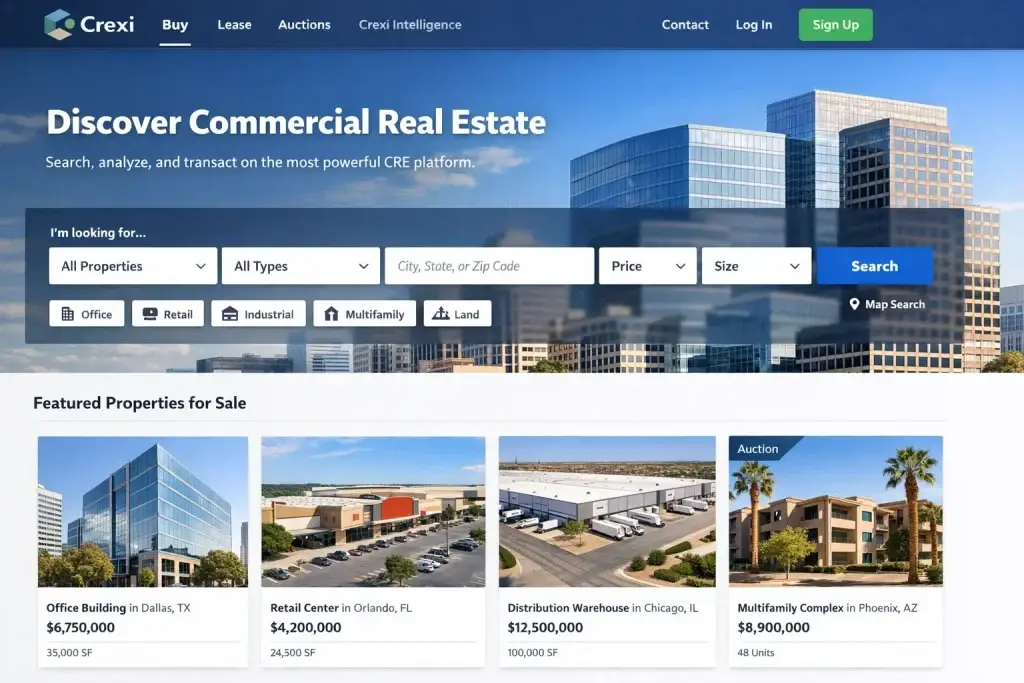
Crexi is a digital commercial real estate marketplace where users can search, market, analyze, and connect around properties for sale or lease. It is built specifically for commercial real estate, covering categories like retail, office, industrial, multifamily, land, hospitality, and more, while also offering research and data tools through products like Crexi Intelligence.
The Core Problem Crexi Solves
Commercial real estate has traditionally been hard to navigate. Listings were spread across broker networks, spreadsheets, email chains, and local connections. Buyers and tenants struggled to find the right opportunities, while brokers needed better ways to market listings and manage leads.
Crexi solves that by putting the commercial real estate journey into one digital platform. Users can search listings, compare opportunities, contact brokers, and explore property data in one place. Brokers can market listings to a wider audience and use platform tools to manage visibility and deal flow.
In simple terms, Crexi makes commercial real estate easier to discover and easier to operate.
Who Uses Crexi?
Crexi serves several major user groups across the U.S. commercial real estate market:
• Buyers looking for income-producing or owner-user commercial properties
• Tenants searching for space to lease
• Brokers marketing listings and finding leads
• Investors researching deals and comps
• Developers analyzing sites and opportunities
• Owners and landlords looking to sell or lease assets
Because the platform supports both sale and lease activity, it is useful to a much broader audience than a pure investment-sales site.
Crexi’s Market Position
Crexi is one of the strongest digital-first platforms in U.S. commercial real estate. On its official site, it positions itself as a place to buy, sell, or lease commercial real estate across the U.S., and its property universe spans major sectors like land, retail, office, industrial, and multifamily.
Its research layer also matters. Crexi Intelligence is positioned as a platform for evaluating properties, data, and markets instantly, which means Crexi is not just competing on listing volume. It is also competing on analytics and decision support.
Why Did Crexi Become Successful?
Crexi became successful because it brought a more modern product experience to a very traditional industry.
Its growth comes from a few simple strengths:
• A strong national marketplace for commercial listings
• Support for both sale and lease use cases
• A broker-friendly marketing and lead-generation model
• Built-in research and analytics tools through Crexi Intelligence
• A much more digital workflow than older CRE discovery methods
Crexi’s own live listing structure shows just how broad the platform is. Its searchable marketplace includes huge volumes of land, retail, office, industrial, and multifamily inventory across U.S. markets. (crexi.com)
What Makes Crexi Different from Traditional Commercial Real Estate Search?
Traditional CRE search often depends on who you know, what broker emails you receive, and how much scattered market data you can collect yourself.
Crexi changes that by combining listings, marketing, search, and research inside one platform. A user can discover a property, analyze it, and connect with the right broker without leaving the broader Crexi ecosystem. That makes it feel much more like a commercial real estate operating platform than a simple listing board.
How Does Crexi Work? Step-by-Step Breakdown
Crexi works like a digital commercial real estate exchange. Property seekers use it to find sale and lease opportunities, while brokers and owners use it to market listings, handle interest, and move deals forward. The platform’s main site is organized around sale, lease, auctions, and comps & records, which shows that Crexi is designed to support more than just listing discovery.
How Crexi Works for Buyers, Tenants, and Investors
Search and Property Discovery
• Users can search by property type, location, and deal type such as sale or lease
• Crexi supports categories like retail, multifamily, office, industrial, hospitality, land, and more
• Users can also browse specialized categories like self storage, mobile home parks, senior living, restaurants, and warehouses
This makes it easier for buyers and tenants to find very specific commercial opportunities instead of digging through generic real estate portals.
Reviewing Listings
• Once a user clicks into a property, they can review listing details, media, pricing, and broker information
• For sale users can compare investment opportunities across many asset classes
• Lease users can browse spaces based on type and market
Crexi’s marketplace is built to help users explore, research, and compare properties right on the platform, which is one of its biggest strengths.
Using Research and Market Data
• Investors and buyers can go beyond the listing itself by using Crexi Intelligence
• Intelligence gives access to verified sales comps, lease rates, ownership history, financial profiles, demographic insights, and market trends
• Interactive maps also help users study population, income, traffic counts, and nearby points of interest
This is what makes Crexi feel more like a deal-evaluation platform than a simple listing board.
Moving Toward a Deal
• Interested users can connect with brokers directly through listings
• They can also send documents, reports, and listing information digitally
• In auction situations, buyers can bid online and move toward non-contingent contracts with a 30-day close, according to Crexi’s auction platform messaging
So while the final negotiation may still happen between parties, Crexi speeds up the path from discovery to action.
How Crexi Works for Brokers, Owners, and Sellers
Creating and Marketing Listings
• Brokers and owners can add listings for sale or lease directly on the platform
• They can publish properties to a national audience instead of relying only on private email lists or local broker networks
• Crexi promotes broker tools specifically for marketing properties and connecting with qualified leads
That is a big part of why brokers use the platform: it turns listing visibility into measurable lead flow.
Managing Leads and Documents
• Brokers can use the platform to respond to interest and send documents faster
• Crexi users on its built-for-you page specifically highlight the speed of sending signed CAs, reports, and listings to tenants or buyers
• That makes outreach and follow-up more efficient than traditional CRE workflows
In other words, Crexi helps brokers reduce friction in the middle of a deal, not just at the beginning.
Running Auctions
• Crexi also supports a dedicated auction workflow
• Sellers can list auction properties, and buyers can bid online
• The platform says its auction process is designed around non-contingent contracts and a 30-day close
This gives brokers and sellers another transaction path beyond standard marketing and direct negotiation.
Technical Overview Explained Simply
At a simple level, Crexi works like this:
• Brokers, owners, and landlords upload sale or lease listings
• The platform organizes those listings by property type, market, and transaction type
• Users search and compare properties using filters and maps
• Investors can layer on comps, records, and market intelligence
• Interested parties contact brokers, review documents, and move toward a deal
• In some cases, transactions can move through Crexi’s auction workflow
Crexi Intelligence adds another layer by letting users evaluate opportunities with property records, sales comps, lease data, and demographic context inside the same ecosystem. Crexi says users can search over 153 million property records and 46 million plus verified comps, along with market and lease data, which shows how much research power sits behind the marketplace.
In simple terms, Crexi helps commercial real estate users do three things in one place: find properties, evaluate opportunities, and move deals forward.
Crexi’s Business Model Explained
Crexi makes money by serving the professional side of commercial real estate. Rather than acting like a traditional broker that earns a commission on every deal, Crexi mainly monetizes through subscription products, listing visibility, auction-related services, and data tools built for brokers, owners, and investors. Its public product navigation itself shows the model clearly: marketplace listings, auctions, and Crexi Intelligence all sit at the center of the platform.
How Crexi Makes Money
• Broker and professional subscriptions
• Premium listing visibility and marketing tools
• Auction-related services
• Data and research products through Crexi Intelligence
• Workflow tools that help professionals market, analyze, and move deals faster
This structure makes Crexi closer to a commercial real estate software-and-marketplace hybrid than a simple listing portal.
Marketplace Visibility and Broker Tools
A major part of Crexi’s value comes from helping brokers and owners market sale and lease listings to a national audience. Crexi’s site is built around discovering and promoting commercial listings across major asset classes, and its “Built for You” page emphasizes how brokers use the platform to send signed CAs, reports, and listings quickly to tenants and buyers.
Why It Matters: Brokers pay for reach, efficiency, and qualified lead flow.
Technical Innovation: Listing-management systems, digital document workflows, and lead-handling tools turn traffic into active deal opportunities.
Crexi Intelligence as a Paid Research Layer
Crexi Intelligence is one of the clearest revenue drivers beyond listings. Crexi says Intelligence gives users access to over 153 million property records and more than 46 million verified comps, along with ownership history, lease data, market trends, demographics, traffic counts, and nearby points of interest.
Why It Matters: Investors and brokers need decision-grade research, not just listing photos.
Technical Innovation: A large commercial property-data layer turns the platform into an analysis tool as well as a discovery tool.
Auction-Driven Monetization
Crexi also monetizes through commercial property auctions. Its platform highlights auctions as a dedicated product, and Crexi says its auction process is built around non-contingent contracts with a 30-day close.
Why It Matters: Auctions create another monetizable transaction path for sellers and brokers who want speed and certainty.
Technical Innovation: Online bidding workflows, auction listing exposure, and transaction support tools make digital auction execution possible in a traditionally offline sector.
Subscription Economics and Platform Stickiness
Crexi’s business becomes stronger when professionals rely on multiple parts of the ecosystem at once. A broker using the platform for listing exposure, lead generation, document sharing, comps, and auctions is much more likely to stay inside the product long term. That kind of workflow depth is one of the biggest strengths of Crexi’s model. This is partly an inference from the way its product stack is structured across marketplace, intelligence, and workflow tools. It is supported by the company’s own positioning around helping users market, evaluate, and close deals.
Market Size and Opportunity
Crexi operates in the U.S. commercial real estate market, which spans office, retail, multifamily, industrial, land, hospitality, and specialty assets. Because commercial real estate is a high-value sector with repeated need for marketing, research, and leasing support, even software-style monetization can scale very effectively. Crexi’s ability to support both sale and lease workflows broadens that opportunity significantly.
Revenue Model Breakdown
| Revenue Stream | How It Works | Why It Matters |
|---|---|---|
| Listing and Broker Products | Professionals pay for marketplace exposure and workflow tools | Drives leads and visibility |
| Crexi Intelligence | Paid access to comps, records, ownership, and market data | Supports analysis and underwriting |
| Auctions | Auction workflows and exposure help move deals faster | Adds a transaction-oriented revenue path |
| Integrated Platform Use | Users rely on multiple products in one ecosystem | Improves retention and platform value |
Crexi’s business model works because it sells attention, data, and workflow efficiency to commercial real estate professionals while keeping the demand side of the marketplace active through searchable inventory. That combination is what makes the platform commercially powerful.
Read More :- Business Model for Real Estate App
Key Features That Make Crexi Successful
Crexi stands out because it combines listings, comps, records, broker tools, and auction workflows in one commercial real estate platform. Instead of forcing users to jump between separate tools for discovery, marketing, and research, it brings those layers together inside one product ecosystem. Crexi itself says it helps users market, evaluate, and close CRE deals using tools for listing, leasing, analyzing, and investing.
Nationwide Sale and Lease Search
Crexi supports both property-for-sale and property-for-lease workflows across major commercial categories like retail, office, industrial, multifamily, land, and hospitality.
Why It Matters: Users can handle more of the commercial real estate journey in one place instead of splitting work across multiple platforms.
Technical Innovation: Unified search architecture organizes sale, lease, and auction inventory across asset classes and markets.
Crexi Intelligence
Crexi Intelligence gives users access to over 153 million property records and 46 million+ verified comps, along with transaction history and pricing insights.
Why It Matters: Investors, brokers, and appraisers need more than listings — they need reliable underwriting and valuation data.
Technical Innovation: A large integrated data layer connects property records, comps, and market context inside the same workflow.
Comps and Records Search
Crexi’s platform includes dedicated Comps & Records functionality, and its help center explains that Pro and Intelligence users can search comps and property records directly within the platform.
Why It Matters: This makes prospecting, valuation, and deal analysis much faster for CRE professionals.
Technical Innovation: Searchable records infrastructure supports property-level research instead of just surface-level listing browsing.
Broker Marketing Tools
Crexi offers broker-facing plans built around marketing, lead generation, and prospecting, and it positions these tools as a way to reach a wider audience and attract more potential buyers.
Why It Matters: Brokers need exposure and lead flow, not just a place to upload listings.
Technical Innovation: Listing media tools, digital marketing systems, and integrated lead workflows help turn visibility into deal activity.
Fast Document and Deal Sharing
Crexi’s “Built for You” page specifically highlights how professionals use the platform to quickly send documents, reports, and listings.
Why It Matters: In commercial real estate, response speed can directly affect whether a lead moves forward.
Technical Innovation: In-platform document sharing and digital workflow support reduce manual back-and-forth during active deals.
Auction Platform
Crexi has a dedicated auction platform for nationwide online commercial property bidding, and it promotes quick closing with non-contingent contracts and a 30-day close.
Why It Matters: Auctions create another path to liquidity and can speed up deal execution for certain asset types.
Technical Innovation: Online bidding workflows and auction-specific transaction support bring digital execution into a traditionally offline process.
Verified Research and Pricing Context
Crexi emphasizes that its intelligence tools provide verified data, full transaction history, and pricing insights.
Why It Matters: Commercial real estate users often make high-value decisions, so confidence in the data matters a lot.
Technical Innovation: Verification and transaction-history layers help create more trustworthy market analysis.
Interactive Market and Demographic Analysis
Crexi Intelligence includes demographic information and broader market context, and newer intelligence features also include interactive map overlays and local rental-comps visualization.
Why It Matters: Good CRE decisions depend heavily on surrounding market conditions, not just the property itself.
Technical Innovation: Map overlays, demographic data, and contextual comparison tools help users evaluate location quality more intelligently.
Broad Asset-Type Coverage
Crexi supports not only core categories like retail and office, but also specialty types such as self-storage, mobile home parks, senior living, medical, hospitality, and more.
Why It Matters: A platform with broader asset coverage can serve more professionals and more niche deal types.
Technical Innovation: Flexible marketplace taxonomy supports many property verticals inside one search system.
Platform for the Full CRE Workflow
Crexi positions itself as a place where users can handle more of the CRE process online, from listing and marketing to analysis and closing.
Why It Matters: This creates strong platform stickiness because users do not need separate tools for every stage of a deal.
Technical Innovation: A connected product suite across search, research, marketing, and auctions creates a more end-to-end commercial workflow.
What Sets Crexi Apart
What really sets Crexi apart is that it is not just a commercial listing site. It blends a national marketplace with broker tools, comps, records, market analysis, and auctions. That combination makes it useful to both the demand side and the professional side of CRE, which is a big reason it has grown so quickly in the U.S. market.
The Technology Behind Crexi
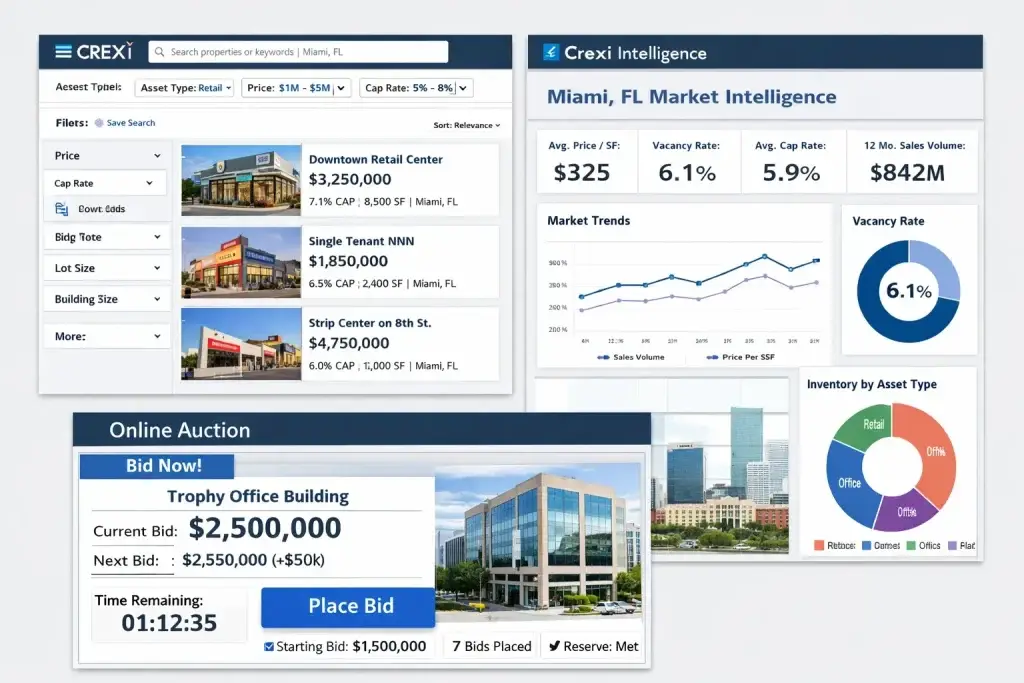
Crexi runs as a cloud-based commercial real estate platform that connects listing discovery, broker marketing, research, and transaction workflows in one place. Its own product pages describe it as an all-in-one platform to market, evaluate, and close commercial property deals, while the core navigation is organized around sale, lease, auctions, comps & records, and intelligence. That structure tells you a lot about the technology underneath: it is not a single listing database, but a connected set of marketplace, data, and workflow systems.
Marketplace Infrastructure
At the foundation, Crexi needs a large listing and search engine capable of handling commercial properties across many categories and markets. The live platform supports sale listings, lease listings, auctions, and highly specialized property types ranging from office and retail to self-storage, mobile home parks, and senior living. That kind of breadth suggests a flexible marketplace architecture built to organize many asset classes and many transaction types inside one searchable environment.
Search and Categorization Technology
Commercial real estate search is more complex than residential search because users often filter by asset class, investment strategy, square footage, lease structure, and market. Crexi’s live marketplace is structured around multiple search tabs and property-type filters, which means the platform relies heavily on indexing, categorization, and ranking systems to surface relevant opportunities fast. In simple terms, the technology has to understand what kind of property the user wants and where they want it, then return results quickly across a huge dataset.
Data and Intelligence Layer
One of Crexi’s biggest technical advantages is its research stack. Crexi Intelligence says users can analyze market-level data, research properties, and pull comps and property records with “accuracy, speed, and confidence.” It also says users can search over 13 million sales comps and 153 million property records nationwide, along with ownership details, lending information, demographics, and trends. That means Crexi is not just storing listings — it is operating a very large structured data layer for underwriting, prospecting, and valuation.
Interactive Mapping and Geographic Analysis
Crexi Intelligence also highlights interactive maps that show population, income, traffic counts, and points of interest, plus context around a property within 1-, 3-, and 5-mile ranges. This matters because commercial real estate decisions are deeply location-driven. A retail investor may care about traffic and income, while an industrial user may care about logistics and surrounding land use. Crexi’s map layer helps turn raw location data into a practical decision tool.
Broker Workflow and Document Handling
Crexi’s “Built for You” page shows that the platform is also designed to reduce friction during active deals. One broker testimonial says that documents, reports, and listings can now be sent with a click, instead of taking days to move through the process. That suggests Crexi includes internal workflow tools for document sharing and deal coordination, which are especially valuable in a sector where speed can determine whether a lead turns into a transaction.
Auction Technology
Crexi has a dedicated auction platform, and the live site says users can bid online for nationwide auction properties with non-contingent contracts and a 30-day close. Supporting that kind of experience requires more than normal listing software. It means the platform must support timed bidding, auction-specific listing visibility, buyer participation flows, and deal execution logic tied to auction outcomes. That adds a transaction technology layer on top of the core marketplace.
Subscription and Professional Tooling
Crexi’s product stack also shows clear software-style architecture for professionals. It offers broker plans, auction products, and intelligence products as separate but connected tools. This matters because the technology is designed not only for consumers browsing listings, but also for professionals who need repeatable workflows for marketing, research, and lead handling. In practice, that makes Crexi more like a CRE operating platform than a basic portal.
Why This Technology Matters for Business
The technology behind Crexi matters because it helps the platform do three things extremely well: attract demand through a searchable marketplace, support professionals with workflow tools, and increase trust through structured data and research. That combination is why Crexi has become more than a place to post listings. It gives brokers and investors a faster path from discovery to analysis to deal action, which is exactly the kind of product advantage that creates long-term platform value.
Crexi’s Impact & Market Opportunity
Crexi has helped push commercial real estate into a much more digital workflow. Instead of relying only on broker emails, private networks, and scattered data sources, users can now search listings, analyze comps, review property records, and move deals forward inside one connected platform. Crexi itself positions the product as an all-in-one platform to market, evaluate, and close CRE deals, which is a big reason it has become so influential in the space.
How Crexi Changed Commercial Real Estate Search
One of Crexi’s biggest contributions is that it made commercial real estate more searchable and more transparent for a wider audience. Its marketplace supports both sale and lease inventory across major asset classes like retail, office, industrial, multifamily, and land, which gives buyers, tenants, and investors a much broader digital starting point than traditional broker-led discovery alone.
It also expanded beyond simple listing search. With Crexi Intelligence, users can evaluate properties using ownership history, lending information, demographics, traffic counts, and market-level data. That changes the role of the platform from “where you find a listing” to “where you evaluate a deal.”
Also Read :- How to Develop a Real Estate App
Market Size and Growth Opportunity
The opportunity around Crexi is huge because U.S. commercial real estate is both high value and highly fragmented. Crexi’s live marketplace currently shows more than 224,000 commercial properties for sale, while its research layer says users can search over 153 million property records and 13 million sales comps nationwide. That is the kind of scale that makes a marketplace valuable to both the demand side and the professional side of CRE.
Crexi is also positioning itself around current market decision-making, not just static inventory. Its January 2026 national CRE report says it uses Crexi Intelligence data and commercial property listings to highlight pricing, leasing, and investment trends, which shows the platform is becoming a recurring market-information source for professionals.
User Demand and Industry Adoption
Crexi attracts multiple high-intent user groups at once:
• Buyers looking for investment and owner-user properties
• Tenants searching for lease space
• Brokers marketing listings and prospecting
• Investors underwriting deals
• Appraisers and analysts using comps and records
• Sellers using auctions as an alternative path to closing
That diversity matters because it gives Crexi a broader and more resilient marketplace than a niche single-purpose CRE site. Its own platform and product pages repeatedly highlight sale, lease, auction, and intelligence use cases as core parts of the business.
Future Trends and Why the Opportunity Is Still Strong
The future of platforms like Crexi looks bigger than listing exposure alone. The market is moving toward:
• Better comps and records access
• Faster underwriting and valuation workflows
• More digital auctions
• Stronger broker productivity tools
• Richer map-based and demographic analysis
• Data-backed market intelligence for investors
Crexi is already moving in that direction. Its Intelligence product emphasizes market-level analysis, interactive maps, ownership data, and property records, while its auction product adds a more transaction-oriented layer to the platform.
Opportunities for Entrepreneurs
Crexi’s success is a strong signal for founders. There is room to build niche CRE marketplaces, lease-focused platforms, valuation and comps tools, broker productivity software, and investment research products. The bigger lesson is simple: when a platform combines listings, data, and workflow efficiency, it becomes much harder to replace. Crexi has shown that commercial real estate users do not just want inventory — they want speed, context, and execution support too.
This massive success is why many entrepreneurs want to create similar platforms that connect brokers, buyers, tenants, and investors through technology-driven commercial real estate marketplaces.
Building Your Own Crexi-Like Platform
Crexi’s growth shows that commercial real estate users want much more than a place to browse listings. The real value comes from combining marketplace visibility, broker tools, comps, records, analytics, and transaction support in one product. Crexi itself organizes its platform around sale, lease, auctions, and Intelligence, which is a strong signal that the winning model in CRE is no longer just “post a listing and wait.” It is about helping users discover, evaluate, and act faster.
Why Businesses Want a Crexi Clone
Founders are attracted to this model because commercial real estate is a high-value market with recurring demand from multiple user groups. Crexi’s live marketplace shows more than 224,000 commercial properties for sale, and its Intelligence layer says users can access over 153 million property records and 13 million sales comps. That kind of scale shows how valuable a strong CRE platform can become when it captures both search demand and professional workflow demand.
A Crexi-like platform is especially appealing because it can create value for both sides of the market:
• Buyers and investors want searchable opportunities and reliable data
• Tenants want easier lease discovery
• Brokers want visibility, lead flow, and faster deal tools
• Owners and sellers want better marketing and auction options
• The platform owner can monetize subscriptions, premium exposure, data access, and workflow products
That makes this one of the strongest marketplace-plus-SaaS models in real estate tech.
Key Considerations Before Development
Before building a Crexi-style platform, a business needs to define what part of commercial real estate it wants to own.
Important decisions include:
• Will the platform focus on sales, leasing, auctions, or all three?
• Will it target all CRE categories or specialize in one niche like multifamily, retail, or industrial?
• Will it stop at listing discovery, or include comps, records, and underwriting support?
• Will brokers get a dedicated dashboard for leads, listings, and document workflows?
• Will the product include auction capability or just standard inquiry-based deal flow?
• How will market data, valuation context, and geographic insights be surfaced?
These decisions matter because Crexi’s edge comes from its connected workflow, not just its inventory.
Cost Factors & Pricing Breakdown
Building a CREXi-style commercial real estate (CRE) marketplace from scratch normally requires broker/listing workflows, high-volume CRE inventory (sale & lease), map-based geo search + advanced filters, lead capture & routing, and often premium modules like auctions, analytics, and marketing tools—making it more complex than a basic residential listing portal.
CREXi–Like App Development — Market Price
| Development Level | Inclusions | Estimated Market Price (USD) |
|---|---|---|
| 1. Basic CRE Listings MVP | Property listings, user signup/login, basic search & filters, property detail pages, inquiry/lead form, basic admin panel, basic analytics | $50,000–$100,000 |
| 2. Mid-Level Commercial Marketplace Platform | Map view + geo filters, broker profiles, listing verification workflows, lead routing dashboard, alerts/notifications, saved searches, richer analytics, mobile-responsive web | $100,000–$250,000 |
| 3. Advanced CREXi-Style CRE Ecosystem | Multi-region scaling, advanced geo-search performance, premium placements/ads, stronger security & monitoring, enterprise analytics, cloud-native scalable architecture | $250,000–$500,000+ |
CREXi-Style Commercial Real Estate Platform Development
The prices above reflect the global market cost of developing a CRE marketplace like CREXi—typically ranging from $50,000 to $500,000+, with a delivery timeline of around 4–12 months for a full, from-scratch build (scope increases with geo-search performance, listing verification, lead workflows, and analytics).
Miracuves Pricing for a CREXi–Like Custom Platform
Miracuves Price: Our ready-made property listing platform starts at $4,299 and is delivered in 6 days. Users can search, compare and enquire about properties. It is not a copy of Crexi. Auction and deal-room features are priced as custom work.
A custom build is scoped for a feature-rich, JS-based CREXi-style commercial real estate marketplace that can include:
- CRE listing management (admin + broker workflows)
- Search, filters, map view, property detail pages, favorites/saved searches
- Lead capture and inquiry routing for brokers/agents
- Alerts/notifications and analytics dashboards for listing + lead performance
- A scalable foundation that can be extended into featured listings, premium placements, auctions modules, and deeper integrations as your CRE marketplace grows
Note: This includes full non-encrypted source code, complete deployment support, backend setup, admin panel configuration, and publishing on the Google Play Store and Apple App Store—ensuring you receive a fully operational ecosystem ready for launch and future expansion.
Delivery Timeline for a CREXi–Like Platform with Miracuves
For a CREXi-style, JS-based custom build, the typical delivery timeline with Miracuves is 15-30 days, extending to 45-60 days for larger scope, depending on map/geo complexity, broker workflows, verification layers, and third-party integrations.
Tech Stack
We preferably will be using JavaScript for building the entire solution and Flutter / React Native for apps, considering speed, scalability, and one codebase for multiple platforms. Other tech stacks can be discussed upon request –Contact us.
Essential Features to Include
A strong Crexi-like platform should include:
• Advanced commercial property search across sale and lease listings
• Filters by asset class, size, pricing, and market
• Broker and owner listing dashboards
• Lead capture and inquiry routing
• Property detail pages with financial and location context
• Comps and property records access
• Interactive maps and demographic overlays
• Document-sharing tools
• Admin controls for moderation and listing quality
More advanced features should include:
• Auction workflows for digital bidding
• Underwriting and valuation tools
• Ownership and lending data
• Broker productivity and CRM-style tools
• Market-reporting dashboards
• Subscriptions for research and analytics access
Crexi’s current live product already points in this direction through its marketplace, auction platform, and Intelligence stack.
Read More :- How to Market a Real Estate App Successfully After Launch
Conclusion
Crexi shows how commercial real estate is moving from relationship-heavy, offline workflows to data-rich digital platforms. What makes it especially interesting is that it does not stop at listings. It combines marketplace search, broker marketing, comps, property records, market analysis, and auction workflows in one ecosystem, which is exactly why it has become more useful than a traditional CRE listing board. Crexi itself frames the platform around helping users market, evaluate, and close deals, while Crexi Intelligence adds deep research with millions of comps and property records nationwide.
For entrepreneurs, the bigger lesson is clear: the strongest PropTech products do not just attract traffic, they remove friction across the full deal journey. When a platform helps users find opportunities faster, analyze them with confidence, and move toward action inside the same product, it becomes much harder to replace. That is why so many founders want to build Crexi-like marketplaces today.
FAQs :-
What is Crexi?
Crexi is a digital commercial real estate platform where users can search, market, analyze, and transact around properties for sale or lease. It supports major commercial asset types and also offers research tools through Crexi Intelligence.
How does Crexi make money?
Crexi makes money through professional products tied to listing visibility, broker tools, auctions, and paid data and research access through Crexi Intelligence. Its platform is built around marketplace listings plus subscription-style tools for marketing, analysis, and deal support.
Is Crexi only for buying commercial property?
No. Crexi supports both commercial property sales and commercial leases, and it also has a dedicated auction workflow. That makes it useful for buyers, investors, tenants, brokers, and landlords.
What types of properties are listed on Crexi?
Crexi covers a wide range of commercial real estate categories, including retail, office, industrial, land, multifamily, hospitality, self-storage, mobile home parks, senior living, and more.
What is Crexi Intelligence?
Crexi Intelligence is Crexi’s research and analytics product. The company says it gives users access to over 153 million property records, more than 46 million verified comps, ownership history, market trends, demographics, traffic counts, and other evaluation tools.
Does Crexi offer comps and property records?
Yes. Crexi includes Comps & Records tools, and its help documentation says Pro and Intelligence users can search comps and property records directly within the platform.
Can brokers use Crexi to market listings?
Yes. Crexi offers broker-focused tools for listing exposure, marketing, lead generation, and faster deal workflows. Its broker plans are specifically positioned to help professionals reach more buyers and manage opportunities more efficiently.
Does Crexi support commercial real estate auctions?
Yes. Crexi has a dedicated auction platform for nationwide online commercial property bidding. The platform says its auction process is built around non-contingent contracts and a 30-day close.
What makes Crexi different from older CRE platforms?
Crexi stands out because it combines listings, broker tools, auctions, comps, records, and market analysis in one connected platform. That makes it more than a simple commercial listing board — it functions more like a marketplace plus workflow and research system.
Can I build a platform like Crexi?
Yes. A Crexi-like platform would usually need commercial listing search, broker dashboards, lead routing, comps and records access, interactive maps, analytics, and possibly auction workflows. Crexi’s own product structure shows that the biggest value comes from combining marketplace discovery with professional tools and research.
Related Articles :-
Miracuves is an independent software development company. We are not affiliated with, connected to, sponsored by, or endorsed by any company or product named in this article.
Terms such as “X Clone” are used descriptively. It is how the software industry refers to building a platform with functionality comparable to a known service, and how clients search for it.
The entire design and codebase of our products is built by our own team. Our products contain no code, design, graphics, or content originating from any third-party website or applications.
All third-party names and marks referenced in this article are the property of their respective owners, referenced solely to identify the services discussed.