


Key Takeaways
- A short-stay rental platform connects guests searching for accommodation, hosts managing properties, and marketplace operators overseeing bookings, payments, trust, and platform activity.
- Core workflows include property discovery, availability calendars, booking requests, secure payments, host payouts, messaging, reviews, cancellations, and reservation management.
- Successful marketplace operations depend on keeping guest booking, host management, payment settlement, moderation, and admin controls connected within one platform.
Guest & Host Workflow Signals
- Guests use location search, filters, maps, property listings, reviews, pricing, and availability calendars to compare stays before completing a booking.
- Hosts manage property details, photos, availability, nightly rates, booking requests, guest communication, cancellations, earnings, and payout preferences.
- Booking confirmations, notifications, check-in details, reviews, refunds, and payout updates keep both sides informed throughout the short-stay rental journey.
Marketplace Operator Insights
- Marketplace operators need visibility into users, listings, reservations, commissions, payments, payouts, refunds, disputes, reviews, and platform performance.
- Admin controls for listing approval, user verification, pricing rules, commission settings, moderation, reporting, and analytics help maintain trust and operational consistency.
- Miracuves develops customizable short-stay rental platforms with guest booking flows, host dashboards, property management, payments, payouts, reviews, analytics, and marketplace admin controls.
A short-stay rental platform connects people looking for temporary stays with hosts who want to list homes, apartments, rooms, villas, serviced units, or local accommodations. On the surface, it looks simple: a guest searches, books, pays, stays, and reviews. But behind that flow is a marketplace system that must balance availability, trust, host control, payments, refunds, reviews, and platform operations.
A platform such as 9flats belongs to this category. But for founders, the more useful question is not just what the platform is. The better question is how the short-stay rental model works as a business system.
This guide explains the full workflow from three sides: the guest, the host, and the marketplace operator. It also shows where founders should focus if they want to understand the business logic behind a property booking marketplace before exploring a launch-ready short-stay rental marketplace solution.
What Is a Short-Stay Rental Platform?
A short-stay rental platform is a digital marketplace where guests book temporary accommodation from hosts. The platform usually does not own every listed property. Instead, it provides the technology layer that helps both sides complete the transaction. Founders exploring different rental business types can also review Miracuves’ rental and property app solutions to understand how short-stay, property, and asset rental models connect.
For guests, the platform offers search, filters, listing pages, availability, secure checkout, messages, booking history, and reviews.
For hosts, it provides tools to add properties, set prices, manage availability, communicate with guests, accept bookings, and receive payouts.
For the platform operator, it creates a controlled business environment where bookings, users, hosts, listings, payments, commissions, refunds, and disputes can be managed from an admin dashboard.
The real value of this model is not only the listing page. It is the trust and transaction layer between strangers who need a smooth booking experience.
How the Guest Booking Flow Works
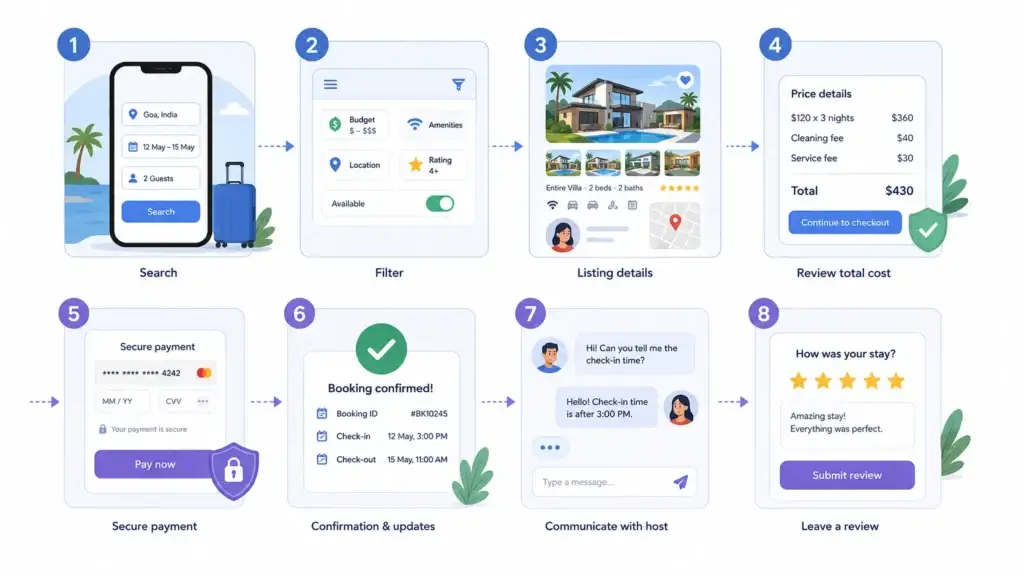
The guest journey decides whether visitors trust the platform enough to complete a booking. If the search flow is confusing, availability is unclear, or payment feels risky, users leave before checkout.
A strong guest flow usually includes these stages:
- Search by destination, dates, guests, and property type.
- Filter by budget, amenities, location, rating, and availability.
- Open a listing page with photos, description, rules, pricing, map, and host details.
- Review total booking cost before checkout.
- Pay through a secure payment gateway.
- Receive confirmation, check-in details, and booking updates.
- Communicate with the host if needed.
- Leave a review after the stay.
For founders, the guest flow should be designed around confidence. Guests need to know what they are booking, what they are paying, what happens after payment, and how support works if something goes wrong.
How Hosts Use a Short-Stay Rental Platform
Hosts are the supply side of the marketplace. Without enough good listings, guests have no reason to search. That is why host tools matter as much as the guest app.
A host dashboard usually allows property owners or managers to:
- Create and edit listings.
- Upload photos and property details.
- Set nightly pricing, seasonal pricing, or date-based pricing.
- Manage availability calendars.
- Accept instant bookings or review booking requests.
- Communicate with guests.
- Track earnings and payout status.
- Manage reviews and property performance.
- Update house rules, cancellation settings, and check-in instructions.
The host experience must be simple because many hosts are not technical operators. They may be individuals, boutique property managers, villa owners, serviced apartment operators, or small hospitality businesses.
If the host dashboard is difficult, supply growth slows down. If calendar control is weak, double-bookings can happen. If payout visibility is unclear, host trust drops.
What Marketplace Operators Need to Control
The marketplace operator is the business owner or platform team running the entire ecosystem. This role needs more than a front-end app. It needs a control layer.
An operator dashboard should help manage:
| Area | What the Operator Controls | Why It Matters |
|---|---|---|
| Users | Guest accounts, host accounts, roles, verification status | Keeps the marketplace organized and safer |
| Listings | Approval, moderation, categories, locations, media, status | Prevents poor-quality or misleading listings |
| Bookings | Booking history, cancellations, refunds, disputes | Helps resolve operational issues faster |
| Payments | Payment status, service fees, payout requests, transaction logs | Keeps financial workflows transparent |
| Commissions | Platform fee rules, host fees, guest fees, promotions | Supports monetization and pricing control |
| Content | FAQs, policies, banners, notifications, emails | Keeps communication consistent |
| Reports | Booking volume, revenue, active hosts, cancellations | Helps founders make better growth decisions |
This is where many early-stage founders underestimate the product. A marketplace is not just a guest app and a host app. It is an operating system for managing both sides of demand and supply.
The Three-Sided Marketplace Logic
A short-stay rental platform is usually a three-sided operating model:
Guests want trust, choice, fair pricing, and a smooth booking experience.
Hosts want visibility, easy listing tools, booking control, and reliable payouts.
Operators want supply growth, safe transactions, monetization, reporting, and dispute control.
The platform succeeds when these three interests stay balanced. If guest fees are too high, demand drops. If host payouts are slow or unclear, supply drops. If the operator has weak admin controls, support costs rise.
This is why the strongest rental marketplaces are built around workflows, not just screens.
Core Features That Support the Platform Flow
A short-stay rental platform needs features that make the business easier to operate. The goal is not to add every possible feature from day one. The goal is to include the right foundation.
| Feature | Business Value | Founder Impact |
| Destination search | Helps guests discover available stays quickly | Improves booking conversion |
| Availability calendar | Shows real-time or managed availability | Reduces booking conflicts |
| Listing management | Allows hosts to control property details | Improves supply quality |
| Secure checkout | Handles online payments and booking confirmation | Builds transaction trust |
| Host dashboard | Gives hosts control over bookings and earnings | Improves host retention |
| Admin dashboard | Lets operators manage users, listings, bookings, and payments | Reduces manual operations |
| Reviews and ratings | Builds trust between guests and hosts | Improves marketplace credibility |
| Messaging | Keeps guest-host communication inside the platform | Reduces off-platform leakage |
| Payout workflow | Helps hosts track earnings and payment status | Builds host confidence |
| Dispute handling | Supports refunds, complaints, and booking issues | Protects platform reputation |
A ready-made rental marketplace foundation can help founders start with these core flows already structured, then customize the experience based on region, property type, pricing rules, and business model. For a deeper breakdown of guest tools, host controls, booking flows, admin modules, and payout workflows, explore the full short-stay rental platform features guide.
How Short-Stay Rental Platforms Make Money
Most property booking marketplaces earn revenue from transactions, visibility, or value-added services. The monetization model depends on the type of audience, market maturity, host supply, and platform positioning.
Common revenue streams include:
| Revenue Stream | How It Works | Best For |
| Guest service fee | Guest pays a small platform fee during booking | Platforms with strong guest demand |
| Host commission | Platform deducts a percentage from host earnings | Marketplaces focused on transaction volume |
| Featured listings | Hosts pay for better visibility | Competitive destinations or premium properties |
| Subscription plans | Hosts pay monthly or yearly for platform access | Professional hosts and property managers |
| Cleaning or add-on fees | Extra services are added to the booking flow | Managed stays, villas, serviced apartments |
| Advertising | Local businesses or hosts promote offers | Platforms with high traffic |
| Partner services | Insurance, verification, photography, or concierge services | Mature rental ecosystems |
Founders should not select a revenue model only because another platform uses it. The better approach is to match pricing with market behavior. A host-heavy market may respond better to subscriptions. A demand-heavy market may support guest fees. A niche luxury stay platform may monetize through add-ons and service layers. Founders comparing service fees, host commissions, featured listings, subscriptions, and add-on revenue can also review the rental marketplace business model guide for deeper monetization planning.
Why Trust and Safety Matter in Rental Marketplaces
Trust is the foundation of a short-stay rental platform. Guests are booking a place they may not have seen in person. Hosts are allowing strangers into their property. The operator is responsible for reducing uncertainty on both sides.
Important trust layers include:
- Guest and host verification.
- Listing approval workflows.
- Secure payment gateway integration.
- Booking confirmation records.
- Refund and cancellation policies.
- Review moderation.
- Abuse reporting.
- Dispute management.
- Admin activity logs.
- Role-based dashboard access.
Security and compliance should be treated as a foundation, not a marketing add-on. Final compliance requirements depend on the operating region, legal review, payment integrations, tax rules, housing rules, and the platform’s business model. For a deeper look at verification, secure payments, moderation, access controls, and dispute workflows, read the short-stay rental app security guide.
Founder Decision Signals Before Building a Rental Marketplace
Supply Readiness
If you already have access to hosts, property managers, hotels, villas, or local stay providers, a short-stay rental platform becomes easier to seed.
Booking Complexity
If your market needs seasonal pricing, room-level availability, deposits, cancellation rules, or payout controls, backend logic matters more than simple listing pages.
Trust Requirements
If guests need verification, secure payments, reviews, and support before booking, the platform must include safety workflows from the beginning.
Launch Speed
If the goal is to validate demand quickly, a ready-made foundation can reduce the time spent building common marketplace modules from zero.
Common Mistakes Founders Should Avoid
Many founders focus too much on the visible app and too little on the operational backbone. That creates problems after the first few bookings.
The first mistake is building only a listing directory. A rental marketplace needs availability, booking, payment, host, guest, and admin workflows. Without these, the business becomes manual very quickly.
The second mistake is ignoring the host experience. If hosts cannot manage pricing, calendars, bookings, and payouts easily, they will not stay active.
The third mistake is adding too many property categories before proving demand. A focused city, niche, or property type can be easier to validate than a broad marketplace with weak supply. Once the initial positioning is clear, founders should also plan host onboarding, local demand generation, and repeat booking campaigns. The short-stay rental app marketing strategy guide can support that next step.
The fourth mistake is using unclear commission logic. Hosts and guests should understand what they pay, when payment is collected, and when payouts happen.
The fifth mistake is treating trust as a later feature. Verification, reviews, support, refunds, and moderation should be part of the platform foundation.
Ready-Made vs Custom Development for Short-Stay Rental Platforms
Founders usually have two practical routes: build from scratch or start with a ready-made platform foundation.
| Build Route | How It Works | Best For | Main Tradeoff |
| Custom development | Build every flow, module, and integration from the ground up | Highly unique business models with unusual workflows | More time, more planning, and higher execution risk |
| Ready-made foundation | Start with existing marketplace flows and customize branding, features, and business rules | Founders who want faster market validation | Needs careful customization to match the target market |
A custom build can make sense when the product model is completely new. But for short-stay rental marketplaces, many core flows are already known: search, listing, booking, payment, host management, admin control, reviews, and payouts.
That is why many founders prefer a ready-made approach when the goal is to launch faster, validate demand, and customize around a proven marketplace structure. If budget planning is your next step, the rental marketplace development cost factors guide explains what can affect pricing, customization scope, integrations, and launch planning.
Do not link the same money page twice in the body. One clean contextual link is enough. Also, the HTML in this paragraph has escaped characters, so removing it improves formatting.
Where Miracuves Fits Into This Model
For founders exploring a short-stay rental marketplace, the biggest challenge is not just launching a booking app. It is building the right foundation for guests, hosts, payments, listings, commissions, and admin control.
Miracuves helps founders start with a ready-made, white-label rental marketplace foundation that can be customized for different business models, property types, regions, and branding needs.
This gives founders a faster way to validate a local stay, serviced apartment, villa rental, or niche accommodation marketplace without building every core workflow from zero.
The benefit of this approach is control. Founders can adjust booking rules, commission structures, host approval flows, payment gateways, and marketplace policies based on how their target market behaves.
Instead of treating the platform as only a travel booking product, Miracuves helps shape it as a complete marketplace system where guest experience, host management, and operator visibility work together from the beginning. Founders comparing implementation partners can also review what to look for in a rental marketplace development company before choosing a build route.
Final Thoughts
A short-stay rental platform is not just a travel booking website. It is a marketplace system that must coordinate guest demand, host supply, payments, availability, trust, and platform operations.
For founders, the smartest starting point is understanding the flow before choosing the build route. Guests need a smooth booking experience. Hosts need control and payout clarity. Operators need admin visibility and business rules that can scale.
Once these foundations are clear, building the platform becomes a more practical decision. Miracuves can help founders move from idea to launch faster with a white-label, source-code-owned rental marketplace foundation designed for customization, monetization, and admin control.
FAQs
What is a short-stay rental platform?
A short-stay rental platform is a digital marketplace where guests book temporary accommodation from hosts. It usually includes property listings, search filters, booking calendars, payments, reviews, host dashboards, and admin controls.
How does a guest book a stay on a rental marketplace?
A guest usually searches by location and date, compares listings, checks pricing and availability, completes payment, receives booking confirmation, communicates with the host, and leaves a review after the stay.
What tools do hosts need in a property booking marketplace?
Hosts need listing management, calendar control, pricing tools, booking updates, guest messaging, payout tracking, review management, and profile verification. These tools help them manage properties without depending on manual communication.
Why does a rental marketplace need an admin dashboard?
The admin dashboard allows the platform operator to manage users, hosts, listings, bookings, payments, commissions, refunds, disputes, content, and reports. Without admin control, the marketplace becomes difficult to operate as bookings grow.
How do short-stay rental platforms make money?
They can earn through guest service fees, host commissions, featured listings, subscription plans, add-on services, advertising, or partner services. The right model depends on the target market, property type, and platform positioning.
What is the difference between a listing website and a rental marketplace?
A listing website mainly displays properties. A rental marketplace manages the complete transaction flow, including search, booking, payment, host tools, reviews, payouts, disputes, and admin operations.
Is a ready-made rental marketplace suitable for founders?
A ready-made foundation can be useful when founders want to validate demand faster and avoid building common marketplace workflows from zero. It should still be customized for the target market, branding, payment gateway, pricing rules, and operational model.
What should founders check before launching a short-stay rental platform?
Founders should check host supply, target geography, booking rules, pricing model, payment flow, verification needs, support process, legal requirements, and the admin controls needed to manage the marketplace.
Miracuves is an independent software development company. We are not affiliated with, connected to, sponsored by, or endorsed by any company or product named in this article.
Terms such as “X Clone” are used descriptively. It is how the software industry refers to building a platform with functionality comparable to a known service, and how clients search for it.
The entire design and codebase of our products is built by our own team. Our products contain no code, design, graphics, or content originating from any third-party website or applications.
All third-party names and marks referenced in this article are the property of their respective owners, referenced solely to identify the services discussed.