Imagine you’re working on a research paper, business report, or evidence-based article and you need to survey hundreds of papers, find key evidence, summarize findings, and compare outcomes—all in a short timeframe. Traditionally, research means countless hours combing through databases, reading abstracts, and manually organizing notes. With Elicit, much of that grunt work is automated so you can spend your energy on thinking, analyzing, and writing.
Elicit is an AI research assistant platform that uses advanced language models to help users discover, organize, and synthesize information from academic literature and web sources. It’s particularly popular among students, researchers, and professionals who need deep research workflows—including literature reviews, evidence comparisons, systematic summaries, and hypothesis generation.
Unlike simple AI chat tools, Elicit is built with research workflows in mind: it structures queries, finds relevant papers and data, extracts key information, organizes insights into digestible formats, and helps users explore evidence with minimal manual searching.
By the end of this guide, you’ll understand what Elicit is, how it works step by step, its business model, key features, the technology behind it, and why many entrepreneurs see opportunities in building similar AI research platforms—with help from Miracuves if you want to launch one quickly.
What Is Elicit? The Simple Explanation
Elicit is an AI-powered research assistant that helps users find, organize, and summarize information from academic papers and online sources. In simple terms, it acts like a smart research partner that reads studies for you and pulls out the most relevant facts, evidence, and insights.
The Core Problem Elicit Solves
Doing proper research often means:
- Searching through large academic databases
- Reading dozens of abstracts and full papers
- Manually extracting key results and data points
- Organizing everything into notes or spreadsheets
Elicit automates much of this by:
- Finding relevant papers based on your question
- Summarizing methods, results, and conclusions
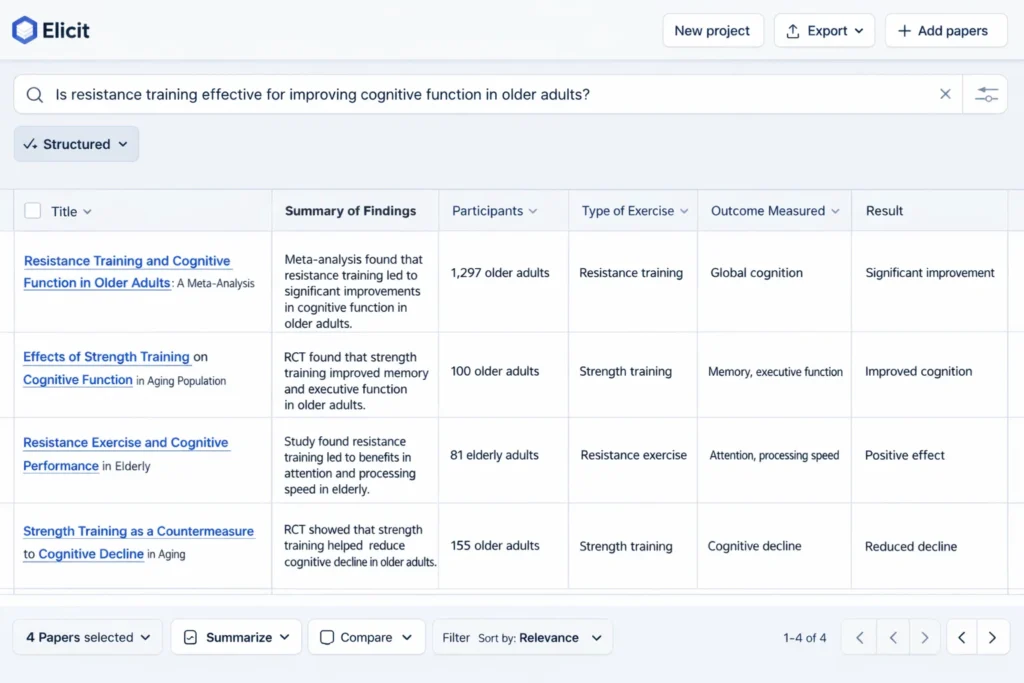
- Extracting structured information (like sample size, outcomes, and variables)
- Helping compare evidence across studies
It turns manual literature review into an AI-assisted workflow.
Target Users and Use Cases
Elicit is commonly used by:
• Academic researchers and students
• Policy analysts and consultants
• Product and market researchers
• Journalists and content creators
• Healthcare and social science professionals
Typical use cases include literature reviews, evidence synthesis, hypothesis generation, academic writing, and policy research.
Current Market Position
Elicit is positioned as a specialized AI research tool rather than a general chatbot. It focuses on academic and evidence-based workflows, which sets it apart from broad AI assistants.
Why It Became Successful
Elicit gained traction because it addressed a real pain point: reading and organizing research is slow and exhausting. By automating search and summarization, it lets users focus on insight rather than information gathering.
How Elicit Works — Step-by-Step Breakdown
For Researchers, Analysts, and Knowledge Workers
Asking a research question
Users begin by typing a natural-language research question such as “Does remote work increase productivity?” or “What factors influence customer churn in SaaS?” Elicit treats this as a research query, not just a keyword search.
Finding relevant papers and sources
Elicit scans academic databases and credible web sources to:
- Identify papers, articles, and reports related to the question
- Rank them by relevance and quality
- Surface both highly cited studies and recent publications
This step builds a research set instead of a simple link list.
Extracting structured information
Once sources are selected, Elicit:
- Reads abstracts and key sections
- Pulls out structured data like methods, sample size, variables, and outcomes
- Organizes findings into tables or lists
This makes it easy to compare evidence across multiple studies.
Summarizing and synthesizing results
Elicit generates clear summaries that explain:
- What the studies say overall
- Where findings agree or disagree
- What gaps or limitations exist
The goal is understanding, not just collection.
Refining and exploring further
Users can:
- Ask follow-up questions
- Filter papers by year, type, or topic
- Add or remove sources
- Export results for writing or analysis
Typical workflow
Research question → source discovery → structured extraction → summary synthesis → export to paper/report.
Technical Overview (Simple)
Elicit combines:
- Large language models for understanding questions and writing summaries
- Retrieval systems to search academic and web sources
- Information extraction models to pull structured data from papers
- Ranking systems to prioritize relevant and credible sources
- Interfaces for comparing and exporting results
This turns Elicit into a research pipeline, not just a chat interface.
Read More :- How to Develop an AI Chatbot Platform
Elicit’s Business Model Explained
How Elicit Makes Money
Elicit operates on a freemium + subscription model. The platform offers basic research features for free, while advanced workflows and higher usage limits are available through paid plans.
Main revenue streams include:
- Pro subscriptions: Unlock deeper search, more queries, and advanced extraction tools
- Team and organization plans: Shared workspaces and collaboration features for research groups and companies
- Enterprise licensing: Custom deployments, integrations, and higher security for large organizations
This model aligns pricing with how intensively users rely on the tool for research.
Pricing Structure (Typical Model)
Elicit’s pricing generally depends on:
- Free vs paid access level
- Monthly or annual subscription
- Query limits and paper analysis volume
- Collaboration and export features
Students and casual users can stay on the free tier, while professional researchers upgrade for higher throughput.
Fee Breakdown
- Monthly subscription for Pro users
- Team or enterprise pricing for organizations
- No ads and no commissions
- Usage-based limits tied to query volume
Market Size and Demand
Demand for Elicit-style tools is driven by:
- Growth in academic research and publishing
- Policy and market analysis workloads
- AI adoption in knowledge work
- Need for faster evidence synthesis
- Businesses using research for decision-making
The market for AI research automation is expanding rapidly.
Profitability Insights
Elicit improves profitability by:
- Building recurring subscription revenue
- Expanding within universities and organizations
- Offering premium research workflows as upgrades
- Retaining users through daily research usage
Revenue Model Breakdown
| Revenue Stream | Description | Who Pays | Nature |
|---|---|---|---|
| Pro Subscriptions | Advanced research tools | Individuals | Recurring |
| Team Plans | Shared workspaces | Groups | Tiered |
| Enterprise Deals | Custom deployment | Organizations | Contract |
| Integrations | Workflow embedding | Businesses | Usage-based |
Key Features That Make Elicit Successful
Research-focused question interface
Elicit is designed for research questions, not casual chat. It encourages users to frame queries in a way that leads to better academic and evidence-based results.
Automated paper discovery
Elicit finds and ranks relevant academic papers and reports, helping users build a research set without manually searching databases.
Structured data extraction
One of Elicit’s standout features is its ability to pull structured information from papers, such as methods, sample size, variables, and key outcomes.
Evidence comparison tables
Elicit organizes findings into side-by-side tables, making it easy to compare results across multiple studies.
Summary and synthesis tools
The platform generates clear, high-level summaries that explain what the body of research says as a whole.
Filters and refinement options
Users can narrow results by topic, publication type, or relevance to focus on the most useful sources.
Export and citation support
Elicit allows users to export findings into documents or spreadsheets, making it easier to integrate research into reports and papers.
Collaboration features
Team plans support shared projects and collaborative research workflows.
Academic and professional focus
Unlike general AI chat tools, Elicit stays focused on evidence-based, research-heavy tasks, which builds trust with serious users.
Continuous model improvement
The platform regularly improves how it retrieves and extracts information to increase accuracy and usefulness.
The Technology Behind Elicit
Tech stack overview (simplified)
Elicit is built as a research automation pipeline rather than a simple chatbot. Its technology focuses on finding academic sources, extracting structured data, and turning large volumes of information into usable insights.
At a high level, the stack includes:
- Large language models for understanding questions and generating summaries
- Academic and web retrieval systems for finding relevant papers
- Information extraction models for pulling structured fields (methods, results, variables)
- Ranking and relevance engines to prioritize high-quality sources
- Data tables and comparison tools for evidence synthesis
- Cloud infrastructure for scalable processing and storage
How Elicit turns a question into research output
When you enter a research question, Elicit:
- Interprets the intent and key concepts in the query
- Searches academic databases and trusted sources
- Collects relevant papers and reports
- Extracts specific data points from each source
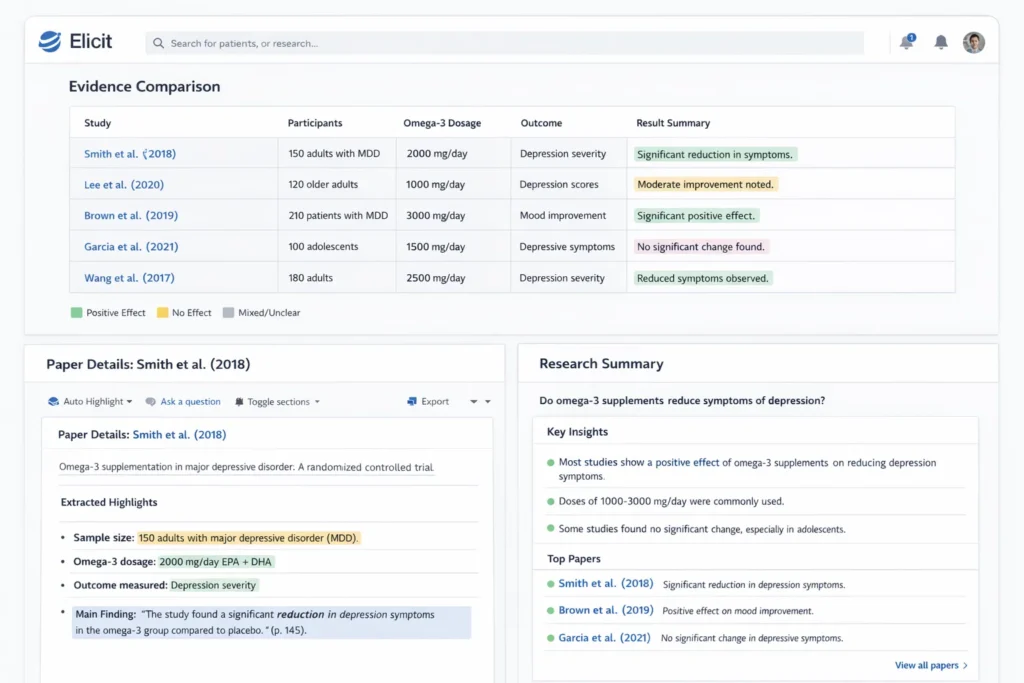
- Organizes results into tables and summaries
This turns what would normally be hours of manual work into a guided research workflow.
Structured information extraction
Instead of only summarizing text, Elicit focuses on pulling out specific fields such as:
- Study design and methodology
- Sample size and population
- Variables and outcomes
- Key findings and limitations
This makes it much easier to compare studies side by side.
Ranking and evidence quality
Elicit uses relevance and quality signals to:
- Surface highly cited or widely referenced papers
- Balance older, foundational studies with newer research
- Reduce noise from low-quality or off-topic sources
Collaboration and data export layer
Because research often happens in teams, Elicit supports:
- Shared workspaces
- Export to documents and spreadsheets
- Structured outputs that can be reused in reports or analysis tools
Performance and scalability
Processing large research queries can be compute-heavy, so Elicit relies on cloud systems to:
- Handle multiple paper analyses at once
- Store research projects securely
- Deliver fast responses for repeated queries
Why this technology matters for business
Elicit’s tech turns research into a repeatable process. Instead of knowledge living in individual notebooks or bookmarks, it become
Elicit’s Impact & Market Opportunity
Industry impact
Elicit has helped shift research from a manual, paper-by-paper process to a more automated, AI-assisted workflow. By structuring evidence into tables and summaries, it’s made systematic reviews and market research more accessible to people who don’t have formal academic training.
For businesses and policy teams, this means faster access to evidence-backed insights instead of opinion-based summaries.
Market demand and growth drivers
Demand for Elicit-style platforms is driven by:
- Growth in academic publishing and open-access research
- Businesses using research for product and policy decisions
- Students and professionals adopting AI for learning and analysis
- Need for faster literature reviews and evidence synthesis
- Pressure to reduce research time and cost
These trends support a growing market for AI-powered research automation.
User segments and behavior
Elicit attracts:
- Academic researchers and graduate students
- Policy analysts and consultants
- Product and market research teams
- Healthcare and social science professionals
- Journalists and investigative writers
A common behavior pattern is iterative exploration. Users often refine questions multiple times and compare evidence across different angles.
Geographic reach
As a cloud-based platform, Elicit is used globally by research teams and individuals, especially in regions with strong academic and professional research communities.
Future direction
Elicit-style platforms are likely to expand into:
- Better integration with academic databases and publishers
- Automated citation management
- Research project management tools
- AI-generated visualizations of evidence
- Enterprise knowledge base connections
Opportunities for entrepreneurs
This massive success is why many entrepreneurs want to create similar platforms—especially for:
- Corporate research and intelligence tools
- Legal and compliance research platforms
- Healthcare evidence analysis systems
- Education-focused study tools
- Policy and government research systems
Building Your Own Elicit-Like Platform
Why businesses want AI research automation tools
Elicit shows that research doesn’t have to live in scattered PDFs and bookmarks. When evidence is structured, searchable, and shareable, teams can make faster and more confident decisions. Businesses and institutions want similar platforms because:
- Research time is expensive and slow
- Teams need consistent, evidence-backed insights
- Knowledge is often siloed across individuals
- AI can turn large information sets into usable outputs
- Subscription models fit professional workflows
This makes research automation valuable across education, policy, healthcare, and enterprise intelligence.
Key considerations before development
If you’re planning to build an Elicit-style platform, focus on:
- High-quality academic and web retrieval sources
- Reliable structured data extraction
- Transparent citation and evidence tracking
- Clean comparison tables and summaries
- Project-based research workflows
- Team collaboration and permissions
- Data privacy and compliance
Trust and accuracy are critical in research tools.
Read Also :- How to Market an AI Chatbot Platform Successfully After Launch
Cost Factors & Pricing Breakdown
Elicit–Like App Development — Market Price
| Development Level | Inclusions | Estimated Market Price (USD) |
|---|---|---|
| 1. Basic AI Research Assistant MVP | Core web interface for research queries, user registration & login, integration with a single LLM/API, query → AI response flow, basic paper search (via open APIs), simple summaries, citations export (CSV/PDF), standard admin panel, basic usage analytics | $80,000 |
| 2. Mid-Level AI Research Platform | Semantic paper search, AI-generated summaries & comparisons, document upload & annotation, project/workspaces, citation manager, prompt templates, analytics dashboard, usage/credits tracking, stronger moderation & safety hooks, polished web UI and mobile-ready experience | $160,000 |
| 3. Advanced Elicit-Level Research Intelligence Ecosystem | Large-scale multi-tenant research platform with multi-source academic indexing, advanced RAG pipelines, team collaboration & sharing, enterprise RBAC/SSO, API access, audit logs, governance controls, detailed observability, cloud-native scalable architecture | $280,000+ |
Elicit-Style AI Research Platform Development
The prices above reflect the global market cost of developing an Elicit-like AI research and academic intelligence platform — typically ranging from $80,000 to over $280,000, with a delivery timeline of around 4–12 months for a full, from-scratch build. This usually includes semantic search pipelines, AI summarization, citation workflows, document ingestion, analytics, moderation, and production-grade infrastructure designed for researchers, analysts, and enterprise knowledge teams.
Miracuves Pricing for an Elicit–Like Custom Platform
Miracuves Price: Starts at $15,999
This is positioned for a feature-rich, JS-based Elicit-style AI research platform that can include:
- AI-powered academic and web search with semantic understanding
- Automated paper summaries, comparisons, and citation workflows
- User accounts, projects/workspaces, and document uploads
- Usage and credit tracking with optional subscription or pay-per-use billing
- Core moderation, safety, and compliance hooks
- A modern, responsive web interface plus optional companion mobile apps
From this foundation, the platform can be extended into enterprise knowledge bases, API access, deeper academic indexing, collaborative research tools, and advanced governance features as your AI research product matures.
Note: This includes full non-encrypted source code (complete ownership), complete deployment support, backend & API setup, admin panel configuration, and assistance with publishing on the Google Play Store and Apple App Store—ensuring you receive a fully operational AI research ecosystem ready for launch and future expansion.
Delivery Timeline for an Elicit–Like Platform with Miracuves
For an Elicit-style, JS-based custom build, the typical delivery timeline with Miracuves is 30–90 days, depending on:
- Depth of research features (RAG, citations, comparisons, etc.)
- Number and complexity of AI model, academic data, and moderation integrations
- Complexity of collaboration, enterprise controls (RBAC/SSO), and governance
- Scope of web portal, mobile apps, branding, and long-term scalability targets
Tech Stack
We preferably will be using JavaScript for building the entire solution (Node.js / Nest.js / Next.js for the web backend + frontend) and Flutter / React Native for mobile apps, considering speed, scalability, and the benefit of one codebase serving multiple platforms.
Other technology stacks can be discussed and arranged upon request when you contact our team, ensuring they align with your internal preferences, compliance needs, and infrastructure choices.
Essential features to include
A strong Elicit-style MVP should include:
- Natural-language research queries
- Academic and web source discovery
- Structured extraction (methods, outcomes, variables)
- Evidence comparison tables
- Summaries and synthesis views
- Export to documents and spreadsheets
- Team workspaces and permissions
- Usage tracking and subscriptions
High-impact extensions later:
- Citation management tools
- Visual dashboards for research insights
- Integration with reference managers and LMS systems
- Internal knowledge base search
- API access for custom workflows
Read More :- AI Chat Assistant Development Costs: What Startups Need to Know
Conclusion
Elicit highlights a powerful shift in how people work with information: the real value isn’t just finding more sources—it’s turning evidence into understanding. By structuring research into clear tables and summaries, it helps users move from reading to reasoning much faster.
For founders and product teams, the takeaway is clear: the biggest opportunity in AI research tools lies in workflow design, not just model quality. Platforms that make research repeatable, transparent, and collaborative will become essential infrastructure for knowledge-driven organizations.
FAQs :-
What is Elicit used for?
Elicit is used for AI-powered research and literature review. It helps users find academic papers, extract key data, and summarize evidence for reports, studies, and decision-making.
How does Elicit make money?
Elicit makes money through Pro subscriptions, team plans, and enterprise licensing that unlock higher usage limits, collaboration features, and advanced research tools.
Is Elicit free to use?
Yes. Elicit offers a free tier with basic research features, and paid plans for deeper analysis and higher query limits.
Can Elicit be used outside academia?
Yes. Many businesses use Elicit for market research, policy analysis, product research, and evidence-based strategy, not just academic work.
Does Elicit show sources for its results?
Yes. Elicit emphasizes transparent citations, allowing users to review and verify the original papers and sources.
How accurate is Elicit’s information extraction?
Elicit’s extraction is generally reliable, but users are encouraged to review original sources for critical or high-stakes decisions.
Can I build a platform like Elicit?
Yes. Elicit-style platforms can be built by combining academic retrieval systems, structured data extraction, and AI summarization.
Is Elicit suitable for team collaboration?
Yes. Team plans support shared workspaces and collaborative research projects.
What makes Elicit different from general AI chat tools?
Elicit is focused on evidence-based research workflows, not just conversational answers. It emphasizes structured data, comparison, and citations.
How can Miracuves help build an Elicit-like platform?
Miracuves helps founders build AI-powered research platforms with retrieval engines, structured extraction systems, team dashboards, and subscription billing—enabling fast launch and scalable growth.