


Key Takeaways
- Discount brokerage platforms can generate revenue through brokerage fees, account-related charges, margin services, premium tools, partner products, and other transaction-based services.
- Pricing logic depends on trading volume, customer segments, order types, service costs, product mix, platform usage, and competitive positioning.
- A sustainable brokerage business model balances low-cost trading with diversified revenue streams, efficient operations, user retention, and strong platform engagement.
Revenue & Pricing Signals
- Brokerage charges, account maintenance fees, margin-related income, transaction services, premium subscriptions, and value-added tools can create multiple revenue streams.
- Flat-fee, transaction-based, subscription, and hybrid pricing models can be structured around active traders, long-term investors, and premium users.
- Revenue performance is influenced by active accounts, trading frequency, average transactions, funded balances, premium feature adoption, and customer retention.
Founder Insights
- Founders should define the brokerage model, target users, pricing structure, regulatory requirements, operating costs, and monetization strategy before scaling the platform.
- Low brokerage pricing alone is not enough; reliable execution, transparent fees, strong retention, risk management, and efficient back-office operations support long-term economics.
- Miracuves develops customizable discount brokerage platforms with trading workflows, pricing controls, portfolio tools, payments, risk management, reporting, analytics, and admin dashboards.
A discount brokerage platform does not win only because it offers lower fees. It wins because it changes how users think about trading, investing, pricing, trust, and access.
Traditional brokerage models often depended on percentage-based commissions, relationship managers, branch-led onboarding, and complex fee structures. Discount brokerage platforms simplified that experience. They moved trading and investing into a digital-first environment where users could open accounts online, place orders faster, understand fees clearly, and manage portfolios without depending on offline processes.
That is why the discount brokerage business model is useful for founders to study. It shows how a fintech platform can monetize without overcharging users, build trust without aggressive selling, and scale through product experience instead of only paid marketing.
This article breaks down how discount brokerage platforms make money, why their pricing logic works, what revenue streams support the model, and what founders can learn before entering the online trading and investment platform space.
What Is a Discount Brokerage Business Model?
A discount brokerage business model is built around low-cost, digital-first trading and investing services. Instead of charging high commissions or relying heavily on offline advisory teams, the platform provides users with online account opening, order placement, portfolio tracking, reports, market access, and investment tools.
The business usually earns through a mix of brokerage fees, platform charges, transaction-linked fees, premium tools, margin-related products, APIs, and ecosystem services.
The reason this model works is simple: lower visible pricing attracts a larger user base, while high transaction volume and operational efficiency support monetization at scale.
For founders, the important point is this: a discount brokerage platform is not just a trading screen. It is a full operating system with user onboarding, KYC workflows, trading infrastructure, broker or exchange integrations, payments, reports, risk controls, support workflows, and admin visibility.
If you want to understand the workflow layer in more detail, this guide on how online discount brokerage platforms work explains trading, demat, order execution, and back-office systems in a founder-friendly way.
Why Low-Cost Brokerage Platforms Became So Popular
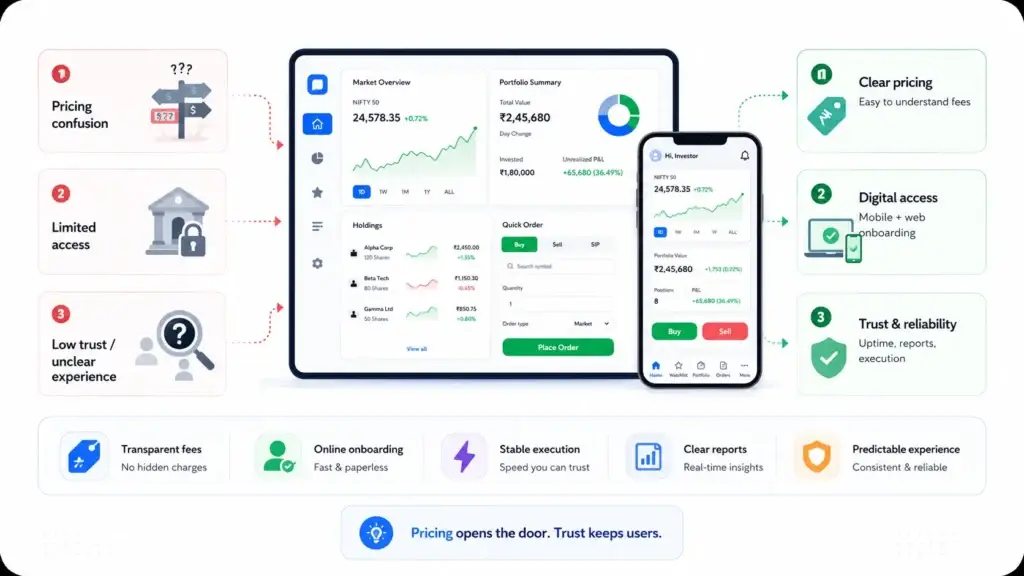
Discount brokerage platforms grew because they solved three major problems for retail investors and traders.
First, they reduced pricing confusion. Users prefer platforms where they can understand what they are paying before placing a trade. For example, leading Indian discount brokerage pricing models commonly use zero brokerage for equity delivery and flat or capped fees for intraday and derivatives trading. Official brokerage charge pages from the category leader show ₹0 brokerage on equity delivery and capped per-order charges for many active trading segments.
Second, they improved access. A user no longer needs to depend on a physical branch or relationship manager for every action. Digital onboarding, mobile apps, web dashboards, and online support make trading more accessible.
Third, they changed trust expectations. In fintech, trust is not created only by branding. It is created by uptime, transparent fees, clean reports, stable order execution, clear communication, and predictable product behavior.
This is why discount brokerage platforms are not merely “low-cost” businesses. They are trust-led fintech businesses with pricing as the entry point.
Core Revenue Streams of Discount Brokerage Platforms
A strong discount brokerage platform usually combines multiple revenue streams. This matters because brokerage income alone can become vulnerable when regulations, user behavior, or competitive pricing changes.
The most resilient platforms build monetization around transactions, tools, ecosystem products, and operational efficiency.
| Revenue Stream | How It Works | Why It Matters for Founders |
|---|---|---|
| Brokerage fees | Users pay a flat or capped fee on eligible trades | Creates predictable revenue from active trading volume |
| Account and platform charges | Charges may apply for account maintenance, specific services, or operational activities | Supports recurring or service-linked income |
| Margin-related income | Platforms may earn from margin products or funding-related services where legally permitted | Can increase revenue from active users, but needs strong risk control |
| Premium tools | Advanced charting, analytics, alerts, APIs, or reporting tools can be monetized | Helps serve serious traders and power users |
| API access | Developers, fintech products, and partner platforms may use trading or market access APIs | Opens B2B monetization opportunities |
| Ecosystem products | Mutual funds, bonds, smallcases, education, analytics, or partner products improve retention | Increases user lifetime value without depending only on trades |
| Interest or float-related income | Depending on market rules and operating structure, platforms may generate income from idle balances or related flows | Needs careful compliance and transparent handling |
| Value-added services | Call-and-trade, reports, premium support, alerts, and educational products can add revenue | Helps monetize service-heavy user needs |
The founder lesson is clear: the brokerage app is only the front end. The real business model sits behind the scenes in pricing design, workflow automation, reporting, risk management, and user retention. For a product-side breakdown, explore this stock trading platform business model guide.
Brokerage Fees: The Transaction Engine
Brokerage fees are a core revenue stream for discount brokerage platforms. The platform earns when users place eligible trades, usually through a flat fee, capped charge, or transaction-based pricing model.
The strength of this model comes from activity volume. Instead of relying on high commissions from every user, the platform grows revenue through repeated trades, frequent order placement, and a large active user base.
Different user groups contribute in different ways. Long-term investors may trade less often because they usually buy and hold. Active traders may place multiple intraday, options, or futures orders, creating more frequent brokerage revenue. Advanced users may also need additional tools, data, reports, or integrations that support deeper monetization.
This is why brokerage platforms often design experiences around user intent.
Long-term investors need clean portfolio tracking, mutual fund access, tax reports, and simple account statements.
Active traders need fast execution, watchlists, charts, price alerts, margin visibility, and stable market data.
Advanced users need analytics, API access, strategy tools, custom reports, and professional dashboards.
The brokerage fee model becomes stronger when each user segment has a clear reason to return, trade, and continue using the platform.
Pricing Logic: Why Simplicity Creates Trust
Pricing plays a major role in how users judge a financial platform. When charges feel unclear, users may hesitate to place trades, add funds, or continue using the product.
Discount brokerage platforms reduce this friction by making fees easier to understand. A simple pricing structure helps users see what they are paying for, when the charge applies, and which costs come from brokerage, taxes, exchange fees, or other mandatory charges.
The best pricing models usually focus on three things:
- They keep investing accessible for new users.
- They make trading charges predictable for active users.
- They separate platform fees from statutory or third-party charges.
This clarity builds confidence. Users are not only looking at the final amount deducted; they are also judging whether the platform feels transparent, fair, and reliable.
For founders, pricing should be treated as part of positioning, not just monetization. A simple pricing model can reduce hesitation, improve trust, and support long-term retention. A confusing fee structure may create short-term revenue, but it can damage user confidence over time.
Premium Tools and Subscriptions
Premium tools are not necessary for every user, but they become valuable as traders grow more active and need deeper control over decisions.
A beginner may only need simple order placement, watchlists, portfolio tracking, and basic reports. Serious traders often look for advanced charts, technical indicators, strategy tools, backtesting, alerts, API access, tax reports, portfolio analytics, and professional dashboards.
This creates a useful monetization opportunity for brokerage platforms. Instead of charging every user for advanced features from day one, the platform can keep the entry experience simple and affordable while offering paid tools to users who need more capability.
For founders, the lesson is clear: do not over-monetize early users before they trust the platform. Build a natural upgrade path. Let beginners start with the essentials, then give advanced users a reason to pay for deeper insights, faster workflows, and more powerful trading tools.
Ecosystem Products: The Real Retention Layer
A brokerage platform becomes stronger when users can do more than place trades.
This is why many modern platforms expand into adjacent experiences such as mutual funds, bonds, educational content, portfolio analytics, tax reports, trading communities, developer APIs, and partner-led financial products.
The goal is not to add random features. The goal is to increase useful product depth around the same user need: managing money, learning markets, and making investment decisions.
For example, official product pages from the category leader show a broader ecosystem that includes trading, reporting, mutual fund investing, educational products, and API products.
That ecosystem creates retention because users do not need to leave the platform for every related financial action. The stronger the ecosystem, the more chances the platform has to increase lifetime value.
Market Education as a Growth Channel
Education is one of the most powerful growth channels in a discount brokerage business model, especially for first-time investors.
Many users do not avoid trading platforms because they lack interest. They hesitate because markets feel complex, risky, and difficult to understand. When a platform explains trading basics, investment instruments, charges, tax implications, risk management, and portfolio decisions in simple language, it reduces that hesitation.
This kind of education builds trust without aggressive selling. A user who understands how the platform works is more likely to complete onboarding, explore features, fund an account, and return with confidence.
For founders, education should not be treated as only a blog or marketing activity. It is part of the product experience. Learning modules, explainers, webinars, FAQs, in-app guidance, and knowledge hubs can help move users from awareness to active usage.
The stronger the education layer, the easier it becomes to onboard users responsibly and build long-term engagement.
Once education improves activation, founders also need a clear acquisition and retention plan. This trading platform marketing strategy explains how trust-building content, onboarding campaigns, referrals, lifecycle emails, and user education can support growth.
How Discount Brokerage Platforms Keep Costs Low
Low pricing only works when the cost structure is efficient.
Discount brokerage platforms usually reduce operating costs through digital onboarding, automated KYC workflows, self-service support, online reports, scalable backend systems, centralized dashboards, and limited dependence on physical branches.
This does not mean the business is simple to operate. In fact, the backend can be complex. The platform must handle user identity checks, order flows, broker integrations, payment gateways, account ledgers, audit logs, tax reports, risk controls, support tickets, and regulatory workflows.
The difference is that these processes are handled digitally instead of manually wherever possible.
Founders should understand this before entering the market. A low-fee model without automation can become operationally expensive very quickly.
If you are estimating the build side, this guide on trading platform development cost factors explains how broker integrations, market data, compliance workflows, testing, and deployment scope influence pricing.
Founder Decision Signals
Speed
If your market already understands digital trading, the launch challenge is not education alone. It is getting a reliable, branded platform foundation live quickly enough to test demand.
Cost
A brokerage platform needs onboarding, trading workflows, reports, admin controls, security, and integrations. Starting from zero can increase cost when the business model is still being validated.
Scalability
Trading platforms need stable backend workflows, audit logs, role-based access, market data handling, and support processes before user volume grows.
Market Fit
The strongest early signal is not downloads. It is repeated trading activity, account funding, portfolio engagement, and trust in pricing transparency.
The Role of Trust in Brokerage Monetization
A brokerage platform handles money, identity, orders, portfolios, and financial decisions. That makes trust more important than most app categories.
Users may forgive a social app for a small glitch. They are less forgiving when a trading order fails, a report is unclear, or pricing feels misleading.
Trust is built through several layers:
- Transparent brokerage and charges.
- Reliable order placement.
- Clear fund movement history.
- Accurate portfolio reporting.
- Secure login and session controls.
- KYC and AML workflow support.
- Role-based admin access.
- Audit logs and dispute handling.
- Clear communication during outages or volatility.
This is where founders should avoid thinking only about front-end design. A clean interface is important, but the backend control layer decides whether the platform can operate responsibly.
Technology Layers Behind the Business Model
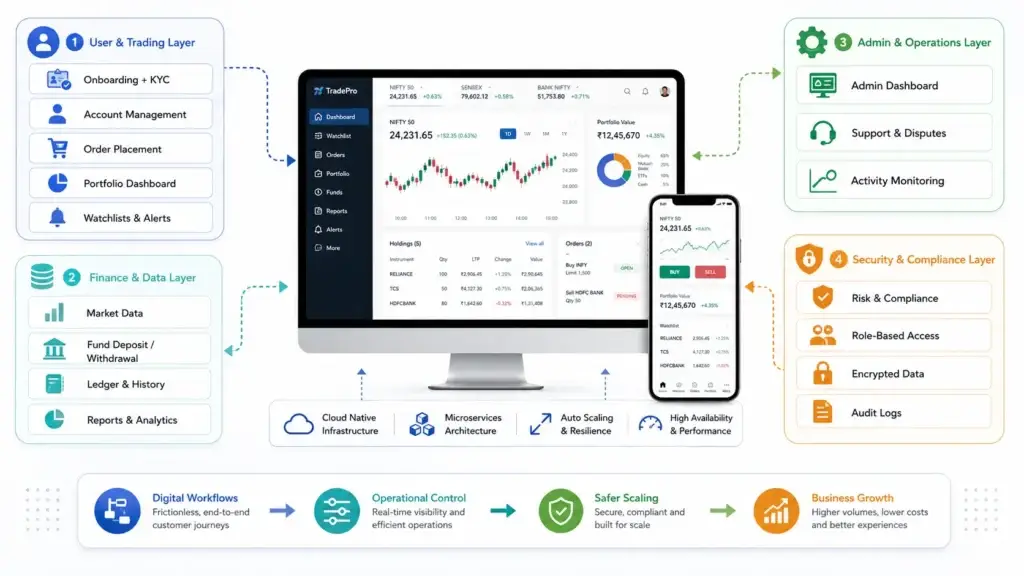
The discount brokerage business model depends on technology because most monetization happens through high-volume digital workflows.
A scalable platform usually needs:
- User onboarding and KYC flows.
- Trading and investment account management.
- Market data integration.
- Order placement workflows.
- Portfolio dashboard.
- Watchlists and alerts.
- Fund deposits and withdrawals.
- Ledger and transaction history.
- Admin dashboard.
- Reporting and analytics.
- Risk and compliance workflows.
- Support and dispute workflows.
- Role-based access control.
- Encrypted data transfer and storage.
- Audit logs.
These systems help the founder control the business beyond the user-facing app. For a deeper module-level view, review this trading platform feature breakdown covering trader workflows, API layers, admin controls, risk monitoring, and compliance console capabilities.
If you want to understand the broader product layer, this guide on modern fintech platform features explains how onboarding, dashboards, payments, wallets, reports, and security workflows fit into fintech app development.
If the admin panel is weak, the founder may struggle to manage users, monitor activity, resolve disputes, review reports, control content, and track operational issues. That can make scaling harder even if the front-end app looks polished.
Revenue Model Comparison
| Model | Revenue Logic | Strength | Risk |
| Traditional brokerage | Higher commissions, advisory-led relationships, offline support | Strong relationship value for high-net-worth or advisory-heavy users | Higher operational cost and slower digital scalability |
| Discount brokerage | Low-cost pricing, transaction volume, self-service workflows | High adoption potential and strong price transparency | Needs large active base and reliable technology |
| Subscription trading platform | Users pay monthly or annual fees for tools and insights | Predictable recurring revenue | Harder to sell to beginners |
| API-led brokerage ecosystem | Developers and fintech partners use platform APIs | B2B scale and ecosystem expansion | Needs strong documentation, uptime, and risk controls |
| Hybrid fintech platform | Brokerage, premium tools, ecosystem products, reports, APIs | More resilient monetization mix | More complex to build and manage |
The hybrid approach is usually the strongest long-term model because it avoids overdependence on one revenue source.
Mistakes Founders Should Avoid
Mistake 1: Thinking Low Pricing Alone Is Enough
Low pricing can attract users, but it does not retain them by itself. Users stay when the platform is stable, transparent, easy to use, and useful during real trading conditions.
Mistake 2: Ignoring Backend Operations
Many founders focus too much on the trading screen and not enough on admin controls, ledger accuracy, KYC review, support workflows, audit logs, and reporting.
Mistake 3: Adding Too Many Financial Products Too Early
A brokerage platform should first solve one core use case well. Expanding into too many products before the core experience is stable can create user confusion and operational risk.
Mistake 4: Treating Compliance as a Later Step
Fintech compliance cannot be bolted on at the end. User verification, transaction monitoring, audit records, data privacy, and risk workflows should be planned early. Final compliance depends on jurisdiction, legal review, integrations, and the operating model.
Mistake 5: Copying a Market Leader Without Localizing the Model
A pricing model that works in one market may not work in another. Founders need to adapt fees, onboarding, regulations, payment flows, and user education to their own region and audience.
What Founders Can Learn From Discount Brokerage Platforms
The biggest lesson for founders is that a discount brokerage business is not built around one feature, one pricing offer, or one trading screen. It works because multiple layers come together: transparent pricing, reliable product experience, user education, ecosystem depth, efficient operations, and long-term trust.
For founders, the real question is not, “How do we copy a successful trading app?”
A better question is, “Which parts of this brokerage model make sense for our market, our users, and our revenue strategy?”
That shift is important. It keeps the focus on business model clarity instead of imitation. A founder should study how discount brokerage platforms attract users, reduce pricing friction, monetize active traders, educate beginners, and retain investors through a broader fintech ecosystem.
Once that logic is clear, the next step is deciding what platform foundation is needed to support the model. That may include onboarding, trading workflows, portfolio dashboards, reports, admin controls, secure access, and monetization-ready modules. This approach helps the blog support the solution page naturally without competing with it.
Where Miracuves Fits Into the Founder Journey
Once a founder understands the discount brokerage business model, the next decision is execution.
Some founders need a fully custom fintech build. Others need a faster way to validate a trading or investing platform idea with branded apps, admin control, source-code ownership, and configurable workflows.
Founders exploring broader fintech opportunities can also review Miracuves’ fintech app development category for related product directions, platform models, and digital finance use cases.
If you are evaluating the product foundation behind this type of brokerage business, you can explore Miracuves’ white-label stock trading platform as the next step after understanding the model.
The goal is not to copy another company blindly. The goal is to use proven fintech patterns, adapt them to your audience, and build with enough control to evolve after launch.
Final Thoughts
The discount brokerage business model works because it aligns user trust with platform monetization.
Users want transparent pricing, fast access, clean reports, and reliable trading workflows. Platform operators need transaction volume, premium tools, ecosystem products, and efficient operations. The best brokerage businesses connect both sides through a digital-first product foundation.
For founders, the opportunity is not in copying a market leader word for word. It is in understanding the mechanics behind the model: simple pricing, scalable technology, responsible onboarding, strong admin control, and monetization that grows with user activity.
This is where Miracuves helps founders think beyond the surface-level app. With the right product foundation, branded workflows, admin control, and source-code ownership, founders can move from business model clarity to practical execution.
That is what turns a trading app from a feature list into a real fintech business.
FAQs
How do discount brokerage platforms make money?
Discount brokerage platforms make money through brokerage fees, premium tools, account-related charges, margin-related services, API access, ecosystem products, and value-added services. The model usually depends on high transaction volume and efficient digital operations.
Why do some brokerage platforms offer zero delivery brokerage?
Zero delivery brokerage helps attract long-term investors and reduce entry barriers. The platform may still earn from active trading segments, premium tools, account services, ecosystem products, and other approved revenue streams.
Is a discount brokerage model profitable?
It can be profitable when the platform has strong transaction volume, low operating costs, automated workflows, reliable infrastructure, and a large base of active users. Low fees alone do not guarantee profitability.
What is the biggest risk in a low-cost brokerage business?
The biggest risk is operational pressure. If the platform has low pricing but weak automation, poor support, unreliable trading workflows, or unclear compliance processes, costs can rise quickly and trust can decline.
What features matter most in a brokerage platform?
Important features include digital onboarding, KYC workflows, market data, order placement, watchlists, portfolio tracking, fund management, reports, admin dashboard, audit logs, risk controls, and secure access management.
Why is user education important for brokerage platforms?
User education reduces hesitation, improves activation, and builds trust. A platform that teaches users how markets, risks, charges, and tools work can improve long-term engagement without relying only on paid acquisition.
When should a founder explore a platform development solution?
A founder should explore platform development after understanding the revenue model, user segment, regulatory expectations, required integrations, and launch scope. At that stage, a branded and source-code-owned platform foundation can help reduce execution risk.
Miracuves is an independent software development company. We are not affiliated with, connected to, sponsored by, or endorsed by any company or product named in this article.
Terms such as “X Clone” are used descriptively. It is how the software industry refers to building a platform with functionality comparable to a known service, and how clients search for it.
The entire design and codebase of our products is built by our own team. Our products contain no code, design, graphics, or content originating from any third-party website or applications.
All third-party names and marks referenced in this article are the property of their respective owners, referenced solely to identify the services discussed.