


Imagine facing a medical emergency, an unexpected accident, or a sudden financial crisis—and instead of handling it alone, you’re able to reach out to friends, family, and even strangers for support in just a few clicks. That’s the real-world problem GoFundMe was built to solve.
GoFundMe is a leading online crowdfunding platform that allows individuals and organizations to raise money for personal causes, medical expenses, education, emergencies, charity initiatives, and community support. It made fundraising simple by removing complex grant processes and letting anyone share their story and receive help directly.
By the end of this guide, you’ll clearly understand what GoFundMe is, how it works behind the scenes, its business model, key features, and why so many entrepreneurs want to build similar crowdfunding platforms—with Miracuves helping turn those ideas into reality.
What Is GoFundMe? The Simple Explanation
GoFundMe is an online crowdfunding platform that helps people raise money by sharing their story and collecting small contributions from many donors. Anyone can start a fundraiser in minutes, set a goal amount, and receive donations directly into their bank account.
The Core Problem GoFundMe Solves
When unexpected expenses arise—medical bills, accidents, funerals, education costs, or emergencies—traditional funding options are slow or unavailable. GoFundMe removes those barriers by enabling fast, people-powered fundraising without paperwork or approval processes.
Target Users and Use Cases
GoFundMe is widely used by:
• Individuals raising money for medical or personal emergencies
• Families facing sudden financial hardship
• Students and creators seeking community support
• Nonprofits and charities running campaigns
• Communities rallying around social causes
Current Market Position
GoFundMe is the most recognized personal crowdfunding platform in the U.S. It dominates the category for medical and emergency fundraising, with strong trust built through its brand, donor protection policies, and ease of use.
Why It Became Successful
GoFundMe succeeded because it made fundraising human and simple. Storytelling, social sharing, and direct payouts turned asking for help into something accessible and dignified, encouraging millions of people to support causes they care about.
How GoFundMe Works — Step-by-Step Breakdown
For Fundraisers (People Raising Money)
Creating a Fundraiser
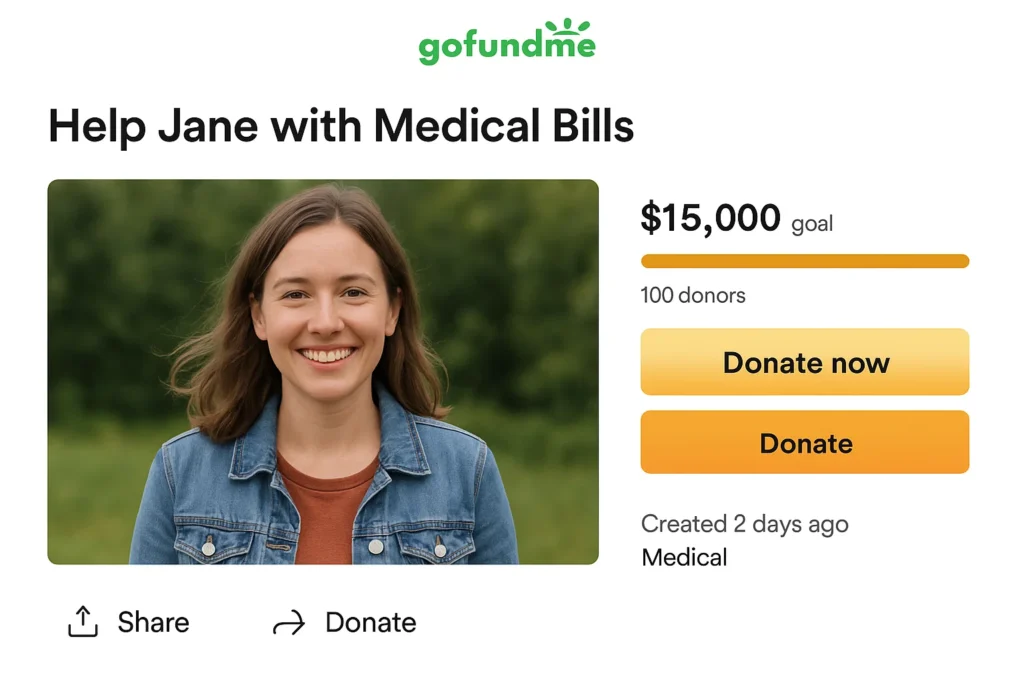
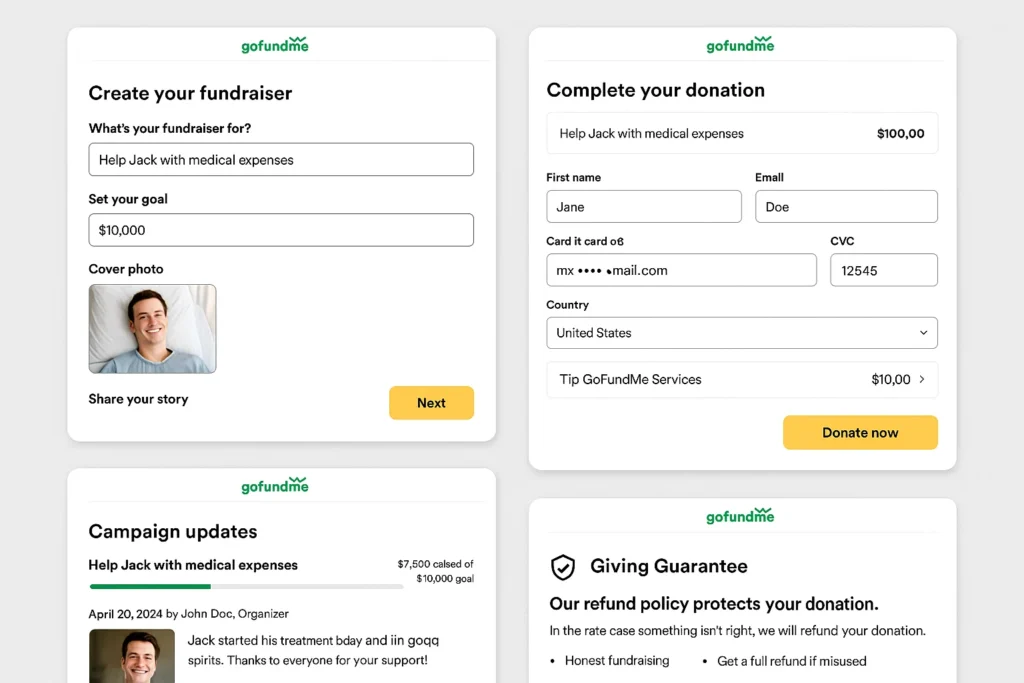
A user signs up with an email or social account and clicks “Start a GoFundMe.” They add a title, fundraising goal, category (medical, emergency, education, charity, etc.), and write a personal story explaining why help is needed. Photos or videos can be added to build trust and emotional connection.
Sharing the Campaign
Once published, the fundraiser gets a unique page link. Users share it through WhatsApp, email, SMS, Facebook, Instagram, and other social platforms. Most donations come from social sharing and word of mouth.
Receiving Donations
Donors can contribute any amount using cards, bank transfers, or digital payment methods. Donations appear on the campaign page in real time, along with supportive messages from contributors.
Managing Funds & Updates
Fundraisers can post updates to keep supporters informed, thank donors, and share progress. Funds can be withdrawn to a linked bank account as donations come in (no need to wait until the goal is reached).
Example User Journey
A family creates a medical fundraiser → shares it on social media → friends donate and reshare → strangers discover the story → funds start arriving within hours → withdrawals are made to pay hospital bills directly.
For Donors (Contributors)
Discovering Causes
Donors find campaigns through social media links, direct messages, search, or GoFundMe’s discovery pages.
Donating Securely
They choose an amount, add a message, and complete payment through a secure checkout. Donors can opt to donate anonymously if they prefer.
Donor Protection
GoFundMe offers donor protection policies that help build trust by addressing misuse or fraud concerns.
Technical Overview (Simplified)
GoFundMe operates through a straightforward but powerful digital flow:
- Fundraiser pages hosted on a scalable web platform
- Secure payment processing and payout systems
- Real-time donation tracking and notifications
- Social sharing integrations to drive reach
- Fraud detection and review systems to protect users
- Admin tools to monitor campaigns and compliance
Read Also :- Most Profitable Digital Banking & Fintech Apps to Launch in 2025
GoFundMe’s Business Model Explained
How GoFundMe Makes Money
GoFundMe primarily earns revenue in two ways:
- Optional donor contributions (tips): When someone donates, they can choose to leave an optional contribution to help support GoFundMe’s operations. It’s not required.
- Transaction fees (payment processing): GoFundMe deducts a transaction fee from each donation to cover payment processing.
This model keeps creating and managing a fundraiser free, while the platform is funded by donors and transaction processing.
Pricing Structure (Current Fee Logic)
- Platform fee to start a fundraiser: $0 (free to create and manage).
- Transaction fee per donation (USA commonly shown): 2.9% + $0.30 per donation (deducted automatically).
- Optional donor tip: Donors can add an optional contribution to GoFundMe at checkout; it’s never required.
Note: Fees can vary by country/currency, and international transaction/conversion fees may apply depending on payment method.
Commission/Fee Breakdown (Simple Example)
When a donor gives $100:
- GoFundMe deducts the transaction fee (percentage + fixed amount).
- The fundraiser receives the remaining amount (then withdraws to a bank account based on payout setup).
- Any donor tip (if chosen) goes to GoFundMe to help run the platform.
Market Size and Growth Signals
GoFundMe’s scale is powered by high-frequency, small-ticket donations and social sharing. For example, GoFundMe’s “Year in Help” reporting highlights very large donation volumes to individuals and nonprofits, plus strong repeat donor behavior.
Profitability Insights (What Matters Most)
GoFundMe’s business economics depend on:
- Donation volume and repeat donors (more campaigns + more donors = more processing revenue).
- Donor tip participation (optional contributions help fund operations).
- Trust and safety effectiveness (strong protections increase donor confidence and conversion).
Revenue Model Breakdown
| Revenue stream | What it is | Who pays | When it happens |
|---|---|---|---|
| Optional donor contribution (tip) | Donor can add a voluntary amount to support GoFundMe | Donor | During checkout |
| Transaction fee | Payment processing fee deducted from each donation | Fundraiser (deducted from donation amount) | Every donation |
| International/conversion fees (if applicable) | Additional costs based on payment method/currency | Depends on donor payment method | Some cross-border cases |
Key Features That Make GoFundMe Successful
1) Anyone-can-start fundraising flow
Why it matters: GoFundMe removes “gatekeeping.” You don’t need approvals, special forms, or an organization to begin.
How it helps users: People can respond to emergencies fast—minutes, not days.
Technical innovation: Guided campaign creation prompts + templates that make it easy to publish a credible page quickly.
2) Story-first fundraiser pages
Why it matters: Donors give to people, not paperwork.
How it helps users: A strong story, photos, and clear needs build trust and empathy.
Technical innovation: Page layouts optimized for readability, image/video support, and mobile-first viewing to improve conversion from social traffic.
3) Frictionless sharing (the real growth engine)
Why it matters: Most campaigns grow when they’re shared repeatedly.
How it helps users: One link can travel through WhatsApp, Instagram, X, email, and community groups instantly.
Technical innovation: Share-ready campaign links, preview cards, and sharing prompts built into the fundraiser journey.
4) Secure donations with optional tips
Why it matters: Donors can give quickly, and creators don’t pay a platform fee to start a fundraiser.
How it helps users: Fundraisers keep more focus on reaching goals, not paying setup costs.
Technical innovation: Checkout that supports optional donor contributions + transparent transaction fee handling.
5) Fast withdrawals to a bank account
Why it matters: Many fundraisers are for time-sensitive needs (medical bills, relief, urgent travel).
How it helps users: Funds can be accessed during the campaign, not only after it ends.
Technical innovation: Integrated payout workflows and identity/bank verification steps to reduce risk.
6) Updates + comments that keep donors engaged
Why it matters: Campaigns perform better when supporters see progress and feel part of the journey.
How it helps users: Updates drive repeat shares and keep donor trust high.
Technical innovation: Update posts, donor messages, and notification systems that re-engage previous visitors.
7) Trust & Safety + the GoFundMe Giving Guarantee
Why it matters: Crowdfunding only works if donors feel safe.
How it helps users: Donors get peace of mind with money-back protection in the rare case something isn’t right, and GoFundMe investigates misuse.
Technical innovation: Fraud prevention tech + dedicated Trust & Safety operations to review reports and reduce misuse.
8) Search and discovery for public fundraisers
Why it matters: Beyond direct sharing, discovery helps campaigns reach new supporters.
How it helps users: Donors can find fundraisers by name, location, or title—especially for trending events.
Technical innovation: Search indexing + trending surfacing for active campaigns.
9) Tools that help people give smarter
Why it matters: Donation habits improve when giving is easy, repeatable, and organized.
How it helps users: Donors can build a consistent giving routine, not just one-time donations.
Technical innovation: “Giving Funds” (GoFundMe’s donor-advised fund concept) aimed at organizing and planning charitable giving.
10) Platform evolution and app improvements
Why it matters: Fundraising behavior changes fast (short-form sharing, mobile-first donors).
How it helps users: Better in-app tools help campaigns convert and keep donors engaged.
Technical innovation: Ongoing app updates focused on helping people “give smarter” and improve fundraising outcomes.
Recent updates and AI/ML integrations
GoFundMe has publicly discussed using generative AI to reduce friction in fundraising—like suggesting titles, social copy, and tailoring suggested donation amounts based on donor behavior. It’s also expanding into structured giving products like Giving Funds to modernize everyday philanthropy.
Read Also :- Top UI/UX Mistakes in Digital Banking & Fintech Apps
The Technology Behind GoFundMe
Tech stack overview
GoFundMe is built like a high-traffic, high-trust payments platform. The core needs are simple to explain, but hard to execute at scale: fast campaign pages, secure checkout, reliable payouts, and strong fraud prevention. A lot of its “technology advantage” comes from how these systems work together smoothly.
Real-time features explained
Live donation updates
As donations come in, the fundraiser page updates amounts, messages, and progress toward the goal. This real-time feedback loop is important because it encourages more sharing and repeat visits.
Instant notifications
Organizers get alerts when donations land or when supporters comment. Donors also receive confirmations and receipts, which builds trust and reduces disputes.
Updates and engagement signals
Campaign updates, thank-you messages, and comments act like engagement signals that keep supporters involved and help a fundraiser stay active longer.
Payments and payouts
GoFundMe’s biggest technical responsibility is moving money safely. It handles donation payments and sends withdrawals to organizers’ bank accounts. GoFundMe’s public materials confirm it’s free to start a fundraiser and that a transaction fee is charged per donation, with optional donor contributions helping support the platform.
A key piece: GoFundMe partners with Stripe, and Stripe has described GoFundMe using Stripe Radar (ML-based fraud tooling) to support trust and safety operations at scale.
Fraud prevention and trust systems
Because crowdfunding depends on trust, GoFundMe invests heavily in safety operations and fraud tooling. It publicly describes proactive monitoring, investigating reported misuse, and offering refunds through the GoFundMe Giving Guarantee when something isn’t right.
What this looks like in practice:
- Behavior monitoring to flag suspicious activity
- Identity/bank verification steps for withdrawals
- Manual reviews when risk signals trigger
- Refund workflows for eligible guarantee claims
Scalability approach
GoFundMe must handle sudden traffic spikes (for example, during major disasters or viral campaigns). That usually means cloud scaling, caching, and resilient services so donation checkout doesn’t fail when a campaign suddenly goes mainstream.
Mobile app vs web platform
- Web is where most sharing links land (fast page load and clear story presentation matter most).
- Mobile apps help organizers manage updates and donors donate quickly with saved payment methods, notifications, and a smoother checkout.
AI and automation inside the platform
GoFundMe has introduced AI-focused tooling (marketed as “GoFundMe Intelligence”) aimed at optimizing campaigns and predicting donor behavior. It has also shared that it offers smart suggestions to help with things like writing stories, picking titles, and setting goals.
Why this tech matters for business
Crowdfunding is not just “a page + a payment button.” The winning platforms are the ones that:
- Convert social traffic into donations with minimal friction
- Keep payouts reliable and compliant
- Prevent misuse without blocking genuine fundraisers
- Build trust so donors feel safe contributing
GoFundMe’s Impact & Market Opportunity
Industry disruption caused
GoFundMe changed fundraising from something that usually required an institution (a charity, a school, a church, a formal event) into something anyone can do in minutes. That shift made “personal crowdfunding” mainstream—especially for medical expenses, emergencies, memorials, and community relief.
It also changed donor behavior. People now commonly give through a link in a message or social post, often within seconds, because the story, progress bar, and updates make the impact feel immediate.
Market statistics and growth
Crowdfunding has grown into a major online giving channel, and GoFundMe sits at the center of that for personal causes. The platform reports large donation volumes and ongoing fundraising activity across countless categories, reflecting how normal this has become for everyday people.
GoFundMe’s expansion into new products like Giving Funds also signals that the company is thinking beyond one-time emergency campaigns and toward ongoing, organized philanthropy.
User demographics and behavior
GoFundMe is used by:
- Individuals and families facing urgent needs (medical bills, accidents, funerals, unexpected travel)
- Communities supporting local causes (schools, neighbors, relief)
- Donors who prefer fast, story-driven giving with social proof (updates, comments, progress)
The most important behavior pattern is share-driven growth: fundraisers spread through trust networks first, then reach broader audiences as shares compound.
Geographic presence
GoFundMe operates internationally, but it remains especially dominant in the U.S. for personal crowdfunding. Its global footprint is supported by localized payment, payout, and policy structures.
Future projections
The future of crowdfunding is leaning toward:
- More trust tooling and fraud prevention (to protect donors and genuine fundraisers)
- More AI-assisted creation and optimization (better stories, better sharing, smarter suggested amounts)
- More structured giving experiences (repeatable giving, planned philanthropy, donor-focused products)
Opportunities for entrepreneurs
There’s a big opportunity to build GoFundMe-like platforms for specific niches where trust, speed, and community matter most, such as:
- Medical fundraising + hospital partnerships
- Verified education and tuition support platforms
- Local community relief networks
- Creator-first patron-style fundraising
- Nonprofit-first crowdfunding with transparency dashboards
This massive success is why many entrepreneurs want to create similar platforms—because a trusted fundraising engine can scale incredibly fast once sharing and conversions work together.
Building Your Own GoFundMe-Like Platform
Why businesses want GoFundMe clones
Entrepreneurs want GoFundMe-like platforms because crowdfunding is a powerful model: it scales through social sharing, it works across many categories, and it creates meaningful impact while building a strong business. A well-built crowdfunding platform can target a niche (medical, education, creators, local causes) and win with trust, community, and better workflows.
Key considerations for development
To build a GoFundMe-style platform that people trust and actually use, these decisions matter early:
- Niche focus: personal emergencies, nonprofits, education, creators, verified causes
- Trust model: verification levels, organizer identity checks, donor protection policies
- Payments and payouts: supported methods, payout timing, chargebacks, international handling
- Moderation: reporting flow, review queue, dispute handling
- Legal/compliance: KYC/AML for payouts, privacy policies, tax receipts where applicable
- Growth loops: share features, referral mechanics, update reminders, donor re-engagement
Cost Factors & Pricing Breakdown
GoFundMe-Like App Development — Market Price
| Development Level | Inclusions | Estimated Market Price (USD) |
|---|---|---|
| Basic Crowdfunding MVP | Core web platform for creating campaigns, user registration & login, basic campaign pages with story, target amount and progress bar, simple image/media upload, manual sharing links, basic donations flow (via a single payment provider), standard admin panel, basic reports | $50,000 |
| Mid-Level Crowdfunding & Donations Platform | Multiple campaign categories, richer campaign pages (updates, galleries, comments), recurring and one-time donations, multi-payment gateways, basic withdrawal/payout flows, social sharing tools, email/notification triggers, fraud flags basics, analytics dashboard, web + mobile-ready experience | $120,000 |
| Advanced GoFundMe-Level Crowdfunding Ecosystem | Global multi-currency platform, advanced trust & safety/fraud systems, team fundraising, beneficiary management, complex payout and compliance workflows (KYC/KYB via providers), tax/compliance receipts logic, rich recommendation & discovery engine, native mobile apps, cloud-native scalable architecture | $220,000+ |
GoFundMe-Style Crowdfunding Platform Development
The prices above reflect the global market cost of developing a GoFundMe-like crowdfunding and donations platform — typically ranging from $50,000 to over $220,000, with a delivery timeline of around 4–12 months for a full, from-scratch build. This usually covers donation flows, campaign management, payout workflows, payment gateway integrations, basic fraud and compliance checks, analytics, and production-grade web and mobile experiences.
Miracuves Pricing for a GoFundMe-Like Custom Platform
Miracuves Price: Starts at $13,999
This is positioned for a feature-rich, JS-based GoFundMe-style crowdfunding platform that covers core journeys such as campaign creation and management, donor registration and donations, campaign updates, goal tracking, multi-gateway payment support (via your providers), basic payout flows, notifications, analytics, and a modern web dashboard plus mobile apps. From this foundation, the platform can be extended into more advanced fraud/trust systems, richer recommendation and discovery, team fundraising, beneficiary tools, and expanded compliance workflows as your fundraising ecosystem grows.
Note: This includes full non-encrypted source code (complete ownership), complete deployment support, backend & API setup, admin panel configuration, and assistance with publishing on the Google Play Store and Apple App Store—ensuring you receive a fully operational crowdfunding ecosystem ready for launch and future expansion.
Delivery Timeline for a GoFundMe-Like Platform with Miracuves
For a GoFundMe-style, JS-based custom build, the typical delivery timeline with Miracuves is 30–90 days, depending on:
- Depth of fundraising features (campaign types, teams, beneficiaries, rewards, etc.)
- Number and complexity of payment, payout, KYC/KYB and fraud/compliance integrations
- Complexity of analytics dashboards, recommendations, and reporting
- Scope of web portal, mobile apps, branding requirements, and long-term scalability plans
Tech Stack
We preferably will be using JavaScript for building the entire solution (Node.js/Nest.js/Next.js for the web backend + frontend) and Flutter / React Native for mobile apps, considering speed, scalability, and the benefit of one codebase serving multiple platforms.
Other technology stacks can be discussed and arranged upon request when you contact our team, ensuring they align with your internal preferences, compliance needs, and infrastructure choices.
Essential features to include
A strong MVP should include:
- Fundraiser creation with story + media
- Goal setting and progress tracking
- Secure donation checkout
- Optional donor tip support
- Payout/withdrawal to bank account
- Donor messages and receipts
- Campaign updates and comments
- Share buttons and link previews
- Reporting, moderation, and admin tools
- Basic fraud signals + verification steps
Read More :- Read the complete guide on fintech app development costs
Conclusion
GoFundMe shows how powerful simple technology can be when it’s built around real human needs. By combining storytelling, social sharing, and secure payments, it turned asking for help into something accessible, fast, and community-driven. Its success proves that platforms centered on trust, empathy, and ease of use can scale globally while creating real-world impact.
FAQs :-
How does GoFundMe make money?
GoFundMe earns revenue through optional donor contributions (tips) and transaction fees that cover payment processing. Creating and managing a fundraiser is free.
Is GoFundMe free to use?
Yes. There is no platform fee to start a fundraiser. A payment processing fee is deducted from each donation, and donors may optionally add a tip to support GoFundMe.
How long does it take to receive funds?
Funds can be withdrawn to a linked bank account as donations come in. Payout timing depends on identity verification and the bank used, but many organizers can access funds quickly during the campaign.
Is GoFundMe safe and trustworthy?
GoFundMe uses secure payments, identity checks for withdrawals, fraud detection systems, and offers a donor protection policy to address misuse or fraud concerns.
Can donors get a refund?
In rare cases where funds are misused or something isn’t right, GoFundMe’s donor protection policy may provide refunds after review.
Is GoFundMe only for medical or emergency causes?
No. While it’s widely used for medical and emergency fundraising, GoFundMe also supports education, memorials, community projects, nonprofit causes, and many personal needs.
Can I donate anonymously?
Yes. Donors can choose to hide their name and donation amount publicly while still completing a secure payment.
Does GoFundMe work internationally?
GoFundMe operates in multiple countries, with localized payment and payout options. Availability and fees can vary by region.
What makes GoFundMe different from other crowdfunding platforms?
GoFundMe focuses on personal and community fundraising, emphasizes storytelling and social sharing, offers fast payouts, and prioritizes trust and safety with donor protection.
Can I build a platform like GoFundMe?
Yes. Many entrepreneurs build crowdfunding platforms for specific niches (medical, education, creators, nonprofits). With the right payment infrastructure, trust systems, and sharing features, it’s very achievable.
How can Miracuves help build a GoFundMe-like platform?
Miracuves helps entrepreneurs launch GoFundMe-style crowdfunding platforms in 30-90 days using proven clone scripts, secure payment workflows, donor and organizer dashboards, and customization options