Key Takeaways
- Multi-Asset Investment Platform should connect onboarding, KYC, stocks, mutual funds, ETFs, IPOs, payments, portfolio tracking, alerts, and admin control inside one investment ecosystem.
- Different asset classes require different transaction, pricing, status, portfolio, and reporting logic even when users manage them through one account.
- Portfolio tracking is a major retention layer because users may transact occasionally but return frequently to monitor holdings, returns, allocation, and goals.
- KYC, audit logs, permissions, payment visibility, and compliance-support workflows should be planned from the beginning rather than added after launch.
- Founders should start with a focused asset mix and expand only when integrations, operational controls, reporting, and compliance dependencies are ready.
Investment Platform Signals
- Stock workflows need market data, watchlists, order entry, charge calculations, order status, holdings, transaction history, and profit-and-loss visibility.
- Mutual fund and SIP modules need fund discovery, recurring investment controls, redemption, NAV-based tracking, reminders, and goal linking.
- ETF workflows combine exchange-style trading with fund-style discovery, requiring price data, index context, holdings, costs, and allocation views.
- IPO modules require issue discovery, subscription windows, lot sizes, application status, payment or mandate flows, allotment updates, and notifications.
- Watchlists, alerts, educational explainers, filters, and progressive discovery help serve both first-time and experienced investors without overwhelming users.
Real Insights
- A multi-asset product is more than a trading interface because each investment type adds different data, transaction, settlement, portfolio, and operational requirements.
- Financial calculations such as charges, transaction values, settlements, and portfolio figures should be controlled securely from the backend rather than relying only on the app interface.
- Adding more asset classes too early can increase integration, compliance, support, reporting, and portfolio-calculation complexity before product-market fit is proven.
- Admin visibility is critical because operators need to manage KYC reviews, users, instruments, orders, payment records, support, reports, and audit trails without constant developer involvement.
- The strongest launch flow is: define target users → choose initial asset classes → map KYC and compliance dependencies → connect market and execution data → structure payment flows → build portfolio tracking → add admin and audit controls → validate core journeys → expand asset coverage gradually.
A multi-asset investment platform allows users to access different financial products through one digital account. Instead of using separate tools for stocks, mutual funds, ETFs, IPO applications, systematic investment plans, and portfolio tracking, users can manage their investment journey from one app or web dashboard.
For founders, this product category is more complex than a basic trading screen. A serious investing platform needs onboarding, identity verification, asset discovery, order placement, fund transactions, portfolio calculations, payment workflows, market data, alerts, admin controls, audit logs, and compliance-ready processes.
The real value is not only giving users more investment choices. The value is helping users understand, compare, act, and monitor their financial positions without switching between fragmented systems.
This guide explains what a multi-asset investment platform is, how its major modules work, and what founders should evaluate before launching a wealth-tech product.
For founders exploring a ready-made route, Miracuves offers a white-label wealth-tech platform foundation with multi-asset workflows, KYC logic, portfolio tools, admin control, source-code ownership, and 6-day deployment where applicable.
What Is a Multi-Asset Investment Platform?
A multi-asset investment platform is a digital wealth product that allows users to discover, invest in, track, and manage multiple investment instruments from one account.
Founders exploring broader wealth-tech product options can also review Miracuves’ investment platform solutions.
Depending on the business model and regulatory setup, the platform may support:
- Stocks
- Mutual funds
- ETFs
- Index funds
- IPO applications
- Derivatives
- Bonds
- Fixed deposits
- Digital gold
- International equities
- REITs
- Goal-based investing
- SIP, STP, and SWP workflows
- Portfolio tracking
- Tax and performance reports
The platform is called “multi-asset” because the user does not need a separate product for every investment category. One account, one profile, one verification flow, and one portfolio dashboard can connect multiple instruments.
For founders, this matters because user retention often improves when more financial activity happens inside one ecosystem. A user who tracks stocks in one app, funds in another, and goals in another may eventually consolidate around the platform that gives better visibility and control.
Why Investors Prefer One Platform for Multiple Asset Classes
Retail investors often want convenience, clarity, and confidence. A multi-asset app can reduce confusion by giving users one place to check investments, compare options, monitor performance, and take action.
The user benefit is simple:
- One account instead of several disconnected accounts
- One dashboard for holdings and performance
- One watchlist for market tracking
- One KYC flow where applicable
- One payment or wallet experience
- One place to track goals and plans
- One notification system for updates
- One support channel
From a founder’s perspective, a broader investing platform can also support stronger engagement. Users may open the app to check stocks, then discover funds, set up recurring plans, apply for new issues, or review long-term portfolio performance.
The product opportunity is not only transaction volume. It is relationship depth.
Core Modules Behind a Multi-Asset Investing App
A strong investment platform is built in layers. The visible app screens are only one part of the product. Behind them are verification workflows, market data, payment flows, asset records, charge calculations, admin reviews, and reporting systems.
For a deeper product-level view, founders can explore these investment app features before finalizing asset modules, portfolio tools, KYC workflows, and admin controls.
Core Product Modules and Founder Impact
| Module | What It Does | Founder Impact |
|---|---|---|
| User onboarding | Manages registration, login, profile setup, risk preferences, and account creation | Improves activation and reduces early user drop-off |
| KYC workflow | Collects and verifies identity, documents, account type, and compliance-related fields where required | Creates a trust and verification foundation for regulated investing workflows |
| Asset catalog | Organizes stocks, funds, ETFs, IPOs, bonds, and other investment products | Decides how easily users discover and compare opportunities |
| Watchlist | Lets users save instruments they want to monitor | Improves repeat app usage and engagement |
| Order flow | Handles buy, sell, invest, redeem, or application actions depending on asset type | Directly affects transaction success and user trust |
| Payment and wallet logic | Supports deposits, withdrawals, settlement records, charges, refunds, and payment gateway connections | Controls money movement and financial visibility |
| Portfolio tracking | Shows holdings, returns, allocation, gains, losses, and asset-wise performance | Creates long-term product stickiness |
| Notifications | Sends alerts for orders, SIPs, market movement, IPO dates, payments, and account actions | Keeps users informed and reduces support pressure |
| Admin console | Helps operators manage users, KYC reviews, instruments, plans, reports, support, and audit trails | Gives the business control over daily operations |
How Stock Investing Works Inside the Platform
Stock investing lets users buy and sell shares listed on supported exchanges through a digital interface. The platform must provide discovery, quotes, charts, watchlists, order entry, charge preview, order status, holdings, and transaction history.
A stock module usually needs:
- Stock search
- Market data
- Company or instrument detail pages
- Watchlists
- Buy and sell order flow
- Order types
- Quantity and price entry
- Brokerage and charge calculation
- Order confirmation
- Holdings view
- Transaction history
- Profit and loss visibility
- Alerts and notifications
For founders, the stock module is not only a trading screen. It requires accurate data handling, server-side charge computation, order validation, settlement visibility, and error handling.
A serious platform should not depend only on the mobile interface to calculate transaction values. Financial calculations should be controlled securely from the backend because pricing, brokerage, tax, and settlement logic affect user trust and revenue accuracy.
How Mutual Funds and SIP Workflows Fit Into Wealth-Tech Apps
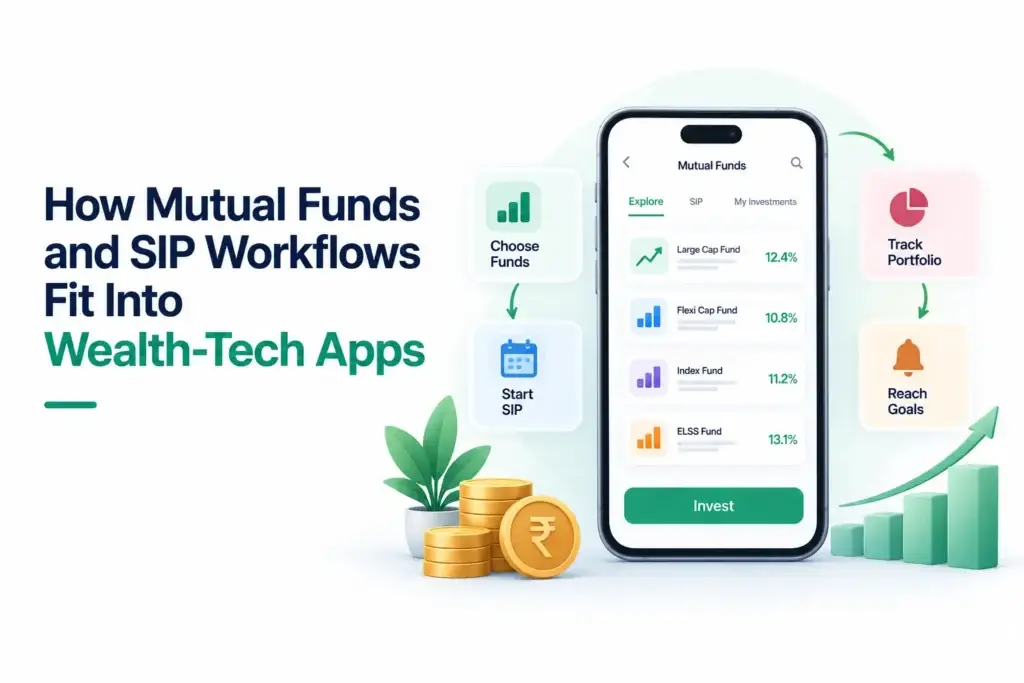
Mutual funds are usually a core part of long-term investing platforms because they support both one-time and recurring investments. Users may browse funds by category, risk profile, fund house, return history, expense ratio, minimum investment amount, and investment objective.
A mutual fund module may include:
- Fund catalog
- Fund categories
- Fund detail pages
- Risk indicators
- NAV data
- One-time investment flow
- SIP setup
- SIP pause, edit, or cancel options
- Redemption flow
- Goal linking
- Investment reminders
- Portfolio allocation
SIP workflows are especially important because they support recurring investment behavior. For founders, this can create stronger retention than one-time transactions because users return to monitor goals, check plan progress, and adjust contributions.
A strong wealth-tech product should treat SIP, transfer, and withdrawal workflows as structured financial journeys, not just form submissions.
How ETFs Work in a Multi-Asset Product
ETFs combine some characteristics of stocks and funds. They are traded on exchanges, but they usually represent a basket of assets such as an index, sector, commodity, or theme.
From a product design perspective, ETFs need discovery and trading workflows similar to stocks, but their explanation layer should feel closer to funds because users often compare them by index, category, expense, liquidity, and tracking behavior.
An ETF module may include:
- ETF search
- Exchange price
- Tracking index
- Category or theme
- Chart view
- Buy and sell flow
- Holdings visibility
- Cost and charge display
- Portfolio allocation
For founders, ETFs are useful because they can attract users who want diversified exposure without choosing individual stocks. But the platform must explain them clearly so first-time investors understand what they are buying.
Education and clarity can improve conversion more than simply adding more instruments.
How IPO Workflows Work Inside an Investing Platform
IPO access allows users to apply for newly offered shares during the subscription window. This module is different from regular stock trading because the user is not buying an already-listed stock through a normal market order.
An IPO workflow may include:
- Upcoming issue list
- Open issue list
- Company or issue details
- Price band
- Lot size
- Subscription dates
- Application form
- Payment or mandate flow
- Application status
- Allotment status
- Listing update
- Notification reminders
For founders, IPO workflows create engagement because they are event-driven. Users may open the app during subscription windows, track allotments, and follow listing dates.
However, IPO modules need careful status handling. Users should clearly understand whether an application is submitted, pending, accepted, rejected, allotted, or not allotted.
Portfolio Tracking: The Feature That Keeps Users Coming Back
Portfolio tracking is often the retention layer of a multi-asset investment platform. Users may transact occasionally, but they check performance frequently.
A good portfolio dashboard should show:
- Total invested value
- Current value
- Unrealized gain or loss
- Realized gain or loss
- Asset allocation
- Stock holdings
- Fund holdings
- ETF holdings
- Goal progress
- Sector exposure
- Returns over time
- Dividends or payouts where relevant
- Transaction history
- Tax-related summaries where applicable
For a multi-asset platform, portfolio tracking becomes complex because each instrument behaves differently. Stocks may move by live market price. Mutual funds update by NAV. IPOs may have application and allotment states before becoming holdings. ETFs behave like listed securities.
The platform must bring these different records into one understandable view.
A founder should treat portfolio tracking as more than a dashboard. It is the user’s financial memory inside the app.
Watchlists, Alerts, and Discovery Features
Not every user is ready to invest immediately. Many users first explore, compare, monitor, and learn. This is where watchlists, alerts, filters, and discovery flows matter.
Useful discovery features include:
- Trending instruments
- Top gainers and losers
- Popular funds
- New listings
- Upcoming IPOs
- ETF categories
- Sector filters
- Risk filters
- Goal-based suggestions
- Educational explainers
- Price alerts
- SIP reminders
- Portfolio movement alerts
These features improve engagement before and after transactions. A user may add a stock to a watchlist, compare funds, track an upcoming issue, or receive reminders before taking action.
For founders, discovery should be planned carefully. Too much information can overwhelm beginners, while too little information may not satisfy experienced investors.
The best product path is to create progressive depth: simple views for beginners and detailed views for advanced users.
KYC, Compliance Workflows, and Trust Controls
Investment platforms often need identity verification, account checks, document collection, audit trails, and role-based admin workflows depending on the target market and operating model.
If your fintech product needs regulated workflows, secure onboarding, transaction visibility, and compliance-ready architecture, Miracuves also offers fintech app development services.
Important trust and compliance-ready layers include:
- User verification
- KYC document upload
- Account type selection
- Risk profile fields
- Bank account verification
- Secure data storage
- Encrypted data transfer
- Audit logs
- Role-based access control
- Admin review desk
- Activity history
- Suspicious activity flags
- Support ticket records
Founders should avoid treating compliance as a final-stage task. KYC workflows, audit logs, and permission-based dashboards should be part of the platform foundation from the beginning.
Final compliance depends on jurisdiction, legal review, licensing, brokerage partnerships, payment providers, data handling practices, and the operating model.
This careful wording matters because fintech platforms cannot promise regulatory readiness without verifying the specific market and legal requirements.
Payment, Wallet, and Settlement Workflows
A digital investing product needs clear money movement. Users may deposit funds, place orders, set up recurring investments, withdraw balances, receive refunds, or track pending transactions.
Payment and wallet workflows may include:
- Add money
- Withdraw money
- Payment gateway integration
- Bank account connection
- Order-linked debit
- Refund handling
- Failed transaction status
- Brokerage and charge display
- Settlement records
- Ledger history
- Admin finance visibility
For founders, payment logic should be planned before development because it touches almost every financial action. A weak payment flow can create support tickets, user mistrust, and reconciliation problems.
Money movement should be transparent for users and traceable for operators.
Admin Dashboard: The Control Layer Founders Should Not Ignore
The admin dashboard is where the platform operator manages the product, users, support, reports, and operational workflows.
A strong admin console may support:
- User management
- KYC review
- Instrument catalog management
- Order visibility
- Payment records
- Refund tracking
- Support tickets
- Notification management
- Subscription plans
- Feature flags
- Reports and analytics
- Audit logs
- Role-based admin access
For fintech founders, admin control is critical because the platform must handle sensitive financial workflows. Business teams should not need developers for every support check, user review, plan update, report export, or operational adjustment.
Miracuves’ investment platform foundation includes web, mobile, API, operator console, KYC stack, audit logging, and multi-asset workflows that can be configured around selected launch scope. The money page also outlines source-code ownership and a 6-day deployment path for the ready-made package.
Monetization Options for a Multi-Asset Investing Platform
A multi-asset investing platform can use different revenue streams depending on licensing, partnerships, product coverage, and operating model.
Founders planning revenue logic can also review this wealth-tech business model to understand how brokerage, subscriptions, premium tools, distribution flows, and partner revenue can connect.
Common monetization options include:
| Revenue Stream | How It Works | Founder Consideration |
|---|---|---|
| Brokerage fees | The platform earns from eligible trading transactions | Needs clear fee display and accurate charge calculation |
| Subscription plans | Users pay for premium tools, analytics, or advanced access | Works when users see ongoing value |
| Distribution fees | Revenue may come from eligible financial product distribution where allowed | Depends on product type and regulation |
| Advisory or research tools | Users pay for research, insights, or premium analytics | Requires careful compliance and clear disclaimers |
| Partner products | The platform earns through approved financial partnerships | Must be transparent and compliant |
| Platform fees | Service or convenience fees may apply in some workflows | Should be clearly disclosed to users |
Founders should not design monetization as an afterthought. Brokerage, subscriptions, fund distribution, premium analytics, and partner workflows all affect platform design, reporting, and compliance review.
Cost Factors Founders Should Evaluate Before Building
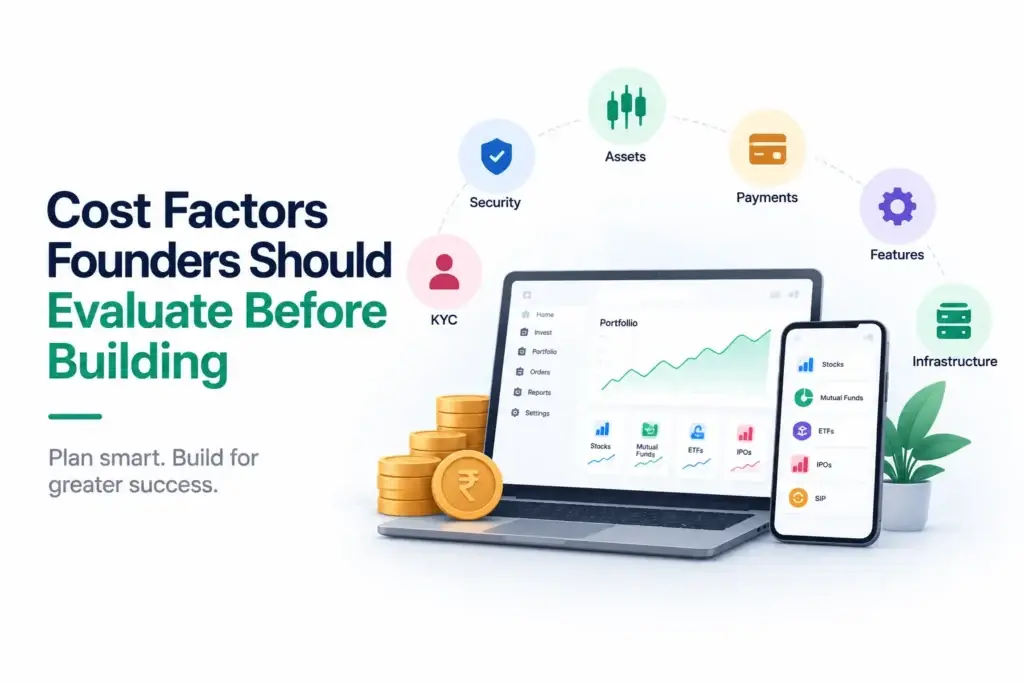
Development cost depends on scope. A simple finance app with educational content is very different from a full multi-asset trading and investment platform.
For scope and budgeting, founders can review this investment platform cost guide before finalizing asset coverage, integrations, KYC depth, admin features, and launch requirements.
Key cost drivers include:
- Number of asset classes
- KYC workflow depth
- Market data integration
- Brokerage or execution integration
- Payment gateway integration
- Portfolio calculation complexity
- SIP and recurring investment logic
- IPO workflow requirements
- Admin console depth
- Audit log requirements
- Mobile app and web coverage
- Security requirements
- Analytics and reporting
- Notifications and alerts
- Custom UI/UX
- Deployment and infrastructure needs
- Compliance-support workflows
A founder should not start with every possible feature. The better launch strategy is to define the first asset mix, first user segment, required integrations, and operational controls clearly.
Miracuves’ ready-made solution is listed as a one-time ready-made package with 6-day go-live where applicable, while enterprise or high-scale requirements depend on final custom scope.
Ready-Made Foundation vs Custom Development
Founders usually choose between a ready-made product foundation and fully custom development. Both options can work, but they solve different problems.
| Build Path | Best For | Founder Impact |
|---|---|---|
| Ready-made foundation | Founders who want faster market validation with existing investment workflows | Reduces time spent rebuilding standard onboarding, asset catalog, portfolio, KYC, and admin modules |
| Custom development | Businesses with highly specific brokerage, compliance, data, or enterprise workflows | Gives deeper flexibility but requires more time, budget, and planning |
| Hybrid approach | Founders who want speed with selected custom workflows | Starts with an existing base and customizes the most important business logic |
A ready-made foundation is useful when core investment workflows already match the launch vision. Custom development is stronger when the platform needs unique infrastructure, advanced integrations, or market-specific regulatory processes.
If your product requires a fully tailored build, Miracuves also offers custom mobile app development for unique fintech workflows.
Founder Decision Signals Before Launch
Asset Scope
If you cannot support every instrument from day one, start with the asset classes your target users understand and need most.
Compliance Readiness
If KYC, audit logs, permissions, and licensing dependencies are unclear, define them before adding advanced trading features.
Portfolio Depth
If users hold multiple instruments, portfolio tracking should be treated as a core retention feature, not a later add-on.
Launch Speed
If timing matters, a ready-made wealth-tech foundation can help you validate faster than building every standard workflow from zero.
Mistakes Founders Should Avoid
Launching Too Many Asset Classes Without Operational Readiness
More asset coverage sounds attractive, but every asset class adds data, order logic, portfolio rules, compliance checks, support needs, and reporting requirements.
Treating Portfolio Tracking as a Basic Dashboard
Portfolio tracking is where users understand returns, allocation, goals, and performance. Weak calculations can reduce trust quickly.
Ignoring KYC and Audit Workflows Early
Identity verification, audit trails, permission controls, and operator review flows are difficult to retrofit if the platform was not planned for them.
Depending Only on Brokerage Revenue
Brokerage can be cyclical. Founders should also evaluate subscriptions, premium tools, systematic plans, distribution partnerships, and long-term engagement models where legally suitable.
Where Miracuves Fits Into Investment Platform Launch Planning
Miracuves helps founders build ready-made and white-label investment platforms with source-code ownership, branded design, multi-asset workflows, KYC logic, portfolio tracking, admin control, and deployment support.
For founders, the advantage is practical. Instead of rebuilding standard wealth-tech modules from zero, they can start with a structured product foundation and focus on licensing, integrations, user acquisition, asset strategy, market positioning, and operational readiness.
If your next step is vendor evaluation, review how to choose an investment app development partner based on source-code ownership, deployment support, security planning, customization, and technical fit.
Where applicable, Miracuves supports 6-day deployment for ready-made investment platform solutions, depending on selected modules, branding, configuration, integrations, and final scope.
Final Thoughts
A multi-asset investment platform is not just a trading app with more product categories. It is a connected wealth-tech ecosystem where onboarding, KYC, stocks, mutual funds, ETFs, IPOs, payments, portfolio tracking, alerts, admin control, and compliance-support workflows need to work together.
For founders, the strongest launch decision is not always to add every asset class from day one. It is to choose the right first asset mix, build trust, simplify investing journeys, control operational risk, and expand once the platform is ready.
Miracuves helps founders move faster with ready-made, white-label, source-code-owned fintech platforms designed for practical execution, admin control, and faster validation.
FAQs
What is a multi-asset investment platform?
A multi-asset investment platform is a digital app or web platform that allows users to access multiple investment products such as stocks, mutual funds, ETFs, IPOs, systematic plans, and portfolio tracking from one account.
How do stocks work inside an investment app?
A stock module usually includes market data, stock search, watchlists, buy and sell order flows, charge calculation, order status, holdings, transaction history, and portfolio performance tracking.
How do mutual funds and SIPs work in a wealth-tech app?
A mutual fund module allows users to browse funds, compare categories, make one-time investments, set up recurring SIPs, track goals, monitor NAV-based performance, and redeem investments where supported.
How are ETFs different from mutual funds in an app?
ETFs are usually traded like listed securities, while mutual funds are typically managed through fund investment and redemption workflows. In a platform, ETFs often need trading screens, price charts, holdings, and portfolio allocation views.
What does an IPO module include?
An IPO module may include upcoming issues, open applications, issue details, lot size, price band, application flow, payment status, allotment status, listing updates, and user notifications.
Why is portfolio tracking important?
Portfolio tracking helps users understand total holdings, returns, allocation, gains, losses, goal progress, and asset-wise performance. It is one of the most important retention features in a wealth-tech platform.
What should founders consider before building an investment platform?
Founders should evaluate asset classes, KYC requirements, market data, execution integrations, payment flows, portfolio calculations, admin controls, audit logs, security, licensing dependencies, and launch scope.
Can Miracuves help launch a multi-asset investment platform faster?
Yes. Miracuves helps founders launch ready-made and white-label investment platforms with source-code ownership, branded design, multi-asset workflows, admin control, and 6-day deployment where applicable.
Miracuves is an independent software development company. We are not affiliated with, connected to, sponsored by, or endorsed by any company or product named in this article.
Terms such as “X Clone” are used descriptively. It is how the software industry refers to building a platform with functionality comparable to a known service, and how clients search for it.
The entire design and codebase of our products is built by our own team. Our products contain no code, design, graphics, or content originating from any third-party website or applications.
All third-party names and marks referenced in this article are the property of their respective owners, referenced solely to identify the services discussed.