


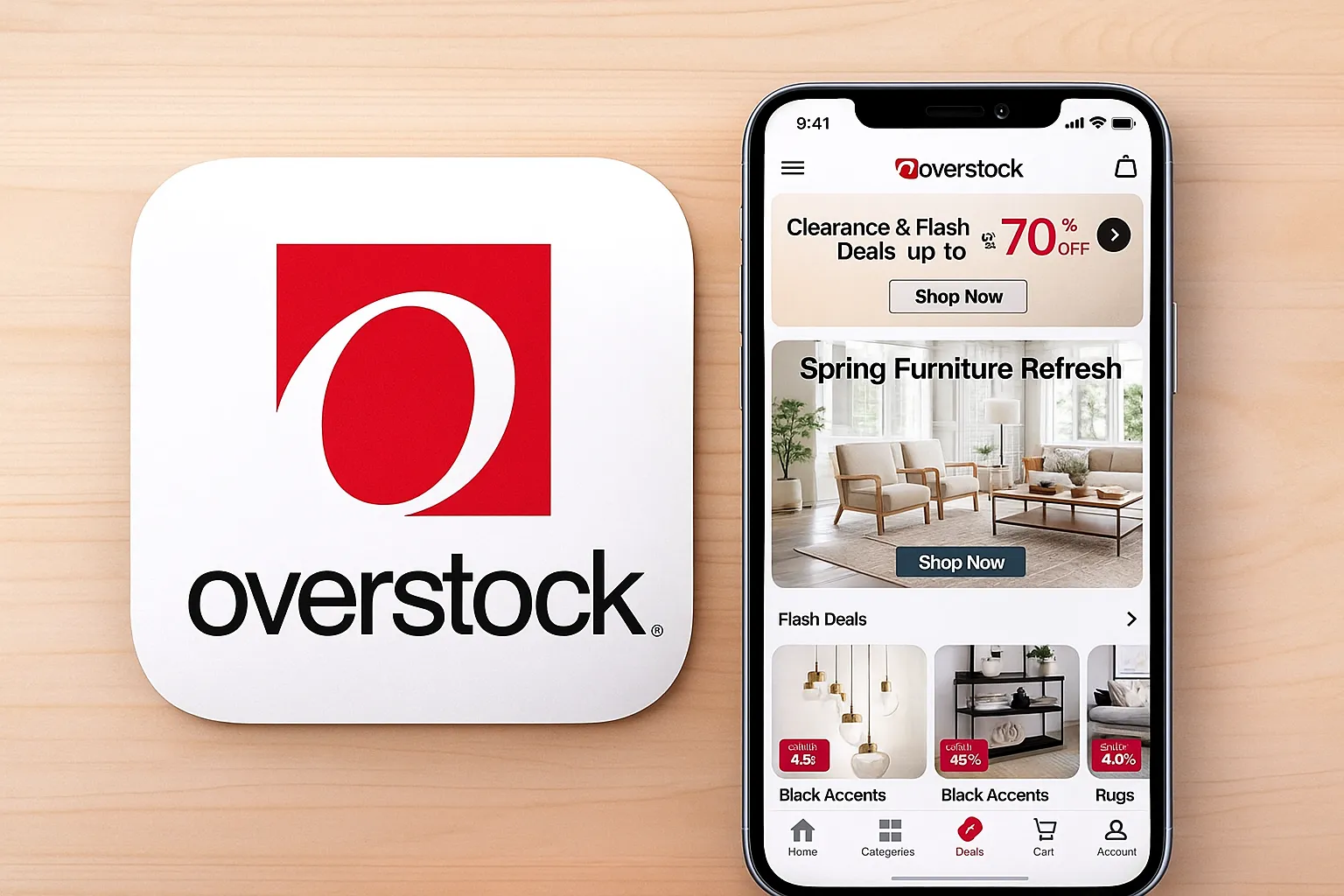
Imagine you’re searching for high-quality home furniture, décor, or electronics—but at prices far lower than big retail chains. You open Overstock, and instantly you’re browsing thousands of discounted, name-brand products shipped right to your door. That’s the core magic of Overstock: luxury + affordability without the retail markup.
Launched in 1999, Overstock began as an online marketplace selling surplus and returned merchandise from major retailers. Over the years, it transformed into a full-scale US ecommerce marketplace offering home goods, furniture, bedding, décor, and lifestyle items at discounted prices. As of 2025, Overstock remains one of America’s most recognized online home-product destinations with millions of loyal shoppers.
What Is Overstock? The Simple Explanation
Overstock is a US-based online marketplace where people can buy discounted furniture, home décor, bedding, kitchenware, and lifestyle products. It focuses on offering high-quality goods at lower prices by sourcing overstocked, surplus, and new items directly from brands and suppliers.
Core Problem It Solves:
Retail stores often have excess inventory that goes unsold. Shoppers, on the other hand, want premium products but not premium pricing. Overstock connects the two — helping brands liquidate extra stock while giving shoppers access to big discounts.
Target Users & Use Cases:
- Homeowners furnishing or redecorating
- Students buying affordable furniture
- Bargain hunters looking for premium décor
- Families buying mattresses & home essentials
- Brands needing a channel to clear inventory
Current Market Position (2025 Stats):
- Estimated 43M+ yearly visitors
- Strong presence in the US home & lifestyle ecommerce market
- Competes with Wayfair, Amazon Home, and Walmart Home
- Revenue powered primarily by home and furniture categories
- Significant loyalty base through Club O rewards
Why It Became Successful:
- Deep discounts and attractive deals
- High product variety
- Trustworthy marketplace with strong return policies
- Smooth shopping experience and user-friendly interface
- Efficient logistics and supplier partnerships
Read more: What is Wayfair and How Does It Work?
How Does Overstock Work? Step-by-Step Breakdown
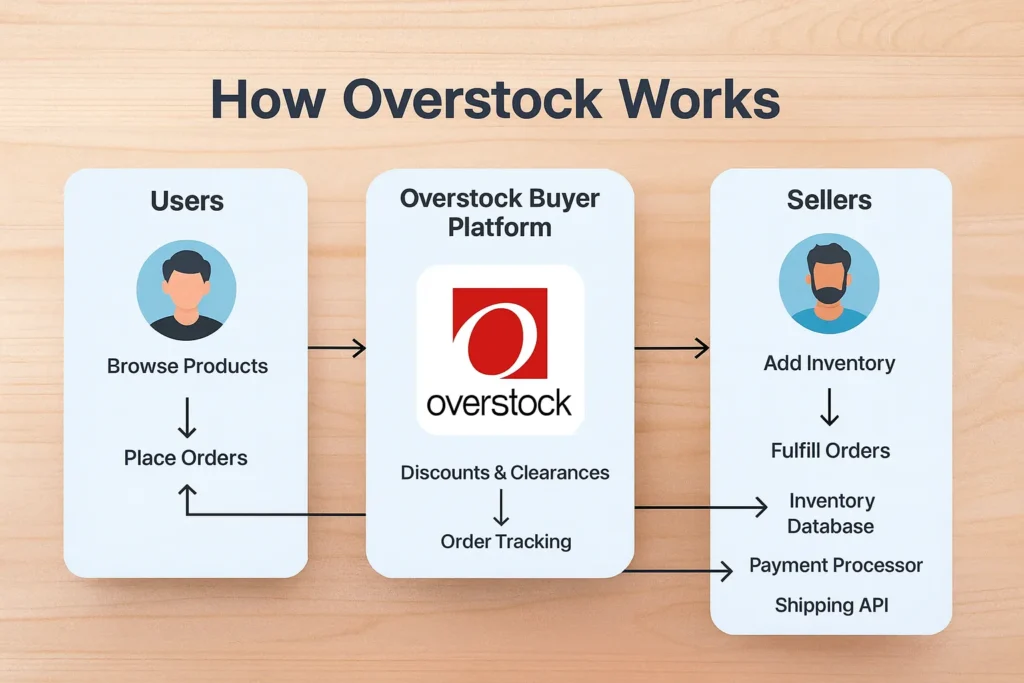
Overstock operates like a modern online marketplace where users browse thousands of products, compare deals, place orders, and get doorstep delivery. Here’s the simplified breakdown for 2025:
For Users (Shoppers)
1. Account Creation
- Sign up using email, Google, or Apple ID
- Set delivery address and preferred payment method
- Optionally join Club O for extra cashback and rewards
2. Main Features Walkthrough
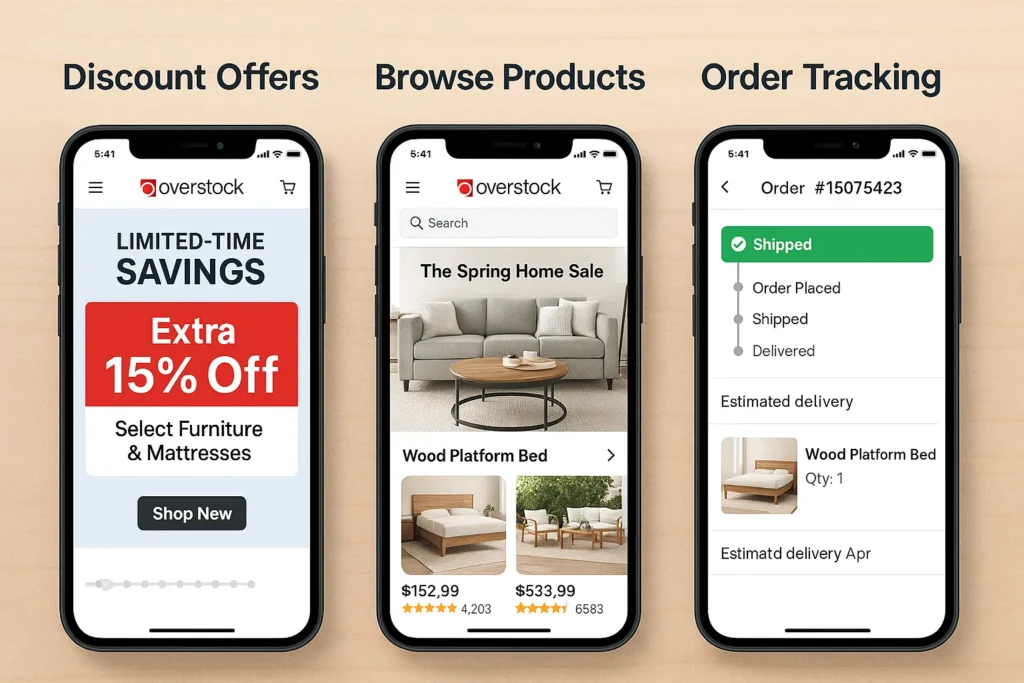
- Search & Filters: Browse by room, style, category, or price
- Deals & Discounts: Clearance, flash sales, weekend offers
- Product Comparison: Ratings, reviews, Q&A, dimensions
- Wishlist: Save items for later
- Order Tracking: Real-time shipping updates
- Customer Support: Chat, email, and return assistance
3. Typical User Journey (Example)
Emma, a new homeowner, wants to decorate her living room affordably.
She opens the Overstock app → types “sectional sofa” → applies filters (under $800, modern style, fast shipping) → finds a top-rated item → checks dimensions + reviews → adds to cart → pays using credit card → receives tracking updates → gets delivery in 3–5 days.
For Sellers / Brands (If Applicable)
Although Overstock is not a fully open marketplace like Amazon, it partners with select brands and suppliers.
1. Onboarding Process
- Supplier applies to join the vendor program
- Product catalog uploaded with images & pricing
- Overstock team reviews and approves listings
2. How They Operate
- Sellers ship from their warehouses OR via Overstock fulfillment partners
- Overstock manages customer service and returns
- Sellers maintain stock availability and performance metrics
3. Earnings / Commission Structure
- Commission: Usually 10–20% depending on category
- No listing fees
- Sellers get paid after order delivery
- Access to Overstock’s marketing promotions (optional cost)
Technical Overview (Simple Explanation)
Basic Architecture
Overstock follows a three-layer structure:
- Frontend: The app + website users see
- Backend: Manages inventory, payments, orders
- Database Layer: Stores product, user, and order data
Key Technologies Used (Simplified)
- Modern web frameworks (React/Next.js) for fast UI
- Cloud hosting (AWS/Google Cloud)
- Secure payment processing
- Recommendation engine for personalized browsing
- AI-assisted search and categorization
Overstock’s Business Model Explained
Overstock runs a streamlined ecommerce business model combining marketplace partnerships, direct retail, and customer loyalty programs. Here’s how it makes money in 2025:
1. Primary Revenue Streams
a) Product Sales (Core Revenue)
Overstock earns profit from selling discounted furniture, bedding, home appliances, and décor.
It purchases surplus/overstock inventory at reduced wholesale prices and sells it at retail margins.
b) Marketplace Commissions
For partnered brands and suppliers, Overstock charges a 10–20% commission depending on category.
This includes:
- Home furniture
- Bedding & mattresses
- Kitchen & décor items
c) Advertising Revenue
Brands can pay for:
- Featured placement
- Homepage banners
- Sponsored product listings
- Seasonal promotion spots
d) Club O Membership (Loyalty Program)
Users pay an annual subscription (~$20–$30/year) to receive:
- 5% cashback
- Exclusive deals
- Free returns on select items
This creates a steady subscription income.
e) Shipping & Logistics Fees
Although many items are shipped free, some oversized furniture items include additional delivery charges.
2. Pricing Structure (2025)
Typical discount ranges available on Overstock:
- Furniture: 20–60% off
- Home Décor: 15–50% off
- Mattresses: 20–40% off
- Electronics: 10–30% off
Sellers do not pay listing fees — only commission after successful sales.
3. Market Size & Growth Stats (2025)
- US eCommerce home goods market → $164B+ valuation
- Online furniture is growing at 11% CAGR
- Overstock ranks among the top US platforms for home goods alongside Wayfair & Amazon Home
- Over 43M+ annual shoppers browse Overstock for deals
4. Profit Margins Insights
Overstock maintains stable margins due to:
- Low acquisition costs (buying surplus inventory)
- Minimum warehouse overhead (drop-ship partnerships)
- High-volume seasonal sales (Black Friday, Memorial Day, etc.)
- Membership-driven loyalty
Revenue Model Breakdown Table
| Revenue Stream | Description | % Contribution (Approx.) |
| Product Sales | Profit from buying wholesale & selling retail | 55–60% |
| Marketplace Commissions | 10–20% commission on partner sales | 20–25% |
| Advertising | Sponsored products, banners | 10–15% |
| Club O Membership | Paid loyalty subscription | 5–7% |
| Shipping Fees | Delivery charges for select items | 3–5% |
Read more: Wayfair Business Model Explained: Key Revenue Streams and Future Trends
Key Features That Make Overstock Successful
Overstock’s success comes from a combination of smart merchandising, a clean user experience, and technology-driven personalization. Here are the 10 most important features that power its growth in 2025:
Top 10 Features Analysis
1. Deep Discounts & Clearance Deals
Why it matters: Users come to Overstock primarily for savings.
Benefit: Shoppers get premium-quality home products at significantly lower prices.
Tech angle: Automated pricing engines detect high-demand items and optimize discount levels.
2. Advanced Search & Smart Filters
Why it matters: Furniture shopping requires specific dimensions, styles, and colors.
Benefit: Users quickly find products that match their room layout or décor style.
Tech angle: AI-powered search ranking + NLP category tagging.
3. Detailed Product Pages
Why it matters: Buying furniture online requires trust.
Benefit: Users see dimensions, materials, reviews, Q&A, and assembly details.
Tech angle: Enhanced PDP templates with dynamic content loading.
4. Personalized Recommendations
Why it matters: Customers often browse multiple items before deciding.
Benefit: Increased conversions through relevant suggestions.
Tech angle: ML-based recommendation engine based on browsing & purchase history.
5. Club O Rewards Program
Why it matters: Loyalty = repeat purchases.
Benefit: 5% cashback, free returns, exclusive offers.
Tech angle: Automated cashback wallet + usage tracking.
6. Augmented Reality (AR) Product Preview
Why it matters: Users want to visualize furniture in their room.
Benefit: Helps buyers check fit, color, and placement before ordering.
Tech angle: AR integration using device camera + product 3D models.
7. Fast & Transparent Shipping
Why it matters: Large furniture pieces require careful logistics.
Benefit: Real-time tracking, estimated delivery windows, and shipping alerts.
Tech angle: Carrier API integrations + automated status updates.
8. Customer Reviews & Q&A
Why it matters: Reviews drive trust and purchase confidence.
Benefit: Users can evaluate quality, durability, and real customer experiences.
Tech angle: Moderation AI + verified purchase tagging.
9. Easy Returns Process
Why it matters: Furniture returns can be stressful.
Benefit: Clear return policies and a smooth refund workflow.
Tech angle: Automated RMA system integrated with seller dashboards.
10. Mobile App Experience
Why it matters: A large percentage of US shoppers buy via mobile.
Benefit: Faster checkout, saved preferences, push notifications for deals.
Tech angle: Lightweight architecture for quick load times + caching layers.
Recent 2025 Updates & Features
- Improved AR visualization for furniture
- AI-powered style matcher: Recommends items to match user’s room aesthetic
- Eco-friendly filters: Shop sustainable & recycled products
- Enhanced 360° product view
- Smarter price-drop alerts and notification personalization
AI/ML Integrations (2025)
- Personalized home-style suggestions
- Automated discount optimization
- Fraud detection for seller operations
- Trend forecasting for seasonal sales
What Sets Overstock Apart
- Premium home products at significant discounts
- Strong focus on furniture & décor categories
- Trust-based shopping experience
- Smooth logistics + RMA workflows
- High accuracy in product recommendations
The Technology Behind Overstock
Overstock may look like a simple ecommerce app on the surface, but behind the scenes it operates on a modern, scalable tech ecosystem built to handle millions of users, massive product catalogs, and complex logistics every day.
1. Tech Stack Overview (Simplified)
While Overstock doesn’t publicly reveal every technology used, based on industry standards and known engineering patterns, its 2025 tech foundation includes:
Frontend Technologies
- React / Next.js for fast, SEO-friendly web pages
- Flutter / Swift / Kotlin for mobile apps
- Responsive UI frameworks for consistent experience across devices
Backend Technologies
- Node.js + Java / .NET services for modular backend operations
- Microservices architecture enabling independent feature scaling
- REST + GraphQL APIs for flexible data usage across devices
Databases
- PostgreSQL / MySQL for structured inventory & user data
- Elasticsearch for fast product search
- Redis for caching and speeding up page loads
Cloud & Infrastructure
- Deployed on AWS / Google Cloud
- Auto-scaling servers to handle peak seasons
- CDN delivery for ultra-fast content loading worldwide
2. Real-Time Features Explanation
Overstock uses real-time systems to ensure shoppers always see accurate pricing, inventory levels, and delivery timelines.
Examples of real-time components:
- Inventory Sync: Live stock updates across warehouses
- Order Tracking: Instant status updates through carrier APIs
- Price Drop Alerts: Automated notifications when an item’s price changes
- Flash Sale Timers: Real-time countdown and deal expiry
These real-time features greatly improve the shopping experience.
3. Data Handling & Privacy
Overstock adheres to strict US and global ecommerce compliance:
- Encrypted user data
- PCI-DSS compliant payment processing
- Secure authentication (OAuth, multi-factor)
- GDPR & CCPA compliance for data privacy
- Fraud detection algorithms to prevent abusive activity
User trust is a high priority, especially for big-ticket furniture purchases.
4. Scalability Approach
Overstock scales easily due to:
- Microservices that allow each feature (search, cart, checkout) to scale independently
- Load balancers to manage heavy traffic during peak seasons (Black Friday, Cyber Monday)
- Cloud auto-scaling to provision more resources instantly
- Database sharding to support millions of products and buyers
This prevents downtime and ensures high-speed performance.
5. Mobile App vs Web Platform
Mobile App
- Offers faster search and checkout
- Push notifications for deals
- Better personalization and AR capabilities
- Optimized for product display
Web Platform
- Broader navigation for complex furniture browsing
- Richer product comparison and review features
- More stable for large-screen usage (interior planning, room setups)
Both platforms sync via unified APIs.
6. API Integrations
Overstock integrates with several systems:
- Payment gateways: Stripe, PayPal, Apple Pay, credit cards
- Shipping carriers: UPS, FedEx, USPS
- Inventory vendors: Supplier-side ERP integrations
- Marketing tools: Email automation, retargeting pixels
- AI tools: Recommendation engines, personalization APIs
These integrations help Overstock operate as a fully automated ecommerce ecosystem.
7. Why This Tech Matters for Business
A strong tech foundation enables Overstock to:
- Load fast (higher conversions)
- Maintain stable inventory accuracy
- Support millions of monthly visitors
- Offer rich visuals like AR and 360° product views
- Personalize every user’s shopping journey
- Scale globally without downtime
This technology backbone is a major reason Overstock remains competitive in 2025.
Overstock’s Impact & Market Opportunity
Overstock has played a major role in shaping the US online home retail industry. Its blend of affordability, product quality, and smooth shopping experience makes it a top destination for smart shoppers—especially in the competitive home & furniture category.
1. Industry Disruption Caused by Overstock
Overstock disrupted traditional retail by:
- Offering brand-new, high-quality home products at deep discounts
- Helping brands liquidate excess inventory faster than offline channels
- Popularizing the “affordable luxury” ecommerce model
- Scaling furniture and décor shopping online when most users still preferred in-store purchases
This created a new category: discounted ecommerce for premium home goods.
2. Market Statistics & Growth (2025)
Here are the most relevant insights for this year:
- US home & furniture ecommerce market size: $164B+
- Expected CAGR through 2028: 11–13%
- Overstock ranks in the Top 5 US home retail platforms, competing with Wayfair, Amazon Home, and Walmart Home
- Over 43 million yearly shoppers browse Overstock
- Average cart value in home goods ecommerce: $180–$350
3. User Demographics & Behavior
Typical Overstock users:
- Age: 25–55
- Gender: Balanced (slightly higher female shopper percentage)
- Lifestyle: Homeowners, renters, families, interior décor enthusiasts
- Behavior:
- Value-driven
- Seeks quality + affordability
- Prefers reviews, AR visualization, and product comparison
- High return customers due to loyalty rewards
4. Geographic Presence
- Primarily serves United States
- Strongest presence in suburban regions and homeownership-focused states
- Offers delivery to all 50 states, including large furniture shipping options
5. Future Projections (2025–2030)
- Home ecommerce expected to reach $250B+ by 2030
- AR integration will become mainstream for furniture shopping
- AI-powered style & room-planning tools will drive personalization
- Overstock likely to expand partnerships with more direct-to-consumer brands
- Discount-driven ecommerce is predicted to accelerate during economic slowdowns
6. Opportunities for Entrepreneurs
The success of Overstock shows massive potential in:
- Vertical-focused marketplaces (e.g., only furniture, décor, or bedding)
- Discount ecommerce models
- AR-enabled home shopping
- B2B liquidation marketplaces
- Niche home interior segments
Natural Transition:
This massive success is exactly why many entrepreneurs today want to create Overstock-like ecommerce platforms—because the demand for affordable, stylish home products continues to rise every year.
Building Your Own Overstock-Like Platform
Overstock’s long-term success proves one thing clearly: affordable, well-designed home products will always have massive demand. That’s why many entrepreneurs, retailers, and D2C brands today want to build their own Overstock-style marketplace—either for a niche vertical or for the complete home category.
1. Why Businesses Want Overstock Clones
- High demand, low competition: Furniture & décor ecommerce still has room for new players
- Strong margins: Home goods have some of the highest retail markups
- Repeat purchase behavior: Home décor, bedding, kitchenware = recurring orders
- Brand partnerships: Easy onboarding for suppliers with surplus inventory
- Chance to build a niche: Rustic décor, modern minimalism, mattress-only, etc.
- Fast scalability: With a solid tech base, inventory & sellers can grow quickly
2. Key Considerations Before Development
To build a successful Overstock-like platform, founders should evaluate:
a) Inventory Strategy
- Will you sell your own products?
- Will you onboard external sellers?
- Hybrid model (Overstock’s approach) works best.
b) Category Selection
Choose focus areas:
- Furniture
- Home décor
- Bedding
- Kitchen
- Lighting
- Rugs
c) User Experience
- High-quality product pages
- AR furniture preview
- Seamless checkout
- Easy returns
d) Logistics & Fulfillment
- Direct shipping from suppliers
- 3PL partnerships
- Clear delivery timelines for large items
e) Pricing & Discounts
Discount model must be transparent and data-driven.
f) Technology & Features
Must include:
- Smart filters
- AR preview
- Personalized recommendations
- Real-time inventory
- Reviews & Q&A
- Loyalty system
Cost Factors & Pricing Breakdown
Overstock-Like App Development — Market Price
| Development Level | Inclusions | Estimated Market Price (USD) |
| Basic Marketplace MVP | Product listings, buyer/seller roles, simple checkout | $50,000 |
| Mid-Level Marketplace | Seller dashboards, mobile apps, payments/shipping integrations | $200,000 |
| Advanced Marketplace | High concurrency backend, multi-warehouse logistics, advanced catalog management, native mobile apps | $250,000+ |
Miracuves Overstock-Style Marketplace Pricing
Miracuves Price: Starts at $2,899
This solution is built with robust frameworks — Web using PHP & MySQL, and Apps using Flutter, optimized for performance, stability, smooth product browsing, and multi-vendor ecommerce operations.
Note: This includes full non-encrypted source code, complete deployment support, backend setup, admin panel configuration, and publishing on the Google Play Store and Apple App Store—ensuring you receive a fully operational ecommerce marketplace ready for launch and future expansion.
Delivery Timeline for Overstock
Deployment is extremely fast — 3–9 days, since the solution is already fully developed and only requires branding, configuration, and server setup.
Tech Stack
This solution is built with robust frameworks — Web using PHP, MySQL & Apps using Flutter, optimized for performance, stability, and easy maintenance. Other tech stacks can be discussed and arranged upon request — Contact us
Essential Features to Include
Your Overstock-like marketplace must have:
- Multi-category product catalog
- Smart search + AI filters
- High-quality images + AR visualization
- Real-time inventory system
- Supplier onboarding
- Ratings, reviews, Q&A
- Advanced deals/discount engine
- Delivery + tracking system
- Wallet and loyalty rewards
- Secure payment gateway integration
Conclusion
Overstock has transformed the way Americans shop for home goods—bringing together affordability, quality, and convenience in one smooth ecommerce experience. Its success is driven by smart sourcing (surplus and overstock inventory), efficient logistics, powerful personalization, and a customer-first shopping flow that keeps users coming back.
In 2025, Overstock continues to stand out as a trusted marketplace for furniture, décor, bedding, and lifestyle essentials. Its journey proves that a well-executed niche marketplace—built around value, usability, and technology—can thrive even in a crowded ecommerce landscape.
For entrepreneurs, this presents a huge opportunity. With the right combination of product strategy, logistics, and a robust tech stack, building an Overstock-like platform is not only achievable but also highly profitable. Whether you want to target a niche décor category or launch a full-scale home marketplace, the model is proven, scalable, and in high demand.
FAQs
Q:1 How does Overstock make money?
Overstock makes money through product sales, marketplace commissions, advertising, shipping fees, and its Club O loyalty membership program.
Q:2 Is Overstock available in my country?
Overstock primarily serves the United States, delivering to all 50 states. International shipping is limited and depends on product eligibility.
Q:3 How much does Overstock charge users?
Overstock does not charge users to browse or shop. Prices vary by product category, and some oversized items may include delivery fees.
Q:4 What’s the commission for sellers on Overstock?
Sellers typically pay a 10–20% commission, depending on the product category and listing arrangement.
Q:5 How does Overstock ensure safety?
Overstock uses secure payment processing (PCI-DSS compliant), encrypted user data, fraud-detection AI, and strict seller verification to ensure buyer safety.
Q:6 Can I build something similar to Overstock?
Yes. Many entrepreneurs build Overstock-style marketplaces using ready-made clone scripts and customizable ecommerce platforms.
Q:7 What makes Overstock different from competitors?
Overstock focuses heavily on discounted home goods, offering premium furniture & décor at lower prices with strong customer loyalty via Club O rewards.
Q:8 How many users does Overstock have?
Overstock receives 43M+ yearly shoppers, making it one of the top online home goods marketplaces in the United States.
Q:9 What technology does Overstock use?
Overstock runs on a modern stack including React/Next.js, microservices, cloud hosting, real-time inventory systems, AI recommendations, and AR visualization tools.
Q:10 How can I create an app like Overstock?
You can create an Overstock-like app using a prebuilt marketplace solution or a customizable clone script that includes inventory management, AR features, reviews, and supplier onboarding.
Related Articles: