


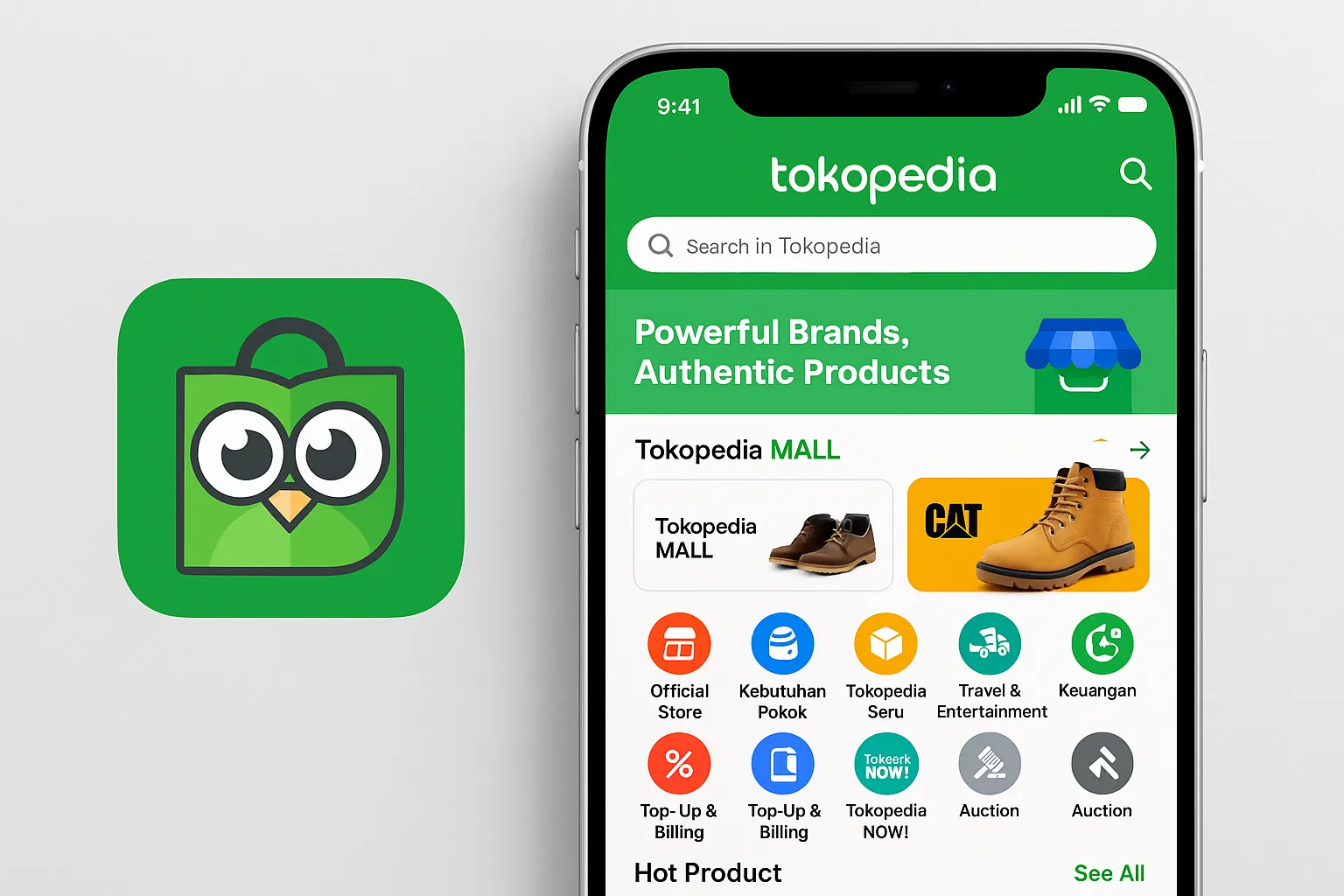
Imagine you’re in a small town in Indonesia — maybe a remote island or a rural district. You want a new smartphone, some clothing, or even a local handicraft from hundreds of kilometers away. Instead of traveling day-long, you just open an app, search, click “Buy”, and the product arrives at your doorstep in a few days. That’s the kind of convenience and access that Tokopedia delivers for millions across Indonesia.
Tokopedia was founded on February 6, 2009 by two young entrepreneurs: William Tanuwijaya and Leontinus Alpha Edison. What began as a humble consumer-to-consumer (C2C) marketplace aiming to connect buyers and sellers online has grown into one of Indonesia’s largest—and most influential—e-commerce platforms. As of 2025, Tokopedia serves tens of millions of users across the archipelago, supports millions of merchants, and helps democratize commerce in a country spread over thousands of islands.
What is Tokopedia? The Simple Explanation
Tokopedia is one of Indonesia’s largest online marketplaces — a platform where anyone can buy or sell almost anything, from electronics and fashion to household items, groceries, digital products, and services. Think of it as a digital shopping mall that connects millions of buyers with millions of independent sellers across Indonesia, all through one easy-to-use app.
Core Problem It Solves
Indonesia is made up of 17,000+ islands. Traditional retail access is uneven, logistics are complex, and many small businesses struggle to reach customers. Tokopedia solves this by giving sellers an instant online storefront and giving buyers access to nationwide product availability at competitive prices.
Target Users & Use Cases
Who uses Tokopedia?
- Everyday shoppers looking for affordable products
- Small merchants & home-based sellers seeking online visibility
- Brands & official stores (Tokopedia Mall) wanting nationwide reach
- Students & digital consumers buying phone credit, game vouchers, tickets, bills, etc.
- Local SMEs expanding beyond regional limits
Use-cases:
- Buying electronics, fashion, groceries
- Paying bills & purchasing digital services
- Shopping from official brand stores
- Selling products without technical knowledge
Current Market Position (2025)
- Over 100+ million monthly active users
- 12+ million merchants on the platform
- Part of the GoTo Group, Indonesia’s tech giant formed by the Gojek–Tokopedia merger
- One of the top e-commerce platforms in Indonesia alongside Shopee & Lazada
- High adoption in Tier-1, Tier-2, and emerging Tier-3 cities
Why It Became Successful
- Zero-barrier merchant onboarding
- Strong logistics solutions through GoTo’s ecosystem
- Trusted payments via GoPay & Tokopedia’s secure payment gateway
- Massive product variety and competitive pricing
- Strong digital services segment (airtime, bills, game credits, travel)
- Aggressive promotions and seasonal mega-sales
Read more: Building an Ecommerce App: A Comparative Guide for Startups and Enterprises
How Does Tokopedia Work? Step-by-Step Breakdown
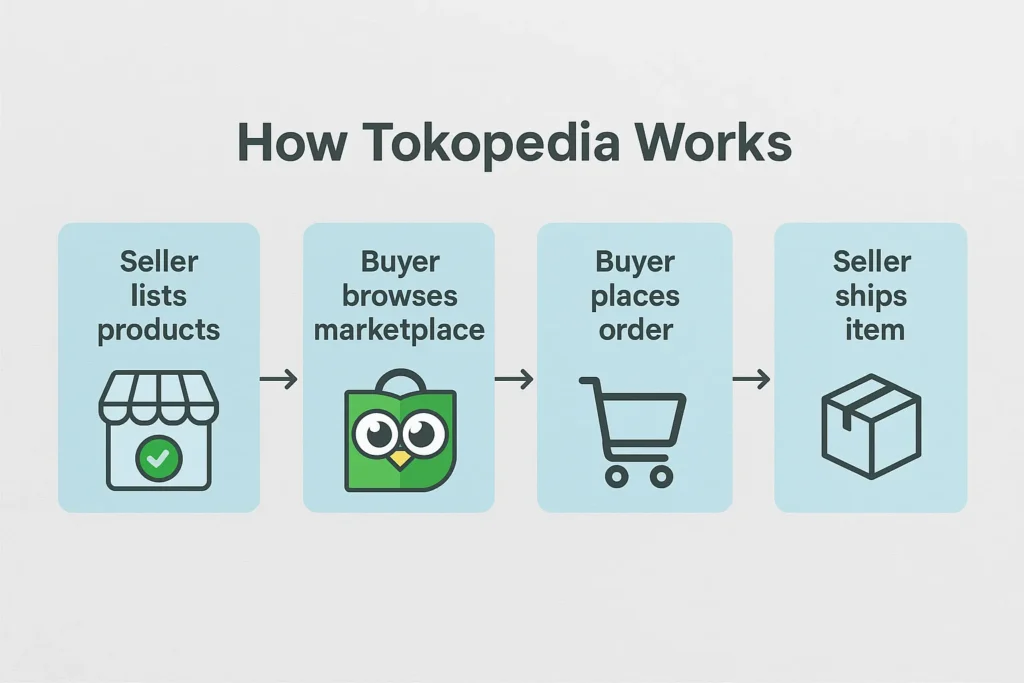
Tokopedia’s workflow is designed to make buying and selling extremely simple. It connects buyers, sellers, logistics, and payments into one seamless ecosystem.
For Users (Buyers)
1. Account Creation
- Download the Tokopedia app (Android/iOS) or use the website
- Sign up using phone number, email, or Google account
- Add address & preferred payment method (GoPay, bank transfer, COD, etc.)
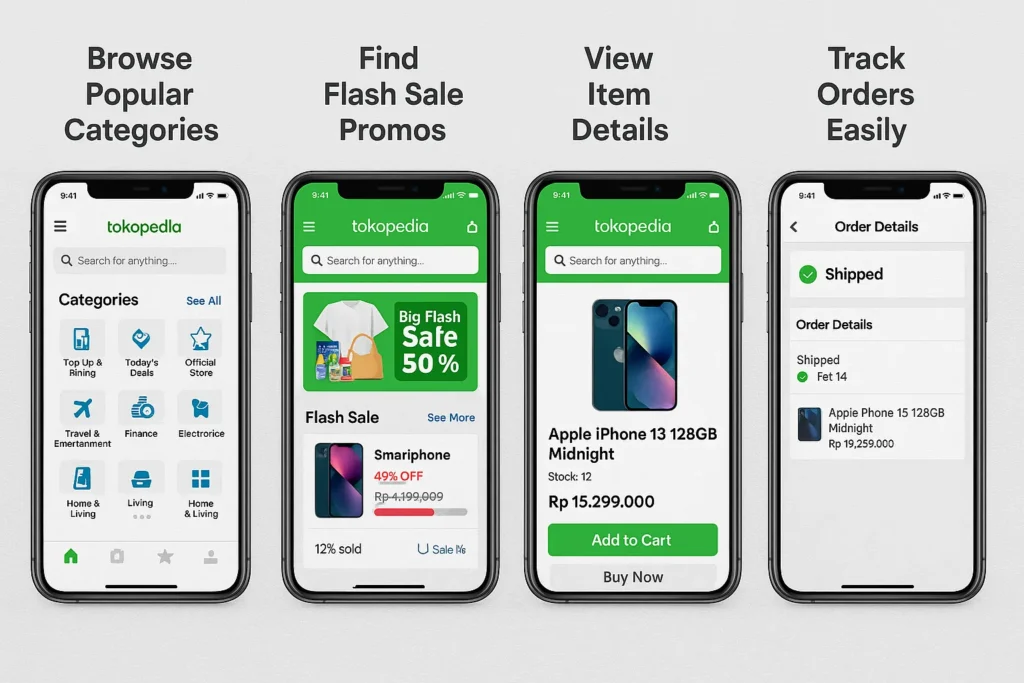
2. Browsing & Searching
Users can:
- Search products using keywords
- Browse categories
- Explore Tokopedia Mall (official brand stores)
- Check ratings, reviews, seller reputation, return policy
3. Placing an Order
- Add product to cart
- Check delivery time & courier options
- Choose payment method: GoPay, bank transfer, credit card, PayLater, COD
- Place order and track it in real-time
4. Delivery & Tracking
Tokopedia integrates with multiple logistics partners and GoTo’s own network.
Buyers receive:
- Live shipment updates
- Delivery ETA
- Notifications at each stage
5. After-Sales
- 7-day return/refund on eligible items
- Chat with sellers
- Rate & review products
A typical user journey looks like this:
Search → Compare → Add to Cart → Checkout → Live Tracking → Delivery → Review
For Sellers (Merchants)
1. Easy Onboarding
Any individual or business can open a store:
- Upload ID (for individuals) or business docs (for brands)
- Add products with photos, descriptions, pricing
- Set shipping options
2. Operating on Platform
Merchants get:
- Store dashboard
- Sales analytics
- Promotional tools (discounts, cashback, campaigns)
- Chat support
- Order management & fulfillment tools
3. Earnings & Fees
- Tokopedia charges a commission fee (varies by category: ~1–5%)
- Additional platform fees for Tokopedia Mall sellers
- Payouts sent to seller’s bank account or GoPay merchant account
Sellers can join major events (11.11, 12.12, Ramadhan Sale) for huge traffic boosts.
Technical Overview (Simple)
1. Platform Architecture
Tokopedia operates as a multi-vendor marketplace, meaning:
- Sellers upload and manage their own products
- Buyers choose from multiple sellers
- Tokopedia handles the marketplace rules, payments, and logistics coordination
2. Key Technologies Used
(Generalized based on modern e-commerce architecture)
- Frontend: React/Next.js for fast, responsive UI
- Backend: Microservices (Java, Go, Node.js)
- Database: Distributed SQL/NoSQL
- Caching: Redis, CDN layers
- AI/ML: Search ranking, recommendations, fraud detection
- Payments: Secure API integrations with GoPay and banks
- Cloud Infrastructure: Auto-scaling distributed systems
3. How It All Works Together
- User searches a product
- Search engine fetches relevant listings
- Buyer chooses a seller
- Checkout triggers payment gateway
- Order forwarded to seller
- Seller prepares item
- Logistics partner picks & delivers
- Payment released to seller after delivery completion
Tokopedia’s Business Model Explained
Tokopedia follows a multi-revenue marketplace model, meaning it earns from several different income streams instead of relying on just commissions. This diversification is one of the reasons the platform remains profitable and sustainable within Indonesia’s competitive e-commerce landscape.
1. How Tokopedia Makes Money (All Revenue Streams)
✔ Commission Fees
Tokopedia charges sellers a small commission depending on:
- Product category
- Seller type (Regular vs. Tokopedia Mall)
Typical range: 1%–5%
Premium categories and official brand stores have higher rates.
✔ Platform Fees (Tokopedia Mall)
Brands joining Tokopedia Mall pay:
- Higher commission
- Additional service fees
- Participation fees for campaign slots
This tier includes official stores like Samsung, Unilever, Xiaomi, etc.
✔ Advertising & Sponsored Listings
Merchants can pay for:
- Sponsored ads
- Product boosts
- Store visibility promotions
- Search placement ads
Advertising is one of Tokopedia’s largest revenue generators.
✔ Fintech Services (GoTo Ecosystem)
As part of GoTo, Tokopedia integrates:
- GoPay & GoPayLater
- Bank transfers and digital wallets
- PayLater interest
- Payment processing fees
Fintech revenue is a big and fast-growing segment.
✔ Logistics & Fulfillment Services
Earnings through:
- Courier partner fees
- Warehousing & fulfillment support
- Same-day delivery services
- Logistic integration fees
Especially strong after merging with Gojek’s delivery ecosystem.
✔ Digital Products Marketplace
Tokopedia earns margins on:
- Mobile top-ups
- Bills (electricity, water, internet)
- Game vouchers
- Travel & tickets
- Insurance products
This category delivers high volume and repeat transactions.
✔ Seasonal Mega Sales
During 11.11, 12.12, Ramadhan Shopping Festival, etc., sellers pay:
- Slot fees
- Cashback funding
- Platform contributions
2. Pricing Structure (2025)
For Buyers
- No signup or usage fee
- Product prices vary by seller
- Delivery costs based on courier & distance
- Optional PayLater interest
For Sellers
- Commission (1%–5%)
- Additional fees for Tokopedia Mall sellers
- Advertising costs (pay-per-click or pay-per-impression)
- Campaign participation fees
3. Commission/Fee Breakdown (Simplified)
- Regular Seller Fee: 1%–3%
- Tokopedia Mall Seller: 3%–5% + platform fee
- Returned/refunded items follow category-based policies
4. Market Size & Growth Statistics (2025)
- Indonesia’s e-commerce market expected to reach $110B+ by 2025
- Tokopedia holds ~30–35% market share
- Part of GoTo Group valued at $25B+ (combined Gojek + Tokopedia ecosystem)
- Over 100M+ monthly active users
- Digital products category sees 20–25% YoY growth
- PayLater adoption increasing rapidly
5. Profit Margins Insight
While marketplace margins are thin, Tokopedia boosts profitability through:
- Ad revenue
- Premium seller fees
- Fintech (GoPayLater)
- High-volume digital products
- Strong logistics partnerships
Fintech + Ads = Tokopedia’s highest-margin businesses.
Revenue Model Breakdown
| Revenue Stream | Description | Est. Contribution |
| Commissions | Category-based seller fees | Medium |
| Tokopedia Mall Fees | Premium official-store fees | Medium–High |
| Advertising | Sponsored product placements | High |
| Fintech (GoPay, GoPayLater) | Payment fees + BNPL revenue | High |
| Logistics | Courier integrations & fulfillment | Medium |
| Digital Products | Vouchers, bills, travel, tickets | High |
| Campaign Fees | Event-based revenue | Medium |
Key Features That Make Tokopedia Successful
Tokopedia’s rise to becoming one of Indonesia’s strongest e-commerce platforms is driven by a combination of smart technology, user-friendly design, and deep understanding of Indonesian consumer behavior. Below are the top 10 features that made Tokopedia a 2025 marketplace leader.
1. Multi-Vendor Marketplace
Why it matters:
Millions of sellers can open stores instantly — no technical skills needed.
Benefit to users:
Huge product variety, competitive pricing, and countless options.
Tech involved:
Distributed databases, automated seller onboarding, scalable product catalog architecture.
2. Tokopedia Mall (Official Store Ecosystem)
Why it matters:
Ensures product authenticity and boosts trust.
Benefit:
Buyers get verified products from major brands.
Tech:
Verified merchant APIs, compliance checks, official-brand dashboards.
3. Secure Payments (GoPay, GoPayLater, Virtual Accounts)
Why it matters:
Indonesia has diverse payment preferences.
Benefit:
Fast, secure, and flexible payment experiences.
Tech:
Payment gateway integration, BNPL algorithms, encrypted transactions.
4. Advanced Search & Recommendation Engine
Why it matters:
Users rely heavily on discovery-based shopping.
Benefit:
Find ideal products quickly based on behavior, price range, and trends.
Tech:
AI/ML models for ranking, NLP-based search, real-time personalization.
5. Chat & Negotiation Feature
Why it matters:
Indonesian users often like to ask questions and negotiate.
Benefit:
Real-time communication builds trust between buyer and seller.
Tech:
Real-time messaging architecture (WebSocket), chat-based order flow.
6. Integrated Logistics Network
Why it matters:
Indonesia’s geography (17,000 islands) is challenging.
Benefit:
Reliable shipping through same-day, next-day, and regular couriers.
Tech:
Courier API integrations, route optimization, order-tracking systems.
7. Digital Products Marketplace
Why it matters:
These categories see high-frequency purchases.
Benefit:
Buyers can top up phone credit, buy game vouchers, pay utility bills.
Tech:
Instant digital fulfillment APIs.
8. Store Analytics & Merchant Tools
Why it matters:
Helps sellers grow more efficiently.
Benefit:
Merchants track sales, manage stock, run ads, and join campaigns.
Tech:
Merchant dashboards, performance analytics, automation.
9. Promotions & Cashback Programs
Why it matters:
Huge role in Indonesia’s competitive e-commerce market.
Benefit:
Lower prices, seasonal mega-deals, more conversions.
Tech:
Campaign engines, eligibility rules, internal coupon systems.
10. AI-Driven Fraud Detection & Secure Transactions
Why it matters:
Marketplace fraud is a major challenge.
Benefit:
Protects buyers and sellers from fraud, fake listings, and suspicious activity.
Tech:
Behavioral anomaly detection, machine learning risk scoring.
Recent 2025 Updates & Enhancements
- Tokopedia NOW! for hyperlocal quick commerce
- Faster cross-island delivery integrations
- Enhanced seller verification & KYC
- AI-powered “Smart Campaigns” for automated ads
- More robust PayLater limits & credit scoring
- Video-based product showcases (2024–2025 trend)
AI/ML Integrations
- Personalized shopping feeds
- Automated seller categorization
- Smart product tagging
- Dynamic pricing recommendations
- Anti-fraud algorithms
- Voice search (Beta in Indonesia)
What Sets Tokopedia Apart
- Ultra-smooth interface with reliable service
- Strong GoTo ecosystem integration (Gojek, GoPay, logistics)
- Deep focus on empowering MSMEs across Indonesia
- Marketplace + fintech + logistics = powerful flywheel
- Exceptional digital product marketplace dominance
The Technology Behind Tokopedia
Tokopedia operates at massive national scale — millions of daily transactions, millions of sellers, hundreds of millions of products, and intense traffic peaks during mega-sales like 11.11 and 12.12. Its technology stack is built to handle this complexity with speed, stability, and intelligence.
Below is a simplified, easy-to-understand breakdown of the tech powering Tokopedia in 2025.
1. Tech Stack Overview (Simplified)
Frontend (User Interface)
- React / Next.js for fast, dynamic web UI
- Native Android (Kotlin) & iOS (Swift) for mobile apps
- GraphQL/REST APIs for smooth data fetching
Why it matters:
Fast loading, smooth navigation, and real-time UI updates.
Backend (Core Services)
Tokopedia uses a microservices architecture, meaning the system is broken into hundreds of small, independent services such as:
- Search service
- Payment service
- Catalog service
- Chat service
- Logistics engine
Backend languages commonly used:
- Java
- Go (Golang)
- Node.js
Why it matters:
Each service can scale independently — crucial during mega sales.
Database & Storage
A combination of:
- MySQL / PostgreSQL for structured data
- MongoDB / Cassandra for product catalogs
- ElasticSearch for search & filtering
- Redis for caching
- Object storage (images & media)
Why it matters:
Millions of products & real-time inventory need fast, distributed storage.
2. Real-Time Features Explained
Tokopedia relies heavily on real-time systems for:
- Live order tracking
- Instant chat between buyers & sellers
- Flash-sale countdowns
- Stock availability updates
Technology used:
- WebSockets for real-time communication
- Event-driven architecture (Kafka, RabbitMQ)
- Push notifications via Firebase & Apple Push
3. Data Handling & Privacy
Tokopedia follows strict security and compliance standards:
- Encrypted payments
- Tokenized user data
- Multi-factor authentication
- KYC verification for sellers
- Fraud detection engines monitoring activity in real time
Data is stored in secure, distributed clusters, ensuring reliability even during high load.
4. Scalability Approach
To serve 100M+ monthly users, Tokopedia uses:
- Auto-scaling cloud infrastructure
- Load balancers across multiple regions
- CDN (Content Delivery Network) for fast loading across Indonesia
- A/B testing systems for continuous UI improvement
- Microservices that scale independently
This ensures 99%+ uptime, even during high-traffic events.
5. Mobile App vs Web Platform
Mobile App (Primary Driver)
- Represents 70–80% of total traffic
- Push notifications drive conversions
- Integrated with GoPay & GoPayLater
Web Platform
- Strong for desktop shoppers
- Used heavily by sellers managing their stores
- Lightweight interface for older devices
6. API Integrations
Tokopedia integrates with:
- Payment gateways (GoPay, banks, e-wallets)
- Logistics partners (JNE, J&T, SiCepat, AnterAja, etc.)
- Fraud detection systems
- Recommendation engines
- Marketing partners
These APIs help Tokopedia operate like a unified ecosystem even though it interacts with multiple external services.
7. Why This Tech Matters for Business
Tokopedia’s tech stack enables:
- Faster checkouts → higher conversions
- Better recommendations → increased order value
- Reliable delivery → higher retention
- Secure payments → customer trust
- Scalable architecture → stable mega-sales performance
- Data-driven decisions → smarter growth
In short, Tokopedia’s technology is one of its biggest strategic advantages.
Tokopedia’s Impact & Market Opportunity
Tokopedia isn’t just an e-commerce platform — it has reshaped the digital economy of Indonesia. With millions of merchants, vast product availability, and deep integration into daily life, Tokopedia has become a major force driving financial inclusion, digital adoption, and nationwide commerce.
1. Industry Disruption Caused by Tokopedia
Tokopedia changed how Indonesians shop and sell by:
- Giving small businesses nationwide exposure
- Helping brands reach customers in remote islands
- Digitizing bill payments, vouchers, and essential services
- Increasing trust in online shopping through Tokopedia Mall
- Reducing barriers to business creation
Its marketplace-first approach empowered millions of micro-entrepreneurs.
2. Market Statistics & Growth (2025)
- Indonesia’s e-commerce market is expected to surpass $110–120B by 2025
- Tokopedia’s monthly active users: 100M+
- Over 12M+ merchants (mostly SMEs)
- Indonesia has 210M+ internet users, fueling massive demand
- Digital payments (GoPay & GoPayLater) growing at 30%+ YoY
- Quick-commerce segment (Tokopedia NOW!) expanding rapidly
3. User Demographics & Behavior
Primary Users
- Gen Z & Millennials (18–35 years)
- SMEs & home-based sellers
- Middle-income shoppers across urban & rural areas
Behavior Trends
- High trust in cashback & promotions
- Growing use of PayLater (BNPL)
- Increased spending on electronics, fashion & digital vouchers
- Strong adoption in Tier 2–3 cities
4. Geographic Presence
Tokopedia operates across all major Indonesian islands, including:
- Java
- Sumatra
- Kalimantan
- Sulawesi
- Bali
- Papua
Logistics reach nearly every district, thanks to GoTo’s delivery ecosystem and partner couriers.
5. Future Projections (2025–2030)
Tokopedia is expected to grow strongly through:
- AI-powered shopping personalization
- Expansion of Tokopedia NOW! hyperlocal services
- Deeper Gojek integration
- Enhanced PayLater financial products
- Sustainable e-commerce initiatives
- Global seller onboarding (export-focused SMEs)
- Video-commerce & livestream shopping boom
6. Opportunities for Entrepreneurs
Tokopedia’s success signals massive potential for new marketplaces in:
- Niche e-commerce segments
- Hyperlocal delivery platforms
- C2C & community-based marketplaces
- Seller-tool SaaS products
- Multi-vendor platforms for vertical markets (health, fashion, electronics, groceries)
Entrepreneurs see Tokopedia’s model as a proven blueprint for scalable marketplaces.
Natural Transition to Clone Development
This massive success is why many entrepreneurs want to build Tokopedia-like platforms — offering multi-vendor shopping, secure payments, smart logistics, and scalable architecture.
Read more: Most Profitable E-commerce Marketplace Apps to Launch in 2025
Building Your Own Tokopedia-Like Platform
The explosive success of Tokopedia shows how powerful a multi-vendor marketplace can be—especially in regions with diverse geography, rising digital adoption, and growing SME participation. Many entrepreneurs today want to create their own Tokopedia-style platform to tap into Indonesia-like market opportunities in their own country or niche.
1. Why Businesses Want Tokopedia Clones
- Proven Business Model: Marketplace + fintech + logistics = unstoppable flywheel
- High Scalability: Works for fashion, electronics, groceries, beauty, digital products, and more
- SME-Friendly: Enables small sellers to go online instantly
- High Revenue Potential: Commissions, ads, BNPL, logistics, digital products
- Fast User Growth: Marketplace apps scale fast when executed properly
- Strong Repeat Purchases: Due to cashback culture, search discovery, and PayLater usage
2. Key Considerations Before Development
✔ Choosing a Marketplace Model
- C2C (consumer to consumer)
- B2C (brands & official stores)
- Hybrid marketplace (like Tokopedia)
✔ Logistics & Delivery Mapping
- Integrate with couriers
- Offer live tracking
- Support same-day/next-day delivery
✔ Payments & Trust
- Secure gateway
- Wallet integration
- PayLater / BNPL
✔ Merchant Tools
- Store analytics
- Discount engine
- Campaign management
- Inventory syncing
✔ Platform Scalability
- Ability to handle thousands of sellers
- Auto-scaling microservices
- Fast search & recommendation engines
Cost Factors & Pricing Breakdown
Tokopedia-Like App Development — Market Price
| Development Level | Inclusions | Estimated Market Price (USD) |
| Basic Marketplace MVP | Product listings, buyer/seller roles, simple checkout | $60,000 |
| Mid-Level Marketplace | Seller dashboards, mobile apps, reviews, payments/shipping integrations | $180,000 |
| Advanced Marketplace (Tokopedia-scale) | High concurrency backend, wallet system, multi-warehouse logistics, voucher engine, native apps | $250,000+ |
These amounts reflect the global market cost of building a Tokopedia-style multi-vendor marketplace from scratch—typically requiring 6–12 months of development depending on platform scale, logistics integrations, and seller ecosystem complexity.
Miracuves Tokopedia-Style Marketplace Pricing
Miracuves Price: Starts at $2,899
Note: This includes full non-encrypted source code, server deployment, backend/API setup, admin panel configuration, and publishing on the Google Play Store & Apple App Store—ensuring a complete, launch-ready multi-vendor marketplace.
Delivery Timeline for Tokopedia
Because Miracuves provides a polished, readymade marketplace solution, deployment takes just 3–9 days, including branding, configuration, and server setup.
Tech-Stack
This solution is built with robust frameworks — Web using PHP, MySQL & Apps using Flutter, optimized for performance, stability, and easy maintenance. Other tech stacks can be discussed and arranged upon request — Contact us
Essential Features for a Tokopedia-Style Platform
- Multi-vendor onboarding
- Store dashboards & analytics
- Product catalog system
- Smart search + AI recommendations
- Cart, checkout, order tracking
- Courier integrations
- Chat system
- Payment gateway
- Wallet / BNPL options
- Promotions & coupons
- Ratings & reviews
- Seller campaigns
- Return/refund system
- Admin panel with category management
- Mobile apps (iOS & Android)
Conclusion
Tokopedia’s journey from a simple C2C marketplace to one of Indonesia’s most powerful digital ecosystems is a remarkable story of innovation, accessibility, and nationwide impact. By empowering millions of sellers, streamlining logistics across a geographically complex country, and adopting fintech solutions like GoPay and PayLater, Tokopedia has fundamentally changed how Indonesians shop, pay, and run their businesses.
Its success proves a crucial point: a well-built multi-vendor marketplace can thrive at scale when powered by seamless technology, strong trust mechanisms, and deep understanding of user behavior. With AI-driven recommendations, fast delivery options, official store verification, and diverse payment choices, Tokopedia continues to set new benchmarks for Southeast Asian e-commerce in 2025 and beyond.
For entrepreneurs, Tokopedia’s model offers a clear blueprint—rich in opportunities across logistics, payment innovation, hyperlocal commerce, and niche marketplace execution. Whether you’re targeting a specific vertical (fashion, groceries, electronics) or planning a national all-in-one e-commerce platform, the Tokopedia framework gives you a battle-tested path to success.
FAQs
Q:1 How does Tokopedia make money?
Tokopedia earns through commissions (1–5%), Tokopedia Mall fees, advertising, GoPay/GoPayLater fintech revenue, logistics partnerships, digital product margins, and seasonal campaign fees.
Q:2 Is Tokopedia available in my country?
Tokopedia primarily operates in Indonesia, but international users can browse products. Full services (orders, delivery, payments) work only within Indonesia.
Q:3 How much does Tokopedia charge users?
Tokopedia does not charge buyers anything to use the app. Users only pay for products, shipping fees, and optional PayLater interest.
Q:4 What’s the commission for sellers on Tokopedia?
Tokopedia charges sellers 1–3% for regular categories and 3–5% plus platform fees for Tokopedia Mall stores.
Q:5 How does Tokopedia ensure safety?
Tokopedia ensures safety through encrypted payments, AI fraud detection, verified sellers, authenticity checks, and secure escrow protection.
Q:6 Can I build something similar to Tokopedia?
Yes. You can create a multi-vendor marketplace with features like seller dashboards, secure payments, courier integrations, and BNPL options using a ready-made Tokopedia clone script or custom-built solution.
Q:7 What makes Tokopedia different from competitors?
Tokopedia stands out for its GoTo ecosystem, strong logistics network, Tokopedia Mall, powerful search recommendations, and massive MSME focus.
Q:8 How many users does Tokopedia have?
As of 2025, Tokopedia has 100M+ monthly active users and 12M+ merchants across Indonesia.
Q:9 What technology does Tokopedia use?
Tokopedia uses microservices architecture, Java/Go/Node.js backend, React/Next.js frontend, ElasticSearch, Redis, real-time WebSockets, AI recommendations, and secure GoPay integrations.
Q:10 How can I create an app like Tokopedia?
You can build a Tokopedia-like marketplace by combining multi-vendor features, payment gateway, seller tools, courier integrations, and AI-based search — or launch much faster with a Tokopedia Clone from Miracuves.
Related Articles: