Key Takeaways
- An online retail marketplace connects buyers, sellers, product catalogs, orders, payments, inventory, delivery, returns, and marketplace administration within one digital commerce system.
- Buyers discover products and place orders, while sellers manage listings, stock, pricing, fulfillment, returns, payouts, and sales performance through dedicated workflows.
- Marketplace operations depend on synchronized order status, payment processing, seller coordination, inventory updates, shipment tracking, and customer communication from checkout to delivery.
Order & Seller Workflow Signals
- The order journey typically moves through product search, cart, checkout, payment authorization, seller confirmation, fulfillment, shipment, delivery, and post-purchase support.
- Sellers need onboarding, catalog management, product variants, inventory controls, pricing, promotions, order processing, returns, payouts, and performance analytics.
- Multi-seller orders may require order splitting, seller-specific fulfillment, separate shipment tracking, commission calculation, refund allocation, and individual settlement records.
Payments & Delivery Insights
- Payment workflows should manage checkout, payment gateways, transaction verification, marketplace commissions, seller settlements, refunds, failed payments, and reconciliation.
- Delivery operations connect warehouses, sellers, logistics partners, shipment creation, tracking updates, delivery estimates, proof of delivery, returns, and reverse logistics.
- Miracuves develops customizable online retail marketplaces with buyer journeys, seller management, orders, payments, inventory, delivery tracking, returns, settlements, analytics, and admin controls.
An online retail marketplace is a digital platform where multiple sellers list products, customers browse and place orders, payments move through secure checkout flows, and delivery partners or logistics teams complete fulfilment. Unlike a single-brand ecommerce store, a marketplace connects many sellers with many buyers under one controlled platform.
For founders exploring retail and ecommerce platform development, this model is attractive because the platform owner does not need to manufacture or stock every product. Instead, the business creates the infrastructure: seller onboarding, catalog control, search, checkout, payments, delivery, commissions, returns, and admin management.
That is also why marketplace apps are more complex than simple shopping apps. A customer sees a clean product page and checkout button, but behind that experience are seller dashboards, order allocation rules, payment settlement workflows, delivery tracking, refund logic, inventory updates, notifications, and admin controls.
If you are planning to build a branded ecommerce marketplace, understanding these moving parts helps you make smarter product, cost, and launch decisions.
What Is an Online Retail Marketplace?
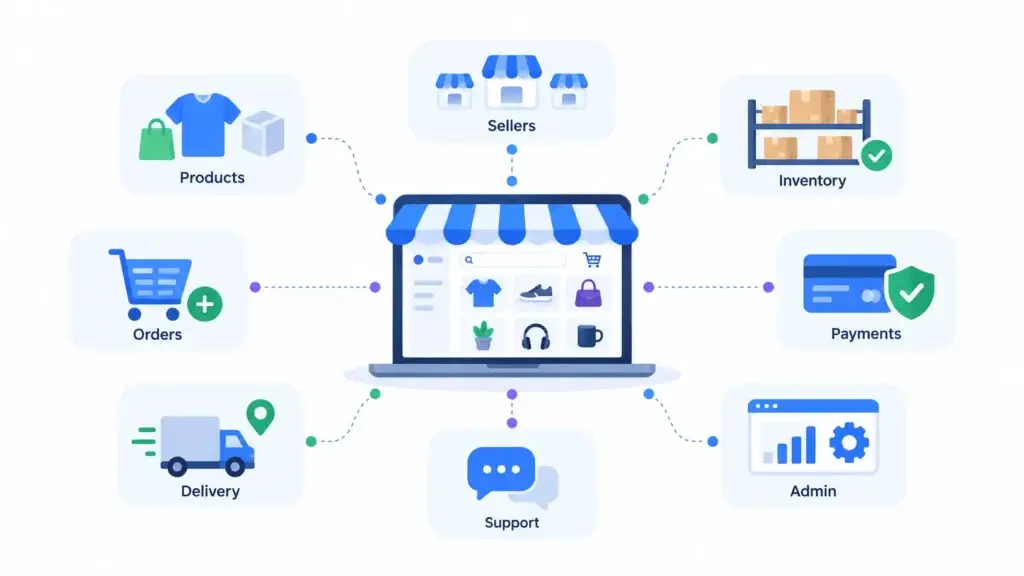
An online retail marketplace is a commerce platform where independent sellers can register, upload products, manage inventory, receive orders, and fulfil purchases through a shared digital storefront. Customers use one app or website to discover products from many sellers, compare prices, read reviews, pay securely, and track delivery.
The marketplace owner controls the rules of the ecosystem. This includes seller approval, product category structure, commission rates, delivery availability, payment methods, promotional campaigns, refunds, customer support, and platform policies.
A single-vendor ecommerce store mainly needs product listings, cart, checkout, payment, and order fulfilment. A marketplace needs all of that plus seller management, commission logic, payout workflows, listing approvals, dispute handling, and multi-party communication. Founders comparing different ecommerce marketplace solutions should evaluate how deeply each platform supports these operational layers.
That difference matters because a marketplace is not just a shopping interface. It is an operating system for digital retail.
How an Online Retail Marketplace Works at a Simple Level
A typical marketplace journey looks like this:
- Sellers register and submit business or product details.
- The platform operator reviews and approves sellers.
- Sellers upload products, prices, stock, images, shipping rules, and offers.
- Customers browse products using search, filters, categories, recommendations, or promotions.
- The customer adds products to cart and places an order.
- The payment system confirms prepaid payment or records cash-on-delivery status.
- The order is assigned to the seller, warehouse, or fulfilment team.
- Delivery is handled through in-house delivery, third-party logistics, seller shipping, or a hybrid model.
- The customer receives tracking updates until delivery.
- The system manages returns, refunds, reviews, seller settlement, and admin reporting.
The customer only sees browsing, checkout, tracking, and support. The founder must think about the full workflow behind the screen.
Core Participants in an Online Retail Marketplace
A scalable marketplace usually has four major participant groups.
| Participant | What They Do | Why It Matters |
|---|---|---|
| Customers | Browse, compare, buy, pay, track orders, request returns, leave reviews | They drive demand and revenue |
| Sellers | Add products, manage prices, update stock, process orders, respond to issues | They create marketplace supply |
| Delivery partners or logistics teams | Pick up, ship, track, and complete deliveries | They affect customer satisfaction and repeat purchases |
| Platform operator | Controls sellers, commissions, payments, disputes, catalog quality, analytics, and policies | They protect trust, margins, and operational stability |
For founders, the operator role is the most important. Without strong admin control, the marketplace can quickly become difficult to manage as sellers, products, orders, refunds, and customer complaints grow.
Customer Journey: From Product Discovery to Checkout
The customer journey begins with product discovery. A strong retail marketplace helps users find the right product quickly without forcing them to scroll through irrelevant listings.
Important discovery features include:
- Category navigation
- Search bar with suggestions
- Product filters
- Sorting by price, rating, popularity, or delivery speed
- Personalized product recommendations
- Recently viewed products
- Wishlist and cart reminders
- Promotional banners and coupon visibility
Once the customer reaches a product page, the platform needs to build trust. This usually happens through product images, clear pricing, available offers, seller details, delivery estimates, ratings, reviews, return policy, warranty information, and payment options.
Checkout should be fast, but not careless. A good checkout flow confirms address, delivery availability, payment method, coupon use, shipping fee, tax, order total, and expected delivery timeline before the order is placed.
For a founder, checkout is where marketplace design becomes revenue design. A confusing checkout flow can reduce conversions, while a smooth flow can increase completed orders. This is where ecommerce app development support becomes useful, especially when the platform needs mobile apps, secure checkout, product discovery, payment flows, and scalable backend logic.
Sellers are the supply engine of an online retail marketplace. The easier it is for trustworthy sellers to join and manage products, the faster the marketplace can expand its catalog.
A seller workflow usually includes:
- Seller registration
- Business verification
- Store profile setup
- Product listing creation
- Product image upload
- Price and stock management
- Shipping settings
- Order alerts
- Invoice and tax details
- Return request handling
- Settlement and payout tracking
- Sales analytics
The seller panel should not feel like an afterthought. Sellers need clear dashboards because they are managing real inventory, real orders, and real customer expectations. For marketplace founders, seller and admin marketplace features should support product uploads, inventory updates, order alerts, pricing control, return handling, and settlement visibility.
If sellers cannot update stock easily, customers may buy unavailable products. If sellers cannot see pending orders clearly, fulfilment gets delayed. If sellers cannot track settlements, trust breaks down. That is why seller experience directly affects customer experience.
How Product Listings and Catalog Management Work
Catalog management is one of the most important parts of an online retail marketplace. Every product listing needs structured data so the platform can support search, filtering, recommendations, delivery rules, taxes, and reporting.
A product listing may include:
- Product title
- Category and subcategory
- Images and videos
- Description
- SKU or product code
- Price
- Discount
- Stock quantity
- Seller information
- Delivery availability
- Product variants such as size, color, or storage capacity
- Return eligibility
- Ratings and reviews
- Tax class
- Shipping weight or dimensions
Founders often underestimate catalog quality. Poor product titles, duplicate listings, weak images, incorrect stock, and inconsistent categories can damage search experience and reduce conversions.
The admin panel should allow the platform operator to approve, reject, edit, merge, or flag listings. This protects the marketplace from low-quality listings, misleading descriptions, duplicate products, and seller misuse.
How Orders Work in a Multi-Vendor Marketplace
Order management becomes more complex when a customer buys products from multiple sellers in one cart. The customer may place one order, but the backend may need to split it into multiple seller-level fulfilment tasks.
For example, one customer order may include:
- One product from Seller A
- Two products from Seller B
- One product from Seller C
The marketplace must decide how to handle inventory, delivery, seller alerts, payment records, invoices, shipping fees, refunds, and commission calculation for each seller.
A strong order management system tracks every status clearly:
| Order Stage | What Happens |
|---|---|
| Order Placed | Customer confirms cart and checkout details |
| Payment Pending or Confirmed | System verifies prepaid payment or records pay-on-delivery status |
| Seller Accepted | Seller confirms product availability |
| Packed | Product is prepared for shipment |
| Picked Up | Delivery partner or logistics team receives the package |
| In Transit | Customer receives tracking updates |
| Delivered | Order is completed |
| Return Requested | Customer asks for return or replacement |
| Refund Processed | Payment or wallet refund is completed based on policy |
| Seller Settled | Seller payout is calculated after commissions, fees, returns, or deductions |
For founders, order visibility is not just a backend feature. It affects support tickets, seller accountability, customer trust, and cash flow. A ready-made retail marketplace platform can help founders start with structured buyer, seller, order, payment, delivery, and admin workflows instead of building every operational layer from zero.
How Payments Work in an Online Retail Marketplace
Marketplace payments involve more than collecting money from customers. The system must support payment acceptance, commission deduction, seller settlement, refund handling, tax records, and sometimes delivery partner collection.
Common payment methods include:
- Cards
- Digital wallets
- Bank transfers
- UPI or local payment rails where relevant
- Cash on delivery
- Buy-now-pay-later options where available
- Store credits or wallet balance
The platform operator needs control over payment status, failed payment handling, refund approvals, seller payout cycles, and transaction reports.
In a prepaid order, the customer pays online and the platform later settles the seller after applying commissions, fees, deductions, and refund rules. In cash-based orders, the system needs an additional reconciliation layer so collected cash is recorded against delivery partners, sellers, and order IDs.
This is where marketplace finance becomes operationally sensitive. A simple payment button is not enough. The platform needs accurate records, clear ledgers, role-based access, audit trails, and well-planned marketplace payment and security workflows to protect customer trust, seller settlements, refunds, and admin decisions.
For founders exploring payment readiness, Miracuves also provides ecommerce marketplace development support around payment gateway integration, order flows, admin controls, and source-code ownership.
How Delivery and Fulfilment Work
Delivery can make or break an online retail marketplace. Even if the product catalog is strong, customers may not return if orders arrive late, tracking is unclear, or returns are difficult.
A marketplace can use different fulfilment models:
| Fulfilment Model | How It Works | Best For |
|---|---|---|
| Seller-managed delivery | Each seller ships their own products | Smaller marketplaces or niche seller networks |
| Platform-managed delivery | The marketplace manages delivery partners or fleets | Higher control over customer experience |
| Third-party logistics | External logistics providers handle shipping | Wider service coverage without owning fleet operations |
| Hybrid fulfilment | Sellers, platform, and logistics partners all participate | Growing marketplaces with mixed categories and locations |
Delivery workflows usually include serviceability checks, delivery fees, pickup assignment, tracking numbers, route updates, failed delivery handling, proof of delivery, and return pickup management.
A marketplace should also support zone-based delivery rules. Some products may be available only in certain locations. Some sellers may ship nationally, while others may serve only selected areas.
This is why delivery logic must connect with product listings, seller locations, customer addresses, payment type, order value, and return policies.
How Returns, Refunds, and Disputes Work
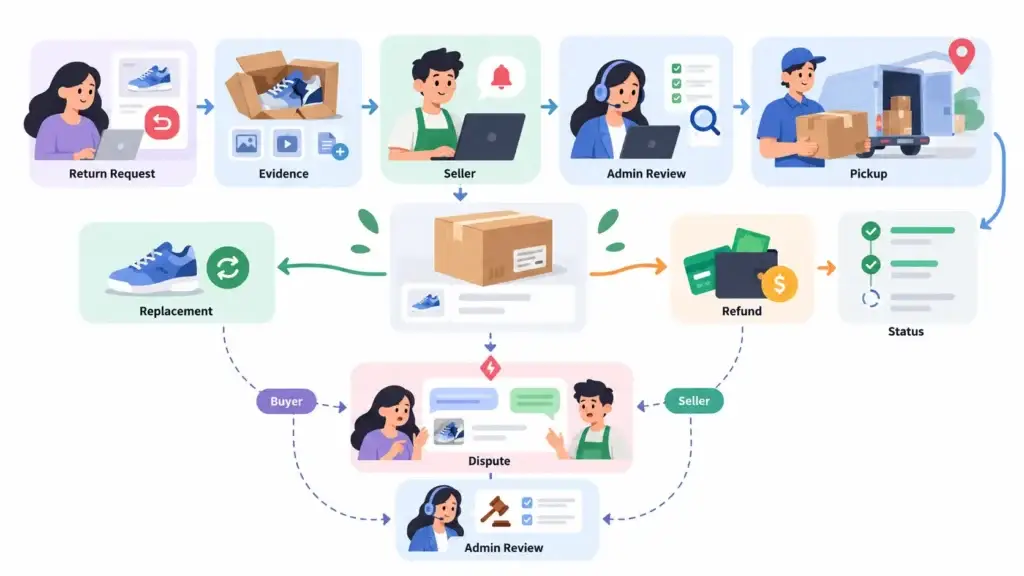
Returns and refunds are not just customer service features. They are trust-building systems.
A customer may request a return because of damaged products, wrong items, delayed delivery, product mismatch, size issues, missing accessories, or changed preference. The platform must then check whether the product is returnable, whether the return window is active, and whether seller approval or admin intervention is needed.
A strong return workflow includes:
- Return eligibility rules
- Reason selection
- Image or evidence upload
- Seller notification
- Admin review where needed
- Return pickup assignment
- Replacement or refund option
- Refund status tracking
- Customer notification
- Seller deduction or settlement adjustment
Dispute management becomes especially important when sellers and customers disagree. The admin panel should allow platform operators to review order history, payment records, product details, delivery proof, customer complaints, seller responses, and refund status before making a decision.
For founders, this reduces operational confusion and protects marketplace trust.
Marketplace Admin Panel: The Control Room Behind the Business
The admin panel is where the platform operator manages the entire marketplace. It is not just a reporting dashboard. It is the control room for operations, finance, sellers, products, customers, orders, delivery, promotions, and support.
A marketplace admin panel should help manage:
- Customer accounts
- Seller approvals
- Product listing approvals
- Categories and attributes
- Orders and fulfilment
- Payment status
- Seller commissions
- Refunds and disputes
- Delivery zones
- Coupon campaigns
- Banners and promotions
- Reviews and ratings
- Notifications
- Reports and analytics
- User roles and permissions
- Platform settings
Without a strong admin layer, every small operational issue becomes a developer dependency. Founders should look for admin controls that allow business teams to update rules, manage sellers, track disputes, launch promotions, and review performance without rewriting code every time.
Founder Decision Signals
Speed
If the goal is to validate a retail marketplace quickly, a ready-made foundation can reduce the time spent building basic buyer, seller, order, payment, and admin flows from zero.
Cost
Marketplace cost depends on features, integrations, mobile apps, payment logic, delivery workflows, seller tools, and custom branding. Clear scope prevents avoidable rebuilds.
Scalability
A scalable marketplace needs structured product data, order status history, seller payout logic, delivery tracking, and admin reporting before transaction volume grows.
Market Fit
The best marketplace model depends on category depth, seller availability, delivery expectations, local payment behavior, and how quickly customers can trust the platform.
How Online Retail Marketplaces Make Money
An online retail marketplace can generate revenue through multiple streams. The strongest model usually combines transaction-based income with seller services and promotional revenue.
| Revenue Stream | How It Works | Founder Benefit |
|---|---|---|
| Seller commission | The platform takes a percentage or fixed fee from each sale | Creates revenue directly from transactions |
| Subscription plans | Sellers pay monthly or yearly for access to selling tools | Builds predictable recurring income |
| Featured listings | Sellers pay for better product visibility | Monetizes seller competition for attention |
| Advertising placements | Brands or sellers pay for banners, search visibility, or campaign slots | Adds high-margin promotional revenue |
| Delivery fees | Customers or sellers pay for shipping or fulfilment | Helps cover logistics costs |
| Payment convenience fees | Small fees may apply for selected payment modes where permitted | Supports payment processing economics |
| Value-added seller services | The platform offers catalog support, packaging, analytics, or marketing help | Creates additional seller-side monetization |
Founders should not add every revenue stream on day one. A better approach is to start with a clean commission model, then add seller subscriptions, ads, delivery monetization, and premium tools when seller demand becomes stronger. Studying a structured retail marketplace revenue model can help founders decide which monetization layers to launch first and which ones to introduce later.
Key Features Every Online Retail Marketplace Should Include
A marketplace should be built around real workflows, not only attractive screens. The feature list should support customers, sellers, delivery teams, and the platform operator.
Online Retail Marketplace Features and Business Value
| Feature | Business Value | Founder Impact |
|---|---|---|
| Seller Panel | Allows sellers to manage products, orders, stock, pricing, and settlements. | Improves seller independence and reduces manual admin work. |
| Product Catalog | Organizes products by category, attributes, variants, prices, and availability. | Improves search, filtering, and conversion quality. |
| Order Management | Tracks order status from placement to fulfilment, cancellation, return, or refund. | Reduces support confusion and improves operational visibility. |
| Payment Gateway Integration | Supports secure online payments, payment confirmation, and transaction records. | Creates smoother checkout and more accurate financial reporting. |
| Delivery Management | Handles pickup, tracking, delivery zones, fees, and fulfilment workflows. | Helps the business control delivery experience and serviceability. |
| Admin Dashboard | Controls sellers, customers, catalog, orders, payments, disputes, and promotions. | Gives the operator business control without constant developer dependency. |
| Reviews and Ratings | Builds trust through customer feedback and seller accountability. | Improves product confidence and repeat purchase behavior. |
| Promotions and Coupons | Supports campaigns, discounts, banners, and seller offers. | Helps drive seasonal sales and category-specific growth. |
For a deeper breakdown of buyer-side, seller-side, and admin-side functionality, founders can also review this guide on online retail marketplace features before finalizing their launch scope.
Security and Trust Layers in Marketplace Operations
Trust is one of the biggest growth factors in online retail. Customers need confidence that payments are safe, sellers are real, products are described accurately, and refunds can be resolved fairly.
Important trust layers include:
- Secure payment gateway integration
- Encrypted data transfer
- Role-based access control
- Seller verification
- Customer account protection
- Activity logs
- Admin approval controls
- Fraud monitoring signals
- Refund and dispute workflows
- Review moderation
- Delivery proof records
- Permission-based dashboards
Security should not be treated as a last-minute technical task. It should be part of the marketplace foundation because payment records, customer data, seller settlements, and order history all affect business credibility.
Ready-Made Marketplace Foundation vs Building From Zero
Founders usually compare two routes: build the marketplace from scratch or start with a ready-made ecommerce marketplace foundation.
| Build Route | What It Means | Best For |
|---|---|---|
| Build from zero | Every customer, seller, order, payment, delivery, admin, and reporting module is designed and developed from scratch. | Businesses with highly unique workflows, deep funding, and longer timelines. |
| Ready-made foundation | Core marketplace modules already exist and are customized with branding, features, integrations, and business rules. | Founders who want faster validation, lower build risk, and quicker launch readiness. |
A ready-made approach does not mean copying another business blindly. The smarter strategy is to use a proven marketplace structure, customize it for your niche, and focus your energy on seller onboarding, category strategy, pricing, delivery operations, and customer acquisition. A launch-ready retail marketplace foundation can support this approach while keeping the blog educational and the commercial page focused on solution-level conversion.
For founders who want to move faster, Miracuves offers a ready-made retail marketplace platform that can support multi-vendor catalog flows, seller tools, admin control, payment workflows, delivery management, white-label branding, and faster launch planning.
Common Mistakes Founders Should Avoid
Starting with only customer-facing screens
A marketplace cannot run on product pages and checkout alone. Sellers, delivery teams, finance workflows, returns, admin permissions, and support teams all need functional systems.
Ignoring seller onboarding quality
If seller verification, listing rules, product approval, and payout policies are weak, the marketplace may fill with poor listings and unreliable fulfilment.
Treating delivery as a simple tracking feature
Delivery affects serviceability, shipping fees, customer satisfaction, returns, failed orders, and operational cost. It needs clear workflows from the beginning.
Not planning refunds and disputes early
Refunds and disputes become expensive when the system does not store order history, payment status, seller records, delivery proof, and customer communication clearly.
When Should a Founder Build an Online Retail Marketplace?
An online retail marketplace makes sense when your business can bring together demand and supply in a focused way. It is not enough to launch a shopping app and wait for sellers to join.
You should consider a marketplace model when:
- You can attract sellers in a specific category or region.
- Customers need more choice than one brand can provide.
- You have a clear commission or seller monetization strategy.
- Delivery and fulfilment can be managed reliably.
- You can maintain product quality and seller standards.
- Your niche has repeat purchase potential.
- You want to build a scalable commerce ecosystem rather than a single online store.
A marketplace is also useful when local sellers need a stronger digital channel but do not want to build independent ecommerce websites. In that case, the platform becomes the shared infrastructure for discovery, orders, payments, and fulfilment.
Miracuves Perspective: Build the Marketplace Around Operations, Not Just Design
A successful ecommerce marketplace is not defined only by how it looks. It is defined by how reliably it handles real transactions.
That means the foundation should support buyers, sellers, product data, payments, refunds, delivery, commissions, and admin control from the start. The more these workflows are connected, the easier it becomes to launch, test, improve, and scale.
Miracuves helps founders build white-label marketplace platforms with source-code ownership, custom branding, seller panels, admin dashboards, payment gateway integrations, delivery workflows, and launch-ready modules. For ready-made marketplace solutions, Miracuves can support 6-day solution delivery, helping founders move faster without building every core module from zero.
If your goal is to launch a branded ecommerce marketplace with practical control over sellers, catalog, orders, payments, and delivery, a multi-vendor retail marketplace build can give you a faster starting point for validation.
Final Thoughts
An online retail marketplace works because it connects buyers, sellers, payments, orders, delivery, refunds, and admin control into one coordinated system. The customer may only notice the product page, cart, checkout, and tracking screen, but the platform operator needs a much deeper foundation.
For founders, the real decision is not simply whether to build a shopping app. The real decision is whether you are ready to manage seller supply, catalog quality, payment flows, delivery reliability, customer trust, and marketplace monetization.
A ready-made marketplace foundation can reduce the risk of starting from zero, especially when your goal is faster launch, faster validation, and stronger operational control.
FAQs
What is an online retail marketplace?
An online retail marketplace is a digital platform where multiple sellers list products and customers buy from them through one website or mobile app. The platform owner manages seller rules, payments, commissions, order tracking, delivery workflows, refunds, and admin controls.
How does an online retail marketplace make money?
An online retail marketplace can make money through seller commissions, subscription plans, featured listings, advertising placements, delivery fees, payment convenience fees, and value-added seller services such as catalog support or analytics.
What is the difference between an ecommerce store and an online marketplace?
An ecommerce store usually sells products from one business. An online marketplace allows multiple sellers to sell through the same platform. A marketplace needs additional workflows such as seller onboarding, product approval, commission logic, seller payouts, dispute handling, and multi-vendor order management.
How do sellers manage products in a marketplace?
Sellers usually manage products through a seller panel. They can add listings, upload images, update prices, manage inventory, process orders, respond to returns, view settlements, and track sales performance.
How do payments work in a multi-vendor retail marketplace?
Payments are collected from customers through supported payment methods. The marketplace system records the transaction, applies commissions or fees, manages refunds where needed, and settles the seller based on payout rules. For cash-based orders, the system also needs reconciliation workflows.
Why is delivery management important in an online retail marketplace?
Delivery management affects customer satisfaction, serviceability, shipping cost, order tracking, return pickup, and repeat purchase behavior. A marketplace needs clear delivery rules for zones, sellers, logistics partners, failed deliveries, and refunds.
What features should an online retail marketplace app include?
A retail marketplace app should include customer accounts, product catalog, search and filters, cart, checkout, payment gateway integration, seller panel, order management, delivery tracking, reviews, refunds, dispute management, admin dashboard, analytics, and promotional tools.
Can Miracuves help launch an online retail marketplace faster?
Yes. Miracuves helps founders launch ready-made and white-label ecommerce marketplace platforms with source-code ownership, custom branding, admin control, seller workflows, payment integration, delivery management, and 6-day solution delivery where relevant.
Miracuves is an independent software development company. We are not affiliated with, connected to, sponsored by, or endorsed by any company or product named in this article.
Terms such as “X Clone” are used descriptively. It is how the software industry refers to building a platform with functionality comparable to a known service, and how clients search for it.
The entire design and codebase of our products is built by our own team. Our products contain no code, design, graphics, or content originating from any third-party website or applications.
All third-party names and marks referenced in this article are the property of their respective owners, referenced solely to identify the services discussed.