



Key Takeaways
What You’ll Learn
- Property listing platform development is not just about publishing real estate ads because the real success depends on listings, agents, buyers, leads, verification, and admin operations working together.
- A scalable platform must support multiple user journeys including buyers, renters, brokers, agents, property owners, builders, and administrators.
- Search quality is the strongest conversion layer because users depend on filters, maps, pricing, location accuracy, amenities, and property comparison before making inquiries.
- Trust systems are critical from the beginning since fake listings, outdated prices, weak broker verification, and poor lead management can reduce marketplace credibility.
- The biggest takeaway for founders is to build a property marketplace around verified listings, smart search, lead management, broker tools, and scalable admin control from day one.
Stats That Matter
- The guide positions property listing platforms as operational marketplaces where discovery, listing management, broker engagement, inquiries, moderation, and monetization must be planned together.
- Core features include advanced search, map-based browsing, property detail pages, media galleries, inquiry forms, agent profiles, saved listings, and admin dashboards.
- Monetization options include featured listings, broker subscriptions, lead generation fees, promoted property placements, advertising, and premium agent packages.
- Admin systems are essential for marketplace quality because teams need to review listings, verify agents, manage users, monitor leads, handle reports, and remove duplicate or fake properties.
- Long-term scalability depends on backend performance because property platforms handle large images, location data, user activity, listing updates, map APIs, notifications, and growing search traffic.
Real Insights
- The biggest mistake in property platform development is treating it like a basic website instead of a marketplace that needs trust, moderation, search logic, and broker-side operations.
- Listing quality directly affects revenue because better photos, accurate details, verified ownership, updated pricing, and responsive agents increase user confidence.
- Lead management should be built into the platform early so brokers and owners can respond faster, track inquiries, manage follow-ups, and measure listing performance.
- Scalable architecture matters before traffic grows because slow search, poor map loading, broken filters, or weak media handling can reduce conversions quickly.
- For entrepreneurs, the biggest lesson is to build a Property Listing Platform around search experience, listing verification, agent workflows, lead tracking, monetization logic, and strong admin operations.
Most property startups assume building a real estate platform is mainly about adding listings, filters, and modern UI design. In reality, successful property marketplaces are built around something much more difficult — trust, operational workflows, inventory quality, and scalable marketplace systems.
A property platform may look simple on the surface, but behind every successful marketplace are multiple moving layers working together continuously. Buyers expect fast property discovery, brokers expect quality leads, property owners expect visibility, and admins need moderation systems capable of controlling marketplace quality as the platform grows.
This is why many property startups struggle even after launching attractive platforms. Problems usually begin when fake listings increase, inquiry quality drops, search experiences become cluttered, or operational systems fail to scale alongside inventory growth.
Modern real estate marketplaces no longer compete only on the number of listings available. They compete on usability, trust, communication speed, mobile experience, and operational efficiency. Businesses entering this space are increasingly focusing on scalable real estate marketplace solutions that support long-term growth instead of basic listing websites.
This is why platforms like Zillow and other leading real estate marketplaces succeeded. They did not simply build property directories. They built ecosystems where buyers, renters, brokers, agencies, and property owners could interact through reliable workflows and structured experiences.
For startups entering this space in 2026, the opportunity remains massive. However, success depends on understanding how marketplace operations, trust systems, scalability, and user experience work together behind the scenes.
This guide explains how to build a scalable property listing platform while covering the business logic, operational workflows, feature planning, monetization systems, and technical foundations required for long-term growth.
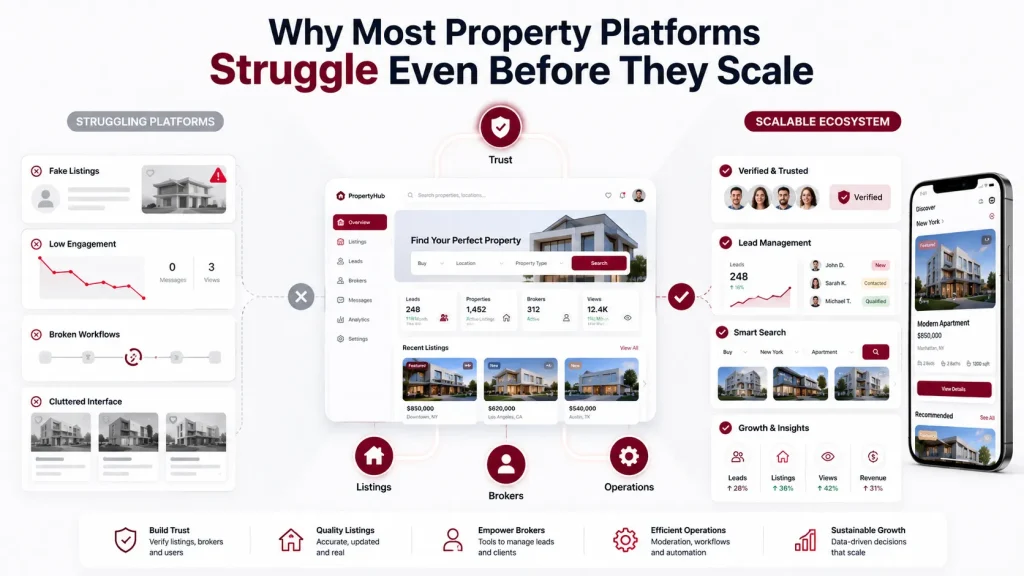
Why Most Property Platforms Struggle Even Before They Scale
Most property startups assume marketplace growth depends mainly on better design, more listings, or aggressive marketing. In reality, many platforms struggle much earlier because operational workflows, listing quality, broker engagement, and trust systems were never structured properly from the beginning.
A property marketplace behaves more like an operational ecosystem than a traditional website. Buyers expect smooth discovery experiences, brokers expect consistent lead quality, and admins need moderation systems capable of maintaining marketplace credibility as listings increase.
When even one side of this workflow becomes weak, platform quality starts declining rapidly. This is why scalable property marketplaces are built around operational structure and trust management — not just frontend experiences.
The Marketplace Decisions That Shape Long-Term Platform Growth
Many property startups begin development before deciding how the marketplace will actually operate at scale. But early decisions around property categories, user behavior, monetization logic, and broker workflows directly influence platform architecture later.
A rental-heavy marketplace behaves very differently from a commercial real estate platform. Search behavior, lead quality expectations, communication speed, and operational complexity all change depending on the marketplace model being targeted.
Rental-Focused Platforms
Rental marketplaces usually depend on high listing activity, fast communication, affordability filters, and location-based discovery. Users expect immediate responses, property availability updates, and quick visit scheduling.
These platforms typically focus more on mobile engagement and repeat usage because renters often browse properties frequently before making decisions.
Property Sales Marketplaces
Property sales platforms involve longer decision cycles and higher trust requirements. Buyers expect detailed specifications, verified property data, financing information, neighborhood insights, and stronger agent credibility systems.
Lead quality matters significantly more in these marketplaces because transactions are larger and conversion timelines are longer.
Commercial Real Estate Platforms
Commercial marketplaces handle offices, warehouses, coworking spaces, retail units, and industrial properties. Search logic becomes more operational and investment-focused compared to residential platforms.
Businesses searching for commercial properties usually prioritize:
- Accessibility and transport connectivity that support employee movement, customer reach, and logistics efficiency across operational locations.
- Pricing transparency and long-term lease flexibility because commercial buyers and tenants evaluate properties based on operational sustainability and future expansion plans.
- Detailed property specifications such as floor plans, parking availability, infrastructure readiness, and compliance suitability before making inquiries.
Hybrid Property Ecosystems
Many modern platforms combine rentals, property sales, commercial listings, and land investments into one ecosystem. This approach increases market reach while creating multiple monetization opportunities inside one marketplace.
However, hybrid models also increase operational complexity because each category requires different discovery logic, search behavior, and lead workflows.
Real Estate Platforms Fail Faster When Market Behavior Is Ignored
Many real estate startups fail because they copy platform features without understanding how users actually search, compare, and trust properties within their local market.
Property behavior changes heavily across cities and regions. Some markets depend on brokers, others prefer direct owner listings, while some users prioritize affordability and others focus entirely on location prestige or investment potential.
The strongest marketplaces are usually built around local behavior patterns instead of generic real estate templates.
Before development begins, businesses should study:
- How users currently search for properties and what frustrations they experience with existing platforms during discovery, communication, and trust verification.
- Which competitors dominate the market and where their weaknesses exist, including outdated UX, fake listings, poor mobile performance, or weak lead quality.
- Which property categories generate the strongest demand locally because rental-heavy markets behave very differently from luxury or commercial real estate ecosystems.
This research directly influences:
- Platform workflows
- Feature prioritization
- Monetization logic
- Mobile UX decisions
- Expansion strategy
The strongest property marketplaces are built around local market behavior — not generic templates.
The Features That Actually Improve Discovery, Trust, and Retention
Many property platforms become overloaded with features that look impressive during development but contribute very little to actual marketplace growth.
Users rarely stay loyal because a platform added more buttons or dashboards. They stay because discovery feels easier, listings feel trustworthy, and communication happens without friction.
The most valuable features are usually the ones that reduce complexity instead of increasing it.
Discovery Features That Improve User Retention
Search and discovery systems are the foundation of the entire platform experience.
Users should be able to:
- Filter properties based on pricing, location, furnishing status, amenities, nearby infrastructure, and property type without feeling overwhelmed by cluttered navigation.
- Explore properties through map-based browsing because location context often matters more than property photos during early-stage discovery.
- Save properties and receive alerts for matching listings, which helps increase repeat engagement and keeps users active inside the marketplace ecosystem.
- Schedule inquiries or visits quickly without switching across multiple communication channels or waiting for delayed broker responses.
The easier discovery becomes, the stronger the retention and inquiry conversion rates become.
Why Agent and Owner Workflows Matter Equally
Most failed marketplaces focus only on the buyer experience while ignoring brokers and property owners.
Without efficient supply-side tools, listing quality eventually declines.
Property owners and agents need:
- Listing management systems that support property uploads, media galleries, pricing updates, and structured property descriptions without operational friction.
- Lead management dashboards that help organize inquiries, monitor conversions, and improve response efficiency across multiple properties simultaneously.
- Promotional tools that increase listing visibility because brokers often prioritize marketplaces capable of generating stronger lead exposure.
- Analytics systems that show impressions, inquiry activity, and listing performance to help improve property marketing decisions over time.
A marketplace without strong supply-side workflows eventually loses inventory quality.
Trust Becomes the Product in Real Estate Marketplaces
In real estate marketplaces, trust eventually becomes more important than property volume itself.
Users stop returning when they repeatedly encounter fake listings, outdated pricing, misleading property details, or brokers who never respond. Once trust starts declining, inquiry conversion rates usually drop with it.
This is why verification and moderation systems are not secondary features. They are part of the marketplace product itself.
Strong trust systems usually include:
- Phone and identity verification workflows that reduce fake account creation and improve accountability across user-generated listings.
- Broker and property validation systems that help confirm whether listings are genuine, active, and connected to legitimate property representatives.
- Manual moderation and reporting systems that allow admins to remove misleading, duplicate, or outdated properties before marketplace quality declines.
- Transparent listing information including verified badges, updated timestamps, and clear property details that improve user confidence during decision-making.
Property Discovery Has Become a Mobile-First Experience
Property discovery has rapidly shifted toward smartphones, especially among renters and younger buyers who compare listings continuously throughout the day.
This means marketplace usability is no longer judged only by visual design. Loading speed, search responsiveness, navigation clarity, and inquiry workflows now directly affect user retention and lead generation performance.
Poor mobile UX quietly damages marketplace growth long before businesses notice engagement problems.
Users expect:
- Fast-loading property pages that allow users to browse listings smoothly without delays, especially during high mobile traffic periods.
- Clear navigation systems that help users compare locations, pricing, and property details without creating unnecessary friction.
- Responsive image browsing experiences that improve property exploration while maintaining mobile usability across different screen sizes.
Poor UX creates operational problems beyond design issues.
For example:
- Slow loading speeds increase bounce rates before users even explore listings.
- Confusing navigation reduces inquiry conversions because users struggle to compare properties efficiently.
- Weak mobile optimization damages trust because users associate poor usability with low marketplace credibility.
This is why UX directly impacts:
- Retention
- Inquiry volume
- User trust
- Repeat visits
- Marketplace reputation
In modern property platforms, UX is not just design. It is a business growth system.
Modern Property Platforms Need Revenue Logic From the Beginning
Many property startups focus heavily on traffic growth while delaying monetization decisions until later stages. But in most marketplaces, revenue systems influence platform workflows much earlier than founders expect.
Featured listings, broker subscriptions, lead generation systems, and promotional visibility all affect how inventory is structured and prioritized inside the platform itself.
The strongest marketplaces build monetization into operational workflows instead of adding it later as a separate layer.
Most Common Revenue Models
| Monetization System | Why It Matters Commercially |
|---|---|
| Featured Listings | Brokers and agencies pay for increased visibility, helping the platform generate recurring visibility-based revenue. |
| Subscription Plans | Professional sellers often require advanced dashboards, analytics, and lead-management access through monthly plans. |
| Lead Generation | Premium property inquiries can become high-value monetization opportunities in competitive markets. |
| Advertising Placements | Mortgage providers, interior businesses, and related services frequently advertise on high-traffic property platforms. |
The key is balancing monetization with usability. Aggressive monetization that damages search quality or overwhelms users usually reduces long-term retention.
Most Marketplace Infrastructure Problems Start During Growth
A property marketplace should never be built only for launch-day traffic.
As inventory grows, the platform must handle:
- Increasing media storage
- Higher search activity
- More user accounts
- Larger inquiry volumes
- Multi-city operations
Without scalable infrastructure, performance problems start appearing quickly.
What Scalable Property Architecture Usually Requires
| Infrastructure Area | Must-Have at Launch | Can Be Expanded Later |
|---|---|---|
| Search & Discovery | Filters, map browsing, categories | AI-powered recommendations |
| Trust Systems | Verification, moderation | Fraud scoring systems |
| Communication | Inquiry forms, scheduling | In-app video consultations |
| Infrastructure | Cloud hosting, scalable database | Multi-region deployment |
| Analytics | User tracking, listing insights | Predictive behavior systems |
Modern property marketplaces increasingly depend on:
- Cloud-based infrastructure
- AI-powered recommendations
- Real-time map systems
- Behavioral analytics
- Multi-device optimization
The architecture decisions made early often determine whether the platform can scale efficiently later.
The Operational Costs That Usually Surprise Property Startups
Most founders prepare budgets around development timelines while underestimating the operational systems required after launch.
As marketplaces grow, moderation workflows, support systems, cloud infrastructure, analytics tools, and communication management become long-term operational expenses that directly affect scalability and platform stability.
In many cases, operational efficiency becomes one of the biggest competitive advantages in large real estate marketplaces.
Some of the biggest operational areas include:
- Listing moderation teams that help reduce fake listings, duplicate properties, and outdated information as marketplace activity grows.
- Cloud hosting and media storage systems required to support high-resolution property images, videos, and increasing user traffic efficiently.
- Third-party APIs for maps, notifications, communication systems, analytics, and verification workflows that expand operational complexity over time.
- Customer support operations needed to manage disputes, inquiry issues, communication problems, and marketplace trust consistently.
Platforms that plan operational scalability early usually survive longer than those focused only on frontend launch speed. In many cases, operational efficiency becomes one of the biggest long-term competitive advantages for growing marketplaces.
Building From Scratch Is Not Always the Smartest Marketplace Strategy
This is one of the biggest strategic decisions for real estate startups.
Building completely from scratch offers maximum flexibility, but it usually increases:
- Development timelines
- Infrastructure planning
- Operational complexity
- Testing cycles
- Market-entry delays
For many startups, this slows growth before the marketplace even gains traction.
Using a structured marketplace foundation often helps accelerate launch timelines because critical systems such as:
- Listing management
- Inquiry workflows
- Admin controls
- Verification systems
- Search logic
- Mobile responsiveness
are already organized at the architecture level.
The goal is not avoiding customization. The goal is avoiding unnecessary rebuilding of foundational marketplace systems.
How Miracuves Helps Businesses Build Scalable Property Marketplaces
At Miracuves, the focus is not just on building property websites but on helping businesses create scalable marketplace ecosystems designed for long-term operational growth. Instead of approaching real estate platforms as simple listing portals, the goal is to structure systems that support property discovery, lead generation, communication workflows, trust management, and marketplace scalability together within one connected platform experience.
This includes:
- Marketplace-ready architecture that supports buyers, renters, brokers, agencies, and admins through structured workflows while improving operational efficiency across the platform.
- Search and discovery systems designed to improve property visibility, inquiry conversion, and mobile-first usability as property inventories continue growing.
- Verification, moderation, and lead-management workflows that help maintain marketplace trust while reducing fake listings and improving inquiry quality.
- Scalable infrastructure and customization flexibility that support expansion across multiple cities, property categories, and future monetization models.
Instead of treating real estate platforms as simple listing directories, the approach focuses on building ecosystems capable of supporting long-term marketplace growth, stronger user retention, operational stability, and sustainable monetization over time.
Conclusion
The real estate industry is becoming increasingly digital, competitive, and trust-driven. Property listing platforms are no longer simple directories where users browse property photos and contact numbers. They now operate as complete ecosystems managing discovery, communication, verification, monetization, and operational workflows simultaneously.
The platforms that succeed in 2026 will prioritize strong search experiences, verified listings, mobile-first usability, scalable infrastructure, and marketplace trust from the beginning instead of treating these systems as later-stage improvements.
For businesses entering this market, success depends on building much more than a property website. The real goal is creating a scalable real estate ecosystem that users, brokers, agencies, and property owners consistently rely on.
Businesses exploring scalable real estate and classified marketplace solutions can also explore Miracuves Listing Platform Solutions to understand how modern listing ecosystems are being structured for long-term marketplace growth.
FAQs
What is a property listing platform?
A property listing platform is a digital marketplace where buyers, renters, brokers, and property owners can discover, manage, and communicate about real estate properties online.
What features are essential in a modern property listing platform?
Core features usually include advanced search filters, map-based browsing, property uploads, inquiry systems, verification workflows, and admin management dashboards.
Why is verification important in real estate marketplaces?
Verification helps reduce fake listings, outdated properties, and misleading information while improving marketplace trust and user confidence.
Can a property listing platform support multiple property categories?
Yes, modern platforms can support rentals, property sales, commercial spaces, land listings, and other categories within one scalable ecosystem.
How do property listing platforms generate revenue?
Most platforms generate revenue through featured listings, subscriptions, advertising placements, lead-generation systems, and promotional property visibility.
Why is mobile-first usability important for property platforms?
Most users now search for properties through smartphones, so fast loading speeds, responsive design, and smooth mobile navigation directly impact engagement and retention.