


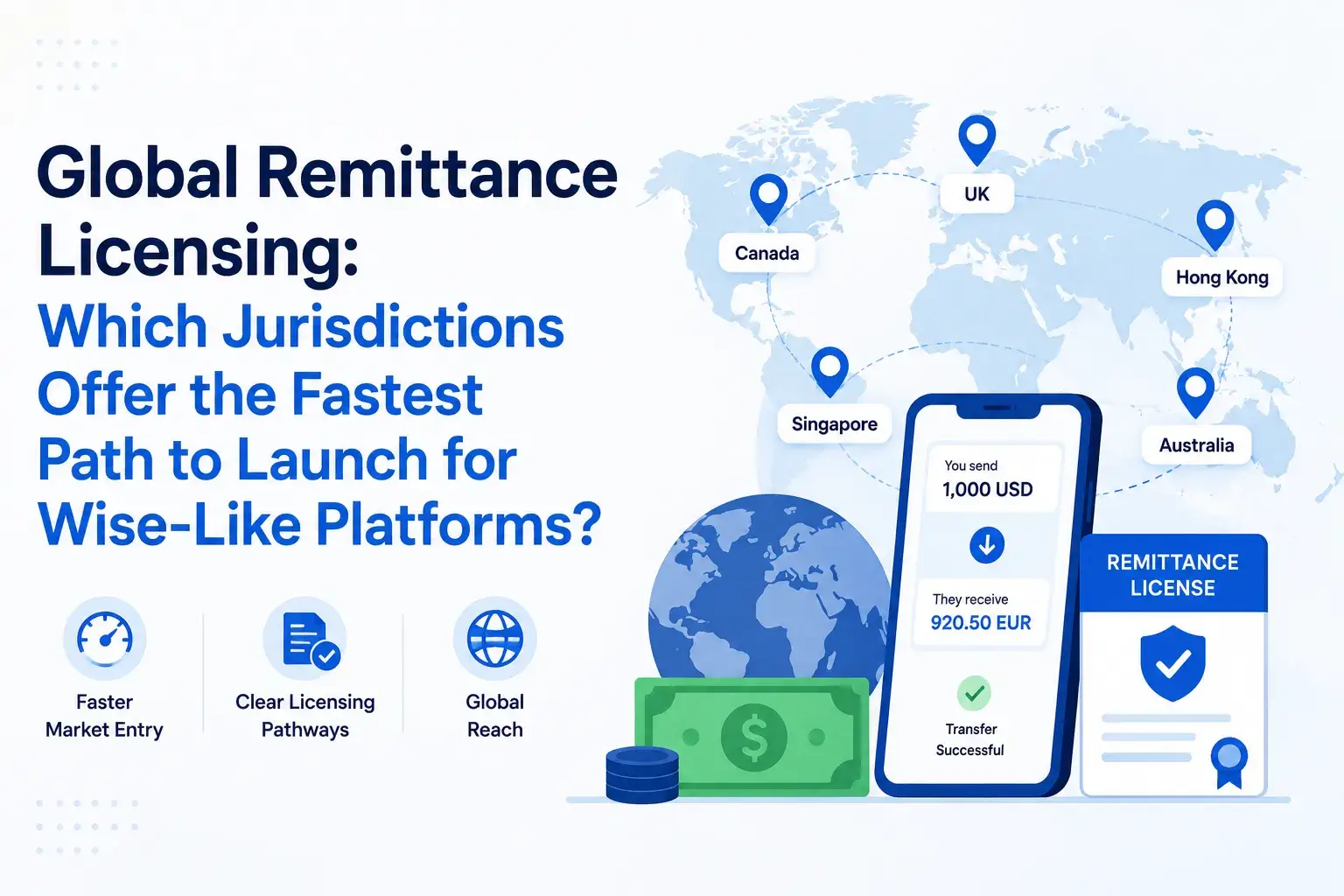
Remittance licensing requirements 2026 are becoming one of the biggest decision points for founders building Wise-like platforms. A money transfer app is not just a fintech interface with currency conversion, wallet balances, and transfer tracking. It is a regulated financial product that must satisfy licensing, KYC, AML, transaction monitoring, safeguarding, reporting, and operational control expectations in the market where it operates.
For founders, the core question is not simply, “Where can I get a license?” The better question is, “Which jurisdiction gives us the fastest credible path to launch, validate demand, and expand without rebuilding the product foundation?”
This guide compares the EU, UK, Singapore, DIFC, and the US from a founder’s perspective. It explains where licensing may be faster, where regulatory credibility is stronger, and where operational complexity can delay launch. This article is for informational purposes only and should not be treated as legal advice. Final licensing strategy should always be confirmed with qualified regulatory counsel in the target jurisdiction.
Why Remittance Licensing Matters Before Building a Wise-Like Platform
A Wise-like remittance platform moves money across borders. That means the product may touch currency conversion, payment accounts, stored value, recipient payout rails, customer due diligence, sanctions screening, transaction monitoring, and suspicious activity reporting workflows.
These are not optional backend details. Regulators expect payment and remittance firms to prove that they can identify users, protect funds, monitor risks, maintain records, handle complaints, and operate with fit-and-proper governance. In 2026, the strongest fintech founders treat licensing as a product architecture decision from day one.
For example, a founder may design a smooth transfer flow, but if the platform cannot show transaction history, user verification status, audit logs, blocked transfer reasons, admin overrides, compliance notes, and role-based review workflows, the licensing path becomes harder.
The regulator is not only reviewing the business plan. It is reviewing whether the operating model can protect users and the financial system.
That is why a ready-made fintech foundation from Miracuves’ Wise clone solution can help founders plan product flows around compliance-ready operations instead of adding regulatory workflows after the product is already built.
Quick Comparison: Fastest Jurisdictions for Remittance Launch in 2026
The “fastest” jurisdiction depends on what the founder means by launch. A sandbox test is faster than full licensing. A single-country pilot is faster than multi-country expansion. A partner-led model may move faster than direct authorization, but it usually gives less control.
For a Wise-like platform, founders should compare speed, credibility, expansion rights, capital expectations, and operational burden together.
| Jurisdiction | Likely Route for Wise-Like Platform | Launch Speed View | Founder Advantage | Main Challenge |
|---|---|---|---|---|
| Singapore | Payment Services Act licence; sandbox or sandbox express where eligible | Fast for controlled testing; full licence depends on scope | Clear fintech regulator, strong APAC positioning | Must fit regulated payment service scope and risk controls |
| UK | FCA payment institution or e-money institution authorization/registration | Potentially predictable if application is complete | Strong regulatory credibility and fintech ecosystem | Preparation quality matters; incomplete applications can extend review |
| EU/EEA | Payment institution or electronic money institution licence | Moderate; strong after authorization due to passporting | One home authorization can support broader EEA expansion | Choosing the right home regulator is strategic |
| DIFC/UAE | DFSA authorization, fintech testing route, or payment services framework depending on model | Potentially useful for regional controlled entry | MENA credibility and financial free-zone positioning | Scope, capital, and regulated activity classification must be carefully mapped |
| United States | FinCEN MSB registration plus state money transmitter licences | Usually slowest for broad launch | Large remittance market and high commercial upside | State-by-state licensing, surety bonds, financial requirements, renewals |
As a practical founder view, Singapore may be attractive for controlled testing, the UK for clear authorization discipline, the EU for expansion leverage, DIFC for MENA positioning, and the US for scale after compliance maturity. This is an inference based on regulator frameworks and operational complexity, not a guarantee of approval speed.
EU EMI Licensing: Strong Passporting Advantage, But Careful Regulator Selection Matters
For Wise-like platforms targeting Europe, the EU remains attractive because payment institutions and electronic money institutions operate under a framework designed to support regulated payment services across the European market.
The strategic benefit of the EU is passporting. Once properly authorized in one eligible home country, a payment or e-money institution may be able to offer services across other EEA markets through passport notification mechanisms, depending on the permissions and regulatory process.
When an EU EMI Route Makes Sense
An EU electronic money institution route may make sense when the platform intends to issue e-money, hold stored value, provide wallet functionality, offer payment accounts, or support multi-currency balances.
A payment institution route may be more suitable if the platform focuses on executing payment transactions or remittance without issuing e-money.
For a Wise-like app, the key product questions are:
Will users hold balances inside the app?
Will the platform issue e-money?
Will the product offer named accounts or IBAN-like functionality?
Will transfers be cross-border only, domestic only, or both?
Will the platform manage FX margins, payout partners, or third-party payment rails?
The answers shape whether the founder should explore an EMI licence, payment institution licence, or regulated partnership model.
EU Founder Decision Signal
The EU may not always be the fastest first authorization path, but it can be one of the strongest expansion paths after authorization. For founders planning pan-European coverage, the regulatory effort may be justified because the licensing strategy can support a broader market footprint.
The mistake is choosing a jurisdiction only because someone says it is “fast.” The better decision is choosing the regulator, permissions, capital model, and compliance plan that match the actual product.
Read More: Remittance Platform Metrics That Matter: 7 KPIs for Profitable Cross-Border Money Transfer Growth
UK FCA Approval Process: Clear Route, Strong Credibility, High Preparation Standard
The UK remains a major fintech jurisdiction for remittance and e-money businesses. The FCA provides specific routes for payment institutions and electronic money institutions, including guidance on whether a firm should apply for registration or authorization depending on payment volume and e-money activity.
For payment and e-money firms, complete applications are usually assessed faster than incomplete applications. That distinction is crucial for founders. A weak application does not just delay approval; it can delay fundraising, hiring, banking relationships, and product launch.
Small vs Authorized Routes in the UK
The UK route may involve small payment institution registration, authorized payment institution authorization, small electronic money institution registration, or authorized electronic money institution authorization.
The right option depends on transaction volume, e-money activity, operating model, safeguarding requirements, and business scope.
For a Wise-like remittance product, founders should carefully evaluate whether the platform only transfers funds or whether it also stores balances, issues e-money, or provides account-like functionality.
Important 2026 UK Safeguarding Note
UK payment and e-money firms should pay close attention to safeguarding obligations. For a remittance founder, this means safeguarding design, reconciliation, customer fund segregation, recordkeeping, and operational resilience should be considered before applying, not after approval.
UK Founder Decision Signal
The UK can be a strong first licensing target if the founder wants credibility, English-language regulatory interaction, strong fintech infrastructure, and a clearly documented process.
However, the application must be complete, evidence-backed, and operationally realistic. The fastest UK path is not a shortcut. It is a well-prepared application.
MAS Sandbox in Singapore: Faster Testing Route for Innovative Payment Models
Singapore is highly relevant for remittance platforms targeting APAC corridors. Under the Payment Services Act, MAS regulates payment service providers and payment systems in Singapore.
MAS regulates different payment service categories, including cross-border money transfer service. A Wise-like platform may need to evaluate whether it falls under cross-border money transfer service, account issuance service, e-money issuance service, domestic money transfer service, or other regulated payment service categories.
Why Singapore Appeals to Remittance Founders
Singapore can be attractive because it combines a sophisticated financial system with clear payment regulation and innovation pathways.
The MAS FinTech Regulatory Sandbox framework allows financial institutions and fintech players to experiment with innovative financial products or services in a controlled environment. This can help founders validate new payment models before moving toward broader authorization.
Singapore Licence Considerations
A Wise-like platform should evaluate:
Whether users send money domestically, cross-border, or both.
Whether users can hold wallet balances.
Whether the platform issues e-money.
Whether the platform controls FX conversion.
Whether payout partners or banking partners are involved.
Whether the model needs a full licence or can begin through a controlled test route.
Singapore Founder Decision Signal
Singapore may offer one of the more founder-friendly routes for controlled testing if the product is innovative and sandbox-eligible. However, sandbox testing is not the same as full commercial authorization.
Founders should treat the sandbox as a validation pathway, not a permanent licensing substitute.
DIFC Fintech License: Strategic MENA Entry, But Scope Matters
The Dubai International Financial Centre can be attractive for fintech founders targeting Middle East, Africa, and South Asia corridors.
For remittance or payment service models, the key question is whether the activity falls within the DFSA’s regulated financial services framework and which authorization category applies.
Innovation Testing in DIFC
DIFC and DFSA innovation routes may be useful for qualifying fintech firms that want to test innovative concepts within a defined scope.
This can help founders validate fintech products in a controlled environment, although the scope and conditions must be carefully reviewed before assuming it fits a remittance model.
DIFC Founder Decision Signal
DIFC can be strategically useful if the founder wants MENA credibility, access to Dubai’s financial ecosystem, and a regulated regional base.
It may not be the simplest route for every remittance product, especially if the model needs retail mass-market coverage, local UAE central bank permissions, or partnerships beyond the DIFC scope.
Founders should map the exact flow of funds before choosing DIFC as the first jurisdiction.
Read More: How High-Volume Remittance Platforms Reduce FX Margins With Liquidity and Nostro Optimization
US State Money Transmitter Licenses: Large Market, Slowest Operational Path
The United States is commercially attractive for remittance businesses, but it is often the slowest broad-launch path because money transmission usually requires both federal and state-level compliance.
At the federal level, money services businesses generally need MSB registration with FinCEN.
Federal registration alone is not enough for broad US operations. Most money transmitters also need state money transmitter licenses in the states where they conduct business.
State requirements commonly involve financial statements, surety bonds, background checks, permissible investments, AML programs, and state-specific filings.
US Founder Decision Signal
The US is usually not the fastest first market for a Wise-like platform that wants nationwide direct licensing.
It can be a strong later-stage market after the company has capital, compliance staff, legal support, banking partners, and operational maturity.
For early validation, founders often evaluate partner-led or limited-state strategies before full nationwide coverage, subject to legal advice.
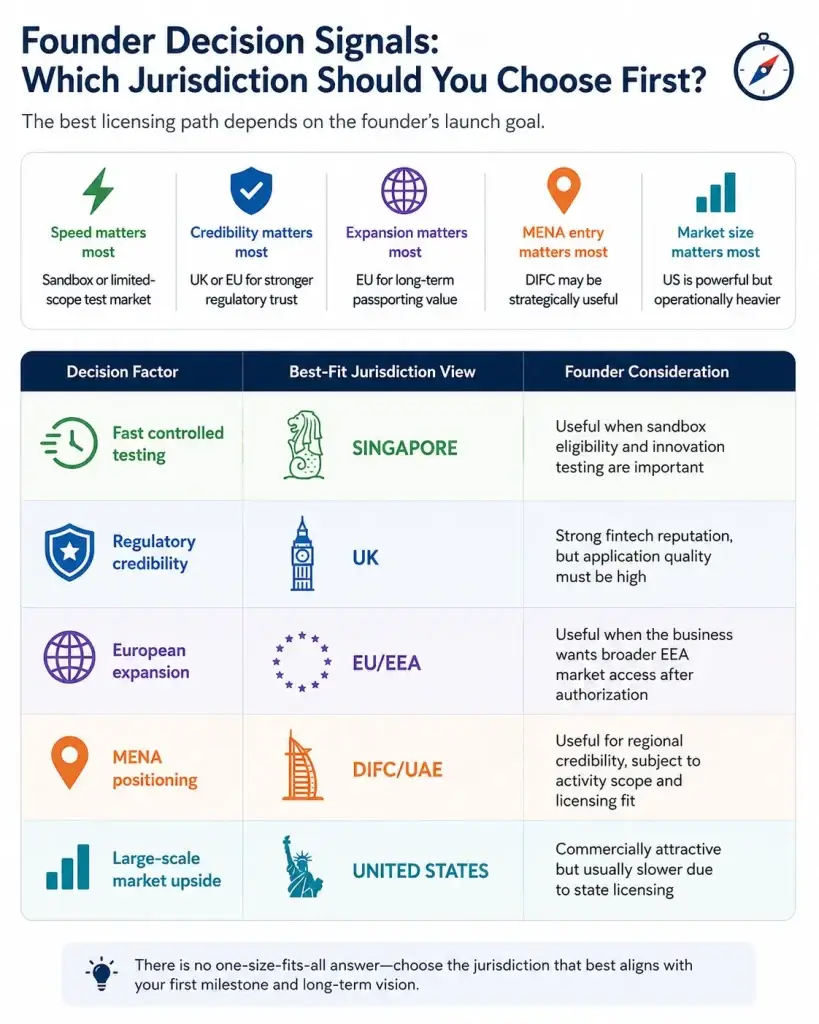
Founder Decision Signals: Which Jurisdiction Should You Choose First?
The best licensing path depends on the founder’s launch goal.
If speed matters most, a sandbox or limited-scope test market may be the right first step.
If credibility matters most, the UK or EU may provide stronger regulatory trust.
If expansion matters most, the EU may offer long-term passporting value.
If MENA entry matters most, DIFC may be strategically useful.
If market size matters most, the US is powerful but operationally heavier.
| Decision Factor | Best-Fit Jurisdiction View | Founder Consideration |
|---|---|---|
| Fast controlled testing | Singapore | Useful when sandbox eligibility and innovation testing are important |
| Regulatory credibility | UK | Strong fintech reputation, but application quality must be high |
| European expansion | EU/EEA | Useful when the business wants broader EEA market access after authorization |
| MENA positioning | DIFC/UAE | Useful for regional credibility, subject to activity scope and licensing fit |
| Large-scale market upside | United States | Commercially attractive but usually slower due to state licensing |
What Founders Should Build Before Applying for a Remittance License
Licensing success depends on more than legal documents. Regulators want to see that the business can operate responsibly. That means the platform itself should support compliance workflows from the beginning..
| Product Layer | Why It Matters for Licensing | Founder Impact |
|---|---|---|
| KYC and identity verification | Supports customer due diligence and risk classification | Reduces onboarding risk and improves audit readiness |
| AML and transaction monitoring | Flags unusual activity, high-risk transfers, and suspicious patterns | Helps compliance teams review risk before payout |
| Wallet ledger and transaction records | Maintains accurate balances, transfer logs, fees, and FX details | Protects customer trust and supports reconciliation |
| Admin dashboard | Gives operators control over users, transfers, rates, limits, reviews, and disputes | Allows business teams to operate without developer dependency |
| Role-based access control | Limits sensitive actions to authorized team members | Improves internal governance and reduces operational abuse |
| Audit logs | Records actions taken by users, admins, and compliance teams | Supports regulatory reviews and internal investigations |
| Safeguarding and reconciliation workflows | Helps protect customer funds and track operational balances | Important for payment and e-money institution readiness |
This is where product readiness and licensing readiness meet. A fintech app can look complete on the frontend but still be unprepared for authorization if the backend cannot support compliance operations.
Common Mistakes Founders Make With Remittance Licensing
Building the App Before Mapping Regulated Activities
A wallet, FX transfer, payout flow, or stored balance can change the licensing route. Founders should map funds flow and regulated activities before finalizing product architecture.
Assuming Sandbox Approval Equals Full Authorization
Sandbox testing can help validate innovation, but it does not automatically replace full licensing. Founders need a transition plan from test environment to commercial launch.
Choosing the US First Without State Licensing Budget
The US market is attractive, but broad state-by-state licensing can require significant time, capital, bonds, compliance support, and operational preparation.
Ignoring Compliance Workflows Inside the Admin Panel
A Wise-like app needs admin controls for user verification, transfer review, blocked transactions, risk flags, refunds, disputes, and audit records.
How Miracuves Helps Build Compliance-Ready Remittance Platforms
Miracuves helps founders build ready-made and white-label fintech platforms designed around faster launch, source-code ownership, admin control, and business model clarity.
For remittance founders, the product foundation matters because licensing teams, banking partners, and compliance advisors need a platform that can support real operational controls.
A Wise clone solution from Miracuves can be customized for user onboarding, KYC workflows, transfer management, transaction history, admin review, payout integrations, fee logic, FX visibility, and compliance-ready dashboards.
For founders comparing broader fintech models, Miracuves’ Revolut clone app and fintech app development solutions can also help evaluate wallet, neobank, and remittance product paths.
Miracuves does not provide legal approval or guarantee regulatory authorization. Final compliance depends on jurisdiction, legal review, banking partners, operating model, integrations, and regulator expectations.
The value of a strong product foundation is that it gives founders a better operational base for the licensing journey.
Conclusion: The Fastest Jurisdiction Is the One That Matches Your Launch Strategy
There is no single fastest jurisdiction for every Wise-like platform.
Singapore may be faster for controlled testing. The UK may be clearer for prepared applicants. The EU may offer stronger expansion leverage after authorization. DIFC may support strategic MENA positioning. The US may offer the biggest upside but usually requires the heaviest licensing operation.
The strongest founder decision is to align licensing, product architecture, banking partnerships, compliance workflows, and launch geography before development goes too far.
Remittance apps are trust products. The faster path is not the one that avoids regulation. It is the one that builds regulatory readiness into the product from the beginning.