Key Takeaways
- A rapid app development process helps founders launch faster by using ready-made foundations, proven workflows, and structured delivery systems.
- The 6-day delivery model works best when the app is built from pre-tested modules instead of starting from a blank codebase.
- Speed does not mean skipping quality; it depends on clear onboarding, defined scope, repeatable QA checks, deployment readiness, and source-code handover.
- Fast delivery helps businesses reduce market-entry delays, test demand earlier, collect real user feedback, and improve based on actual behavior.
- The strongest rapid app development strategy combines speed, customization, admin control, scalable architecture, and post-launch improvement.
Delivery Signals
- Ready-made app foundations reduce development time because core user flows, admin panels, payment logic, and essential modules are already available.
- Structured onboarding helps define branding, app category, feature priorities, customization needs, deployment requirements, and launch expectations early.
- Reusable modules make delivery faster for common app categories such as delivery apps, taxi apps, marketplace apps, fintech apps, rental platforms, and creator platforms.
- QA checks become easier when the team is working with known workflows, tested screens, standard integrations, and documented backend logic.
- Development cost and delivery time can still change based on customization depth, third-party APIs, payment gateways, design changes, compliance needs, and scalability requirements.
Real Insights
- A 6-day app launch is possible only when the delivery process is mature, repeatable, and supported by existing product foundations.
- Founders should judge rapid app development by process quality, not just by the promised timeline on a sales page.
- The real advantage of faster delivery is not just launching quickly; it is learning from users before competitors capture the market.
- A strong rapid delivery model should still include branding, configuration, testing, deployment preparation, admin access, and source-code ownership.
- The best rapid app development process gives founders a launch-ready product foundation today and enough flexibility to customize, scale, and improve tomorrow.
Fast app delivery sounds attractive until a founder asks the serious question: what gets sacrificed to move that quickly?
That question is valid. Many businesses have seen rushed software projects fail because the team skipped planning, ignored QA, delivered weak backend logic, or treated deployment as an afterthought. So when Miracuves says a ready-made app can be launched in 6 days, the claim deserves a transparent explanation.
The answer is simple: Miracuves does not build every app from zero in 6 days.
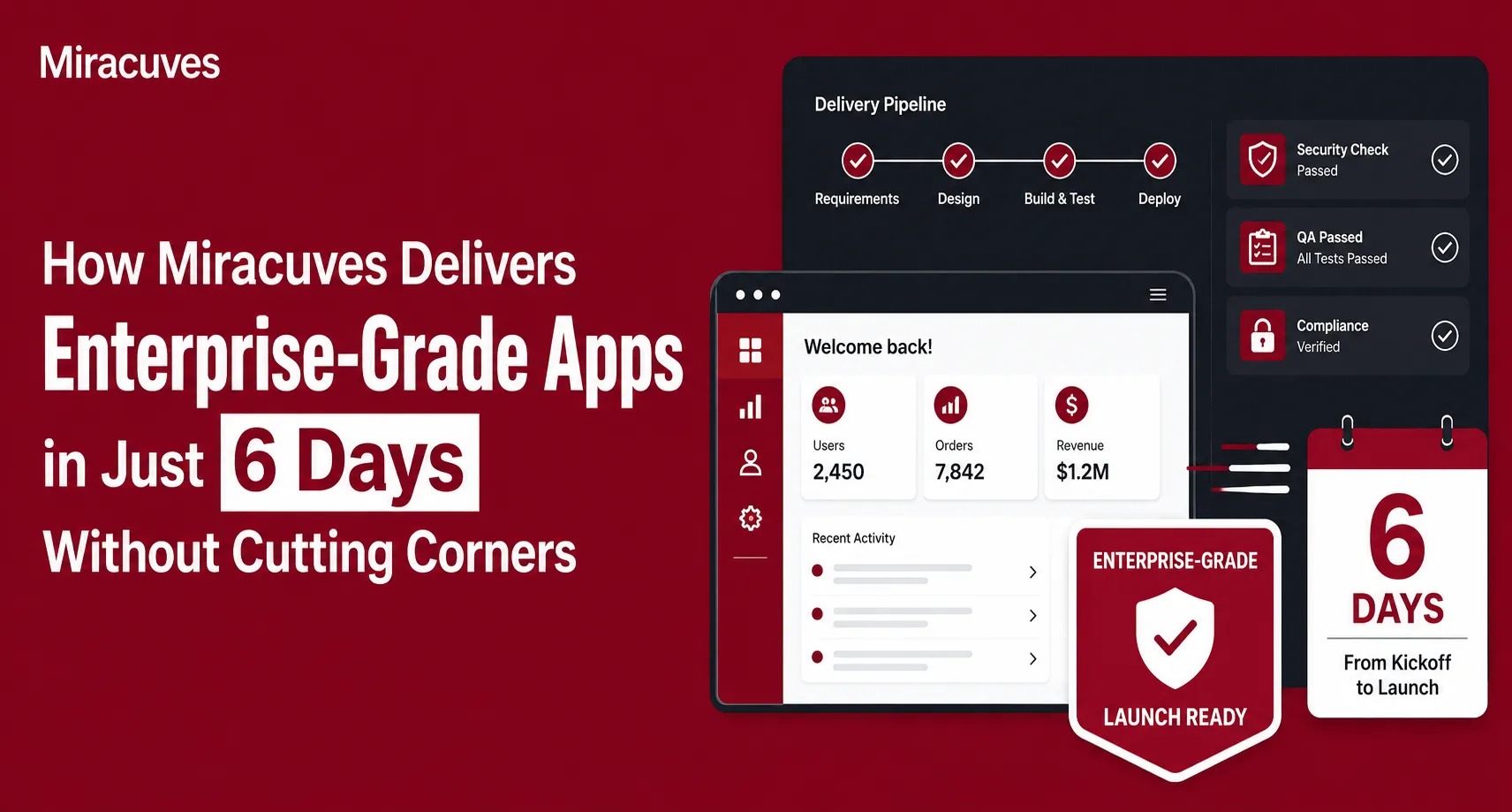
Instead, Miracuves uses a controlled rapid app development process built around ready-made, white-label, source-code-owned app foundations. The core product architecture, user flows, admin controls, and essential modules already exist. The 6-day delivery window is used for requirement alignment, branding, configuration, module verification, QA, server setup, deployment preparation, and handover.
That difference matters.
A rushed custom build often cuts corners. A structured ready-made delivery process reduces avoidable work because the foundation is already available. For founders, this means faster market validation without losing control over branding, admin operations, source code, or launch readiness.
Why Founders Are Right to Question a 6-Day App Launch
Most founders are not skeptical because they dislike speed. They are skeptical because speed often creates risk.
A founder planning a delivery app, fintech product, marketplace, ride-hailing platform, social network, or creator platform needs more than attractive screens. They need working app flows, stable panels, admin control, secure configuration, payment readiness, deployment support, and a clear handover process.
The real concern is not whether an app can be delivered quickly. The concern is whether the app will be usable, manageable, and scalable after delivery.
That is where the Miracuves approach is different. The 6-day model is not based on skipping discovery, ignoring QA, or pushing unfinished code. It is based on using a ready-made product foundation that has already passed through repeated development logic, common workflow design, and reusable platform architecture.
In other words, the speed comes from preparation, not shortcuts.
What Miracuves Means by “Enterprise-Grade” in a Rapid App Development Process
The phrase “enterprise-grade” is often used loosely in app development. For Miracuves, it should be understood through practical product readiness, not inflated language.
An enterprise-grade ready-made app foundation should support the business operator, the end user, and the platform team. It should include the core modules required to run the business, not just a visual demo.
That typically means:
- User-facing app flows
- Admin dashboard control
- Relevant business panels such as vendor, merchant, driver, provider, creator, or partner panels
- Payment or transaction workflow readiness where applicable
- Configurable branding
- Role-based access and platform management
- Source-code handover
- Deployment support
- Post-launch technical support where applicable
For a founder, the most important part is control. A fast launch is not useful if the business cannot manage users, orders, content, payments, commissions, disputes, listings, providers, or reports from the backend.
That is why Miracuves focuses on a launch-ready product foundation rather than only frontend screens.
What Miracuves’ 6-Day Delivery Is : and What It Is Not
A 6-day launch does not mean every possible custom feature, third-party integration, compliance workflow, market-specific rule, or unique product idea is built from scratch in under a week.
It means Miracuves starts from a ready-made, white-label foundation and prepares it for launch within a controlled delivery scope.
| What the 6-Day Model Means | What It Does Not Mean |
|---|---|
| Branding and configuration of a ready-made app foundation | Full custom software built entirely from zero |
| Setup of core modules already available in the solution | Unlimited new feature development |
| QA checks across included workflows | Skipping testing to launch faster |
| Deployment preparation and handover | Guaranteed app store approval timeline |
| Source-code-owned delivery where applicable | Vendor lock-in or demo-only access |
| Faster market validation | A promise that every complex custom idea fits 6 days |
This distinction protects both the founder and the delivery team. When the scope is clear, speed becomes practical. When the scope is vague, even a strong team can lose time to rework, unclear expectations, and last-minute changes.
The Rapid App Development Process Behind Miracuves’ 6-Day Delivery
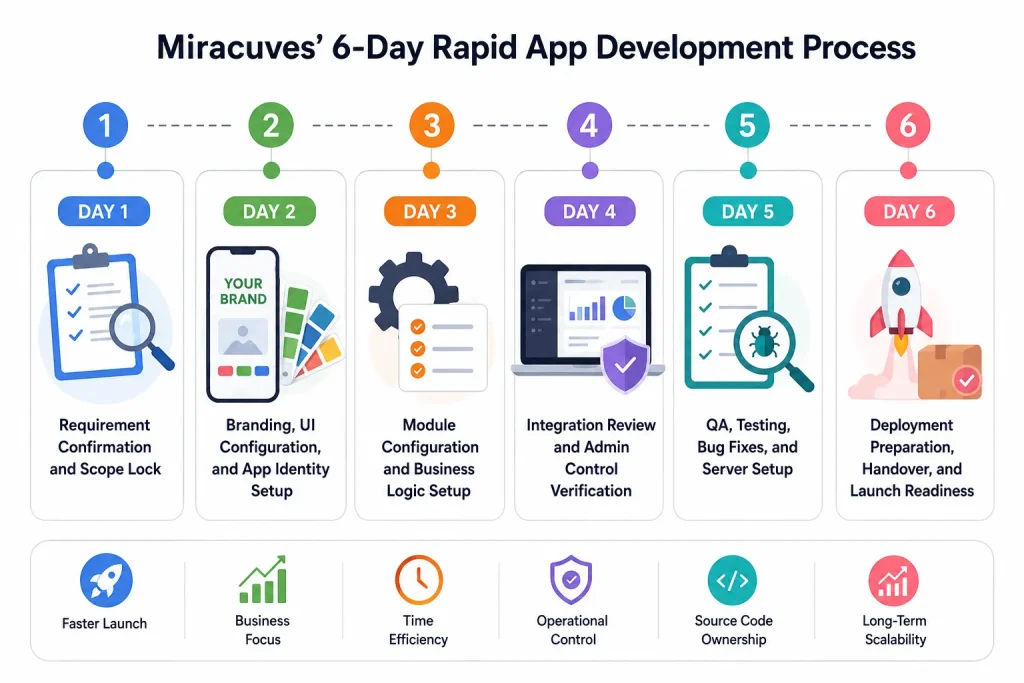
Miracuves’ rapid app development process works because the delivery flow is structured. Each day has a purpose, and each step moves the product closer to launch readiness.
The goal is not to “code fast.” The goal is to execute a prepared delivery system with fewer unknowns.
Day 1: Requirement Confirmation and Scope Lock
The first step is not development. It is alignment.
Miracuves confirms the app category, selected solution, business model, branding requirements, required panels, payment expectations, deployment needs, and any must-have configuration.
This stage is important because most project delays begin with unclear scope. A founder may say they need a delivery app, but the operational meaning can vary widely. Food delivery, grocery delivery, pharmacy delivery, courier delivery, and quick commerce all have different workflows.
A proper Day 1 scope lock helps answer questions such as:
- Which app panels are included?
- Which user roles are active?
- What branding assets are available?
- What payment gateway or configuration is required?
- Which modules are part of the ready-made package?
- Which requests are customizations that may extend the timeline?
This is where Miracuves protects the 6-day model. The process moves quickly because the foundation is already available, but the delivery still needs business clarity.
Day 2: Branding, UI Configuration, and App Identity Setup
Once the scope is confirmed, the next step is brand alignment.
This includes app name, logo, theme colors, splash screens, basic visual identity, and other brand-facing elements supported within the selected solution. The goal is to make the ready-made app feel like the founder’s own product, not a generic template.
White-label delivery matters because users should experience the app as a branded business platform. The founder should be able to present the product to users, investors, partners, merchants, drivers, creators, or service providers with confidence.
This is also where the team checks that the brand identity does not create usability problems. For example, color combinations should remain readable, buttons should remain visible, and core user flows should remain clear after branding changes.
Speed should never come at the cost of basic user experience.
Day 3: Module Configuration and Business Logic Setup
On Day 3, the team focuses on the operational layer.
This may include configuring categories, service types, commission logic, user roles, admin permissions, business rules, language or currency settings where applicable, and other available modules inside the ready-made solution.
This is where the app starts becoming business-ready.
For example, a marketplace app needs listing, booking, payment, review, and admin flows. A ride-hailing app needs rider, driver, booking, tracking, fare, and admin workflows. A delivery app needs customer, merchant, delivery partner, order, dispatch, and admin controls. A fintech app needs wallet, transaction, KYC-ready, and admin risk-control logic depending on the selected product scope.
The value of a ready-made foundation is that these flows do not need to be invented from scratch. They need to be configured, checked, and aligned with the founder’s launch model.
Day 4: Integration Review and Admin Control Verification
A strong app is not only what users see. It is also what the business owner can control.
Day 4 focuses on the backend and admin layer. The team verifies whether the platform operator can manage the important parts of the business.
Depending on the app type, this may include:
- User management
- Vendor or provider management
- Category and listing control
- Order, booking, or transaction review
- Commission settings
- Content moderation
- Payment settings
- Reports and analytics visibility
- Dispute or support management
- Notifications and communication controls
This step is critical because a founder cannot scale a platform that depends on developers for every small operational change.
Admin control is what turns an app from a software package into a business operating system. A rapid app development process should therefore validate the backend before launch, not treat it as a secondary feature.
Day 5: QA, Testing, Bug Fixes, and Server Setup
Day 5 is where speed must meet discipline.
Miracuves checks the included app flows across relevant roles and panels. The purpose is to identify issues before launch, not after users start interacting with the platform.
QA may include:
- Login and registration checks
- User role verification
- App panel navigation
- Admin dashboard checks
- Booking, order, listing, or transaction flow testing
- Payment configuration checks where applicable
- Notification flow review
- Device and screen checks
- Basic performance validation
- Server setup and environment readiness
- Bug fixing for included scope
This is the part that separates a serious rapid app development process from a rushed delivery. Testing is not optional. It is built into the delivery timeline.
A fast launch should still include enough verification to ensure that the core included workflows are working as expected.
Day 6: Deployment Preparation, Handover, and Launch Readiness
Day 6 focuses on final delivery.
This may include deployment preparation, app store or play store submission support where applicable, source code handover, admin credential sharing, documentation guidance, and final launch-readiness checks.
The founder receives the product in a usable form, with the control layer needed to begin operating the app. For ready-made Miracuves solutions, this is where the value of source-code ownership becomes important.
Source code gives the founder more long-term flexibility. It allows future customization, technical review, team expansion, and product evolution without depending entirely on a closed vendor environment.
That is an important difference between renting a platform and owning a launch-ready app foundation.
Why Miracuves Can Move Fast Without Cutting Corners
The reason Miracuves can deliver quickly is not because the team skips steps. It is because the steps are applied to a pre-built foundation.
Traditional custom development often includes months of product discovery, UX design, architecture planning, coding, integration, QA, deployment, and iteration. That path is useful when the product is highly unique and requires custom logic from day one.
But many founders do not need to invent every module from zero. They need a proven app model, branded for their market, configured for their operations, and ready for validation.
Miracuves’ 6-day model works because of four delivery advantages:
1. The Core Architecture Already Exists
The app foundation is already developed around known platform patterns. That means the team is not spending the first week deciding how login, profiles, listings, bookings, orders, payments, admin control, or dashboards should work.
2. Modules Are Reused, Not Rebuilt Every Time
Reusable modules reduce development waste. The team focuses on configuration, branding, QA, and deployment rather than reinventing standard workflows.
3. Scope Is Controlled Early
The 6-day timeline depends on a clear delivery scope. New custom features, complex integrations, and market-specific rules can be added, but they should be treated separately from the ready-made launch timeline.
4. QA Is Part of the Process
Fast delivery does not mean releasing without checks. Miracuves includes QA and setup steps before handover so the founder receives a more launch-ready foundation.
Read More : Why Time to Market Matters More Than Ever in App Development
Rapid App Development Process vs Traditional Custom Development
Both approaches have value. The right choice depends on the founder’s stage, risk tolerance, budget, timeline, and product uniqueness.
| Decision Factor | Ready-Made Rapid App Development | Traditional Custom Development |
|---|---|---|
| Best for | Faster launch, validation, proven app models | Highly unique products with custom logic |
| Timeline logic | Uses pre-built modules and configuration | Starts from planning, design, and coding |
| Founder risk | Lower early-stage build risk | Higher time and budget exposure |
| Customization | Available within and beyond selected scope | Fully flexible but slower |
| QA approach | Checks included workflows before launch | QA across newly built modules |
| Ownership | Source-code-owned delivery where applicable | Depends on vendor agreement |
| Cost logic | More cost-efficient for standard app models | Higher due to ground-up development |
| Market validation | Faster | Slower but deeper customization possible |
The smarter question is not “Which one is better?” The smarter question is: What does the founder need right now?
If the goal is to validate a proven business model quickly, a ready-made app foundation can be the stronger decision. If the business requires a completely original product engine, custom development may be more appropriate.
Miracuves supports both paths, but the 6-day claim applies to ready-made solutions within a defined launch scope.
What Actually Gets Checked Before Launch?
A transparent rapid app development process should include visible readiness checks. Founders should ask what is reviewed before the app is handed over.
Here is a practical launch-readiness view.
| Readiness Area | What Should Be Checked | Why It Matters |
|---|---|---|
| User flows | Registration, login, profile, search, booking, order, payment, or content flow | Confirms users can complete core actions |
| Admin dashboard | User control, settings, reports, categories, transactions, moderation | Gives the founder operational control |
| Business logic | Commission, pricing, service categories, role permissions | Ensures the app matches the business model |
| Branding | Logo, colors, app name, visual identity | Makes the product market-ready |
| Integrations | Payment gateway, notifications, maps, or other selected tools | Reduces launch friction |
| Security basics | Access control, credentials, admin permissions | Protects platform operations |
| Deployment | Server setup, build preparation, app submission support | Moves the app toward public availability |
| Handover | Source code, credentials, usage guidance | Gives the founder long-term control |
This is why QA should not be viewed as only bug detection. QA is business readiness verification.
What Makes a 6-Day App Enterprise-Ready?
Enterprise readiness is not about adding unnecessary complexity. It is about giving the founder a foundation that can support real operations.
A Miracuves-ready app foundation should focus on:
Admin Control
The admin dashboard is the command center of the business. It helps the platform operator manage users, vendors, orders, transactions, listings, categories, reports, disputes, and platform settings depending on the app type.
Without admin control, the founder owns an app but not the business engine.
Source-Code Ownership
Source-code ownership gives founders more flexibility after launch. They can extend features, review architecture, work with internal developers, or request future customization.
This matters because the first launch is rarely the final product. The app should be able to evolve.
Scalable Product Foundation
A scalable foundation helps the app handle future growth more effectively. This includes backend structure, modular workflows, role-based panels, and deployment readiness.
Scalability should be planned early because rebuilding core systems later can become expensive.
White-Label Branding
White-label branding allows the business to launch under its own identity. Users interact with the founder’s brand, not the vendor’s brand.
Monetization Readiness
Most app businesses need revenue logic from the beginning. Depending on the app category, this may include commissions, subscriptions, delivery fees, booking fees, premium listings, ads, creator commissions, or transaction-based models.
Post-Launch Support
A real launch includes follow-up. Post-launch technical support helps founders handle early bugs, setup questions, and operational issues after deployment.
Read More : Clone App Development: The Fastest Way to Validate a Market Without Starting From Zero
Where the 6-Day Model Works Best
The 6-day rapid app development process is especially useful when the founder wants to launch a business based on a proven app model.
Examples include:
- Food delivery platforms
- Grocery delivery apps
- Taxi and ride-hailing apps
- Service marketplaces
- Rental marketplaces
- Fintech and wallet apps
- Short video and creator platforms
- Ecommerce marketplaces
- Logistics and courier apps
- Healthcare booking apps
- Education platforms
- Social networking apps
For these categories, the core workflows are already known. The founder’s advantage comes from market positioning, branding, operations, pricing, supply acquisition, customer acquisition, and post-launch iteration.
A ready-made app helps the founder reach that stage faster.
What May Extend the Timeline Beyond 6 Days?
Trust comes from honesty. Not every request belongs inside a 6-day launch.
The timeline may extend when the founder needs:
- Complex custom features
- New app modules not included in the selected solution
- Advanced third-party integrations
- Heavy UI redesign
- Custom compliance workflows
- Region-specific payment or tax logic
- Multi-language expansion beyond available setup
- Complex data migration
- Unique algorithms
- Enterprise security reviews
- Custom reporting dashboards
- App store review delays outside vendor control
This does not weaken the 6-day claim. It clarifies it.
The 6-day model is for launching a ready-made, white-label foundation. Custom expansion can happen after launch or as a separate scoped phase.
Founder Decision Signals: Is the 6-Day Model Right for You?
Founder Decision Signals
Speed
Choose the 6-day model when you need a launch-ready foundation quickly and your business fits a proven app category.
Cost
A ready-made foundation is more cost-efficient than rebuilding standard modules from zero, especially for validation-stage founders.
Scalability
Look for source code, admin control, modular workflows, and backend readiness so the app can evolve after launch.
Market Fit
Use the first launch to test demand, collect feedback, and decide which custom features deserve investment next.
A fast app launch is not right for every founder. It is right when the business goal matches the delivery model.
Choose a ready-made rapid app development process if:
- You want to validate demand quickly
- Your business model follows a proven app category
- You need user, provider, vendor, driver, creator, or admin panels
- You prefer source-code ownership over platform rental
- You want to avoid building standard modules from zero
- You need a cost-efficient launch path
- You plan to customize after market feedback
- You want faster investor, partner, or user demonstrations
Choose custom development if:
- Your core product logic is highly unique
- Your workflows do not match existing app categories
- You need deep enterprise integrations from day one
- You have a longer development runway
- You need proprietary algorithms or unusual architecture at launch
The best founders do not choose speed blindly. They choose the build path that matches their current business risk.
Mistakes Founders Should Avoid When Choosing Rapid App Development
Fast development can be powerful, but only when expectations are managed correctly.
Mistake 1: Expecting Unlimited Customization Inside a Fixed 6-Day Scope
A ready-made app can be customized, but unlimited changes can turn a rapid launch into a custom project. Founders should separate launch-critical changes from future enhancements.
Mistake 2: Choosing Speed Without Source-Code Ownership
A fast launch is less valuable if the founder does not control the product foundation. Source code helps protect long-term flexibility.
Mistake 3: Ignoring the Admin Dashboard
Many founders focus on mobile screens and forget the backend. The admin dashboard is where the business is actually managed.
Mistake 4: Skipping QA Questions
Founders should ask what is tested, when it is tested, and what happens if bugs appear after launch. A serious rapid app development partner should have a QA process.
Mistake 5: Treating Launch as the Finish Line
Launch is the beginning of market learning. The first version should help the founder test demand, collect feedback, refine operations, and plan the next release.
How Miracuves Reduces Launch Risk for Founders
For most founders, the biggest risk is not only development cost. It is spending months building an app that is still not ready for users, operations, payments, admin control, or market validation.
Miracuves reduces this risk by combining speed, structure, and ownership. The 6-day delivery model is built around a ready-made app foundation, which means the core product flows are already available before the project begins. Instead of spending the first few weeks designing standard modules from zero, the team focuses on preparing the app for a real business launch.
This includes:
| Risk Area | How Miracuves Reduces It | Founder Benefit |
|---|---|---|
| Long development delays | Uses a ready-made foundation with pre-built core modules | Faster launch and earlier market validation |
| Weak operational control | Includes admin dashboard and role-based control panels | Founder can manage users, services, orders, content, payments, or providers |
| Generic branding | Applies white-label branding with app name, logo, colors, and identity | The app launches under the founder’s own brand |
| Vendor lock-in | Provides source-code ownership where applicable | More flexibility for future customization and scaling |
| Poor launch readiness | Adds QA, module checks, and deployment preparation | Fewer avoidable issues before handover |
| Wrong feature investment | Helps launch first, collect feedback, and customize later | Better product decisions based on real user behavior |
This approach is especially useful for founders who want to move quickly but do not want to depend on a no-code prototype, a generic SaaS rental, or a long custom development cycle.
A no-code prototype may help validate an idea visually, but it often lacks deep backend control. A SaaS rental may be quick, but it can limit ownership and customization. A full custom build gives flexibility, but it can take longer and increase early-stage risk.
Miracuves offers a more practical middle path: a ready-made, white-label, source-code-owned app foundation that can be launched faster and improved after real market feedback.
For founders, this means the first launch is not treated as the final product. It becomes a controlled market-entry version that helps test demand, understand user behavior, and decide which features deserve deeper investment next.
Why the 6-Day Claim Is Really About Process Maturity
A weak team cannot deliver faster just by promising speed. Fast delivery requires systems.
Miracuves’ 6-day model is possible because the company is not starting with an empty codebase. It is working from ready-made foundations, known modules, structured onboarding, repeatable QA checks, deployment workflows, and source-code handover practices.
That is the difference between speed as a sales claim and speed as an operating model.
For founders, the value is not only “getting an app quickly.” The value is reducing the time between idea, launch, feedback, and business validation.
Final Thoughts: Fast Delivery Works When the Foundation Is Already Strong
The real value of Miracuves’ rapid app development process is not that it compresses months of custom development into 6 careless days. It is that the core foundation is already prepared, tested, and structured for faster launch.
That is how Miracuves delivers enterprise-grade, white-label app solutions without cutting corners.
The founder gets a branded app foundation, admin control, source code, deployment support, and a faster path to market. Custom features can still be added, but they do not need to block the first launch.
For many founders, that is the smarter path: launch faster, learn earlier, reduce avoidable development risk, and build the next version with real market feedback.
FAQs
What is Miracuves’ rapid app development process?
Miracuves’ rapid app development process is a structured delivery workflow for ready-made, white-label app solutions. It includes requirement confirmation, branding, module configuration, admin verification, QA, deployment preparation, source-code handover, and launch readiness.
How can Miracuves deliver an app in 6 days?
Miracuves can deliver ready-made apps in 6 days because the core app foundation is already built. The 6-day timeline is used for branding, configuration, QA, server setup, deployment preparation, and handover. It is not the same as building a fully custom app from zero.
Does a 6-day app launch mean quality is compromised?
No. A serious rapid app development process should include QA and readiness checks. Miracuves’ model includes verification of core workflows, admin controls, included modules, deployment setup, and handover steps before launch.
Is the 6-day timeline available for custom app development?
The 6-day timeline applies to ready-made Miracuves solutions within a defined scope. Custom app development may take longer depending on features, integrations, design requirements, compliance needs, and technical complexity.
What makes a ready-made app enterprise-grade?
An enterprise-grade ready-made app should include scalable architecture, admin dashboard control, relevant user and business panels, configurable branding, source-code ownership, deployment readiness, and support for monetization workflows.
Will I own the source code after delivery?
Miracuves positions its ready-made solutions around source-code-owned delivery where applicable. Source-code ownership gives founders more flexibility for future customization, technical review, and long-term product growth.
What can extend the delivery timeline beyond 6 days?
Advanced custom features, complex integrations, heavy UI redesign, compliance-specific workflows, custom algorithms, data migration, third-party approval delays, or major scope changes can extend the timeline beyond the standard 6-day ready-made delivery process.
Is rapid app development suitable for startups?
Yes, rapid app development is useful for startups that want to validate a proven business model faster. It helps founders reduce time-to-market, avoid rebuilding standard modules from zero, and invest future customization based on real user feedback.
Miracuves is an independent software development company. We are not affiliated with, connected to, sponsored by, or endorsed by any company or product named in this article.
Terms such as “X Clone” are used descriptively. It is how the software industry refers to building a platform with functionality comparable to a known service, and how clients search for it.
The entire design and codebase of our products is built by our own team. Our products contain no code, design, graphics, or content originating from any third-party website or applications.
All third-party names and marks referenced in this article are the property of their respective owners, referenced solely to identify the services discussed.