


Key Takeaways
- Scaling beyond clone apps often requires moving from monolithic systems to more flexible and scalable custom architecture.
- Clone apps help founders launch quickly, but growing traffic, complex workflows, and new business requirements can expose architectural limitations.
- Custom architecture allows better control over scalability, performance, integrations, security, and feature-specific backend logic.
- The transition should happen strategically through modular upgrades instead of rebuilding the entire platform at once.
- Long-term growth depends on separating business-critical services, optimizing infrastructure, improving APIs, and preparing for future scale.
Architecture Signals
- Common scaling problems include slow APIs, database bottlenecks, payment failures, delayed notifications, heavy server load, and feature deployment friction.
- Microservices, event-driven systems, caching layers, message queues, and scalable cloud infrastructure help improve performance at higher traffic levels.
- Separating services like payments, user management, recommendations, notifications, and analytics improves operational flexibility.
- Modern scaling strategies often include Docker, Kubernetes, Redis, Kafka, CDN optimization, distributed databases, and asynchronous processing.
- Infrastructure decisions should align with business priorities such as speed, reliability, monetization, global expansion, and operational efficiency.
Real Insights
- A clone app is not a limitation by itself; the real challenge comes when business growth outpaces the original architecture design.
- The smartest founders do not rebuild everything immediately; they gradually modernize the most critical bottlenecks first.
- Scaling architecture should be driven by real usage patterns, user pain points, revenue opportunities, and operational challenges.
- Custom architecture becomes valuable when the platform needs unique workflows, advanced automation, AI systems, or large-scale concurrent activity.
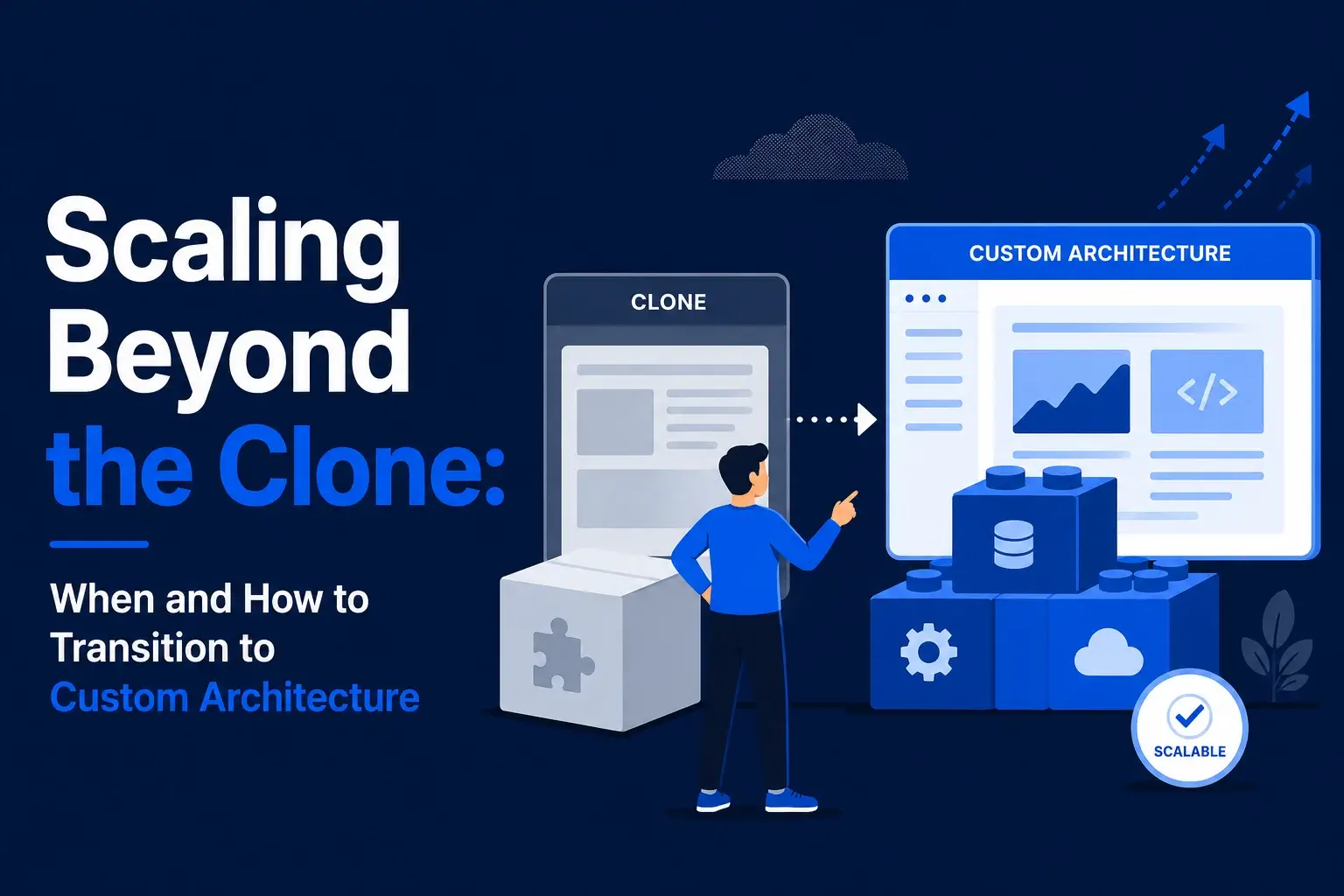
- The strongest growth strategy combines rapid launch speed from clone systems with long-term scalability through carefully planned custom infrastructure.
Launching with a clone app or ready-made app foundation can be one of the smartest early-stage decisions a founder makes. It helps reduce development time, validate demand faster, avoid unnecessary product complexity, and enter the market before competitors spend months building from zero.
But every successful app eventually reaches a question that cannot be ignored:
Is our current architecture strong enough for the next stage of growth?
That is where scale app architecture becomes a serious business decision, not just a technical discussion.
At the beginning, the goal is speed. You need working user flows, admin control, payment logic, notifications, core panels, and a product foundation that lets you test the market. But after traction begins, the priorities change. You now need performance under load, modular feature expansion, cleaner data structure, deeper integrations, stronger security, cloud optimization, and a backend that can support long-term growth. This is where founders must learn how to move beyond the clone without throwing away everything that helped them launch.
A ready-made solution from Miracuves can give founders a strong starting point with white-label branding, source-code ownership, admin dashboards, and faster deployment. But once your platform starts seeing higher usage, complex workflows, regional expansion, or advanced monetization needs, the next move is not simply “add more features.” The next move is to evolve the architecture.
Why Clone App Architecture Works Well in the Early Stage
A clone app is not valuable because it copies another platform. It is valuable because it starts with a proven product pattern.
For early-stage founders, this matters because the first goal is rarely architectural perfection. The first goal is market validation. You need to know whether users will register, vendors will onboard, drivers will accept jobs, creators will upload content, buyers will transact, or customers will return.
A ready-made or clone-based foundation usually gives you:
- User-facing app flows
- Admin dashboard
- Core transaction logic
- Basic monetization modules
- Role-based panels
- Notifications
- Payment gateway integration
- Listing, booking, ordering, or content flows
- White-label branding
- Faster deployment
This is enough for many founders to test pricing, operations, user behavior, supply-demand balance, and retention.
The mistake is not starting with a clone foundation. The mistake is assuming the same architecture should remain unchanged forever.
When “Good Enough to Launch” Becomes “Not Enough to Scale”
A launch-ready architecture is designed to help you enter the market. A scalable architecture is designed to help you survive growth.
These are different goals.
At launch, you may have a few hundred users, limited transactions, a smaller product team, and manageable support requests. As the platform grows, the system starts carrying heavier pressure from every side.
More users create more sessions. More transactions increase database writes. More vendors or providers create admin complexity. More content increases storage and moderation needs. More regions increase compliance and localization requirements. More integrations increase failure points.
This is usually when founders realize that the real bottleneck is not the app screen. It is the architecture behind the screen.
Clear Signs It Is Time to Scale App Architecture
You do not need to rebuild your app just because traffic increased. Scaling should be driven by evidence.
Here are the practical signs that your app architecture needs to evolve.
1. Performance Starts Dropping During Peak Usage
If the app becomes slow during high-traffic windows, campaign launches, order spikes, or creator activity peaks, your backend may not be distributing load efficiently.
This can happen when too many functions depend on one server, one database, one API layer, or one synchronous workflow.
A scalable architecture may require caching, load balancing, background processing, database optimization, and cloud autoscaling. Cloud architecture frameworks from providers such as AWS and Google Cloud focus on designing workloads that are reliable, secure, efficient, cost-aware, and performance-oriented.
2. The Database Becomes the Bottleneck
Many apps scale the frontend before they scale the data layer. That creates problems.
Common database pressure points include:
- Slow queries
- Too many read/write operations
- Unindexed tables
- Large order or transaction histories
- Heavy reporting queries
- Real-time tracking data
- Content feed loading
- Search and filtering delays
At this stage, founders may need read replicas, indexing, caching, database partitioning, separate analytics storage, or even service-specific databases.
3. New Features Take Too Long to Add
Architecture is not only about traffic. It is also about development speed.
If every new feature breaks another module, your product may be too tightly coupled. For example, a delivery app where order logic, payment logic, driver assignment, merchant dashboards, notifications, and admin reports are all deeply connected can become difficult to modify.
This is often the point where a modular monolith or selected microservices can help. Atlassian describes a monolith as a single unified application and microservices as smaller independently deployable services, with the right choice depending on context.
4. Admin Operations Become Hard to Control
Founders often underestimate the backend control layer.
As your app grows, the admin dashboard must handle more than user management. It may need:
- Role-based access control
- Commission rules
- Refund and dispute workflows
- Vendor verification
- Driver or provider approval
- Fraud monitoring
- Content moderation
- Promo code controls
- Payout management
- Audit logs
- Regional settings
- Analytics
If the admin layer cannot support your operating model, your team becomes dependent on developers for every small change.
5. Third-Party Integrations Create Failure Risk
Early apps may use one payment gateway, one SMS provider, one map API, and one email tool. Growth-stage platforms often need multiple payment methods, CRM tools, marketing automation, fraud tools, analytics systems, tax modules, logistics APIs, or compliance workflows.
The more integrations you add, the more important it becomes to separate critical services, handle failures gracefully, retry failed jobs, and monitor API health.
6. You Are Expanding Across Cities, Countries, or Business Models
A local delivery platform may eventually become multi-city. A fintech app may need more KYC and transaction monitoring workflows. A creator platform may need better moderation and payout logic. A marketplace may add subscriptions, ads, premium listings, and vendor analytics.
Expansion usually changes the architecture because the app must now support different rules, roles, pricing, language, currencies, tax settings, and operational policies.
Clone App vs Custom Architecture: What Actually Changes?
The transition from clone app to custom architecture is not just about changing code. It is about changing the system’s ability to support growth.
| Layer | Clone / Ready-Made Foundation | Custom Scalable Architecture |
|---|---|---|
| Product goal | Faster launch and validation | Long-term growth and differentiation |
| Backend | Prebuilt core workflows | Modular, optimized, scalable services |
| Database | Standard structure for core flows | Optimized schema, replicas, partitioning, analytics separation |
| Admin control | Essential admin operations | Advanced role-based control, audit logs, automation, business rules |
| Integrations | Common third-party tools | Multiple integrations with fallback, retries, monitoring |
| Infrastructure | Standard deployment setup | Cloud-native scaling, load balancing, CDN, queues |
| Feature expansion | Customizable but bounded | Built around evolving product roadmap |
| Ownership | Strong when source code is included | Stronger when architecture is planned around business domains |
The right decision is not “clone app or custom architecture.” The smarter decision is clone app first when speed matters, then custom architecture when growth makes it necessary.
The Best Architecture Path Is Usually Gradual, Not a Full Rewrite
A full rewrite feels clean in theory. In practice, it can be risky.
A growing app already has users, transactions, content, vendors, payments, and operational workflows. Rebuilding everything at once can create downtime, data migration risk, delayed feature releases, and cost overruns.
A safer approach is phased modernization.
The strangler fig pattern is commonly used for this type of transition. AWS explains that this pattern helps migrate a monolithic application to microservices incrementally, reducing transformation risk and business disruption. Microsoft’s Azure Architecture Center also describes the strangler fig approach as a way to intercept and replace parts of a solution individually rather than migrate everything in one large cutover.
For founders, the practical meaning is simple:
Do not replace the whole app at once. Identify the modules under the most pressure and modernize those first.
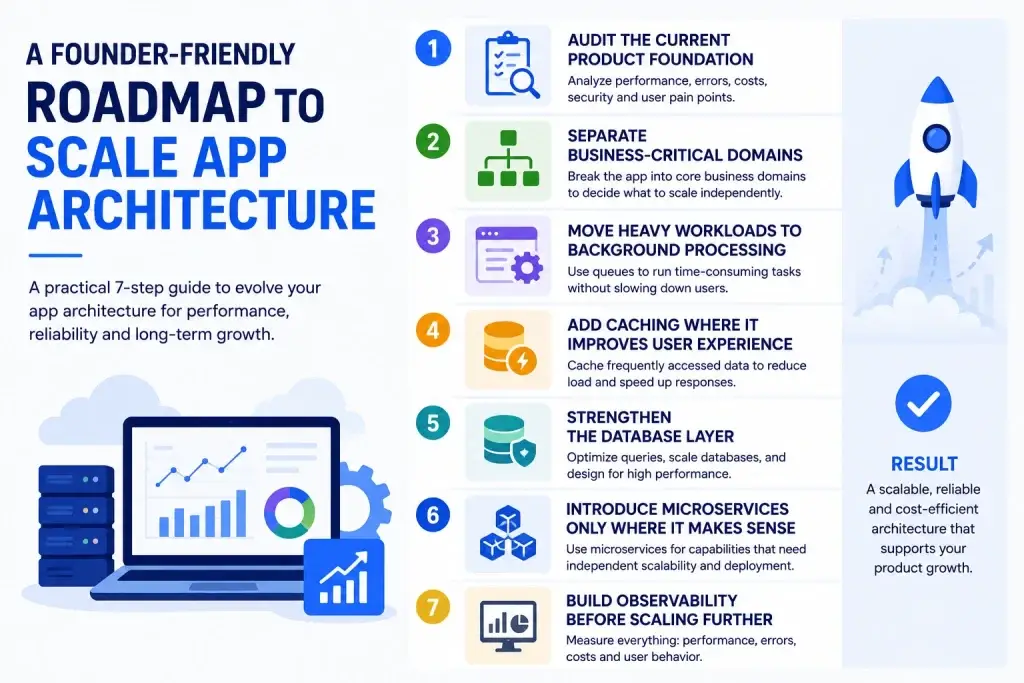
A Founder-Friendly Roadmap to Scale App Architecture
Step 1: Audit the Current Product Foundation
Before changing architecture, understand what is working and what is failing.
A proper audit should review:
- Backend performance
- Database queries
- Server load
- API response times
- Payment flow reliability
- Admin workflow limitations
- Error logs
- Third-party API failures
- Security gaps
- Cloud costs
- Feature development friction
- User complaints related to speed or reliability
This prevents founders from spending money on the wrong layer.
For example, slow checkout may look like a frontend issue, but the real cause may be payment API latency, database locking, or synchronous order processing.
Step 2: Separate Business-Critical Domains
Once the bottlenecks are clear, divide the app into business domains.
For a delivery app, the domains may include:
- User management
- Merchant management
- Catalogue and inventory
- Orders
- Payments
- Delivery allocation
- Tracking
- Notifications
- Ratings and reviews
- Admin reporting
For a short video app, the domains may include:
- User profiles
- Video upload
- Encoding
- Feed ranking
- Content moderation
- Creator monetization
- Notifications
- Comments
- Analytics
This helps the team decide which modules should stay in the core system and which should become independent services later.
Step 3: Move Heavy Workloads to Background Processing
Not every task should happen instantly during a user request.
Some operations can run in the background, such as:
- Sending notifications
- Processing videos
- Generating invoices
- Updating analytics
- Running fraud checks
- Syncing third-party tools
- Preparing reports
- Matching delivery partners
- Sending emails or SMS
- Updating recommendation signals
This is where queue-based architecture helps. Microsoft explains that queue-based load leveling uses a queue as a buffer between tasks and services, which can help improve availability and scalability during demand spikes.
For founders, this means the app feels faster because users do not wait for every backend task to finish in real time.
Step 4: Add Caching Where It Improves User Experience
Caching can reduce repeated database calls and improve response speed.
Useful caching areas include:
- Home page content
- Product listings
- Restaurant menus
- Location-based results
- Frequently viewed profiles
- Feed metadata
- Pricing rules
- Search filters
- Static configuration
- Public content
Azure’s architecture guidance describes caching as a technique that improves performance and scalability by copying frequently accessed data to fast storage closer to the application.
However, caching must be used carefully. Payment status, wallet balance, delivery tracking, and compliance-sensitive records should not rely on stale data without proper rules.
Step 5: Strengthen the Database Layer
Database scaling is often one of the most important parts of custom architecture.
Depending on the app, this may include:
- Better indexing
- Query optimization
- Read replicas
- Write optimization
- Database partitioning
- Archiving old records
- Separating transactional and analytical databases
- Moving logs and events to dedicated storage
- Using search engines for complex search
- Designing service-specific data ownership
A marketplace, delivery, fintech, or creator app can generate massive operational data. Without database planning, even a well-designed frontend will feel slow.
Step 6: Introduce Microservices Only Where They Make Business Sense
Microservices are powerful, but they are not automatically the right answer.
They introduce complexity in deployment, monitoring, communication, testing, data consistency, and DevOps. For many apps, a well-structured modular monolith can scale for longer than founders expect.
Microservices make more sense when:
- Different modules have different scaling needs
- Teams need independent deployment
- A module changes frequently
- A function is business-critical and high-load
- Failure isolation is important
- Integrations require separate reliability handling
- The product roadmap is expanding into multiple business lines
A strong transition strategy does not ask, “Should we use microservices?” It asks, “Which business capability needs independent scalability?”
Step 7: Build Observability Before Scaling Further
You cannot scale what you cannot measure.
Growth-stage apps need visibility into:
- API response times
- Error rates
- Server resource usage
- Database performance
- Queue length
- Payment failures
- Job processing delays
- User drop-off points
- Third-party API latency
- Cloud spending
- Security events
Without observability, scaling decisions become guesswork.
For founders, observability is not just an engineering dashboard. It is a business protection layer. It helps you know whether a campaign, city launch, product update, or integration is creating technical risk.
Founder Decision Signals
Speed
If your app is slow during campaigns, checkout, feed loading, search, or order assignment, architecture—not design—may be limiting growth.
Cost
If cloud bills rise without better performance, your architecture may need optimization through caching, queues, workload separation, and database tuning.
Scalability
If one growing module slows down the entire platform, it may be time to separate that workload into a modular service or dedicated processing layer.
Market Fit
If users are staying, vendors are growing, and transactions are increasing, custom architecture becomes a growth investment rather than a technical luxury.
What to Customize First When Moving Beyond the Clone
Not every layer needs custom architecture at the same time.
The best starting point depends on the app category.
For Delivery and Marketplace Apps
Prioritize:
- Order allocation logic
- Vendor or merchant dashboard
- Commission rules
- Real-time tracking
- Payment and refund workflows
- Search and filtering
- Admin dispute management
- Delivery partner assignment
- Location-based performance
These platforms usually fail when operations become too complex for the original admin and dispatch logic.
For Fintech and Wallet Apps
Prioritize:
- Wallet ledger accuracy
- KYC workflow support
- Transaction monitoring
- Audit logs
- Role-based admin access
- Payment gateway reliability
- User verification
- Compliance-ready reporting
- Suspicious activity flags
Fintech founders should treat security and compliance workflows as part of the product foundation because trust and financial accuracy directly affect growth.
For Creator and Short Video Apps
Prioritize:
- Video upload pipeline
- Encoding and compression
- CDN delivery
- Feed performance
- Recommendation signals
- Content moderation
- Comment moderation
- Creator monetization
- Abuse reporting
- Background processing
A short video platform may look simple on the surface, but video processing, feed ranking, content safety, and storage costs can quickly become major architecture concerns.
Modular Monolith vs Microservices: Which Path Should Founders Choose?
Founders often hear that microservices are the only serious way to scale. That is not always true.
A modular monolith can be a strong middle path. It keeps deployment simpler while organizing the codebase around clear business modules. This can help teams move faster without the operational burden of full microservices.
Microservices are better when the business has enough scale, engineering maturity, and operational need to justify independent services.
| Architecture Option | Best For | Strength | Risk |
|---|---|---|---|
| Standard monolith | Early launch and validation | Simple to deploy and maintain | Can become tightly coupled |
| Modular monolith | Growth-stage apps with increasing complexity | Cleaner structure without excessive DevOps overhead | Still shares deployment and database constraints |
| Selected microservices | High-load modules or independent business domains | Better scalability and failure isolation | Requires stronger DevOps and monitoring |
| Full microservices | Large platforms with multiple teams and domains | Independent deployment and scaling | High operational complexity |
For most founders, the right move is not jumping from clone app to full microservices immediately. The better move is to modularize first, extract high-pressure services second, and only expand microservices when the business case is clear.
Common Mistakes Founders Make During Architecture Scaling
Mistakes Founders Should Avoid
Rebuilding Everything Too Early
A full rebuild before product-market signals are strong can waste budget and delay growth. Scale the architecture based on actual bottlenecks, not assumptions.
Choosing Microservices Without DevOps Readiness
Microservices require monitoring, deployment automation, service communication, and incident handling. Without these, they can create more problems than they solve.
Ignoring the Admin Layer
Many founders scale the customer app but forget the backend control layer. Admin dashboards, permissions, disputes, reporting, and payout workflows become critical as the platform grows.
Scaling Infrastructure Before Optimizing Code and Database
Adding more servers may hide the problem temporarily. Poor queries, missing indexes, synchronous tasks, and weak caching can keep creating performance issues.
How Source-Code Ownership Helps During the Scaling Transition
Source-code ownership becomes especially important when an app moves beyond the launch stage.
If founders do not own the source code, they may be limited in how deeply they can customize architecture, optimize backend logic, change infrastructure, add advanced integrations, or migrate modules.
With source-code-owned architecture, founders have more flexibility to:
- Refactor backend modules
- Optimize database structure
- Add custom APIs
- Build new service layers
- Improve admin workflows
- Integrate advanced tools
- Strengthen security controls
- Move to different infrastructure
- Customize monetization logic
- Avoid long-term vendor lock-in
This is why Miracuves positions source-code ownership as more than a delivery detail. For growth-stage apps, it becomes a strategic control point.
Miracuves Perspective: Start Fast, Then Scale Smarter
The strongest startup architecture is not always the most complex one. It is the one that fits the business stage.
For a new founder, a ready-made clone app can reduce time-to-market and help validate real demand. For a growing founder, custom architecture can improve performance, scalability, security, and operational control.
Miracuves helps founders move through both stages. A launch-ready, white-label app foundation can help you enter the market faster, while source-code ownership gives you the flexibility to customize, optimize, and evolve the architecture as the business grows.
Final Thoughts
A clone app foundation can help founders launch faster, test demand, and avoid building every module from zero. But once the business begins to grow, the architecture must grow with it.
The goal is not to abandon the original foundation. The goal is to evolve it intelligently.
Start by measuring performance. Identify bottlenecks. Modularize business domains. Move heavy workloads to background processing. Add caching carefully. Strengthen the database. Introduce microservices only where they create real business value.
The best app architecture is not the one that sounds most advanced. It is the one that supports your current users, protects your operations, and gives your business enough flexibility for the next stage of growth.
For founders, that is the real meaning of scaling beyond the clone.
FAQs
What does scale app architecture mean?
Scale app architecture means designing or improving an app’s backend, database, infrastructure, integrations, and operational workflows so the system can handle more users, transactions, data, features, and business complexity without performance failure.
When should a founder move beyond clone app architecture?
A founder should consider moving beyond clone app architecture when the app shows signs such as slow response times, database bottlenecks, complex feature expansion, admin workflow limitations, integration failures, or growing traffic that the current setup cannot handle efficiently.
Is a clone app bad for scalability?
No. A clone app is not automatically bad for scalability. A strong clone or ready-made app foundation can be useful for faster launch and validation. The key is source-code ownership, clean customization, and a clear plan to evolve the architecture as the business grows.
Should every growing app move to microservices?
No. Microservices are useful when different modules need independent scaling, deployment, or failure isolation. Many growth-stage apps can first move to a modular monolith before adopting selected microservices.
What should be scaled first in app architecture?
The first layer to scale depends on the bottleneck. Common starting points include database optimization, caching, background processing, API performance, admin workflows, payment reliability, and high-load modules such as feed, search, order allocation, or video processing.
How does source-code ownership help with scaling?
Source-code ownership gives founders the flexibility to refactor backend logic, optimize performance, add custom integrations, change infrastructure, improve security controls, and migrate modules without being locked into a limited platform.
Can Miracuves help with both ready-made apps and custom architecture?
Yes. Miracuves helps founders launch faster with ready-made and white-label app foundations, and also supports customization and architecture evolution when the business needs deeper scalability, admin control, integrations, and long-term technical flexibility
Related Article :