


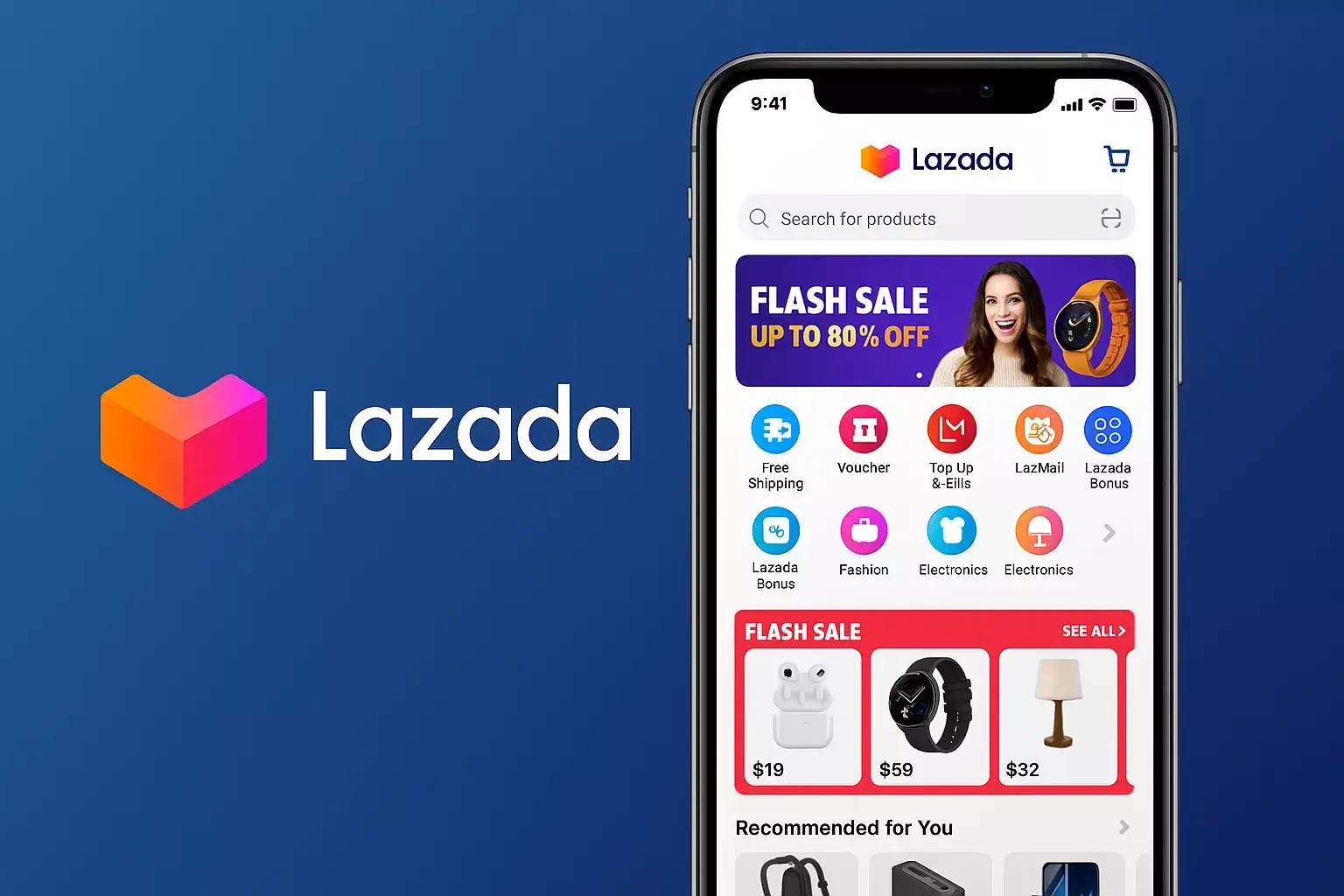
Imagine you’re in Bangkok, Manila, or Jakarta, scrolling through your phone late at night and suddenly realize you need a new pair of shoes or a kitchen gadget. Within seconds, Lazada lets you browse, compare, and order — with delivery often the very next day. That’s the magic of Lazada, one of Southeast Asia’s biggest e-commerce ecosystems.
Founded in 2012 by Rocket Internet and later acquired by Alibaba Group (which now holds a majority stake), Lazada was built to mirror the success of platforms like Amazon and Taobao for Southeast Asia. Over the years, it has expanded across six countries — Indonesia, Malaysia, the Philippines, Singapore, Thailand, and Vietnam — bringing millions of sellers and buyers onto one digital marketplace.
As of 2025, Lazada hosts over 160 million active users, 1 million sellers, and processes billions in GMV (Gross Merchandise Value) annually. It has become a key driver of digital commerce growth in Southeast Asia, offering not just shopping but also logistics, payment gateways (Lazada Wallet), and live shopping features powered by AI.
What is Lazada? The Simple Explanation
Lazada is a leading Southeast Asian e-commerce platform that connects millions of buyers and sellers through a digital marketplace. It allows users to shop for everything — from fashion and electronics to groceries and beauty products — all within a few clicks, offering doorstep delivery, secure payments, and regular promotional events.
The Core Problem It Solves
Before Lazada, online shopping in Southeast Asia faced issues like unreliable delivery, limited payment options, and fragmented seller networks. Lazada solved this by building a centralized e-commerce ecosystem — complete with logistics, warehousing, and its own payment system — to make buying and selling effortless for everyone.
Target Users and Use Cases
- Consumers: Individuals who want a convenient and trustworthy online shopping experience.
- Sellers: Small businesses and large brands seeking to reach a wide Southeast Asian audience.
- Partners: Logistics, financial, and marketing partners who integrate with Lazada’s ecosystem.
Typical use cases include:
- Ordering daily essentials online
- Launching a new store as an SME
- Managing multi-country e-commerce sales under one platform
Market Position (2025 Data)
- Active users: ~160 million (up 18% YoY)
- Annual GMV: Over $28 billion
- Top markets: Indonesia, Philippines, Thailand
- Average delivery speed: 1–3 days region-wide
- Mobile app rating: 4.7★ (Google Play, 2025)
Lazada is currently the second-largest e-commerce platform in Southeast Asia, just behind Shopee, but leads in logistics infrastructure and seller tools due to Alibaba’s technological backing.
Read more: Building an Ecommerce App: A Comparative Guide for Startups and Enterprises
Why Lazada Became Successful
Lazada’s success comes from its early regional expansion, AI-driven personalization, and strong local partnerships. Features like LazLive (live shopping) and Lazada Wallet have made the platform highly engaging, while deep integration with Alibaba Cloud and AI systems ensures seamless performance during massive sales events like 11.11 and 12.12.
How Does Lazada Work? Step-by-Step Breakdown
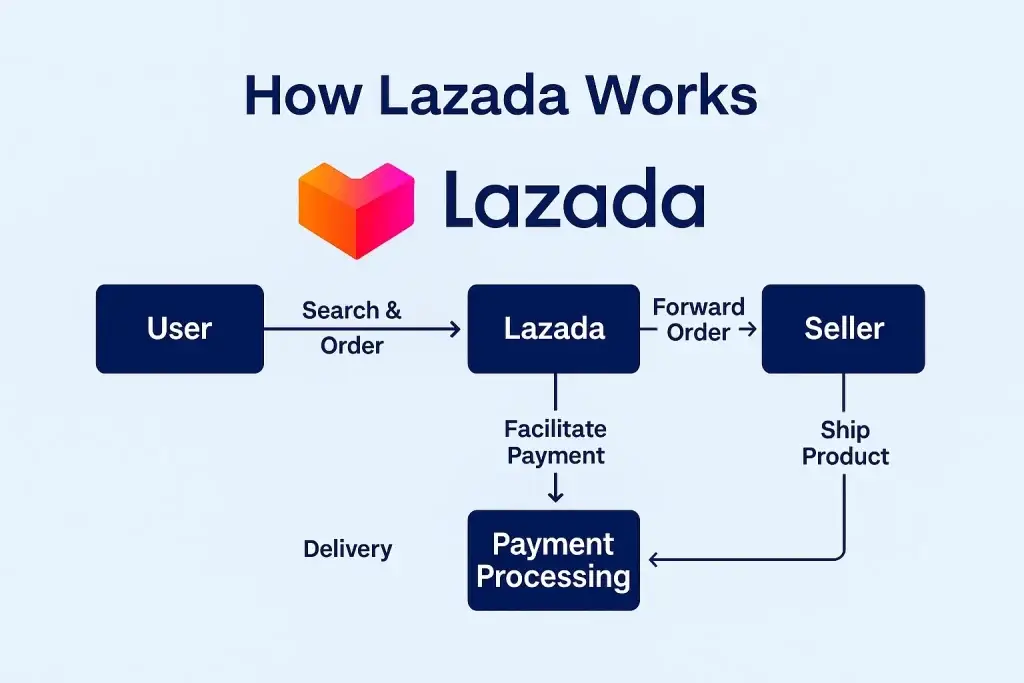
Lazada operates as a multi-vendor online marketplace, connecting shoppers and sellers through an intelligent, AI-powered ecosystem. Let’s break down how it functions for users, sellers, and the underlying technology that keeps it running smoothly.
For Users (Buyers)
1. Account Creation Process
Users sign up via email, phone number, or social login (Google/Facebook). Upon signup, Lazada personalizes recommendations based on browsing behavior and location.
2. Main Features Walkthrough
- Search & Filter: AI-based smart search and category filters for quick discovery
- Product Comparison: Integrated reviews, seller ratings, and price insights
- Secure Payments: Options include Lazada Wallet, COD, cards, or e-wallets
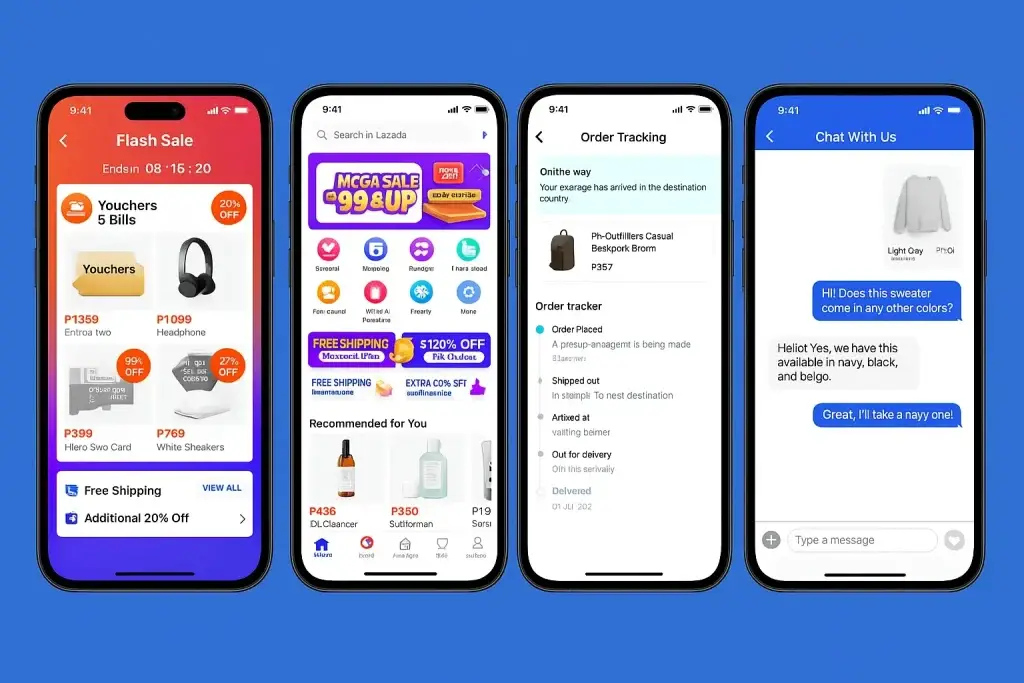
- Delivery Tracking: Real-time logistics updates and Lazada Express integration
- Flash Sales & Vouchers: AI-timed discounts during events like 11.11 and 12.12
3. Typical User Journey (Example)
A customer in Malaysia opens the Lazada app, searches for a “smartwatch,” compares options from multiple sellers, adds one to the cart, checks out with Lazada Wallet, and receives the product within two days via Lazada Logistics — all tracked live within the app.
4. Key Functionalities Explained
- AI-based recommendations
- One-click checkout
- Order tracking dashboard
- Easy refund/return process
For Sellers (Merchants)
1. Onboarding Process
Sellers register on Lazada Seller Center, submit verification details, and set up their store with product listings, pricing, and promotions.
2. Operations on the Platform
They manage inventory, handle orders, and use Lazada Fulfillment Centers (LazGlobal) for shipping and packaging. Sellers can also use LazLive to host livestream shopping sessions.
3. Earnings and Commission Structure (2025)
- Commission: 1–5% depending on category
- Transaction fee: 2% per order
- Payment release: Within 7 days post-delivery
- Bonus tools: Sponsored ads, seller analytics, and AI demand forecasting
This model enables sellers to reach millions without managing logistics or payment processing manually.
Technical Overview (Simplified)
Lazada’s technology backbone is built for massive scalability, real-time data handling, and cross-country synchronization.
Basic Architecture (Non-technical Explanation):
- Frontend: Mobile apps (iOS/Android) + Web portal
- Backend: Microservices hosted on Alibaba Cloud, managing product data, payments, and orders
- Database: Distributed systems ensuring speed across multiple regions
- AI Systems: Powering personalization, fraud detection, and pricing optimization
- APIs: For logistics partners, payment gateways, and third-party apps
Lazada’s ecosystem synchronizes millions of interactions per second, ensuring smooth experiences during mega sales events with over 1 million concurrent users.
Lazada’s Business Model Explained
Lazada’s success lies in its multi-revenue ecosystem, combining marketplace commissions, logistics services, digital payments, and advertising — all powered by Alibaba’s technology and financial infrastructure. Let’s break it down clearly.
How Lazada Makes Money
Lazada doesn’t just earn from sales commissions — it has five major revenue streams:
- Commissions from Sellers
- Takes 1–5% per transaction, depending on product category and region.
- Example: Electronics (3%), Fashion (5%), Groceries (1%).
- Transaction & Service Fees
- 2% transaction fee on each completed order.
- Includes cross-border trade, seller verification, and fulfillment costs.
- Advertising Revenue
- Lazada’s Sponsored Discovery Ads and LazLive placements let sellers promote their products for visibility — similar to Amazon Ads.
- Lazada’s Sponsored Discovery Ads and LazLive placements let sellers promote their products for visibility — similar to Amazon Ads.
- Fulfillment & Logistics (Lazada Express)
- Sellers pay shipping and warehousing fees for using Lazada’s logistics network, known for fast and reliable regional delivery.
- Sellers pay shipping and warehousing fees for using Lazada’s logistics network, known for fast and reliable regional delivery.
- Financial & Wallet Services (Lazada Wallet)
- Transaction revenue from Lazada Wallet top-ups, BNPL (Buy Now Pay Later), and LazPayLater — a digital credit service integrated via partnerships with regional fintech companies.
Read more: Business Model for E-commerce Apps
Pricing Structure (2025 Snapshot)
| Category | Commission | Transaction Fee | Fulfillment (Optional) |
| Electronics | 3% | 2% | Yes |
| Fashion | 5% | 2% | Yes |
| Groceries | 1% | 2% | Yes |
| Beauty/Health | 4% | 2% | Yes |
| Cross-border sellers | 5% | 2.5% | Yes |
Market Size & Growth Stats (2025)
- SEA eCommerce Market (2025): Estimated at $230 billion GMV, growing 16% YoY.
- Lazada Share: ~12% of the regional market.
- Active Sellers: Over 1 million, with 30% new entrants from SMEs annually.
- Projected Growth: Expected to reach $35B GMV by 2026.
Profit Margins & Monetization Insights
While Lazada still invests heavily in marketing and logistics, its profitability is rising, thanks to:
- AI-driven ad placement (higher conversion rates)
- LazPayLater interest income
- Warehousing efficiencies and optimized shipping routes
- Seller subscription tools and data-driven pricing algorithms
By 2025, Lazada’s estimated annual revenue is around $3.2 billion, with a net margin of ~9% in its strongest markets (Thailand and Malaysia).
Key Features That Make Lazada Successful
Lazada stands out not only for its wide selection of products but also for the innovative features that define its user experience, seller empowerment, and technological sophistication. Below are the features that have shaped Lazada’s dominance in 2025.
Top 10 Features Analysis
| Feature | Why It Matters | Benefit to Users | Technical Innovation |
| 1. Smart AI Search & Recommendations | Helps users find the right products instantly | Personalized suggestions and faster shopping | Deep learning models using Alibaba Cloud AI |
| 2. Lazada Wallet & LazPayLater | Simplifies payments and adds financial flexibility | Seamless checkout, instant refunds, credit-based purchases | Built-in payment gateway + fintech integration |
| 3. LazLive (Live Shopping) | Engages users through real-time seller interactions | Watch, chat, and buy products instantly during livestreams | Real-time streaming tech + interactive APIs |
| 4. LazMall (Verified Brands) | Builds trust and guarantees authenticity | Access to 100% genuine products from top brands | Brand verification via blockchain-like ID |
| 5. Flash Sales & Mega Campaigns | Drives engagement during peak shopping days | Access to limited-time deals and discounts | Automated price triggers + event-based scaling |
| 6. Lazada Logistics (LEX) | Ensures reliable delivery across Southeast Asia | 1–3 day regional shipping with tracking | Route optimization algorithms + real-time GPS |
| 7. Multi-language & Multi-currency Support | Serves diverse SEA markets seamlessly | Users shop in native language and currency | Localized backend services per country |
| 8. AI Chatbot Support | Provides instant, multilingual customer service | 24/7 help for order, returns, and payment queries | NLP-based chatbot using Alibaba DAMO Academy |
| 9. Seller Center & Analytics Dashboard | Empowers merchants to grow faster | Real-time sales data, ad tools, and conversion insights | Data visualization and predictive analytics |
| 10. Social Integration & Gamified Shopping | Keeps users engaged between purchases | Reward points, spin-the-wheel games, vouchers | Gamification engine tied to user retention AI |
Recent 2025 Updates & Enhancements
- AI-Generated Product Descriptions: Lazada now uses generative AI to auto-write product copy for sellers.
- Eco Packaging Program: Integrated sustainability scoring for sellers.
- LazRewards Expansion: Unified rewards across all SEA countries.
- Voice Shopping (Beta): Users can search and shop using voice commands.
- Lazada X AI Studio: Helps sellers generate ad creatives automatically.
AI/ML Integrations Driving Lazada Forward
- Recommendation Engine: Learns from behavior and intent to personalize homepages.
- Fraud Detection: AI identifies fake reviews and fraudulent sellers in real time.
- Predictive Delivery: Uses machine learning to forecast logistics demand.
- Dynamic Pricing: Adjusts discounts based on competitor and demand data.
What Sets Lazada Apart
Unlike competitors, Lazada’s deep integration with Alibaba Cloud enables massive scalability, smart logistics, and financial ecosystem synergy — combining marketplace + fintech + entertainment into a single superapp experience.
The Technology Behind Lazada
Tech Stack Overview (Simplified)
- Lazada runs on top of Alibaba Cloud’s infrastructure, leveraging its cloud services (compute, storage, big-data, CDN, security) to support operations across Southeast Asia.
- For data and analytics, Lazada uses:
- For content delivery, live streaming & global access: CDN, anti‐DDoS, edge nodes to ensure fast, reliable service during big events.
Real-Time Features
- During major shopping events (like 11.11, 12.12), Lazada’s system must handle huge peaks of traffic, orders, live streams, and logistics updates. Their architecture supports this by using distributed microservices and real-time streaming analytics.
- Example: They ingest user clickstreams + purchase events → Flink processes streams → Hologres serves real-time analytics to marketing systems so coupons, deals, recommendations can be adjusted instantly.
Data Handling & Privacy
- All user data, order data, payment data is stored in secure cloud-infrastructure with managed databases and encrypted storage.
- Lazada uses Alibaba Cloud’s security solutions (including Anti-DDoS) to safeguard the platform.
- Because Lazada operates across multiple countries with diverse regulations, compliance and localization of data (e.g., where data is stored) are important.
Scalability Approach
- The platform is built to scale horizontally: during peak sale events, new compute instances spin up, microservices handle requests, CDNs distribute content globally with minimal latency.
- Lazada migrated from more “traditional batch” systems to real-time architecture to reduce latency and support instantaneous decisions.
- The use of microservices and cloud infrastructure means they can support multiple countries (six + Southeast Asia markets) with one underlying platform.
Mobile App vs Web Platform
- Mobile: Native apps for Android/iOS provide richer features (live video, wallet, push notifications, single-tap checkout).
- Web: Browser version covers desktop/laptop and provides full catalog access. The same backend supports both.
- Both share the same backend services (APIs, data layers), so user experiences (cart, wishlist, promotions) sync across devices.
API Integrations
- Lazada integrates with:
- Payment gateways (cards, e-wallets, COD processing)
- Logistics networks (tracking, last-mile, fulfillment centres)
- Seller systems (inventory management, analytics dashboards)
- Live-streaming modules for LazLive.
- These APIs allow third-party services (logistics partners, payment providers) to plug in easily and scale across markets.
Why This Tech Matters for Business
- Enables fast, reliable shopping experience: minimizes crashes during big sale events.
- Supports personalisation, which boosts conversion rates (AI recommendations, localized content).
- Facilitates seller growth: merchants access dashboards, analytics, operate across multiple markets with one backend.
- Prepares for future expansion: The architecture is built for adding new countries, more categories, more active users.
Lazada’s Impact & Market Opportunity
Lazada isn’t just an e-commerce app — it’s a digital economy catalyst reshaping how Southeast Asia buys, sells, and interacts online. Its 2025 influence spans across logistics, fintech, retail, and even entertainment.
Industry Disruption Caused by Lazada
When Lazada entered the scene, online shopping in Southeast Asia was fragmented. Each country had its own local marketplaces with inconsistent logistics and payment support. Lazada disrupted this by introducing:
- Unified regional operations — one platform across six countries.
- Localized experiences — language, currency, and cultural customization.
- Alibaba-backed technology — world-class logistics, AI, and payments infrastructure.
This model revolutionized how Southeast Asians trust and adopt online shopping, paving the way for a new generation of digital-first businesses.
Market Statistics & Growth (2025 Snapshot)
| Metric | Value (2025) | Insight |
| Active Users | 160+ million | Growing at 18% YoY |
| Gross Merchandise Value (GMV) | $28–30 billion | On track to reach $35B by 2026 |
| Active Sellers | 1 million+ | 30% growth from SMEs |
| Market Share (SEA) | 12% | Second only to Shopee |
| Daily Orders | 10 million+ | Driven by mobile-first users |
| Mobile App Rating | 4.7★ | Reflecting high satisfaction |
User Demographics & Behavior
- Age Group: 18–44 years (core buyers)
- Gender Split: 55% female, 45% male
- Top Categories: Electronics, Fashion, Beauty, Groceries
- Shopping Frequency: 3–5 purchases per month (avg. per user)
- Preferred Channels: 85% via mobile apps
- Peak Engagement Time: 8 PM–11 PM (live shopping hours)
Lazada has cultivated trust and habit, making online shopping a lifestyle — not just a transaction.
Geographic Presence
Lazada operates in six major markets:
🇮🇩 Indonesia
🇲🇾 Malaysia
🇵🇭 Philippines
🇸🇬 Singapore
🇹🇭 Thailand
🇻🇳 Vietnam
Each country has dedicated logistics hubs, warehouses, and payment integrations, making Lazada one of the most localized global brands in Southeast Asia.
Future Projections (2025–2030)
- Expansion into cross-border trade hubs and AI-driven delivery optimization.
- Integration of AR/VR shopping experiences (already in pilot stage).
- Growth of LazPayLater and Lazada Wallet to compete with regional fintechs.
- Deeper AI personalization and live shopping integration.
- Expected valuation to surpass $40B by 2030 if current trajectory continues.
Opportunities for Entrepreneurs
Lazada’s model proves that regional marketplaces thrive on:
- Localized logistics + payments
- Strong seller support infrastructure
- Engagement-driven experiences (live shopping, rewards, gamification)
These insights create enormous opportunities for entrepreneurs to replicate Lazada’s success in niche or emerging markets — from groceries to luxury goods to B2B e-commerce.
Natural Transition
This massive success is exactly why entrepreneurs around the world are looking to create Lazada-like platforms. And that’s where Miracuves comes in — with ready-to-deploy, customizable Lazada Clone solutions that can help you launch your e-commerce platform.
Building Your Own Lazada-Like Platform
Creating a platform like Lazada is no longer reserved for billion-dollar corporations. With the right technology partner, entrepreneurs can launch their own marketplace ecosystem quickly — complete with multi-vendor tools, logistics integrations, and payment gateways.
Why Businesses Want Lazada Clones
- Proven Model: Lazada’s framework — marketplace + fintech + logistics — has already validated user demand across Southeast Asia.
- Scalable Opportunity: Regional e-commerce is projected to hit $230 billion GMV by 2025, with plenty of room for niche marketplaces.
- Technology Availability: Ready-made clone solutions and SaaS tools now allow fast, affordable launches.
- Localized Market Gaps: Entrepreneurs can specialize in verticals (fashion, grocery, electronics, or B2B) within their country.
Key Considerations for Development
- Define Your Niche – Choose between general marketplace or category-specific focus.
- Decide Your Revenue Model – Commissions, subscription, ads, or hybrid.
- Prioritize Trust & Security – Verified sellers, safe payments, and buyer protection.
- Build for Scalability – Prepare backend for peak traffic (festivals, flash sales).
- Enable Multi-Language/Currency Support – Local relevance increases conversions.
- Focus on UI/UX – Simple checkout flow, engaging visuals, clear CTAs.
- Integrate AI Features Early – Personalization, fraud detection, and logistics forecasting.
Cost Factors & Pricing Breakdown
Lazada-Like App Development — Market Price
| Development Level | Inclusions | Estimated Market Price (USD) |
| Basic Marketplace MVP | Buyer/seller roles, product listings, simple checkout | $10,000 |
| Mid-Level Marketplace | Wallet, logistics/shipping modules, seller dashboards, mobile apps | $20,000 |
| Advanced Marketplace (Lazada-scale) | High-concurrency backend, multi-warehouse logistics, voucher/promo engine, flash sale system, native mobile apps | $50,000+ |
Miracuves Lazada-Style Marketplace Pricing
Miracuves Price: Starts at $14,999
This delivers a modern multi-vendor ecommerce ecosystem with seller onboarding, catalog & inventory tools, wallet/payment modules, logistics support, voucher & promotions engine, and mobile-ready architecture.
Note: This includes full non-encrypted source code, complete deployment support, backend setup, admin panel configuration, and publishing on the Google Play Store and Apple App Store—giving you a fully operational marketplace ready for launch.
Delivery Timeline for Lazada-Style Marketplace
Miracuves development timeline including setup, configuration, admin deployments, API integrations, and platform handover in approximately 30–90 days, depending on customization and additional functional layers requested. This ensures a stable, market-ready system with predictable delivery and no hidden engineering delays.
Tech Stack
We use JavaScript (Node.js + Next.js + PostgreSQL) for the platform and Flutter/React Native for mobile apps, ensuring high performance, modularity, and long-term scalability. Other tech stacks can be discussed and arranged upon request — Contact us
Essential Features to Include
| Category | Must-Have Features |
| User Side | Product search, filters, cart, wishlist, secure checkout, tracking |
| Seller Side | Dashboard, inventory, pricing, analytics, payouts |
| Admin Panel | User management, commission setup, CMS, analytics |
| Advanced Modules | Live shopping, wallet, AI recommendations, multi-vendor chat |
| Tech Essentials | APIs for payment & logistics, cloud scalability, encryption |
Build your own powerful online marketplace with Miracuves’ E-Commerce App Development Services — fully customizable, scalable.
Read more: How to Market an e-commerce app Successfully After Launch
Conclusion
Lazada’s rise is a textbook example of innovation meeting localization. From a startup aiming to mimic Amazon to becoming a regional giant under Alibaba, Lazada has mastered the blend of technology, trust, and tailored user experience. Its AI-driven ecosystem, fintech integration, and logistics excellence continue to redefine how Southeast Asia shops online.
In 2025, Lazada represents more than a shopping platform — it’s a complete digital economy enabler, empowering millions of buyers and sellers daily.
For entrepreneurs, the Lazada model proves that data-driven marketplaces can thrive in emerging economies by focusing on user engagement, personalization, and reliability.
Launch Your Lazada-Like App Today — Contact Us for a free demo and pricing details!
FAQs
Q:1 How does Lazada make money?
Lazada earns through commissions (1–5%), transaction fees, advertising, logistics (Lazada Express), and financial services via Lazada Wallet and LazPayLater. Its multi-stream model mirrors Alibaba’s ecosystem strategy.
Q:2 Is Lazada available in my country?
As of 2025, Lazada operates in six Southeast Asian countries: Indonesia, Malaysia, the Philippines, Singapore, Thailand, and Vietnam. Expansion into new SEA markets is under review.
Q;3 How much does Lazada charge users?
Lazada doesn’t charge buyers directly — users only pay product and shipping costs. Discounts, vouchers, and cashback are frequent, especially during events like 11.11 and 12.12.
Q:4 What’s the commission for sellers on Lazada?
Lazada charges 1–5% commission based on category, plus a 2% transaction fee. Sellers can choose to handle their own shipping or use Lazada Fulfillment Services for an additional fee.
Q:5 How does Lazada ensure safety and trust?
Lazada protects users through LazMall verified stores, AI fraud detection, encrypted payments, and secure delivery systems. Users are covered by Lazada Buyer Protection for refunds and replacements.
Q:6 Can I build something similar to Lazada?
Absolutely! You can create your own marketplace using Miracuves’ Lazada Clone Script — a ready-to-deploy, customizable platform. It includes buyer/seller apps, admin panels, and AI-powered analytics
Q:7 What makes Lazada different from competitors like Shopee?
Lazada stands out with Alibaba Cloud technology, better logistics infrastructure (LEX), LazPayLater financial products, and LazLive interactive shopping — creating a deeper ecosystem beyond simple e-commerce.
Q:8 How many users does Lazada have?
As of 2025, Lazada has over 160 million active users across Southeast Asia and is growing at an annual rate of 18%.
Q:9 What technology does Lazada use?
Lazada runs on Alibaba Cloud, with microservices, real-time analytics (Apache Flink, Hologres), AI-driven personalization, and secure APIs connecting payments, sellers, and logistics seamlessly.
Q:10 How can I create an app like Lazada?
You can create an app like Lazada using Miracuves’ Lazada Clone Script, a ready-made, customizable marketplace solution with full tech support.
Related Articles: