


Key Takeaways
What You’ll Learn
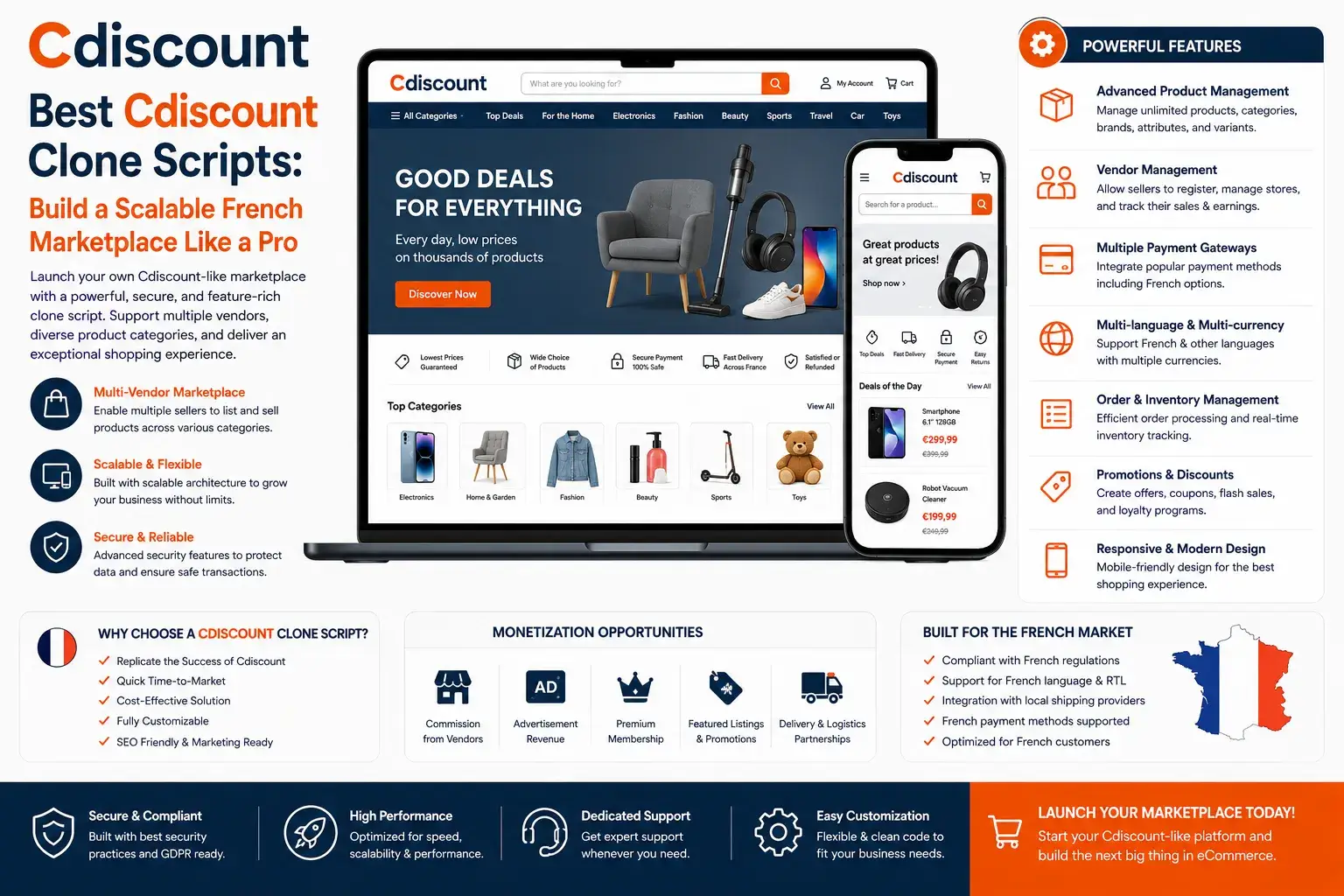
- A Cdiscount clone script helps businesses build scalable ecommerce and marketplace platforms.
- Features like multi-vendor management, secure payments, logistics tracking, and AI recommendations improve platform efficiency.
- Marketplace commissions, subscriptions, ads, and direct product sales create multiple revenue opportunities.
- Mobile-first ecommerce experiences help improve customer engagement and conversions.
- White-label marketplace solutions help startups launch ecommerce businesses faster and more cost-effectively.
Stats That Matter
- Global ecommerce marketplaces continue expanding rapidly with increasing mobile shopping adoption.
- Multi-vendor ecommerce platforms are becoming a preferred business model for scalable online retail.
- AI-driven recommendations and personalized shopping experiences improve conversion rates.
- Secure payment systems and logistics integrations are essential for modern ecommerce operations.
- Cloud-based ecommerce infrastructure helps platforms scale during high-traffic shopping periods.
Real Insights
- Marketplace platforms grow faster when they balance customer experience with seller efficiency.
- Inventory management and logistics coordination are critical for scaling ecommerce marketplaces.
- Trust, reviews, and secure payment processing strongly influence customer retention.
- AI-powered product discovery and recommendation systems improve engagement and repeat purchases.
- Long-term ecommerce success depends on scalability, operational reliability, and user trust.
A few years ago, launching a “Cdiscount-style” marketplace sounded like something only big retail groups could afford. Today, the playbook is clear: win with selection depth, sharp pricing, fast fulfillment, and a marketplace engine that lets third-party sellers grow your catalog while you focus on brand, trust, and operations. That’s how platforms like Cdiscount scaled into a major French e-commerce destination—serving 7.5 million active customers through its flagship site ecosystem.
Now here’s why this clone model matters even more in 2026: the market is expanding, but competition is brutal. French e-commerce hit €175.3B in online sales in 2024, and the momentum is pushing founders to build marketplaces that are faster, smarter, and more defensible than basic stores. If you’re considering Cdiscount Clone Development, you’re not just copying an interface—you’re replicating a growth machine: multi-vendor onboarding, category expansion, loyalty loops, and monetization that compounds over time.
In this guide, we’ll break down what makes the Best Cdiscount Clone Script 2026 worth investing in, what features actually move the needle, and how Miracuves Clone Solutions help founders launch with production-ready architecture instead of “v1 spaghetti” that collapses at scale.
What Makes a Great Cdiscount Clone?
A great Cdiscount Clone Development project in 2026 isn’t “a marketplace website with a cart.” It’s a high-performance retail engine built for two growth curves at the same time: customers who want speed + savings, and sellers who want predictable sales + easy operations. That dual engine is why marketplace models keep winning globally—marketplaces now account for a major share of online sales according to Forrester’s 2026 marketplace tracker.
To build the Best Cdiscount Clone Script 2026, you need to copy the outcomes, not the pixels: aggressive merchandising, seller expansion, loyalty loops, and fulfillment coordination. Even Cdiscount’s broader ecosystem has shown how scale looks in practice—Cnova reported 10.3M active customers and a loyalty program reaching 2.3M members (2020), plus ongoing investments in logistics and delivery programs that strengthen the marketplace flywheel.
And timing matters: France’s e-commerce market hit €175.3B in 2024, with transactions rising and price-sensitive consumers actively comparing offers—exactly the environment where a Cdiscount-style model performs when the experience is fast, trustworthy, and deal-smart.
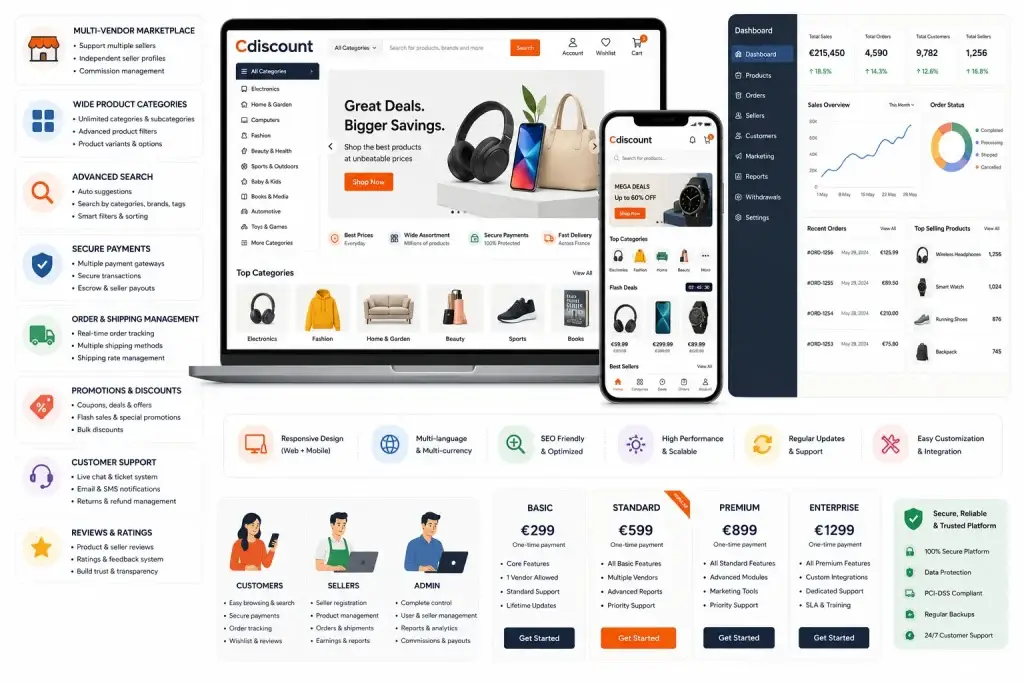
What defines a “great clone” in 2026 (in plain founder terms)
A strong clone is one that feels instant, stays stable on peak traffic days, and helps you monetize without annoying users. That means: clean UI/UX, strong search + discovery, reliable payments, seller quality controls, and automation everywhere so your ops team doesn’t drown as orders scale.
Must-have 2026 capabilities (summarized)
- Performance & reliability: API response targets <300ms for core reads (catalog, search suggestions), 99.9% uptime SLA mindset, CDN + edge caching for images and category pages
- Scalability: horizontally scalable services, queue-based order events, autoscaling rules for peak campaigns (flash deals, payday spikes)
- UI/UX built for conversion: fast category navigation, “deal-first” merchandising modules, trust cues (returns, warranties, delivery promises)
- Monetization-ready core: seller commissions, promoted listings/ads, subscription/loyalty, fulfillment fees, and fintech add-ons (EMI/BNPL)
- AI automation: smart search ranking, auto-tagging/catalog enrichment, dynamic pricing rules, fraud/anomaly detection, customer support triage
- Blockchain transparency (where it matters): optional verification for high-risk categories (warranty proofs, authenticity trails, supplier attestations) rather than “blockchain everywhere”
- Cross-platform integration: web + mobile apps, seller portal, ERP/accounting hooks, shipping aggregators, email/SMS/WhatsApp notifications
Technical “non-negotiables” checklist (quick scan)
- P95 latency targets defined per service (search, PDP, checkout) and monitored 24/7
- Rate-limiting + WAF + bot protection (scraping and coupon abuse are real)
- PCI-aware payment flows, tokenization, and least-privilege access controls
- Observability: logs + traces + metrics with alerting for checkout errors, payment failures, stock mismatches
Table: Modern Cdiscount-style clones and what differentiates them
| Clone direction | What makes it win | Best-fit monetization | Must-have differentiator |
|---|---|---|---|
| Retail + Marketplace Hybrid | Trust + deals + wide assortment | Commissions + promos + loyalty | Seller quality scoring + strong returns/refunds engine |
| Deals-first / Flash Marketplace | High urgency + price discovery | Sponsored slots + flash fees | Real-time inventory locks + anti-bot controls |
| Fulfillment-led Marketplace | Faster delivery promises | Fulfillment/storage fees + commissions | Carrier orchestration + SLA tracking per seller |
| Vertical Marketplace (e.g., electronics/home) | Deep category authority | Higher AOV + warranties/services | Category-specific filters + warranty/authenticity workflows |
| Subscription/Loyalty-led Marketplace | Retention + predictable revenue | Membership + perks | Personalized offers + churn prediction automation |
Essential Features Every Cdiscount Clone Must Have
When founders pitch a marketplace idea, they usually talk about “products” and “sellers.” But the real reason Cdiscount-style marketplaces scale is simpler: they reduce friction at every step—discover, trust, buy, deliver, repeat. Your clone succeeds in 2026 when it feels effortless for buyers, profitable for sellers, and controllable for admins—even during peak traffic days. That’s the difference between a marketplace that grows and one that becomes a support-ticket factory.
The 3 functional layers you must build (and why each one matters)
1) User Side: Experience, convenience, retention tools
Your buyers should feel like the app “gets them” in the first 30 seconds. In a deals-heavy marketplace, speed + trust equals conversion, so your user layer needs: fast discovery, clear value, and repeat reasons.
Core user-side features (2026-ready)
- Smart search + filters: typo-tolerant search, category facets, price sliders, availability, brand, delivery time filters
- Personalized home feed: AI-driven recommendations based on intent (browsing vs buying), not just past purchases
- Product detail page that converts: variants, rich media, price history (optional), delivery ETA, seller rating, return policy, warranty/service add-ons
- Cart + checkout acceleration: saved addresses, one-tap reorder, guest checkout option, wallet/UPI/cards, COD (region-based), installment/BNPL (optional)
- Retention loops: wishlists, back-in-stock alerts, price-drop alerts, loyalty points, referral rewards
Advanced user features for 2026 - AI-based personalization: next-best-offer suggestions, bundling (frequently bought together), dynamic coupons for churn-risk users
- AR onboarding (optional): “how it fits” previews for select categories, guided UI tours for first-time users
- Blockchain verification (selective): authenticity verification for high-risk SKUs (warranty proofs, seller attestations) where trust is critical
2) Admin Panel: Control, analytics, automation
If your admin layer is weak, growth becomes chaos. In a Cdiscount-like model, the admin panel isn’t a dashboard—it’s the command center for pricing, quality, compliance, and profitability.
Admin must-haves
- Catalog governance: category rules, attribute templates, duplicate detection, bulk updates, content quality scoring
- Seller management: KYC/verification workflows, commission rules, SLA enforcement, penalty logic, dispute handling
- Order operations: order timeline, partial shipments, returns/refunds, RTO handling, replacement workflows
- Campaign engine: flash deals, coupons, bundles, dynamic pricing rules, scheduling, A/B testing for promo blocks
- Analytics that drive action: conversion funnel, search-to-buy terms, refund reasons, seller performance, cohort retention, CAC-to-LTV view
Admin automation - AI moderation: detect prohibited items, misleading titles, fake reviews, suspicious sellers, abnormal refund spikes
- Fraud/anomaly detection: coupon abuse, bot traffic, payment risk scoring, address/device intelligence
3) Seller Side: Real-time tracking, earnings dashboard, AI recommendations
Sellers power your growth, but only if you make selling easy. The best clone scripts treat sellers like customers too: smooth onboarding, clear earnings, fast fulfillment, and practical recommendations.
Seller portal essentials
- Onboarding + verification: document upload, bank details, store profile, category approvals
- Inventory + pricing: bulk upload, SKU mapping, low-stock alerts, pricing rules, competitor-price insights (optional)
- Order processing: pick-pack-ship workflow, label printing, pickup scheduling, shipment tracking, cancellations management
- Earnings dashboard: payouts, commissions, fees breakdown, tax invoices, settlement schedule
Seller intelligence - AI recommendations: “restock these SKUs,” “optimize price by X%,” “improve listing quality,” “predict demand spikes”
- SLA coaching: automated nudges when late dispatch risk is detected
Technical architecture requirements (so it doesn’t break at scale)
A Cdiscount clone must behave like an enterprise system even when you launch as an MVP. Here’s the architecture baseline serious founders target in 2026:
Performance + scalability targets
- API response time: aim for <300ms for core read endpoints (catalog, search suggestions, cart retrieval) under normal load
- Uptime: design for 99.9% availability with redundancy, health checks, and automated failover
- Load handling: autoscaling for campaign peaks, queue-based processing for orders/notifications, caching for category + media
Security layers (non-negotiable) - Token-based auth, role-based access (user/seller/admin), secure session handling
- WAF + rate limiting + bot protection (marketplaces get scraped and abused)
- Payment tokenization, PCI-aware flow design, audit logs for admin actions
Third-party APIs you typically need - Payments (cards/UPI/wallet/COD providers), SMS/email/WhatsApp notifications
- Shipping/carrier aggregation, address validation, tax invoicing (region-based)
- Analytics, crash reporting, APM/monitoring (alerts for checkout errors and payment failures)
Feature Comparison Table: Basic vs Professional vs Enterprise (Cdiscount-style)
| Layer | Basic (MVP) | Professional (Growth) | Enterprise (Scale) |
|---|---|---|---|
| User experience | Search, categories, PDP, cart, checkout | Personalized feed, advanced filters, loyalty, referrals | AI bundling, dynamic offers, multi-region localization |
| Seller portal | Seller signup, product upload, order view | Bulk tools, payout dashboard, SLA tracking | AI seller coaching, automated quality scoring, fraud flags |
| Admin control | Basic catalog + orders + refunds | Campaign engine, seller policies, analytics dashboards | Advanced automation, anomaly detection, A/B testing, governance |
| Performance | CDN media, basic caching | Autoscaling, queues for events | Multi-service scaling, disaster recovery, high-availability design |
| Security | Role-based access, secure auth | WAF + rate limiting | Advanced fraud scoring, audit-grade logging, compliance workflows |
| Integrations | Payments + notifications | Shipping aggregator + analytics | ERP/warehouse hooks, data pipelines, BI dashboards |
How Miracuves implements this in its clone scripts
Miracuves doesn’t build “just screens.” We build marketplace-ready systems with the exact layers founders need to scale: a conversion-first buyer experience, a seller portal that reduces operational friction, and an admin command center designed for automation and profitability. The result is a Cdiscount-style foundation that’s built to evolve—new categories, new sellers, new regions—without rebuilding from scratch. You get a roadmap-friendly architecture, production-grade security practices, and integrations that support real operations from day one, with a delivery approach aligned to a 30–90 day build cycle for serious implementations.
Miracuves Cdiscount-Like eCommerce Marketplace Platform Solution Cost and Tech Stack
Miracuves Pricing for a Cdiscount-Like eCommerce Marketplace Platform developed using Node.js / React.js Architecture is available on request. Contact Miracuves for custom pricing based on platform features, scalability requirements, integrations, and deployment scope. Estimated delivery timeline: 30 to 90 Days.
Build a powerful multi-category eCommerce marketplace platform designed for startups, online retailers, marketplace businesses, wholesalers, and enterprise commerce operations.
Core Workflows: Product listing management, multi-vendor marketplace operations, customer shopping workflows, inventory management, order processing, payment handling, product recommendations, and online retail operations.
Built-in Commerce Operations: Real-time inventory synchronization, commission management, shipping workflows, discount and coupon systems, transaction tracking, customer reviews, analytics reporting, and seller payout systems.
Management Hub: Admin dashboards, seller management systems, product moderation controls, inventory analytics, customer reporting dashboards, dispute management, audit logs, and centralized marketplace operations management.
Enterprise-Ready: Fully customizable architecture prepared for secure scaling, high-volume product catalogs, multi-region marketplace operations, cloud infrastructure expansion, enterprise retail ecosystems, and long-term platform growth.
Why does a Cdiscount-Like Platform require Node.js / React.js architecture?
eCommerce marketplace platforms process high customer traffic, large product inventories, payment workflows, inventory updates, and concurrent buyer-seller interactions. These platforms require scalable infrastructure, responsive interfaces, and efficient commerce operations across web and mobile ecosystems.
We recommend a modern JavaScript-based architecture for this type of platform because:
Built for Real-Time Operations: Node.js enables scalable backend operations for order processing, inventory synchronization, seller management, payment workflows, and concurrent marketplace activities.
Advanced Dashboard Experience: React.js supports highly interactive interfaces for product browsing, seller dashboards, shopping experiences, analytics reporting, and seamless customer journeys.
Enterprise Scalability: This architecture is well-suited for handling large product inventories, high customer traffic, multi-vendor ecosystems, and rapidly growing marketplace operations.
Flexible Integration Layer: Easily integrates with payment gateways, shipping providers, CRM systems, ERP software, analytics platforms, customer support tools, and third-party commerce services.
You get a scalable, enterprise-grade eCommerce marketplace platform designed for long-term operational growth.
Note: Final pricing depends on platform modules, marketplace workflows, third-party integrations, deployment infrastructure, payment systems, and custom workflow development.
Customization & White-Label Option
Building a Cdiscount-style large-scale ecommerce marketplace isn’t just about listing products online — it’s about operating a high-volume, price-competitive retail ecosystem that supports multi-category catalogs, aggressive promotions, private labels, and efficient fulfillment. A platform like this must balance performance, affordability, and operational control while delivering a smooth experience to millions of users.
Miracuves delivers a fully white-label Cdiscount-style solution that allows deep customization across marketplace structure, pricing logic, supplier management, promotions, and backend operations. Whether you are targeting electronics, home appliances, lifestyle products, or a broad multi-category retail model, the platform can be tailored to your brand and market strategy.
Why Customization Matters
In mass-market ecommerce, success depends on speed, pricing flexibility, and scale. Customers expect fast discovery, competitive deals, reliable delivery, and transparent policies. Customization ensures your platform can adapt to changing market conditions, supplier diversity, and promotional strategies without sacrificing performance.
What You Can Customize
Complete UI/UX Personalization
Customize homepage layouts, category navigation, product listing pages, search behavior, filters, banners, deal sections, typography, color schemes, and mobile-first layouts.
Multi-Category Product & Catalog Management
Configure complex category trees, bulk product imports, SKU management, pricing rules, stock availability logic, and supplier-based catalog controls.
Deals, Discounts & Promotional Engines
Set up flash sales, daily deals, clearance sections, coupon systems, bundle offers, dynamic pricing, and personalized promotions based on user behavior.
Marketplace & Seller Management
Onboard third-party sellers, define commission structures, manage seller dashboards, product approvals, performance scoring, and compliance rules.
Checkout, Payments & Fulfillment
Customize cart logic, multi-seller checkout flows, shipping rules, delivery options, returns and refunds handling, tax configuration, and order lifecycle tracking.
Customer Accounts & Engagement
User profiles, order history, wishlists, reviews and ratings, notifications, loyalty programs, and personalized product recommendations.
Backend & Integrations
Integrate payment gateways, logistics partners, ERP/CRM systems, warehouse management tools, analytics platforms, and customer support software.
Monetization & Revenue Models
Enable commission-based sales, advertising placements, promoted products, private-label visibility, subscription perks, and data-driven upsell opportunities.
How Miracuves Handles Customization
Miracuves follows a structured customization approach built for high-traffic ecommerce platforms.
- Requirement Understanding
Analysis of your target categories, pricing strategy, supplier model, and traffic expectations. - Planning & Breakdowns
Customization tasks are organized into scalable modules for efficient execution. - Design & Development
UI/UX enhancements, catalog logic, and promotion engines are implemented according to your roadmap. - Testing & Quality Assurance
Load testing, performance optimization, security validation, and usability checks ensure stability. - Deployment
Your fully white-labeled ecommerce marketplace goes live with complete branding and operational setup.
Real Examples from the Miracuves Portfolio
Miracuves has powered 9k+ successful ecommerce and marketplace deployments, including:
- Multi-category retail marketplaces with millions of SKUs
- Deal-driven ecommerce platforms focused on aggressive pricing
- Seller-enabled marketplaces with commission-based revenue models
- White-label retail platforms integrated with logistics and ERP systems
These real-world deployments demonstrate how customization transforms a Cdiscount-style platform into a scalable, performance-driven ecommerce business.
Launch Strategy & Market Entry
A Cdiscount-style marketplace doesn’t win because it “exists.” It wins because it launches with a clear wedge, builds trust fast, and turns first-time buyers into repeat buyers while sellers keep expanding your catalog. Think of launch like a three-part system: product readiness, market entry, and growth loops that compound.
Pre-Launch Checklist (what serious founders do before day 1)
Before you spend on ads or influencers, make sure the product is operationally ready. Here’s a practical checklist you can run like a founder-operator.
Product readiness
- Define your wedge: 1–2 categories, 1 region, 1 primary buyer persona
- Lock your core flows: search → PDP → checkout → order tracking → returns/refunds
- Validate seller workflows: onboarding, listing uploads, pricing, dispatch, payout visibility
- Confirm “trust blocks” are visible: delivery ETA, returns policy, warranty, seller rating, support channels
Testing and quality - Load testing for campaigns: simulate peak traffic and flash-deal spikes
- Payment failure testing: retries, alternate methods, partial payments, COD (if applicable)
- Shipment + return simulations: RTO, lost package, damaged item, replacement vs refund
- Crash and bug monitoring: analytics, session replay, error logging, alerting rules
Compliance and platform setup - Terms, privacy, refund policy, seller agreement, prohibited items list
- Tax/invoice rules and payout documentation (region-based)
- App store assets (if apps): screenshots, preview video, keywords, age rating, review responses
Marketing prep - Landing pages for top categories + top deals + seller onboarding page
- Referral program rules, welcome offers, and retention messaging sequence
- Creator/influencer brief + tracking links + attribution plan
Regional entry strategies (Asia, MENA, Europe, U.S.) with localized tactics
Different regions reward different levers. The smartest approach is to localize your trust signals, payments, delivery promises, and category wedge.
Asia (high adoption, deal sensitivity, strong mobile commerce)
- Prioritize fast discovery + price-drop alerts + wallet/UPI methods (market dependent)
- Build referral loops early; optimize onboarding to be 30 seconds or less
- Focus on low-friction support via chat + WhatsApp-style messaging flows
MENA (trust + convenience + COD dynamics in many markets) - COD-friendly flows where relevant, plus clear returns/refund messaging
- Arabic-first UX (if targeting Arabic markets), localized customer support scripts
- Strong seller verification and quality control to protect trust quickly
Europe (privacy expectations + returns culture + category trust) - Strong compliance posture and transparent policies from day one
- Returns/refunds flow must be simple, trackable, and predictable
- Win with vertical authority: pick categories where trust and service matter (electronics, home, specialty)
U.S. (competition + logistics expectations + brand differentiation) - Wedge hard into niche categories with a clear value promise
- Compete on trust signals, delivery clarity, and customer experience, not “more products”
- Start with regional logistics partners or hybrid fulfillment strategy if delivery speed is your differentiator
User acquisition frameworks that work for marketplaces in 2026
You need growth loops, not one-time campaigns. Here are founder-friendly frameworks you can execute.
- Influencer-to-category wedge
- Partner with niche creators (category experts), not generic big pages
- Build “creator storefronts” or curated deal collections to track performance
- Offer limited-time bundles that convert and create urgency without discounting everything
- Referral loop with real incentive design
- Give rewards that match your margins: credits, free delivery, loyalty points, member perks
- Add anti-fraud rules so referrals don’t become abuse
- Trigger referrals at moments of delight: successful delivery, refund resolution, first savings milestone
- Retention funnel that compounds
- Day 0–7: onboarding + first deal win + wishlist habit
- Day 7–30: price-drop alerts, restock alerts, personalized recommendations
- Day 30–90: loyalty tier unlocks, membership perks, reorder reminders, category expansion prompts
Top monetization models proven for Cdiscount-style marketplaces
A strong marketplace monetization stack usually combines multiple streams instead of relying on one.
Core monetization
- Seller commissions (category-wise, tiered based on volume or SLA)
- Listing fees (optional, especially for competitive categories)
- Fulfillment fees (storage, pick-pack-ship, priority dispatch) if you offer platform-led logistics
Growth monetization - Promoted listings/sponsored slots (seller ads)
- Deal placement fees (featured deal blocks, flash-sale participation)
- Loyalty membership (free delivery thresholds, early-access deals, bonus points)
Fintech-style add-ons (optional, market dependent) - Installments/BNPL, wallet, cashback partnerships, extended warranties, service bundles
How Miracuves supports your end-to-end launch (beyond development)
Miracuves doesn’t stop at “handover.” We help founders launch like a real business operation. Typical support includes:
- Deployment planning: environments, domains, CDN, monitoring, backups
- Store readiness: release checklists, performance hardening, error monitoring setup
- Marketplace ops setup: seller onboarding flow, commission rules, returns/refunds workflows, support macros
- First 90-day growth roadmap: category wedge strategy, retention loops, referral design, campaign calendar, and KPI tracking (conversion, repeat rate, refund rate, seller SLA)
Why Choose Miracuves for Your Cdiscount Clone
Most marketplace startups don’t fail because the idea is wrong. They fail because execution becomes messy: slow releases, unstable performance, seller chaos, refund overload, and a backend that can’t keep up once traction arrives. A Cdiscount-style marketplace needs a partner who thinks like a product team and builds like an engineering company—so you launch with confidence and scale without rewrites. That’s where Miracuves comes in.
The Miracuves advantage (built for founders, not just features)
9k+ successful deployments means we’ve seen what breaks marketplaces in the real world—and we build to prevent those failures from day one. We don’t just ship a marketplace UI; we deliver the operational layers that actually run your business: seller control, return flows, campaign automation, analytics, and performance tuning designed for growth.
Here’s what you get with Miracuves Clone Solutions for a Cdiscount-style build:
- 9k+ successful deployments: proven delivery patterns across ecommerce, marketplaces, and on-demand platforms
- 30–90 day delivery cycle: structured implementation for serious marketplace builds, aligned to real launch needs (not endless “phase 1”)
- Full source-code ownership: you control your product roadmap, customization, scaling, and future upgrades
- Future-proof architecture: built to add categories, sellers, regions, and new monetization streams without rebuilding the core
What this looks like in real founder outcomes (short transformation stories)
Story 1: From “catalog chaos” to a marketplace that runs itself
A founder started with a simple marketplace MVP but got stuck with messy seller listings, inconsistent product quality, and rising refund disputes. With a marketplace-first build approach, they implemented seller onboarding gates, listing quality scoring, and a cleaner returns workflow—reducing operational friction and helping the team scale sellers without scaling headaches.
Story 2: From slow conversions to repeat buyers
Another team had traffic but weak checkout completion. After optimizing the discovery-to-checkout journey—faster search, clearer trust cues on product pages, simpler checkout steps, and retention loops like price-drop alerts and wishlists—the platform shifted from “one-time bargain hunters” to repeat customers who came back for deals and convenience.
Story 3: From launch delay risk to a predictable rollout
A marketplace aiming for a regional launch needed a tight schedule, stable infrastructure, and a clear go-live plan. With a structured build cycle and deployment readiness process, they launched with a reliable foundation, then iterated fast using data from real users instead of guessing in development for months.
Final Thought
A Cdiscount-style marketplace is not “just ecommerce.” It’s a compounding business engine—one that grows stronger as sellers expand your catalog, customers return for value, and your operations become more automated over time. When you truly understand the model, you stop thinking like a store owner and start thinking like a platform builder: trust, logistics clarity, seller quality, retention loops, and monetization that scales with every transaction.
In 2026, the founders who win with Cdiscount Clone Development won’t be the ones who copy the surface design. They’ll be the ones who replicate the deeper logic: fast discovery, deal-smart merchandising, reliable checkout, clean returns, and an admin + seller system that can handle growth without chaos. That’s exactly why choosing the Best Cdiscount Clone Script 2026 matters—it determines whether your marketplace becomes a stable machine or a fragile project that needs constant patching.
With Miracuves Clone Solutions, you’re not starting from scratch—you’re launching with a foundation built for real traction. You get a roadmap-friendly platform that can evolve, a delivery cycle aligned to a 30–90 day build window, and the flexibility to white-label and customize your marketplace into a brand that can dominate a niche. The result is simple: you launch faster, scale smarter, and build a marketplace that can actually hold its ground when competition increases.
Ready to launch your Cdiscount clone? Get a free consultation and detailed project roadmap from Miracuves.
How quickly can Miracuves deploy my Cdiscount clone?
Most serious Cdiscount-style marketplace builds are delivered within a 30–90 day timeline, depending on customization depth, integrations, and feature scope.
Can I get full source-code access?
Yes. Miracuves provides full source-code ownership, so you control customization, scaling, and your long-term roadmap without vendor lock-in.
How does Miracuves ensure scalability?
We build with scalability in mind: performance-focused architecture, caching for heavy catalog pages, queue-based processing for order events, and infrastructure patterns designed to handle peak traffic and campaign spikes.
Does Miracuves assist with app store approval?
Yes. We support launch readiness and help you prepare the assets and technical requirements typically needed for store submission, including stability checks, build configurations, and release guidance.
Can Miracuves integrate custom payment gateways?
Yes. We can integrate payment gateways based on your target region and business needs, including multiple methods for higher conversion and better checkout completion.
What’s the upgrade/update policy?
Your marketplace can be upgraded iteratively—new modules, seller tools, monetization features, and integrations can be added in planned releases, keeping your platform modern as your business grows.
How does white-labeling work?
White-labeling means the platform is branded entirely as your product—your name, identity, UI style, domain, and app store presence—so users and sellers see it as a standalone marketplace brand.
What kind of ongoing support can I expect?
After launch, you can continue with structured support for updates, performance optimization, feature expansions, and operational improvements—so your marketplace keeps improving as your traction grows.
Related Articles
- Best Faire Clone Scripts 2025: Build a B2B Wholesale Marketplace That Scales
- Best Shopify Clone Scripts 2025: Build a Scalable eCommerce Platform Faster
- Best WooCommerce Clone Scripts 2025: Build a Scalable Ecommerce Platform from Day One
- Best BigCommerce Clone Scripts 2025: Build a Scalable SaaS Ecommerce Platform
- Best Wish Clone Scripts 2025: Build a High-Profit Social Commerce App
- Best DHgate Clone Scripts 2025: Build a Global B2B Wholesale Marketplace Faster
- Best Revolve Clone Scripts 2025: Launch a Premium Fashion E-Commerce Store That Scales