
Key Takeaways
- Retail Marketplace Features and Cost should be evaluated together because seller workflows, catalog complexity, payments, delivery, returns, integrations, and admin control directly influence development scope.
- The first release should prioritize buyer accounts, seller onboarding, product management, search, checkout, payments, orders, returns, payouts, and admin controls.
- Marketplace costs increase as additional user roles, complex catalogs, payment rules, logistics workflows, integrations, and custom features are introduced.
- A strong seller dashboard and admin system can reduce manual operational work as products, vendors, orders, and transactions grow.
- Founders should choose between ready-made, custom, or hybrid development based on launch speed, workflow uniqueness, budget, scalability, and required customization.
Cost Signals
- Platform coverage affects cost because web storefronts, buyer apps, seller apps, delivery apps, and admin dashboards each add development and testing requirements.
- Catalog complexity grows with variants, SKU-level inventory, attributes, filters, bulk uploads, multiple images, and product approval workflows.
- Payment architecture becomes more complex when commissions, seller payouts, cash orders, wallets, refunds, delivery fees, and settlement rules must work together.
- Delivery models influence serviceability, tracking, order status, return pickup, fee calculation, logistics integrations, and admin operations.
- Advanced personalization, marketplace advertising, multi-language support, multi-currency, loyalty systems, analytics, and automation should be added when justified by business maturity.
Real Insights
- The cheapest initial build is not always the lowest-cost option if essential seller tools, payment logic, admin controls, deployment, or customization are missing.
- The admin dashboard should be treated as a marketplace backbone because weak operational controls can create recurring technical-support costs after launch.
- Seller experience affects growth as much as buyer experience; difficult catalog, order, inventory, and payout workflows can reduce seller participation.
- Founders should avoid overbuilding before validating seller supply, buyer demand, delivery feasibility, payment methods, and category strategy.
- The strongest planning flow is: choose the marketplace model → define essential features → map seller and buyer workflows → structure payments and payouts → plan delivery and returns → define admin control → evaluate integrations → select the development route → scale advanced features after validation.
Introduction
Launching an online retail marketplace is not just about building a product catalog and checkout page. Founders need to think through seller onboarding, product listings, inventory updates, payment flows, commission rules, delivery operations, returns, refunds, admin control, and long-term scalability before development begins.
This is where many marketplace ideas become expensive. The first version may look simple, but once multiple sellers, delivery partners, refund cases, cash orders, promotional campaigns, and category rules enter the system, the platform becomes a full business engine.
For founders, the smarter question is not, “How many features can we add?” It is:
Which features are necessary to launch, validate demand, support sellers, protect buyer trust, and control operating costs?
This guide breaks down the key features and cost factors founders should evaluate before building a Retail Marketplace Features and Cost platform. It also explains where a ready-made foundation can reduce development effort and help businesses move faster without rebuilding standard marketplace workflows from zero.
Why Marketplace Planning Should Start Before Development
A retail marketplace has more moving parts than a single-seller ecommerce store. In a single-seller model, one business controls the inventory, pricing, fulfillment, refund rules, and customer support. In a marketplace model, the platform must coordinate many independent sellers while still giving buyers one smooth shopping experience.
That changes the product strategy.
A founder must evaluate:
- Who will sell on the platform?
- How will sellers list products?
- Who approves listings?
- How will orders be assigned and fulfilled?
- How will payments and seller payouts work?
- What happens when buyers request returns or refunds?
- How will the admin team control commissions, categories, banners, disputes, and reports?
- Which features are needed at launch, and which can wait?
A marketplace should not be planned only as a shopping app. It should be planned as a controlled operating system for buyers, sellers, delivery workflows, payments, support, and business growth.
For founders exploring a ready-made approach, Miracuves offers a launch-ready regional retail marketplace platform that can support multi-seller commerce, order workflows, delivery operations, admin control, and branded deployment.
What Founders Should Understand About Retail Marketplace Models
Before choosing features, founders should decide what type of marketplace they are building. The model affects the feature list, cost structure, monetization options, and launch plan.
| Marketplace Model | How It Works | Best For | Founder Consideration |
|---|---|---|---|
| Multi-seller marketplace | Independent sellers list products and fulfill orders through one platform | Regional commerce, category marketplaces, local retail networks | Requires strong seller tools, commission logic, and admin approval workflows |
| Own-inventory marketplace | The platform sells products directly from its own stock | Retailers, distributors, warehouse-led businesses | Easier seller control but higher inventory responsibility |
| Hybrid marketplace | The platform sells its own inventory while also allowing selected sellers | Growing retail brands and regional commerce operators | Needs clear rules for inventory, fulfillment, pricing, and seller visibility |
| Hyperlocal marketplace | Sellers serve buyers within selected delivery zones | Grocery, essentials, local products, city-based commerce | Requires serviceability checks, local delivery rules, and zone-based operations |
| Vertical marketplace | The platform focuses on one category or niche | Fashion, electronics, beauty, home goods, handmade products | Easier positioning but needs category-specific filters and catalog rules |
Founders exploring broader commerce models can also review Miracuves’ ecommerce marketplace solutions to understand different platform possibilities.
This decision should come before development. A hyperlocal grocery marketplace, a fashion marketplace, and a multi-category retail platform may all look similar to buyers, but their backend workflows can be very different.
Core Retail Marketplace Features Founders Should Prioritize
The first version of a retail marketplace should focus on reliable commerce operations. Advanced features can be added later, but the core workflows must be strong from the beginning.
Essential Retail Marketplace Feature Layers
| Feature Layer | What It Does | Why It Matters for Founders |
|---|---|---|
| Buyer accounts | Manages login, addresses, order history, wishlist, reviews, and support requests | Improves repeat purchases and reduces checkout friction |
| Seller onboarding | Allows sellers to register, submit business details, and get approved by the platform | Helps founders build supply while maintaining seller quality |
| Product catalog | Manages categories, SKUs, variants, pricing, images, attributes, and stock | Prevents catalog confusion as products and sellers increase |
| Search and filters | Lets buyers discover products by category, price, brand, rating, stock, location, or delivery option | Improves product discovery and conversion |
| Cart and checkout | Connects product selection, address, delivery fee, taxes, coupons, and payment confirmation | Directly affects revenue and abandonment rates |
| Payment system | Supports payment gateway integration, cash collection where relevant, refunds, commissions, and seller payouts | Controls revenue flow and seller trust |
| Order management | Tracks order placement, seller processing, dispatch, delivery, cancellation, return, and refund status | Reduces support pressure and improves buyer confidence |
| Seller dashboard | Gives sellers tools for listings, pricing, stock, orders, earnings, and performance reports | Improves seller activation and retention |
| Admin dashboard | Controls users, sellers, products, commissions, banners, orders, disputes, reports, and platform settings | Gives the founder operational control after launch |
| Returns and refunds | Handles return requests, refund approvals, seller responsibility, and payment reversal logic | Protects buyer trust and reduces operational confusion |
For a deeper product-level view, founders can explore this retail marketplace feature breakdown to understand how buyer journeys, seller workflows, delivery operations, and admin controls can be structured.
Buyer Features That Influence Trust and Conversion
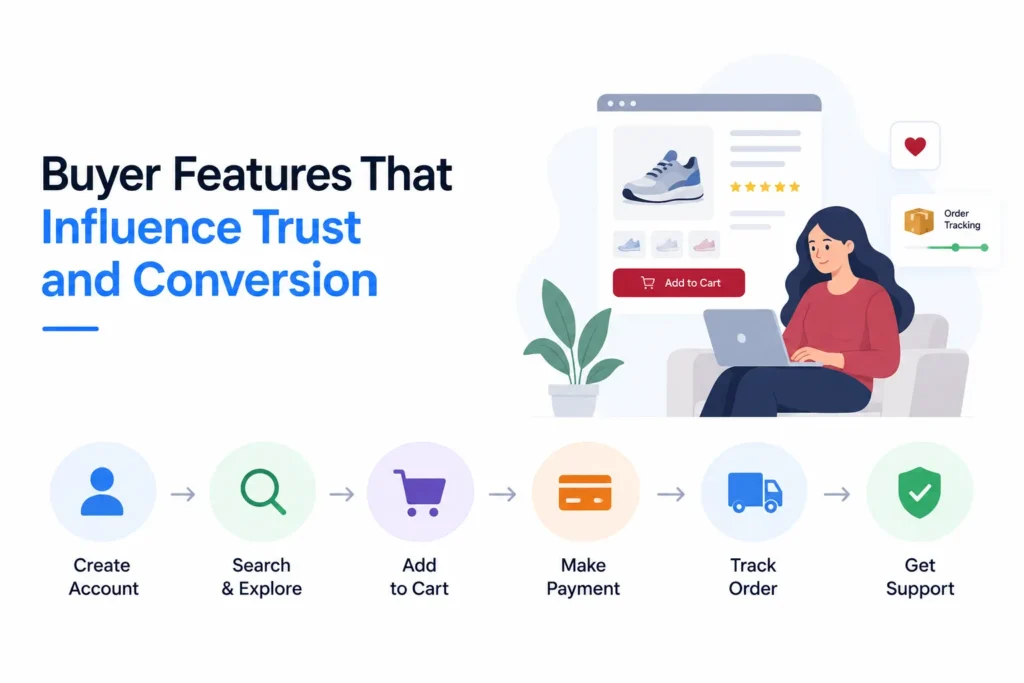
The buyer side of the marketplace should make shopping simple, fast, and trustworthy. Buyers should be able to discover products, compare options, understand delivery expectations, complete payment, and get post-purchase support without confusion.
Important buyer features include:
- Simple registration and login
- Product search with filters and sorting
- Product detail pages with images, variants, stock, price, offers, and reviews
- Wishlist and cart
- Multiple payment methods
- Coupon and discount support
- Order tracking
- Cancellation requests
- Return and refund requests
- Ratings and reviews
- Notifications for order status
- Help center, support tickets, or chat support
Founders should avoid making the buyer app too complex at launch. The first goal is not to add every possible personalization feature. The first goal is to make shopping reliable.
A practical founder test is:
Can a buyer find a product, trust the seller, understand delivery, complete payment, and get support after purchase?
If the answer is yes, the buyer side is ready for early market validation.
Seller Features That Decide Marketplace Supply
A marketplace cannot grow without active sellers. If sellers find the dashboard confusing, listing products becomes slow. If payouts are unclear, sellers lose confidence. If orders are hard to manage, sellers stop participating.
Seller-side features should include:
- Seller registration
- Admin approval
- Business profile management
- Product listing tools
- Bulk upload where needed
- Inventory and stock updates
- Price and discount management
- Order processing
- Return and refund visibility
- Earnings dashboard
- Payout history
- Seller notifications
- Performance reports
Seller experience is not only a backend feature. It is a growth driver.
When sellers can onboard quickly, list products easily, manage orders, and understand earnings, the marketplace can grow supply faster. When seller workflows are weak, founders often spend more on manual support, training, and operational fixes.
Admin Control Is the Real Marketplace Backbone
Many founders focus on the app interface first and the admin dashboard later. That is a costly mistake. The admin dashboard is where the platform operator manages the real business.
A strong admin layer should allow control over:
- Buyer accounts
- Seller approvals
- Product approvals
- Category structure
- Commission settings
- Payment records
- Seller payouts
- Delivery status
- Refund requests
- Return rules
- Coupons and offers
- Homepage banners
- Notifications
- Reviews and ratings
- Dispute cases
- Reports and analytics
- Role-based access
This matters because marketplace operations change frequently after launch. Founders may need to adjust delivery zones, approve sellers, pause products, update commissions, run promotional campaigns, handle refund disputes, and track category performance.
If the admin dashboard is weak, the platform becomes dependent on developers for daily business decisions.
A good admin system gives founders flexibility without slowing down operations.
Payment, Commission, and Payout Logic
Payment logic is one of the biggest cost drivers in retail marketplace development. A simple store collects payment from a buyer and sends the product. A marketplace may need to manage payments across buyers, sellers, delivery teams, and the platform operator.
Founders should evaluate:
- Which payment methods are needed at launch?
- Will the platform support cash collection?
- How will commission be calculated?
- Will commission vary by seller, category, product, or order type?
- How will seller payouts be handled?
- What happens when an order is cancelled?
- How will refunds be processed?
- Will delivery fees be separate from product value?
- Will the platform use wallet balances or settlement records?
These decisions should be made before development because payment architecture affects order flow, wallet records, refund handling, reports, and seller trust.
For founders planning monetization, this marketplace revenue and margin model explains how commission, seller plans, delivery margin, featured placement, cash-handling logic, and settlement workflows can connect inside a commerce platform.
Delivery, Serviceability, and Return Workflows
Retail marketplace delivery is not just shipping. It affects checkout eligibility, customer satisfaction, refund rates, support load, and operating margins.
Founders should define:
- Which areas are serviceable?
- Will sellers deliver independently?
- Will the platform manage delivery partners?
- Will third-party logistics be integrated?
- Will buyers see delivery tracking?
- How will delivery fees be calculated?
- What happens when delivery fails?
- How will return pickup work?
- Who approves returns?
- Who absorbs the cost of failed delivery or refund disputes?
For hyperlocal and regional commerce models, serviceability is especially important. The platform should avoid accepting orders from locations that cannot be fulfilled reliably.
Returns should also be planned early. A marketplace that launches without clear return and refund rules can face buyer dissatisfaction, seller disputes, and unnecessary support costs.
Security and Trust Features Founders Should Not Delay
Trust is a major part of marketplace growth. Buyers must trust the payment process. Sellers must trust payout records. Admin teams must be able to detect suspicious activity, manage disputes, and protect platform data.
Important trust and security layers include:
- Secure login
- Encrypted data transfer
- Secure payment gateway integration
- Seller verification
- Admin approval controls
- Role-based access control
- Activity logs
- Payment records
- Order history
- Refund records
- Review moderation
- Abuse reporting
- Dispute management
- Fraud monitoring signals
- Permission-based dashboards
Security should be treated as part of the product foundation, not a marketing add-on. Final compliance requirements depend on the target market, legal review, payment providers, data handling practices, and operating model.
Miracuves Flipkart-Like Platform Solution Cost and Tech Stack
Miracuves Pricing for a Flipkart-Like Online Retail Marketplace developed in PHP For $2,799 USD (One-Time Price) in just 6 days
Get a fully developed, deployment-ready online retail marketplace modeled around Flipkart-style multi-vendor ecommerce operations. Built on a stable PHP foundation, this complete package includes everything you need to launch and scale:
Core Workflows: Buyer registration, seller onboarding, product listing, category management, product search, cart checkout, order processing, shipment tracking, returns, refunds, and customer notifications.
Built-in Revenue Logic: Seller commissions, listing fees, promoted products, advertising placements, subscription plans, transaction charges, delivery fees, and marketplace service fees.
Management Hub: Centralized admin dashboard, seller management, buyer management, product approval, category controls, order monitoring, payment records, refund handling, dispute management, and marketplace analytics.
Launch-Ready: Fully prepared for your custom branding, configuration, payment gateway setup, seller onboarding, product category setup, shipping configuration, and immediate market entry.
Why Is Flipkart-Like Marketplace Development More Affordable?
Most online retail marketplaces become expensive when businesses choose fully custom development from scratch. Building separate workflows for buyers, sellers, product catalogs, inventory, payments, orders, shipping, returns, promotions, notifications, and admin controls can increase cost, timeline, and technical complexity.
We took a smarter, more practical approach:
You Aren’t Paying for Ground-Up Development: Our ecommerce marketplace engine is already developed, tested, and ready to deploy. You skip the inflated cost and long waiting period usually required to build a large online retail marketplace from scratch.
The Power of PHP: We built this solution on a reliable and cost-effective PHP architecture. This keeps the upfront price affordable while supporting essential seller management, product catalogs, buyer orders, payment workflows, shipping operations, and admin controls.
You get a launch-ready Flipkart-like online retail marketplace with practical multi-vendor ecommerce features, source code access, and faster deployment without the high custom development price tag.
What Actually Affects Marketplace Development Cost?
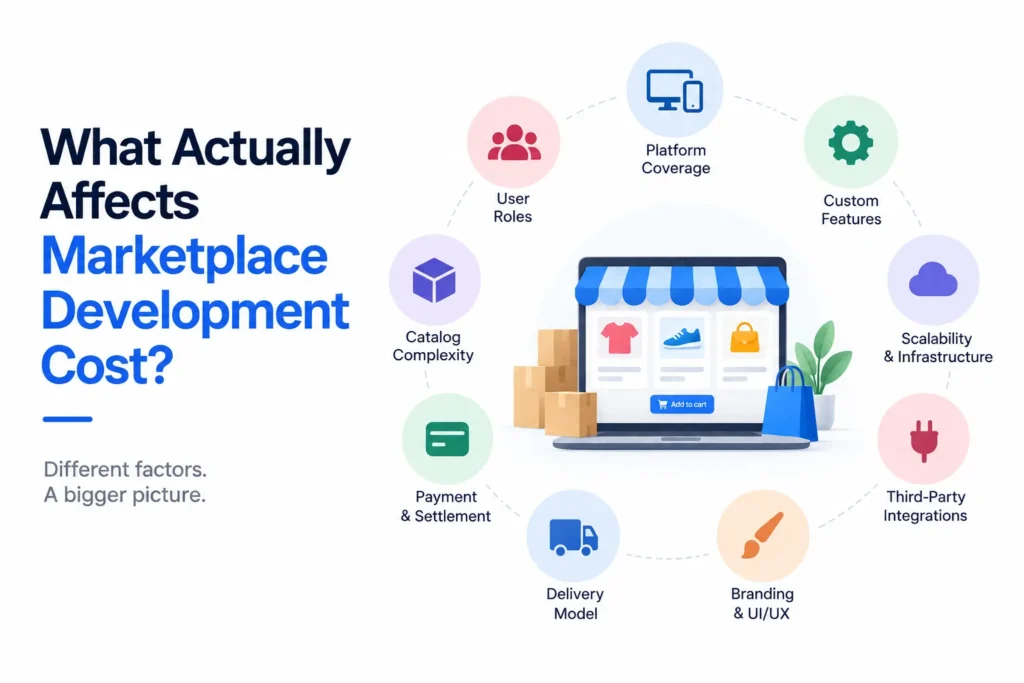
Retail marketplace development cost depends on scope. Two marketplace projects can look similar from the outside but require very different budgets because of user roles, integrations, delivery logic, catalog depth, and customization requirements.
Here are the main cost factors founders should evaluate.
1. Platform Coverage
A web-only marketplace usually requires less work than a full ecosystem with customer mobile apps, seller apps, delivery apps, admin dashboards, and responsive storefronts.
Founders should decide which platforms are essential for launch and which can be added after validation.
2. Number of User Roles
Cost increases when the platform supports multiple roles such as buyers, sellers, delivery partners, support agents, finance teams, category managers, and platform administrators.
Each role adds screens, permissions, workflows, notifications, and testing requirements.
3. Catalog Complexity
A basic catalog is easier to build than a large multi-category retail catalog with product variants, SKU-level stock, size charts, color options, brand filters, multi-image galleries, bulk uploads, and approval workflows.
Catalog complexity affects search, filtering, inventory, seller onboarding, and performance.
4. Payment and Settlement Rules
Payment logic becomes more expensive when the platform needs multiple payment methods, cash handling, wallet records, seller payouts, refund reversals, delivery fees, tax rules, and commission variations.
For marketplace businesses, unclear payment logic often creates expensive changes later.
5. Delivery and Logistics Model
Delivery cost depends on whether the marketplace uses seller-managed fulfillment, platform-managed delivery, third-party logistics, local delivery partners, pickup points, or regional service zones.
Each model changes order status, tracking, fee calculation, admin control, and support workflows.
6. Custom Branding and UI/UX
White-label branding is usually faster than designing everything from scratch. However, highly custom layouts, animations, category templates, promotional screens, and unique design systems can increase development time and cost.
7. Third-Party Integrations
Common integrations include payment gateways, SMS, email, maps, analytics, tax tools, shipping providers, CRM systems, customer support tools, and marketing automation platforms.
Each integration requires setup, testing, error handling, and maintenance planning.
8. Scalability and Infrastructure
The platform should be built to handle expected traffic, product growth, order volume, and seller activity. However, founders should avoid overbuilding infrastructure before demand is proven.
The better approach is to plan a scalable foundation and expand infrastructure as usage increases.
9. Custom Feature Requests
Advanced features such as AI product recommendations, loyalty programs, advanced seller analytics, marketplace ads, dynamic pricing, multi-language support, multi-currency support, and warehouse automation can increase scope.
These features may be valuable, but they should be prioritized based on launch goals and business maturity.
For a more focused pricing view, founders can review this marketplace development cost breakdown before finalizing scope.
Ready-Made Foundation vs Custom Development
Founders usually compare two paths: custom development from zero or a ready-made marketplace foundation. Both can work, but they solve different problems.
| Build Path | What It Means | Best For | Cost and Timeline Logic |
|---|---|---|---|
| Ready-made marketplace foundation | Core marketplace workflows are already built and customized for your brand | Founders who want faster launch and market validation | More cost-efficient because standard modules already exist |
| Custom development | The platform is designed and built from scratch | Businesses with unique workflows or validated complex requirements | Higher effort because each feature is planned, developed, tested, and refined from zero |
| Hybrid approach | Start with a ready-made foundation and customize priority workflows | Founders who want speed with selected differentiation | Balanced path for faster deployment and practical customization |
If your business needs a fully tailored build instead of a ready-made foundation, Miracuves also offers custom mobile app development for unique product workflows.
A ready-made foundation is useful when the business model needs proven marketplace workflows such as buyer accounts, seller tools, product catalog, checkout, payments, order tracking, delivery coordination, admin control, and reports.
Custom development is better when the business has very specific workflow requirements that cannot fit into an existing architecture.
Founders comparing both paths can read this guide on marketplace build options to understand how speed, cost, ownership, and flexibility influence the decision.
Founder Decision Signals Before Launch
Speed
If the market opportunity is time-sensitive, a ready-made marketplace foundation can help you move faster than building every standard workflow from zero.
Cost
If budget control matters, prioritize seller onboarding, catalog, checkout, payments, orders, delivery visibility, returns, and admin control before advanced personalization.
Scalability
If the catalog will grow quickly, plan product attributes, SKU logic, category structure, search, filters, inventory, and database performance early.
Market Fit
If seller supply or delivery readiness is uncertain, validate operations before investing heavily in advanced buyer-side features.
Product planning and marketing should move together. Before launch, founders should also prepare a marketplace launch marketing so seller onboarding, buyer acquisition, and launch campaigns are not handled too late.
What Founders Should Ask Before Choosing a Marketplace Development Partner
Choosing a development partner is not only about price. Founders should evaluate whether the partner understands marketplace operations, seller workflows, payments, delivery logic, admin control, source-code ownership, and post-launch customization.
Ask these questions before committing:
- Do I get full source-code ownership?
- Which user roles are included?
- Is the seller dashboard included?
- Is delivery workflow included or only integrated later?
- Can commissions be configured by category, seller, or product?
- Are refunds and returns part of the workflow?
- Can the admin team manage users, sellers, products, orders, payouts, banners, and reports?
- Which payment gateways can be integrated?
- What is included in deployment?
- What changes require additional scope?
- Is the platform white-label and brand-ready?
- What support is available after launch?
If your next step is vendor evaluation, this guide on choosing a marketplace development partner can help you compare ownership, technical fit, timeline clarity, and operational readiness.
Common Mistakes Founders Should Avoid
Building Too Many Features Before Validating Sellers
A marketplace with advanced personalization still struggles if sellers are inactive, product listings are weak, or catalog quality is poor. Seller supply should be validated early.
Treating the Admin Dashboard as a Minor Backend
The admin dashboard controls daily business operations. Weak admin control creates hidden costs because every small change depends on technical support.
Ignoring Delivery and Return Workflows
Checkout is only the beginning. Delivery failures, refund requests, and return disputes affect buyer trust, seller relationships, and platform profitability.
Choosing Based Only on the Lowest Initial Quote
A low starting cost can become expensive if seller tools, payment rules, source code, deployment, admin controls, and customization support are not clearly included.
Where Miracuves Fits Into Marketplace Launch Planning
Miracuves helps founders build ready-made and white-label marketplace platforms with source-code ownership, branded design, admin control, seller workflows, buyer journeys, payment logic, and deployment support.
For founders, the advantage is practical. Instead of spending months building standard marketplace modules from scratch, they can start from a structured foundation and focus on business execution:
- Seller acquisition
- Category strategy
- Delivery planning
- Buyer acquisition
- Payment setup
- Branding
- Launch campaigns
- Operations
- Post-launch optimization
Where applicable, Miracuves supports 6-day solution delivery for ready-made marketplace deployments, depending on selected modules, branding, integrations, and final scope.
Final Thoughts
A successful retail marketplace is not built by adding features randomly. It is built by understanding how buyers, sellers, payments, delivery, returns, refunds, support, and admin control work together.
Founders should begin with clarity: the marketplace model, seller workflows, catalog requirements, payment rules, delivery responsibilities, admin permissions, and launch priorities. Once those decisions are clear, development becomes easier to scope and easier to control.
The strongest launch is not always the largest build. It is the version that helps founders validate real transactions, support sellers, serve buyers, and improve the platform with confidence.
Miracuves helps founders move faster with ready-made, white-label, source-code-owned marketplace solutions designed for practical execution and faster market validation.
FAQs
What features should a retail marketplace platform include?
A retail marketplace platform should include buyer accounts, seller onboarding, product catalog management, search and filters, cart and checkout, payment integration, order tracking, delivery workflows, returns, refunds, reviews, seller dashboards, and admin controls.
What affects the cost of marketplace development?
Marketplace development cost depends on platform coverage, number of user roles, catalog complexity, payment logic, delivery model, third-party integrations, custom design, scalability needs, and advanced feature requirements.
Is a marketplace more complex than a single-seller ecommerce store?
Yes. A single-seller store usually manages one inventory source, while a marketplace must manage multiple sellers, product listings, commissions, payouts, delivery responsibilities, returns, disputes, and platform rules.
Should founders use a ready-made marketplace foundation or custom development?
A ready-made foundation is useful for faster launch and market validation when standard marketplace workflows already match the business model. Custom development is better when the platform requires highly unique workflows or complex architecture from the beginning.
Why is the admin dashboard important for a marketplace?
The admin dashboard helps control sellers, buyers, products, categories, commissions, orders, payouts, promotions, refunds, disputes, and analytics. Without strong admin control, daily marketplace operations become slow and expensive.
How should founders plan payment and payout features?
Founders should define payment methods, commission rules, seller payout cycles, refund logic, cancellation rules, delivery fees, wallet records, and settlement reports before development begins.
Can Miracuves help launch a retail marketplace quickly?
Yes. Miracuves helps founders launch ready-made and white-label marketplace platforms with source-code ownership, branded design, admin control, marketplace workflows, and 6-day deployment where applicable.
What should founders validate before launch?
Founders should validate seller supply, buyer demand, delivery feasibility, payment methods, commission structure, return rules, category focus, and operational readiness before investing in advanced features.
Miracuves is an independent software development company. We are not affiliated with, connected to, sponsored by, or endorsed by any company or product named in this article.
Terms such as “X Clone” are used descriptively. It is how the software industry refers to building a platform with functionality comparable to a known service, and how clients search for it.
The entire design and codebase of our products is built by our own team. Our products contain no code, design, graphics, or content originating from any third-party website or applications.
All third-party names and marks referenced in this article are the property of their respective owners, referenced solely to identify the services discussed.