Key Takeaways
- A retail marketplace script helps startups launch a multi-vendor shopping platform with ready-made ecommerce workflows.
- Buyers, sellers, delivery partners, payment teams, support teams, and admins need connected marketplace operations.
- Product listings, seller dashboards, inventory, carts, checkout, payments, orders, and delivery tracking are core features.
- Pricing depends on app platforms, marketplace modules, seller tools, integrations, design, and customization needs.
- A retail marketplace platform can help founders reduce launch time while testing product demand, seller supply, and buyer behavior.
Feature Signals
- Buyers need product search, filters, wishlists, carts, secure checkout, order tracking, returns, and refund visibility.
- Sellers need product uploads, inventory control, pricing tools, order management, payout tracking, and sales reports.
- Delivery teams need order assignment, route details, pickup updates, delivery status, proof of delivery, and performance tracking.
- Admins need control over users, sellers, products, commissions, coupons, payments, disputes, reports, and analytics.
- Notifications keep buyers, sellers, delivery teams, and admins updated on orders, payments, returns, refunds, and account activity.
Real Insights
- A retail marketplace needs strong seller onboarding, clean product data, smooth checkout, and reliable order management.
- Weak inventory logic can create cancelled orders, poor buyer trust, and support issues after launch.
- Returns, refunds, delivery tracking, seller ratings, and dispute handling are important for long-term marketplace quality.
- Founders should compare total launch readiness, not only feature count or upfront development cost.
- Miracuves builds retail marketplace platforms with multi-vendor workflows, seller dashboards, product management, payments, delivery tracking, returns, analytics, and admin control.
Founders who plan to launch an omnichannel retail platform often start with one question: “What features do I need, and how much will it cost?”
That is the right question, but it is not complete.
A retail marketplace is not only a storefront. It is a connected operating system where customers, sellers, inventory, payments, fulfilment, returns, discounts, analytics, and admin controls work together. If one layer is weak, the entire business feels it later through overselling, delayed orders, refund disputes, poor seller experience, or rising support costs.
This guide helps founders evaluate the most important omnichannel retail platform features and the cost factors that shape development before launch. It is written for startups, retail operators, agencies, and ecommerce founders who want clarity before choosing between custom development, a ready-made product foundation, or a white-label marketplace platform.
For founders who want to move faster with a retail marketplace foundation instead of building every workflow from zero, Miracuves offers a launch-ready retail commerce solution that can be explored here: retail marketplace solution foundation.
Why Omnichannel Retail Is More Complex Than a Basic Ecommerce Store
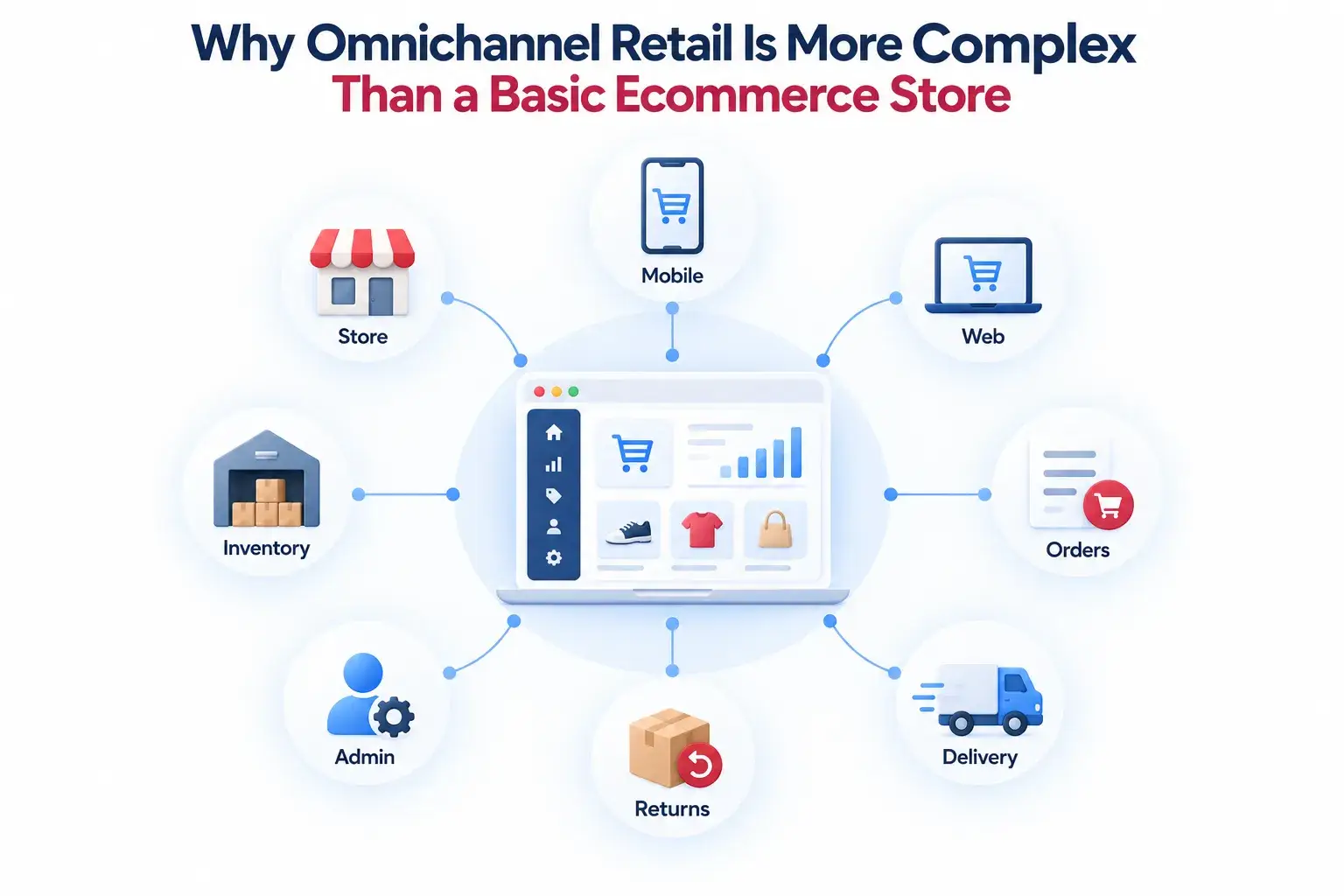
A basic ecommerce store focuses on listing products, taking payments, and shipping orders. An omnichannel retail platform has a wider responsibility. It must manage customer demand across mobile apps, web storefronts, warehouses, sellers, local stores, delivery partners, returns, refunds, and admin rules.
For founders, this matters because the platform is not just a sales channel. It becomes the operational backbone of the business.
A customer may browse on mobile, add items to cart on web, choose delivery from a nearby store, return one item later, and expect a refund update in the same account. A seller may update stock from a dashboard while the warehouse system has another inventory count. The admin team may need to approve sellers, adjust commissions, review refunds, and monitor fulfilment performance.
That is why omnichannel commerce should be planned as a connected system from day one.
The strongest retail platforms usually solve these layers together:
- Product catalog and category structure
- Real-time or near-real-time inventory visibility
- Seller or vendor onboarding
- Customer apps and web storefront
- Cart, checkout, taxes, coupons, and payment flow
- Order management and fulfilment routing
- Delivery, pickup, or ship-from-store logic
- Returns, refunds, and dispute handling
- Admin dashboard and role-based access
- Analytics, reporting, and operational monitoring
A founder who only compares frontend features may underestimate the actual build effort. The real cost sits in the backend logic, workflows, integrations, permissions, and post-order operations.
Core Features Every Omnichannel Retail Platform Should Include
The right feature set depends on the business model. A single-brand D2C store, multi-vendor marketplace, grocery delivery platform, B2B wholesale marketplace, and regional retail app do not need the same product architecture.
Still, most retail platforms need a few core layers to work properly. Founders who want a more detailed retail marketplace feature checklist can also review Miracuves’ retail operations and feature breakdown before finalizing their launch scope.
Omnichannel Retail Platform Feature Evaluation Table
| Feature Layer | What Founders Should Evaluate | Why It Affects Cost |
|---|---|---|
| Product Catalog | Categories, SKUs, variants, attributes, images, bundles, brands, and search filters. | Complex catalogs require stronger data structure, bulk upload tools, and better admin control. |
| Inventory Sync | Stock visibility across sellers, warehouses, stores, and marketplace channels. | Multi-location stock logic adds integration, buffer rules, conflict handling, and alerts. |
| Customer Experience | Mobile app, web storefront, product discovery, wishlist, cart, checkout, order history, and support. | More customer touchpoints increase UI, testing, notification, and performance work. |
| Seller or Vendor Dashboard | Product listing, price updates, stock management, order acceptance, payouts, and performance reports. | Seller self-service reduces admin workload but requires permission-based workflows. |
| Checkout and Payments | Payment gateways, wallets, taxes, coupons, refunds, partial payments, and order confirmation. | Payment complexity affects gateway integration, error handling, reconciliation, and compliance workflows. |
| Order Management | Order routing, fulfilment status, cancellations, partial shipments, pickup, delivery, and returns. | Order logic becomes more expensive when multiple fulfilment paths are involved. |
| Delivery and Fulfilment | Courier integration, internal fleet, delivery slots, route logic, tracking, and serviceability checks. | Delivery workflows require mapping, assignment rules, tracking, notifications, and operational dashboards. |
| Returns and Refunds | Return requests, refund rules, item condition checks, seller liability, wallet refunds, and dispute flows. | Returns are often underestimated but directly affect margins, trust, and support costs. |
| Admin Dashboard | User control, seller approval, catalog review, orders, payments, reports, commissions, disputes, and settings. | The admin panel decides how much the founder can manage without developer dependency. |
| Analytics and Reports | Sales, conversion, seller performance, stock movement, abandoned carts, refund rate, and repeat purchases. | Useful reporting requires event tracking, clean data structure, and role-based access. |
Customer App Features Founders Should Not Treat as “Basic Screens”
The customer-facing experience is where conversion happens, but many founders underestimate how much logic sits behind simple actions.
A product search page is not just a list of products. It may need filters, sorting, stock visibility, delivery availability, seller ratings, discounts, sponsored listings, and personalized recommendations. A checkout page is not just a payment button. It may need address validation, tax calculation, coupon rules, wallet balance, payment failure recovery, and delivery slot selection.
Important customer-side features include:
- Account registration and login
- Product browsing by category, brand, seller, location, or offer
- Smart search and filters
- Product detail pages with images, variants, reviews, and delivery promise
- Wishlist and saved cart
- Cart and checkout
- Multiple payment options
- Coupon, promo, and loyalty support
- Order tracking
- Return and refund request flow
- Push notifications, SMS, and email updates
- Help center or support ticket flow
The founder question is not “Can users buy products?” The better question is “Can users discover, trust, purchase, track, return, and reorder without friction?”
That shift changes the quality of the platform.
Seller and Vendor Features That Decide Marketplace Scalability
If the platform includes third-party sellers, the seller dashboard becomes one of the most important cost and scalability factors.
Without seller self-service, the admin team has to manually upload products, update stock, check order status, handle payout questions, approve returns, and resolve listing issues. That may work with five sellers, but it breaks quickly when the marketplace grows.
A strong seller dashboard should support:
- Seller registration and approval
- Business profile management
- Product listing and bulk upload
- SKU, variant, and stock control
- Price and discount management
- Order acceptance and fulfilment status
- Return and refund visibility
- Payout history
- Commission visibility
- Performance reports
- Support and dispute communication
Founders should also decide how much control sellers should have. Some marketplaces allow sellers to publish products instantly. Others require admin approval for listings, images, pricing, or restricted categories. More control improves governance, but it also adds workflow complexity.
For founders comparing ecommerce marketplace models, Miracuves also provides broader white-label ecommerce app solutions that help teams evaluate different commerce structures before choosing the final platform direction.
Admin Dashboard Features That Protect Founder Control
The admin dashboard is where the business is actually managed. A weak admin panel creates developer dependency for routine changes. A strong admin panel gives the founder and operations team control over daily decisions.
For an omnichannel retail platform, the admin dashboard should help manage:
- Customers, sellers, and staff roles
- Product categories and catalog rules
- Seller approvals and verification
- Inventory visibility
- Orders, cancellations, and returns
- Payment status and refunds
- Commission rules and payout cycles
- Coupons, discounts, and promotions
- Delivery settings and service areas
- Support tickets and disputes
- Ratings and reviews
- Reports and analytics
- Platform settings and content pages
Role-based access is important. The finance team should not need the same permissions as the catalog team. Support staff should not have full control over payout settings. Operations teams need access to orders and fulfilment, but not necessarily platform configuration.
This is why admin control should be discussed before development begins, not after launch.
What Actually Drives Omnichannel Retail Platform Cost?
The cost of building an omnichannel retail platform depends on scope, feature depth, integrations, design requirements, delivery model, and ownership expectations. For founders who want a deeper breakdown of retail marketplace pricing logic, Miracuves has a dedicated retail platform development cost guide.
Founders should avoid one-size-fits-all pricing assumptions. Two platforms may both look like ecommerce apps from the outside, but one may have simple checkout while the other needs seller payouts, warehouse sync, store pickup, wallet refunds, tax rules, delivery slots, and return automation.
Below are the most important cost factors.
1. Number of User Panels
A simple retail app may need only a customer app and admin dashboard. A marketplace model may require customer app, seller panel, delivery partner app, and admin dashboard.
Each panel adds design, development, testing, permissions, and workflow logic.
2. Catalog and SKU Complexity
A platform selling five product categories is easier to manage than one with thousands of SKUs, size/color variants, product bundles, perishables, warranties, or regulated items.
Catalog complexity affects:
- Database structure
- Search and filter logic
- Bulk upload tools
- Product approval workflow
- Seller controls
- Inventory mapping
3. Inventory and Stock Sync
Inventory is one of the biggest technical cost drivers in omnichannel retail. If stock exists across multiple stores, warehouses, sellers, and online channels, the platform needs a reliable source of truth.
Founders must decide whether the first version needs real-time stock sync, scheduled sync, manual seller updates, buffer stock rules, or ERP integration.
4. Checkout, Payment, and Refund Logic
Payment complexity increases when the platform supports multiple payment gateways, wallets, split payments, seller payouts, promo credits, refunds, tax handling, and reconciliation.
A strong payment workflow should be designed for trust, not only transaction completion.
5. Fulfilment Model
The cost changes significantly depending on whether the business uses:
- Standard courier delivery
- Internal delivery fleet
- Store pickup
- Ship-from-store
- Seller-managed delivery
- Hyperlocal delivery
- Scheduled delivery slots
- Multi-package fulfilment
Each fulfilment path needs its own order status logic and customer communication flow.
6. Returns and Disputes
Many founders plan the forward order path but ignore returns. That is risky.
Returns affect margin, customer trust, seller accountability, refund timing, inventory restocking, and support workload. If your platform sells fashion, grocery, electronics, or high-frequency household items, return logic should be planned early.
7. Third-Party Integrations
Integrations can increase development cost depending on API quality, documentation, approval process, testing requirements, and failure handling.
Common integrations include:
- Payment gateways
- Maps and location services
- SMS, email, and push notifications
- ERP or warehouse systems
- Shipping providers
- Tax tools
- Analytics tools
- CRM or support software
- Accounting systems
8. UI/UX and Branding Scope
A white-label platform can launch faster when branding is focused on logo, colors, content, and practical interface adjustments. A full custom design system takes longer because every screen, component, edge case, and interaction needs more design and QA work.
Founders should decide whether the first launch needs deep custom UI or a clean, branded, conversion-ready interface.
9. Source Code and Ownership
Source-code ownership matters when the founder wants flexibility after launch. It allows the business to extend the platform, audit the code, move infrastructure, integrate new systems, or work with another technical team later.
A lower-cost platform without ownership may look attractive initially but can create vendor lock-in later.
10. Support, QA, and Launch Readiness
Testing is not optional in retail. Checkout errors, inventory mismatch, payment failures, broken notifications, and poor order tracking directly affect revenue and trust.
Cost should include proper QA, deployment preparation, admin training, documentation, and post-launch support where applicable.
Ready-Made vs Custom Development: Which Route Fits Your Retail Launch?
The build route should match the founder’s risk, budget, timeline, and product differentiation.
| Build Route | Best For | Cost Logic | Founder Risk |
|---|---|---|---|
| Ready-made white-label platform | Founders who want to launch faster using proven retail workflows | More cost-efficient when catalog, checkout, seller tools, and admin workflows already exist | Risk is lower if scope is clear and customization is controlled |
| Custom development from zero | Founders with highly unique retail logic or proprietary workflows | Usually higher because every module, panel, integration, and test flow is built from scratch | Risk increases if requirements are unclear or timelines stretch |
| Hybrid approach | Founders who want a ready foundation with selected custom modules | Balanced cost when the foundation is reused and only differentiating features are custom-built | Works well when founders know which features truly matter |
A ready-made approach does not mean the business has no differentiation. It means the founder avoids rebuilding standard retail infrastructure from zero and invests more energy into seller acquisition, customer demand, logistics, pricing strategy, and operational execution.
Miracuves’ 6-day solution delivery is relevant here because ready-made retail platforms can move faster when the foundation already includes core app flows, admin control, and marketplace modules. Custom features, heavy integrations, or unique fulfilment rules may extend the timeline, so scope clarity is important before launch.
Founders who want to compare a productized retail marketplace foundation can review this high-volume retail commerce platform and use it as a reference point for feature planning.
Founder Decision Signals
Speed
If your goal is to validate demand quickly, start with the features needed to sell, fulfil, support, and learn. Avoid delaying launch for features that only matter after traction.
Cost
Cost is shaped more by workflows, integrations, panels, and operational rules than by the number of frontend screens alone.
Scalability
Choose architecture that can support more sellers, SKUs, orders, fulfilment paths, and admin roles without forcing a rebuild too early.
Market Fit
The first launch should help you test category demand, seller supply, repeat purchase behavior, and fulfilment reliability before adding advanced layers.
Monetization Models Founders Should Plan Before Development
An omnichannel retail platform should be built around the business model, not the other way around. Monetization affects seller dashboards, checkout logic, commission settings, reporting, payout workflows, and promotional tools.
Common monetization options include the models below. Founders who want to go deeper into commission, delivery fees, promoted listings, and seller-side revenue streams can explore this retail marketplace business model guide before deciding which levers to activate first.
| Monetization Model | How It Works | Platform Feature Required |
|---|---|---|
| Commission on Sales | The platform earns a percentage from each seller transaction. | Commission engine, seller payout reports, settlement rules |
| Listing Fees | Sellers pay to list products or categories. | Seller subscription or listing payment workflow |
| Featured Placement | Sellers pay for better visibility. | Sponsored listing controls and admin approval |
| Delivery Fees | Customers pay delivery charges based on distance, order value, or service level. | Delivery fee rules and serviceability logic |
| Subscription Plans | Buyers or sellers pay recurring fees for benefits. | Subscription billing and access control |
| Advertising | Brands or sellers pay for banners, promoted products, or campaign visibility. | Ad inventory management and reporting |
| Value-Added Services | The platform charges for fulfilment, warehousing, packaging, or analytics. | Service fee configuration and reporting |
Founders should decide which revenue streams matter in the first launch and which ones can wait. Too many monetization layers too early can increase cost and operational complexity before the platform has enough usage data.
Security, Permissions, and Trust Workflows to Include Early
Retail platforms handle customer data, seller records, payment status, addresses, invoices, refund requests, and operational reports. Security should not be treated as a final add-on.
Important trust and security layers include:
- Encrypted data transfer
- Secure payment gateway integration
- Role-based access control
- Admin activity logs
- Seller verification workflows
- Customer account protection
- Refund and dispute records
- Review moderation
- Fraud monitoring signals
- Permission-based dashboards
- Secure API integration
Final compliance requirements depend on jurisdiction, payment providers, data handling rules, business model, and legal review. However, founders should still build a compliance-ready foundation that supports clean records, controlled permissions, and safe operational workflows.
Mistakes Founders Should Avoid
Choosing a platform only by frontend design
A clean interface matters, but retail success depends on inventory, checkout, order routing, returns, seller control, and admin workflows working together.
Ignoring returns until after launch
Returns affect customer trust, seller accountability, refund timing, and profit margin. They should be planned before the platform goes live.
Building every advanced feature before testing demand
Personalization, loyalty, subscriptions, and automation are valuable, but they should not delay the first market-ready version if the core buying and fulfilment flows are not yet validated.
Accepting vendor lock-in without thinking long term
Founders should understand whether they receive source code, deployment access, documentation, admin control, and the freedom to extend the platform later.
How Miracuves Helps Founders Launch Retail Platforms Faster
Miracuves helps founders build ready-made and white-label app solutions with branded design, admin control, source-code ownership, and faster deployment. For retail and ecommerce founders, this means the business can start from a working product foundation instead of rebuilding every standard marketplace module from zero.
A Miracuves-ready foundation can help with:
- Customer app workflows
- Seller or vendor tools
- Admin dashboard control
- Product catalog management
- Cart and checkout
- Payment gateway integration
- Order and fulfilment workflows
- Commission and monetization logic
- Branding and configuration
- Source-code-owned delivery
- 6-day launch path for ready-made solutions within defined scope
Founders exploring broader commerce infrastructure can also review Miracuves’ retail and ecommerce development expertise and ecommerce app development services for custom or ready-made execution paths.
Final Thoughts: Build the Retail Platform Around Operations, Not Just Screens
The cost of an omnichannel retail platform is not decided by the homepage, product page, and checkout page alone. It is decided by the operational depth behind those screens.
Inventory sync, fulfilment routing, seller control, admin permissions, returns, refunds, payments, analytics, and source-code ownership all shape the real cost and long-term flexibility of the platform.
For founders, the smarter path is to define the launch model clearly, choose the features that support early validation, avoid unnecessary complexity, and use a ready-made foundation where it reduces risk. Miracuves can help founders launch faster with a white-label, source-code-owned retail platform that supports branding, admin control, monetization, and future customization.
FAQs
What are the most important omnichannel retail platform features?
The most important features include product catalog management, inventory sync, customer app, seller dashboard, cart and checkout, payment gateway integration, order management, fulfilment tracking, returns, refunds, admin dashboard, analytics, and role-based access control.
How much does it cost to build an omnichannel retail platform?
The cost depends on feature scope, number of user panels, catalog complexity, inventory logic, fulfilment model, payment integrations, seller tools, UI customization, source-code ownership, QA, and launch support. Founders should confirm pricing based on selected modules and customization requirements.
Why does inventory sync increase ecommerce platform cost?
Inventory sync increases cost because the platform must manage stock across sellers, stores, warehouses, and online channels. This may require real-time updates, buffer stock rules, alerts, ERP integration, and conflict handling to prevent overselling.
Is a ready-made retail platform better than custom development?
A ready-made platform is often better for founders who want faster market validation and do not need highly unique logic in the first version. Custom development is better when the business model depends on proprietary workflows, unusual fulfilment rules, or deep system-specific integration.
Should founders launch with mobile apps and web together?
It depends on the target market. If customers are mobile-first, launching with mobile apps can improve accessibility and repeat purchases. If SEO, catalog discovery, or B2B buying is important, a web storefront may also be valuable from the beginning.
What cost factors are most commonly underestimated?
Founders often underestimate returns, refunds, seller payouts, inventory sync, admin permissions, tax rules, delivery workflows, QA, and third-party integration testing. These are not always visible on the frontend, but they strongly affect platform stability.
Can Miracuves help launch an omnichannel retail platform faster?
Yes. Miracuves helps founders launch ready-made and white-label retail app solutions with branded design, admin dashboard, source-code ownership, and 6-day delivery for defined ready-made scopes. Advanced custom features or complex integrations may require additional time.
What should founders prepare before requesting a quote?
Founders should prepare the business model, target region, product categories, number of sellers, required user panels, payment gateway preference, fulfilment model, inventory requirements, branding expectations, and any required third-party integrations.
Miracuves is an independent software development company. We are not affiliated with, connected to, sponsored by, or endorsed by any company or product named in this article.
Terms such as “X Clone” are used descriptively. It is how the software industry refers to building a platform with functionality comparable to a known service, and how clients search for it.
The entire design and codebase of our products is built by our own team. Our products contain no code, design, graphics, or content originating from any third-party website or applications.
All third-party names and marks referenced in this article are the property of their respective owners, referenced solely to identify the services discussed.