


Key Takeaways
What You’ll Learn
- Lalamove-style app security must protect customers, drivers, and business operations simultaneously, making it more complex than typical apps.
- Major risks include API vulnerabilities, location data leaks, and account takeover attacks that can expose sensitive delivery information.
- Real-time GPS tracking increases both functionality and risk, requiring strict access control and data protection.
- Strong authentication, encryption, and role-based access control are essential for securing all platform layers.
- Security must be built into the system architecture from the start, not added later as a patch.
Stats That Matter
- On-demand delivery apps handle real-time location, identity, and payment data, making them high-value targets for cyberattacks.
- Over 60% of logistics app breaches originate from unsecured APIs, highlighting the importance of backend protection.
- Security measures like TLS encryption, SSL, and hashed passwords are standard practices to protect user data.
Real Insights
- Logistics apps are high-risk platforms because they combine financial data with real-world movement and delivery routes.
- Driver identity verification systems such as facial authentication help prevent fraud and account misuse.
- Location data security is critical because exposure can lead to physical safety risks, not just digital threats.
- Continuous monitoring and audits are necessary to detect threats early and reduce damage.
- The strongest delivery platforms succeed when security, compliance, and operational reliability are built together into one system.
You’ve heard the horror stories — delivery apps leaking customer locations, payment data breaches, and platforms getting shut down due to compliance failures.
If you’re planning to launch a white-label Lalamove app, one question probably keeps you up at night:
Is it actually safe?
In 2026, app security is no longer a “technical detail.” It is a business survival factor. On-demand logistics platforms like Lalamove handle real-time location data, driver identities, customer addresses, and payment transactions — making them prime targets for cyberattacks, fraud, and regulatory scrutiny.
What makes this even more sensitive is the white-label model. While it accelerates time-to-market, many founders worry:
- Will my app be secure enough?
- Who is responsible if data is breached?
- Can a white-label Lalamove app meet enterprise and government compliance standards?
- Am I exposed legally if something goes wrong?
These are valid concerns — and ignoring them has cost startups millions in fines, lawsuits, and brand damage.
This guide gives you an honest, no-fluff security assessment of white-label Lalamove-style apps. You’ll understand:
- Where real security risks exist
- Which fears are myths and which are justified
- What security standards matter in 2026
- How to choose a provider that prioritizes safety, not shortcuts
Most importantly, you’ll learn how Miracuves approaches white-label app security differently, treating it as a core product feature — not an optional add-on.
Understanding White-Label Lalamove App Security Landscape
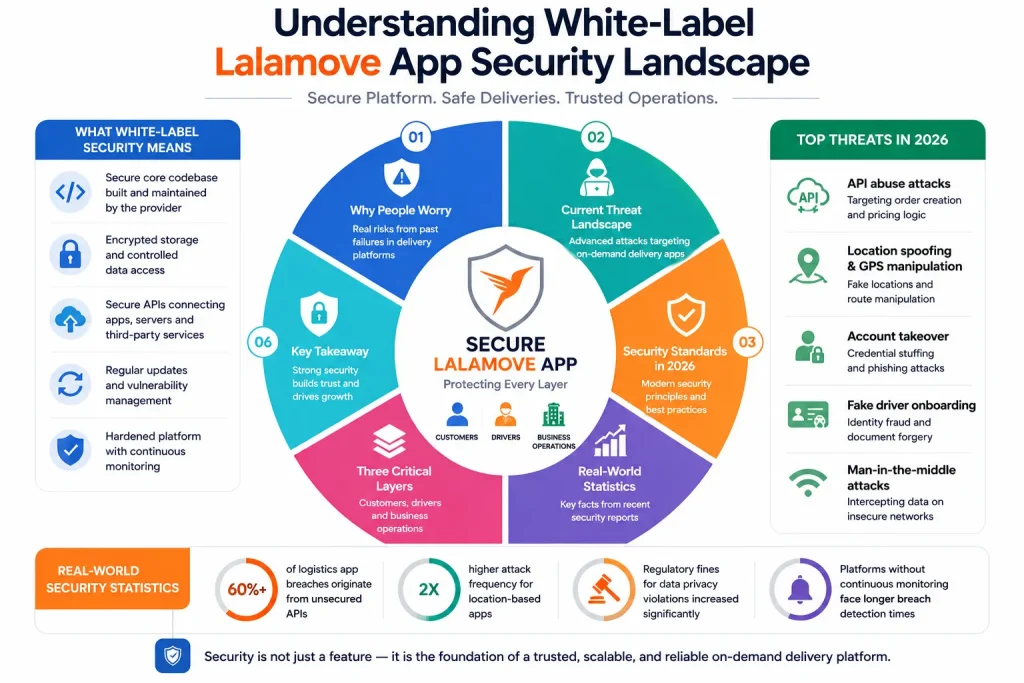
White-label app security does not mean “shared” or “generic” security. It means the underlying architecture is prebuilt, but how securely it is implemented depends entirely on the provider.
For a white-label Lalamove app, security must protect three critical layers at once: customers, drivers, and business operations. Each layer introduces unique risks that must be engineered for from day one.
What White-Label App Security Actually Means
In a white-label Lalamove app, security is defined by:
- How the core codebase is written and maintained
- How data is stored, encrypted, and accessed
- How APIs communicate between apps, servers, and third-party services
- How updates and vulnerabilities are handled after launch
A secure white-label app is not just a rebranded UI. It is a hardened platform with controlled access, encrypted data flows, and continuous monitoring.
Why People Worry About White-Label Lalamove Apps
Concerns usually come from real industry failures:
- Delivery apps exposing real-time driver locations
- Insecure APIs leaking customer addresses
- Payment data mishandled by third-party gateways
- Platforms fined for GDPR violations due to poor consent handling
Because a Lalamove-style app operates in real-world logistics, even a small breach can create physical safety risks — not just digital ones.
Current Threat Landscape for On-Demand Delivery Platforms
In 2026, white-label Lalamove apps face advanced threats such as:
- API abuse attacks targeting order creation and pricing logic
- Location spoofing and GPS manipulation
- Account takeover attacks using credential stuffing
- Fake driver onboarding and identity fraud
- Man-in-the-middle attacks on poorly secured networks
Delivery platforms are increasingly targeted because they combine financial data, movement patterns, and operational intelligence.
Security Standards in 2026
Modern white-label app security is measured against:
- Zero-trust architecture principles
- Encryption at rest and in transit
- Role-based access control for admins, drivers, and customers
- Secure DevOps pipelines with automated vulnerability scanning
- Compliance-driven data handling frameworks
Security is no longer reactive. It must be built into the product lifecycle.
Real-World Statistics on App Security Incidents
Recent industry reports show:
- Over 60% of logistics app breaches originate from unsecured APIs
- Location-based apps face 2x higher attack frequency than generic e-commerce platforms
- Regulatory fines for data privacy violations increased significantly year-over-year
- Platforms without continuous security monitoring experience longer breach detection times, increasing damage
These numbers explain why serious founders no longer ask “Is security needed?” but instead ask “How strong is it, really?”
Read more : – Top Lalamove App Features Explained
Key Security Risks & How to Identify Them
A white-label Lalamove app handles highly sensitive operational data every second. Understanding where real risks exist helps you prevent problems before they turn into business-ending incidents.
Data Protection and Privacy Risks
On-demand delivery apps collect more personal data than most platforms. If this data is not protected correctly, both users and the business are exposed.
User personal information includes names, phone numbers, email addresses, delivery history, and saved locations. If databases are not encrypted or access-controlled, this information can be leaked or misused.
Payment data security is another major concern. Even when using third-party gateways, improper token handling or insecure callbacks can expose transaction details and create PCI compliance violations.
Location tracking introduces additional risk. Real-time GPS data reveals user movement patterns and driver routes. Poorly secured location services can lead to stalking risks, cargo theft, or route manipulation.
Privacy regulations such as GDPR and CCPA require explicit consent, data minimization, and the ability for users to request deletion. Many unsafe white-label apps fail here due to weak data governance.
Technical Vulnerabilities
Code quality issues are one of the most common weaknesses in unsafe white-label apps. Hardcoded credentials, outdated libraries, and lack of input validation make the app vulnerable to attacks.
Server security gaps appear when cloud infrastructure is misconfigured. Open ports, weak firewall rules, and unrestricted admin access can allow attackers to gain control of backend systems.
API vulnerabilities are especially dangerous in Lalamove-style platforms. APIs control pricing, driver assignment, order status, and payouts. If authentication and rate limiting are weak, attackers can manipulate core business logic.
Third-party integrations such as maps, payment gateways, notifications, and analytics introduce external risk. If these integrations are not vetted or updated, they become entry points for attackers.
Business Risks
Legal liability arises when customer or driver data is compromised. In many regions, the platform owner is held responsible regardless of whether the breach came from a third-party provider.
Reputation damage spreads faster than technical fixes. A single public incident can destroy user trust and permanently reduce platform adoption.
Financial losses include regulatory fines, chargebacks, legal fees, compensation payouts, and revenue downtime during incident response.
Regulatory penalties are becoming stricter. Authorities now actively audit platforms handling location and payment data, especially in logistics and delivery sectors.
Risk Assessment Checklist
Before launching a white-label Lalamove app, verify the following:
Are all user and driver data fields encrypted at rest and in transit
Are APIs protected with authentication, authorization, and rate limiting
Is payment processing fully PCI-compliant
Are location services access-controlled and anonymized where possible
Is there a documented incident response plan
Are regular security audits scheduled
Is compliance support provided for different regions
If a provider cannot clearly explain how these risks are handled, the platform is not ready for real-world deployment.
Security Standards Your White-Label Lalamove App Must Meet
In 2026, security is measured against formal standards, not promises. A white-label Lalamove app must meet globally recognized frameworks to be considered safe, scalable, and legally defensible.
Essential Certifications
- ISO 27001 compliance indicates that the provider follows a structured information security management system. It ensures risks are identified, monitored, and continuously improved.
- SOC 2 Type II focuses on how customer data is handled over time. It validates controls related to security, availability, confidentiality, and data integrity — especially important for logistics platforms operating 24/7.
- GDPR compliance is mandatory for platforms serving users in or connected to the European Union. It governs consent management, data storage, breach reporting, and user rights.
- HIPAA applies only if the delivery platform handles medical or healthcare-related shipments. In such cases, strict safeguards around health data become mandatory.
- PCI DSS is non-negotiable for payment processing. Even if a third-party gateway is used, the app must follow secure transaction handling and tokenization standards.
Technical Security Requirements
- End-to-end encryption protects data as it moves between the user app, driver app, admin panel, and backend servers. Without this, sensitive data can be intercepted.
- Secure authentication mechanisms such as two-factor authentication and OAuth prevent unauthorized account access and reduce the risk of credential-based attacks.
- Regular security audits identify vulnerabilities before attackers do. These audits should include both automated scans and manual reviews.
- Penetration testing simulates real-world attacks on the platform. It exposes weaknesses in APIs, authentication flows, and business logic.
- SSL certificates ensure secure communication between users and servers. Expired or misconfigured certificates are a common cause of data exposure.
- Secure API design enforces authentication, authorization, input validation, and rate limiting across all endpoints.
Security Standards Comparison Table
- Basic white-label apps rely on shared hosting, minimal encryption, and reactive fixes after issues occur.
- Enterprise-grade white-label apps use dedicated cloud infrastructure, encrypted databases, secured APIs, continuous monitoring, and documented compliance processes.
- Miracuves-built white-label Lalamove apps fall into the enterprise-grade category, designed to meet regulatory expectations from day one rather than after problems arise.
Read more : – Lalamove Marketing Strategy for Logistics App Growth
Red Flags: How to Spot Unsafe White-Label Providers
Not all white-label app providers treat security seriously. Many focus on speed and low pricing, leaving founders exposed to hidden risks that surface only after launch.
Knowing the warning signs early can save you from costly mistakes.
Warning Signs You Should Never Ignore
- No security documentation is a major red flag. A serious provider can clearly explain how data is stored, encrypted, and protected.
- Cheap pricing without technical justification often means security corners are being cut. Enterprise-grade security requires investment in infrastructure, audits, and skilled engineers.
- No compliance certifications indicate the provider is not prepared for regulatory scrutiny. This becomes a serious issue as soon as the platform gains traction.
- Outdated technology stacks increase vulnerability to known exploits. Unsupported frameworks and libraries are common entry points for attackers.
- Poor code quality leads to unstable performance and security flaws. If demos crash or admin panels feel unreliable, backend risks are usually worse.
- No security update policy means vulnerabilities will remain unpatched. In logistics platforms, this is especially dangerous due to real-time operations.
- Lack of data backup systems puts the business at risk of permanent data loss in case of attacks or system failures.
- No insurance coverage exposes founders to direct financial liability during security incidents.
Evaluation Checklist for White-Label Lalamove App Providers
Before choosing a provider, ask:
- How is user, driver, and order data encrypted
- How often are security audits performed
- What compliance standards are supported by default
- How are API vulnerabilities prevented
- What happens if a security incident occurs
Request the following documents:
- Security architecture overview
- Compliance certificates or audit reports
- Data protection and privacy policy templates
- Incident response procedures
Test the platform by:
- Reviewing API authentication and access controls
- Checking admin role permissions
- Evaluating update and patch delivery processes
Perform due diligence by:
- Reviewing past project security history
- Asking about breach response timelines
- Confirming ongoing security support after launch
If a provider hesitates or gives vague answers, consider it a clear sign to walk away.
Best Practices for Secure White-Label Lalamove App Implementation
Security does not end at launch. A white-label Lalamove app must be implemented with a clear security lifecycle that covers both pre-launch preparation and post-launch operations.
Pre-Launch Security Practices
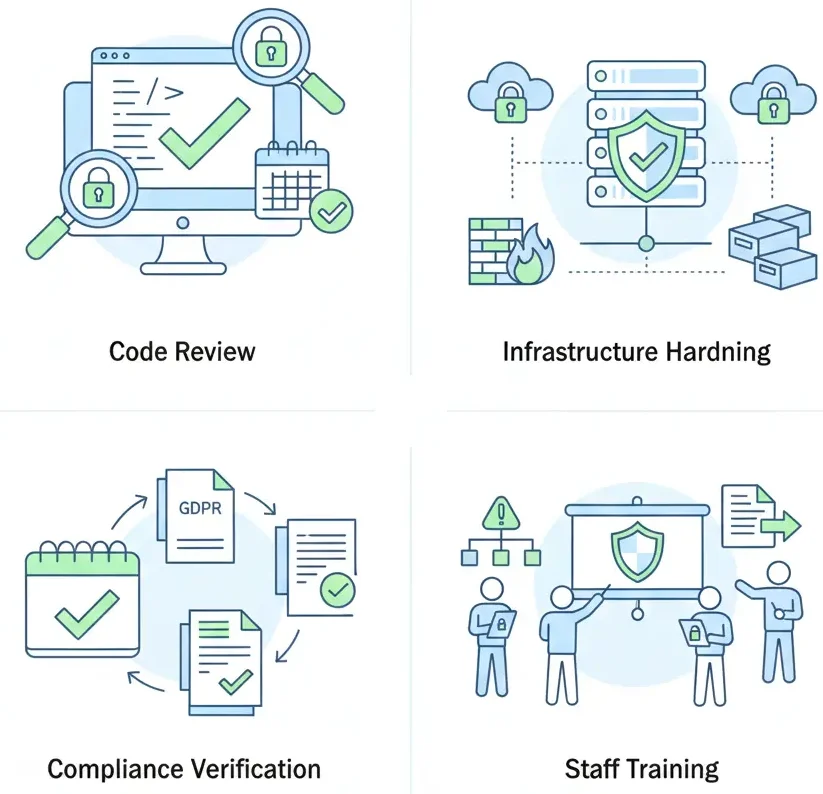
A structured security audit process should be completed before the app goes live. This includes reviewing backend infrastructure, APIs, databases, and access controls.
Post-Launch Monitoring and Protection
Continuous security monitoring helps detect suspicious activity in real time. This includes abnormal login attempts, API abuse, and data access anomalies.
- Regular updates and patches close newly discovered vulnerabilities. A secure white-label app evolves alongside emerging threats.
- Incident response planning ensures fast action if a breach or system failure occurs. Clear roles and response timelines reduce damage and downtime.
- User data management policies control how data is stored, accessed, archived, and deleted. This is essential for privacy compliance and long-term trust.
- Backup and recovery systems protect the business from ransomware attacks, data corruption, and operational failures. Secure backups should be automated and tested regularly.
Security Implementation Timeline
- Before launch: security audit, compliance checks, infrastructure hardening, and internal training.
- At launch: live monitoring, access control enforcement, and secure onboarding of users and drivers.
- After launch: continuous updates, periodic audits, incident drills, and compliance reviews.
- This lifecycle approach is what separates secure logistics platforms from those that fail under pressure.
Legal & Compliance Considerations
A white-label Lalamove app operates at the intersection of technology, logistics, and data protection law. Ignoring legal and compliance responsibilities can expose the business to shutdowns, fines, and long-term operational restrictions.
Regulatory Requirements
- Data protection laws vary by region but share common principles. Platforms must collect only necessary data, store it securely, and use it transparently.
- In the European Union, GDPR requires lawful data processing, explicit user consent, breach reporting within strict timelines, and support for user data deletion requests.
- In the United States, CCPA and CPRA focus on user rights, data disclosure, and opt-out mechanisms. Logistics platforms must clearly explain how location and transaction data is used.
- In regions like India, Southeast Asia, and the Middle East, data localization and consumer protection laws are becoming stricter. Delivery platforms must adapt quickly to remain compliant.
- Industry-specific regulations apply when transporting regulated goods such as medical supplies, food, or hazardous materials.
- User consent management must be built into the app. Consent logs, privacy controls, and transparent policies are no longer optional.
- Privacy policies must clearly explain data collection, sharing, retention, and security practices. Generic templates often fail compliance audits.
- Terms of service should define platform responsibilities, user obligations, dispute resolution, and acceptable use.
Liability Protection Measures
- Insurance coverage helps reduce financial exposure during security incidents. Cyber liability insurance is increasingly expected for logistics platforms.
- Legal disclaimers clarify the scope of platform responsibility and reduce ambiguity during disputes.
- User agreements must address data usage, payment handling, and platform limitations in clear language.
- Incident reporting protocols ensure regulators and users are informed in a timely and compliant manner after security events.
- Ongoing compliance monitoring is required because regulations evolve. Platforms must regularly review and update policies and practices.
Compliance Checklist by Region
- Global operations: GDPR-aligned data handling, encryption, and breach notification processes.
- United States: CCPA-compliant privacy disclosures and user rights management.
- India: Data protection alignment with emerging national privacy frameworks and secure data storage.
- Asia-Pacific and Middle East: Localization compliance, consent tracking, and regulatory reporting readiness.
- Legal compliance is not just a paperwork exercise. It is a core pillar of sustainable app operations.
Read more : – How to Hire the Best Lalamove Clone Developer
Why Miracuves White-Label Lalamove App is Your Safest Choice
When security is treated as an afterthought, white-label apps fail under real-world pressure. Miracuves approaches security as a foundational system — engineered into every layer of the white-label Lalamove app.
Miracuves Security Advantages
Miracuves builds enterprise-grade security architecture designed specifically for high-risk, real-time logistics platforms. This ensures customer, driver, and operational data remain protected at all times.
- Regular security audits and structured compliance reviews are part of the development lifecycle, not optional add-ons. Vulnerabilities are identified and resolved before they can be exploited.
- GDPR and CCPA compliance are built in by default. Consent management, data minimization, and user rights workflows are implemented at the core level.
- Twenty-four by seven security monitoring detects abnormal behavior across APIs, databases, and authentication systems, enabling rapid response.
- Encrypted data transmission protects all communications between user apps, driver apps, admin panels, and backend services.
- Secure payment processing follows PCI DSS standards, reducing financial and compliance risk.
- Regular security updates ensure the platform stays protected against emerging threats as the app scales.
- Insurance coverage is included to provide additional risk protection and business continuity assurance.
Final Thought
Don’t compromise on security. Miracuves white-label Lalamove app solutions come with enterprise-grade protection built in from day one. With over 9K+ successful projects and zero major security breaches, Miracuves helps businesses launch safe, compliant, and scalable delivery platforms. Get a free security assessment and see why serious founders trust Miracuves for secure on-demand logistics apps.
The difference lies in choosing a provider that treats security as engineering discipline, not marketing language. When data protection, compliance, and risk management are built into the app from the start, growth becomes safer and faster.
A white-label Lalamove app can be secure, compliant, and enterprise-ready — if it is built the right way.
FAQs
1. How secure is a white-label Lalamove app compared to custom development
A white-label Lalamove app can be as secure as custom development if it is built with enterprise-grade architecture, audited code, and compliance-first practices. Poor security comes from weak providers, not the white-label model itself.
2. What happens if there is a security breach
A secure provider follows a defined incident response plan that includes breach isolation, user notification, regulatory reporting, and system hardening to prevent recurrence.
3. Who is responsible for security updates
The white-label app provider is responsible for core security updates, patches, and vulnerability fixes, while the business owner must follow recommended operational security practices.
4. How is user data protected in a white-label Lalamove app
User data is protected through encryption at rest and in transit, role-based access control, secure APIs, and regulated data retention policies.
5. What compliance certifications should I look for
At minimum, ISO 27001, GDPR compliance, and PCI DSS for payments. SOC 2 Type II is strongly recommended for enterprise readiness.
6. Can white-label apps meet enterprise security standards
Yes, when built with dedicated infrastructure, continuous monitoring, and audited security controls, white-label apps can meet enterprise and government standards.
7. How often should security audits be conducted
Security audits should be conducted before launch and at least annually, with continuous monitoring and vulnerability scanning in between.
8. What is included in Miracuves security package
Miracuves includes encrypted data handling, compliance-ready architecture, regular security updates, monitoring, and risk mitigation support.
9. How is security handled across different countries
The app follows region-specific data protection laws with configurable consent, storage, and compliance workflows.
10. What insurance is needed for app security
Cyber liability insurance and data breach coverage are recommended to protect against financial and legal risks.
Related Articles: