

Key Takeaways
What You’ll Learn
- Lalamove’s revenue model is built on multiple logistics-focused income streams rather than depending on just delivery charges alone.
- Base delivery fees, distance-based pricing, and vehicle-type charges form the core of its transaction-based earnings.
- Peak-hour pricing, priority delivery, and extra service add-ons help increase order value and improve monetization efficiency.
- Business delivery partnerships and enterprise logistics support create stronger recurring demand beyond one-time customer orders.
- The model becomes stronger when on-demand delivery, business logistics, and operational add-ons work together in one platform.
Stats That Matter
- Delivery fees remain the main revenue driver, especially when pricing varies by vehicle type, route complexity, and delivery urgency.
- Enterprise and SME logistics demand helps create repeat business and stronger long-term platform revenue.
- Value-added services such as extra stops, waiting time, helpers, and premium delivery options increase average order earnings.
Real Insights
- Lalamove does not earn only from moving packages because its real strength comes from monetizing speed, flexibility, and business logistics convenience.
- Dynamic pricing is a major advantage since it helps balance demand, driver availability, and profitability during peak periods.
- B2B logistics is a key growth lever because regular business deliveries create more stable and recurring revenue than one-time personal orders.
- Operational efficiency directly impacts margins because route planning, delivery batching, and driver utilization shape platform profitability.
- The strongest logistics platforms succeed by combining flexible pricing, repeat business demand, and scalable delivery operations into one system.
Lalamove has redefined logistics in Asia and beyond. Founded in 2013 in Hong Kong, it began as a simple same-day delivery service and quickly scaled into a hyperlocal logistics platform operating in more than 20 countries. With a focus on speed, convenience, and real-time driver matching, Lalamove has become a go-to solution for businesses and individuals needing everything from documents to furniture delivered instantly.
Its appeal lies in its seamless app experience, wide fleet options (motorbikes to trucks), and transparent pricing. But beneath the slick interface is a highly optimized revenue model — built to handle high-volume, low-margin deliveries across urban and suburban landscapes.
In this blog, we’ll break down exactly how Lalamove earns money, why its business model thrives in 2026, and how startups can replicate this revenue system using a white-label Lalamove clone from Miracuves.
How Lalamove Makes Money
Lalamove operates with a streamlined yet multi-faceted monetization strategy. Here are the core revenue streams fueling its growth:
- Delivery Fees from Customers – Charges users based on distance, vehicle type, and delivery urgency.
- Commission from Drivers – Takes a percentage of every completed delivery job.
- Value-Added Services – Offers services like loading assistance, manpower, multiple stops, and special handling.
- Business Solutions & API Access – Provides logistics-as-a-service to SMBs and enterprises via B2B integrations.
- Surge Pricing – Implements dynamic pricing during high-demand hours or traffic congestion.
- Subscription Programs – Offers priority bookings or discounted fees for frequent users and businesses.
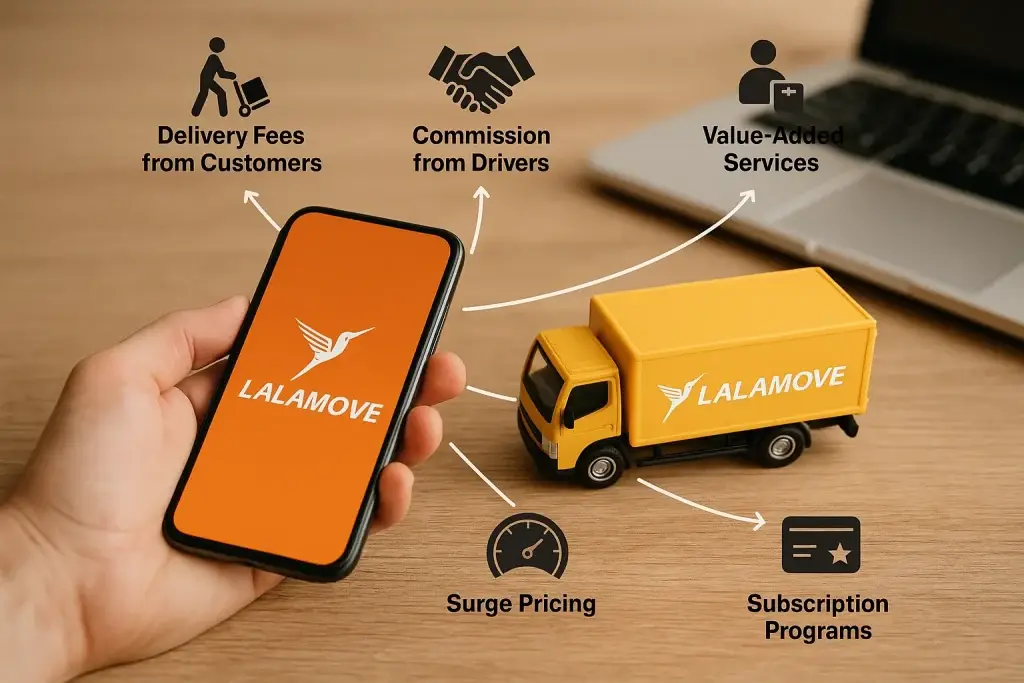
Lalamove’s model thrives on scale and flexibility, allowing it to serve both individual users and high-volume business clients efficiently.
Global Factors & Pricing Breakdown
These values reflect global development cost estimates for a Lalamove-like logistics and delivery platform. The Miracuves row shows our own custom-build pricing.
Miracuves Lalamove-Like App Solution Cost and Tech Stack
Miracuves Pricing for a Lalamove-Like Logistics & Delivery Platform developed in PHP/Laravel with Flutter Apps for $2,499 USD (One-Time Price) in just 6 days
Get a fully developed, deployment-ready platform modeled after Lalamove. Built on a reliable PHP/Laravel backend with Flutter mobile apps, this complete solution helps you launch and scale a logistics and delivery business quickly and efficiently.
- Core Workflows: Instant booking, driver matching, multi-vehicle selection, route optimization, real-time tracking, and customer-driver communication.
- Built-in Operations: Dynamic pricing logic, distance-based fare calculation, order management, delivery scheduling, and payment processing.
- Management Hub: Centralized admin panel to manage customers, drivers, fleet operations, orders, transactions, and overall platform activity.
- Launch-Ready: Fully prepared for your branding, configuration, and immediate go-to-market execution.
Why is it so affordable?
Most modern logistics and delivery platforms are built using complex architectures like Node.js or microservices. While powerful, these approaches require large engineering teams, longer timelines, and significantly higher development costs.
We took a smarter and more practical approach:
- You Aren’t Paying for Ground-Up Development: Our logistics engine is already developed, tested, and ready to deploy. You skip months of development time and avoid the high costs of building from scratch.
- The Power of PHP / Laravel: Built on one of the most trusted and widely used frameworks globally, this solution keeps upfront costs low while ensuring long-term flexibility. With a large developer ecosystem, it becomes easier and more cost-effective to maintain, scale, and customize your platform.
- Built for Practical Growth: You get a strong, market-ready logistics platform with essential features like driver allocation, real-time tracking, and delivery workflows—without the complexity and expense of enterprise-level builds.
You get a scalable, production-ready platform without paying inflated development costs.
Note: This cost is for the solution, re-branding, deployment, and source code only.
Lalamove connects businesses and customers with on-demand logistics—discover what Lalamove app is and how it works for instant deliveries.
Detailed Breakdown of Revenue Channels
Delivery Fees from Customers
Lalamove charges users a base delivery fee calculated on factors like distance, weight, vehicle type (bike, van, truck), and service time. For instance, a motorcycle delivery might start at $3–$5 for short distances, scaling up for vans and trucks.
- Who Pays? End-users and businesses requesting deliveries
- Why It Scales? High-frequency use across personal and business needs, with transparent per-km pricing
Commission from Drivers
Lalamove takes a commission from the total amount paid for each completed delivery. Commissions usually range between 10%–20% depending on region and type of service.
- Who Pays? Drivers, deducted from their earnings
- Why It Scales? The more drivers and jobs on the platform, the more Lalamove earns — without owning vehicles
Value-Added Services
Users can add extras like:
- Multiple Drop-Offs
- Extra Helpers or Loaders
- Toll Handling
- Return Trips
Each service is charged separately, boosting average order value (AOV).
- Who Pays? Customers during checkout
- Why It Scales? Adds convenience while increasing per-delivery revenue
Business Solutions & API Access
Lalamove serves thousands of SMBs and e-commerce stores through branded dashboards and logistics APIs. Businesses can automate deliveries, track fleet performance, and integrate the service into their own platforms.
- Who Pays? Businesses using enterprise dashboards or custom integrations
- Why It Scales? Creates B2B revenue from high-volume clients with recurring delivery needs
Surge Pricing
Similar to ride-hailing apps, Lalamove increases pricing during peak hours, bad weather, or when driver availability is low. This boosts platform revenue while incentivizing more drivers to come online.
- Who Pays? Customers opting to book during high-demand times
- Why It Scales? Balances supply and demand dynamically while increasing profitability
Subscription Programs
In select markets, Lalamove offers subscription plans to businesses for a flat fee, giving benefits like:
- Priority allocation
- Lower per-delivery rates
- Dedicated account managers
- Who Pays? High-frequency users and business clients
- Why It Scales? Ensures predictable monthly income and customer retention
From instant booking to real-time tracking, Lalamove makes logistics effortless—explore the Lalamove app features that drive its success.
Why This Revenue Model Works in 2026
Lalamove’s monetization strategy isn’t just surviving in 2026 — it’s thriving. Several macro trends and behavioral shifts are fueling the ongoing success of its revenue model.
Urbanization and Same-Day Expectations
As cities grow and consumer patience shrinks, on-demand delivery has moved from luxury to necessity. Lalamove’s model — which profits per delivery — fits perfectly into this high-frequency, fast-turnover ecosystem.
Gig Economy Workforce
The availability of freelance drivers reduces operational overhead while expanding capacity. Lalamove earns on every gig, without owning vehicles or hiring full-time staff — a lean model that scales profitably.
Rise of Micro and Social Commerce
From home bakers to Instagram boutiques, small sellers need fast, local logistics. Lalamove’s business APIs and bulk booking tools let it monetize this exploding merchant class efficiently.
AI and Route Optimization
By leveraging real-time data, Lalamove minimizes fuel costs and idle times for drivers. This improves delivery speed, increases job volume per driver, and boosts both customer satisfaction and revenue per hour.
Recurring Business Demand
Grocery chains, pharmacies, e-commerce warehouses — they all need daily hyperlocal delivery. Lalamove’s B2B services generate consistent income and higher basket sizes through subscriptions and API usage.
Lalamove grew from a local service into a global logistics leader—explore the Lalamove marketing strategy that fueled its rapid rise.
Can Startups Replicate Lalamove’s Revenue Model?
Yes — but launching a scalable, logistics-first delivery platform like Lalamove from scratch involves serious complexity.
From real-time driver tracking and route optimization to demand-based pricing and B2B dashboards, the underlying infrastructure is massive. Add to that: multi-vehicle support, commission settings, and customer support systems — and you’re looking at a costly, multi-year development journey.
That’s exactly why startups and digital agencies turn to Miracuves.
With our Lalamove Clone solution, you get a ready-to-launch, fully customizable delivery platform that replicates Lalamove’s revenue model from day one. Here’s what it includes:
- Flexible commission engine for different regions and services
- Built-in surge pricing and real-time delivery fees
- Multi-vehicle support with geofencing and location tracking
- Add-on modules for loaders, special handling, and multi-stop deliveries
- B2B dashboards and API access for high-volume clients
- Admin controls for pricing, driver onboarding, and service settings
Whether you’re targeting urban couriers, retail delivery, or last-mile e-commerce logistics, Miracuves equips you with the tech and tools to replicate Lalamove’s monetization strategy — faster and more affordably.
The Lalamove Clone by Miracuves is priced at $2,499 built for fast, efficient, and scalable logistics operations.
Enable real-time tracking, route optimization, and multi-vehicle dispatch management.
Miracuves development timeline including setup, configuration, admin deployments, API integrations, and platform handover in 6 Days, depending on customization and additional functional layers requested. This ensures a stable, market-ready system with predictable delivery and no hidden engineering delays.
This solution is built with robust frameworks — Web using PHP, MySQL & Apps using Flutter, optimized for performance, stability, and easy maintenance. Other tech stacks can be discussed upon request — Contact us
Startups looking to enter logistics can launch faster with the best Lalamove clone scripts in 2026, save time and cost by choosing our Lalamove clone over custom development, and scale confidently with the help of our full-stack developer guide to building a Lalamove-like app.
Related reading: logistics platform security guide.
Conclusion
Lalamove’s revenue model proves that on-demand logistics isn’t just operational — it’s deeply profitable when executed right. From charging delivery fees and earning driver commissions to monetizing business APIs and surge pricing, the platform turns every delivery into a revenue opportunity.
And the best part? This proven monetization strategy is within your reach.
With Miracuves’ ready-to-deploy Lalamove Clone you don’t need to build a logistics empire from scratch. You get all the core monetization tools — pricing controls, commission engines, business dashboards, and scalable architecture — right out of the box.
FAQs
How does Lalamove generate revenue?
Lalamove earns through delivery charges, driver commissions, value-added services like extra stops, surge pricing, and B2B offerings such as logistics APIs and business dashboards.
Is Lalamove profitable in 2026?
While profitability varies by region, Lalamove continues to grow revenue with the rise of local commerce, same-day delivery demand, and recurring business use — supported by tech-driven cost efficiency.
What are the main income sources for Lalamove?
Key income streams include customer delivery fees, commission from drivers, paid add-ons, surge charges, and logistics services for SMBs and enterprises.
Can startups use the same revenue model as Lalamove?
Yes, but building the tech and operational backend from scratch is time-intensive. A clone solution from Miracuves allows startups to use the same revenue levers without massive investment.
Does Miracuves offer a Lalamove clone with monetization features?
Absolutely. Miracuves provides a Lalamove clone that includes commission settings, delivery pricing, add-on services, surge logic, and business tools — all customizable for your local market.
Related Articles :-
Miracuves is an independent software development company. We are not affiliated with, connected to, sponsored by, or endorsed by any company or product named in this article.
Terms such as “X Clone” are used descriptively. It is how the software industry refers to building a platform with functionality comparable to a known service, and how clients search for it.
The entire design and codebase of our products is built by our own team. Our products contain no code, design, graphics, or content originating from any third-party website or applications.
All third-party names and marks referenced in this article are the property of their respective owners, referenced solely to identify the services discussed.