


Key Takeaways
- A Zillow-style app needs secure property and user data handling.
- Listings, leads, payments, and agent workflows must be protected.
- Verification helps reduce fake listings and scam inquiries.
- Admin controls are needed for approvals, reports, and disputes.
- A safe launch depends on privacy, trust, and marketplace control.
Safety Signals
- Verify property owners, agents, and listing submissions.
- Use role-based access for buyers, agents, owners, and admins.
- Protect user profiles, saved searches, leads, and contact data.
- Review suspicious listings before they go live.
- Log admin actions, listing edits, payments, and lead activity.
Real Insights
- Real estate apps need trust before traffic growth.
- Fake listings can damage platform reputation quickly.
- Lead privacy matters for buyers, sellers, and agents.
- Clear moderation helps keep listings accurate and safe.
- Miracuves builds Zillow Clone apps with secure real estate workflows.
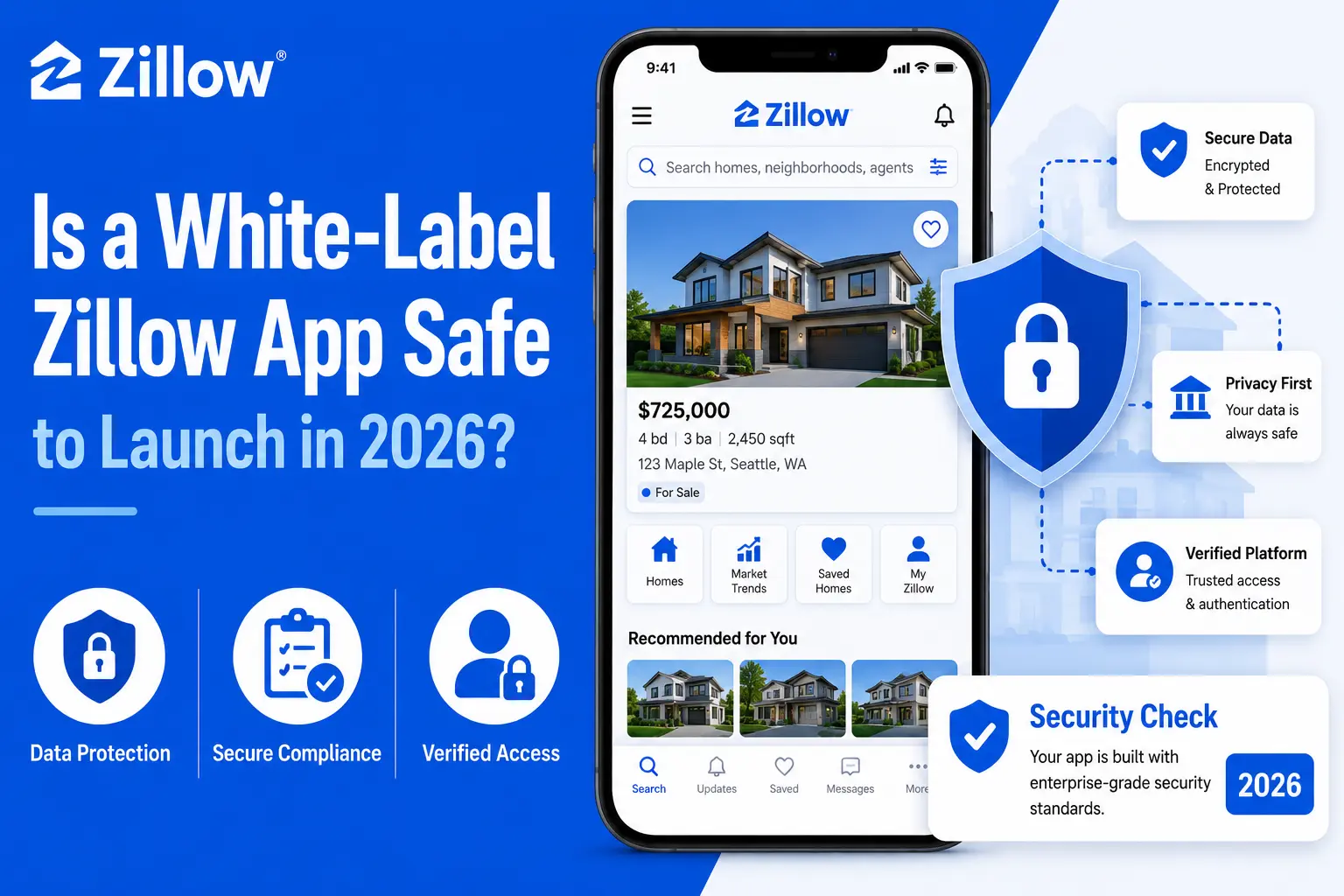
You’ve heard the horror stories — real estate apps leaking user data, exposing property owner details, or getting hacked due to weak security foundations. When your platform handles sensitive information like home addresses, pricing data, user identities, and payment details, security is no longer optional.
In 2026, launching a white-label Zillow clone without a serious security framework is one of the fastest ways to destroy user trust, invite legal trouble, and damage your brand before it has a chance to scale.
This guide offers an honest, practical security assessment of white-label Zillow apps — what risks actually exist, what standards matter, and how to build a property platform that is safe, compliant, and trusted by users.
We’ll also show how Miracuves approaches white-label app security differently, with enterprise-grade safeguards built from day one.
Understanding White-Label Zillow App Security Landscape
What “White-Label App Security” Really Means
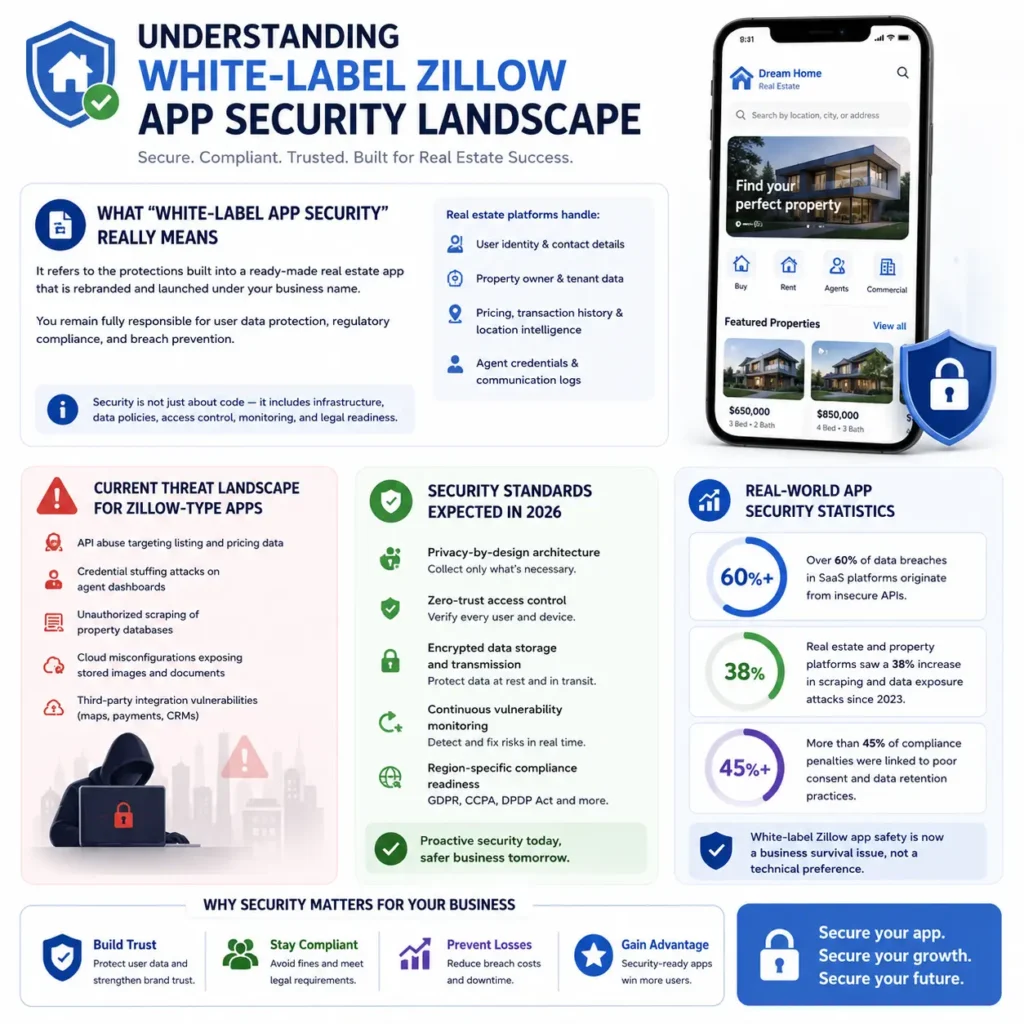
White-label app security refers to the protections built into a ready-made real estate app that is rebranded and launched under your business name. While the core architecture is pre-developed, you remain fully responsible for user data protection, regulatory compliance, and breach prevention.
Security is not just about code — it includes infrastructure, data handling policies, access control, monitoring, and legal readiness.
Real estate platforms handle:
- User identity and contact details
- Property owner and tenant data
- Pricing, transaction history, and location intelligence
- Agent credentials and communication logs
A single vulnerability can expose thousands of listings and users, triggering regulatory action and reputational damage.
Current Threat Landscape for Zillow-Type Apps
In 2026, white-label Zillow-style apps face:
- API abuse targeting listing and pricing data
- Credential stuffing attacks on agent dashboards
- Unauthorized scraping of property databases
- Cloud misconfigurations exposing stored images and documents
- Third-party integration vulnerabilities (maps, payments, CRMs)
Security Standards Expected in 2026
Modern real estate apps are expected to follow:
- Privacy-by-design architecture
- Zero-trust access control
- Encrypted data storage and transmission
- Continuous vulnerability monitoring
- Region-specific compliance readiness (GDPR, CCPA, DPDP Act)
Real-World App Security Statistics
- Over 60% of data breaches in SaaS platforms originate from insecure APIs
- Real estate and property platforms saw a 38% increase in scraping and data exposure attacks since 2023
- More than 45% of compliance penalties were linked to poor consent and data retention practices
These numbers explain why white-label Zillow app safety is now a business survival issue, not a technical preference.
Key Security Risks & How to Identify Them
Data Protection & Privacy Risks
User Personal Information
A white-label Zillow app collects names, phone numbers, email IDs, preferences, and behavioral data. If access controls are weak or databases are improperly secured, attackers can extract entire user profiles.
Key risk indicators:
- No role-based access control
- Plain-text data storage
- Shared admin credentials
Payment Data Security
If your app supports paid listings, featured properties, or subscriptions, payment information becomes a prime target.
High-risk signs:
- Non–PCI DSS-compliant payment gateways
- Storing card data on your own servers
- Missing transaction encryption
Location Tracking & Property Data
Property apps expose exact addresses, GPS coordinates, and neighborhood insights. Location data leakage can lead to stalking, fraud, and legal exposure.
Watch for:
- Unrestricted API endpoints
- Public access to unpublished listings
- Weak map service integrations
GDPR / CCPA Compliance Gaps
Non-compliance can result in heavy penalties.
Risk indicators:
- No consent management system
- No data deletion or export option
- Unclear privacy policy implementation
Technical Vulnerabilities
Code Quality Issues
Low-quality code increases:
- SQL injection risk
- Cross-site scripting (XSS)
- Logic bypass vulnerabilities
A secure white-label Zillow app must follow secure coding standards and undergo regular reviews.
Server & Infrastructure Weaknesses
Common failures include:
- Misconfigured cloud storage
- Open admin ports
- No firewall or intrusion detection
Infrastructure security is often the weakest link in unsafe white-label apps.
API Vulnerabilities
APIs power listings, search, maps, and user accounts. Poorly secured APIs are responsible for most modern breaches.
Red flags:
- No authentication tokens
- Excessive data exposure per request
- No rate limiting
Third-Party Integrations
Map services, analytics tools, CRMs, and payment gateways can introduce hidden risks if not properly audited.
Business-Level Security Risks
Legal Liability
As the app owner, you are legally accountable for:
- Data leaks
- Regulatory violations
- User privacy breaches
Providers are rarely liable once the app is delivered.
Reputation Damage
Trust is everything in real estate. One breach can permanently damage:
- User confidence
- Agent partnerships
- Investor credibility
Financial Losses
Security incidents lead to:
- Regulatory fines
- Legal fees
- Customer churn
- Emergency remediation costs
White-Label Zillow App Risk Assessment Checklist
- Is all sensitive data encrypted at rest and in transit?
- Are APIs authenticated and rate-limited?
- Is payment processing PCI DSS compliant?
- Are admin actions logged and monitored?
- Is user consent properly recorded and stored?
- Are third-party services security-audited?
- Is there a defined breach response plan?
If you cannot confidently answer “yes” to most of these, your white-label Zillow app is exposed to serious risk.
Read more : – Zillow App Features Explained for Startups & Founders
Security Standards Your White-Label Zillow App Must Meet
Essential Security Certifications
ISO 27001 Compliance
ISO 27001 ensures that your white-label Zillow app follows a structured information security management system. It covers data handling, access control, incident response, and risk management.
Why it matters:
- Protects user and property data
- Demonstrates security maturity to partners and investors
- Reduces breach probability through documented controls
SOC 2 Type II
SOC 2 Type II validates how security controls operate over time, not just on paper.
Key focus areas:
- Security
- Availability
- Confidentiality
- Processing integrity
For real estate apps handling continuous data flow, SOC 2 Type II is a trust requirement in 2026.
GDPR Compliance
Mandatory if your app serves users in the EU.
Requirements include:
- Explicit user consent
- Data access and deletion rights
- Breach notification within 72 hours
- Data minimization practices
Non-compliance can lead to penalties up to 4% of global annual revenue.
HIPAA (If Applicable)
If your property platform stores tenant medical accommodation data or senior housing records, HIPAA may apply in certain regions.
PCI DSS for Payments
Any app processing payments must comply with PCI DSS.
This ensures:
- Secure card transactions
- Encrypted payment data
- Reduced fraud exposure
Technical Security Requirements
End-to-End Encryption
All data must be encrypted:
- In transit using TLS 1.3
- At rest using AES-256 standards
This protects user data even if servers are compromised.
Secure Authentication
A safe white-label Zillow app must support:
- Two-factor authentication
- OAuth-based login
- Role-based access control for admins and agents
Regular Security Audits
Security audits should be:
- Conducted quarterly
- Performed by independent auditors
- Documented with remediation actions
Penetration Testing
Pen testing simulates real-world attacks to uncover vulnerabilities before hackers do.
Best practice:
- Annual full-scope testing
- API-focused penetration assessments
SSL Certificates
All domains and subdomains must be protected using strong SSL certificates to prevent man-in-the-middle attacks.
Secure API Design
API security should include:
- Token-based authentication
- Rate limiting
- Data scope restrictions
- Continuous monitoring
Security Standards Comparison Table
| Security Standard | Required for Zillow App | Risk if Missing |
|---|---|---|
| ISO 27001 | Highly Recommended | Weak governance |
| SOC 2 Type II | Strongly Recommended | Trust loss |
| GDPR | Mandatory (EU) | Heavy fines |
| PCI DSS | Mandatory (Payments) | Payment fraud |
| Pen Testing | Mandatory | Undetected vulnerabilities |
| Encryption | Mandatory | Data exposure |
Meeting these standards is not optional in 2026 — it is the baseline for launching a safe, compliant white-label Zillow app.
Red Flags – How to Spot Unsafe White-Label Providers
Warning Signs You Should Never Ignore
No Security Documentation
If a provider cannot clearly explain:
- How data is stored
- How APIs are secured
- What encryption standards are used
They are not ready for enterprise use.
Cheap Pricing Without Explanation
Unrealistically low pricing usually means:
- No security audits
- Reused, outdated code
- Shared infrastructure across clients
Security requires ongoing investment — it cannot be free.
No Compliance Certifications
A serious white-label Zillow app provider should openly discuss:
- GDPR readiness
- PCI DSS payment compliance
- ISO or SOC processes
Silence here is a major risk indicator.
Outdated Technology Stack
Old frameworks increase exposure to:
- Known vulnerabilities
- Unsupported libraries
- Compatibility issues with modern security tools
Poor Code Quality
Signs include:
- Hardcoded credentials
- No separation between user and admin roles
- Lack of logging and monitoring
No Security Update Policy
If updates are only provided “on request,” your app will remain vulnerable to newly discovered threats.
Lack of Backup & Recovery Systems
Without secure backups:
- Data loss becomes permanent
- Recovery after incidents is slow or impossible
No Insurance Coverage
Professional providers carry cyber liability insurance to protect both parties.
Evaluation Checklist for White-Label Zillow App Providers
Critical Questions to Ask
- How is user and property data encrypted?
- Do you conduct regular penetration testing?
- Who is responsible for security updates?
- How do you handle data breaches?
- What compliance standards do you follow?
Documents You Must Request
- Security architecture overview
- Audit or penetration testing reports
- Data protection and privacy policy
- Compliance readiness documentation
- Incident response plan
Testing Procedures Before Launch
- Vulnerability scanning
- API security testing
- Role-based access validation
- Payment flow testing
Due Diligence Steps
- Review past security incidents
- Verify certifications and claims
- Check client references
- Assess long-term support and update commitments
Choosing the wrong provider is not just a technical mistake — it is a long-term business risk for your white-label Zillow app.
Read more : – Zillow App Marketing Strategy: Turning Clicks into Closings
Best Practices for Secure White-Label Zillow App Implementation
Pre-Launch Security Practices
Security Audit Process
Before launch, a complete security audit should be performed covering:
- Application code
- APIs and integrations
- Server and cloud configuration
- Data storage practices
This helps identify vulnerabilities early, when fixes are least expensive.
Code Review Requirements
All core modules should undergo:
- Secure code review
- Validation against OWASP Top 10 risks
- Dependency and library scanning
High-quality white-label Zillow apps enforce strict internal coding standards.
Infrastructure Hardening
Secure infrastructure includes:
- Firewalls and intrusion detection systems
- Isolated environments for production and testing
- Restricted admin access by IP and role
- Encrypted backups stored separately
Compliance Verification
Before going live, verify:
- GDPR consent flows
- Payment compliance (PCI DSS)
- Regional data residency requirements
- Privacy and terms implementation
Staff Training Programs
Security is not only technical. Teams must be trained on:
- Secure admin access
- Phishing awareness
- Data handling best practices
- Incident reporting protocols
Post-Launch Security Monitoring
Continuous Security Monitoring
A live white-label Zillow app must be monitored for:
- Unauthorized access attempts
- API abuse
- Suspicious login behavior
- Data exfiltration patterns
Regular Updates and Patches
Security updates should be:
- Scheduled and documented
- Applied without service disruption
- Communicated transparently to stakeholders
Incident Response Planning
A defined incident response plan should include:
- Detection and containment steps
- Internal escalation procedures
- User and regulator notification workflows
- Post-incident audits
User Data Management
Best practices include:
- Limited data retention policies
- User-controlled data access
- Secure deletion workflows
- Periodic data audits
Backup and Recovery Systems
Your app should maintain:
- Automated daily backups
- Encrypted backup storage
- Regular recovery testing
White-Label Zillow App Security Implementation Timeline
- Week 1–2: Security audit and gap analysis
- Week 3: Code review and infrastructure hardening
- Week 4: Compliance validation and penetration testing
- Launch: Continuous monitoring enabled
- Ongoing: Monthly updates and quarterly audits
Security is not a one-time task — it is a continuous commitment that protects your platform as it scales.
Legal & Compliance Considerations
Regulatory Requirements by Region
Global Data Protection Laws
A white-label Zillow app must comply with multiple data protection frameworks depending on user location:
- GDPR for European users
- CCPA for California residents
- DPDP Act for Indian users
- PIPEDA for Canada
Each law governs how user data is collected, stored, processed, and deleted.
Industry-Specific Regulations
Real estate platforms may also need to comply with:
- Local property advertising laws
- Broker and agent disclosure requirements
- Fair housing regulations
- Digital communication record retention rules
User Consent Management
Your app must clearly:
- Collect explicit consent
- Allow consent withdrawal
- Log consent records securely
- Update consent when policies change
Privacy Policy & Terms Requirements
Legal documents must be:
- Easily accessible in-app
- Written in clear language
- Updated with regulatory changes
- Enforced technically, not just displayed
Liability Protection Measures
Insurance Requirements
Cyber liability insurance helps cover:
- Data breach costs
- Legal defense expenses
- Regulatory penalties
- Incident response services
Legal Disclaimers
Proper disclaimers reduce exposure by:
- Defining platform responsibility
- Limiting liability scope
- Clarifying user obligations
User Agreements
Strong agreements should address:
- Data usage permissions
- User responsibilities
- Dispute resolution
- Jurisdiction clauses
Incident Reporting Protocols
Regulations require:
- Timely breach notification
- Transparent communication
- Documented remediation actions
Ongoing Compliance Monitoring
Compliance is not static. Laws evolve, and your app must adapt through:
- Regular legal reviews
- Policy updates
- Compliance audits
Read more : – Reasons startup choose our Zillow clone over custom development
Why Miracuves White-Label Zillow App Is Your Safest Choice
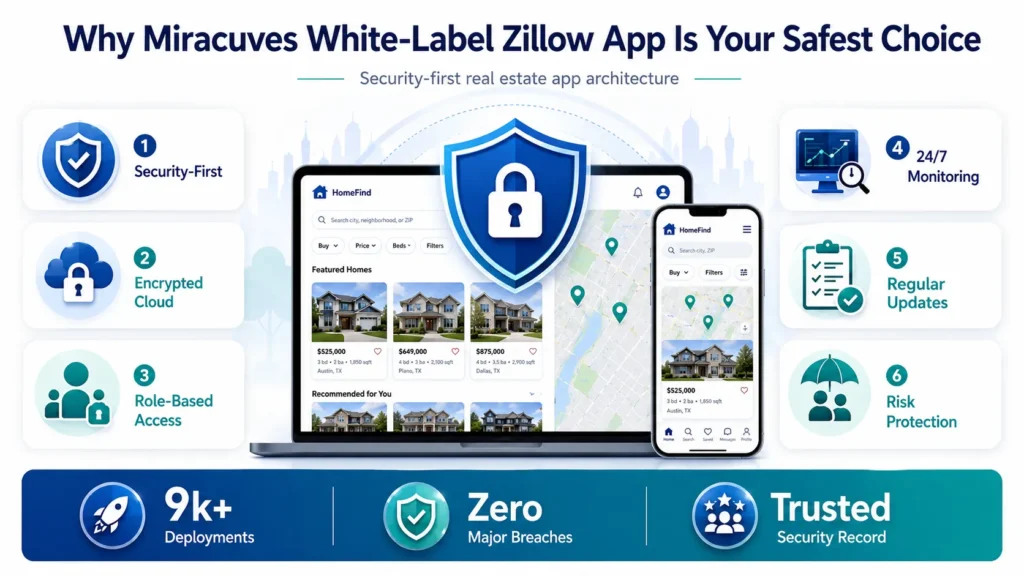
Image Source: AI-generated visual by Miracuves
Miracuves Security-First Approach
Miracuves builds white-label Zillow-style apps with security embedded at the architectural level, not added later as a patch. Every component — from databases to APIs — is designed to protect sensitive real estate data from day one.
Enterprise-Grade Security Architecture
Miracuves apps are engineered with:
- Encrypted data storage and transmission
- Secure cloud infrastructure with isolated environments
- Role-based access control for admins and agents
- Hardened APIs with strict authentication
Compliance-Ready by Default
A Miracuves white-label Zillow app is built to support:
- GDPR and CCPA compliance
- Secure consent management
- PCI DSS–compliant payment processing
- Regional data protection requirements
This reduces your legal risk and speeds up market entry.
Continuous Security Monitoring
Miracuves implements:
- 24/7 security monitoring
- Real-time threat detection
- Automated alerts for suspicious activity
- Regular vulnerability assessments
Regular Audits and Updates
Security does not stop at launch. Miracuves provides:
- Ongoing security updates
- Periodic code and infrastructure reviews
- Proactive patching against new threats
Insurance and Risk Protection
Miracuves-backed projects include:
- Professional risk coverage
- Structured incident response processes
- Support during compliance audits and investigations
Why Businesses Trust Miracuves
With 9k+ successful app deployments and a proven security record, Miracuves has maintained zero major reported security breaches across its white-label platforms.
Final Thought
Don’t compromise on security. Miracuves white-label Zillow app solutions come with enterprise-grade protection built in. Get a free security assessment and launch a compliant, trusted real estate platform with confidence. Launching a white-label Zillow app in 2026 is not risky by default — launching one without proper security is. Most failures happen not because white-label apps are unsafe, but because security is ignored, rushed, or misunderstood.
When built with the right standards, audits, and compliance controls, a white-label Zillow app can be just as secure as enterprise-grade platforms. Choosing a security-first provider like Miracuves ensures your app is designed to protect users, data, and your business from day one.
FAQs
1. How secure is a white-label Zillow app compared to custom development?
A white-label Zillow app can be equally secure or more secure than custom development when built on a hardened architecture with regular audits, encryption, and compliance controls. Security depends on implementation quality, not development method.
2. What happens if there is a security breach?
A proper incident response plan includes immediate containment, user and regulator notification, forensic analysis, and remediation. Providers like Miracuves support structured breach response and recovery.
3. Who is responsible for security updates?
The app owner is legally responsible, but a reliable provider handles continuous updates, patches, and vulnerability fixes as part of ongoing support.
4. How is user data protected in a white-label Zillow app?
User data is protected using encryption at rest and in transit, role-based access control, secure APIs, and continuous monitoring to prevent unauthorized access.
5. What compliance certifications should I look for?
Essential certifications include GDPR compliance, PCI DSS for payments, ISO 27001 for information security, and SOC 2 Type II for operational trust.
6. Can white-label Zillow apps meet enterprise security standards?
Yes. When built with enterprise-grade infrastructure, audited code, and compliance-ready architecture, white-label Zillow apps can meet and exceed enterprise security expectations.
7. How often should security audits be conducted?
Security audits should be conducted at least quarterly, with penetration testing performed annually or after major updates.
8. What is included in the Miracuves security package?
Miracuves provides encrypted data handling, secure infrastructure, compliance-ready architecture, regular updates, monitoring, and incident response support.
9. How should security be handled across different countries?
Security must adapt to regional data protection laws, data residency requirements, and consent regulations through configurable compliance controls.
10. What insurance is needed for app security?
Cyber liability insurance is recommended to cover data breaches, legal costs, regulatory penalties, and incident response expenses.
Related Articles: