



In less than a decade, the Business Model of StockX transformed sneaker reselling from street-level hustling into a global, data-driven marketplace. What started in 2015 as a niche platform for sneakerheads evolved into a multi-category resale exchange spanning sneakers, apparel, electronics, collectibles, and luxury goods.
By 2026, StockX operates in over 200 countries, authenticates millions of products annually, and has facilitated billions of dollars in transactions, positioning itself not just as a marketplace—but as a “stock market of things.”
StockX doesn’t rely on hype alone. Its business model is built on price transparency, trust through authentication, and exchange-style mechanics that mirror financial markets more than traditional eCommerce.
At Miracuves, we often study platforms like StockX because they demonstrate how infrastructure, not inventory, creates defensible digital businesses—especially in peer-to-peer and asset-backed marketplaces. In the sections ahead, we’ll break down how business model of StockX works, how it makes money, and why it continues to scale in 2026’s resale economy.
How the StockX Business Model Works
StockX operates on a hybrid marketplace–exchange business model. At its core, it connects individual sellers and buyers for high-demand consumer goods—but layers this with real-time pricing data, standardized product listings, and mandatory authentication to eliminate trust friction.
Unlike traditional resale platforms that rely on listings and negotiations, StockX functions more like a financial exchange, where products trade based on supply, demand, and historical pricing.
Core Framework Overview
StockX’s model is designed around liquidity, trust, and price discovery—three elements that are critical in any secondary market.
Type of Business Model
- Primary Model: Two-sided marketplace (Buyer ↔ Seller)
- Structural Layer: Exchange-style pricing mechanism (bids & asks)
- Operational Layer: Centralized authentication and logistics
- Revenue Nature: Transaction-based, asset-light
This hybrid structure allows StockX to scale globally without owning inventory, while still maintaining quality and trust control.
Value Proposition by User Segment
For Buyers
- Access to authenticated, brand-new products
- Transparent, market-driven pricing (no hidden markups)
- Global inventory without dealing with individual sellers
For Sellers
- Instant liquidity via lowest-ask matching
- Global buyer access without marketing effort
- Protection from fraud and chargeback risks
For Brands & Culture Ecosystem
- Market pricing data and trend visibility
- Legitimation of resale as and economic layer
- Extended lifecycle for products beyond retail drops
Key Stakeholders & Their Roles
- Buyers: Create demand and price discovery
- Sellers: Supply inventory and liquidity
- StockX Authentication Centers: Enforce trust and standardization
- Logistics Partners: Enable cross-border fulfillment
- Payment Processors: Secure high-value transactions
StockX acts as the central clearinghouse, controlling quality, flow, and dispute resolution.
Evolution of the Model
- 2015–2017: Sneakers-only resale with simple fees
- 2018–2020: Expansion into streetwear and collectibles
- 2021–2023: Electronics, luxury goods, and global logistics scale
- 2024–2025: Data-driven pricing tools, faster payouts, regional authentication hubs
Each phase added infrastructure depth, not just categories—strengthening long-term defensibility.
Why the Model Works in 2026
- High demand for authenticated resale amid counterfeit growth
- Cultural normalization of resale as investment and consumption
- Inflation-driven consumers seeking asset-backed purchases
- Global digital payments and cross-border logistics maturity
StockX’s model aligns perfectly with 2026 consumer behavior, where buyers expect trust, transparency, and speed, and sellers want liquidity without complexity.
Read more : What is StockX and How Does It Work?
Target Market & Customer Segmentation Strategy
StockX didn’t grow by targeting “everyone.” It scaled by owning a highly defined cultural niche first, then expanding outward while preserving brand credibility. Its segmentation strategy balances culture-driven users with value-driven global buyers, allowing the platform to grow without losing trust.
Primary Customer Segments
1. Core Resale Sellers (Supply Drivers)
- Demographic: 18–35, digitally native, culture-savvy
- Behavior: Buys limited-edition products for resale value
- Motivation: Price arbitrage, fast liquidity, global reach
- Retention Trigger: Quick payouts, reliable authentication, transparent fees
2. Enthusiast Buyers (Demand Anchors)
- Demographic: 18–40, sneakerheads, collectors, streetwear fans
- Behavior: Tracks price trends, waits for dips, buys selectively
- Motivation: Authenticity, access to rare items, market pricing
- Retention Trigger: Trust, historical pricing data, product condition assuranceZ
Secondary Customer Segments
3. Value-Conscious Global Buyers
- Demographic: International users across Europe, Asia, Middle East
- Behavior: Purchases popular items unavailable locally
- Motivation: Access + price transparency
- Retention Trigger: Cross-border logistics and currency support
4. Collectors & Investors
- Behavior: Treats items as assets (hold or flip)
- Motivation: Price appreciation and scarcity
- Retention Trigger: Market data, volatility, and historical trend insights
Customer Journey Mapping
Discovery
- Social media culture (Instagram, TikTok, YouTube)
- Influencer and drop-based hype cycles
- SEO-driven “price check” and “authentic resale” searches
Conversion
- Bid/Ask interface reduces negotiation friction
- Market price graphs build confidence
- Clear authentication guarantee
Retention
- Price alerts and watchlists
- Faster seller payouts
- Expansion into new categories (electronics, collectibles)
StockX optimizes lifetime value (LTV) by encouraging repeat transactions, not one-time purchases .
Acquisition Channels by Segment
- Organic: Cultural relevance, user-generated content, hype drops
- Paid: Performance ads around product demand spikes
- Partnerships: Collaborations with cultural platforms and creators
- Product-led Growth: Data tools that encourage frequent re-engagement
Market Positioning & Competitive Edge
StockX positions itself as:
- The most trusted resale exchange, not just a marketplace
- Data-first, not hype-first
- Global by default, not region-locked
Differentiation Factors
- Mandatory authentication
- Exchange-style pricing mechanics
- Historical sales transparency
By 2026, StockX holds a dominant mindshare in sneaker and streetwear resale, even as competitors enter with lower fees but weaker trust systems.
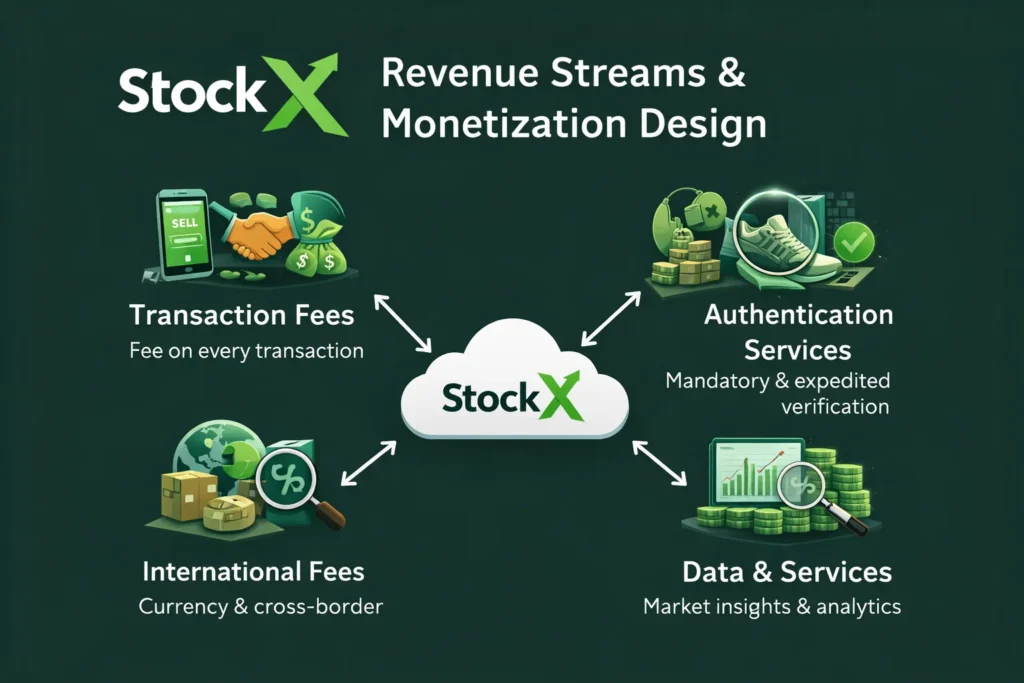
Revenue Streams and Monetization Design
Once StockX solved trust and liquidity, monetization became a natural extension of the transaction flow. Unlike retail platforms that depend on inventory margins, StockX’s revenue model is purely transactional and asset-light, allowing it to scale efficiently across geographies and categories.
Primary Revenue Stream 1: Transaction Fees (Core Engine)
Mechanism
StockX charges sellers a fee on every completed transaction. Buyers pay a processing fee and shipping, while sellers fund the platform’s core economics.
Pricing Model (2026)
- Seller transaction fee: ~8%–10% (varies by seller tier and region)
- Payment processing fee: ~3%
- Shipping and authentication fees passed through the transaction
Revenue Contribution
- Accounts for the largest share of StockX’s revenue
- Directly correlated with Gross Merchandise Value (GMV)
Growth Trajectory
- Higher transaction volume from category expansion
- Increased repeat selling by power sellers
- Improved fee efficiency through automation
This stream scales cleanly because StockX never touches inventory ownership risk.
Secondary Revenue Stream 2: Authentication & Value-Added Services
Mechanism
- Mandatory authentication for every product
- Expedited processing and premium handling in select regions
Why It Matters
- Reinforces trust (core brand promise)
- Creates defensibility against low-fee competitors
- Justifies transaction fees psychologically
This turns trust into a monetizable infrastructure layer.
Secondary Revenue Stream 3: International & Cross-Border Fees
Mechanism
- Currency conversion
- Cross-border logistics handling
- Regional pricing adjustments
As global demand grows, international trades increase effective revenue per transaction.
Secondary Revenue Stream 4: Data & Market Insights (Emerging)
Mechanism
- Aggregated pricing and trend data
- Market intelligence tools for power sellers and partners
While still emerging in 2026, data monetization positions StockX for B2B revenue diversification.
How the Monetization Strategy Works as a System
StockX’s revenue design is intentionally layered:
- Transaction fees monetize liquidity
- Authentication monetizes trust
- Data tools monetize insight
- Global scale monetizes infrastructure
Psychology Behind Pricing
- Sellers accept fees because trust reduces risk
- Buyers accept prices because transparency reduces uncertainty
- Exchange mechanics remove emotional pricing bias
At Miracuves, this layered approach mirrors how scalable marketplaces should monetize—capture value at every friction point you remove.
Read more : StockX Revenue Model: How StockX Makes Money in 2025
Operational Model & Key Activities
Behind StockX’s clean user interface sits a highly orchestrated operational engine. While the platform is asset-light in inventory, it is operations-heavy in trust, logistics, and technology—and that’s exactly what makes the model defensible.
Core Operational Pillars
1. Platform & Technology Management
- Exchange-style bid/ask matching engine
- Real-time price discovery and historical data tracking
- Fraud detection and seller behavior monitoring
- Scalable cloud infrastructure supporting global traffic spikes
2. Authentication Operations (Trust Engine)
- Centralized authentication centers across key regions
- Category-specific experts (sneakers, luxury, electronics)
- Standardized inspection workflows to reduce variance
- Continuous improvement using counterfeit trend data
Authentication is StockX’s largest operational cost—but also its strongest moat.
3. Logistics & Fulfillment Coordination
- Seller ships item → StockX authentication hub
- StockX verifies → ships to buyer
- Integrated tracking and dispute resolution
This controlled flow ensures quality without owning inventory.
4. Customer Support & Dispute Resolution
- Handling authentication disputes
- Chargebacks and payment issues
- Cross-border delivery concerns
High-value transactions demand high-touch support, especially in resale markets.
Resource Allocation Strategy (Indicative 2026 Split)
- Technology & Infrastructure: ~35%
(Matching engine, data systems, security, AI tools) - Operations & Authentication: ~30%
(Staff, training, facilities, quality assurance) - Marketing & Growth: ~20%
(Drop-based campaigns, regional expansion) - HR, Legal & Compliance: ~15%
(Global operations, payments, regulatory readiness)
This allocation reflects a business optimized for scale, not short-term margin extraction.
Regional Expansion Execution
- Local authentication hubs to reduce shipping time
- Regional payment methods and currencies
- Local compliance with import/export and consumer laws
StockX scales region by region, not with a one-size-fits-all approach.
At Miracuves, this operational architecture is a textbook example of how marketplace platforms must invest in backend excellence to unlock frontend trust.
Strategic Partnerships & Ecosystem Development
StockX understands that no marketplace scales alone. Its long-term strength comes from carefully chosen partnerships that enhance trust, reach, and operational efficiency—without diluting platform control.
Rather than chasing volume-driven alliances, StockX focuses on infrastructure-first collaborations that deepen ecosystem value.
Partnership Philosophy
StockX partners where partnerships:
- Reduce friction (payments, logistics)
- Increase credibility (authentication, compliance)
- Accelerate global expansion
- Strengthen network effects
Every partnership is evaluated on ecosystem impact, not just short-term revenue.
Key Partnership Categories
1. Technology & API Partners
- Cloud infrastructure providers for scalability
- Fraud detection and AI verification tools
- Data analytics platforms for pricing intelligence
These partnerships ensure the platform remains fast, resilient, and data-rich.
2. Payment & Financial Services Alliances
- Global payment processors for multi-currency support
- Local payment gateways in emerging markets
- Payout optimization for sellers
Reliable payments are critical in high-value resale transactions.
3. Logistics & Fulfillment Partners
- Global shipping carriers
- Regional last-mile providers
- Customs and cross-border compliance services
These partners enable predictable delivery timelines, which directly impacts buyer trust.
4. Cultural & Distribution Partnerships
- Collaborations with influencers and creators
- Integrations with social commerce touchpoints
- Visibility during major product drops
These partnerships fuel organic discovery and cultural relevance.
5. Regulatory & Expansion Alliances
- Local compliance consultants
- Trade and import/export advisors
- Tax and consumer protection specialists
Proactive regulatory alignment allows StockX to enter markets faster and safer.
Ecosystem Strategy & Competitive Moat
StockX’s ecosystem creates:
- Network effects: More sellers → better pricing → more buyers
- Partner stickiness: Deep integrations reduce switching
- Monetization depth: Fees, services, and data flow through partners
The result is a marketplace that’s hard to replicate without years of trust-building and operational partnerships.
From a platform-building perspective, Miracuves applies similar ecosystem thinking—designing products where partners amplify value, not complexity.
Read more : Best StockX Clone Scripts 2025: Build Your Own Sneaker & Collectibles Marketplace Fast
Growth Strategy & Scaling Mechanisms
StockX’s growth is not driven by discounts or aggressive advertising alone. It scales through a combination of cultural momentum, data intelligence, and infrastructure expansion, allowing the platform to grow while protecting trust.
Core Growth Engines
1. Organic Virality & Cultural Loops
- Product drops create natural demand spikes
- Social media amplifies resale value conversations
- Users share price movements and “wins,” reinforcing engagement
Culture acts as free marketing, especially in sneakers and streetwear.
2. Product-Led Growth
- Price alerts and watchlists drive repeat visits
- Historical price charts increase transaction confidence
- Simplified selling flows reduce friction for new sellers
These features turn StockX into a daily-check platform, not a one-time marketplace.
3. Paid Acquisition & Demand Capture
- Performance marketing around trending products
- SEO-driven capture of “resale price” and “authentic marketplace” searches
- Retargeting during high-volatility pricing periods
Paid spend is used surgically, not broadly.
4. Category & Product Expansion
- Sneakers → apparel → collectibles → electronics → luxury
- Expansion follows demand density, not hype
- Each new category leverages existing authentication and logistics infrastructure
This minimizes marginal expansion cost.
5. Geographic Expansion Model
- Entry into regions with strong sneaker and resale culture
- Local authentication hubs reduce delivery time
- Regional pricing and currency support
StockX scales city-by-city and region-by-region, ensuring operational readiness before marketing push.
Scaling Challenges & How StockX Addressed Them
Operational Complexity
- Challenge: Rising authentication volume
- Solution: Regional hubs and workflow automation
Trust at Scale
- Challenge: Counterfeit sophistication
- Solution: Continuous authentication training and AI-assisted detection
Regulatory Barriers
- Challenge: Cross-border compliance
- Solution: Local legal partnerships and staged market entry
Cost Control
- Challenge: Authentication and logistics expenses
- Solution: Volume efficiencies and process standardization
Why This Growth Model Works in 2026
- Resale demand is global and category-agnostic
- Trust is the primary conversion driver
- Data-driven pricing increases transaction velocity
- Asset-light scaling protects capital efficiency
For founders, this proves that growth without infrastructure is fragile, while growth with systems compounds.
Competitive Strategy & Market Defense
StockX operates in a crowded resale ecosystem, competing with platforms like GOAT, eBay, Grailed, and emerging regional marketplaces. Yet it continues to defend its position through structural advantages, not price wars.
Its competitive strategy is built around trust, data, and ecosystem lock-in.
Core Competitive Advantages
1. Network Effects
- More sellers increase inventory depth
- More buyers improve price discovery
- Better pricing attracts both sides back to the platform
These self-reinforcing loops make it difficult for new entrants to reach liquidity parity.
2. Trust as a Brand Asset
- Mandatory authentication on every transaction
- Consistent quality standards across regions
- Dispute resolution credibility
Trust is not a feature—it’s StockX’s brand identity.
3. Data & Pricing Intelligence
- Real-time bid/ask transparency
- Historical pricing and volatility tracking
- Demand forecasting signals
This positions StockX closer to a financial exchange than a marketplace.
4. Operational Scale & Infrastructure
- Global authentication centers
- Integrated logistics control
- High-volume transaction handling
These create high fixed costs, which act as a natural barrier to entry.
Market Defense Tactics
Handling New Entrants
- Focus on trust and reliability, not fee undercutting
- Continuous improvement in authentication speed
Pricing & Fee Pressure
- Tiered seller fees to retain power sellers
- Value justification through services and protection
Feature Rollout Strategy
- Introduce tools that increase engagement before competitors
- Gradual rollouts to avoid trust disruption
Strategic Partnerships & M&A
- Strengthening logistics and payments rather than brand dilution
- Expanding ecosystem depth instead of chasing user numbers
Why Competitors Struggle to Displace StockX
Competitors may match:
- Lower fees
- Faster shipping in select regions
But struggle to replicate:
- Exchange-style liquidity
- Global trust consistency
- Data transparency at scale
For founders, this reinforces a critical lesson: the strongest defense is a business model competitors can’t easily copy.
Lessons for Entrepreneurs & Implementation
This is where StockX’s story becomes most valuable—not as a case study, but as a playbook. The platform didn’t win by being the cheapest or the fastest. It won by owning trust, standardization, and data in a fragmented market.
Let’s translate those insights into actionable lessons for founders.
Key Factors Behind StockX’s Success
- Trust Was Designed Into the Model
- Authentication wasn’t optional—it was mandatory
- Trust costs were treated as investments, not overheads
- Liquidity Came Before Scale
- Focused on sneakers first to concentrate demand
- Expanded only after achieving healthy bid–ask activity
- Data Reduced Human Friction
- Market prices replaced negotiation
- Transparency increased buyer confidence and seller efficiency
- Infrastructure Created Defensibility
- Logistics, authentication, and payments were tightly controlled
- High fixed costs discouraged casual competitors
Replicable Principles for Startups
- Start with a high-trust niche before expanding
- Standardize products to simplify transactions
- Use data visibility to increase transaction velocity
- Monetize the friction you remove (trust, speed, access)
These principles apply well beyond resale—to freight, fintech, B2B marketplaces, and on-demand platforms.
Common Mistakes to Avoid
- Scaling categories before solving trust
- Underestimating operational complexity
- Competing on fees without differentiation
- Treating compliance and verification as add-ons
Adapting StockX’s Model to Local or Niche Markets
- Focus on a single category with high resale demand
- Build regional authentication or verification flows
- Localize payments and logistics early
- Educate users on price transparency
Ready to implement StockX’s proven business model for your market?
Miracuves builds scalable platforms with tested business models and growth mechanisms. We help founders launch trust-first marketplaces designed for long-term scale.
Get your free business model consultation today.
Conclusion :
StockX proves that the most powerful platforms aren’t built on hype—they’re built on structure, discipline, and execution. By transforming resale into an exchange, StockX didn’t just create a marketplace; it redefined how people value, trade, and trust digital goods.
Its success shows that in modern platform economies, infrastructure beats inventory, and data beats guesswork. The companies that win in 2026 and beyond won’t be those chasing attention, but those engineering systems that remove friction at scale.
For entrepreneurs, the real takeaway is clear:
If you can standardize trust, make pricing transparent, and scale operations intelligently, you can unlock markets that once felt too fragmented to monetize.
As resale, on-demand, and asset-backed platforms continue to evolve, StockX stands as a blueprint for how innovation plus operational excellence creates sustainable digital businesses.
FAQs :
What type of business model does StockX use?
StockX operates a two-sided marketplace combined with an exchange-style pricing model, where buyers and sellers trade authenticated products using real-time bid and ask mechanisms.
How does StockX’s business model create value?
StockX creates value by eliminating trust issues through mandatory authentication, enabling transparent price discovery, and providing global liquidity for resale products.
What are StockX’s key success factors?
Its success is driven by trust-first authentication, data-driven pricing, strong network effects, and operational control over logistics and payments.
How scalable is the StockX business model?
Highly scalable. StockX does not own inventory and scales by expanding authentication infrastructure, categories, and regions rather than physical stock.
What are the biggest challenges StockX faces?
High operational costs from authentication, increasing counterfeit sophistication, regulatory complexity, and competition from low-fee marketplaces.
How can entrepreneurs adapt the StockX model to their region?
By focusing on a high-demand niche, building localized verification workflows, standardizing listings, and ensuring transparent pricing from day one
What are alternatives to the StockX model?
Negotiation-based marketplaces (eBay), curated resale platforms (GOAT), and peer-to-peer listing platforms—though each trades off transparency or trust.
How has StockX’s business model evolved over time?
It evolved from a sneaker-only exchange into a multi-category global resale platform by expanding authentication, logistics, and data capabilities.
Related Article :