


Key Takeaways
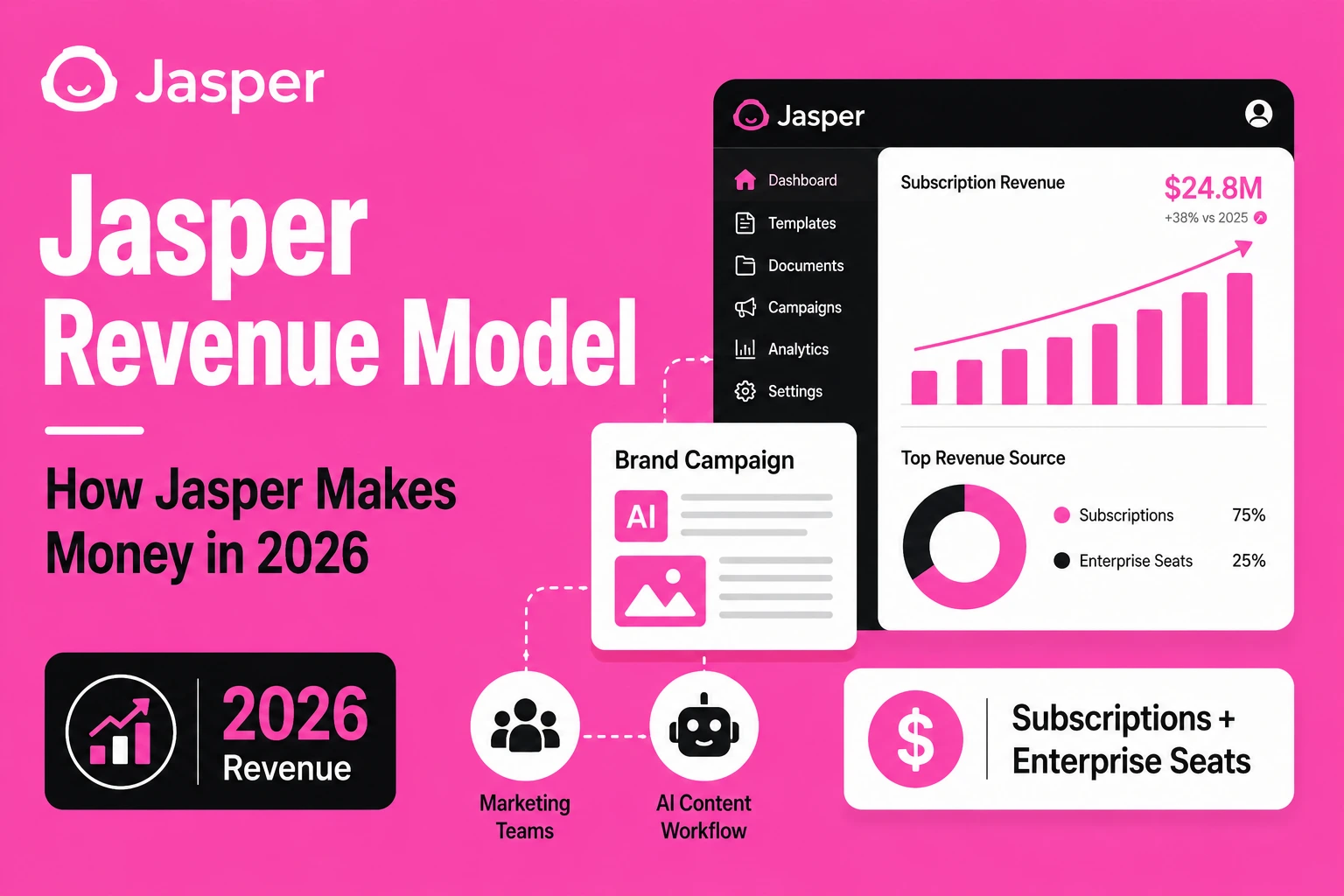
- Jasper earns through AI SaaS subscriptions for marketers, teams, and businesses.
- Paid plans create recurring revenue based on users, features, and usage limits.
- Enterprise solutions add value through custom workflows and team controls.
- AI writing tools support content creation, campaigns, and brand messaging.
- The model depends on AI adoption, team usage, content demand, and retention.
What You’ll Learn
- How Jasper makes money through AI content tools.
- Subscription pricing helps monetize creators, teams, and brands.
- Enterprise plans support larger teams with advanced needs.
- Templates and workflows improve content speed and productivity.
- Revenue growth depends on product value, usage, integrations, and customer retention.
Real Insights
- Jasper grows with AI content adoption across marketing teams.
- Brand control matters for businesses using AI-generated content.
- Team workflows improve retention by making Jasper part of daily work.
- Enterprise clients increase revenue through larger contracts.
- The best insight is that Jasper earns by turning AI writing into business productivity.
In 2026, Jasper stands as one of the most recognizable AI-powered content platforms in the global SaaS ecosystem.
The company has evolved from a simple AI writing tool into a full-scale enterprise-grade brand voice and content automation platform, serving marketing teams, agencies, and multinational organizations.
For entrepreneurs, Jasper’s revenue model shows how AI software can transition from low-ticket subscriptions into high-value enterprise contracts with predictable, recurring income.
Jasper Revenue Overview – The Big Picture
Estimated Revenue: The company generates strong annual revenue through platform fees, subscriptions, transaction-based income, advertising, premium services, and other monetization channels, depending on its business model and market reach.Valuation (Private Market Estimates): $1.2–1.5 billion range
Year-over-Year Growth: ~30–45%
Revenue by Region:
- North America: ~55%
- Europe: ~25%
- Asia-Pacific & Others: ~20%
Profit Margins:
Gross margins are estimated between 65–75%, reflecting strong SaaS economics balanced by increasing enterprise support, compliance, and AI infrastructure costs.
Competition Benchmark:
Compared with platforms like Copy.ai and Writesonic, Jasper leads in brand voice management, enterprise compliance, and long-form content automation, allowing it to command higher per-account revenue.
Read More: What Is Jasper AI and How Does It Work? Inside Brand-Safe AI for Marketing Teams
Primary Revenue Streams Deep Dive
Revenue Stream #1: SaaS Subscriptions
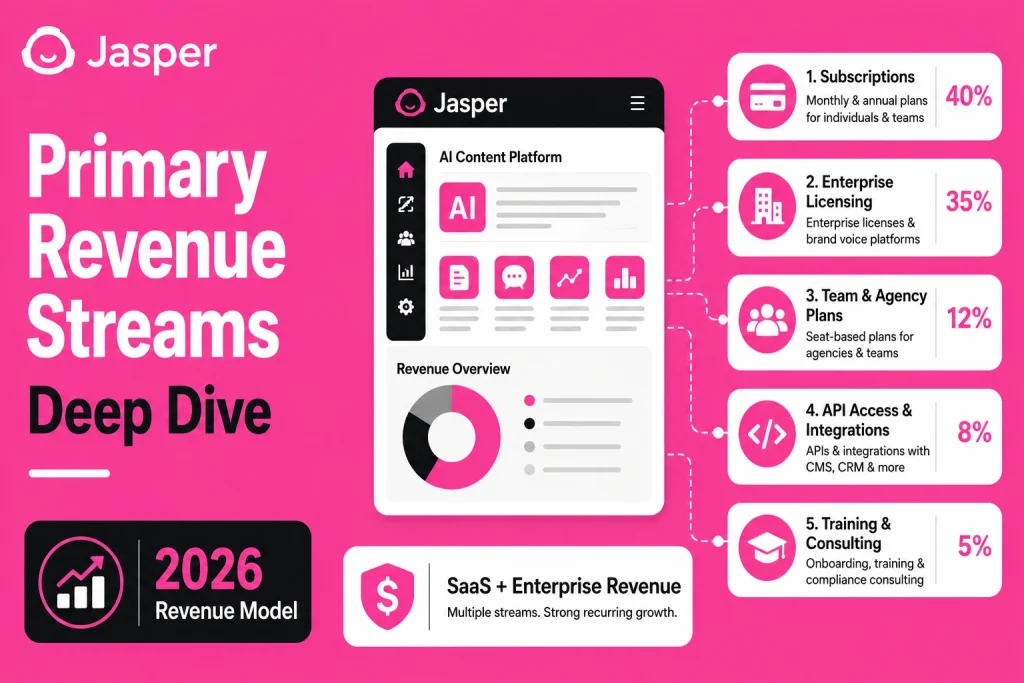
How It Works: Monthly and annual plans for individuals, freelancers, and small marketing teams.
Pricing Range: $49–$125 per user/month
Revenue Share: ~40%
Why It Works: Creates a wide top-of-funnel with predictable recurring income.
Revenue Stream #2: Enterprise Licensing & Brand Voice Platforms
How It Works: Large organizations license Jasper’s brand voice system, collaboration tools, and compliance features.
Contract Size: $20,000–$500,000+ annually
Revenue Share: ~35%
Why It Works: High retention and strong expansion revenue inside enterprise accounts.
Revenue Stream #3: Team & Agency Plans
How It Works: Seat-based pricing for marketing agencies managing multiple clients.
Revenue Share: ~12%
Why It Works: Scales naturally as agencies add new brands.
Revenue Stream #4: API Access & Platform Integrations
How It Works: Jasper integrates into CMS platforms, CRM systems, and marketing automation stacks.
Revenue Share: ~8%
Why It Works: Usage grows automatically with customer activity.
Revenue Stream #5: Training, Onboarding & Compliance Consulting
How It Works: Premium services for regulated industries and global brand teams.
Revenue Share: ~5%
Why It Works: High-margin service layer on top of SaaS.
Revenue Streams Percentage Breakdown
| Revenue Stream | % Share | Primary Customers | Monetization Style |
|---|---|---|---|
| Subscriptions | 40% | Creators & SMBs | Monthly/Annual Plans |
| Enterprise Licensing | 35% | Enterprises | Annual Contracts |
| Agency Plans | 12% | Marketing Agencies | Per-Seat Pricing |
| API & Integrations | 8% | Tech Platforms | Usage-Based |
| Training & Compliance | 5% | Regulated Firms | Project-Based |
The Fee Structure Explained
User-Side Fees:
- Monthly SaaS plans
- Per-seat team upgrades
- Premium feature access (brand voice, templates, governance)
Provider-Side Fees:
- Cloud infrastructure and AI compute
- Security, compliance, and data protection
- Customer success and onboarding teams
Hidden Revenue Layers:
- Enterprise add-ons for workflow governance
- API call overages
- Dedicated account management
Regional Pricing Variation:
- North America: Full enterprise pricing
- Europe: GDPR-compliant packages with higher compliance fees
- Asia-Pacific: Tiered pricing for market penetration
Complete Fee Structure by User Type
| User Type | Pricing Model | Average Annual Spend | Key Revenue Driver |
|---|---|---|---|
| Solo Users | Subscription | $600–$1,500 | Renewals |
| SMB Teams | Per-Seat SaaS | $3,000–$10,000 | Team Growth |
| Agencies | Volume Licensing | $8,000–$25,000 | Client Expansion |
| Enterprises | Licensing | $30,000–$500,000+ | Long-Term Contracts |
How Jasper Maximizes Revenue Per User
Segmentation: Creators, agencies, marketing departments, and enterprise brand teams.
Upselling: Free and basic users are guided toward brand voice and collaboration features.
Cross-Selling: Enterprise clients adopt API access and compliance modules.
Dynamic Pricing: Per-seat scaling as teams expand.
Retention Monetization: Custom workflows and brand memory reduce churn.
LTV Optimization: Annual billing discounts and multi-year contracts.
Psychological Pricing: Mid-tier plans positioned as “best value.”
Real Example:
A 25-person marketing team paying $99 per user per month generates nearly $30,000 annually before adding enterprise features or integrations.
Cost Structure & Profit Margins
Infrastructure Costs:
AI compute, data storage, and hosting (~25–30% of revenue).
Customer Acquisition Cost (CAC):
SEO, paid ads, affiliate marketing, and sales (~15–20%).
Operations:
Support, onboarding, and compliance teams (~10%).
R&D:
Model training, workflow automation tools, and product innovation (~15%).
Unit Economics:
Strong gross margins allow aggressive reinvestment into enterprise growth.
Profitability Path:
High-value licensing contracts move Jasper toward sustained operating profitability.
Future Revenue Opportunities & Innovations
New Streams:
- AI-powered content governance systems
- Voice and video content automation
- Internal enterprise knowledge assistants
AI/ML-Based Monetization:
Private AI models trained on brand and regulatory data.
Market Expansion:
Localized enterprise platforms for LATAM, Middle East, and Southeast Asia.
Predicted Trends (2025–2027):
- AI content compliance engines
- Multi-modal brand AI platforms
- Vertical AI tools for healthcare, legal, and finance
Risks & Threats:
- Open-source AI platforms
- Falling AI model costs
- Enterprise data privacy regulations
Opportunities for Founders:
Industry-specific AI SaaS for regulated and high-compliance markets.
Lessons for Entrepreneurs & Your Opportunity
What Works:
Enterprise licensing combined with SaaS subscriptions stabilizes revenue.
What to Replicate:
Brand memory and workflow automation instead of basic text generation.
Market Gaps:
AI platforms tailored for compliance-heavy industries.
Founder Advantage:
Most competitors focus on creativity tools, not operational systems.
Read more: Best Jasper Clone Script 2026 : Build Your Own AI Writing Assistant Platform
Final Thought
Jasper shows how AI platforms grow faster when they solve business governance, not just content creation.
The real value lies in managing brand voice, compliance, and workflows at scale.
For founders, this model opens the door to building high-margin, enterprise-focused AI businesses that grow beyond simple SaaS tools.
Want to turn your business idea into a scalable digital platform?
Contact Us today to explore custom app development and ready-made solutions tailored to your market, goals, and growth plans.
FAQs
1) How much does Jasper make per transaction?
Jasper primarily earns through subscriptions and enterprise contracts, not per-transaction fees.
2) What’s Jasper’s most profitable revenue stream?
Enterprise licensing and brand voice platforms generate the highest margins.
3) How does Jasper’s pricing compare to competitors?
It is typically priced higher due to compliance, governance, and enterprise features.
4) What percentage does Jasper take from providers?
Jasper does not operate a provider marketplace.
5) How has Jasper’s revenue model evolved?
It shifted from creator subscriptions to enterprise brand automation licensing.
6) Can small platforms use similar models?
Yes, by focusing on niche industries with strong compliance needs.
7) What’s the minimum scale for profitability?
Around 1,000 paying users or a few enterprise contracts.
8) How to implement similar revenue models?
Combine SaaS subscriptions with enterprise licensing and API monetization.
9) What are alternatives to Jasper’s model?
Freemium AI platforms, usage-based APIs, or ad-supported tools.