
Key Takeaways
- Short-video platforms grow faster when user acquisition focuses on creators, community engagement, referrals, and viral content loops.
- The strongest acquisition strategies combine creator onboarding, social sharing, influencer partnerships, paid campaigns, and retention-focused product design.
- Micro creators often generate better early-stage engagement because they build niche communities with stronger audience interaction.
- User acquisition becomes expensive when platforms ignore creator retention, recommendation quality, onboarding experience, and content consistency.
- The most successful short-video apps grow when creators, viewers, algorithms, and community participation reinforce each other continuously.
Growth Signals
- Creator-led growth works because creators continuously attract audiences through uploads, trends, collaborations, and social sharing.
- Referral systems, rewards, hashtag challenges, duet features, and remix tools can improve organic user acquisition without depending only on ads.
- Recommendation algorithms increase retention by showing users highly relevant content based on watch time, interactions, and viewing behavior.
- Community engagement features such as comments, live sessions, creator interaction, and trending campaigns improve repeat platform usage.
- Acquisition cost changes based on creator payouts, ad strategy, geographic targeting, retention quality, influencer partnerships, and platform competition.
Real Insights
- Short-video platforms do not grow only through downloads; they grow through consistent creator activity and repeat audience engagement.
- The biggest early-stage mistake is spending heavily on ads before building enough creator content and retention systems.
- Micro creators can help platforms scale faster because they often deliver stronger engagement and community trust compared to celebrity-only campaigns.
- Retention is closely connected with acquisition because users only invite others when the content experience feels addictive and personalized.
- The strongest user acquisition strategy combines creator incentives, viral mechanics, recommendation quality, social sharing, and scalable engagement infrastructure.
Short video platforms are no longer limited to global entertainment giants. businesses across industries are launching their own creator ecosystems to build communities, increase engagement, and unlock new monetization opportunities. From fitness brands and education companies to ecommerce startups and media networks, organizations increasingly want branded short-video experiences instead of depending entirely on centralized social platforms.
This is where the concept of a multi-tenant video platform becomes highly valuable. A multi-tenant architecture allows multiple branded short-video apps to run from one centralized backend infrastructure while maintaining independent branding, user management, analytics, and monetization controls. This approach significantly reduces infrastructure costs while helping businesses expand faster into multiple markets and niches.
At Miracuves, scalable SaaS-based short-video ecosystems are increasingly becoming the preferred approach for businesses planning long-term creator economy expansion because centralized infrastructure now plays a critical role in supporting rapid multi-brand deployment strategies.
What Is a Multi-Tenant Video Platform?
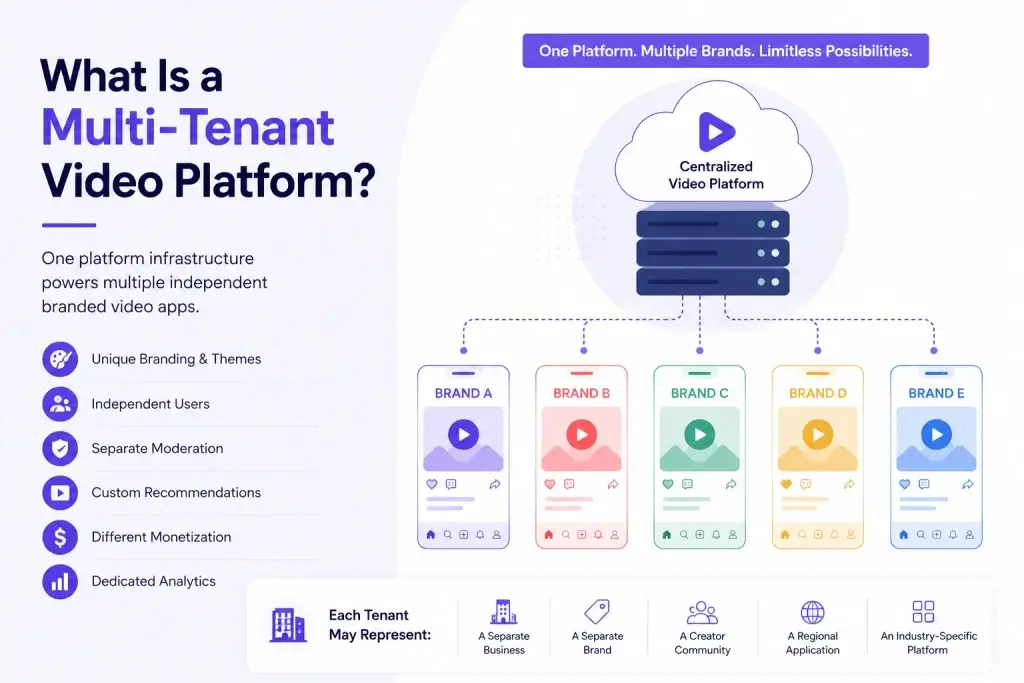
A multi-tenant video platform is a centralized software architecture where multiple branded applications operate on shared backend infrastructure while remaining logically separated from one another.
In simple terms, one platform infrastructure powers many independent video apps.
Each tenant may represent:
- A separate business
- A separate brand
- A separate creator community
- A regional application
- An industry-specific platform
Although all tenants use the same backend systems, each branded application can still maintain:
- Unique logos and themes
- Independent users
- Separate moderation settings
- Custom recommendation priorities
- Different monetization models
- Dedicated analytics dashboards
This model is widely used in modern SaaS ecosystems because it enables rapid scalability without rebuilding infrastructure repeatedly.
Single-Tenant vs Multi-Tenant Video Architecture
Single-Tenant Model
In a single-tenant architecture:
- Every app has its own backend
- Infrastructure costs are duplicated
- Updates must be deployed separately
- Scaling becomes expensive
- Maintenance complexity increases
This model may work for large standalone platforms but becomes inefficient when businesses want to launch multiple branded applications.
Multi-Tenant Model
A multi-tenant video platform centralizes:
- Cloud infrastructure
- Video processing systems
- Authentication services
- Streaming pipelines
- AI recommendation infrastructure
- Analytics systems
while still giving each tenant operational independence.
This allows businesses to launch multiple branded video apps much faster and more efficiently.
Why Businesses Are Choosing Multi-Tenant Video Platforms
The creator economy continues expanding rapidly, and businesses increasingly require scalable infrastructure models that support fast deployment and efficient growth.
Lower Infrastructure Costs
Infrastructure duplication is one of the biggest financial challenges in video platform development.
A multi-tenant architecture reduces costs by sharing:
- Cloud hosting
- Video encoding pipelines
- CDN systems
- AI processing infrastructure
- Monitoring systems
- DevOps workflows
Instead of operating five independent infrastructures, businesses can operate one centralized scalable platform.
This creates significant savings in:
- Server expenses
- Engineering costs
- Scaling operations
- Security maintenance
- Monitoring systems
Faster Market Expansion
Businesses can launch multiple branded applications quickly using a multi-tenant model.
This helps companies:
- Enter new regions faster
- Launch niche creator platforms
- Test new verticals
- Build localized communities
- Expand into international markets
For example, one infrastructure can simultaneously power:
- A UAE-focused creator platform
- A gaming short-video app
- A fitness creator network
- A fashion commerce video platform
without rebuilding backend systems repeatedly.
Centralized Product Updates
Managing separate deployments across multiple apps becomes difficult at scale.
Multi-tenant SaaS infrastructure simplifies:
- Security updates
- Feature rollouts
- Performance optimizations
- Infrastructure scaling
- Compliance updates
One centralized deployment can improve the entire ecosystem simultaneously.
Read more : Personalized Video Platforms: A Cost Guide for Entrepreneurs and Startups
SaaS Expansion Models Enabled by Multi-Tenant Video Platforms
The biggest advantage of a multi-tenant video platform is its ability to support scalable SaaS expansion strategies.
White-Label SaaS Licensing
Businesses can rent branded short-video platforms to external clients.
Examples include:
- Media companies
- Creator agencies
- Sports communities
- Educational institutions
- Ecommerce businesses
- Influencer networks
Instead of building their own infrastructure, clients receive:
- Custom branding
- Independent dashboards
- Separate user environments
- Dedicated monetization settings
while the SaaS provider manages the infrastructure centrally.
This creates recurring subscription-based revenue opportunities.
Regional Expansion Strategy
Multi-tenant systems make regional expansion much easier.
Different regional apps can operate independently while sharing centralized infrastructure.
Each regional tenant may customize:
- Language support
- Payment systems
- Local moderation policies
- Regional recommendation priorities
- Currency support
- Local compliance workflows
This helps businesses scale internationally without rebuilding architecture for every market.
Industry-Specific Video Networks
Many industries are now adopting Tiktok short-video engagement systems.
Examples include:
- Real estate walkthrough platforms
- Fitness coaching apps
- Healthcare awareness platforms
- Ecommerce video shopping apps
- Gaming creator communities
- Educational micro-learning systems
A multi-tenant model allows businesses to launch vertical-specific ecosystems quickly while maintaining centralized infrastructure efficiency.
Franchise-Based Expansion Models
Large enterprises can also use multi-tenant systems for franchise expansion.
For example:
- Restaurant chains
- Retail franchises
- Sports organizations
- Education groups
can allow each franchise partner to operate branded creator ecosystems under one centralized platform.
This creates:
- Consistent infrastructure
- Centralized analytics
- Unified compliance
- Independent local operations
Core Features Required in a Multi-Tenant Video Platform
Building a scalable multi-tenant ecosystem requires advanced infrastructure and SaaS management capabilities.
Tenant Management System
The platform should support:
- Tenant onboarding
- Subscription plans
- User role management
- Resource allocation
- Usage monitoring
- Feature toggles
A strong tenant management system becomes the operational foundation of the SaaS platform.
Custom Branding Engine
Each tenant should be able to customize:
- Logos
- Themes
- Fonts
- Domain mapping
- Mobile app branding
- Creator onboarding experiences
Brand independence is critical for white-label scalability.
AI Recommendation Infrastructure
Recommendation systems are central to modern short-video engagement.
A scalable multi-tenant recommendation engine should support:
- Shared AI infrastructure
- Tenant-specific engagement signals
- Personalized feeds
- Regional recommendation priorities
- Content moderation scoring
This allows each platform to maintain unique audience experiences while sharing centralized AI systems.
Technical Challenges of Building Multi-Tenant Short Video Platforms
Although multi-tenant systems provide major scalability benefits, they also introduce significant engineering complexity.
Data Isolation and Security
Tenant isolation is one of the most critical architectural challenges.
The platform must ensure:
- Secure database partitioning
- User privacy protection
- Isolated analytics
- Secure API access
- Role-based permissions
Poor tenant isolation can create major security risks.
High-Concurrency Scaling
Short-video platforms generate enormous real-time workloads.
Infrastructure must support:
- Millions of video uploads
- Concurrent streaming sessions
- Live engagement signals
- Real-time notifications
- AI recommendation updates
Distributed event-driven architecture often becomes necessary at scale.
Businesses increasingly combine:
- Kubernetes
- Redis
- Kafka
- Microservices
- Cloud-native auto-scaling
to handle high concurrency efficiently.
Recommendation Engine Complexity
Different tenants may require different recommendation priorities.
For example:
- Ecommerce apps prioritize conversions
- Entertainment apps prioritize watch time
- Educational apps prioritize completion rates
The recommendation system must remain flexible enough to support varying business objectives across tenants.
Infrastructure Cost Balancing
Shared infrastructure improves efficiency, but balancing resource allocation remains difficult.
The system must intelligently manage:
- Compute allocation
- Video storage
- CDN bandwidth
- AI processing costs
- Scaling priorities
without negatively affecting tenant performance.
Revenue Models for Multi-Tenant Video Platform Businesses
A multi-tenant video platform enables several recurring SaaS revenue opportunities.
Monthly SaaS Subscription Plans
Businesses can charge tenants monthly for:
- Hosting
- Video bandwidth
- Feature access
- Analytics systems
- AI recommendation tools
This creates predictable recurring revenue.
White-Label Setup Fees
Many SaaS providers charge additional fees for:
- App customization
- Branding
- Deployment
- Store publishing
- Regional localization
Revenue Sharing Models
Some platforms share creator revenue with tenants.
Revenue-sharing may include:
- Advertising income
- Creator subscriptions
- Sponsorship systems
- Video commerce commissions
Premium AI Recommendation Services
Advanced AI optimization can become a premium enterprise offering.
Businesses may pay extra for:
- Personalized recommendation tuning
- Predictive analytics
- Audience segmentation
- AI moderation systems
Advertising and Commerce Revenue
Short-video ecosystems increasingly integrate:
- Video commerce
- Sponsored content
- Brand collaborations
- Affiliate systems
- Live shopping
creating additional monetization opportunities for SaaS platform operators.
Future Trends in Multi-Tenant Video Platform Development
The future of multi-tenant short-video infrastructure will likely focus heavily on AI-driven automation and vertical-specific creator ecosystems.
Emerging trends include:
- AI-generated content moderation
- Regional recommendation optimization
- Vertical creator marketplaces
- Video commerce ecosystems
- Decentralized creator monetization
- AI audience prediction systems
- Automated localization workflows
- Enterprise creator collaboration tools
Businesses increasingly prefer scalable white-label ecosystems because creator-driven engagement continues expanding across nearly every industry.
Conclusion
Short-video infrastructure is evolving rapidly, and businesses are no longer limited to building single standalone platforms. Modern SaaS-based architectures now allow organizations to launch multiple branded creator ecosystems using one centralized infrastructure model.
A scalable multi-tenant video platform helps businesses: Reduce infrastructure costs ,Accelerate market expansion , Launch niche creator ecosystems ,Centralize platform management ,Improve deployment efficiency , Scale globally with greater operational control
As the creator economy continues expanding across entertainment, education, ecommerce, fitness, gaming, and enterprise collaboration, multi-tenant architecture is becoming one of the most efficient approaches for building scalable video ecosystems. Businesses planning long-term growth increasingly rely on centralized SaaS infrastructure because managing multiple isolated platforms is no longer operationally efficient at scale.
Planning to launch multiple branded short-video apps using scalable SaaS infrastructure?
Explore how Miracuves helps businesses build multi-tenant video platforms designed for rapid expansion, centralized management, and long-term creator ecosystem growth.
FAQs
1. What is a multi-tenant video platform?
A multi-tenant video platform is a centralized infrastructure model where multiple branded video applications operate using shared backend systems while maintaining separate branding, users, analytics, and monetization controls.
2. How does multi-tenant architecture reduce infrastructure costs?
It reduces costs by sharing cloud infrastructure, AI systems, CDN delivery networks, analytics systems, and DevOps operations across multiple applications instead of duplicating infrastructure for every platform.
3. Can businesses launch multiple branded apps from one backend?
Yes. Multi-tenant architecture allows businesses to launch multiple branded short-video apps using one centralized backend while maintaining independent branding and operational settings.
4. Which industries benefit most from multi-tenant short-video platforms?
Industries including ecommerce, education, fitness, gaming, media, real estate, and creator economy platforms benefit significantly from scalable multi-tenant video infrastructure.
5. Which technologies are commonly used in multi-tenant video platforms?
Popular technologies include Flutter, React Native, Node.js, Golang, Kubernetes, Redis, Kafka, AWS, TensorFlow, and distributed CDN systems.
Miracuves is an independent software development company. We are not affiliated with, connected to, sponsored by, or endorsed by any company or product named in this article.
Terms such as “X Clone” are used descriptively. It is how the software industry refers to building a platform with functionality comparable to a known service, and how clients search for it.
The entire design and codebase of our products is built by our own team. Our products contain no code, design, graphics, or content originating from any third-party website or applications.
All third-party names and marks referenced in this article are the property of their respective owners, referenced solely to identify the services discussed.