Key Takeaways
What You’ll Learn
- Event-driven architecture helps short video apps manage likes, comments, follows, uploads, notifications, and watch-time signals efficiently.
- It separates user actions from heavy backend tasks so the app stays fast during high traffic.
- Queues, event streams, and message brokers allow multiple backend services to process workloads independently.
- Real-time event data supports recommendations, analytics, moderation, engagement tracking, and user alerts.
- The main goal is to help short video platforms handle millions of user actions without slowing down the user experience.
Stats That Matter
- Every swipe, view, like, share, comment, and follow can create backend events in a short video platform.
- A viral video can trigger sudden spikes in notifications, feed updates, analytics, and recommendation processing.
- Synchronous systems often struggle when multiple services must respond to the same action at the same time.
- Distributed event pipelines help platforms process high-volume engagement activity more reliably.
- Scalable backend architecture becomes essential as user activity, content uploads, and real-time engagement grow.
Real Insights
- A user like should not wait for analytics, notifications, moderation, and recommendation updates to finish first.
- Event-driven systems improve responsiveness by allowing backend services to work asynchronously.
- Independent consumers reduce failure risk because one slow service does not block the entire platform.
- Kafka, Redis Streams, RabbitMQ, SQS, and similar tools help distribute traffic across backend systems.
- Long-term short video app success depends on balancing speed, scalability, reliability, infrastructure cost, and user engagement.
Short-video platforms now process millions of interactions every minute. Every swipe, like, follow, share, watch-time signal, upload, and notification creates backend activity that must be handled instantly and reliably.
Modern platforms similar to TikTok, Instagram Reels, and YouTube Shorts operate in environments where user engagement happens continuously across regions, devices, and recommendation systems. A single viral video can suddenly trigger millions of concurrent events within minutes.
Traditional backend systems often struggle under this level of concurrency because synchronous request-response architectures create bottlenecks. Notification systems slow down, APIs overload, recommendation engines lag, and user experience becomes inconsistent during traffic spikes.
This is where event-driven architecture social video systems become essential.
Instead of processing everything synchronously, event-driven systems allow platforms to handle interactions asynchronously through queues, event streams, distributed consumers, and scalable processing pipelines. This architecture enables modern short-video apps to maintain smooth feeds, instant notifications, responsive engagement systems, and real-time personalization even during massive traffic bursts.
At miracuves, scalable backend planning for high-concurrency video platforms increasingly relies on distributed event processing models because modern social video applications can no longer scale efficiently using traditional monolithic backend architectures alone.
In this article, you’ll learn:
- Why short-video apps generate massive event traffic
- How event-driven architecture works
- Why synchronous systems fail at scale
- How Kafka, queues, and async systems improve scalability
- How modern short-video platforms process millions of interactions in real time
- Why distributed event infrastructure improves both reliability and user experience
Why Short Video Apps Generate Massive Event Traffic
Short-video applications generate significantly more backend activity than most traditional content platforms because user engagement happens continuously and rapidly. Users move through content quickly, triggering constant recommendation updates and behavioral tracking events while interacting with videos at high frequency.
A single user session may involve dozens or even hundreds of engagement signals. Every interaction contributes to recommendation systems, analytics pipelines, feed ranking algorithms, notification infrastructure, and moderation workflows.
How User Interactions Create Backend Workloads
When a user watches a video, the platform may track:
- Watch duration
- Rewatch behavior
- Scroll speed
- Completion rate
- Pause activity
- Engagement likelihood
- Content affinity
At the same time, additional services process likes, comments, follows, shares, and recommendation recalculations.
This creates a highly dynamic infrastructure environment where backend systems must continuously process millions of events simultaneously.
Read More :- CDN Optimization for Short Video Apps: How to Deliver Videos Faster With Lower Latency
Why Viral Traffic Creates Scalability Pressure
The complexity becomes even greater during viral traffic spikes. A trending video can suddenly generate massive bursts of engagement across multiple regions, forcing backend systems to handle huge notification loads, feed refreshes, recommendation updates, and analytics processing within seconds.

Common High-Volume Events in Short-Video Platforms
Modern short-video platforms generate enormous volumes of real-time engagement data every minute. Every user interaction inside the app triggers backend processing across multiple systems simultaneously. Actions such as likes, comments, follows, shares, watch completion signals, uploads, and feed scrolling continuously create events that power recommendation engines, analytics pipelines, notifications, moderation systems, and engagement tracking infrastructure. Because these workloads increase rapidly during viral traffic spikes, scalable event-driven systems become essential for maintaining smooth performance and real-time responsiveness.
| User Activity | Backend Event Trigger |
|---|---|
| Like | Engagement scoring |
| Comment | Moderation and notification processing |
| Follow | Feed and follower graph updates |
| Share | Distribution event |
| Watch completion | Recommendation recalculation |
| Video upload | Processing workflow trigger |
| Notification interaction | Behavioral analytics |
| Feed scrolling | Real-time engagement tracking |
Modern short-video infrastructure must scale continuously because user activity patterns are highly unpredictable.
What Is Event-Driven Architecture?
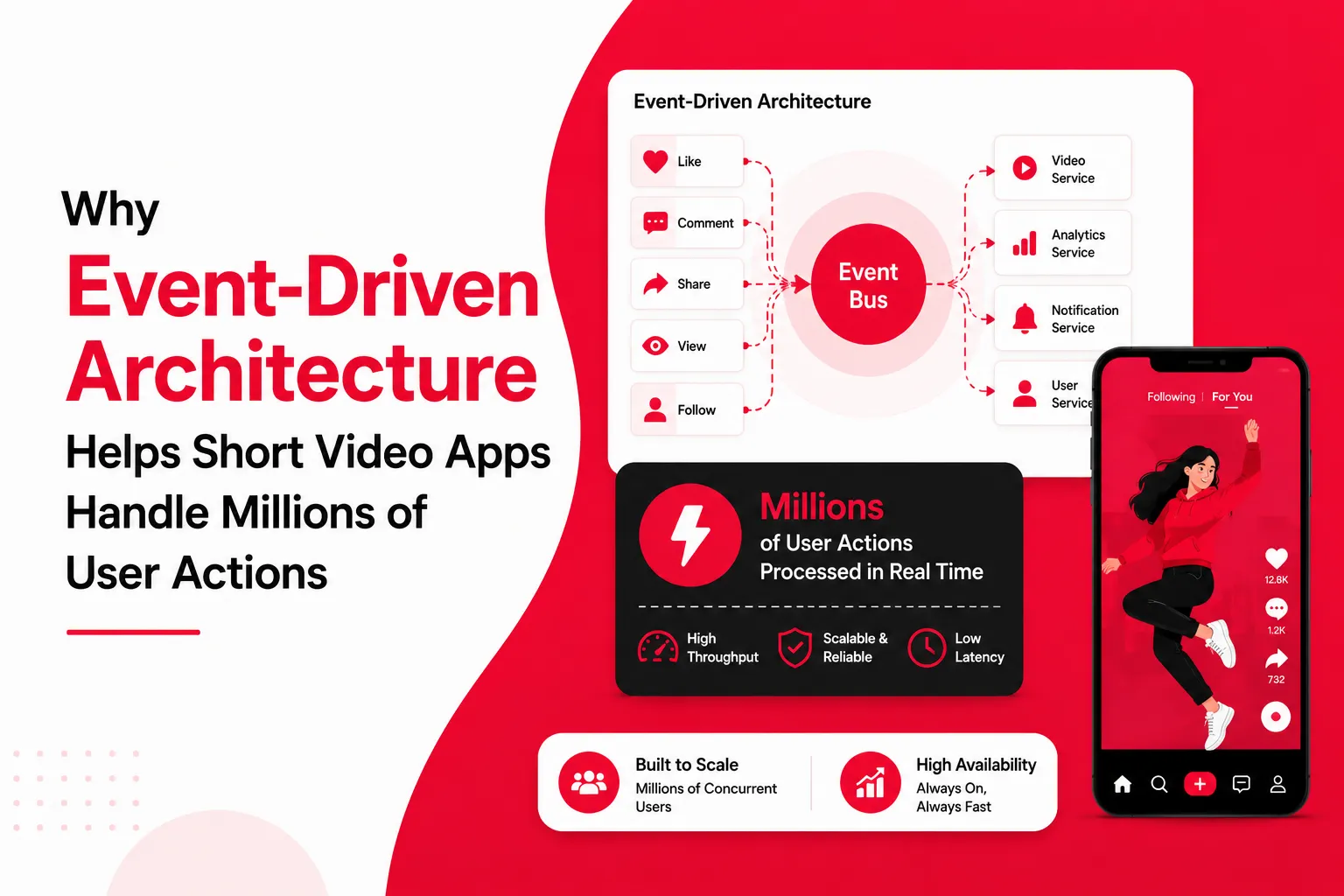
Event-driven architecture is a backend design model where applications communicate through events rather than depending entirely on direct synchronous communication.
In simple terms, every user action generates an event.
That event is then published into a queue or distributed event stream where multiple independent services can process it asynchronously.
How Event-Driven Systems Work
For example, when a user likes a video, the platform generates a “like event.” Instead of forcing one backend service to process analytics, recommendations, notifications, and counters simultaneously, the event is distributed across multiple systems.
One service may process recommendation updates.
Another may handle notification delivery.
Another may update engagement analytics.
Another may refresh counters inside the feed.
Because each system works independently, the platform becomes more scalable and resilient.
Why Event-Driven Infrastructure Matters
This architecture is especially valuable for social-video applications because workloads can increase dramatically within minutes during viral traffic spikes.
Event-driven systems help platforms:
- Scale workloads independently
- Reduce backend bottlenecks
- Improve responsiveness
- Maintain feed performance
- Handle unpredictable traffic surges
Core Components of Event-Driven Systems
Modern event-driven architecture depends on multiple independent components working together to process large volumes of user interactions efficiently. Instead of handling everything through a single backend request, workloads are distributed across scalable event pipelines.
| Component | Role |
|---|---|
| Event Producer | Generates user events |
| Message Broker | Routes events between services |
| Queue or Stream | Buffers traffic spikes |
| Consumer Service | Processes workloads independently |
| Notification Service | Sends alerts and engagement updates |
| Analytics Pipeline | Processes behavioral data |
Event Producer
Event producers generate events whenever users interact with the platform. Actions such as likes, comments, follows, shares, and uploads create events that enter the backend processing system.
Message Broker
The message broker distributes events between backend services. Technologies such as Apache Kafka help route workloads efficiently across recommendation systems, analytics pipelines, and notification services.
Queue or Stream
Queues and event streams help platforms manage sudden traffic spikes. During viral moments, these systems buffer workloads and prevent backend overload.
Consumer Service
Consumer services process events independently. One service may handle notifications while another updates recommendations or analytics data. This improves scalability and fault isolation.
Notification Service
Notification systems process engagement alerts such as likes, comments, mentions, and follows asynchronously to maintain responsiveness during high-concurrency periods.
Analytics Pipeline
Analytics pipelines process behavioral data including watch time, engagement patterns, and recommendation signals to help personalize feeds in real time.
Why Traditional Architectures Struggle in Social Video Apps
Traditional monolithic architectures often rely heavily on synchronous processing models. In these systems, multiple backend operations happen inside a single request cycle.
This becomes problematic for short-video applications because engagement activity grows extremely fast during peak traffic periods.
The Problem with Synchronous Processing
For example, a single “like” interaction may trigger:
- Database writes
- Recommendation updates
- Notification generation
- Analytics processing
- Counter refreshes
When millions of users interact simultaneously, these synchronous operations create significant pressure on APIs and databases.
Infrastructure Bottlenecks During Viral Traffic
As traffic increases, backend systems start facing:
- API bottlenecks
- Database contention
- Notification delays
- Feed inconsistency
- Latency spikes
- Cascading service failures
The problem becomes even more severe during viral content events because traffic patterns become highly unpredictable.
Modern short-video platforms require architectures capable of distributing workloads dynamically across independent systems rather than forcing everything through centralized backend flows.
Read More :- How Smart Video Feed Design Keeps Users Watching Longer in Short Video Apps
How Event-Driven Architecture Helps Short Video Apps Scale
Event-driven architecture allows short-video platforms to process engagement asynchronously while maintaining responsive feeds and stable infrastructure performance.
Instead of forcing every interaction through one overloaded backend process, workloads are distributed across independent event consumers and scalable processing pipelines.
Handling Likes and Engagement at Massive Scale
This becomes extremely important for platforms handling millions of simultaneous interactions.
Likes, follows, comments, notifications, recommendation updates, analytics signals, and moderation workflows can all be processed independently without blocking user-facing systems.
For example, when a user comments on a viral video, the platform may simultaneously trigger moderation pipelines, spam detection systems, recommendation updates, engagement scoring, and notification delivery systems.
With synchronous infrastructure, these operations can quickly create performance bottlenecks.
With event-driven systems, each workload scales independently.
Real-Time Recommendation Processing
Recommendation systems especially benefit from event-driven infrastructure because modern social-video feeds depend heavily on real-time behavioral analytics.
Recommendation engines continuously analyze:
- Watch-time behavior
- Completion rates
- Rewatch activity
- Engagement velocity
- Content affinity
- User interaction patterns
These signals flow through distributed event streams and analytics pipelines in near real time, allowing platforms to personalize feeds dynamically while maintaining scalability.
Scalable Notification Systems
Notification infrastructure also becomes significantly more reliable through asynchronous systems. Instead of overloading APIs during engagement spikes, notification workloads can be buffered through queues and processed independently across distributed delivery systems.
This improves:
- Notification speed
- Reliability
- Delivery consistency
- Platform responsiveness
Distributed Video Upload Pipelines
Video upload systems rely heavily on async workflows as well.
Modern short-video platforms process uploads through distributed pipelines that handle transcoding, moderation checks, compression systems, thumbnail generation, metadata indexing, and CDN publishing independently.
This prevents uploads from overwhelming backend infrastructure while improving scalability.
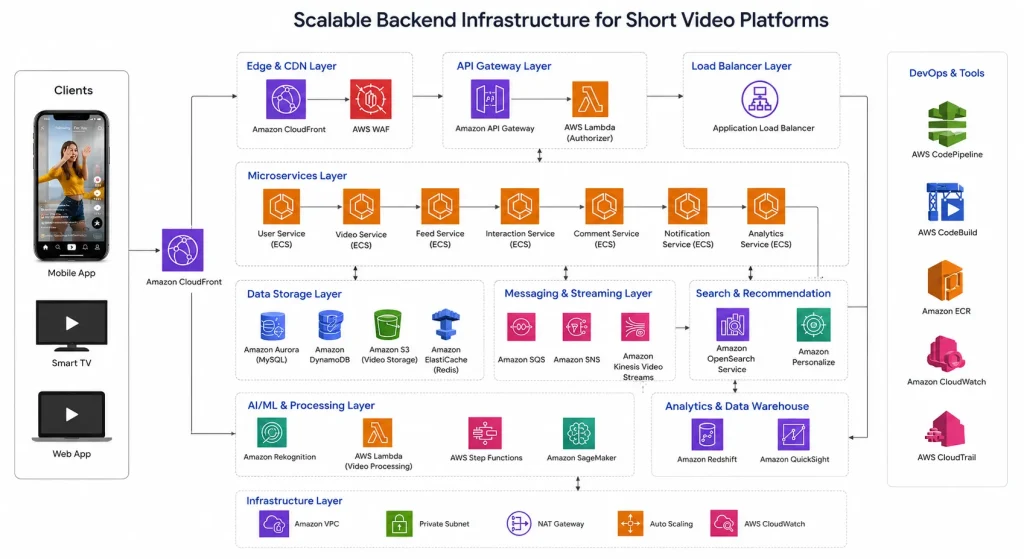
Core Technologies Used in Event-Driven Social Video Infrastructure
Modern scalable social-video infrastructure depends on multiple distributed systems technologies working together efficiently.
Apache Kafka for Event Streaming
Apache Kafka has become one of the most widely used technologies for large-scale event streaming because it supports high-throughput processing, event retention, distributed scalability, and real-time analytics pipelines.
Kafka allows platforms to process enormous engagement workloads without relying entirely on synchronous communication.
Redis for Low-Latency Performance
Redis helps improve low-latency performance through caching systems, fast counters, Pub/Sub messaging, and feed optimization.
Queue Systems and Async Workers
Message queue technologies such as RabbitMQ and Amazon Web Services SQS help platforms buffer traffic spikes while supporting asynchronous workers and retry systems.
Microservices Architecture
Most scalable short-video applications also rely heavily on microservices because independent services improve fault isolation, deployment flexibility, scalability, and infrastructure resilience.
Recommended Infrastructure Stack
Modern event-driven video platforms rely on multiple infrastructure layers working together to process high-concurrency workloads efficiently. From real-time event streaming and queue management to caching, notifications, analytics, and distributed backend services, each layer plays an important role in maintaining scalability and responsiveness. Choosing the right infrastructure stack helps short-video platforms handle viral traffic spikes, improve recommendation performance, reduce latency, and maintain stable user experiences during continuous engagement activity.
| Infrastructure Layer | Recommended Technologies |
|---|---|
| Event Streaming | Kafka |
| Queue Systems | RabbitMQ / SQS |
| Backend Services | Node.js / Go |
| Real-Time Cache | Redis |
| Notifications | Firebase / APNs |
| Databases | PostgreSQL / Cassandra |
| Analytics | Kafka Streams |
Real-World Event-Driven Systems in Social Platforms
Large-scale social platforms increasingly rely on distributed event systems because synchronous architectures struggle to support modern engagement volumes reliably.
Feed Ranking and Recommendations
Event-driven infrastructure powers recommendation pipelines that continuously process watch-time behavior, engagement patterns, and user interests in real time. Feed algorithms update dynamically based on behavioral analytics streams instead of delayed batch processing.
This allows modern short-video platforms to deliver highly personalized feeds without sacrificing scalability.
Notification Infrastructure at Scale
Notification systems depend heavily on asynchronous delivery pipelines because modern short-video apps generate enormous engagement-triggered notification traffic every minute.
Without distributed event systems, viral traffic spikes would quickly overwhelm APIs and delay notification delivery across the platform.
Queue systems help platforms distribute workloads efficiently while maintaining delivery reliability during sudden engagement surges.
Messaging and Analytics Systems
Messaging infrastructure and analytics pipelines also rely heavily on distributed event processing because workloads can scale independently without affecting overall platform stability.
Modern analytics systems continuously process:
- User engagement signals
- Watch-time behavior
- Feed interaction patterns
- Retention metrics
- Recommendation performance
This helps platforms improve personalization while maintaining operational efficiency.
Common Event-Driven Architecture Mistakes Startups Make
Many startups adopt event-driven systems too aggressively or without long-term infrastructure planning.
Overcomplicating Microservices Too Early
One of the most common mistakes is building overly complex microservices before traffic levels actually require distributed scaling.
This often increases operational complexity while slowing product development unnecessarily.
Weak Event Schema Planning
Poorly structured event schemas create maintenance problems as systems grow.
Without proper versioning and event consistency, backend services become difficult to scale and manage.
Ignoring Observability and Monitoring
Many startups initially underestimate the importance of monitoring:
- Queue health
- Event pipelines
- Consumer performance
- Retry systems
- Infrastructure bottlenecks
Without strong observability, debugging distributed systems becomes extremely difficult during production traffic spikes.
Underestimating Recommendation Infrastructure
Recommendation systems process massive behavioral datasets continuously.
Poorly optimized recommendation analytics can quickly become one of the largest scalability bottlenecks inside social-video platforms.
Successful event-driven systems require balancing simplicity, scalability, observability, and long-term infrastructure efficiency.
Why Event-Driven Architecture Improves User Experience
Infrastructure quality directly influences user experience quality.
When backend systems scale efficiently, users experience smoother feeds, faster notifications, more responsive engagement systems, and lower latency during peak traffic periods.
Faster Feed Responsiveness
Event-driven systems improve feed quality by allowing recommendation pipelines to process behavioral signals in near real time.
Instead of relying on delayed updates, platforms continuously personalize feeds dynamically based on engagement behavior.
Reliable Notifications During Traffic Spikes
Notification systems become significantly more stable because asynchronous delivery pipelines reduce the risk of bottlenecks during viral engagement periods.
Users receive faster engagement updates even during high-concurrency traffic spikes.
Better Personalization and Engagement
Modern recommendation infrastructure depends heavily on real-time analytics processing.
Event-driven systems help platforms deliver:
- Better recommendations
- Faster engagement updates
- More accurate personalization
- Improved retention experiences
That is why scalable backend systems have become one of the most important competitive advantages for modern short-video platforms.
Businesses planning scalable architectures similar to a TikTok Clone Solution increasingly prioritize async event systems and distributed infrastructure planning from the earliest development stages.
Read More :- How Short Video Apps Can Reduce Streaming Costs Without Losing Playback Quality
Why Choose Miracuves for Scalable Event-Driven Video Infrastructure
Building scalable short-video infrastructure requires significantly more than traditional backend development.
Modern platforms must support high-concurrency engagement systems, distributed notifications, recommendation pipelines, real-time analytics, moderation workflows, and viral traffic handling simultaneously without affecting user experience quality.
Distributed Event Pipeline Architecture
Miracuves helps startups and growing businesses design scalable event-driven architectures capable of supporting long-term engagement growth efficiently.
The infrastructure approach focuses heavily on distributed event pipelines, queue-based processing systems, cloud-native scalability, and high-throughput backend architecture optimized for modern social-video platforms.
Real-Time Recommendation and Analytics Systems
Recommendation infrastructure is planned around real-time behavioral analytics so platforms can process engagement signals dynamically without creating scalability bottlenecks as traffic grows.
Analytics pipelines are optimized to handle continuous streams of user interaction data while maintaining performance consistency.
Scalable Notification and Engagement Infrastructure
Notification systems are designed using asynchronous delivery models that improve reliability during high-volume engagement spikes, while distributed queue systems help maintain platform responsiveness during unpredictable viral traffic bursts.
Cloud-Native Scalability Planning
Miracuves also focuses heavily on scalable cloud-native deployment strategies because short-video applications often experience rapid growth patterns that require flexible infrastructure scaling.
From MVP-stage planning to large-scale production environments, scalable infrastructure decisions are approached with long-term operational efficiency in mind.
Businesses exploring scalable Short Video App Development Infrastructure increasingly rely on distributed systems planning because future-ready social-video platforms now depend heavily on real-time event processing.
Conclusion
Short-video applications now operate in one of the most demanding real-time digital environments. Every like, comment, follow, upload, notification, and recommendation signal creates continuous backend activity that must be processed instantly without affecting user experience.
Traditional synchronous systems struggle to handle this level of concurrency efficiently at scale. That is why modern platforms increasingly rely on event-driven architecture powered by technologies such as Apache Kafka, Redis, distributed queues, cloud-native infrastructure, and real-time analytics pipelines.
By using asynchronous communication and distributed event processing, short-video platforms can deliver smoother feeds, faster notifications, scalable recommendation systems, and more reliable engagement experiences even during massive viral traffic spikes.
As user engagement continues growing globally, event-driven infrastructure will remain one of the most important foundations behind reliable, scalable, and future-ready social-video applications.
Businesses planning to build or scale high-concurrency video platforms should focus on long-term infrastructure strategy early rather than waiting for scalability bottlenecks to appear later.
For architecture planning, scalable backend consultation, and event-driven infrastructure strategy for modern short-video platforms — schedule a consultation with Miracuves to explore scalable solutions built for long-term growth.
FAQs :-
What is event-driven architecture in social-video apps?
Event-driven architecture is a backend design model where user interactions generate events that are processed asynchronously through distributed systems.
Why do short-video platforms use event queues?
Event queues help platforms process engagement workloads efficiently during high-concurrency traffic periods.
How does Kafka help social-video apps scale?
Kafka supports distributed event streaming, scalable analytics, and real-time engagement processing.
Why are async systems important for notifications?
Async systems improve reliability and prevent notification delays during engagement spikes.
What role does Redis play in scalable short-video infrastructure?
Redis improves low-latency performance through caching, counters, and real-time data handling.
Why do viral videos create infrastructure challenges?
Viral content generates sudden traffic spikes that create massive engagement workloads simultaneously.
Are microservices necessary for scalable short-video apps?
Microservices improve scalability, deployment flexibility, and fault isolation for large-scale social platforms.
How do recommendation systems use event streams?
Recommendation engines process watch-time signals, behavioral analytics, and engagement patterns through distributed event pipelines.
What are the biggest benefits of event-driven architecture?
The biggest advantages include scalability, reliability, responsiveness, and improved concurrency handling.
Why is scalable backend infrastructure important for TikTok-like apps?
Scalable infrastructure helps maintain smooth feeds, fast notifications, and stable engagement systems during rapid user growth.
Related Articles :-
Miracuves is an independent software development company. We are not affiliated with, connected to, sponsored by, or endorsed by any company or product named in this article.
Terms such as “X Clone” are used descriptively. It is how the software industry refers to building a platform with functionality comparable to a known service, and how clients search for it.
The entire design and codebase of our products is built by our own team. Our products contain no code, design, graphics, or content originating from any third-party website or applications.
All third-party names and marks referenced in this article are the property of their respective owners, referenced solely to identify the services discussed.