


Key Takeaways
What You’ll Learn
- CRED operates as a fintech platform focused on credit card users with high credit scores.
- The company earns revenue through lending, payment services, partnerships, and financial products.
- Reward-based engagement helps CRED build strong customer retention and platform activity.
- CRED has expanded beyond bill payments into lending, insurance, and wealth management services.
- Its premium user ecosystem creates monetization opportunities across multiple fintech verticals.
Stats That Matter
- CRED reported operating revenue of ₹2,735 crore in FY25.
- The platform serves millions of users and processes large-scale payment transactions across India.
- Lending has become one of CRED’s largest revenue-generating segments.
- CRED expanded into wealth management after acquiring Kuvera.
- India’s digital fintech ecosystem continues growing rapidly with increased mobile payment adoption.
Real Insights
- Fintech platforms can scale faster by targeting high-value user segments.
- Gamification and rewards improve customer engagement in financial apps.
- Integrated financial ecosystems create stronger monetization opportunities beyond payments.
- Trust and user experience play a major role in retaining fintech customers.
- Expanding into lending, insurance, and wealth services helps fintech companies diversify revenue streams.
In just a few years, CRED transformed from a niche credit card payment app into one of India’s most influential fintech platforms. Founded in 2018 by Kunal Shah, the company reached a valuation of over $6.4 billion while serving millions of high-credit-score users.At first glance, that sounds like an expensive strategy. But behind the rewards, CRED quietly built a high-trust digital ecosystem of premium consumers — arguably one of the most valuable audiences in India’s digital economy.
Today in 2026, the business model of CRED powers a comprehensive fintech ecosystem spanning credit card payments, lending, merchant commerce, financial products, premium marketplace services, UPI payments, and wealth solutions.Rather than being just a payment app, CRED functions as a curated financial ecosystem for high-credit-score consumers.For entrepreneurs studying modern platform businesses, the CRED model offers key lessons in trust-based customer acquisition, premium audience monetization, fintech ecosystem design, and community-driven loyalty economics.
And for companies like Miracuves, which specialize in building scalable digital platforms, CRED represents a powerful example of how product positioning and ecosystem strategy can unlock new revenue architectures.
How the CRED Business Model Works
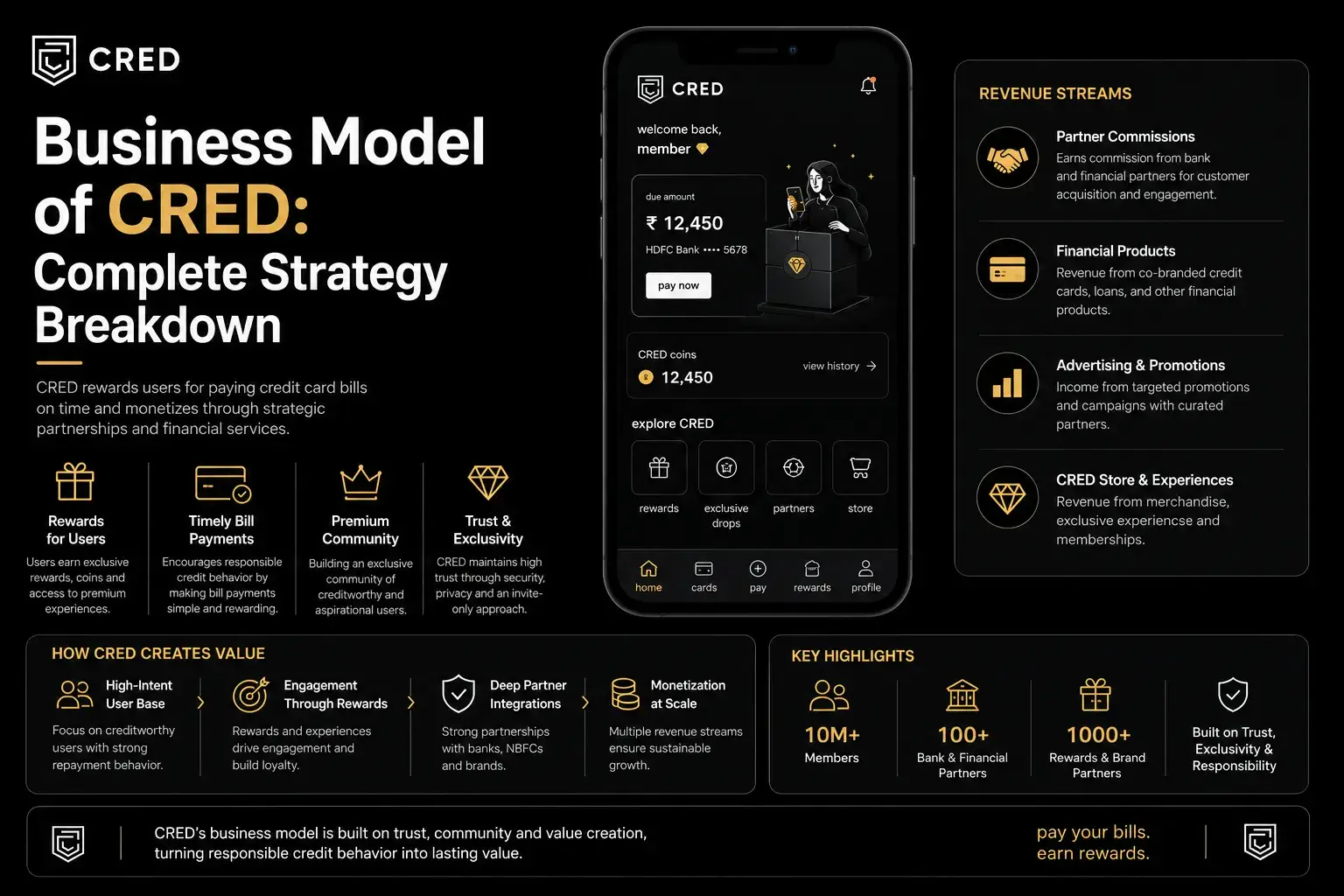
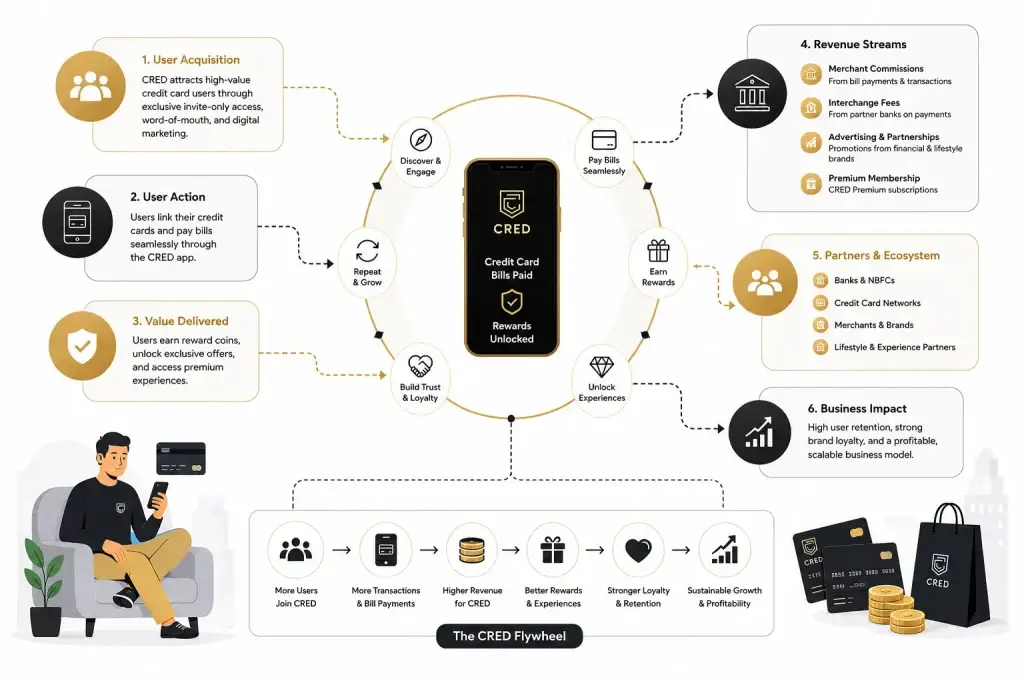
business model of CRED’s is built on a trust-first fintech ecosystem that aggregates high-creditworthiness consumers and monetizes their financial behavior through multiple financial and commerce services.
Unlike traditional fintech platforms that target mass adoption, CRED deliberately restricts access to users with strong credit histories. This exclusivity creates a premium consumer network, which becomes highly valuable for financial institutions and brands.
In simple terms, CRED doesn’t just process payments — it monetizes the trust and purchasing power of its users.
Type of Business Model
CRED operates a hybrid fintech platform model combining several frameworks:
- Fintech Platform Model – digital financial services ecosystem
- Marketplace Model – connecting premium consumers with brands
- Commission-Based Model – earning from transactions and financial products
- Data & Insights Model – leveraging behavioral financial insights
- Lending Platform Model – facilitating credit products
This hybrid approach allows CRED to diversify monetization without charging its core user base directly.
Evolution of the CRED Business Model
CRED did not launch as a full fintech ecosystem. Its model evolved rapidly.
Phase 1 (2018–2019): Credit Card Bill Payments
The initial value proposition was simple:
- Pay credit card bills
- Earn CRED Coins
Revenue generation was minimal.
The focus was user trust and growth.
Phase 2 (2020–2022): Premium Commerce & Lending
CRED expanded into:
- CRED Store
- CRED Pay
- CRED RentPay
- Personal lending partnerships
Now the platform could monetize transactions and financial services.
Phase 3 (2023–2026): Full Financial Ecosystem
Today CRED includes:
- UPI payments
- Credit lines
- Instant loans
- Financial product marketplace
- Premium brand partnerships
- Travel and lifestyle benefits
This evolution transformed CRED into a high-value financial ecosystem rather than a single fintech product.
Read more : What is CRED and How Does It Work?
Target Market & Customer Segmentation Strategy
Understanding who CRED serves is the key to understanding why its business model works. Unlike most fintech apps that chase scale through mass adoption, CRED intentionally targets a narrow but extremely valuable segment of consumers.
By focusing on users with high credit scores and strong financial discipline, the platform attracts a demographic that brands, banks, and lenders are eager to reach.
This targeted approach allows CRED to maintain a premium brand identity while creating higher lifetime value per user.
Primary Customer Segments
CRED’s core audience consists of creditworthy urban professionals.
1. High Credit Score Consumers (Primary Segment)
These users typically have:
- Credit score 750+
- Multiple credit cards
- High monthly spending capacity
- Strong repayment history
- Digital-first financial behavior
Demographically, this group includes:
- Urban professionals
- Startup founders
- Tech employees
- Consultants and corporate executives
- Affluent millennials and Gen Z professionals
These users represent a high-value financial demographic because they:
- Spend more
- Default less
- Adopt new financial products faster
This makes them extremely attractive to banks, fintech companies, and premium brands.
2. Financial Institutions & Lenders
Banks and NBFCs form the second major customer segment.
They use CRED as a customer acquisition and distribution platform for:
- Personal loans
- Credit lines
- Credit card upgrades
- Financial products
Instead of spending heavily on marketing campaigns, these institutions can access a curated pool of low-risk borrowers.
3. Premium Brands and Merchants
The third segment consists of consumer brands targeting affluent buyers.
These partners include:
- Luxury lifestyle brands
- D2C startups
- Travel platforms
- Premium retail companies
- Experience-based services
CRED allows these brands to market directly to high-spending consumers, increasing both conversion rates and brand perception.
Customer Journey: From Discovery to Loyalty
CRED carefully designs the user journey to maximize engagement and retention.
1. Discovery
Users typically discover CRED through:
- Word-of-mouth referrals
- Influencer marketing
- Viral advertising campaigns
- App store discovery
- Social media promotions
CRED’s bold and humorous advertising strategy has played a significant role in building awareness.
2. Onboarding & Verification
To join CRED, users must verify their:
- Credit score
- Credit card details
This gated onboarding process creates exclusivity and builds brand prestige.
Psychologically, users feel they are joining an elite financial community.
3. Engagement
Once inside the app, users interact with multiple features:
- Credit card bill payments
- Rewards and CRED coins
- Exclusive offers and experiences
- UPI payments
- Shopping in CRED Store
Gamification and rewards encourage frequent app usage.
4. Retention & Expansion
CRED retains users through:
- Loyalty rewards
- Financial product offers
- Premium brand experiences
- Continuous feature expansion
As users engage more, their lifetime value increases through lending products and marketplace transactions.
Customer Segment Analysis
| Segment | Value Provided | Monetization Opportunity |
| Creditworthy Consumers | Rewards, premium financial services | Lending, commerce, payments |
| Banks & Lenders | Low-risk borrower access | Commission from loan distribution |
| Brands & Merchants | Access to affluent consumers | Marketplace commissions |
| Payment Networks | Increased card usage | Transaction partnerships |
For companies like Miracuves, CRED demonstrates an important platform strategy:
You don’t always need millions of users — sometimes the right users are far more valuable than the largest audience.
Revenue Streams and Monetization Design
Now that we understand who CRED serves, the next critical question is:
How does CRED actually make money?
For years, this was one of the most debated questions in India’s startup ecosystem. CRED spent heavily on rewards and marketing while keeping its core service free for users.
But beneath the surface, the company quietly built a multi-layered monetization architecture.
Instead of relying on a single revenue source, CRED generates income from financial products, commerce, payments, and partnerships.
This diversified approach allows the platform to monetize its high-value user base in several strategic ways.
Primary Revenue Stream: Lending Partnerships
One of CRED’s most important revenue engines comes from facilitating lending products through partner financial institutions.
Through features like CRED Cash and instant credit lines, the platform connects users with loans offered by banks and NBFCs.
How It Works
- A CRED user applies for a loan inside the app.
- Partner lenders evaluate the request using credit data and user profiles.
- The loan is issued by the financial institution.
- CRED earns a commission for enabling the transaction.
Why This Works
Because CRED users already have high credit scores, they represent a low-risk borrower segment.
This leads to:
- Higher approval rates
- Lower default risk
- Faster loan disbursement
- Higher lender confidence
Revenue Impact
Lending distribution has become a major fintech monetization model globally, and it represents one of CRED’s fastest-growing revenue streams.
Secondary Revenue Streams
CRED has gradually expanded its revenue architecture through multiple channels.
1. Merchant Commissions (CRED Store)
The CRED Store allows premium brands to sell products to CRED users.
Brands offer:
- Exclusive discounts
- Limited deals
- Early access product drops
CRED earns commission fees from each transaction.
Benefits for merchants include:
- Access to affluent consumers
- Higher conversion rates
- Targeted marketing opportunities
2. Payment Transaction Fees
Through services like:
- CRED Pay
- CRED UPI
- RentPay
the platform processes various financial transactions.
CRED can generate revenue via:
- Merchant fees
- Processing commissions
- Payment network incentives
While payment fees are usually small, high transaction volume creates scalable revenue.
3. Financial Product Distribution
CRED also acts as a financial product marketplace, offering services such as:
- Personal loans
- Credit lines
- Insurance
- Wealth products
- Credit card upgrades
Financial institutions pay distribution commissions when users adopt these products through the platform.
This model resembles a digital financial brokerage.
4. Brand Partnerships & Marketing Campaigns
CRED’s premium audience attracts many brands looking for high-quality customer acquisition.
Brands collaborate with CRED through:
- Sponsored offers
- Co-branded campaigns
- Premium experiences
- Event partnerships
These collaborations generate marketing and partnership revenue.
5. Data-Driven Financial Insights (Indirect Value)
While CRED does not sell personal user data, the platform benefits from behavioral financial insights that help optimize:
- Lending recommendations
- Merchant targeting
- Product personalization
This intelligence improves monetization efficiency across all revenue streams.
Read more : Best CRED Clone Scripts 2025: Build a High-Engagement Rewards & Credit Bill Payment App
Operational Model & Key Activities
Behind CRED’s sleek interface and premium branding lies a complex operational engine that keeps the platform running smoothly at scale.
Operating a fintech ecosystem requires constant coordination between technology infrastructure, financial partners, merchant networks, and regulatory frameworks.
CRED’s operational model focuses on three main pillars: platform reliability, financial partnerships, and user experience excellence.
Core Operations
1. Platform Management
At the center of CRED’s operations is its mobile-first fintech platform.
Key responsibilities include:
- Maintaining secure payment infrastructure
- Managing credit card integrations
- Ensuring seamless transaction processing
- Handling user authentication and verification
- Managing reward systems and loyalty programs
Because the platform deals with sensitive financial information, security and compliance are critical.
Operational priorities include:
- End-to-end encryption
- Fraud detection systems
- Real-time transaction monitoring
2. Technology Infrastructure
CRED is fundamentally a technology-driven fintech company.
The tech stack supports:
- High-volume transaction processing
- Credit data analytics
- AI-driven financial recommendations
- Merchant marketplace operations
- Lending integrations with banks and NBFCs
Modern fintech platforms like CRED typically rely on:
- Cloud infrastructure
- API-based integrations
- Data analytics engines
- AI-powered fraud prevention systems
The technology backbone enables CRED to scale rapidly while maintaining system reliability.
3. Financial Ecosystem Integration
CRED works with multiple financial stakeholders.
Operational teams coordinate with:
- Banks
- NBFC lenders
- Credit bureaus
- Payment networks
- Regulatory bodies
These integrations enable services like:
- Credit score tracking
- Instant loan approvals
- Card payment automation
- Credit card statement analysis
Maintaining these relationships requires strong compliance frameworks and financial operations expertise.
4. Merchant & Brand Partnerships
The CRED Store and brand ecosystem require continuous merchant onboarding and relationship management.
Key operational activities include:
- Partner onboarding and contract management
- Offer management and campaign execution
- Inventory coordination for premium product launches
- Performance analytics for merchant partners
This marketplace layer helps drive commerce engagement within the platform.
5. Customer Support & Experience
Fintech platforms must provide reliable customer support to maintain trust.
CRED invests heavily in:
- Customer support teams
- Dispute resolution systems
- Payment issue handling
- Loan application support
Because the platform targets premium consumers, user experience standards are particularly high.
Strategic Partnerships & Ecosystem Development
CRED’s growth is not driven only by its app features — it is powered by a carefully constructed ecosystem of strategic partnerships.
Instead of building every capability internally, CRED collaborates with banks, fintech infrastructure providers, merchants, and technology companies to expand its services quickly and efficiently.
This partnership-driven strategy allows CRED to scale faster while maintaining its premium positioning.
In essence, CRED acts as a platform orchestrator, connecting high-quality consumers with a network of trusted partners.
Collaboration Philosophy
CRED focuses on curated partnerships rather than open marketplaces.
The goal is to ensure that every service inside the platform aligns with its brand promise:
premium experience for financially responsible users.
This means CRED selectively partners with organizations that can provide:
- High-quality financial services
- Premium consumer products
- Reliable infrastructure
- Regulatory compliance support
By doing this, CRED protects its trust-based ecosystem.
Key Types of Partnerships
1. Technology and API Partners
CRED relies heavily on fintech infrastructure providers to power its platform.
These partnerships support services like:
- Payment processing
- Credit bureau integrations
- Financial data analytics
- Identity verification
- Fraud detection systems
Technology partners enable CRED to build advanced fintech capabilities without building every system from scratch.
2. Banking and Lending Partnerships
Banks and NBFCs play a central role in CRED’s business model.
These financial institutions provide:
- Personal loans
- Credit lines
- Credit card upgrades
- Lending products distributed through the platform
In return, they gain access to a curated pool of high-creditworthiness borrowers.
This relationship creates a win-win dynamic:
- Banks reduce customer acquisition costs
- CRED earns commissions from product distribution
3. Payment and Infrastructure Alliances
To support bill payments and transactions, CRED collaborates with:
- Credit card networks (Visa, Mastercard, RuPay)
- Payment gateways
- UPI infrastructure providers
- Settlement and compliance systems
These partnerships ensure secure and reliable transaction processing.
4. Merchant and Brand Collaborations
CRED’s marketplace and reward ecosystem depend heavily on brand partnerships.
Brands join CRED to access:
- High-spending consumers
- Exclusive campaign opportunities
- Premium positioning within the app
Examples of partnership categories include:
- Consumer electronics brands
- Luxury lifestyle companies
- Travel platforms
- D2C startups
- Premium retail brands
These collaborations power features like:
- CRED Store
- Limited-time deals
- Exclusive product launches
5. Marketing and Distribution Partnerships
CRED also works with external partners to amplify its brand reach.
These include:
- Advertising agencies
- Influencer networks
- Media platforms
- Event partners
CRED’s unconventional marketing campaigns often involve high-profile collaborations that help the brand stand out in the fintech industry.
6. Regulatory and Compliance Alliances
Because fintech operates in a highly regulated environment, CRED must work closely with:
- Financial regulators
- Compliance partners
- Legal advisory firms
These partnerships ensure that all financial services offered on the platform comply with national regulations and financial policies.
Read more : Best Elicit Clone Script 2026 : Build Your Own AI Research Assistant Platform
Growth Strategy & Scaling Mechanisms
CRED’s rapid rise in India’s fintech landscape wasn’t accidental. Its growth has been driven by a combination of brand-led virality, product expansion, and ecosystem scaling.
Instead of following the traditional fintech strategy of competing on cashbacks and payment incentives, CRED focused on building a strong identity and premium community. This helped the platform grow not just in user numbers, but in user value and engagement.
Growth Engines
1. Organic Virality & Referral Loops
One of CRED’s most powerful growth tools has been word-of-mouth adoption.
Because entry into the platform requires a high credit score, joining CRED feels like becoming part of an exclusive club.
This exclusivity naturally drives users to:
- Invite friends
- Share rewards and offers
- Recommend the platform within professional networks
Referral programs amplify this behavior by rewarding both the inviter and the invited user.
This creates a self-sustaining growth loop:
User joins → experiences benefits → invites peers → network expands.
2. Bold Brand Marketing
CRED’s marketing strategy is widely regarded as one of the most distinctive in India’s startup ecosystem.
Instead of conventional fintech advertising, the company uses:
- Celebrity-driven campaigns
- Humorous storytelling
- High-production digital ads
- Viral social media content
These campaigns often feature unexpected personalities — including former athletes, film stars, and public figures — delivering quirky narratives that make the ads memorable.
The result is strong brand recall and cultural relevance.
3. Product Expansion
CRED initially launched with a single use case:
credit card bill payments.
But over time, it expanded into a broader financial ecosystem.
Key product expansions include:
- CRED Pay – simplified payment experience
- CRED UPI – everyday digital transactions
- CRED Cash – personal lending products
- CRED RentPay – rent payments using credit cards
- CRED Store – premium e-commerce marketplace
Each new feature increases the number of touchpoints between the user and the platform, strengthening retention.
4. High-Value User Acquisition
Instead of targeting the entire population, CRED focuses on quality over quantity.
This means acquiring users who:
- Spend more
- Borrow responsibly
- Engage frequently with financial products
This strategy increases customer lifetime value (CLV) significantly.
For lenders and brands, these users are far more valuable than average digital consumers.
5. Geographic Scaling Strategy
While CRED initially gained traction in India’s largest metropolitan cities, it has gradually expanded to:
- Tier-1 cities
- Tier-2 urban markets
- Emerging professional hubs
These regions are seeing rapid growth in:
- Credit card adoption
- Digital payments
- Consumer spending
This makes them ideal markets for CRED’s expansion.
For digital platform builders like Miracuves, CRED’s growth story demonstrates an essential principle:
Sustainable scaling comes from combining strong branding, product expansion, and ecosystem partnerships — not just user acquisition alone.
Competitive Strategy & Market Defense
India’s fintech market is one of the most competitive digital sectors in the world. Major players like PhonePe, Paytm, Google Pay, Slice, OneCard, and various neobanks constantly innovate to capture user attention.
Yet CRED has managed to carve out a distinct and defensible market position by focusing on premium users, strong branding, and ecosystem innovation.
Rather than competing head-to-head with mass payment platforms, CRED plays a different strategic game.
Core Competitive Advantages
1. Curated User Network (High-Value Community)
CRED’s biggest strategic advantage is its user base itself.
Most payment platforms focus on maximum scale, onboarding anyone with a smartphone. CRED does the opposite by restricting entry to users with high credit scores.
This creates a powerful competitive advantage:
- Higher spending users
- Lower credit risk
- Stronger engagement with financial products
- Premium brand partnerships
For many banks and merchants, CRED users are among the most valuable digital consumers in India.
2. Network Effects
The platform benefits from two-sided network effects.
As more premium users join:
- More brands want to partner with CRED.
- More financial institutions want access to its users.
This creates a self-reinforcing loop:
Better users → better partners → better offers → more user growth.
Over time, these network effects strengthen CRED’s position against competitors.
3. Strong Brand Identity
CRED has built one of the most recognizable fintech brands in India.
Its marketing campaigns are known for:
- Humorous storytelling
- Celebrity appearances
- Cultural relevance
- Viral digital content
Instead of positioning itself purely as a financial tool, CRED presents itself as a lifestyle and membership brand for responsible credit users.
This emotional branding helps the platform stand apart from transactional payment apps.
4. Technology & Data Advantage
Because users connect their credit cards, payment activity, and financial behavior to the platform, CRED collects valuable insights about spending patterns.
This data enables:
- Personalized offers
- Better lending recommendations
- Targeted brand promotions
- Improved risk assessment
Competitors without similar high-credit user data pools cannot easily replicate this advantage.
5. Product Innovation
CRED continuously expands its ecosystem to stay ahead.
Major innovations include:
- CRED UPI
- CRED Cash
- CRED Pay
- CRED Store
- Credit card bill automation
These features transform the platform from a single-use payment tool into a comprehensive financial ecosystem.
Lessons for Entrepreneurs & Implementation
CRED’s journey offers powerful insights for entrepreneurs building fintech, marketplace, or platform-based businesses. Its success didn’t come from simply launching another payments app—it came from rethinking who the platform should serve and how value should be created.
Instead of chasing the largest user base, CRED focused on building a high-trust, high-value community, and then layered monetization opportunities around that community.
For founders, the key lesson is clear:
The right audience can be more valuable than the biggest audience.
Key Factors Behind CRED’s Success
1. Community-First Platform Design
CRED built a curated ecosystem of financially responsible users.
This strategy delivered several benefits:
- Higher user spending power
- Lower credit risk
- Premium brand partnerships
- Stronger trust within the ecosystem
By focusing on quality over quantity, CRED created a platform that attracts valuable partners.
2. Premium Brand Positioning
Most fintech apps compete on cashbacks and discounts.
CRED took a different route by positioning itself as a premium financial membership platform.
This brand identity helps the company:
- Attract affluent users
- Collaborate with premium brands
- Maintain strong user loyalty
For entrepreneurs, this demonstrates how brand perception can influence business model strength.
3. Ecosystem Monetization Strategy
Instead of relying on a single revenue stream, CRED built multiple interconnected monetization layers.
These include:
- Lending partnerships
- Financial product distribution
- Merchant marketplace commissions
- Payment transaction revenues
- Brand collaborations
This diversification reduces risk and increases long-term scalability.
4. Trust as a Strategic Asset
CRED’s entire platform is built around trust in financial behavior.
By rewarding responsible credit usage, the company created a positive behavioral loop:
Responsible users → better financial offers → higher engagement.
Trust-driven platforms often achieve higher retention and customer lifetime value.
Implementation Timeline for a Similar Platform
For founders planning to build a platform inspired by CRED, a phased approach works best.
Phase 1 — Core Platform Development
- Define the target community
- Build the core mobile platform
- Develop onboarding and verification systems
- Launch initial product features
Phase 2 — User Acquisition & Community Growth
- Introduce referral programs
- Launch marketing campaigns
- Build trust through user engagement features
- Expand partnerships with service providers
Phase 3 — Ecosystem Expansion
- Introduce new financial or marketplace services
- Build partnerships with brands and institutions
- Develop advanced analytics and personalization tools
Phase 4 — Monetization Optimization
- Scale financial products
- Expand commerce integrations
- Optimize cross-selling strategies
- Strengthen ecosystem partnerships
Miracuves builds scalable platforms with tested business models and growth mechanisms.
Get your free business model consultation today.
Conclusion
CRED’s journey proves that innovation in business models can be just as powerful as innovation in technology.
What began as a simple credit card bill payment app evolved into a multi-layered fintech ecosystem serving millions of high-value consumers across India. By focusing on trust, premium user segments, and ecosystem partnerships, CRED demonstrated that building the right community can unlock powerful monetization opportunities.
Instead of competing in the crowded cashback-driven payments market, CRED created its own category — a financial lifestyle platform for responsible credit users.
For entrepreneurs and digital platform builders, the bigger lesson is clear: Trust can be monetized , Curated communities create premium markets ,Ecosystems scale faster than standalone products
As the platform economy continues to evolve in 2026 and beyond, companies that combine smart product design, strong brand identity, and strategic partnerships will shape the next generation of digital businesses And CRED is a powerful example of how vision, positioning, and execution together create sustainable growth.
FAQs
What type of business model does CRED use?
How does CRED’s business model create value?
What are CRED’s key success factors?
How scalable is CRED’s business model?
What are the biggest challenges in CRED’s business model?
How can entrepreneurs adapt CRED’s model to their region?
What are alternatives to the CRED business model?
How has CRED’s business model evolved over time?
Related Articles