

Key Takeaways
- A credit card bill payment app should combine card linking, bill reminders, payment processing, transaction history, rewards, notifications, and secure account management in one streamlined experience.
- Core features may include multiple card management, automatic bill detection, scheduled payments, payment status tracking, cashback or rewards, referral programs, and user dashboards.
- Development scope and pricing depend on payment gateway integrations, banking APIs, KYC requirements, security controls, reward logic, admin tools, platform scale, and customization needs.
Feature & Pricing Signals
- User-side features such as card onboarding, due-date reminders, bill payments, autopay, transaction records, rewards, offers, referrals, and payment notifications shape the core product scope.
- Pricing can increase with bank integrations, payment APIs, multi-card support, fraud detection, KYC verification, loyalty engines, analytics, automation, and third-party service connections.
- Admin modules should support users, transactions, payment status, rewards, disputes, promotions, commissions, reports, risk controls, notifications, and platform analytics.
Founder Planning Insights
- Founders should define target users, supported cards, payment flows, revenue model, rewards strategy, regulatory requirements, integrations, and MVP scope before development begins.
- Security, payment reliability, transparent transaction status, simple onboarding, useful reminders, and clear reward rules are critical for building user trust and repeat payment behavior.
- Miracuves develops customizable credit card payment platforms with card management, bill payments, rewards, referrals, payment integrations, analytics, security, and admin controls.
Credit card bill payment apps are no longer simple utility tools. For users, they offer a convenient way to track due dates, pay bills on time, earn rewards, view payment history, and manage credit card activity from one place. For founders, this creates an opportunity to build a recurring-use fintech product around bill payments, loyalty, partner offers, spending insights, and premium user engagement.
But building this type of platform requires more than adding a payment button and a rewards screen. The real product value comes from how payments, reminders, reward logic, credit insights, partner campaigns, admin controls, security, and monetization work together. If these layers are planned poorly, the app may look attractive but fail to retain users or operate efficiently after launch.
This guide explains the core features, pricing factors, development considerations, security layers, monetization options, and business planning decisions founders should understand before launching a credit card bill payment app. It will help you decide what to build first, what can be added later, and what actually affects development cost.
Why Credit Card Bill Payment Apps Are Attractive for Founders
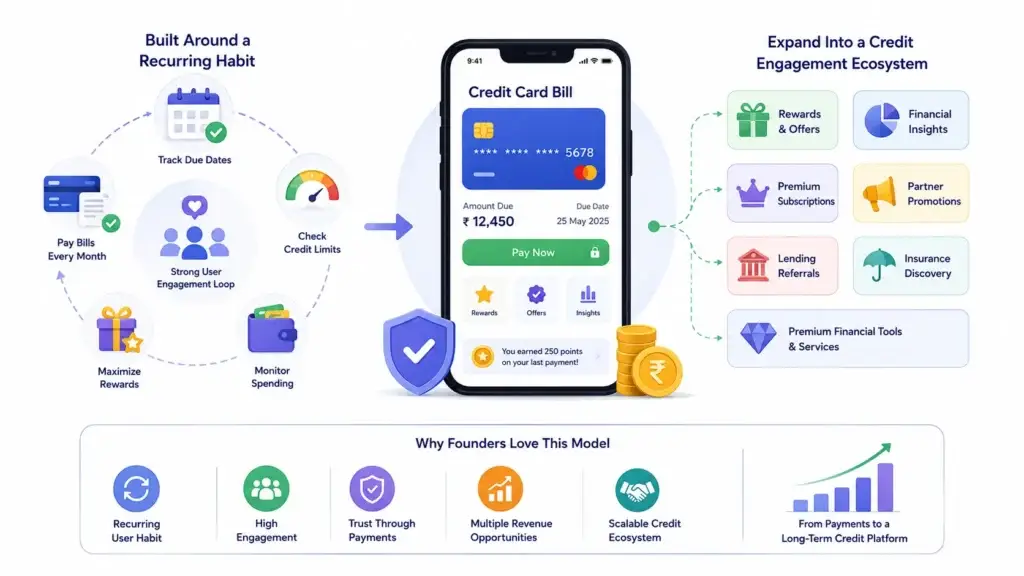
A credit card bill payment platform is built around a recurring user habit. Credit card users pay bills every month, track due dates, check available limits, monitor spending, and look for ways to maximize rewards. This creates a strong engagement loop when the product is designed well.
For founders, this matters because fintech products often struggle with repeat usage. A bill payment app solves part of that problem by connecting the product to a regular financial task. Once users trust the app for payments, the platform can expand into rewards, offers, financial insights, subscriptions, partner promotions, lending referrals, insurance discovery, or premium financial tools.
The opportunity is not just payment processing. The opportunity is building a trusted credit engagement ecosystem.
What a Credit Card Bill Payment App Actually Does
A credit card bill payment app helps users manage and pay their credit card bills through a digital platform. Depending on the scope, the app may allow users to add multiple cards, view bill amounts, receive due-date reminders, pay bills, earn rewards, redeem offers, track credit usage, and review spending patterns.
For the business owner, the platform usually includes an admin dashboard to manage users, transactions, payment gateways, rewards, offers, partner campaigns, disputes, reports, and notifications.
A simple version may focus only on bill reminders and payments. A more advanced version may include reward coins, cashback campaigns, credit score tracking, branded offers, referral systems, financial product cross-sell, and advanced analytics. Founders who want to move beyond a basic payment utility can explore a ready-made credit rewards platform that connects card management, bill payment, rewards, user engagement, and admin control in one product foundation.
Core User Features Every Credit Card Bill Payment App Should Include
The user-side experience decides whether people return every month. A good app should feel fast, trustworthy, and useful before it tries to sell additional financial products.
For founders planning the product scope, Miracuves also provides a deeper breakdown of the feature stack for a credit rewards app, including card vault, bill payment flows, reward logic, reminders, user dashboards, and platform controls.
1. Secure User Registration and Login
The first feature is user onboarding. Users should be able to create an account through mobile number, email, OTP, or social login depending on the market and compliance needs.
For fintech products, onboarding should not feel careless. The app may need identity verification, device checks, consent screens, and secure session management. Founders should plan this carefully because weak onboarding can create fraud risk, while overly complex onboarding can reduce activation.
2. Credit Card Addition and Management
Users should be able to add and manage multiple credit cards inside the app. The card management flow may include issuer selection, card nickname, last four digits, billing cycle details, due date, total amount due, minimum amount due, and payment status.
A strong card management experience helps users see all their credit obligations in one place. This is especially useful for users who hold multiple cards and want better control over payment dates.
3. Bill Due Date Reminders
Reminders are one of the most important retention features. The app should notify users before the due date through push notifications, email, SMS, or WhatsApp depending on the target market and allowed communication channels.
Founders should avoid treating reminders as basic alerts. Smart reminders can be personalized based on due date, user behavior, unpaid amount, preferred payment timing, and past activity. This improves the chance that users return to the app before the bill cycle closes.
4. Credit Card Bill Payment Flow
The payment flow is the core transaction layer. It should allow users to select a card, view the payable amount, choose a payment mode, apply eligible rewards or offers, confirm payment, and receive transaction confirmation.
This flow must be fast, clear, and reliable. Users should understand whether payment is successful, pending, failed, refunded, or under review. Payment status transparency is critical because users are dealing with time-sensitive financial obligations.
5. Transaction History
A transaction history section helps users track past payments, reward earnings, failed attempts, refunds, and redemption activity.
For founders, transaction history is also important from a support and trust perspective. When users raise disputes, the platform needs clear payment records, timestamps, status logs, and reference IDs.
6. Reward Points, Coins, Cashback, or Voucher Engine
Rewards are what turn a payment utility into an engagement platform. A reward engine can give users points, coins, cashback, vouchers, badges, or exclusive offers based on completed payments or campaigns.
The reward system should be flexible enough for the admin to define rules. For example, the platform may offer rewards based on transaction value, card type, payment method, user segment, campaign period, or partner brand.
A weak reward engine becomes expensive without improving retention. A strong reward engine encourages repeat behavior while giving the business control over reward cost.
Founders researching reward-led fintech products can also explore Miracuves’ fintech rewards app content hub for more related insights around loyalty, rewards, user engagement, and financial app monetization.
7. Partner Offers and Redemption Marketplace
A partner marketplace can allow users to redeem rewards for vouchers, brand discounts, subscriptions, travel deals, dining offers, shopping credits, or financial product benefits.
This feature can create monetization opportunities through affiliate revenue, sponsored placements, partner campaigns, and brand collaborations. However, the marketplace should be planned carefully because poor offer quality can reduce trust.
8. Credit Usage and Spending Insights
Credit insights can help users understand spending behavior, utilization trends, upcoming dues, payment history, and card-wise usage.
These insights do not need to be overly complex at launch. Even simple visual summaries can improve user value. Over time, the platform can add personalized recommendations, category-level insights, card optimization tips, and financial health indicators.
9. Referral System
A referral system can help the app grow through user invitations. Founders can reward users for inviting friends, completing first bill payments, or reaching transaction milestones.
The referral system should include fraud checks, reward limits, eligibility rules, and admin controls. Without these controls, referral campaigns can become expensive and difficult to manage.
For a deeper look at referral-led fintech growth, this Miracuves guide on referral UX and reward tracking in fintech apps explains how simple sharing flows, transparent rewards, and clear tracking can improve user acquisition.
10. Support and Dispute Management
Payments can fail, get delayed, or require clarification. Users need a simple way to raise support tickets, track complaints, upload screenshots, and receive updates.
For the platform operator, dispute management should connect with transaction logs, payment references, user details, and admin notes. This makes support faster and reduces operational confusion.
Admin Features Founders Should Not Ignore
Many founders focus heavily on the user app and underestimate the admin dashboard. That is a mistake. The admin panel is where the business owner controls the platform after launch.
A strong admin dashboard should include:
- User management
- Transaction monitoring
- Payment status tracking
- Rewards configuration
- Offer and campaign management
- Partner management
- Referral controls
- Dispute management
- Notification management
- Reports and analytics
- Role-based admin access
- Audit logs
- Fraud monitoring signals
The admin dashboard directly affects operating efficiency. Without proper admin control, the founder may need developer support for small changes like updating reward rules, pausing an offer, checking a failed payment, or managing user complaints.
Feature Stack by Launch Stage
Not every founder needs every feature on day one. The smarter approach is to define the first launch version clearly and expand based on market response.
| Launch Stage | Feature Focus | Best For |
|---|---|---|
| Basic Launch | User registration, card management, bill reminders, payment flow, transaction history, basic admin dashboard | Testing demand with a focused payment utility |
| Growth Version | Rewards engine, cashback rules, referral system, partner offers, campaign dashboard, push notifications | Improving engagement and repeat usage |
| Advanced Platform | Credit insights, segmented campaigns, partner marketplace, analytics, fraud signals, advanced admin roles | Building a wider fintech engagement ecosystem |
| Enterprise Scope | Multi-region support, advanced compliance workflows, deeper integrations, custom reporting, scalable infrastructure | Larger fintech brands or funded teams |
The right feature stack depends on the founder’s business model, budget, launch market, integration needs, and compliance requirements.
What Drives the Cost of a Credit Card Bill Payment App?
The cost of building a credit card bill payment app depends on scope. A simple app with reminders and basic payments will cost less than a full rewards-led fintech platform with multiple integrations, credit insights, partner offers, and advanced admin controls.
Founders should evaluate cost based on the modules they actually need rather than asking for one generic price. To understand how pricing changes with features, integrations, reward logic, admin depth, and deployment scope, you can review these credit bill payment app development cost factors before finalizing the build plan.
1. App Platforms
Building for Android, iOS, and web increases scope. Some founders start with one mobile platform and an admin dashboard. Others choose cross-platform development to reach both Android and iOS users faster.
The platform decision affects UI design, testing, deployment, maintenance, and future updates.
2. Payment Gateway and Bill Payment Integrations
Payment integrations are one of the biggest cost drivers. The app may need payment gateway integration, biller integration, payment status callbacks, refund handling, reconciliation reports, and transaction failure management.
Each integration adds technical and operational complexity. Founders should confirm which payment methods and bill payment rails are required for the target market before finalizing scope.
3. Reward Engine Complexity
A simple reward system may only assign fixed points for every payment. A more advanced system may support dynamic rules, tiered rewards, partner campaigns, cashback, vouchers, expiry dates, referral bonuses, and user segmentation.
The more flexible the reward engine, the more backend logic and admin controls it needs.
4. Credit Data and Financial Insight Integrations
Credit score tracking, bureau integrations, spending analytics, and financial insights can increase development scope. These features may require consent flows, secure data handling, API integration, data visualization, and compliance review.
Founders should decide whether credit insights are essential for launch or better added in a later phase.
5. UI and Product Experience
A payment app must feel trustworthy. Users may hesitate if the interface looks unpolished, slow, or confusing.
Premium UI design, smooth animations, clear payment confirmation screens, personalized dashboards, and strong onboarding flows can increase design and frontend development effort. But this investment often matters because fintech users expect clarity and reliability.
6. Security and Compliance Workflows
Security is not optional in fintech. The app should be planned with encrypted data transfer, encrypted data storage, secure API integration, role-based access control, audit logs, transaction monitoring, admin access controls, and privacy-conscious data handling.
Final compliance depends on the launch market, legal review, payment partners, data handling rules, and operating model. Founders should treat compliance readiness as part of the product foundation, not as a final-stage add-on.
7. Admin Dashboard Depth
A basic admin dashboard may only show users and transactions. A stronger admin dashboard may include reward configuration, campaign controls, dispute workflows, user verification, fraud flags, partner analytics, transaction reconciliation, and role-based permissions.
Admin depth increases cost, but it also reduces operational dependency after launch.
8. Partner Marketplace and Offer Management
Partner offers can add strong business value, but they also increase product complexity. The platform may need voucher management, redemption logic, merchant dashboards, offer categories, expiry rules, usage limits, campaign analytics, and settlement reporting.
Founders should launch partner offers only when they can manage offer quality, fulfillment, and campaign rules properly.
9. Scalability and Infrastructure
Credit card bill payments often happen around billing cycles. This can create traffic spikes. The backend should be able to handle peak transaction periods, notification loads, payment callbacks, reward calculations, and reporting queries.
Infrastructure planning affects hosting, database design, API performance, monitoring, and long-term maintenance.
Miracuves Credit Card Bill Payment App Solution Cost and Tech Stack
Miracuves Pricing for a Credit Card Bill Payment App developed in JavaScript For $6,999 USD (One-Time Price) in just 6 days
Get a fully developed, deployment-ready credit card bill payment platform built for fintech startups, payment businesses, rewards platforms, digital wallet companies, and founders launching financial utility apps. Built on a modern JavaScript foundation, this complete package includes everything you need to launch and scale:
Core Workflows: User registration, card linking, bill fetch, due-date tracking, payment initiation, transaction status updates, payment history, reminders, rewards tracking, and customer notifications.
Built-in Revenue Logic: Transaction fees, convenience charges, premium memberships, rewards partnerships, cashback campaigns, referral programs, financial product cross-selling, and partner-based monetization.
Management Hub: Centralized admin dashboard, user management, payment monitoring, card issuer configuration, transaction records, reward controls, refund handling, support management, risk monitoring, and fintech analytics.
Launch-Ready: Fully prepared for your custom branding, configuration, payment gateway setup, banking/API integrations, notification workflows, rewards configuration, and immediate market entry.
Why Is Credit Card Bill Payment App Development More Affordable?
Most fintech payment platforms become expensive when businesses choose fully custom development from scratch. Building separate workflows for users, card linking, bill retrieval, payments, reminders, rewards, transaction tracking, security controls, support, and admin operations can significantly increase cost, timeline, and technical complexity.
We took a smarter, more practical approach:
You Aren’t Paying for Ground-Up Development: Our bill payment platform engine is already developed, tested, and ready to deploy. You skip the inflated cost and long development cycles normally associated with building a complete fintech payment product from scratch.
The Power of JavaScript: We built this solution on a modern JavaScript architecture that supports interactive payment experiences, scalable transaction workflows, API-driven financial integrations, real-time status updates, and smooth administrative operations.
You get a launch-ready credit card bill payment platform with practical payment, rewards, transaction management, monetization, and admin features, source code access, and faster deployment without the high custom development price tag.
Note: This cost is for the solution, re-branding, deployment, and source code only.
Ready-Made Foundation vs Custom Development
Founders usually choose between two routes: building everything from scratch or starting with a ready-made foundation that can be customized.
Custom development gives complete flexibility, but it usually requires more time, planning, testing, and budget. This route makes sense when the product has unusual workflows, complex integrations, or a highly differentiated operating model.
If your fintech idea needs unusual payment workflows, custom dashboards, unique integrations, or a product experience that cannot be handled through a ready-made foundation, Miracuves’ custom mobile app development services</a> can help you plan a build from the ground up with source-code ownership and a defined execution scope.
When choosing a build partner, founders should evaluate whether the fintech app development partner understands payment flows, reward balances, admin workflows, transaction security, user engagement, and post-launch scalability.
A ready-made foundation can help founders move faster because common modules such as user flows, admin controls, payment logic, reward structure, and app panels may already exist. This is useful when the founder wants to validate the market without building every core workflow from zero.
Miracuves supports founders with white-label, source-code-owned fintech solutions that can be adapted for credit bill payments, rewards, user engagement, admin control, and monetization planning. For founders who want to reduce build risk, this approach can create a faster path from concept to market.
Monetization Models for Credit Card Bill Payment Apps
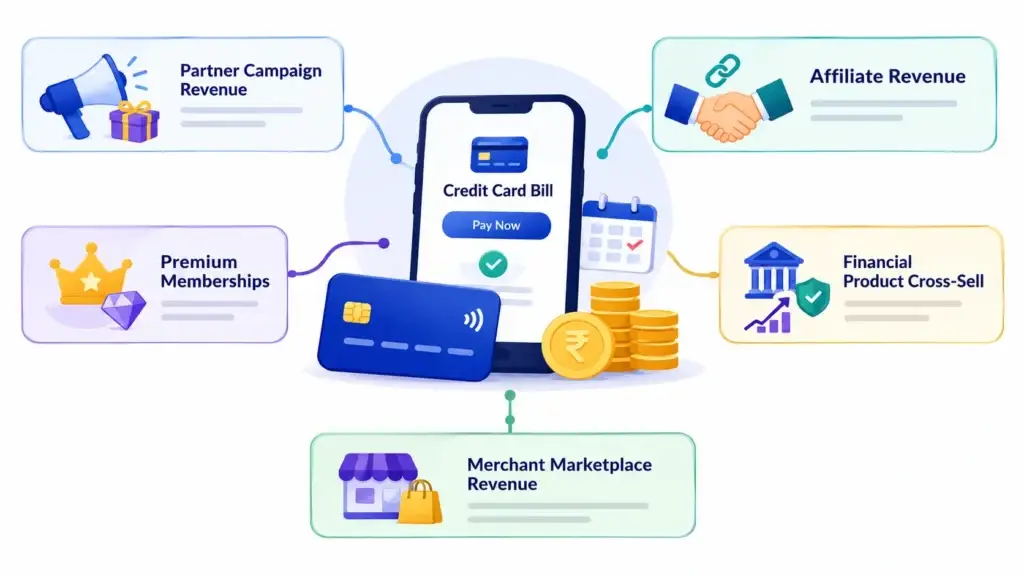
A credit card bill payment app should not rely on one revenue stream. The strongest model usually combines several monetization layers.
Before choosing rewards, partner offers, premium plans, or affiliate revenue streams, founders should map the revenue model for a rewards-based fintech platform so the product is built around sustainable engagement instead of short-term user acquisition only.
Partner Campaign Revenue
Brands may pay for visibility, sponsored offers, voucher placements, or campaign participation. This works best when the platform has a clear user segment and strong engagement.
Affiliate Revenue
The app can earn revenue by referring users to financial products, cards, loans, insurance, subscriptions, or partner services. This should be handled carefully and transparently.
Premium Memberships
A premium plan can offer exclusive rewards, advanced insights, priority support, better offers, or higher reward limits. This model works when users clearly see added value.
Financial Product Cross-Sell
Once users trust the platform, the business can introduce relevant financial products through approved partners. This may include loans, credit products, insurance, or investment-related services depending on the market and legal structure.
Merchant Marketplace Revenue
A redemption marketplace can generate revenue through commissions, listing fees, promotional placements, or campaign partnerships.
Security Layers Founders Should Plan Early
Fintech trust is built through security, transparency, and operational control. Security should be planned from the beginning instead of added after launch.
Important security layers include:
- Encrypted data transfer
- Encrypted data storage
- Secure payment gateway integration
- Tokenized payments where applicable
- Role-based access control
- Admin audit logs
- Transaction monitoring
- Suspicious activity flags
- User verification workflows
- Secure API integrations
- Permission-based dashboards
- Privacy-conscious data handling
- Dispute and refund records
Founders should also plan legal and compliance review based on the launch region. The platform can support compliance workflows, but final compliance depends on jurisdiction, integrations, legal requirements, and business operations.
Speed
A ready-made fintech foundation may help you launch faster when your core requirement is bill payments, rewards, admin control, and branded user experience.
Cost
Pricing should be based on integrations, reward logic, app platforms, admin dashboard depth, and security needs rather than a generic package name.
Scalability
Plan for billing-cycle traffic, notification loads, transaction callbacks, reward calculations, payment status updates, and reporting before launch.
Market Fit
Start with a clear user segment, such as premium credit card users, reward seekers, or multi-card users, instead of trying to serve everyone from day one.
Common Mistakes Founders Should Avoid
Building Rewards Without Cost Control
Rewards can improve retention, but they can also damage margins if the rules are not controlled. Founders should define reward limits, expiry rules, campaign budgets, and eligibility conditions from the start.
Treating the Admin Dashboard as an Afterthought
The admin panel controls the business. Without a strong admin dashboard, the operator may struggle to manage users, offers, refunds, disputes, and reporting after launch.
Adding Too Many Financial Products Too Early
Lending, insurance, and premium financial products can create revenue opportunities, but they also increase compliance, partnership, and operational complexity. Founders should first validate the core payment and rewards loop.
Ignoring Payment Failure Scenarios
Payment failures are unavoidable. The app must explain pending payments, failed transactions, refunds, and support status clearly. Poor payment communication can quickly damage user trust.
Copying a Popular App Without a Market Angle
A successful credit bill payment platform needs a clear user segment, reward strategy, partner network, and monetization plan. Copying surface-level features is not enough.
How Miracuves Helps Founders Build Faster
Miracuves helps founders build launch-ready fintech platforms with white-label branding, source-code ownership, admin dashboards, scalable backend workflows, and customization support.
For a credit card bill payment app, Miracuves can help founders plan the product around user payments, reward logic, transaction history, admin control, partner offers, and monetization workflows. The goal is not to copy another product blindly. The goal is to launch with a strong foundation and adapt it to the founder’s market, brand, and business model.
Founders can explore Miracuves’ credit-card rewards and banking app solutions to understand how a ready-made fintech foundation can support faster execution.
Final Thoughts
A credit card bill payment app is not just a transaction product. It is a recurring engagement platform built around payments, rewards, reminders, financial visibility, and user trust.
For founders, the right question is not only “How much does it cost?” The better question is: which features are essential for launch, which integrations are required, which reward rules are sustainable, and which admin controls are needed to operate the business confidently?
A ready-made fintech foundation from Miracuves can help founders move faster while still allowing room for branding, customization, monetization, and long-term product expansion.
FAQs
What are the most important features of a credit card bill payment app?
The most important features include secure login, card management, bill reminders, payment flow, transaction history, rewards, partner offers, referral system, support workflows, and an admin dashboard.
How much does it cost to build a credit card bill payment app?
The cost depends on app platforms, payment integrations, reward engine complexity, credit data integrations, admin dashboard depth, security requirements, UI design, and customization scope. The final quote should be confirmed after defining the required modules.
Can a credit card bill payment app include rewards and cashback?
Yes. The app can include reward points, coins, cashback, vouchers, referral bonuses, and partner offers. The reward rules should be configurable from the admin dashboard so the business can control campaign costs.
What payment integrations are needed for a bill payment platform?
Required integrations depend on the launch country and business model. A platform may need payment gateway integration, bill payment rails, refund workflows, transaction status callbacks, and reconciliation reporting.
How does a credit card bill payment app make money?
Common monetization models include partner campaigns, affiliate revenue, premium memberships, financial product referrals, marketplace commissions, sponsored offers, and value-added services.
Is security important for a credit card payment app?
Yes. Security is essential because the platform handles sensitive user, payment, and transaction data. Important layers include encryption, secure APIs, tokenized payments where applicable, audit logs, admin access control, and transaction monitoring.
Should founders build from scratch or use a ready-made fintech foundation?
Custom development offers flexibility but usually takes more planning, budget, and time. A ready-made foundation can help founders launch faster when the core workflows are already defined and only need branding, integrations, and customization.
Can Miracuves customize a credit card bill payment app for my market?
Yes. Miracuves can help customize the app experience, branding, payment workflows, admin controls, reward rules, partner modules, and monetization logic based on the founder’s target market and launch scope.
Miracuves is an independent software development company. We are not affiliated with, connected to, sponsored by, or endorsed by any company or product named in this article.
Terms such as “X Clone” are used descriptively. It is how the software industry refers to building a platform with functionality comparable to a known service, and how clients search for it.
The entire design and codebase of our products is built by our own team. Our products contain no code, design, graphics, or content originating from any third-party website or applications.
All third-party names and marks referenced in this article are the property of their respective owners, referenced solely to identify the services discussed.