

Key Takeaways
- What is CRED and how does it work can be understood through a simple flow: users link credit cards, track bills, receive reminders, make payments, earn rewards, redeem offers, and return through recurring engagement loops.
- A credit card bill payment platform combines bill management, payment execution, rewards, partner offers, credit insights, and user engagement within one experience.
- The real product complexity sits behind onboarding, card verification, bill fetching, payment confirmation, reward calculations, fraud checks, and redemption logic.
- Rewards, streaks, credit insights, personalized offers, and reminders help turn a monthly financial task into a repeat user habit.
- Long-term trust depends on secure authentication, transparent payment status, controlled reward logic, consent workflows, fraud monitoring, and strong admin controls.
User Journey Signals
- The typical journey follows: signup → eligibility → card linking → bill detection → reminder → payment → confirmation → reward → redemption → retention.
- Payment states should distinguish initiated, pending, successful, failed, reversed, and refunded transactions instead of relying on a simple success-or-failure model.
- Reward engines should track earning rules, expiry, reversals, promotional credits, redemption inventory, fraud checks, and reward liability.
- Partner offers can increase perceived user value while supporting promotional, affiliate, campaign, or performance-based revenue opportunities.
- Credit insights and utilization alerts can deepen engagement by helping users understand financial behavior beyond simply paying a bill.
Real Insights
- A bill payment product becomes more valuable when it solves recurring financial management rather than acting as a one-time payment utility.
- Security should be built into card handling, payment APIs, user verification, admin permissions, activity logs, and financial data workflows from the beginning.
- A reward system can become expensive if points, cashback, vouchers, campaign rules, and reversals are not financially controlled.
- Admin control is essential because payment issues, reward campaigns, partner offers, fraud flags, user tiers, and support cases change continuously.
- The strongest product loop is: bill visibility → timely payment → reliable confirmation → meaningful reward → useful insight → recurring monthly engagement.
Credit card bill payment and rewards apps became popular because they solved a real user problem: people often manage multiple cards, multiple due dates, changing statement cycles, reward points, spending patterns, and payment reminders across different banking apps.
A credit card bill payment platform brings these actions into one experience. Users can add their cards, track upcoming bills, receive reminders, pay on time, earn rewards, monitor credit behavior, and discover partner offers. For founders, the appeal is clear: the model combines recurring user activity with financial discipline, gamification, brand partnerships, and high-intent fintech engagement.
But building this type of product is not just about adding a payment button and a reward screen. The real product logic sits behind onboarding, card verification, bill fetching, payment confirmation, reward calculation, fraud checks, offer redemption, and long-term user retention.
This guide explains what is CRED and how does it work, how the user journey is structured, what trust layers are required, and how engagement loops keep users returning after the first payment.
What Is a Credit Card Bill Payment and Rewards App?
A credit card bill payment and rewards app is a fintech platform that helps users manage credit card bills and earn rewards for financial actions. Instead of checking different bank apps, users can view due dates, bill amounts, reminders, payment options, and reward opportunities in one interface.
The app usually includes three connected layers.
The first layer is bill management. Users add credit cards, track payment due dates, and receive reminders before the bill becomes overdue.
The second layer is payment execution. Users pay their card bills through supported payment rails such as UPI, bank transfer, card payment, wallet, or other local payment methods depending on the market.
The third layer is engagement and rewards. Users receive points, cashback, coins, vouchers, partner discounts, or tier-based benefits for paying bills, maintaining streaks, referring friends, or interacting with offers.
For founders, this model is powerful because bill payments create recurring behavior. Credit card bills return every month, which gives the platform a natural reason to bring users back.
Why These Apps Are More Than Payment Utilities
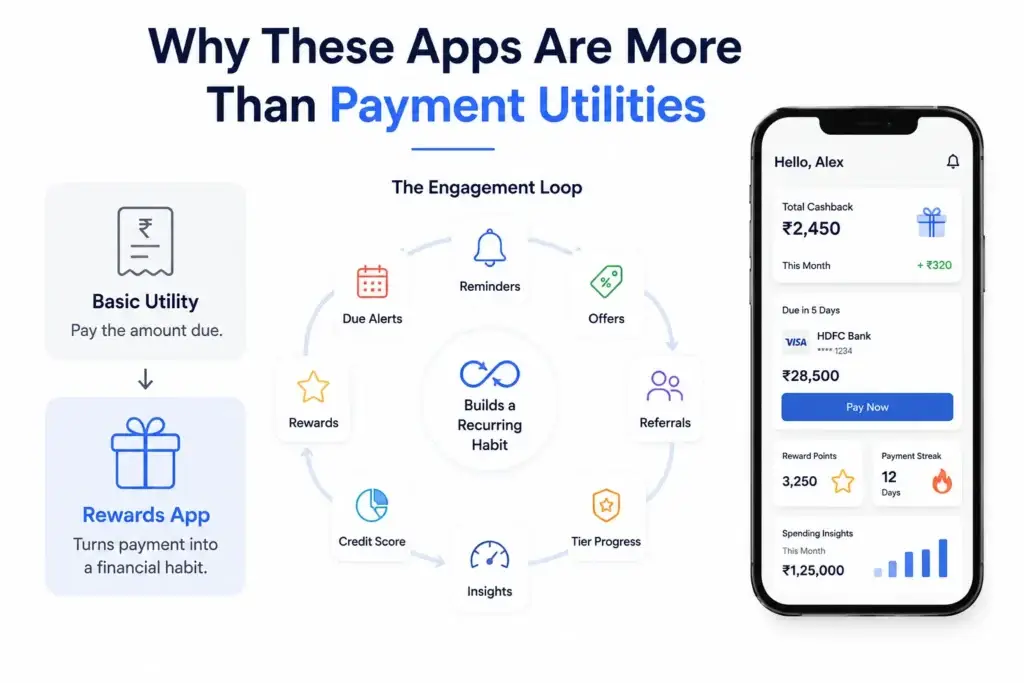
A basic bill payment utility solves one task: pay the amount due.
A modern credit card rewards app does more. It turns a routine payment into a financial engagement loop.
That loop may include:
- Card bill reminders
- Due date alerts
- Credit utilization insights
- Payment streaks
- Reward points
- Cashback offers
- Partner deals
- Referral bonuses
- Tier progression
- Credit score visibility
- Spending insights
- Personalized financial nudges
This is why the category is attractive to fintech founders. The app does not depend only on one-time transactions. It can become a recurring financial habit.
The stronger the habit, the better the retention potential.
Core User Journey of a Credit Card Bill Payment Platform
A strong product experience should feel simple to the user, even when the backend is complex.
The typical user journey looks like this:
| Stage | User Action | Platform Logic |
|---|---|---|
| Signup | User enters mobile number or email | Account creation and authentication |
| Eligibility | User profile is checked | Risk, credit profile, or membership rule is applied |
| Card Linking | User adds one or more cards | Card details are stored securely or tokenized through approved workflows |
| Bill Detection | Platform fetches or records bill details | Due date, amount, issuer, and payment status are updated |
| Reminder | User receives alerts before due date | Notification jobs trigger based on card cycle |
| Payment | User initiates bill payment | Gateway, UPI, bank, or payment rail flow begins |
| Confirmation | Payment status is verified | Success, pending, failed, or reversed status is recorded |
| Reward | User earns points, coins, or cashback | Reward engine calculates eligible benefit |
| Redemption | User redeems rewards | Catalog, inventory, ledger, and partner rules are updated |
| Retention | User receives insights and offers | Personalization keeps the loop active |
This flow shows why a credit card bill payment app is not just a frontend product. It needs a strong backend, payment status handling, reward ledger, notification system, and admin console.
Step 1: User Onboarding and Eligibility
Onboarding is the first trust moment.
A fintech rewards app may ask users to provide:
- Mobile number
- Email address
- Name
- Date of birth
- PAN or national identity details where required
- Credit score consent
- Payment method details
- Basic profile preferences
Some platforms use eligibility logic to create a premium or trusted user base. This may include credit score checks, identity verification, or invitation-based access depending on the business model.
From a founder’s perspective, onboarding should balance two goals.
The first goal is conversion. If onboarding is too long, users may drop off.
The second goal is trust. If onboarding is too loose, the platform may face fraud, abuse, fake accounts, or reward manipulation.
A practical onboarding flow should collect only what is needed for the current stage, then unlock deeper features after verification.
Step 2: Card Linking and Card Vault Logic
The card vault is where users manage their credit cards.
A useful card management layer may include:
- Card issuer
- Last four digits
- Card type
- Billing cycle
- Due date
- Total outstanding amount
- Minimum amount due
- Available credit
- Credit limit
- Payment status
- Auto-reminder settings
- Card nickname
- Statement history
For security, card data should be handled carefully. Sensitive data should not be stored casually. Tokenization, encrypted storage, secure API integration, role-based access control, and permission-based dashboards are important when payment and financial records are involved.
The goal is to give users a clear view of their cards without exposing the platform to unnecessary data risk.
Step 3: Bill Fetching, Due Date Tracking, and Reminder Logic
Bill reminder logic is one of the most important retention drivers.
Choosing the right development partner matters because this type of product is not only a fintech interface. It requires payment logic, reward rules, admin controls, user verification, secure data handling, and engagement workflows. Founders comparing vendors can use this guide on selecting a credit card bill payment app development company to evaluate technical fit and launch readiness.
A user may install the app for rewards, but they continue using it because it helps avoid missed due dates.
The reminder system should account for:
- Statement generation date
- Payment due date
- Grace period
- Minimum payment due
- Full payment amount
- Reminder frequency
- User notification preference
- Payment status
- Failed payment retry
- Autopay rules where available
Useful reminders include:
- “Your bill is due in 7 days”
- “Your bill is due tomorrow”
- “Payment pending confirmation”
- “Payment successful”
- “Reward unlocked”
- “Your card utilization is higher than usual”
The strongest bill payment platforms do not only notify users. They help users take action at the right time.
Step 4: Payment Initiation and Status Handling
Payment logic must be reliable because users trust the app with financial actions.
A payment flow usually includes:
- User chooses card bill
- Platform generates payable amount
- User selects payment method
- Payment gateway or payment rail is triggered
- Payment request is created
- Payment status is verified
- Ledger entry is created
- User and admin records are updated
- Reward eligibility is calculated
Payment states should be clear.
| Payment Status | Meaning | Why It Matters |
| Initiated | User has started payment | Prevents duplicate payment confusion |
| Pending | Payment is waiting for confirmation | Handles delayed gateway responses |
| Successful | Payment is confirmed | Unlocks receipt, card update, and reward logic |
| Failed | Payment did not go through | Allows retry and support clarity |
| Reversed | Payment was returned or cancelled | Keeps financial records accurate |
| Refunded | Eligible amount was returned | Supports dispute and correction workflows |
Founders should avoid treating payment as a single “success or failure” event. Fintech payment systems often need pending, retry, reconciliation, and dispute handling.
Step 5: Reward Engine and Points Economy
Rewards are the emotional hook of the product.
A reward engine may calculate benefits based on:
- Bill amount
- Payment timeliness
- Payment streak
- Card type
- User tier
- Referral activity
- Partner campaign
- App engagement
- Cashback eligibility
- Promotional rules
- Risk status
- Fraud checks
A good reward system should feel exciting to users, but it must remain financially controlled for the business.
Important reward engine rules include:
- Define when points are earned
- Define when points expire
- Prevent duplicate reward credit
- Track reward reversals
- Connect redemptions to inventory
- Limit abuse from fake referrals
- Separate promotional credits from real cash liabilities
- Maintain an append-only reward ledger
- Allow admin review for suspicious activity
A weak rewards system can become expensive quickly. Founders should design the points economy before launch, not after users start earning benefits.
Step 6: Offer Marketplace and Partner Redemption
Many credit card rewards apps use partner offers to create perceived value.
Partner offers may include:
- Shopping vouchers
- Food delivery discounts
- Travel deals
- Lifestyle brand offers
- Subscription discounts
- Wellness benefits
- Event access
- Cashback campaigns
- Card-linked offers
- Premium brand deals
The platform may earn from partner promotions, affiliate commissions, featured placements, campaign fees, or increased transaction volume.
But the offer marketplace should be curated. If users see low-quality or irrelevant offers, engagement drops. The strongest offer marketplace connects rewards with user profile, spending behavior, location, interest, and tier.
Step 7: Credit Score and Financial Insight Layer
Credit score visibility can make a bill payment app more useful.
Users may want to understand:
- Credit score trend
- Utilization ratio
- Payment history impact
- Open credit lines
- Risk factors
- Card-wise usage
- Score improvement tips
- Credit behavior alerts
For founders, this feature creates higher trust and deeper engagement. Instead of only asking users to pay bills, the app helps them understand financial behavior.
However, credit data handling must be careful. Access to bureau data, score refresh rules, user consent, privacy controls, and jurisdiction-specific compliance requirements should be planned with legal and technical teams.
Use safe language in the product: the app can help users view or understand credit behavior, but it should not guarantee score improvement.
Step 8: Gamification and Engagement Loops
Gamification helps turn a monthly payment action into a habit.
Useful engagement mechanics include:
- Payment streaks
- Tier progression
- Reward unlocks
- Referral milestones
- Spin-wheel or campaign-based rewards
- Leaderboards where appropriate
- Achievement badges
- Limited-time partner offers
- Personalized nudges
- Weekly financial insights
- Budget alerts
- Card utilization alerts
The goal is not to add games randomly. The goal is to connect engagement to useful financial behavior.
For example:
- Paying before the due date extends a streak.
- Keeping utilization below a threshold unlocks an educational nudge.
- Referring a verified user earns bonus points.
- Redeeming a partner offer moves the user toward a tier benefit.
Gamification works best when users feel rewarded for responsible actions, not distracted from financial decisions.
Step 9: Admin Console and Operator Control
The admin console is where the platform operator manages the system.
A fintech rewards platform may need admin control over:
- Users
- KYC or verification status
- Linked cards
- Payment records
- Failed payments
- Reward rules
- Reward inventory
- Offer partners
- Cashback campaigns
- Referral rules
- Fraud flags
- Support tickets
- Notifications
- User tiers
- Reports and analytics
- Role-based access
Admin control matters because fintech operations change often. Reward campaigns change. Partners change. Compliance workflows change. Support issues appear. Payment disputes need review.
If every small update requires developer involvement, the platform becomes hard to operate.
A strong operator console lets the business team manage campaigns, monitor payment health, review users, update offers, and track reward liability without rebuilding the product every week.
Founder Decision Signals Before Building This Type of App
Trust
If users are sharing financial and payment behavior, the product must prioritize secure authentication, clear consent, payment records, and privacy-conscious workflows.
Engagement
If the app only reminds users to pay bills, retention may be limited. Rewards, streaks, insights, and partner offers help create repeat usage.
Monetization
If the reward economy is not planned carefully, cashback and points can become a cost center instead of a growth engine.
Operations
If the admin console cannot manage users, payments, rewards, offers, and support workflows, the product becomes difficult to scale.
Trust Logic: What Makes Users Feel Safe?
Trust is the foundation of any credit card bill payment platform.
Credit card bill payment platforms sit close to banking, insurance, payments, credit behavior, and financial trust. Founders building in this space should think carefully about user verification, payment security, activity logs, consent flows, and admin access controls. Miracuves’ banking and insurance app solutions page can help connect this product model to broader fintech industry workflows.
Users are sharing financial behavior, payment actions, card details, due dates, identity information, and sometimes credit score consent. That means the app must feel secure from the first screen.
Important trust layers include:
- Secure authentication
- OTP or multi-factor login
- Biometric login where supported
- Encrypted data transfer
- Encrypted data storage
- Tokenized payment data
- Role-based admin access
- Activity logs
- Fraud monitoring
- Payment reconciliation
- Clear consent screens
- Privacy-conscious data handling
- Secure API integration
- User-controlled notification settings
- Transparent reward rules
Trust is not created only by saying “secure.” It is created through clear flows, visible confirmations, transparent records, and strong backend controls.
Core Feature Checklist for a Credit Card Bill Payment Platform
A strong bill payment product needs more than one payment screen. It needs card management, due-date reminders, payment status tracking, rewards, partner offers, credit insights, admin controls, and security workflows working together. Founders who want to compare these modules in more detail can review the key credit card rewards app features before finalizing their product scope.
Credit Card Bill Payment Platform Feature Checklist
| Feature | Business Value | Founder Impact |
|---|---|---|
| User onboarding | Creates the first trust and eligibility layer | Improves activation while managing risk |
| Card vault | Lets users manage multiple credit cards in one place | Improves repeat usage and product stickiness |
| Bill reminders | Helps users avoid missed due dates | Creates recurring monthly engagement |
| Payment gateway integration | Enables bill payments through supported rails | Turns the app into a transaction platform |
| Payment status tracking | Shows pending, successful, failed, and reversed payments | Reduces user confusion and support load |
| Reward engine | Calculates points, cashback, streaks, and campaign rewards | Drives engagement and user retention |
| Offer marketplace | Connects users with partner deals and redemption options | Creates monetization opportunities |
| Credit insight layer | Helps users understand utilization, score trends, and payment behavior | Improves trust and financial usefulness |
| Admin console | Controls users, rewards, payments, offers, partners, and reports | Gives the operator business control |
| Security controls | Supports authentication, access control, logs, and secure payment handling | Protects the platform as fintech activity scales |
Business Model: How These Apps Can Make Money
A credit card bill payment and rewards platform can monetize through multiple channels.
Founders also need to connect revenue strategy with product architecture. A credit and rewards platform may need commission settings, partner offer controls, premium membership tiers, campaign dashboards, and reward liability tracking. To understand how these revenue layers can be structured inside the product, explore the credit and rewards platform business model.
The monetization layer should be planned before development begins. Partner offers, premium memberships, payment-related fees, referral revenue, merchant campaigns, and financial product partnerships all require different backend controls. For a deeper informational breakdown, read this guide on the rewards fintech business model.
Common revenue streams include:
| Revenue Stream | How It Works | Founder Consideration |
| Partner offers | Brands pay for visibility or performance | Works when user base is attractive to partners |
| Payment-related fees | Convenience or service fee on selected flows | Must be transparent and compliant |
| Premium membership | Users pay for exclusive benefits | Needs strong perceived value |
| Lending partnerships | Qualified users access credit products | Requires careful compliance and partner agreements |
| Insurance or financial product referrals | Platform earns referral or distribution revenue | Must be transparent and suitable |
| Subscription plans | Users or partners pay for premium tools | Works when platform offers recurring value |
| Merchant campaigns | Brands run targeted offers | Requires strong segmentation and reporting |
| Data insights | Aggregated, privacy-conscious trends | Must avoid misuse of personal data |
The most sustainable model is not the one with the most fees. It is the one where users, partners, and the platform all receive clear value.
Mistakes Founders Should Avoid
Building Only the Payment Flow
A bill payment app needs more than checkout. Card management, reminders, payment status tracking, rewards, support, and admin controls are equally important for retention.
Ignoring Reward Liability
Rewards feel exciting to users, but every point, voucher, or cashback promise has a business cost. Founders should define limits, expiry rules, reversal logic, and inventory controls early.
Making Security an Afterthought
Fintech users expect secure authentication, encrypted records, transparent payment history, and clear consent. Weak security planning can damage trust quickly.
Depending on Manual Campaign Management
Reward campaigns, partner offers, user tiers, and notification rules should be manageable from an admin console. Manual updates slow down growth.
Build From Scratch or Start With a Ready-Made Fintech Foundation?
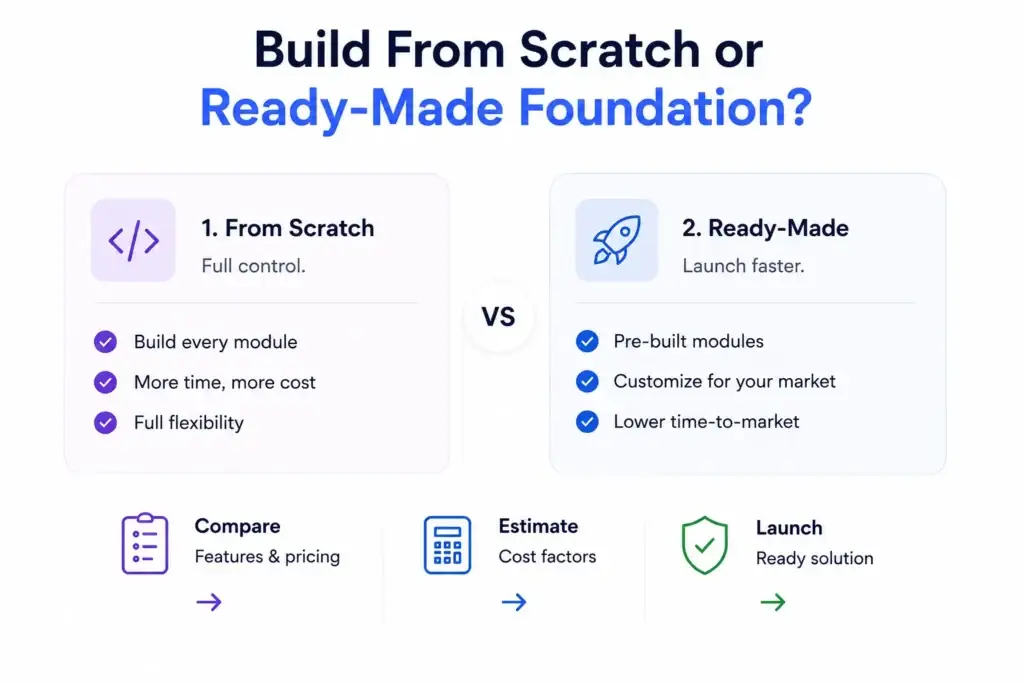
Founders usually have two paths.
The first path is custom development. This gives full control, but it also means the team must plan every module from zero: onboarding, card vault, bill reminders, payment status, reward rules, partner offers, credit insights, admin controls, notification jobs, and security workflows.
Some founders may want to compare ready-made product scope before deciding whether to build every module from zero. In that case, this ready-made fintech app feature and pricing guide can help evaluate available modules, pricing logic, and launch considerations.
The second path is starting with a ready-made fintech foundation and customizing it for the target market. This can make sense when the goal is to launch faster, validate demand, and focus on brand positioning, partnerships, payment rails, and reward strategy instead of rebuilding common fintech modules.
Development scope changes quickly when a fintech rewards app includes card vaults, bill reminders, payment gateway integrations, reward ledgers, offer marketplaces, referral flows, credit insights, and operator dashboards. Founders estimating budget can explore these fintech rewards app development cost factors to understand how features, integrations, security, and customization affect the final build.
For founders who want to explore a launch-ready product foundation, Miracuves offers a credit and rewards app solution with member flows, bill payment logic, reward systems, and operator controls that can be customized for your business model.
Miracuves Perspective: Build the Trust Layer Before the Growth Layer
A credit card bill payment platform succeeds when users trust it enough to return every billing cycle. That trust comes from accurate reminders, clear payment status, secure records, transparent reward rules, and a smooth redemption experience.
Miracuves helps founders create fintech app solutions with ready-made workflows, white-label branding, admin dashboards, payment integration support, reward logic, and source-code ownership. Instead of treating bill payment, credit insights, and rewards as separate features, founders can build them as one connected engagement system.
The strongest product is not the one with the most reward screens. It is the one where the user understands what to do next, feels safe making a payment, sees value after the transaction, and has a reason to come back next month.
Final Thoughts
Credit card bill payment and rewards apps work because they connect a practical financial task with a strong engagement loop. Users need reminders, payment convenience, card visibility, credit insights, and transparent records. Rewards, offers, tiers, streaks, and partner deals make that financial behavior more engaging.
For founders, the real product challenge is not copying a popular fintech interface. It is building the logic behind trust, payments, rewards, compliance-ready workflows, and operator control.
A strong credit card bill payment platform should help users act on time, feel secure, understand their financial behavior, and receive meaningful value after each transaction. When those layers work together, the app becomes more than a payment utility. It becomes a recurring fintech habit.
Founders who want to launch faster may not need to rebuild every fintech workflow from zero. A structured product foundation can help reduce development friction while still allowing customization around payments, rewards, branding, integrations, and user engagement. Miracuves’ clone app development services support businesses that want a faster path from concept to launch-ready digital product.
FAQs
What is a credit card bill payment platform?
A credit card bill payment platform is a fintech app that helps users add credit cards, track due dates, pay bills, receive reminders, monitor payment status, and earn rewards or cashback through one digital experience.
How do credit card bill payment and rewards apps work?
They usually work through user onboarding, card linking, bill tracking, payment initiation, payment confirmation, reward calculation, offer redemption, and ongoing engagement through reminders, credit insights, and personalized offers.
Why do bill payment apps offer rewards?
Rewards encourage users to return every billing cycle. They also create engagement, support partner promotions, increase payment volume, and help the platform build loyalty around a routine financial action.
What features should a credit card payment app include?
Important features include user onboarding, card vault, bill reminders, payment gateway integration, payment status tracking, reward engine, offer marketplace, credit score or credit behavior insights, referral system, admin console, and security controls.
How can a fintech rewards app make money?
A fintech rewards app can earn through partner campaigns, offer placements, premium subscriptions, lending partnerships, payment-related service fees, merchant promotions, referral revenue, and value-added financial products.
What security features are important for this type of app?
Important security layers include secure authentication, encrypted data transfer, encrypted storage, role-based access control, audit logs, tokenized payments, fraud monitoring, secure API integration, and clear user consent workflows.
Should founders build this platform from scratch?
Custom development can work when the founder needs a unique product model, unusual integrations, or deep control. A ready-made fintech foundation can be better when the goal is faster validation with core modules already structured.
How does the rewards engine work in a bill payment app?
A rewards engine calculates points, cashback, coins, tiers, or vouchers based on payment activity, campaign rules, user tier, referral activity, partner offers, and fraud checks. It should also track expiry, reversals, redemption inventory, and reward history.
Miracuves is an independent software development company. We are not affiliated with, connected to, sponsored by, or endorsed by any company or product named in this article.
Terms such as “X Clone” are used descriptively. It is how the software industry refers to building a platform with functionality comparable to a known service, and how clients search for it.
The entire design and codebase of our products is built by our own team. Our products contain no code, design, graphics, or content originating from any third-party website or applications.
All third-party names and marks referenced in this article are the property of their respective owners, referenced solely to identify the services discussed.