Key Takeaways
What You’ll Learn
- Blinkit is a quick commerce app that delivers groceries and essentials within minutes.
- Users place orders instantly through a simple app with real-time tracking and fast checkout.
- Dark stores and delivery partners power rapid fulfillment in local areas.
- Digital payments enable seamless and cashless transactions.
- Hyperlocal operations are the key to scaling quick delivery services efficiently.
Stats That Matter
- Blinkit operates across multiple major Indian cities with rapid delivery networks.
- India’s quick commerce market is growing rapidly and expected to reach multi-billion dollar scale.
- Instant grocery delivery is becoming a daily habit for urban consumers.
- High-frequency orders drive consistent revenue in this model.
- Quick commerce platforms are becoming a core part of urban convenience.
Real Insights
- Speed wins when groceries are delivered in minutes, not hours.
- Successful platforms optimize inventory, logistics, and delivery routing.
- Real-time tracking builds trust and repeat usage.
- Location-based fulfillment is critical for quick commerce success.
- Growth depends on operational efficiency and delivery consistency.
The rapid rise of quick commerce has transformed how people buy groceries. Apps like Blinkit have set new expectations—customers now expect essentials delivered in minutes, not hours. For startups and entrepreneurs, this creates a strong opportunity to enter a high-demand market.
However, building a grocery delivery app like Blinkit is not just about creating an app—it’s about designing a system that balances speed, logistics, user experience, and scalability.
In this guide, we’ll break down how to build a grocery delivery app like Blinkit, including its core features, working model, development process, and key decisions you need to make before starting.
Planning to build in this space? Miracuves offers a ready-made Q-Commerce grocery delivery platform that you can launch under your own brand.
Understanding the Blinkit Business Model
Before building the app, it’s important to understand how platforms like Blinkit operate.
Key Components of the Model
- Dark Stores / Micro Warehouses
Small fulfillment centers located close to customers for faster delivery. - Real-Time Inventory Management
Inventory is updated dynamically to avoid stock issues. - Hyperlocal Delivery Network
Delivery partners operate within small geographic zones. - Fast Checkout & Minimal Friction
Simplified UX ensures users can place orders in seconds.
How a Grocery Delivery App Like Blinkit Works
A typical workflow looks like this:
- User opens the app and enters location
- The app displays available products based on nearby warehouses
- User adds items to cart and places an order
- Warehouse staff picks and packs items
- Delivery partner picks up the order
- Order is delivered within minutes
This system depends heavily on real-time coordination between multiple components, not just the app interface.
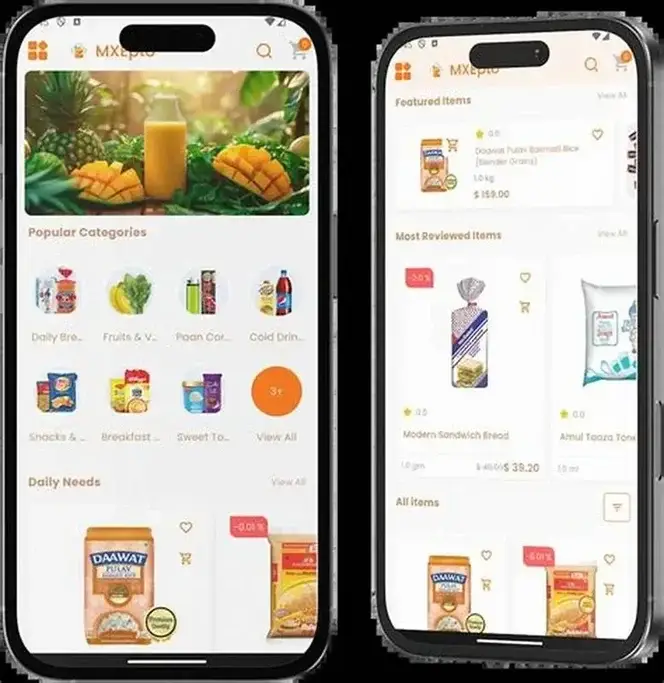
Essential Features of a Grocery Delivery App
To build a competitive platform, you need to focus on three main panels:
1. User App Features
- Easy registration and login
- Smart product search and filters
- Real-time product availability
- Cart and instant checkout
- Multiple payment options
- Live order tracking
- Push notifications
2. Delivery Partner App Features
- Order assignment and navigation
- Route optimization
- Earnings dashboard
- Status updates (picked, delivered)
3. Admin Panel Features
- Inventory and warehouse management
- Order tracking and control
- Delivery partner management
- Analytics and reporting
- Pricing and discount controls
Key Technologies Required
Choosing the right tech stack ensures scalability and performance.
| Component | Recommended Technology |
|---|---|
| Frontend (App) | Flutter / React Native |
| Backend | Node.js / Laravel |
| Database | PostgreSQL / MongoDB |
| Real-Time Tracking | Firebase / WebSockets |
| Maps & Navigation | Google Maps API |
| Payments | Stripe / Razorpay |
| Cloud Hosting | AWS / Google Cloud |
Step-by-Step Process to Build a Grocery Delivery App
Step 1: Define Your Business Model
Decide whether you want:
- Inventory-based (own warehouses)
- Marketplace-based (partner with stores)
- Hybrid model
Step 2: Market Research and Target Audience
Understand:
- Your target city or region
- Customer buying behavior
- Competitor gaps
Step 3: Design User Experience (UX/UI)
Focus on:
- Minimal clicks to checkout
- Fast loading interface
- Clear product categorization
Step 4: Develop Core Features (MVP First)
Start with:
- Product listing
- Cart system
- Order placement
- Delivery tracking
Avoid building everything at once—launch a lean version first.
Step 5: Integrate Real-Time Systems
This includes:
- Live inventory sync
- Delivery tracking
- Order status updates
Step 6: Testing and Optimization
- Test app speed under load
- Ensure accurate delivery tracking
- Fix UI/UX friction points
Step 7: Launch and Scale
- Start with one city
- Optimize operations
- Expand gradually
Challenges You Must Be Ready For
Building a Blinkit-like app comes with operational complexity.
Common Challenges
- Managing real-time inventory accurately
- Ensuring ultra-fast delivery timelines
- Handling peak-hour demand
- Optimizing delivery routes
- Maintaining consistent user experience
Practical Insight
The biggest challenge is not app development—it’s logistics execution. Even a perfectly built app fails without strong backend operations.
Best Practices for Building a Successful Grocery Delivery App
Focus on Speed First
Your app must feel fast—both technically and operationally.
Start Hyperlocal
Launch in a small area before scaling.
Optimize Inventory Placement
Keep high-demand products closer to users.
Use Data for Decision Making
Track:
- Order frequency
- Popular products
- Delivery times
Monetization Strategies for Grocery Delivery Apps
To make your platform profitable, consider:
- Delivery fees
- Surge pricing during peak hours
- Subscription plans (free delivery benefits)
- Product markups
- Brand promotions and ads
If you’re planning to launch a grocery delivery platform, working with the right development partner can save months of effort and reduce risks.
Contact us to explore how Miracuves can help you build and launch a scalable, high-performance grocery delivery app tailored to your business goals.
Conclusion
Building a grocery delivery app like Blinkit is a combination of technology, logistics, and user experience. While the idea may seem simple, execution requires careful planning—from choosing the right business model to managing real-time operations.
The key is to start lean, focus on speed and reliability, and scale based on real-world performance.
FAQs
1. How long does it take to build a grocery delivery app like Blinkit?
It depends on complexity, but a basic version can be launched within weeks, while advanced platforms may take a few months.
2. Do I need warehouses to start?
Not necessarily. You can start with a marketplace model and later move to your own inventory system.
3. What is the most important feature?
Real-time inventory and fast delivery tracking are critical for user satisfaction.
4. Can I start with a single city?
Yes, and it’s recommended. Scaling gradually helps reduce risk.
5. Is this business profitable?
It can be, but profitability depends on operational efficiency, delivery optimization, and customer retention.
Related Article :
Miracuves is an independent software development company. We are not affiliated with, connected to, sponsored by, or endorsed by any company or product named in this article.
Terms such as “X Clone” are used descriptively. It is how the software industry refers to building a platform with functionality comparable to a known service, and how clients search for it.
The entire design and codebase of our products is built by our own team. Our products contain no code, design, graphics, or content originating from any third-party website or applications.
All third-party names and marks referenced in this article are the property of their respective owners, referenced solely to identify the services discussed.