


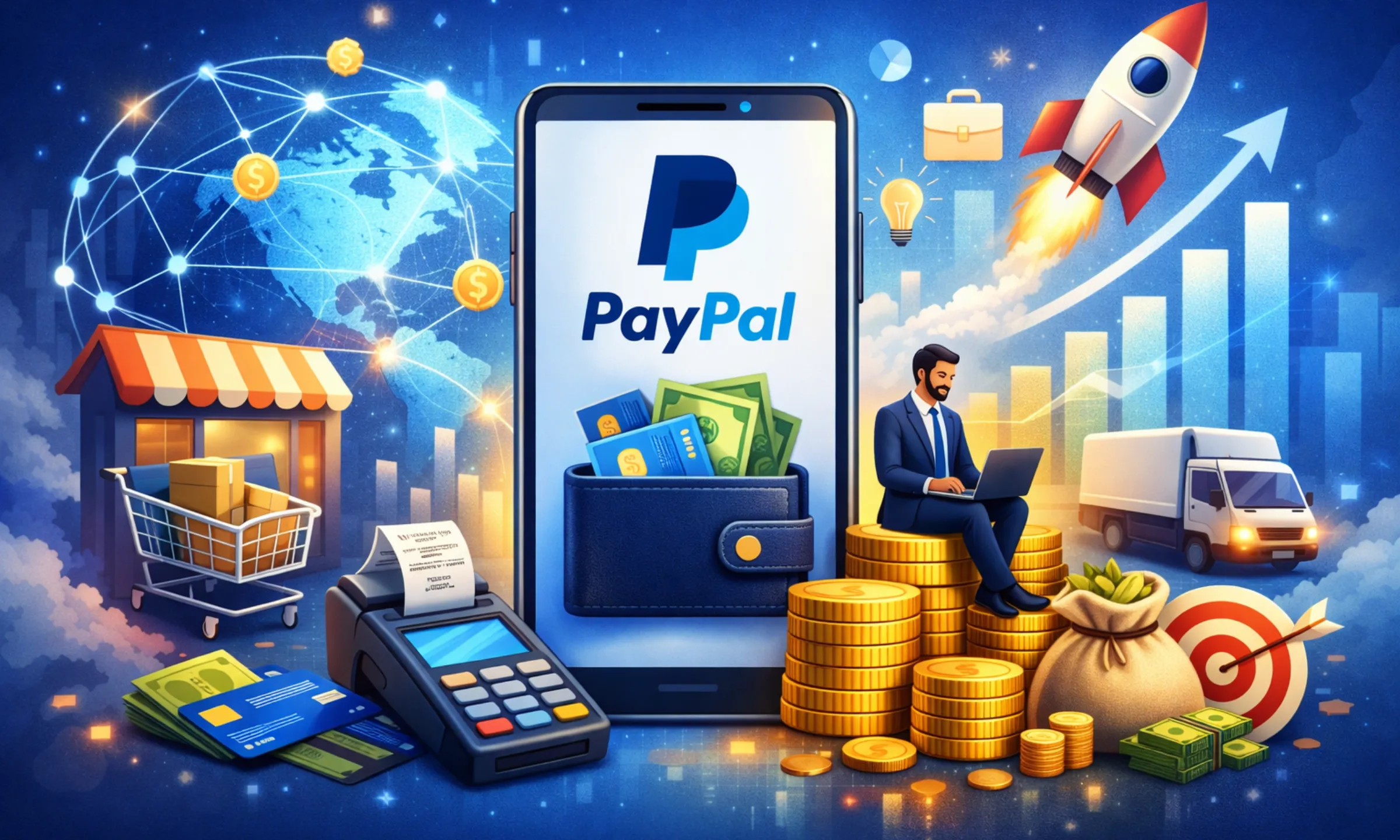
PayPal grew from an early online payments startup into a global fintech leader by making digital transactions feel simple, fast, and trusted. In 2026, its business model matters more than ever because consumers and businesses expect instant checkout, strong fraud protection, and cross-border payment options without friction.
The business model of PayPal works as a two-sided payment ecosystem connecting shoppers, merchants, platforms, and financial partners. Users get secure payments, buyer protection, and easy money transfers, while merchants gain higher conversion rates, faster settlements, and access to millions of active accounts. PayPal also strengthens its network through products like PayPal Checkout, Venmo, PayPal Credit, and merchant tools.
PayPal monetizes mainly through transaction fees charged to merchants, plus value-added services like currency conversion, cross-border fees, and financing. Its growth strategy focuses on improving checkout performance, expanding partnerships, and using risk + data systems to reduce fraud while increasing approval rates—creating a compounding advantage in the platform economy.
How the PayPal Business Model Works
PayPal runs a hybrid fintech platform model that combines payments infrastructure, digital wallets, merchant checkout, and embedded finance. At its core, PayPal sits between buyers and sellers, helping money move securely while reducing friction at checkout. In 2026, its strength is not just “sending money”—it’s becoming a complete payment layer that works across ecommerce, apps, subscriptions, and cross-border transactions.
Type of Model
- Hybrid model: Payment platform + wallet + merchant services
- B2C + B2B ecosystem: Consumers pay, merchants accept, platforms integrate
- Network-driven model: More users → more merchants → better conversion → more users
Value Proposition (By Segment)
For Consumers
- One-click checkout + saved cards
- Buyer protection + fraud monitoring
- Easy transfers (PayPal + Venmo where available)
For Merchants
- Higher checkout conversion (trusted brand)
- Faster payments + global acceptance
- Tools for refunds, disputes, recurring billing
For Partners (Platforms + Banks)
- APIs to embed payments inside apps
- Compliance + risk systems handled at scale
- Access to PayPal’s payment rails and identity layer
Key Stakeholders
- Consumers: Pay, store funds, send money
- Merchants: Accept payments, manage disputes
- Payment networks & banks: Process card/bank rails
- Regulators: KYC, AML, data compliance
- Partners: Ecommerce platforms, marketplaces, fintech apps
Evolution of the Model
- Started as online payments for ecommerce
- Expanded into mobile wallet + P2P
- Built merchant checkout dominance
- Added BNPL/credit, subscription tools, and fraud intelligence
- Shifted focus to branded checkout + unbranded processing + platform integrations
Why It Works in 2026
PayPal wins because modern commerce demands:
- Trust + security at scale
- Fast checkout on mobile
- Cross-border support
- Fraud prevention without blocking good customers
- API-first integrations for apps and marketplaces
Read More : What is PayPal and How Does It Work?
Target Market & Customer Segmentation Strategy
PayPal scales because it serves multiple customer groups at the same time—and each group strengthens the other. In 2026, the PayPal strategy is built around one simple idea: own the checkout moment while staying useful before and after the transaction (wallet, transfers, refunds, credit, subscriptions).
Primary Customer Segments
1) Online Shoppers (B2C)
- People who want fast checkout, trusted payments, and protection
- High intent users: frequent ecommerce buyers, cross-border shoppers
- Retention driver: saved payment methods + security confidence
2) Merchants (B2B)
- Ecommerce brands, D2C stores, service businesses
- Need: higher conversion, global payments, dispute handling
- Retention driver: stable payment performance + merchant tools
Secondary Customer Segments
3) Small Businesses & Freelancers
- Use PayPal for invoices, international payments, quick settlements
- Prefer low setup friction and brand trust
4) Platforms & Marketplaces
- Apps that embed payments through APIs
- Want scalable onboarding + compliance support
Customer Journey (Discovery → Conversion → Retention)
- Discovery: Search, app stores, referrals, merchant checkout pages
- Conversion: One-click PayPal button at checkout builds instant trust
- Retention: Repeat purchases + stored wallet + protection programs
- Expansion: Users adopt Venmo/P2P, Pay Later, subscriptions, credit
Acquisition Channels
- Merchant placement (PayPal button visibility)
- Partnerships with ecommerce platforms
- App-based usage loops (wallet + transfers)
- Performance marketing for merchant signups
Market Positioning
PayPal competes on trust + global scale + checkout performance. Its edge is the ability to reduce payment friction while managing fraud and compliance—helping merchants grow revenue, not just process transactions.
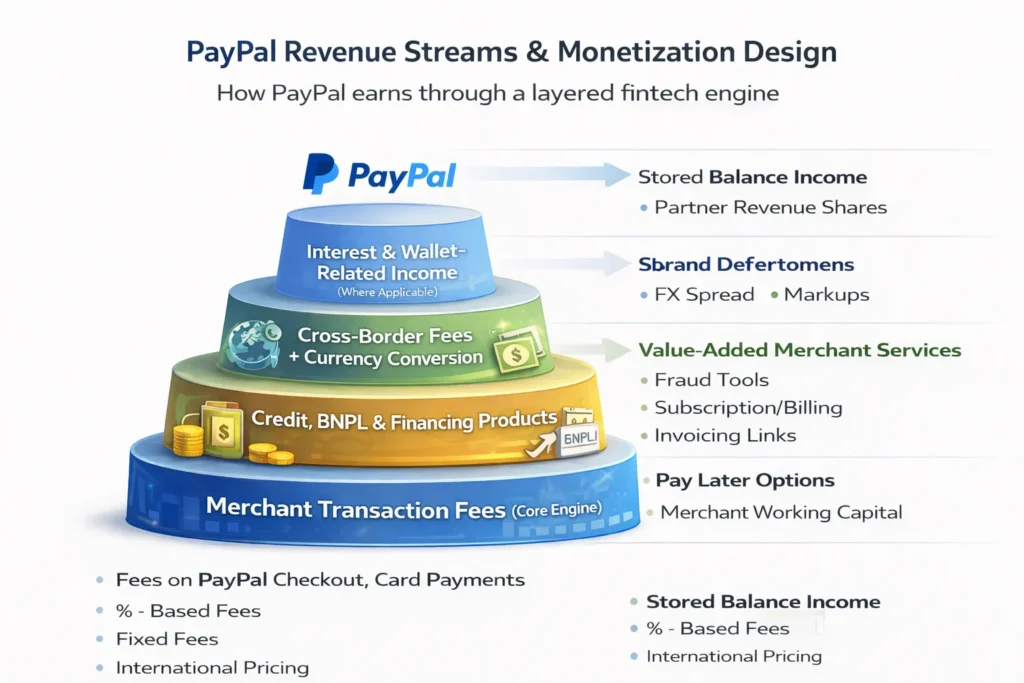
Revenue Streams and Monetization Design
Once you understand who PayPal serves, the next question becomes clear: how does PayPal actually make money?
In 2026, PayPal’s revenue model is built like a layered fintech engine. It earns primarily when transactions happen, but it increases profitability through value-added services like cross-border processing, currency conversion, and merchant financial products.
Primary Revenue Stream 1: Merchant Transaction Fees (Core Engine)
Mechanism
PayPal charges merchants a fee when customers pay using PayPal Checkout, card processing, or wallet-based payments.
Pricing Model
- Percentage-based fee per transaction
- Fixed fee component per payment
- Higher pricing for international payments and certain payment methods
Revenue Contribution
- Largest revenue driver for PayPal
- Scales directly with total payment volume (TPV)
Growth Trajectory (2026)
- Strong focus on improving checkout conversion
- Expansion of PayPal’s “branded checkout” share
- Growth in digital commerce and subscription payments
Secondary Revenue Stream 2: Cross-Border Fees + Currency Conversion
Mechanism
PayPal earns extra margin when users or merchants transact internationally or convert currencies.
Monetization Levers
- FX conversion spread
- Cross-border processing fees
- Multi-currency settlement support
Why it matters
- Higher-margin revenue stream
- Benefits from global ecommerce growth
Secondary Revenue Stream 3: Value-Added Merchant Services
Mechanism
PayPal sells merchant tools that improve payment performance and business operations.
Examples
- Advanced fraud protection
- Chargeback and dispute management tools
- Recurring billing + subscription management
- Invoicing and payment links
Revenue Impact
- Improves merchant retention
- Adds predictable service-based income
Secondary Revenue Stream 4: Credit, BNPL & Financing Products
Mechanism
PayPal earns through financing solutions that increase purchase completion and order size.
Examples
- Pay Later / installment options
- Merchant financing and working capital programs
- Consumer credit offerings (market-dependent)
Why it works
- Increases conversion rate and AOV (average order value)
- Strengthens PayPal’s role beyond payments
Secondary Revenue Stream 5: Interest & Wallet-Related Income (Where Applicable)
Mechanism
PayPal can earn from stored balances and financial partnerships depending on regulations and region.
Examples
- Interest on certain balances
- Partner revenue shares
- Banking ecosystem integrations
Overall Monetization Strategy
PayPal’s monetization is designed around checkout dominance + layered upsells:
- The core engine is merchant transaction fees
- High-margin growth comes from FX, cross-border, and services
- Financing increases conversion, frequency, and cart value
- Merchant tools improve retention, reducing churn and stabilizing revenue
This is why PayPal’s model stays strong in 2026: it’s not dependent on one income source—it compounds value across the full payment lifecycle.
Operational Model & Key Activities
PayPal’s business model works because the company runs like a high-trust financial infrastructure layer, not just a consumer app. Behind every “Pay Now” click is a complex system managing risk, compliance, approvals, disputes, and settlement—all in seconds. In 2026, operational excellence is PayPal’s real advantage because payments is a game of reliability, security, and scale.
Core Operations (What PayPal Does Daily)
1) Platform & Infrastructure Management
- Runs secure payment rails across web, mobile, and embedded checkout
- Maintains uptime, speed, and global transaction processing stability
- Supports APIs for merchants, apps, and marketplaces
2) Risk Management & Fraud Prevention
- Detects fraud patterns using behavior signals and transaction intelligence
- Balances strict security with smooth user experience
- Prevents chargebacks and reduces unauthorized payment losses
3) Compliance & Regulatory Operations
- KYC (Know Your Customer) onboarding flows
- AML (Anti-Money Laundering) monitoring
- Region-specific rules for payments, wallets, and data handling
4) Customer Support & Dispute Resolution
- Handles refunds, chargebacks, buyer protection claims
- Merchant dispute workflows and evidence collection
- Trust-building support operations across countries
5) Merchant Growth & Performance Optimization
- Checkout optimization tools to improve approval rates
- Subscription billing and recurring payment management
- Reporting dashboards for payments and settlement tracking
Resource Allocation (Where the Business Invests Most)
In 2026, PayPal typically prioritizes investment into:
- Technology & Security: platform reliability, fraud systems, encryption, API scalability
- Risk & Compliance: regulatory readiness and transaction monitoring
- Product & UX: improving checkout speed, wallet experience, and merchant integrations
- Sales & Partnerships: acquiring merchants, platforms, and enterprise accounts
- Regional Expansion: local payment methods, currency support, and compliance readiness
Why This Operational Model Works
PayPal’s operations are designed to deliver:
- High approval rates (more successful payments)
- Low fraud rates (less loss and higher trust)
- Fast dispute handling (better customer confidence)
- Scalable integrations (easy for merchants to adopt globally)
That operational consistency is what keeps PayPal competitive even when pricing pressure increases.
Read more : Best PayPal Clone Scripts 2025 Launch a Secure Global Digital Payment Platform
Strategic Partnerships & Ecosystem Development
PayPal doesn’t grow only by building features—it grows by building alliances that strengthen its payment ecosystem. In fintech, partnerships are not optional. They decide distribution, trust, compliance reach, and how quickly a platform can enter new markets. In 2026, PayPal’s partnership strategy is designed to expand where payments happen and to reduce friction for both consumers and merchants.
Partnership Philosophy (How PayPal Collaborates)
PayPal partners to achieve three outcomes:
- Increase adoption (more merchants and users)
- Improve transaction success (higher approval rates, fewer drop-offs)
- Expand ecosystem value (more use cases beyond checkout)
Key Partnership Types
1) Technology & API Partners
- Ecommerce platforms that make PayPal easy to install
- Checkout and payment gateway integrations
- App and marketplace payment enablement through APIs
Why it matters
- Faster merchant onboarding
- Higher distribution without heavy sales cycles
2) Payment Networks & Banking Alliances
- Card networks for processing and authorization
- Banks for settlement, compliance support, and regional rails
- Local payment method partnerships for market fit
Why it matters
- Helps PayPal operate globally with reliability
- Improves acceptance across currencies and regions
3) Merchant & Retail Partnerships
- Large brands using PayPal for checkout and recurring billing
- Subscription-based businesses integrating PayPal payments
- Cross-border merchants using PayPal’s international reach
Why it matters
- Builds trust through visibility at major checkout points
- Improves volume and repeat usage
4) Marketing & Distribution Partners
- Co-marketing with merchants and platforms
- Referral programs and promotional partnerships
- Strategic placement of PayPal/Venmo options at checkout
Why it matters
- Drives low-friction growth
- Strengthens brand recall at purchase moments
5) Regulatory & Expansion Alliances
- Compliance-focused partnerships for identity verification
- Local entities and frameworks to meet licensing requirements
- Risk and fraud intelligence collaborations
Why it matters
- Enables smoother market entry
- Reduces operational and regulatory delays
Ecosystem Strategy Insight
PayPal’s ecosystem becomes stronger because partnerships increase network effects:
- More merchants → more consumer trust and usage
- More consumer usage → higher merchant conversion
- Better conversion → merchants stay longer and expand PayPal usage
PayPal also monetizes this ecosystem through:
- Higher transaction volume
- Premium merchant tools
- Cross-border and currency services
- Financing and credit adoption
This is how PayPal turns partnerships into long-term market defense—because once embedded into merchant checkout flows and platforms, switching becomes costly and risky.
Growth Strategy & Scaling Mechanisms
PayPal’s growth story is not just about being “early” in online payments. It’s about scaling a product that sits at the most valuable point in digital commerce: the moment money moves. In 2026, PayPal grows by improving checkout performance, expanding distribution through partners, and increasing how often users and merchants rely on PayPal across different use cases.
Growth Engines (How PayPal Scales)
1) Organic Growth Through Trust + Habit
PayPal benefits from a powerful behavioral loop:
- Users choose PayPal because it feels safer and faster
- Successful payments build confidence
- Confidence drives repeat usage and saved checkout behavior
Key drivers:
- One-click checkout convenience
- Buyer protection and dispute handling
- Strong brand trust in online transactions
2) Merchant-Led Distribution
PayPal scales by being placed directly where transactions happen.
- Every merchant checkout page becomes a growth channel
- More merchants → more payment volume → better ecosystem strength
Examples of scaling levers:
- Easy integrations with ecommerce platforms
- Optimized checkout flows for mobile
- Subscription and recurring billing support
3) Paid Marketing + Merchant Acquisition
PayPal uses targeted acquisition to grow merchants and specific user segments:
- Incentives for merchant adoption
- Performance marketing for SMB signups
- Campaigns focused on “checkout conversion” benefits
This is less about mass advertising and more about ROI-driven merchant growth.
4) Product Expansion & Use-Case Growth
PayPal increases revenue and retention by expanding into:
- Pay Later / installment payments
- Merchant services (fraud tools, invoicing, reporting)
- Cross-border commerce enablement
- Wallet + P2P usage (market dependent)
This strategy increases:
- Frequency of usage
- Average transaction value
- Merchant dependency on PayPal tools
5) Geographic Expansion Strategy
PayPal scales globally by:
- Supporting local payment methods
- Building compliance-ready onboarding
- Partnering with regional payment and banking systems
- Adapting risk models to local fraud patterns
Scaling Challenges & How PayPal Handles Them
Challenge 1: Fraud, Chargebacks & Trust Risk
As PayPal scales, fraud attempts scale too.
Solution
- AI-driven fraud detection
- Risk scoring and identity signals
- Dispute workflows that protect both sides (buyers + merchants)
Challenge 2: Checkout Drop-Off and Payment Failures
Even a small drop in approval rates can cost merchants millions.
Solution
- Constant checkout optimization
- Better authorization logic
- Smart routing across payment rails and risk rules
Challenge 3: Competitive Pressure from Wallets and Gateways
Fintech is crowded in 2026 with many payment options.
Solution
- Focus on branded trust at checkout
- Strong partnerships and platform integrations
- Expansion into merchant services and financing products
Challenge 4: Regulatory Complexity Across Regions
Different rules can slow expansion.
Solution
- Compliance-first infrastructure
- Local partnerships and licensing alignment
- Regional risk and policy teams
PayPal’s scaling advantage comes from improving both sides of the market at once: more merchants increase usefulness for consumers, and more consumers increase value for merchants—creating a compounding growth flywheel.
Competitive Strategy & Market Defense
Payments is one of the most competitive spaces in tech because every platform wants to own the checkout layer. In 2026, PayPal protects its position by focusing on what matters most to merchants and users: trust, conversion, security, and global reliability. Its competitive strategy is not built on “being cheaper,” but on being the option that reduces risk and increases successful transactions.
Key Competitive Advantages
1) Network Effects & Switching Barriers
PayPal benefits from a two-sided advantage:
- More users make PayPal valuable to merchants
- More merchants make PayPal convenient for users
Switching barriers exist because merchants integrate PayPal into:
- checkout flows
- subscription billing
- dispute systems
- fraud tooling
Once embedded, removing PayPal can reduce conversion and increase payment risk.
2) Brand Equity & Trust at Checkout
PayPal’s brand is a conversion tool.
- Many customers feel safer paying with PayPal than entering card details
- Trust becomes a performance advantage, not just marketing
This matters most in:
- high-ticket purchases
- cross-border orders
- first-time brand purchases
3) Risk, Fraud & Compliance Strength
In payments, trust is built by preventing problems before they happen.
PayPal’s edge comes from:
- fraud detection systems
- chargeback handling workflows
- identity and behavior intelligence
- compliance readiness across markets
4) Data-Driven Personalization
PayPal uses transaction-level insights to improve:
- authorization success
- fraud prevention accuracy
- checkout speed and user experience
This creates a measurable advantage for merchants in conversion and approval rates.
5) Ecosystem Depth (Beyond Simple Payments)
PayPal competes as an ecosystem, not a single feature:
- PayPal Checkout
- wallet and stored credentials
- recurring payments
- cross-border and FX support
- financing options and merchant services
This makes PayPal harder to replace with one alternative provider.
Market Defense Tactics
1) Handling New Entrants & Pricing Wars
Instead of competing only on price, PayPal defends through:
- performance-based value (higher conversion)
- reduced fraud and dispute costs
- trust-led checkout adoption
This makes it harder for low-cost competitors to win long-term.
2) Strategic Feature Rollouts
PayPal protects market share by releasing features that directly impact merchant revenue:
- faster checkout experiences
- improved payment approval rates
- better subscription and billing tools
- enhanced fraud controls
Timing matters because payments adoption depends on confidence and stability.
3) Partnerships and Platform Lock-In
PayPal strengthens distribution by integrating deeply with:
- ecommerce platforms
- marketplaces
- subscription businesses
- international merchants
These partnerships make PayPal a default choice rather than an optional add-on.
4) Defensive Expansion into Merchant Tools
PayPal reduces churn by becoming useful after the payment too:
- reporting and analytics
- invoicing tools
- dispute handling support
- merchant financing options
This creates a full-stack merchant relationship, not just transaction processing.
In 2026, PayPal’s competitive defense is built around one clear principle: the platform that increases trust and payment success wins more volume, retains merchants longer, and compounds growth over time.
Lessons for Entrepreneurs & Implementation
PayPal’s journey is a strong reminder that the biggest platforms don’t win only because they have a great idea—they win because they build trust, reliability, and repeat usage into the product. In 2026, entrepreneurs studying the PayPal business model should focus less on “payments” and more on the real engine behind it: reducing friction while managing risk at scale.
Key Factors Behind PayPal’s Success
- Trust-first positioning: users feel safer paying through PayPal
- Two-sided ecosystem: consumers and merchants grow together
- Frictionless checkout: fewer steps = higher conversion
- Risk + compliance excellence: fraud prevention becomes a growth driver
- Layered monetization: multiple revenue streams, not just one fee
Replicable Principles for Startups
If you want to build a PayPal-style platform in your niche, copy the principles—not the product.
- Build a clear core action (pay, book, order, hire, subscribe)
- Reduce user effort with saved preferences + one-click flows
- Add trust signals early: verification, refunds, dispute support
- Monetize in layers: core fees + premium services + upsells
- Use partnerships to scale distribution faster than ads alone
Common Mistakes to Avoid
- Launching without fraud controls and clear refund rules
- Competing only on low pricing instead of performance and trust
- Ignoring merchant tools and focusing only on consumer UX
- Scaling too fast without compliance readiness
- Building features before solving the core transaction flow
How to Adapt This Model for Local or Niche Markets
PayPal’s model can be adapted into many high-growth categories like:
- local service booking platforms
- ecommerce marketplaces
- subscription commerce
- B2B invoicing and payments
- cross-border freelancer payment platforms
Key adaptation moves:
- support local payment preferences
- design for low-trust markets with stronger verification
- focus on one niche first, then expand
Implementation Timeline & Investment Priorities
A practical build path looks like this:
Phase 1 : MVP
- user onboarding + wallet/payment flow
- merchant/provider onboarding
- basic transaction tracking
Phase 2 : Trust Layer
- fraud checks + dispute workflows
- refund and support system
- analytics dashboard
Phase 3 : Monetization + Scale
- premium merchant tools
- subscription/recurring billing
- partnerships and integrations
Ready to implement PayPal’s proven business model for your market? Miracuves builds scalable platforms with tested business models and growth mechanisms. We’ve helped 200+ entrepreneurs launch profitable apps. Get your free business model consultation today.
Conclusion :
PayPal’s business model proves a powerful lesson for founders in 2026: the biggest opportunities are not always in creating a new category, but in making a critical process faster, safer, and more reliable at scale. PayPal didn’t win because payments were exciting—it won because payments were essential, and it built the trust layer that digital commerce needed to grow.
For entrepreneurs, the real takeaway is clear: when you combine a simple user experience with strong risk handling, smart partnerships, and layered monetization, you don’t just build a product—you build an ecosystem. And in the platform economy of 2026 and beyond, ecosystems are what create long-term defensibility, compounding growth, and billion-dollar outcomes.
FAQs
What type of business model does PayPal use?
PayPal uses a hybrid fintech platform model. It combines digital wallet services, merchant payment processing, and financial tools to connect consumers and businesses in one ecosystem.
How does PayPal’s model create value?
PayPal creates value by making payments fast, secure, and trusted. Consumers get easy checkout and protection, while merchants get higher conversion, global acceptance, and smoother dispute handling.
What are PayPal’s key success factors?
Its biggest success factors are brand trust, strong fraud prevention, seamless checkout experience, and a large two-sided network of users and merchants.
How scalable is PayPal’s business model?
PayPal’s model is highly scalable because revenue grows with transaction volume, and the platform can expand across markets through APIs, partnerships, and digital commerce growth.
What are the biggest challenges in PayPal’s model?
Key challenges include fraud risk, chargebacks, regulatory compliance, competition from other payment providers, and maintaining high payment approval rates at scale.
How can entrepreneurs adapt PayPal’s model to their region?
Start by focusing on one niche market, support local payment methods, build strong verification and refund policies, and grow through merchant partnerships instead of relying only on paid ads.
What are alternatives to this model?
Alternatives to PayPal’s model include a subscription billing SaaS model, a marketplace escrow system, a bank-led payment gateway, or a super app payment layer bundled with multiple services. These models work best depending on your product type, trust needs, and how you want to monetize transactions
How has PayPal evolved over time?
PayPal evolved from a simple online payments tool into a full ecosystem with wallet services, merchant checkout tools, cross-border payments, financing options, and advanced fraud systems.
Related Article :