


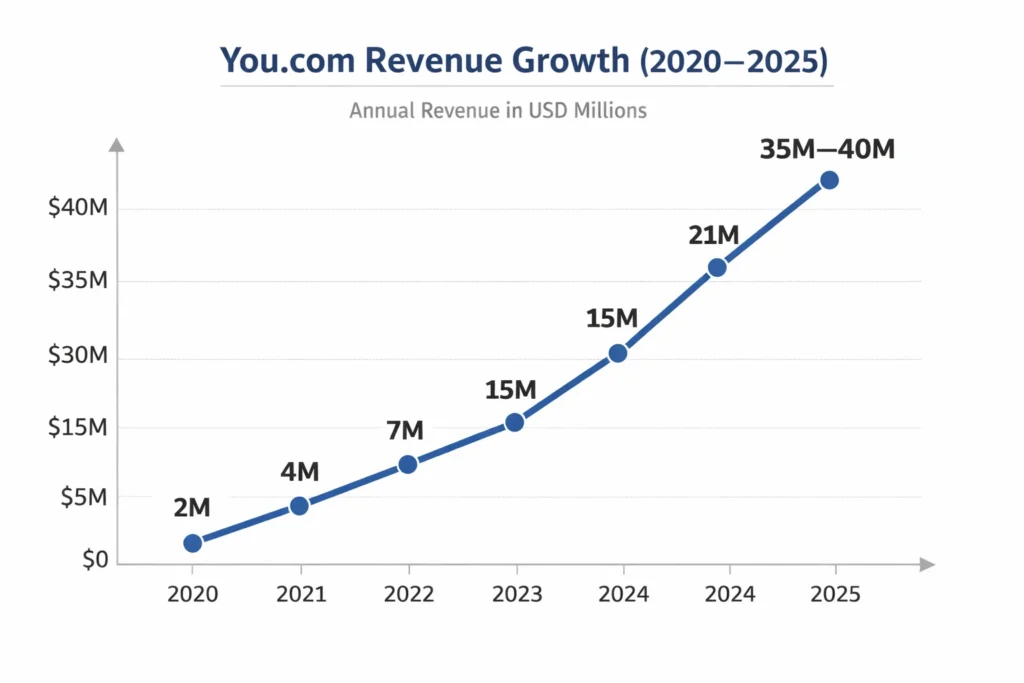
In 2026, You.com is estimated to be generating more than $35 million in annual recurring revenue, positioning itself as one of the fastest-growing AI-powered search platforms in the market.
For founders, You.com represents a new category of business: AI-first search engines that combine productivity tools, privacy-driven discovery, and enterprise-grade AI services into a single monetization engine.
Studying You.com’s revenue model reveals how AI infrastructure, freemium access, and enterprise adoption can transform a consumer-facing search product into a high-margin SaaS and platform business.
You.com Revenue Overview – The Big Picture
2025 Estimated Revenue: ~$35–40 million ARR
Valuation: ~$300–450 million (private market estimates based on funding and AI SaaS revenue multiples)
YoY Growth: ~70–90% growth from 2024 to 2025
Revenue by Region:
- North America: ~50%
- Europe: ~25%
- Asia-Pacific: ~20%
- Rest of World: ~5%
Profit Margins:
- Gross Margin: ~65–75% (after AI compute and cloud infrastructure costs)
- Net Margin: Reinvestment phase (near break-even or modest operating loss due to rapid AI and product expansion)
Competition Benchmark:
- Competes with Perplexity AI, Bing AI, Google’s AI search features, and enterprise knowledge search tools.
- Differentiates with customizable AI apps, privacy-first search, and developer-friendly AI integrations.
Read More: You.com Explained: A Privacy‑Focused, AI‑Powered Search & Chat Platform
Primary Revenue Streams Deep Dive
Revenue Stream #1: Pro & Premium Subscriptions
How it works: Individuals and professionals pay for advanced AI search, unlimited queries, premium models, document uploads, and productivity tools.
Pricing: $15–30 per user/month
% Share: ~45% of total revenue
2025 Data: Strong adoption among developers, consultants, marketers, and researchers.
Revenue Stream #2: Enterprise & Team Licensing
How it works: Businesses purchase bulk licenses with admin dashboards, compliance features, private AI deployments, and internal knowledge search.
Pricing: $3,000–50,000+ per year per organization
% Share: ~30%
2025 Data: Growing demand from tech companies, law firms, and consulting agencies.
Revenue Stream #3: API & Developer Platform
How it works: Developers integrate You.com’s AI search, summarization, and chatbot features into their own products.
Pricing: Usage-based API fees
% Share: ~15%
2025 Data: Used by SaaS startups building AI-powered customer support and search tools.
Revenue Stream #4: Sponsored AI Results & Advertising
How it works: Privacy-safe sponsored placements within AI-assisted search results.
Pricing: CPC and CPM-based models
% Share: ~7%
2025 Data: Selective ad model focused on high-intent business and SaaS keywords.
Revenue Stream #5: Custom AI Deployments
How it works: Tailored AI search systems for enterprises with proprietary data and internal indexing.
% Share: ~3%
2025 Data: High-margin enterprise contracts with regulated industries.
Revenue streams percentage breakdown
| Revenue Stream | % Share | Monetization Model |
|---|---|---|
| Premium Subscriptions | 45% | Monthly/Annual SaaS |
| Enterprise Licensing | 30% | Annual Contracts |
| API Platform | 15% | Usage-Based |
| Sponsored Results | 7% | Advertising |
| Custom AI Deployments | 3% | Project-Based |
The Fee Structure Explained
User-Side Fees
- Free tier with limited AI searches and basic models
- Pro plans for advanced AI models, unlimited queries, and productivity tools
- Annual billing discounts for professionals and teams
Provider-Side Fees
- Developers pay for API usage and compute-based consumption
- Enterprises pay deployment and maintenance fees
Hidden Revenue Layers
- Priority compute access for premium users
- Data indexing fees for large enterprise datasets
- Model upgrades and compliance add-ons
Regional Pricing Variation
- Lower-cost plans for students and emerging markets
- Enterprise pricing adjusted for regional compliance and hosting needs
Complete fee structure by user type
| User Type | Pricing Model | Features |
|---|---|---|
| Free Users | $0 | Limited AI search, basic tools |
| Pro Users | $15–30/month | Premium models, unlimited search, uploads |
| Teams | Custom | Collaboration, admin controls |
| Enterprises | Annual Contracts | Private AI, compliance, API access |
How You.com Maximizes Revenue Per User
Segmentation: Consumer, professional, developer, and enterprise tiers
Upselling: Free → Pro → Team → Enterprise
Cross-Selling: API access, compliance tools, and data indexing services
Dynamic Pricing: Usage-based pricing for developers and large teams
Retention Monetization: Saved workflows, personalized AI agents, and team knowledge bases
LTV Optimization: Annual contracts and multi-year enterprise deals
Psychological Pricing: Low entry price for individuals drives upgrades
Real Data Example: Enterprise users generate 5–7x higher lifetime value than individual subscribers.
Cost Structure & Profit Margins
Infrastructure Cost: AI compute, cloud hosting, and indexing (~35% of revenue)
CAC & Marketing: SEO, developer outreach, and partnerships (~15%)
Operations: Support, compliance, and admin (~10%)
R&D: AI model tuning, UX, and product innovation (~20%)
Unit Economics:
- Average Revenue Per User (ARPU): ~$260/year
- Customer Acquisition Cost (CAC): ~$80–120
- Payback Period: 4–7 months
Margin Optimization:
- Model efficiency improvements
- Enterprise-first sales strategy
- Long-term cloud and compute contracts

Future Revenue Opportunities & Innovations
New Streams: AI-powered internal search engines for enterprises
AI/ML Monetization: Industry-specific AI agents for legal, finance, and healthcare
Market Expansion: Asia-Pacific startup ecosystems and EU compliance markets
Predicted Trends (2025–2027):
- AI search replacing traditional internal knowledge systems
- Growth of private, on-premise AI deployments
- Rise of developer platforms for AI search APIs
Risks & Threats:
- Big tech competition (Google, Microsoft)
- Rising compute costs
- Open-source AI search tools
Opportunities for New Founders:
- Niche AI search platforms for industries
- Regional enterprise AI solutions
- Multilingual AI discovery tools
Lessons for Entrepreneurs & Your Opportunity
What Works:
- Freemium funnel with strong premium conversion
- Enterprise upsell strategy
- Developer ecosystem monetization
What to Replicate:
- Modular AI tools instead of one-size-fits-all search
- Transparent pricing tiers
- API-first product design
Market Gaps:
- AI search for regulated industries
- Offline enterprise AI systems
- Vertical-specific AI agents
Improvements Founders Can Use:
- Faster onboarding flows
- Pre-built industry templates
- Custom AI training for business data
To build on this revenue model, our ready-made AI chat assistant platform starts at $2,799 and is delivered in 6 days, with monthly and annual subscription plans. It is not a copy of You.com, and web search features are added as custom work.
Related reading: AI search platform features and pricing guide and travel platform revenue model breakdown.
Final Thought
You.com’s growth story in 2025 shows how search is evolving from a passive discovery tool into an active AI-powered productivity platform. Users no longer just look for answers — they expect systems that summarize, automate, and guide decisions in real time. This shift opens up entirely new business categories for founders willing to rethink how search and AI intersect.
For entrepreneurs, the deeper lesson is in platform design. You.com doesn’t rely on a single revenue stream. It layers subscriptions, enterprise contracts, APIs, and selective advertising into a diversified model that balances growth with long-term stability. This approach reduces dependency on any one market segment and increases resilience against competition.
The next wave of AI businesses will likely emerge from specialization rather than scale alone. Founders who build AI search and discovery tools for specific industries, regions, or professional roles will be well-positioned to capture loyal users and premium pricing in an increasingly crowded AI landscape.
FAQs
1. How much does You.com make per transaction?
You.com primarily earns through subscriptions and enterprise contracts rather than per-search fees, averaging $15–30 per user per month.
2. What’s You.com’s most profitable revenue stream?
Enterprise licensing is the most profitable due to long-term contracts and high user retention.
3. How does You.com’s pricing compare to competitors?
It is competitively priced for individuals and premium for enterprise deployments compared to other AI search platforms.
4. What percentage does You.com take from providers?
You.com does not charge content providers; it monetizes user access, APIs, and enterprise services.
5. How has You.com’s revenue model evolved?
It evolved from a privacy-focused search engine into a multi-tier AI SaaS and developer platform.
6. Can small platforms use similar models?
Yes, niche AI search tools can replicate this model with subscriptions and industry-focused features.
7. What’s the minimum scale for profitability?
Roughly 6,000–10,000 paying users or a small number of enterprise clients can cover core operational costs.
8. How to implement similar revenue models?
Start with freemium access, introduce paid tiers, and build enterprise-grade features for long-term contracts.
9. What are alternatives to You.com’s model?
Pure API monetization, usage-based pricing, or data licensing models.
Miracuves is an independent software development company. We are not affiliated with, connected to, sponsored by, or endorsed by any company or product named in this article.
Terms such as “X Clone” are used descriptively. It is how the software industry refers to building a platform with functionality comparable to a known service, and how clients search for it.
The entire design and codebase of our products is built by our own team. Our products contain no code, design, graphics, or content originating from any third-party website or applications.
All third-party names and marks referenced in this article are the property of their respective owners, referenced solely to identify the services discussed.