

Periscope was founded by Kayvon Beykpour and Joe Bernstein, and even before launching publicly, it was acquired by Twitter (now X) for roughly $50–$100 million in 2015, signaling the massive strategic value of live video for social media platforms. But Periscope’s story is more than just a startup success — it’s a case study in platform economics, network effects, and product integration. Despite its early growth, the app was eventually discontinued in March 2021 as its functionality merged into Twitter’s ecosystem.
For modern founders building live-streaming, creator, or real-time social platforms, the Periscope story offers important lessons. It shows how live interaction platforms can scale quickly through network effects, why ecosystem integration often matters more than standalone growth, and how a strong monetization strategy is essential for long-term platform survival.
At Miracuves, we analyze these models because building scalable platforms today requires understanding how engagement loops, creator economies, and real-time experiences work together. In this breakdown, we’ll analyze how the business model of Periscope worked, how it generated value, and what entrepreneurs can learn from its rise and fall.
How the Periscope Business Model Works
Periscope operated on a real-time social broadcasting model, where users could instantly stream live video to a global audience. The platform’s core idea was simple but powerful: turn every smartphone into a live TV channel.
Unlike traditional video platforms that relied on edited or pre-recorded content, Periscope focused on authentic, unfiltered, real-time experiences. This immediacy created strong engagement loops between creators and viewers.
At its core, Periscope functioned as a two-sided platform connecting:
- Content creators (streamers) who broadcast live experiences
- Viewers who joined, interacted, and shared streams
Twitter’s acquisition amplified this model by integrating live streaming with social media distribution, allowing broadcasts to instantly reach millions through tweets.
Type of Business Model
Periscope used a Hybrid Platform Model combining:
- Social Media Platform
- Creator Economy Platform
- Freemium Engagement Model
Key characteristics included:
- Free access for both creators and viewers
- Monetization primarily driven by engagement value within Twitter’s ecosystem
- Creator incentives through audience growth and visibility
Unlike subscription platforms like Netflix, Periscope’s value came from attention and engagement rather than direct payments.
Key Stakeholders in the Ecosystem
Periscope’s ecosystem involved several important participants.
1. Streamers / Creators
- Produced live content
- Drove audience engagement
- Built communities
2. Viewers
- Consumed streams
- Provided interaction signals (comments, hearts)
- Shared streams across networks
3. Twitter Platform
- Distributed live streams via tweets
- Provided social graph and discovery engine
4. Brands & Media
- Used live streaming for marketing campaigns
- Broadcast events, announcements, and promotions
Evolution of the Business Model
Periscope’s model evolved quickly as the live-streaming market matured.
2015 – Launch Phase
- Standalone live-streaming app
- Viral growth through Twitter integration
2016 – Competition Phase
- Facebook Live and Instagram Live entered the market
- Periscope introduced Super Hearts (creator tipping)
2017–2019 – Creator Monetization
- Virtual gifting system to reward streamers
- Increased integration with Twitter feeds
2021 – Platform Integration
- Standalone Periscope app shut down
- Live streaming moved directly into Twitter
Why the Model Worked (and Why It Struggled)
Why It Worked
Periscope succeeded because it leveraged:
- Real-time authenticity
- Strong network effects
- Built-in distribution via Twitter
- Low barriers to content creation
This combination allowed it to scale quickly.
Why It Struggled
However, several challenges emerged:
- Competitors like Facebook Live and Instagram Live copied the model
- Limited standalone monetization
- Infrastructure costs of live streaming
- Platform dependence on Twitter
By 2026 standards, the biggest insight is that live video works best when embedded into larger social ecosystems, rather than as a separate app.
This is why modern platforms like TikTok Live, YouTube Live, and Instagram Live integrate live streaming directly within their main platforms.
At Miracuves, many entrepreneurs building streaming or creator platforms adopt this integrated ecosystem approach to ensure long-term scalability.
Read more : How Safe is a White-Label Periscope App? Security Guide 2026
Target Market & Customer Segmentation Strategy
Periscope’s rapid growth came from its ability to attract both content creators and curious viewers who wanted to experience events live. The platform tapped into a fundamental human behavior — the desire to witness moments in real time.
Instead of targeting only professional creators, Periscope focused on everyday users, journalists, influencers, and brands who wanted to broadcast instantly from their smartphones. This approach helped the platform scale quickly across global markets.
Primary Customer Segments
1. Individual Creators & Influencers
These were everyday users who turned their smartphones into broadcasting tools.
Typical characteristics:
- Age group: 18–35
- Tech-savvy social media users
- Aspiring influencers or content creators
- Interested in building personal audiences
Their motivations included:
- Personal branding
- Real-time interaction with followers
- Growing a digital audience
- Sharing unique experiences live
Examples of creator use cases:
- Travel vloggers streaming city tours
- Musicians performing live sessions
- Journalists covering breaking news
- Gamers and entertainers engaging audiences
2. Social Media Viewers
The second core segment consisted of users who consumed live streams.
Behavior patterns included:
- Browsing live broadcasts for entertainment
- Discovering trending events worldwide
- Participating in live chats
- Sending hearts or reactions
These users were typically:
- Active Twitter users
- Fans of influencers or celebrities
- Curious audiences seeking authentic content
Their engagement drove the network effect that powered Periscope’s growth.
Secondary Customer Segments
3. Brands and Marketers
Companies quickly realized the marketing potential of live video.
Brands used Periscope for:
- Product launches
- Behind-the-scenes content
- Live Q&A sessions
- Event streaming
Industries that adopted it early:
- Media and entertainment
- Sports organizations
- Fashion brands
- Technology companies
Live streaming allowed brands to create authentic engagement instead of traditional advertising.
4. Journalists & News Organizations
Periscope became a powerful tool for real-time citizen journalism.
News outlets and independent reporters used it to:
- Stream protests and breaking news
- Provide on-ground reporting
- Offer unfiltered perspectives
This capability helped Periscope position itself as a real-time information network.
Customer Journey: From Discovery to Retention
Periscope’s user lifecycle followed a simple but effective journey.
1. Discovery
Users discovered streams through:
- Twitter timeline integration
- Push notifications for live broadcasts
- Trending live streams
- Influencer shares
This built-in distribution dramatically reduced customer acquisition costs.
2. Conversion
New users converted when they:
- Watched engaging live streams
- Interacted through comments and hearts
- Followed creators they liked
The real-time interaction created a strong emotional connection with creators.
3. Retention
Retention strategies included:
- Notifications when creators went live
- Replay features for missed streams
- Community engagement through comments
- Gamification via hearts and viewer rankings
These features kept viewers returning to the platform.
Revenue Streams and Monetization Design
While Periscope gained massive popularity for live broadcasting, its monetization model was relatively limited compared to modern creator platforms. The platform focused primarily on engagement growth first, with monetization evolving later as the creator economy matured.
Because Periscope was owned by Twitter, its revenue strategy also aligned with Twitter’s broader advertising and engagement ecosystem rather than relying solely on direct payments from users.
Primary Revenue Stream: Creator Tipping (Super Hearts)
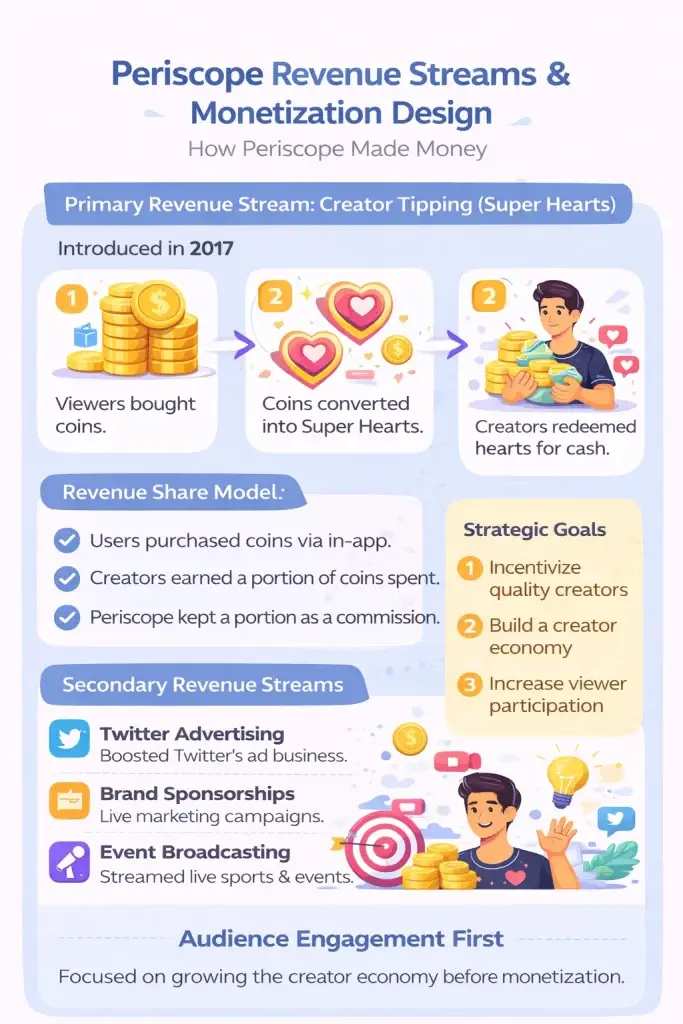
Periscope’s most direct monetization feature was Super Hearts, introduced in 2017.
This system allowed viewers to send virtual gifts to creators during live streams.
How It Worked
- Viewers purchased virtual coins using real money.
- Coins could be exchanged for Super Hearts during broadcasts.
- Creators accumulated these hearts and later redeemed them for cash.
Pricing Model
Typical structure included:
- Users purchased coins via in-app purchases.
- Coins converted into virtual gifts.
- Creators earned a portion of the gift value.
Strategic Purpose
The feature aimed to:
- Incentivize high-quality creators
- Build a creator economy
- Increase viewer participation during streams
Revenue Share Model
Periscope kept a portion of transactions, while the rest went to creators.
This was similar to monetization strategies later popularized by:
- TikTok Live gifts
- YouTube Super Chat
- Twitch Bits
Although promising, the tipping system launched relatively late in Periscope’s lifecycle.
Secondary Revenue Streams
1. Twitter Advertising Ecosystem
Periscope indirectly supported Twitter’s core advertising revenue.
Live video increased:
- User engagement
- Time spent on the platform
- Content sharing activity
These metrics boosted Twitter’s advertising business by generating:
- Higher ad impressions
- Increased user retention
- Stronger advertiser interest
In this way, Periscope functioned as an engagement engine rather than a primary revenue generator.
2. Brand Collaborations and Sponsored Streams
Brands used Periscope for live marketing campaigns.
Typical brand uses included:
- Product launch events
- Influencer collaborations
- Live interviews
- Behind-the-scenes experiences
Brands benefited from:
- Authentic engagement
- Real-time audience feedback
- Organic social sharing
Although Periscope itself did not heavily monetize brand content, the feature created new marketing opportunities.
3. Event Broadcasting
Many organizations used Periscope to stream live events such as:
- Sports commentary
- Conferences
- Concerts
- Political speeches
This increased platform visibility and audience growth.
In theory, event streaming could have evolved into premium content monetization, though this was never fully developed.
Operational Model & Key Activities
Behind Periscope’s simple interface was a complex operational infrastructure designed to support real-time broadcasting at global scale. Running a live-streaming platform requires continuous management of video delivery, user moderation, platform reliability, and creator engagement systems.
Periscope’s operations were closely integrated with Twitter’s technology ecosystem, which helped it scale faster than most early live-streaming startups.
Core Operations
Periscope’s daily operations revolved around maintaining a stable and engaging live video platform.
1. Platform Management
The company constantly monitored platform performance to ensure smooth streaming.
Key tasks included:
- Managing millions of live broadcasts
- Handling real-time video encoding and distribution
- Optimizing stream latency and quality
- Monitoring platform uptime
Because live streaming requires extremely low delay, maintaining infrastructure reliability was a top priority.
2. Technology Infrastructure
Periscope relied on advanced cloud and video delivery systems.
Infrastructure responsibilities included:
- Video processing and compression
- Global content delivery networks (CDNs)
- Mobile streaming optimization
- Real-time data processing
Live video platforms require significantly more bandwidth than traditional social media platforms, making infrastructure costs a major operational factor.
3. Content Moderation & Quality Control
Real-time broadcasting also created moderation challenges.
Periscope implemented several control mechanisms:
- Community reporting tools
- Automated content detection
- Moderator teams reviewing flagged streams
- Temporary bans for violating users
Moderation was crucial to maintain platform trust and comply with global regulations.
4. User Support & Community Management
Supporting creators and viewers was another essential operational activity.
Teams handled:
- User account issues
- Content disputes
- Creator guidance
- Community feedback
Strong community management helped maintain creator loyalty and user satisfaction.
5. Marketing & User Growth
Periscope leveraged Twitter’s network to acquire new users.
Growth activities included:
- Promoting live streams in Twitter timelines
- Influencer partnerships
- Social media campaigns
- Event-based promotions
This integration dramatically lowered customer acquisition costs compared to independent apps.
Resource Allocation
Operating a live-streaming platform requires significant investment across multiple departments.
Typical allocation priorities included:
Technology & Infrastructure (Largest Investment)
Estimated major resource areas:
- Cloud infrastructure
- Video streaming technology
- AI moderation tools
- Platform scalability engineering
Live streaming platforms often allocate 40–50% of resources to technology and infrastructure.
Operational Insight for Entrepreneurs
One major lesson from Periscope’s operations is that live platforms are infrastructure-heavy businesses.
For founders building similar apps today, success requires:
- Reliable streaming architecture
- Scalable cloud infrastructure
- Strong moderation systems
- Creator support ecosystems
At Miracuves, scalable platform development focuses on designing high-performance systems capable of supporting real-time digital experiences, which is essential for live-streaming or creator platforms.
Strategic Partnerships & Ecosystem Development
Periscope’s growth strategy relied heavily on ecosystem integration rather than standalone expansion. Instead of building an isolated streaming network, the platform leveraged partnerships—especially its integration with Twitter’s global social network—to accelerate adoption and distribution.
This ecosystem-driven approach allowed Periscope to scale rapidly while benefiting from existing social graphs, content discovery systems, and user engagement loops.
In the modern platform economy, this type of partnership strategy is essential because platforms rarely grow in isolation. Instead, they thrive by connecting with technology providers, distribution networks, payment systems, and creators.
Key Partnership Types
1. Technology & API Partners
Live streaming requires strong technological infrastructure. Periscope collaborated with various technology providers to maintain high-quality broadcasting capabilities.
These partnerships helped support:
- Video encoding and compression systems
- Cloud hosting and server infrastructure
- Content delivery networks (CDNs) for global streaming
- Mobile platform integrations (iOS and Android)
Technology partners ensured that streams could be delivered to millions of users with minimal latency.
2. Social Media & Distribution Partnerships
Periscope’s most important ecosystem partnership was with Twitter.
This integration enabled several powerful growth mechanisms:
- Live broadcasts automatically shared on Twitter timelines
- Real-time notifications for followers when creators went live
- Easy discovery of trending streams
- Social sharing across global audiences
This partnership created strong viral distribution loops, which significantly accelerated user growth.
3. Payment & Monetization Partners
With the launch of Super Hearts, Periscope introduced in-app purchases that required payment processing infrastructure.
Key components included:
- App Store and Google Play payment systems
- Digital wallet processing
- Secure transaction management
These payment partnerships enabled the creator tipping economy on the platform.
4. Media & Brand Collaborations
Periscope worked with media organizations, influencers, and brands to showcase the potential of live streaming.
Examples of collaborations included:
- News outlets streaming live events
- Brands hosting interactive Q&A sessions
- Influencers broadcasting behind-the-scenes content
- Event organizers streaming conferences or concerts
These partnerships helped demonstrate how live video could be used for marketing, storytelling, and audience engagement.
5. Regulatory & Market Expansion Alliances
As Periscope expanded globally, compliance with regional regulations became important.
Strategic coordination with:
- App marketplaces
- Telecommunications networks
- Local content regulations
helped the platform expand into multiple international markets while maintaining operational compliance.
Competitive Moats from Partnerships
Periscope created several competitive advantages through its partnerships:
- Instant access to Twitter’s massive user base
- Real-time social discovery
- Built-in content distribution
- Cross-platform engagement loops
These factors helped Periscope gain early traction before competitors entered the live streaming space.
For modern startups, this demonstrates that strategic ecosystem design can be as important as product innovation.
At Miracuves, many successful platform startups we support focus on building partner-enabled ecosystems, ensuring their apps integrate seamlessly with payment systems, APIs, social networks, and digital marketplaces.
Growth Strategy & Scaling Mechanisms
Periscope’s growth was fueled by a powerful combination of viral social sharing, creator-driven content, and deep integration with Twitter’s global network. Instead of relying solely on paid marketing, the platform grew primarily through organic engagement loops and real-time content discovery.
The nature of live video made Periscope inherently shareable — when something interesting happened on a stream, viewers immediately shared it across social media, creating instant viral exposure.
Growth Engines
1. Organic Virality & Referral Loops
Periscope’s most powerful growth mechanism came from real-time social sharing.
Key viral drivers included:
- Twitter users sharing live streams instantly
- Notifications when friends started broadcasting
- Trending live streams appearing in discovery feeds
- Interactive engagement through comments and hearts
These features created network effects where every new user increased the platform’s value.
Example growth loop:
- Creator starts a live stream
- Followers receive a notification
- Viewers join and interact
- Viewers share the stream on social media
- New audiences discover the broadcast
This loop helped Periscope scale rapidly without massive marketing budgets.
2. Influencer and Creator Adoption
Early growth was accelerated by influencers, journalists, and public figures who adopted the platform.
These creators used Periscope to:
- Broadcast behind-the-scenes content
- Host live Q&A sessions
- Share exclusive moments with fans
When celebrities and influencers streamed live events, their audiences followed, bringing thousands of new users to the platform.
This strategy effectively bootstrapped the creator ecosystem.
3. Paid Marketing & Strategic Promotion
Although organic growth dominated early adoption, Periscope also used targeted marketing strategies.
These included:
- Social media campaigns promoting live streaming
- Partnerships with influencers and media outlets
- Event-based live broadcasts
- Cross-promotion inside the Twitter platform
Because Periscope had direct access to Twitter’s user base, customer acquisition costs remained relatively low.
4. Product Innovation & Feature Expansion
Periscope continued adding features to increase engagement.
Important product updates included:
- Replay streams for viewers who missed broadcasts
- Map-based discovery of live streams worldwide
- Super Hearts for creator monetization
- Improved comment and interaction tools
Each update strengthened the platform’s user engagement and retention.
5. Geographic Expansion
Periscope expanded globally by targeting regions with strong social media usage.
Major growth markets included:
- United States
- Europe
- Japan (one of its most active user bases)
- Latin America
Mobile-first users in these regions embraced live streaming for entertainment, journalism, and community engagement.
Read more : Best Periscope Clone Script 2026 : Build Your Own Live Streaming Platform
Competitive Strategy & Market Defense
Periscope entered the market as a pioneer of mobile live streaming, giving it a strong first-mover advantage. However, the social media industry moves quickly, and within a year of its launch, large platforms began replicating its core functionality.
To stay competitive, Periscope relied on network effects, Twitter integration, and product innovation. These factors initially helped the platform maintain relevance despite increasing competition.
Core Competitive Advantages
1. First-Mover Advantage in Live Streaming
When Periscope launched in 2015, real-time mobile broadcasting was still a novel concept.
This early entry allowed the platform to:
- Capture the first wave of live-streaming creators
- Build brand recognition in the live video category
- Experiment with interactive streaming features before competitors
Many early Periscope users became pioneers of live digital storytelling, attracting significant audiences.
2. Network Effects
Like most social platforms, Periscope benefited from network effects.
The platform became more valuable as:
- More creators started broadcasting
- More viewers joined streams
- More interactions occurred in real time
These engagement loops created strong user retention during the platform’s early growth phase.
However, when competitors introduced similar features, network effects began shifting toward larger ecosystems like Facebook and Instagram.
3. Integration with Twitter’s Social Graph
Periscope’s strongest competitive advantage was its connection to Twitter.
This integration allowed:
- Live broadcasts to appear directly in tweets
- Followers to receive instant live-stream notifications
- Real-time conversations during streams
Because Twitter was already known for real-time news and events, live streaming fit naturally into its ecosystem.
4. Real-Time Authentic Content
Unlike traditional video platforms that focused on polished content, Periscope emphasized authentic live moments.
This included:
- Breaking news streams
- Citizen journalism
- Behind-the-scenes experiences
- Interactive Q&A sessions
This authenticity created a unique form of engagement that traditional media struggled to replicate.
Market Defense Strategies
As competition increased, Periscope attempted several strategies to defend its market position.
1. Feature Innovation
To keep users engaged, the platform introduced features such as:
- Replay functionality for missed streams
- Global live stream map showing broadcasts worldwide
- Super Hearts for creator tipping
- Improved interaction tools
These updates aimed to improve creator incentives and viewer engagement
2. Creator Engagement Tools
Periscope invested in tools that encouraged creators to stay active on the platform.
Examples included:
- Live audience interaction through comments
- Gamified engagement via hearts
- Creator recognition systems
These features helped maintain strong communities around popular broadcasters.
3. Platform Integration Strategy
Instead of competing directly with massive social networks, Periscope gradually moved toward full integration with Twitter.
Eventually:
- Live streaming features were embedded directly into Twitter
- The standalone Periscope app was discontinued in 2021
- Live broadcasting became a native social feature
This strategy allowed Twitter to retain the technology and community while simplifying the user experience.
For entrepreneurs building digital platforms today, the key takeaway is that technology innovation alone is not enough — sustainable competitive advantage requires ecosystem scale, strong monetization, and continuous product evolution.
At Miracuves, this is why many platform strategies focus on building defensible ecosystems with strong engagement loops and scalable monetization models.
Lessons for Entrepreneurs & Implementation
Periscope’s journey from a fast-growing startup to a feature embedded within Twitter offers powerful lessons for entrepreneurs building digital platforms today. It demonstrates that innovation alone is not enough — sustainable success requires strong monetization, ecosystem strategy, and continuous evolution.
For founders exploring live streaming, social platforms, or creator-driven ecosystems, Periscope’s story provides both inspiration and caution.
Key Factors Behind Periscope’s Early Success
Several strategic elements helped Periscope scale quickly in its early years.
1. Solving a Real Human Desire
Periscope tapped into a universal curiosity:
People want to experience events in real time.
Live streaming enabled users to:
- Witness breaking news instantly
- Explore new places through others’ perspectives
- Interact directly with broadcasters
This real-time authenticity made the platform highly engaging.
2. Leveraging an Existing Ecosystem
Instead of building distribution from scratch, Periscope used Twitter’s massive user base.
Benefits included:
- Instant global reach
- Built-in audience discovery
- Low customer acquisition cost
- Viral content sharing
This shows the power of platform integrations for rapid growth.
3. Low Barrier to Content Creation
Periscope allowed anyone with a smartphone to broadcast live.
This simplicity created:
- A massive supply of content
- Diverse creator communities
- Continuous user engagement
Modern creator platforms follow the same principle:
make content creation as easy as possible.
Implementation Roadmap for Entrepreneurs
Founders interested in building live-streaming platforms can follow a structured development approach.
Phase 1 – Platform Development
Focus on core features:
- Mobile live-streaming infrastructure
- Real-time interaction tools
- User discovery and recommendation systems
Phase 2 – Community Building
Build a creator ecosystem through:
- Influencer partnerships
- Early adopter incentives
- Community engagement programs
Phase 3 – Monetization Expansion
Introduce scalable revenue models such as:
- Virtual gifts and tipping
- Creator subscriptions
- Premium content access
- Advertising integration
Miracuves builds scalable platforms with tested business models and growth mechanisms. We’ve helped 1500+ entrepreneurs launch profitable apps across industries including social media, marketplaces, and creator platforms. Get your free business model consultation today and turn your platform idea into a scalable digital ecosystem.
Conclusion
Periscope’s journey highlights a key lesson in the digital economy: innovation can drive rapid growth, but long-term success depends on ecosystem strategy. By turning smartphones into real-time broadcasting tools, Periscope helped pioneer the live-streaming movement and inspired features now used by platforms like TikTok Live, Instagram Live, YouTube Live, and Twitch.
For entrepreneurs, the bigger takeaway is clear—successful platforms are built around strong creator communities, scalable monetization, and seamless integrations. Even though Periscope no longer exists as a standalone app, its influence continues to shape the creator-driven platform economy of 2026 and beyond.
FAQs
1. What type of business model did Periscope use?
Periscope used a hybrid social media and creator platform model. It connected live-stream creators with viewers while generating value through engagement and creator tipping features.
2. How did Periscope’s model create value?
Periscope created value by enabling real-time video broadcasting from smartphones, allowing users to share live moments instantly. This authenticity and interactivity kept viewers highly engaged.
3. What were the key success factors of Periscope?
Its early success came from first-mover advantage in live streaming, strong Twitter integration, and easy mobile broadcasting. These factors helped the platform grow rapidly in its early years.
4. How scalable was the Periscope business model?
The model was highly scalable because it relied on user-generated live content and social sharing loops. As more creators joined, viewer engagement increased, strengthening network effects.
5. What were the biggest challenges Periscope faced?
Periscope faced intense competition from Facebook Live, Instagram Live, and YouTube Live, which integrated live streaming into larger ecosystems. High infrastructure costs and limited monetization also created pressure.
6. How can entrepreneurs adapt the Periscope model for their region?
Entrepreneurs can adapt the concept by building niche live-streaming platforms such as e-commerce live selling, education streaming, or local event broadcasting tailored to regional audiences.
7. What are alternatives to the Periscope model?
Modern alternatives include platforms like Twitch, TikTok Live, Instagram Live, and YouTube Live, which combine live streaming with stronger monetization tools and larger creator ecosystems.
8. How did the Periscope business model evolve over time?
Initially launched as a standalone live-streaming app, Periscope later introduced creator tipping and deeper Twitter integration before its features were eventually merged into Twitter’s core platform in 2021.
Related article :
Miracuves is an independent software development company. We are not affiliated with, connected to, sponsored by, or endorsed by any company or product named in this article.
Terms such as “X Clone” are used descriptively. It is how the software industry refers to building a platform with functionality comparable to a known service, and how clients search for it.
The entire design and codebase of our products is built by our own team. Our products contain no code, design, graphics, or content originating from any third-party website or applications.
All third-party names and marks referenced in this article are the property of their respective owners, referenced solely to identify the services discussed.