

Key Takeaways
What You’ll Learn
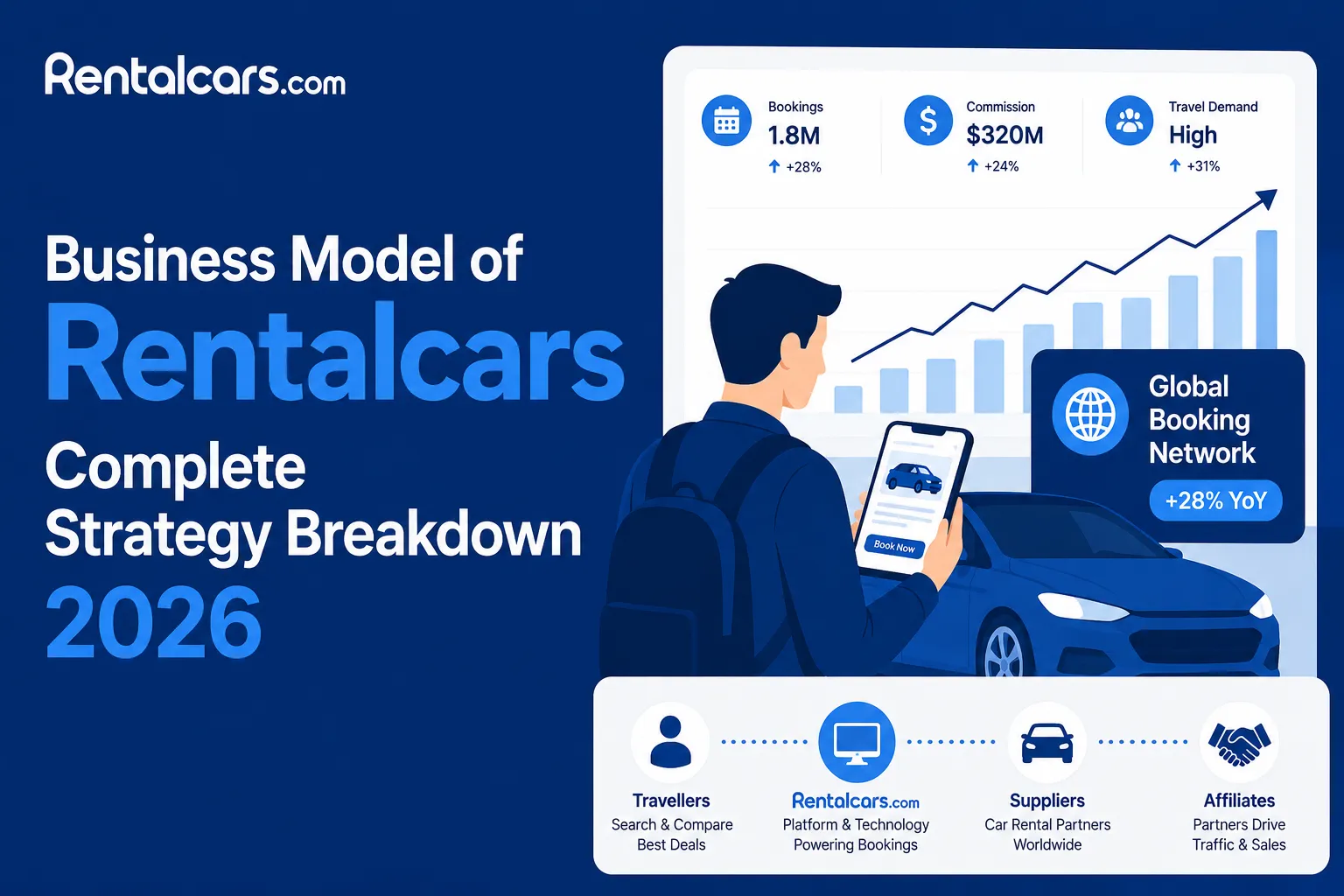
- Rentalcars operates as a global marketplace connecting travelers with rental car providers.
- The platform follows an asset-light business model without owning vehicle fleets.
- Revenue is generated mainly through commissions, booking fees, and travel partnerships.
- The platform simplifies price comparison, booking, and payment processing for users.
- The model focuses on scalability through aggregation and digital distribution.
Stats That Matter
- Rentalcars works as a marketplace aggregator connecting demand and supply digitally.
- Commission-based bookings are a major revenue source for rental marketplace platforms.
- Asset-light models reduce operational costs compared to fleet-owning businesses.
- Travel partnerships and integrations expand customer reach globally.
- Digital booking systems improve scalability and operational efficiency.
Real Insights
- Marketplace models scale faster because they avoid fleet ownership and maintenance costs.
- Price comparison features increase trust and improve booking conversions.
- Global expansion becomes easier through local rental provider partnerships.
- An intuitive booking experience is critical for user retention in travel platforms.
- Long-term success depends on balancing supplier growth, customer trust, and platform efficiency.
In the global travel industry, Rentalcars.com grew from a small UK startup into one of the world’s largest car rental marketplaces, connecting travelers with 900+ rental companies across 160+ countries. Today, as part of Booking Holdings (the same group behind Booking.com, Agoda, and Priceline), the platform processes millions of bookings annually and generates hundreds of millions in commission-based revenue.
What makes business model of Rentalcars fascinating is not just the scale — but the simplicity of its model.Instead of owning vehicles or operating rental fleets, the company built a global aggregator platform that sits between travelers and rental companies. By focusing on price comparison, convenience, and distribution, it became a dominant player in online travel
In 2026, when platform economies dominate industries from mobility to logistics, the Rentalcars strategy shows how digital aggregation can outperform traditional asset-heavy models.For companies like Miracuves, which build scalable marketplace and booking platforms, Rentalcars represents a powerful example of technology-driven travel ecosystems that generate revenue without operational complexity.
How the Rentalcars Business Model Works
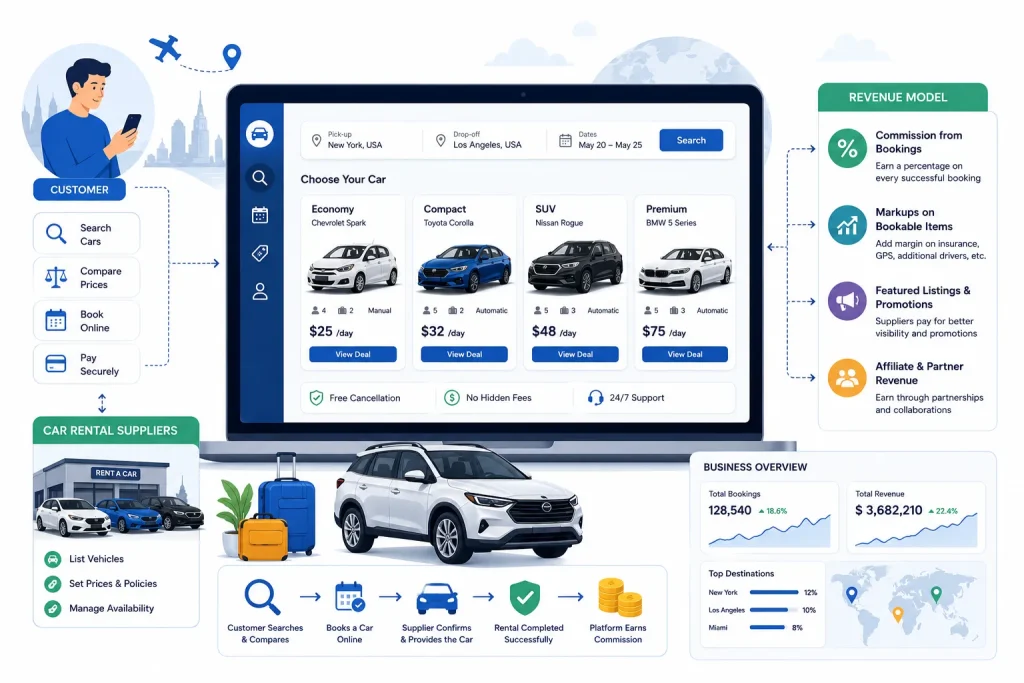
At its core, Rentalcars operates as a global travel marketplace and aggregator platform. Instead of owning vehicles or running rental branches, the company connects travelers searching for rental cars with rental companies that supply them.
The platform acts as the digital middle layer between demand (travelers) and supply (car rental providers), simplifying price comparison, booking, and payment processing.
This asset-light model allows Rentalcars to scale globally without the capital-heavy burden of owning fleets — a strategy that has proven extremely effective in the modern platform economy of 2026.
Type of Business Model
Rentalcars operates using a hybrid marketplace + commission model.
Primary structure:
- Marketplace Aggregator
- Commission-based revenue model
- B2C distribution platform
- Travel-tech ecosystem player
Similar platforms include:
- Booking.com (hotels)
- Expedia (travel aggregator)
- Skyscanner (flight comparison)
However, Rentalcars specializes specifically in vehicle rentals, making it one of the largest car rental comparison engines globally.
Core Value Proposition
Rentalcars delivers value to multiple user groups simultaneously, which is key to any successful marketplace.
1. Travelers (Consumers)
For customers, Rentalcars simplifies what is usually a complicated travel decision.
Key benefits include:
- Instant price comparison across multiple providers
- Access to 900+ rental brands globally
- Transparent pricing and insurance options
- Multi-language support (40+ languages)
- One unified booking interface
Instead of visiting 10 rental company websites, users can compare everything in one search.
2. Car Rental Companies (Suppliers)
Rentalcars provides massive customer acquisition and distribution power for rental companies.
Benefits include:
- Access to a global customer base
- Increased fleet utilization
- International exposure
- Booking infrastructure without building their own platform
- Marketing support through Booking Holdings’ ecosystem
For many regional rental companies, Rentalcars acts as a primary digital sales channel.
3. Booking Holdings Ecosystem
Since Rentalcars is owned by Booking Holdings, it integrates with other travel platforms like:
- Booking.com
- Agoda
- Priceline
- Kayak
This ecosystem allows cross-selling such as:
- Hotel + car bundles
- Airport travel packages
- Last-minute booking combinations
This shared traffic ecosystem dramatically reduces acquisition costs.
Evolution of the Business Model
Rentalcars did not start at its current scale.
The platform evolved through several stages:
2004 — Startup Phase
- Founded in the UK
- Focused on European rental aggregation
2010 — Acquisition
- Purchased by Priceline Group (now Booking Holdings)
2015–2020 — Global Expansion
- Integrated with Booking.com traffic
- Expanded supplier partnerships
2021–2026 — Platform Optimization
- AI pricing comparison
- Dynamic insurance upsells
- Mobile-first booking experiences
Today the company functions as a fully integrated global travel distribution platform.
Why the Model Works in 2026
Several modern trends make the Rentalcars model even stronger today.
1. Platform Economy Dominance
Consumers prefer aggregators over individual service providers.
Examples:
- Amazon vs individual stores
- Uber vs taxi companies
- Booking.com vs hotel direct booking
Rentalcars benefits from this shift.
2. Global Travel Recovery & Growth
International tourism in 2025–2026 has surpassed pre-pandemic levels, increasing demand for flexible transportation options.
Car rentals are especially important for:
- airport travel
- road trips
- regional tourism
3. Asset-Light Scalability
Because Rentalcars does not own vehicles, its growth is limited only by:
- platform technology
- supplier onboarding
- marketing reach
This allows high-margin scaling compared to traditional rental companies.
For companies like Miracuves, this type of aggregator marketplace architecture is a proven framework when building scalable booking or mobility platforms.
Target Market & Customer Segmentation Strategy
To understand how Rentalcars scaled into a global car rental marketplace, we must examine who its users are and how the company strategically captures demand across different traveler segments.
Unlike traditional rental companies that focus mostly on local or airport customers, Rentalcars targets a global digital-first audience, primarily travelers who prefer online booking and price comparison before arriving at their destination.
By positioning itself as a travel planning tool rather than just a rental provider, Rentalcars successfully attracts millions of users across leisure and business travel markets.
Primary Customer Segments
Rentalcars focuses on two main demand groups with slightly different motivations and booking behaviors.
1. International Leisure Travelers
This is the largest customer segment for Rentalcars.
Typical characteristics:
- Tourists traveling internationally
- Age group: 25–55
- Prefer planning transportation before arriving
- Highly price-sensitive
- Compare multiple rental options before booking
Common use cases:
- Airport pickups
- Vacation road trips
- Regional travel between cities
These travelers rely heavily on comparison platforms to find the best deal quickly.
2. Business Travelers
A smaller but high-value segment.
Characteristics:
- Frequent travelers
- Corporate travel planners
- Higher willingness to pay for convenience
Their needs include:
- Fast booking
- Reliable brands
- Flexible cancellation
- Premium vehicle categories
This segment helps increase average booking value.
Secondary Customer Segments
Beyond individual travelers, Rentalcars also captures demand from several additional sources.
Travel Platforms & Booking Ecosystems
Rentalcars receives traffic from:
- Booking.com
- Agoda
- Kayak
- Priceline
Users booking hotels or flights often add car rentals as a bundled travel component.
Travel Agencies & Corporate Travel Managers
Some agencies integrate Rentalcars into their booking workflows to provide:
- multiple supplier options
- competitive pricing
- centralized booking systems
Digital Nomads & Long-Term Travelers
A fast-growing segment in 2025–2026.
These users need:
- flexible rental durations
- multi-country travel options
- easy cancellation policies
This segment benefits from Rentalcars’ global coverage.
Customer Journey: Discovery → Conversion → Retention
Rentalcars optimizes the entire customer journey to maximize conversion and lifetime value (LTV).
1. Discovery
Users typically discover Rentalcars through:
- Google travel searches
- Booking.com integrations
- travel blogs and affiliate sites
- airport transportation searches
Example search intent:
- “Car rental Barcelona airport”
- “Cheap rental car in Dubai”
SEO plays a major role in traffic acquisition.
2. Conversion
Once users land on the platform, conversion is driven by:
- price comparison tables
- trust signals and ratings
- transparent insurance options
- simplified checkout process
Conversion boosters include:
- limited-time pricing
- “best value” labels
- supplier ratings
3. Retention
Rentalcars encourages repeat usage through:
- loyalty benefits via Booking Holdings ecosystem
- email remarketing campaigns
- travel reminder notifications
- future trip discounts
Many users return when planning their next international trip.
Customer Segment Analysis
| Segment | Needs | Value Provided | Revenue Impact |
| Leisure Travelers | Cheap rentals, easy comparison | Price transparency and variety | High volume |
| Business Travelers | Speed and reliability | Trusted suppliers | High booking value |
| Travel Platforms | Integrated services | API integrations | Cross-sell revenue |
| Travel Agencies | Multiple supplier options | Centralized booking | B2B bookings |
| Digital Nomads | Flexibility | Global vehicle access | Growing segment |
Understanding these segments reveals a critical insight:
Rentalcars succeeds not by owning vehicles, but by owning the customer discovery process.For companies like Miracuves, this principle is essential when building marketplace platforms — controlling demand aggregation often matters more than owning supply.
Revenue Streams and Monetization Design
After understanding who uses Rentalcars, the next critical question is: how does the platform generate revenue?
Rentalcars follows a multi-layered monetization strategy built around commissions, insurance products, and platform optimization. Because the company doesn’t own vehicles, its revenue model focuses on facilitating transactions and adding value through services.
This structure allows Rentalcars to scale globally while maintaining high-margin digital revenue streams.
Primary Revenue Stream: Commission from Rental Companies
The core revenue driver for Rentalcars is commission on each completed booking.
How It Works
When a user books a car through Rentalcars:
- The customer pays through the platform (or sometimes directly to the supplier).
- The rental company fulfills the service.
- Rentalcars receives a commission for generating the booking.
Typical commission range:
- 15% – 30% per booking
The exact percentage varies depending on:
- supplier agreements
- location
- booking volume
- promotional placement
Why Suppliers Accept This
Car rental companies benefit because Rentalcars provides:
- international customers
- digital marketing reach
- booking infrastructure
- customer acquisition
For many smaller rental providers, Rentalcars acts as a global distribution channel.
Secondary Revenue Stream #1: Insurance & Protection Packages
One of the most profitable monetization layers is rental protection coverage.
When customers book a car, Rentalcars offers optional add-ons such as:
- Collision Damage Waiver (CDW)
- Theft protection
- Full coverage packages
- Refundable excess insurance
These insurance products typically carry higher margins than commissions.
Why this works:
- Customers want peace of mind while traveling
- Rental companies often charge high coverage fees
- Rentalcars can offer competitive alternatives
Insurance add-ons can significantly increase average order value (AOV).
Secondary Revenue Stream #2: Premium Placement for Rental Companies
Rentalcars also monetizes its search visibility.
Rental companies can pay for:
- promoted listings
- “recommended supplier” badges
- priority search placement
This is similar to sponsored listings in travel marketplaces.
Benefits for suppliers:
- increased visibility
- higher booking probability
Benefits for Rentalcars:
- additional advertising revenue
- improved marketplace liquidity
Secondary Revenue Stream #3: Cross-Selling Travel Services
Because Rentalcars is integrated into the Booking Holdings ecosystem, it can cross-sell services such as:
- hotels
- flights
- airport transfers
- travel insurance
Example customer journey:
Hotel booked on Booking.com → prompt appears:
“Need a car for your trip?”
This cross-selling increases the lifetime value of travelers within the ecosystem.
Secondary Revenue Stream #4: Affiliate Revenue
Rentalcars partners with thousands of travel websites and bloggers.
These partners:
- promote Rentalcars search tools
- earn commissions on bookings
This creates a performance-based marketing ecosystem where Rentalcars pays only when bookings occur.
It’s a low-risk customer acquisition model.
Secondary Revenue Stream #5: Currency Conversion & Payment Fees
International travelers often pay in different currencies.
Rentalcars may earn revenue from:
- currency exchange margins
- international payment processing
- booking service fees
While smaller compared to commissions, these fees contribute to overall revenue.
For companies like Miracuves, building a successful marketplace means designing flexible revenue architecture that supports commissions, add-ons, and ecosystem integrations from day one.
Operational Model & Key Activities
Behind the seamless booking experience of Rentalcars lies a complex operational engine that manages global supplier integrations, customer support, pricing optimization, and platform infrastructure.
Because Rentalcars operates in 160+ countries and integrates hundreds of rental providers, its operational model focuses heavily on technology automation, supplier management, and scalable platform infrastructure.
Unlike traditional rental companies that manage fleets, Rentalcars runs a digital-first operations system designed to support millions of bookings each year.
Core Operations
Platform Management
The platform itself is the heart of the business.
Key responsibilities include:
- Managing the search and comparison engine
- Processing global bookings in real time
- Maintaining supplier APIs and integrations
- Handling booking modifications and cancellations
- Ensuring platform security and uptime
The search system must constantly update:
- vehicle availability
- pricing changes
- supplier inventory
This ensures users always see accurate, real-time options.
Technology Infrastructure
Rentalcars relies heavily on cloud infrastructure and data systems to handle massive traffic volumes.
Key tech capabilities include:
- AI-powered price comparison algorithms
- dynamic search ranking
- mobile app optimization
- secure payment processing
- multilingual interface support
The platform also integrates with hundreds of supplier systems via APIs, enabling automated booking confirmation.
Supplier & Inventory Management
Rentalcars maintains partnerships with 900+ global and regional rental brands.
Operational teams handle:
- supplier onboarding
- contract negotiations
- inventory integration
- performance monitoring
They also ensure suppliers meet service quality standards, since customer experience directly affects the platform’s reputation.
Customer Support & Experience
Because travel plans often change, Rentalcars provides 24/7 multilingual customer support.
Support teams assist with:
- booking changes
- cancellation requests
- insurance claims
- supplier coordination
Customer satisfaction is critical because reviews and ratings influence future bookings.
Marketing & Demand Generation
Operational marketing teams focus on:
- search engine optimization (SEO)
- travel keyword advertising
- retargeting campaigns
- affiliate partnerships
The goal is to ensure Rentalcars appears when travelers search for:
- airport car rentals
- destination-specific rentals
- last-minute transportation
Resource Allocation
To maintain a global marketplace, Rentalcars invests across several operational areas.
Technology Investment
A significant portion of resources goes toward platform development.
Typical priorities include:
- search engine optimization algorithms
- mobile experience improvements
- AI-based pricing recommendations
- fraud detection and payment security
Technology investment is essential because the platform must remain faster and more reliable than competitors.
Marketing & Customer Acquisition
A large operational budget is dedicated to traffic generation.
Major channels include:
- Google travel searches
- affiliate travel websites
- cross-promotion within Booking Holdings platforms
Because the company operates in a competitive travel market, customer acquisition efficiency is crucial.
Operations Flowchart
A simplified operational cycle looks like this:
Traveler Search
↓
Platform Price Comparison
↓
Supplier Inventory Integration
↓
Customer Booking & Payment
↓
Supplier Fulfillment (Vehicle Pickup)
↓
Insurance & Add-on Upsell
↓
Customer Support & Review
↓
Supplier Performance Optimization
The operational strength of Rentalcars lies in technology-driven coordination rather than physical asset management.
Instead of managing vehicles, the company manages data, partnerships, and customer experiences — which is far more scalable.
For companies like Miracuves, this operational approach highlights the importance of building robust marketplace infrastructure capable of handling global suppliers and millions of transactions.
Strategic Partnerships & Ecosystem Development
One of the biggest reasons behind Rentalcars’ global success is its powerful partnership-driven ecosystem strategy. Instead of operating in isolation, the platform collaborates with travel companies, technology providers, rental suppliers, and financial partners to create a seamless travel experience.
This ecosystem approach allows Rentalcars to scale rapidly across regions while maintaining a strong network effect between travelers and suppliers.
In the platform economy of 2026, no travel marketplace grows alone — success depends on building a connected ecosystem of services that support the customer journey.
Collaboration Philosophy
Rentalcars follows a “distribution-first” partnership philosophy.
The idea is simple:
- Partner with as many travel touchpoints as possible
- Integrate services directly into customer booking journeys
- Allow partners to benefit from shared demand
This ensures that whenever someone plans a trip, car rentals appear naturally as part of the travel planning process.
Technology & API Partners
Technology integrations are essential for keeping the platform operational and scalable.
Key technology partnerships include:
- Car rental supplier APIs that connect fleet inventory to the platform
- Cloud infrastructure providers that support large-scale booking traffic
- mapping and location services for pickup and drop-off navigation
- data analytics platforms for pricing optimization and demand forecasting
These integrations ensure that:
- vehicle availability updates instantly
- bookings confirm in real time
- pricing remains competitive
Without strong API partnerships, a global aggregator like Rentalcars could not operate efficiently.
Payment & Financial Service Partnerships
Since Rentalcars processes bookings from travelers worldwide, secure payment infrastructure is critical.
Key payment ecosystem partners include:
- global payment gateways
- digital wallet providers
- currency conversion services
- fraud detection systems
These partnerships enable:
- multi-currency payments
- secure international transactions
- simplified refunds and cancellations
For travelers, this means a smooth checkout experience regardless of location.
Read more : Best Rentalcars Clone Script 2026: Build Your Own Car Rental Marketplace
Growth Strategy & Scaling Mechanisms
Scaling a global travel platform like Rentalcars requires more than just supplier listings. The company’s growth strategy relies on three powerful engines: ecosystem distribution, data-driven marketing, and geographic expansion.
Because Rentalcars operates within the Booking Holdings travel network, it benefits from a built-in growth advantage — millions of travelers already using related platforms. By combining this traffic with smart acquisition strategies and product innovation, Rentalcars has been able to expand into 160+ countries while maintaining steady booking growth.
Let’s break down the mechanisms that power this scale.
Growth Engine 1: Organic Virality & Platform Traffic
One of Rentalcars’ biggest growth drivers is organic traffic from the Booking Holdings ecosystem.
Platforms that funnel users into Rentalcars include:
- Booking.com
- Kayak
- Agoda
- Priceline
This creates a powerful travel planning funnel.
Example user flow:
Traveler searches for flights on Kayak
↓
Books a hotel on Booking.com
↓
Receives a prompt: “Add a rental car for your trip”
Because these services share data and user behavior insights, Rentalcars can target users at the exact moment they need transportation.
This dramatically improves conversion rates.
Growth Engine 2: Search Engine Dominance (SEO)
Rentalcars invests heavily in search engine optimization, targeting high-intent travel queries.
Examples include:
- “Car rental Barcelona airport”
- “Cheap car rental Dubai”
- “Best rental car in Los Angeles”
These searches indicate immediate purchase intent, making them extremely valuable.
SEO strategies include:
- location-based landing pages
- travel guide content
- airport rental comparisons
- localized websites in 40+ languages
This approach generates millions of organic visitors every month.
Growth Engine 3: Paid Marketing & Retargeting
While organic traffic is crucial, Rentalcars also uses paid advertising to capture demand quickly.
Key channels include:
- Google Ads
- travel comparison ads
- display remarketing campaigns
- mobile app promotion
Retargeting campaigns are particularly effective.
Competitive Strategy & Market Defense
The global travel booking industry is intensely competitive. Platforms like Expedia, DiscoverCars, Auto Europe, Kayak, and Skyscanner all compete to capture the same traveler demand. Yet Rentalcars has managed to maintain a strong market position by combining distribution dominance, data-driven optimization, and ecosystem advantages.
Its strategy is not simply about offering rental cars — it is about owning the traveler’s booking journey within a broader travel ecosystem.
Core Competitive Advantages
Rentalcars maintains its leadership through several structural advantages that are difficult for competitors to replicate.
1. Network Effects
Rentalcars benefits from a classic two-sided marketplace network effect.
The more rental companies join the platform:
- the more vehicle options become available
- the more competitive the prices become
- the more travelers choose the platform
This increased demand then attracts even more rental suppliers, strengthening the marketplace further.
Over time, this cycle creates self-reinforcing growth.
2. Booking Holdings Ecosystem Power
One of the biggest competitive advantages is being part of Booking Holdings, one of the largest travel technology companies in the world.
This provides Rentalcars access to:
- massive global traffic
- integrated travel booking flows
- cross-selling opportunities
Platforms contributing traffic include:
- Booking.com
- Kayak
- Agoda
- Priceline
This ecosystem gives Rentalcars a built-in distribution network that many competitors lack.
3. Brand Trust & Customer Confidence
Travelers often prefer trusted platforms when booking transportation abroad.
Rentalcars builds trust through:
- transparent pricing
- verified supplier ratings
- global brand reputation
- multilingual support
Since the platform connects users to major rental brands like Hertz, Enterprise, and Avis, customers feel more confident booking through it.
4. Data-Driven Personalization
Modern travel platforms compete heavily on data intelligence.
Rentalcars uses behavioral data to optimize:
- search ranking algorithms
- pricing recommendations
- vehicle suggestions
- location-based deals
For example:
- frequent business travelers may see premium vehicle options first
- budget travelers may see low-cost suppliers highlighted
This improves conversion rates and customer satisfaction.
5. Technology & Search Optimization
Rentalcars continuously invests in improving its platform technology.
Key innovation areas include:
- AI-powered price comparison
- mobile-first booking design
- dynamic search filters
- faster booking confirmations
Speed and usability are crucial in travel booking — users often choose the platform that shows the best options fastest.
Competitive Landscape Snapshot
Key competitors in the global rental marketplace include:
| Competitor | Strength | Weakness |
| Expedia | Large travel ecosystem | Less specialized in car rentals |
| DiscoverCars | Strong price comparison | Smaller global reach |
| Auto Europe | Long-standing rental aggregator | Limited tech innovation |
| Kayak | Huge search traffic | Not a dedicated rental marketplace |
Rentalcars stands out due to its combination of specialization and ecosystem integration.
Lessons for Entrepreneurs & Implementation
Studying the Rentalcars business model reveals powerful insights for entrepreneurs building modern digital platforms. The company didn’t succeed by owning cars or building massive physical infrastructure. Instead, it focused on aggregating demand, connecting suppliers, and building a scalable marketplace ecosystem.
For founders planning to launch travel, mobility, or service marketplaces, Rentalcars provides a practical blueprint for building a profitable, asset-light platform.
Key Factors Behind Rentalcars’ Success
Several strategic principles helped Rentalcars scale globally.
1. Asset-Light Marketplace Strategy
Rentalcars does not own vehicles, which dramatically reduces operational complexity.
Instead, the platform focuses on:
- connecting demand and supply
- facilitating transactions
- optimizing customer experience
This allows the company to scale across 160+ countries without owning physical assets.
For startups, this means technology and partnerships can replace heavy infrastructure investments.
2. Control of the Discovery Funnel
Rentalcars positioned itself where travelers start their search.
Instead of competing with rental companies directly, it became the comparison layer that customers trust.
This approach provides major advantages:
- higher customer traffic
- supplier competition on the platform
- stronger pricing transparency
Controlling the customer discovery stage often creates the biggest strategic advantage in digital marketplaces.
3. Ecosystem Integration
Rentalcars benefits enormously from being part of the Booking Holdings ecosystem.
This ecosystem creates natural cross-selling opportunities:
Hotel booking → suggest rental car
Flight search → offer transportation
Travel planning → bundle services
For entrepreneurs, this highlights the value of building products that integrate into larger digital ecosystems.
4. Multiple Revenue Streams
Successful marketplaces rarely rely on a single monetization model.
Rentalcars generates revenue through:
- booking commissions
- insurance add-ons
- supplier promotions
- affiliate partnerships
This diversified revenue structure increases profitability while keeping the core service accessible to users.
Example Startup Implementation
Entrepreneurs can structure their marketplace launch in stages.
Phase 1 – Market Validation
- identify fragmented supply industry
- validate customer demand
- onboard initial suppliers
Phase 2 – Platform Development
- build marketplace infrastructure
- integrate payment systems
- launch search and booking features
Phase 3 – Growth & Partnerships
- expand supplier network
- invest in SEO and marketing
- form distribution partnerships
Phase 4 – Monetization Expansion
- add premium listings
- introduce add-on services
- expand geographically
Ready to implement Rentalcars’ proven marketplace strategy for your own industry?
Miracuves specializes in building scalable digital platforms with validated business models and growth frameworks.
Get your free business model consultation today and start building your next platform success story.
Conclusion
The Rentalcars business model proves that in the modern digital economy, success often comes from platform innovation rather than asset ownership. By positioning itself as a global aggregator between travelers and rental companies, Rentalcars created a scalable marketplace that simplifies transportation booking across 160+ countries.
For entrepreneurs, the biggest takeaway is clear: the platforms that control discovery, comparison, and transaction flow often dominate entire industries.
As we move deeper into the platform economy of 2026 and beyond, businesses that successfully combine technology, partnerships, and customer trust will continue to reshape traditional industries—just as Rentalcars did for the global car rental market.
FAQs
What type of business model does Rentalcars use?
How does Rentalcars’ model create value?
What are the key success factors of Rentalcars?
How scalable is the Rentalcars business model?
What are the biggest challenges for Rentalcars?
How can entrepreneurs adapt the Rentalcars model in their region?
What are alternatives to the Rentalcars model?
How has the Rentalcars business model evolved over time?
Related Article
Miracuves is an independent software development company. We are not affiliated with, connected to, sponsored by, or endorsed by any company or product named in this article.
Terms such as “X Clone” are used descriptively. It is how the software industry refers to building a platform with functionality comparable to a known service, and how clients search for it.
The entire design and codebase of our products is built by our own team. Our products contain no code, design, graphics, or content originating from any third-party website or applications.
All third-party names and marks referenced in this article are the property of their respective owners, referenced solely to identify the services discussed.