
Key Takeaways
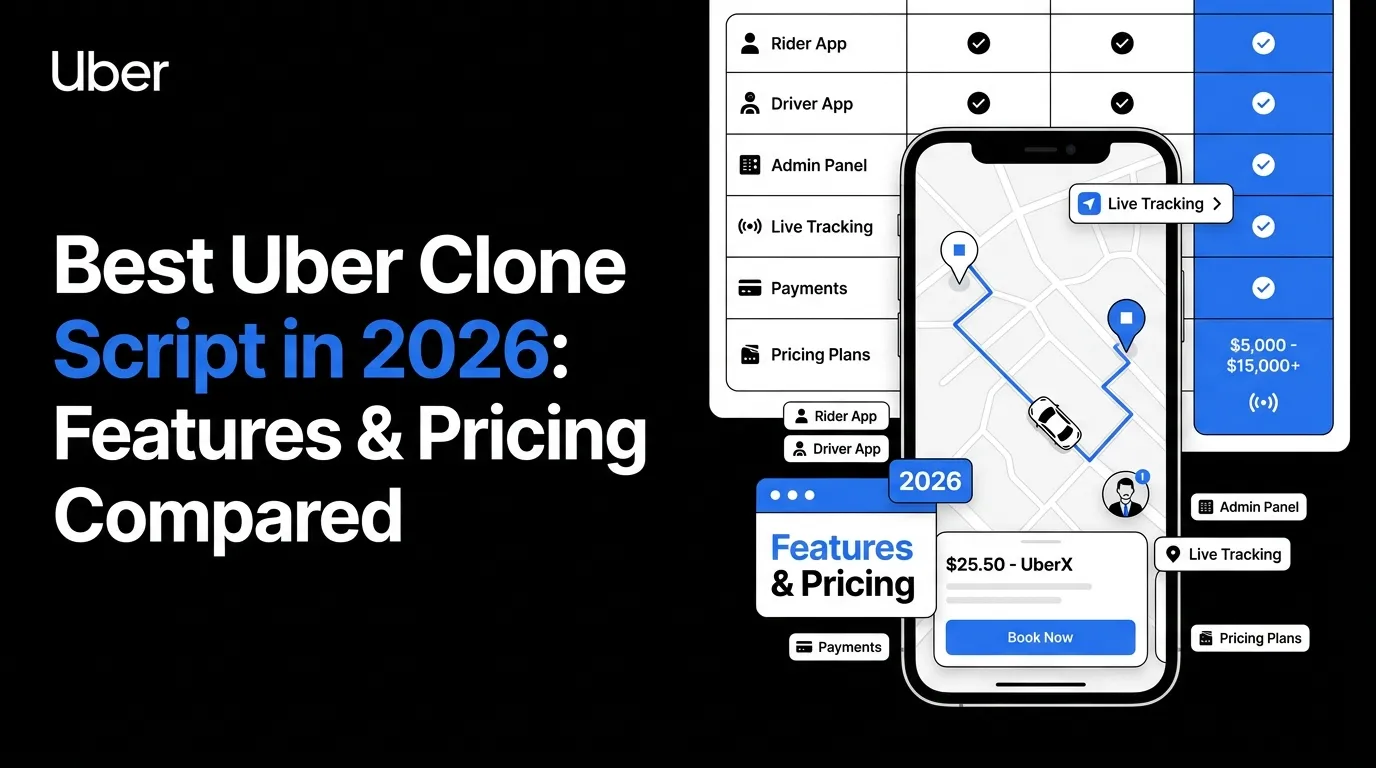
- An Uber clone script helps startups launch a ride-hailing platform faster with ready-made rider, driver, and admin workflows.
- Riders, drivers, dispatch teams, payment partners, and admins need connected app functionality.
- Ride booking, driver matching, fare calculation, GPS tracking, payments, ratings, and trip history are core features.
- Pricing depends on app platforms, feature scope, map APIs, payment integrations, customization, and scalability needs.
- A strong Uber clone script can reduce development time while supporting safer and more reliable ride operations.
Feature Signals
- Riders need simple onboarding, pickup selection, fare estimates, ride booking, live tracking, and secure checkout.
- Drivers need ride requests, route navigation, trip status updates, earnings tracking, availability control, and payouts.
- Admins need control over riders, drivers, trips, fares, commissions, disputes, payments, reports, and service zones.
- Map integration, GPS accuracy, fare logic, and dispatch rules help improve booking reliability.
- Real-time notifications keep riders and drivers updated on bookings, arrivals, cancellations, payments, and trip completion.
Real Insights
- A ride-hailing app needs strong dispatch logic before it can handle peak demand and multiple service areas.
- Weak location tracking can increase wait times, wrong pickups, cancellations, and rider complaints.
- Clear fares, ETA updates, driver details, and trip records help users trust the platform.
- Driver verification, ratings, payment security, and dispute handling improve safety and marketplace quality.
- Miracuves builds Uber Clone apps with rider apps, driver apps, dispatch workflows, payments, live tracking, and admin control.
In this guide, you will learn how Uber clone scripts work, which features matter most in 2026, how pricing changes by platform depth, what founders should check before buying, and when a ready-made Uber-like app solution makes better business sense than custom development from scratch.
If you are comparing Uber clone scripts in 2026, you are probably not just looking for code. You are trying to understand whether a ready-made ride-hailing platform can help you launch faster, control operations, manage drivers, accept payments, and validate demand without building everything from zero.
That is the right way to evaluate an Uber clone script. The real question is not “Which script is the cheapest?” The better question is: “Which solution gives me the rider app, driver app, admin panel, dispatch logic, payment flow, source code, customization flexibility, and launch support needed to run a real ride-hailing business?”
For founders who want to move beyond research and see a product-ready option, Miracuves offers a ready-made Uber-like app solution. This blog still helps you compare features and pricing, but it also shows what to check before choosing a ride-hailing app foundation for your market.
Let’s break down what separates a practical Uber clone script from a basic app template.
What Exactly Is an Uber Clone Script?
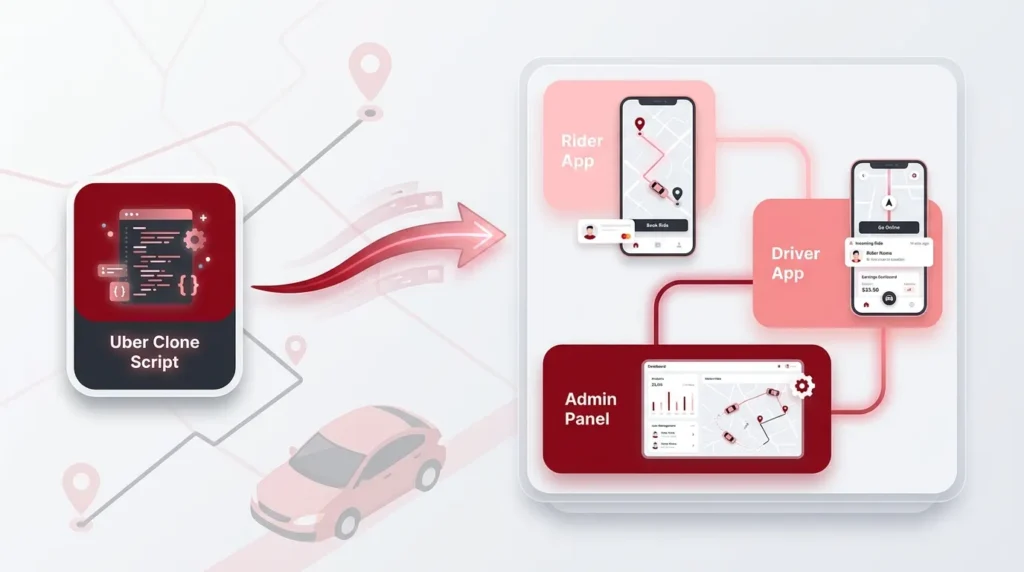
An Uber clone script is a prebuilt software foundation that replicates the core functionality of a ride-hailing app. It usually includes a rider app, driver app, admin dashboard, geolocation, ride booking, fare calculation, payment handling, and trip management.
A good Uber clone script is not a fake Uber. It is a customizable ride-hailing business foundation that lets you launch your own branded taxi booking or mobility platform using proven product flows.
Modern Uber clone scripts are more flexible than older taxi app templates. Depending on the platform, you may be able to support daily rides, rentals, outstation trips, shared rides, bike taxis, fleet management, driver subscriptions, wallets, promo codes, and regional payment gateways.
The main value is speed. Instead of spending months building basic ride-hailing workflows from scratch, founders can begin with a launch-ready foundation and customize it for their market, brand, pricing model, and business logic.
Read More: Top 14 Must-Have Features in an Uber Clone for Ride-Hailing Success
What Turns an Uber Clone Script Into a Real Ride-Hailing Business?
A script is only the starting point. A real ride-hailing business needs operational control. That means you should look beyond the rider-facing app and check whether the platform can support driver onboarding, live ride tracking, fare rules, commissions, cancellations, refunds, dispute handling, payment settlements, promo campaigns, and admin reporting.
For a founder, this matters because the backend decides how quickly you can respond to daily business problems. Can you adjust pricing by city? Can you manage driver payouts? Can you monitor active rides? Can you handle support issues without asking developers for every small change?
A strong Uber clone script should give you three layers:
- Rider and driver experience: booking, tracking, payments, ratings, notifications, and trip history.
- Operations layer: admin dashboard, driver management, ride monitoring, fare control, dispute handling, reports, and payouts.
- Growth layer: referral campaigns, promo codes, corporate rides, subscriptions, multiple ride types, and regional customization.
- When these three layers work together, the script becomes more than software. It becomes a launch-ready foundation for a ride-hailing business.
Read More: How to Build a Ride-Hailing App like Uber : A Complete Guide
Must-Have Features in 2026 Uber Clone Scripts
A practical Uber clone script should not only look good on the front end. It should help the business operate rides, manage users, control pricing, and resolve issues at scale.
Real-Time Ride Matching and GPS Tracking
Real-time ride matching connects riders with nearby available drivers. This is one of the most important features in any ride-hailing app because it directly affects wait time, driver utilization, and user satisfaction.
The platform should support live driver location, route visibility, pickup tracking, drop-off tracking, and map integration. For founders, this feature is not just technical. It shapes the trust users place in the platform.
Dynamic Fare Calculation
Your platform should support multiple pricing models, including distance-based pricing, time-based pricing, flat fares, surge pricing, waiting charges, rental pricing, and promotional discounts.
Dynamic fare logic gives founders more control over local market conditions. For example, pricing may need to change by city, time of day, vehicle type, demand level, airport route, or driver availability.
In-App Chat and Call
Riders and drivers often need to communicate before pickup. In-app chat and call features help reduce cancellations, missed pickups, and support tickets.
For stronger privacy, the platform should support masked communication where possible, so users and drivers do not need to expose personal phone numbers unnecessarily.
Digital Wallet and Multiple Payment Gateways
A ride-hailing app should support multiple payment options because user habits vary by market. Cash, card, wallet, local payment gateways, and promo balance support can all improve adoption.
Wallet logic is also important for driver payouts, refunds, promotional credits, referral bonuses, and platform-managed balances.
Ratings, Reviews, and Dispute Resolution
Ratings and reviews help maintain service quality. Riders should be able to rate drivers, drivers should be able to rate riders where relevant, and the admin team should have visibility into complaints.
A serious platform should also include dispute handling, cancellation reason tracking, refund workflows, and support management.
Admin Superpowers
A powerful admin panel allows the platform operator to manage users, drivers, vehicles, rides, payments, commissions, incentives, disputes, cancellations, reports, and promotions.
Without a strong admin dashboard, even a polished rider app can become difficult to manage once real users, drivers, and payments start moving through the platform.
Why These Features Matter for Founders
Features should not be evaluated only by how impressive they sound. They should be evaluated by the business problem they solve.
Real-time tracking improves rider trust and reduces pickup confusion. Dynamic fare calculation helps you control pricing across distance, time, demand, waiting charges, and local market conditions. Wallets and multiple payment gateways make the platform more accessible across regions where user payment habits differ. Ratings, reviews, and dispute tools help protect service quality.
The admin panel is especially important. It gives the platform operator visibility into rides, drivers, users, commissions, cancellations, promo codes, reports, and support issues. Without a strong admin layer, even a good-looking Uber-like app can become difficult to operate once real users, drivers, and payments start flowing through the system.
Read More: The Future of Ride-Hailing Apps: Why Uber Clone is Leading the Charge
Pros and Cons of Using an Uber Clone Script
| Factor | Advantage | What to Check Before You Choose |
|---|---|---|
| Launch speed | You can avoid building every rider, driver, payment, and admin workflow from scratch. | Check whether deployment, branding, app publishing, and basic configuration are included. |
| Cost efficiency | A ready-made script can reduce early development cost compared with a fully custom build. | Confirm what is included in the quoted price and what counts as extra customization. |
| Source-code ownership | Source code gives you more long-term control over customization and future development. | Avoid closed systems where you cannot access or modify the code. |
| Admin control | A strong backend helps manage drivers, rides, pricing, payouts, disputes, and promotions. | Ask for an admin panel demo before purchase. |
| Customization | You can adapt the platform for local pricing, languages, vehicle types, ride categories, and branding. | Check whether customization affects launch time and final cost. |
| Scalability | A good foundation can support city-wise expansion, more drivers, and new service types. | Review architecture, hosting setup, database structure, and support options. |
The biggest risk is choosing a script only because it looks affordable. A low-cost script can become expensive later if it lacks source code, proper admin controls, payment flexibility, or reliable support. The better decision is to compare total launch value, not just initial price.
Read More: Uber Clone vs. InDrive Clone: Which Ride-Hailing Platform is More Scalable?
What Actually Affects Uber Clone Script Pricing?
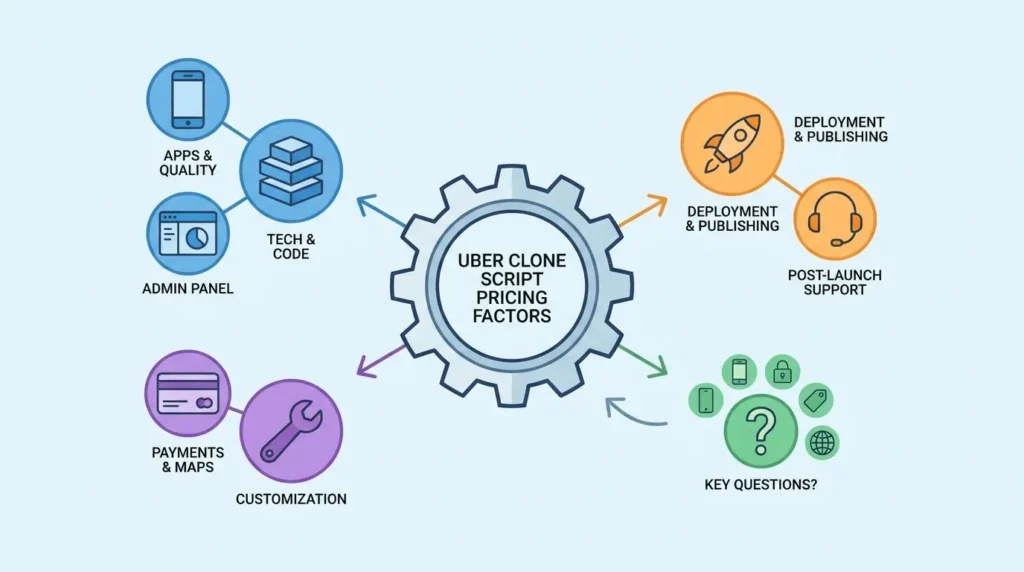
Uber clone script pricing depends on more than the app screens. The final cost changes based on the tech stack, source-code access, rider and driver app quality, admin dashboard depth, payment gateway integrations, map APIs, customization scope, deployment support, app publishing, and post-launch support.
For founders, the pricing decision should be tied to launch goals. A basic script may be enough for a small pilot, but a serious ride-hailing platform needs stable ride matching, transparent fare logic, driver management, payment tracking, safety controls, and admin visibility.
Before comparing prices, ask these questions:
- Does the price include rider and driver apps?
- Is the admin panel included?
- Do I get source code access?
- Are branding and deployment included?
- Can I add local payment gateways?
- Can the platform support multiple cities or ride categories?
- What support is included after launch?
This keeps the pricing conversation practical and prevents you from choosing a script that looks inexpensive upfront but becomes difficult to operate later.
Uber-Style Ride-Hailing Platform: Cost by Build Approach
| Build Option | Cost Logic | Best For | What to Check |
| Basic script purchase | Lower upfront cost, but may require more setup, integrations, and technical work. | Founders testing a small local idea with limited customization. | Source-code access, payment setup, app publishing, support, and admin depth. |
| Ready-made Uber-like solution | Faster launch path because core workflows, branding, admin panel, and deployment support may already be included. | Founders who want to move from research to launch planning faster. | Demo, deliverables, rebranding, source code, support period, and customization scope. |
| Custom ride-hailing development | Higher cost because rider, driver, admin, backend, APIs, and workflows are built around unique requirements. | Businesses with highly specific workflows or large-scale technical needs. | Timeline, architecture, product roadmap, development team, and maintenance cost. |
| Enterprise mobility platform | Higher investment due to advanced dispatch, multi-city operations, fleet tools, analytics, and high-concurrency infrastructure. | Large operators, fleet networks, or multi-region mobility businesses. | Scalability, reporting, infrastructure, security, and operational controls. |
Tech Stack and Pricing Considerations
| Tech Stack | Typical Use Case | Cost Logic | Founder Consideration |
| PHP/Laravel with Flutter apps | Practical launch-ready taxi booking platforms and cost-efficient ride-hailing solutions. | Often more accessible for startups because development and maintenance talent is widely available. | Good fit when faster deployment and maintainable operations matter. |
| Node.js or Python backend | Real-time-heavy platforms with more advanced dispatch, tracking, and data workflows. | Usually requires more specialized engineering and backend planning. | Useful when real-time scale and complex logic are priorities. |
| Go or microservices architecture | Enterprise-grade ride-hailing networks with high concurrency and complex service separation. | Higher investment due to infrastructure and engineering depth. | Better for mature operators planning large-scale expansion. |
The right stack depends on your launch stage. A startup entering one or two cities may not need enterprise-grade infrastructure on day one. However, the platform should still be built well enough to support ride tracking, driver availability, fare calculations, payment records, and future expansion.
Miracuves Uber-Like App Solution Cost and Tech Stack
Miracuves Pricing for a Uber-Like Ride-Hailing App for $3,099 USD (One-Time Price) in just 6 days
Get a fully developed, deployment-ready ride-hailing platform modeled after Uber. Built on a stable PHP foundation, this complete package includes everything you need to launch and scale a taxi booking and mobility business:
Core Workflows: Rider registration, driver onboarding, ride booking, fare estimation, driver matching, trip acceptance, live ride tracking, cancellation flow, ride completion, ratings, and customer notifications.
Built-in Revenue Logic: Ride commissions, booking fees, dynamic pricing, cancellation charges, driver payout setup, promo codes, referral campaigns, wallet logic, and platform service fees.
Management Hub: Centralized admin dashboard, rider management, driver management, vehicle management, trip monitoring, fare controls, payment records, payout tracking, support handling, and ride analytics.
Launch-Ready: Fully prepared for your custom branding, configuration, payment gateway setup, map integration, driver onboarding, ride category setup, and immediate market entry.
Why Is Uber-Like App Development More Affordable?
Most ride-hailing apps become expensive when businesses choose fully custom development from scratch. An Uber-style platform usually needs rider apps, driver apps, admin controls, live tracking, fare calculation, booking logic, payment workflows, cancellation handling, notifications, ratings, and payout management. Building every component separately can increase both development cost and launch time.
We took a smarter, more practical approach:
You Aren’t Paying for Ground-Up Development: Our ride-hailing platform engine is already developed, tested, and ready to deploy. You avoid the inflated cost and extended timeline associated with building every mobility workflow from scratch.
The Power of PHP: We built this solution on a reliable and cost-effective PHP architecture. This keeps the upfront price affordable while supporting essential ride-hailing workflows such as rider booking, driver matching, fare calculation, live tracking, payment handling, payouts, and admin control.
You get a launch-ready Uber-like ride-hailing platform with practical mobility, monetization, and management features, along with source code access and faster deployment.
Note: This cost is for the solution, re-branding, deployment, and source code only. Payment gateway charges, hosting infrastructure, third-party map services, regional compliance requirements, and custom security integrations are not included.
Read More: Best Uber for Massage Clone Script in 2026: Features & Pricing Compared
Miracuves Uber-Like App Solution: When a Ready-Made Route Makes Sense
A ready-made Uber-like app solution makes sense when your goal is faster market entry, not experimental development from zero. Instead of spending months building core ride-booking flows, you can begin with an existing foundation that already supports important mobility workflows such as ride booking, driver matching, live tracking, fare calculation, payments, provider management, and admin control.
Miracuves positions its Uber Clone solution for founders who want a white-label, source-code-owned ride-hailing platform that can be branded, configured, and deployed faster. The product page currently highlights a ready-made offer with 6-day launch positioning, source code, rebranding, white-labeling, app publishing support, and technical support.
Use this section as a decision point. If you only need information, continue comparing features and pricing. If you are actively planning to launch, review the demo, admin panel, deliverables, support scope, and customization options before deciding.
Read More: Uber Clone App Guide: Key Features for a Successful Ride-Sharing Platform
Admin Panel, Security, and Control: What Serious Buyers Should Check
A ride-hailing app handles location data, payments, driver profiles, rider details, trip records, ratings, complaints, and payout information. That makes admin control and security important from the beginning.
Before choosing any Uber clone script, check whether the platform supports:
- Role-based admin access
- Driver and rider verification workflows
- Secure payment gateway integration
- Trip history and transaction records
- Real-time ride monitoring
- Commission and payout management
- Promo code and referral controls
- Cancellation and refund handling
- Dispute management
- SOS or emergency support features
- Activity logs and reporting
These controls matter because ride-hailing businesses depend on trust. Riders need safe bookings. Drivers need transparent earnings. Operators need visibility into every ride, payment, complaint, and performance issue. A script without strong admin and security controls may look ready, but it can create operational risk once the business starts scaling.
Read More: Business Model of Uber in 2026: How It Works & What Founders Can Learn
Monetization Models for an Uber-Like App
A ride-hailing platform should not depend on only one revenue stream. The best monetization model depends on your target market, driver supply, rider demand, competition, and local pricing expectations.
| Revenue Model | How It Works | Founder Value |
|---|---|---|
| Ride commission | The platform takes a percentage or fixed fee from each completed ride. | Simple core revenue model for most taxi booking platforms. |
| Driver subscription | Drivers pay a recurring fee for access, visibility, or lower commission. | Helps create predictable revenue if driver demand is strong. |
| Cancellation fees | Fees apply when riders or drivers cancel after a defined stage. | Protects platform time and reduces misuse. |
| Surge or demand pricing | Prices increase during peak demand, low driver availability, or special conditions. | Helps balance supply and demand. |
| Corporate rides | Businesses use the platform for employee transport or regular bookings. | Creates B2B revenue and repeat usage. |
| Ads and promotions | Local brands, drivers, or service partners pay for placement or promotions. | Adds revenue once user activity grows. |
| Rental and outstation rides | Longer ride categories generate higher order value. | Expands the platform beyond short city rides. |
For early-stage founders, the practical approach is to start with one or two monetization models and expand after real usage data becomes available. Trying to launch every revenue stream on day one can complicate the product and delay validation.
Customization Options Founders Should Consider
A good Uber clone script should support local customization. Your market may not behave exactly like Uber’s core market, so the platform should be flexible enough to support your own operating model.
Important customization areas include:
- Brand name, logo, colors, and app theme
- Local currency and payment gateways
- Local languages and regional content
- Vehicle categories such as taxi, bike, auto, luxury car, EV, or rental fleet
- Ride types such as daily rides, pool rides, rentals, outstation rides, and scheduled rides
- Fare rules by region, distance, demand, time, or service category
- Driver onboarding and document verification
- Commission models and payout cycles
- Promo codes, referrals, loyalty credits, and wallet rules
- Support workflows and cancellation policies
This is where source-code ownership becomes valuable. When you own the source code, your team has more flexibility to adapt the platform as the business learns from users, drivers, and local operating conditions.
Read More: Top 14 Must-Have Features in an Uber Clone for Ride-Hailing Success
Key Trends Driving Uber Clone Popularity in 2026
Uber clone scripts are becoming popular because founders are no longer thinking only about copying a global ride-hailing app. They are using proven mobility flows to solve local transport problems.
Rise of Niche Ride-Hailing Platforms
Many cities still have underserved mobility segments. Women-only rides, student transport, senior citizen rides, EV taxi networks, airport taxi booking, tourist rides, and local taxi union platforms can all use ride-hailing technology without copying Uber’s exact model.
More Localized Pricing Models
Local platforms can compete by creating pricing rules that match regional expectations. A city with high cash usage, local taxi associations, or different vehicle types may need a different fare structure from a global ride-hailing platform.
Fleet and Driver Digitization
Taxi operators, fleet owners, and local transport providers are using app-based platforms to modernize dispatch, ride tracking, driver visibility, and payout management.
Expansion Beyond Daily Rides
Ride-hailing apps are increasingly supporting rentals, outstation rides, shared rides, scheduled rides, corporate transport, parcel movement, and other mobility services.
Stronger Focus on Safety and Trust
Features such as SOS buttons, driver verification, live tracking, masked communication, ratings, and dispute handling are becoming more important for user confidence.
Read More: A Complete Guide to Developing a Scalable Ride-Hailing Platform
Best Use Cases for Uber Clone Platforms
Uber clone platforms can support multiple mobility business models, but the strongest use case depends on the specific market gap a founder wants to solve. A successful ride-hailing platform is not built only by copying Uber’s booking flow. It becomes valuable when it improves access, pricing, safety, driver availability, or service quality for a clearly defined audience.
For startups, an Uber clone platform can be a practical foundation for launching taxi booking services in tier-2 and tier-3 cities where users may still struggle with limited cab availability, inconsistent fares, or poor digital booking options. Local markets often need transport platforms that understand regional pricing, language preferences, driver networks, and customer expectations better than large generic platforms.
Taxi unions can also use an Uber clone platform to digitize their existing driver network. Instead of depending only on phone bookings or offline dispatching, unions can manage ride requests, driver assignments, payments, commissions, customer feedback, and service visibility through a centralized digital system. This helps them modernize operations while still maintaining control over their local driver base.
Fleet owners can use the same platform to manage drivers, vehicles, bookings, earnings, and customer communication from one admin dashboard. For businesses operating multiple vehicles, this creates better control over availability, route planning, driver performance, trip history, and payment tracking.
Uber clone platforms are also useful for airport and railway taxi booking systems, where scheduled pickups, fixed routes, verified drivers, and predictable pricing matter more than random ride discovery. Similarly, women-only ride-hailing services can use the platform to build trust through verified driver onboarding, live tracking, emergency support, ride history, and controlled safety workflows.
EV ride-hailing and green mobility platforms can position themselves around sustainable transportation, while corporate employee transport platforms can manage recurring office rides, assigned routes, staff movement, and centralized billing. Tourism and outstation ride-booking businesses can use the model for long-distance trips, hourly rentals, city tours, and pre-scheduled travel experiences.
The platform can also be customized for bike taxi services, auto-rickshaw booking, local transport networks, rental rides, and scheduled ride services. Each model works best when the business identifies a clear operational advantage, such as faster pickup times, better pricing transparency, safer rides, stronger driver management, or deeper local relevance.
The key is to choose a market where the platform can solve a real transportation problem better than existing alternatives. When the niche is clear, an Uber clone platform becomes more than a taxi booking app. It becomes a scalable mobility foundation that can be adapted around local demand, business operations, and long-term growth.
Founder Decision Signals: When to Move From Research to Demo
You should move from research to demo when you have already answered these five questions:
- Which city, region, or niche will you launch in first?
- Will your pricing model be fixed fare, dynamic fare, rental, pooling, corporate rides, or a mix?
- Do you need only taxi booking, or do you also need rentals, outstation rides, fleet management, or dispatch support?
- Which payment gateways, languages, currencies, and map providers are needed for your market?
- Do you want source-code ownership so your team can customize and scale later?
If these answers are becoming clear, the next useful step is not reading another generic script list. The next step is reviewing a working Uber-like app demo, checking the admin panel, and confirming what can be customized for your launch model.
Launch Checklist Before Choosing an Uber Clone Script
Before you finalize any Uber clone script, use this checklist:
- Confirm rider app, driver app, admin panel, and web panel availability.
- Ask for a live demo, not only screenshots.
- Review admin dashboard access and control options.
- Check whether source code is included.
- Confirm branding, white-labeling, and app publishing support.
- Ask which payment gateways are supported.
- Check map, route, and location API options.
- Review driver verification and document upload workflows.
- Confirm ride categories such as daily rides, rentals, share pool, and outstation if needed.
- Ask about hosting, deployment, maintenance, and future upgrades.
- Review support duration and what is included.
- Confirm what customization costs extra.
A reliable vendor should be able to explain what is included, what is optional, and what needs extra development. Clear scope is more important than a long feature list.
Final Thoughts: Choose an Uber Clone Script Based on Launch Readiness, Not Just Price
The best Uber clone script is not always the one with the longest feature list or the lowest upfront price. The stronger choice is the one that helps you launch with the right rider experience, driver workflow, admin control, payment setup, security foundation, customization flexibility, and source-code ownership.
For founders, the goal is not to copy Uber feature by feature. The goal is to use a proven ride-hailing model, adapt it for a specific market, and launch with enough operational control to learn from real users.
If you are still comparing options, use this blog as your checklist. If you are ready to evaluate a launch-ready product, review Miracuves’ Uber Clone solution and check the demo, deliverables, pricing, source-code access, and customization scope before making a decision.
FAQs
What should I check before buying an Uber clone script?
Before buying an Uber clone script, check the rider app, driver app, admin panel, dispatch logic, payment gateway support, real-time tracking, fare management, source-code access, branding options, deployment support, and post-launch technical support. A script should be evaluated as a business foundation, not only as app screens.
How is an Uber clone script different from an Uber clone app?
An Uber clone script usually refers to the prebuilt codebase or software foundation. An Uber clone app is the customer-facing and driver-facing product built from that foundation, usually customized with your branding, payment setup, region-specific features, and admin controls.
How much does an Uber clone script cost?
Uber clone script pricing depends on features, tech stack, source-code access, customization, payment integrations, deployment, app publishing, and support. A basic script may cost less upfront, while a launch-ready ride-hailing solution with admin control, branding, and deployment support provides stronger practical value for founders.
Why is source-code ownership important in a ride-hailing app?
Source-code ownership gives you more control over future customization, feature additions, integrations, performance improvements, and long-term scaling. Without source code access, your business may depend heavily on the original vendor for every change.
What admin panel features should an Uber-like app include?
A strong admin panel should support user management, driver management, live ride monitoring, fare settings, commission control, promo codes, reports, payouts, cancellations, refunds, dispute handling, and platform-wide analytics. This is where the operator manages the business, not just the app.
Can an Uber clone script be customized for a local market?
Yes. A good Uber clone script can be customized for local currencies, payment gateways, languages, ride types, pricing models, service zones, vehicle categories, driver rules, and branding. The level of customization depends on the script architecture and vendor support.
Is security important for an Uber-like ride-hailing app?
Yes. Ride-hailing apps handle location data, payments, user records, driver details, trip history, and support issues. Important security layers include secure payment integration, user and driver verification, role-based access, activity logs, encrypted data handling, and emergency support workflows.
When should I choose a ready-made Uber-like app solution instead of custom development?
Choose a ready-made Uber-like app solution when you want faster launch, lower initial development complexity, source-code ownership, branding flexibility, and a working app foundation. Choose custom development when your model is highly unique and cannot be supported by a ready-made ride-hailing architecture.
Related Articles
Miracuves is an independent software development company. We are not affiliated with, connected to, sponsored by, or endorsed by any company or product named in this article.
Terms such as “X Clone” are used descriptively. It is how the software industry refers to building a platform with functionality comparable to a known service, and how clients search for it.
The entire design and codebase of our products is built by our own team. Our products contain no code, design, graphics, or content originating from any third-party website or applications.
All third-party names and marks referenced in this article are the property of their respective owners, referenced solely to identify the services discussed.