

Key Takeaways
- CDN optimization plays a major role in short-video app performance because users expect videos to load instantly with minimal buffering.
- Modern TikTok-like platforms depend on edge caching, adaptive bitrate streaming, regional delivery, and optimized video routing to reduce latency.
- Faster video delivery improves watch time, feed transitions, retention rates, and overall user engagement inside short-video ecosystems.
- CDN infrastructure becomes even more important when platforms scale globally across different network conditions and mobile devices.
- Successful short-video platforms continuously optimize delivery architecture to balance speed, scalability, streaming quality, and infrastructure cost.
CDN Optimization Decision Signals
- Use edge caching to store popular videos closer to users so playback starts faster with lower latency.
- Adaptive bitrate streaming helps platforms maintain smooth playback when mobile bandwidth changes suddenly.
- Regional CDN distribution improves performance for international audiences by reducing long-distance delivery delays.
- Efficient cache-control policies help platforms balance delivery speed, storage usage, and bandwidth costs.
- Infrastructure complexity increases as platforms scale because CDN routing, transcoding, video replication, and traffic optimization require stronger backend systems.
Real Insights
- Users rarely tolerate slow-loading short videos, especially inside continuous scrolling feeds where instant playback is expected.
- Poor CDN optimization can reduce engagement because buffering interrupts the fast-consumption experience users expect from short-video apps.
- Recommendation systems also depend indirectly on delivery speed because smoother playback increases session duration and content interaction.
- Founders should treat CDN optimization as a growth infrastructure layer instead of only a backend engineering task.
- The strongest TikTok-like platforms combine scalable CDN architecture, adaptive streaming, intelligent caching, compression systems, and global delivery optimization.
Short video platforms operate in one of the most demanding delivery environments on the internet. Unlike traditional streaming services where viewers stay on a single video for long sessions, TikTok-style applications continuously load new content every few seconds as users scroll through feeds. Every swipe creates another playback request, and users expect videos to begin instantly without visible buffering or lag.
This creates a massive infrastructure challenge for businesses building modern short-video ecosystems. Even small playback delays can interrupt scrolling behavior, reduce watch duration, increase abandonment rates, and negatively affect overall engagement quality. As platforms expand globally, the problem becomes even more complex because users experience different mobile network conditions, geographic latency, and bandwidth limitations depending on their region.
Large-scale platforms like TikTok rely on globally distributed CDN infrastructure and multi-region delivery systems capable of handling billions of video requests daily. As short-video consumption continues increasing worldwide, low-latency edge delivery has become one of the most important infrastructure layers behind feed responsiveness, creator retention, and recommendation stability.
This is why CDN optimization has become a critical technical foundation behind scalable short video apps. Businesses building modern TikTok-like platforms now rely heavily on edge caching, adaptive bitrate streaming, intelligent prefetching, regional traffic routing, multi-CDN architecture, and low-latency delivery workflows specifically designed for mobile-first viewing behavior.
More importantly, delivery speed now affects far more than playback quality. CDN performance influences recommendation systems, creator reach, audience retention, infrastructure costs, and long-term platform scalability. For businesses launching TikTok-like applications, optimizing content delivery has become a core growth requirement rather than a secondary backend improvement.
Short Video Apps Break Traditional CDN Logic Here’s Why
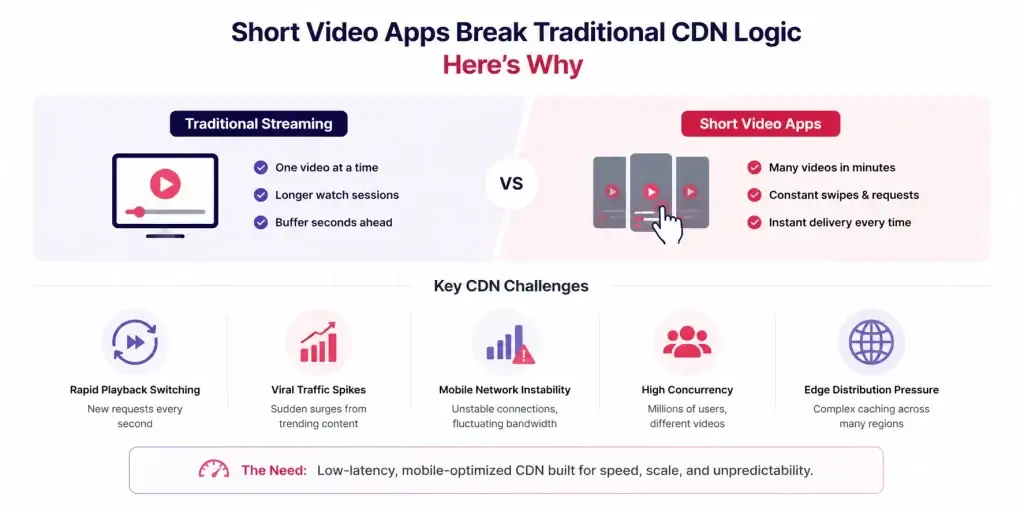
Short video applications generate completely different traffic patterns compared to traditional streaming platforms. Instead of watching one long video session, users rapidly move through dozens or even hundreds of short clips within minutes.
This behavior creates constant playback pressure across delivery infrastructure because every swipe triggers another media request that must resolve almost instantly.
A movie-streaming platform may buffer several seconds ahead because viewers usually remain on the same video for longer durations. Short video feeds cannot rely on the same delivery logic because users continuously jump between new content items.
As engagement increases, platforms usually encounter several infrastructure challenges simultaneously.
- Rapid playback switching: Users continuously generate new playback requests within seconds, forcing CDN systems to deliver video segments much faster than traditional streaming environments.
- Viral traffic concentration: A trending video can suddenly attract massive regional demand, creating unpredictable traffic spikes that overload poorly distributed infrastructure.
- Mobile network instability: Most short-video consumption happens on changing mobile connections where bandwidth quality fluctuates frequently during playback sessions.
- High concurrency pressure: Millions of viewers may request different videos simultaneously, increasing cache distribution complexity across edge regions.
These conditions require CDN systems specifically optimized for low-latency mobile delivery rather than conventional streaming architectures designed around long-form viewing sessions.
Read more – The Backend Architecture Every TikTok Clone Needs to Scale
The Delivery Stack Behind Instant Short Video Playback
A Content Delivery Network (CDN) distributes media across geographically distributed edge locations. Instead of every playback request reaching centralized origin storage, viewers receive content from nearby delivery nodes positioned closer to their location.
For short video apps, this dramatically reduces the physical distance video data must travel before playback begins.
The process usually starts when creators upload content to the platform. Videos are then transcoded into multiple resolutions and segmented into smaller streaming chunks before being replicated across regional CDN infrastructure.
When users open the app, playback requests are dynamically routed toward the nearest available edge server capable of delivering content quickly and consistently.
| Delivery Layer | Function Inside Short Video Apps |
|---|---|
| Origin Storage | Stores master video assets |
| Transcoding Pipeline | Generates multiple adaptive resolutions |
| CDN Edge Network | Replicates trending content near viewers |
| Request Routing | Directs playback toward nearest edge region |
| Adaptive Streaming | Adjusts video quality dynamically |
| Cache Management | Prioritizes popular media across edge locations |
This architecture reduces startup latency, improves playback consistency, and lowers pressure on centralized infrastructure during traffic surges.
Edge Caching Is What Makes Feeds Feel Instant
Edge caching is one of the biggest reasons modern short video platforms can deliver smooth scrolling experiences at scale. Instead of repeatedly fetching videos from centralized storage, CDN systems temporarily keep frequently viewed content inside nearby edge servers.
This becomes especially important when videos suddenly go viral.
Without efficient edge caching, playback requests repeatedly travel back to origin infrastructure, increasing latency and creating unnecessary bandwidth pressure. As traffic grows, startup delays become more noticeable and buffering frequency rises sharply.
Modern short video apps solve this problem by prioritizing localized caching for high-demand content.
For example, if a creator’s video suddenly trends in India, the platform can aggressively replicate that content across nearby regional edge nodes instead of depending on distant servers.
More advanced delivery systems also use intelligent cache prioritization. Rather than storing every uploaded video equally, platforms dynamically decide which content deserves stronger edge placement based on engagement activity and regional demand patterns.
This usually includes signals such as:
- Trending acceleration: Videos gaining rapid engagement growth are replicated faster across regional infrastructure to absorb rising traffic more efficiently.
- Replay consistency: Content with stronger repeat-viewing behavior often remains cached longer because future playback demand becomes easier to predict.
- Regional popularity clustering: CDN systems prioritize delivery near regions where viewer engagement is actively increasing instead of distributing resources uniformly worldwide.
This strategy improves playback speed while using edge resources more efficiently.
Why Regional Delivery Strategy Matters for TikTok-Like Platforms
Many growing platforms underestimate how strongly geography affects playback quality. Even highly optimized applications experience delivery delays when video traffic travels across distant network routes.
This becomes particularly noticeable in mobile-first regions where network quality differs significantly between cities, carriers, and countries.
For example, users in Southeast Asia, the Middle East, or South America may experience higher startup latency if content is delivered primarily from North American infrastructure.
Modern short video platforms therefore rely heavily on regional delivery architecture.
Instead of operating through one centralized CDN configuration, platforms replicate popular content strategically across multiple geographic zones based on active viewer demand patterns.
Regional optimization improves several aspects of playback performance.
| Regional Optimization | Impact on User Experience |
|---|---|
| Local edge replication | Faster first-frame loading |
| Regional traffic routing | Lower congestion during peak usage |
| Carrier-aware delivery | Better mobile playback consistency |
| Multi-region redundancy | Improved reliability during outages |
| Localized cache placement | Reduced buffering frequency |
Large-scale short video apps often combine multiple CDN providers because delivery quality varies geographically. One provider may perform exceptionally well in India while another handles European or North American traffic more efficiently.
This multi-CDN approach improves both reliability and latency optimization globally.
Read more – How to Launch a TikTok Clone Startup With the Right Product Strategy
Why ABR Streaming Is Non-Negotiable for Mobile Short Video Apps
Mobile network conditions constantly change while users consume content. Someone watching videos on stable WiFi may suddenly switch to weaker mobile data while traveling or commuting.
If the platform serves only one fixed-quality video stream, buffering becomes unavoidable under unstable bandwidth conditions.
Adaptive bitrate streaming (ABR) solves this problem by generating multiple encoded versions of the same video. During playback, the player dynamically switches between resolutions depending on real-time network quality.
This allows platforms to prioritize uninterrupted playback rather than forcing ultra-high resolution under weak bandwidth conditions.
For short video apps, smoother playback generally performs better than higher resolution delivery with repeated interruptions.
Typical adaptive streaming behavior looks like this:
| Network Environment | Video Quality Served |
|---|---|
| High-speed WiFi | 1080p or higher |
| Stable 5G/4G | 720p |
| Moderate mobile network | 480p |
| Weak bandwidth conditions | 240p–360p |
The impact of CDN optimization becomes even clearer when comparing startup latency across different delivery models.
| Video Delivery Scenario | Average Startup Time | Buffering Frequency |
|---|---|---|
| Centralized video delivery | 3–5 seconds | High |
| Basic CDN delivery | 1.5–2 seconds | Moderate |
| Edge caching + ABR optimization | 0.3–0.8 seconds | Low |
| Multi-CDN + intelligent prefetching | Under 0.5 seconds | Very Low |
In short video environments, even small startup delays can heavily affect feed retention because users make viewing decisions within seconds. This is why platforms invest heavily in edge delivery and adaptive streaming optimization to reduce playback friction as much as possible.
Scroll-Aware Prefetching Reduces Startup Delay
Short video feeds create highly predictable interaction patterns. Most users continue swiping downward through content, which allows platforms to anticipate future playback requests before they fully occur.
Modern delivery systems use this behavior through intelligent prefetching.
Prefetching loads small portions of upcoming videos in advance so playback can begin immediately once users swipe to the next content item.
This strategy plays a major role in creating the “instant feed” experience users associate with platforms like TikTok.
However, efficient prefetching requires careful balance. Overly aggressive preloading increases bandwidth waste because users often skip videos quickly. Smarter systems therefore adjust prefetching intensity dynamically based on viewing behavior and network conditions.
Optimization decisions usually consider:
- Scroll velocity patterns: Users who swipe rapidly through feeds require lighter preloading logic to avoid unnecessary network consumption.
- Recommendation confidence scores: Videos with stronger recommendation probability receive earlier prefetch priority because viewers are more likely to watch them.
- Device limitations: Memory availability, battery state, and connection stability all influence how much content should preload ahead of playback.
When optimized properly, scroll-aware delivery dramatically reduces first-frame latency across continuous feed environments.
6 CDN Optimization Strategies TikTok-Scale Platforms Actually Use
As short video ecosystems scale globally, basic caching alone becomes insufficient. High-growth platforms require deeper CDN optimization strategies designed specifically for viral traffic behavior, mobile playback efficiency, and regional scalability.
HLS Segment Optimization
Short video apps typically divide videos into smaller HLS segments before delivery. Smaller segment sizes help reduce startup delay because playback can begin before the entire media file loads completely.
This also improves adaptive bitrate switching during unstable mobile conditions since the player reacts faster when bandwidth quality changes suddenly.
For continuous scrolling feeds, shorter segments improve transition smoothness because users frequently move between videos instead of remaining on one long playback session.
Cache-Control and TTL Policies
Efficient caching depends heavily on how long content remains stored across edge locations. Platforms usually apply different TTL (Time To Live) rules depending on video popularity, freshness, and engagement velocity.
For example, viral content may receive longer regional caching windows while low-engagement uploads expire more quickly from edge storage.
This helps platforms improve cache hit ratios without wasting infrastructure resources on inactive media that generates minimal traffic demand.
Origin Shielding
Origin shielding creates an additional protection layer between CDN edge servers and centralized storage infrastructure.
Instead of thousands of edge nodes directly requesting content from origin storage during viral traffic spikes, requests pass through a shield layer first.
This significantly reduces infrastructure pressure during sudden traffic surges and helps platforms maintain stable playback even when videos experience explosive engagement growth.
Multi-CDN Routing
Large-scale short video platforms rarely depend on a single CDN provider globally because delivery quality varies across regions, carriers, and mobile environments.
Multi-CDN routing allows traffic to shift dynamically based on latency, uptime, congestion, and real-time delivery performance.
If one provider experiences regional slowdowns or outages, playback requests automatically reroute through alternative infrastructure without heavily affecting viewer experience.
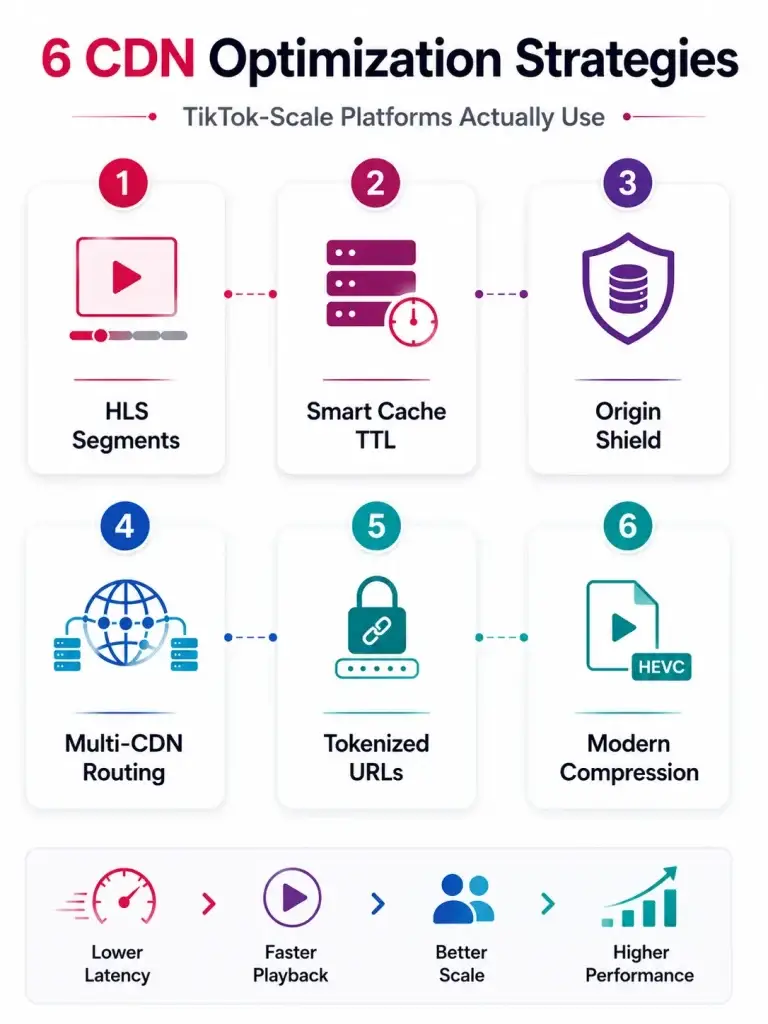
Tokenized Video URLs
Short video platforms often secure media delivery using tokenized playback URLs. These temporary access links help prevent unauthorized content sharing, scraping, and direct video redistribution.
This becomes especially important for creator monetization systems, premium content workflows, and private community platforms where delivery security directly affects revenue protection.
Modern Compression Formats
Efficient video compression significantly affects playback speed and bandwidth costs. Modern codecs reduce file size while maintaining acceptable visual quality across mobile devices.
Smaller media payloads improve startup latency, reduce buffering frequency, and lower CDN transfer expenses — particularly important for platforms operating at large traffic scale.
Read more – Why Recommendation Algorithms Decide Whether Short Video Apps Grow or Disappear
CDN Performance Directly Influences Recommendation Systems
Many businesses separate recommendation infrastructure and delivery infrastructure into completely different technical discussions. In practice, both systems strongly affect each other.
Recommendation engines rely heavily on behavioral signals such as:
- Watch completion behavior: Algorithms evaluate how consistently viewers finish videos before deciding future distribution potential.
- Replay activity patterns: Repeated viewing often signals stronger engagement quality and higher recommendation relevance.
- Session retention signals: Longer viewing sessions help platforms understand whether feed experiences remain engaging overall.
Poor playback performance can distort all of these signals.
For example, users may abandon videos because of startup delay or buffering rather than actual content quality. Slow delivery may reduce watch duration artificially, causing recommendation systems to misinterpret viewer interest.
Over time, weak CDN optimization can negatively affect creator visibility, audience retention, and overall feed quality itself.
This is one reason large-scale short video platforms optimize recommendation systems and delivery architecture together rather than independently.
Read more –
Common CDN Mistakes That Hurt Short Video Apps
Many startups initially focus heavily on frontend features and recommendation logic while underestimating delivery infrastructure complexity. As traffic grows, several architectural mistakes begin affecting scalability.
One common issue is relying entirely on a single CDN provider. While easier to manage early on, this often creates inconsistent regional performance and increases platform risk during outages.
Another major mistake is inefficient cache allocation. Some platforms attempt to cache every uploaded video equally even though only a small percentage generates meaningful traffic.
Weak encoding strategy also creates unnecessary performance problems. Large file sizes increase startup latency, mobile buffering frequency, and infrastructure costs significantly.
Some growing platforms also delay playback monitoring implementation until user complaints become widespread. Without visibility into buffering ratios, regional latency, and playback failures, identifying delivery bottlenecks becomes extremely difficult.
The Most Important Metrics for CDN Optimization
Short video platforms require much deeper delivery monitoring than basic bandwidth tracking. Businesses need visibility into how playback performance affects actual viewer behavior.
Some of the most important metrics include:
| Metric | Why It Matters |
|---|---|
| First Frame Time (FFT) | Measures how quickly playback begins |
| Rebuffering Ratio | Tracks playback interruption frequency |
| Cache Hit Ratio | Indicates edge delivery efficiency |
| Playback Failure Rate | Detects loading reliability issues |
| Regional Latency | Identifies geographic delivery bottlenecks |
| Bitrate Stability | Measures adaptive streaming consistency |
| Session Completion Rate | Reflects playback impact on retention |
Monitoring these metrics helps platforms optimize both infrastructure performance and engagement quality simultaneously.
How Miracuves Helps Businesses Build Scalable Short Video Platforms
Miracuves helps businesses launch TikTok-like platforms designed for scalable short-video ecosystems where playback performance, feed responsiveness, and delivery infrastructure directly affect long-term growth.
Modern short video apps require much more than creator uploads and recommendation feeds. Businesses also need backend systems capable of supporting CDN-ready architecture, regional traffic distribution, scalable engagement workflows, and high-concurrency mobile playback environments.
The platform infrastructure supports:
- Mobile-first video delivery workflows: Systems optimized for smooth playback across varying mobile networks, devices, and regional conditions.
- Scalable content distribution architecture: Infrastructure designed to support edge caching, regional scaling, and growing traffic demand efficiently.
- Recommendation-ready engagement systems: Backend workflows structured around feed personalization, audience interaction tracking, and creator ecosystem scalability.
- Operational platform management: Moderation systems, analytics workflows, admin controls, and scalable management infrastructure for growing video ecosystems.
Businesses planning to launch modern short-video ecosystems can also explore the TikTok Clone Solution designed for scalable video platform deployment. For businesses evaluating architecture, scalability, or deployment strategy, they can also schedule a consultation with the Miracuves team.
As global competition around short-form video continues increasing, delivery infrastructure is rapidly becoming one of the strongest differentiators behind retention, recommendation quality, and platform scalability.
Conclusion
CDN optimization has become much more than a backend infrastructure upgrade for modern short video platforms. In today’s mobile-first ecosystem, delivery performance directly shapes user experience. Faster playback, lower latency, smoother feed transitions, and stable regional delivery all influence how long users stay engaged with the platform. As competition in the short-video market continues growing, even small playback delays can negatively affect retention and engagement quality.
Modern TikTok-like apps rely heavily on edge caching, adaptive bitrate streaming, regional replication, intelligent prefetching, and advanced traffic routing systems to maintain smooth viewing experiences across millions of users. These technologies are no longer optional improvements added later in development. They have become core infrastructure layers that support recommendation systems, creator visibility, audience retention, and long-term scalability.
More importantly, CDN performance now affects much more than playback quality alone. Recommendation algorithms depend on behavioral signals like watch duration, replay activity, and session consistency. If videos buffer frequently or load slowly, platforms begin collecting weaker engagement signals that can eventually affect feed personalization and content discovery quality.
For businesses building scalable short-video ecosystems, optimized content delivery is quickly becoming one of the most important competitive advantages behind platform growth, retention, and long-term success.
FAQs
What is the ideal CDN setup for a short video app?
Most scalable short video platforms use edge caching, adaptive bitrate streaming, regional delivery nodes, and multi-CDN routing to maintain low-latency playback globally.
How does CDN latency affect TikTok-style platforms?
Higher latency increases startup delay and buffering frequency, which can reduce watch time, engagement quality, and overall feed retention.
Why is edge caching important for short video apps?
Edge caching stores popular content closer to viewers, helping videos load faster and reducing pressure on centralized servers during traffic spikes.
What is adaptive bitrate streaming in short video platforms?
Adaptive bitrate streaming automatically adjusts video quality based on network conditions to maintain smoother playback across mobile devices.
Can CDN optimization improve recommendation system performance?
Yes. Faster playback improves watch duration and engagement consistency, which helps recommendation algorithms receive more accurate behavioral signals.
Why do large short video apps use multiple CDN providers?
Different CDN providers perform differently across regions. Multi-CDN strategies improve reliability, latency optimization, and global playback consistency.
Miracuves is an independent software development company. We are not affiliated with, connected to, sponsored by, or endorsed by any company or product named in this article.
Terms such as “X Clone” are used descriptively. It is how the software industry refers to building a platform with functionality comparable to a known service, and how clients search for it.
The entire design and codebase of our products is built by our own team. Our products contain no code, design, graphics, or content originating from any third-party website or applications.
All third-party names and marks referenced in this article are the property of their respective owners, referenced solely to identify the services discussed.