

Key Takeaways
- A short-form video platform launch strategy should connect product readiness, creator supply, content seeding, onboarding, feed quality, moderation, monetization, and early user acquisition.
- Before launch, founders should validate video uploads, playback speed, personalized feeds, engagement features, notifications, creator workflows, reporting, and admin operations.
- Early growth depends on giving creators enough reasons to publish while ensuring new viewers immediately find fresh, relevant, and varied content worth returning for.
Launch Readiness Signals
- Founders should test signup, creator onboarding, video uploads, transcoding, feed loading, playback, likes, comments, shares, follows, notifications, and moderation before bringing meaningful traffic to the platform.
- Content seeding should cover important categories, creators, trends, and viewing interests so first-time users do not encounter an empty or repetitive feed.
- Performance monitoring should cover Time to First Frame, buffering, upload failures, feed latency, crash rates, moderation queues, and backend capacity before acquisition campaigns scale.
Early Growth Insights
- Founding-creator programs, referrals, challenges, niche communities, social sharing, partnerships, and targeted campaigns can help generate the first cycle of creators and viewers.
- Track creator activation, first uploads, content supply, viewer activation, completion rate, session depth, follows, shares, retention, and repeat viewing before aggressively increasing acquisition spend.
- Miracuves develops customizable short-form video platforms with vertical feeds, creator tools, video processing, recommendations, engagement features, moderation, analytics, monetization, and admin controls.
Launching a short-form video platform is not just about building a scrolling feed and allowing users to upload videos. The real challenge is creating a product that feels active from the first session, gives creators a reason to publish, helps viewers discover relevant content quickly, and gives the founder enough control to improve the platform after launch.
Many founders start with feature questions too early. They ask what screens, filters, effects, and monetization tools they need. Those questions matter, but they should come after a stronger strategic question: what specific audience, creator group, content category, or regional community will this platform serve better than broad social platforms?
A strong launch strategy connects product readiness with creator supply, content density, moderation, analytics, monetization timing, and early growth loops. That is where short-form video businesses usually win or fail. The product must be ready enough to create trust, but focused enough to validate demand without delaying launch for unnecessary complexity.
Miracuves helps founders move faster with ready-made, white-label short-video app solutions that can be customized around a niche audience, branded experience, and monetization model. Founders who want to validate faster can also explore a launch-ready short-form video solution that supports branded deployment, creator workflows, source-code ownership, and faster market entry without building every module from zero.
Why Short-Form Video Platforms Need Strategy Before Features
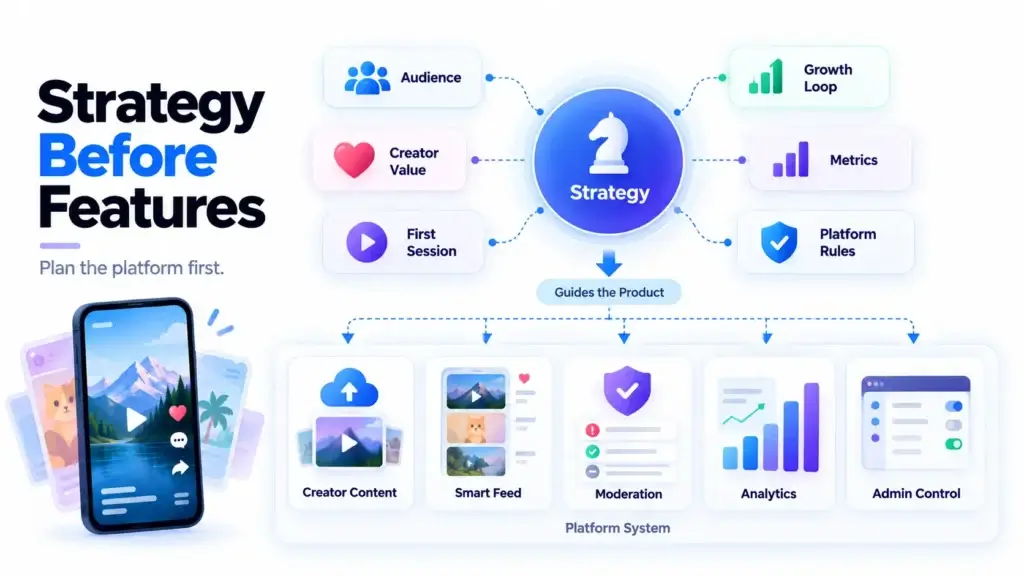
Short-form video apps look simple from the outside. A user opens the app, watches a video, swipes to the next one, likes something, follows a creator, and returns later for more. Behind that simple behavior is a complex business system.
The platform needs creators to publish regularly. It needs viewers to find relevant content quickly. It needs a feed that improves with user behavior. It needs moderation workflows to manage user-generated content. It needs analytics to show which creators, categories, and campaigns are working. It also needs an admin layer where the founder can manage content, users, reports, payouts, trends, and platform rules.
This is why a founder should not treat development as the first step. Development should support a clear launch plan. The best product foundation will still struggle if the market, audience, creator promise, and early growth loop are unclear.
A better launch strategy starts with these questions:
- Who is the platform for?
- Why would creators publish here?
- What content should users see in their first session?
- What makes the community feel focused instead of generic?
- How will the founder know whether the product is working?
- What should be measured before adding advanced features?
When these questions are answered first, the app becomes easier to shape, launch, and improve.
Product Readiness: What Should Be Ready Before Launch?
Product readiness does not mean building every possible feature. It means having enough of the right product foundation to test whether users create, watch, engage, and return.
For a short-form video platform, the first release should usually focus on the core loop: create, publish, watch, engage, follow, return, and manage. Anything that does not support this loop should be evaluated carefully before launch.
| Product Area | What Should Be Ready | Why It Matters |
|---|---|---|
| User onboarding | Sign-up, profile setup, interest selection, language or category preferences | Helps the platform personalize early sessions |
| Video creation | Upload, record, trim, captions, hashtags, drafts, thumbnails | Gives creators a simple publishing flow |
| Vertical feed | Smooth swipe experience, fast playback, category discovery | Creates the main consumption experience |
| Engagement | Likes, comments, shares, saves, follows | Creates signals for recommendation and community activity |
| Creator profiles | Bio, content library, followers, creator identity | Helps creators build audience value |
| Admin control | User management, content review, reports, categories, analytics | Gives the founder operational control after launch |
| Moderation | Abuse reporting, manual review, comment control, spam checks | Protects trust and platform quality |
| Analytics | Watch time, completion, uploads, retention, shares, reports | Helps the founder improve based on behavior |
For founders planning the first product version, it is useful to review the core short-form video platform features needed for creator onboarding, video uploads, vertical feed engagement, moderation, analytics, and admin control before adding advanced modules.
Advanced modules such as live commerce, complex creator marketplaces, deep social shopping, paid boosts, and premium creator tools can be added after early retention and creator activity are proven. A focused launch is usually stronger than a crowded first version.
Choosing a Niche Without Limiting Future Growth
A common mistake in short-form video startup planning is trying to build for everyone from day one. Broad positioning sounds exciting, but it creates a weak early market. If the platform is for everyone, the content feed has no identity, creators have no strong reason to join, and viewers do not immediately understand why they should return.
A niche gives the platform a starting advantage. It makes creator recruitment easier, content seeding more focused, moderation more predictable, and early growth campaigns more targeted.
Strong niche directions can include:
| Niche Direction | Why It Can Work | Product Strategy Implication |
|---|---|---|
| Regional language content | Local creators often need better discovery and community relevance | Add language filters, regional categories, and local trend pages |
| Fitness and wellness clips | High repeat viewing and strong creator-led routines | Add challenges, progress content, and creator programs |
| Education and skill-based videos | Utility content is searchable, shareable, and repeatable | Add playlists, saved clips, verified educator profiles |
| Food and recipe videos | Visual content performs well and supports local discovery | Add cuisine tags, ingredients, creator collections |
| Beauty and fashion creators | Strong fit for influence, tutorials, and product-led discovery | Add creator storefront options later |
| Local commerce creators | Content can connect to buying intent | Add product tags, merchant profiles, and campaign tools later |
| Fan communities | Higher loyalty and monetization potential | Add subscriptions, gifts, and exclusive content workflows later |
A niche does not mean the platform cannot expand. It simply gives the business a clear opening wedge. Once creator supply, user engagement, and retention signals improve, the founder can expand into nearby categories.
Creator Supply Comes Before User Acquisition
A short-form video platform without creators feels empty. This is why creator supply should be planned before broad user acquisition.
Founders often spend too early on downloads, ads, and influencer promotions without preparing the content base. The result is a weak first session. Users open the app, see limited content, scroll through repetitive videos, and leave before the platform has a chance to build habit.
A better approach is to build a founding creator group before public launch.
This group can include niche creators, local influencers, educators, entertainers, product reviewers, community leaders, or micro-creators with loyal audiences. The goal is not to recruit the biggest names immediately. The goal is to recruit creators who will publish consistently and help the platform feel alive.
Once the founding creator group is clear, the next step is building a focused creator platform growth strategy around onboarding, content planning, audience invitations, early engagement, and repeat creator participation.
A simple creator-readiness checklist includes:
- Identify 20 to 50 relevant creators in the launch niche.
- Understand what they dislike about existing platforms.
- Offer clear reasons to publish, such as early visibility, niche audience quality, creator badges, better moderation, or monetization access.
- Help creators prepare starter content before launch.
- Create weekly themes, challenges, or prompts.
- Give creators feedback from early engagement data.
- Reward consistent contributors with visibility and platform support.
The platform’s early creator promise should be specific. “Upload videos and grow” is too generic. A stronger promise is: “Build your audience inside a focused short-video community designed around your category.”
Content Seeding Makes the First Session Feel Alive
The first user session is critical. Users decide very quickly whether the platform feels relevant, active, and worth returning to. If the first feed looks empty, random, or low-quality, early trust drops.
Content seeding solves this problem before launch.
Seeded content can include founding creator videos, brand-owned educational clips, challenge templates, featured creator introductions, local trend content, tutorials, category explainers, and curated content where rights and permissions are properly managed.
The purpose is not to fake scale. The purpose is to make the platform’s identity clear from the beginning.
A viewer should understand three things within the first session:
- What kind of content lives here?
- Who are the creators?
- Why should I come back?
For a short-form video startup, 500 relevant videos in one focused niche can be more useful than thousands of random uploads across unrelated categories. The early feed should feel intentional, not crowded.
Recommendation Signals That Matter in Early Growth
The recommendation system is one of the most important parts of a short-form video platform. But early-stage founders should understand that recommendation quality depends on clean signals, not just advanced technology.
In the beginning, the platform has limited user history and limited creator performance data. This creates a cold-start problem. The app must still create a relevant experience before it has enough behavior data.
To improve early recommendations, founders can use onboarding preferences, category selection, language choices, editor-picked starter feeds, trending tags, creator segmentation, and manual curation.
Important signals to track include:
- Watch time
- Completion rate
- Rewatches
- Skips
- Likes
- Comments
- Shares
- Follows
- Saves
- Not-interested actions
- Creator affinity
- Category engagement
- Repeat sessions
A strong feed does not simply show popular content. It balances relevance, freshness, content quality, creator diversity, and safety. For early growth, the founder should watch whether users return because the feed feels more relevant over time.
Community Density Matters More Than Random Downloads
Downloads can look good in reports, but they do not always prove market fit. A short-form video platform succeeds when a focused group of users and creators interact frequently enough to create momentum.
Community density means the platform has enough relevant creators, viewers, comments, shares, trends, and repeat sessions inside a focused category or region.
A platform with 5,000 engaged users and 200 active creators can produce stronger learning signals than a platform with 100,000 random installs and weak retention. The first group gives the founder usable feedback. The second group may create vanity metrics without product clarity.
Community density improves:
- Creator motivation
- Viewer retention
- Trend formation
- Comment activity
- Share behavior
- Recommendation quality
- Content quality
- Monetization readiness
This is why launch campaigns should not only chase volume. The early goal is to make the platform feel active inside a specific community.
Early Growth Loops for a Short-Form Video Platform
Growth should be designed into the platform experience, not added only through advertising. A good launch strategy creates natural reasons for creators and viewers to invite others.
These loops become stronger when the product includes viral engagement features for short-video apps, such as challenges, creator spotlights, shareable videos, referral triggers, and participation-based community campaigns.
Early growth loops can include:
- Creator invitation programs
- Hashtag challenges
- Weekly niche contests
- Referral rewards
- Featured creator pages
- Local creator spotlights
- Community-led themes
- Shareable video links
- Invite-only early access
- Brand-sponsored challenges
- Creator education session
A practical early growth loop could work like this:
- A founding creator publishes a challenge.
- The platform promotes it inside a niche feed.
- Viewers participate by posting their own videos.
- Top videos are featured by the admin team.
- Creators invite their audience to vote, watch, or join.
The platform captures more behavior data and improves recommendations.
This loop is more valuable than a one-time paid campaign because it creates repeat participation. Short-form video growth depends on habits, not just installs.
Monetization Should Follow Retention
Monetization is important, but timing matters. Too many founders try to monetize before users have formed a habit. Heavy ads, paid boosts, or aggressive subscriptions can damage early experience if the platform has not yet proven repeat engagement.
The best monetization model depends on audience behavior and creator motivation. Once retention improves, founders can map the right short-video platform business model around gifts, subscriptions, sponsored challenges, paid boosts, social commerce, premium creator tools, and creator revenue flows.
| Monetization Model | Best Stage | Why It Works |
|---|---|---|
| Virtual gifts and coins | Engagement stage | Works well when creators have active fan interaction |
| Creator subscriptions | Growth stage | Helps loyal fans support premium or exclusive content |
| Sponsored challenges | Niche authority stage | Works when brands want access to a focused audience |
| Paid boosts | Early revenue stage | Helps creators promote selected content without overwhelming users |
| Social commerce | Community-commerce stage | Works for fashion, beauty, food, local products, and creator-led selling |
| Premium creator tools | Creator growth stage | Monetizes power users who need analytics, promotion, or content tools |
| Live session monetization | Advanced stage | Works once creator loyalty and real-time engagement are proven |
The right question is not “How can the app make money immediately?” The stronger question is “Which monetization model matches the behavior users already show?”
A fitness-focused platform may monetize through subscriptions and coaching. A local commerce platform may monetize through product discovery. A fan community may monetize through gifts, exclusive content, and live sessions.
Moderation and Safety Should Be Built Into the Foundation
Short-form video platforms rely on user-generated content. That means moderation, reporting, and admin control should be included from the beginning.
Trust systems protect users, creators, brands, and the business itself. Without moderation workflows, the platform can quickly face spam, abuse, inappropriate content, copyright complaints, fake accounts, or payout disputes.
Trust systems protect users, creators, brands, and the business itself.
Because short-form video platforms depend heavily on user-generated content, founders should also review a practical short-video app security guide before scaling uploads, comments, creator activity, payouts, and community participation.
A practical trust layer should include:
- Content moderation
- Abuse reporting
- Comment moderation
- Creator verification
- Spam detection
- Copyright reporting workflows
- Age-gating where relevant
- Manual review queues
- Admin access controls
- Activity logs
- Payout monitoring
Security and compliance should be treated as product foundations, not marketing claims. Final legal, policy, and compliance requirements depend on the target country, app category, operating model, integrations, and legal review.
Infrastructure Planning Protects the User Experience
Video apps create technical and operating challenges earlier than many founders expect. Every upload creates storage needs. Every playback creates bandwidth usage. Every viral post can increase CDN demand. Every user interaction creates analytics events. Every creator payout or report adds operational complexity.
Founders do not need enterprise-scale systems on day one, but they do need a product foundation that can grow without forcing a rebuild after early traction.
Video infrastructure also affects operating margins, so founders should understand video hosting and architecture costs before pushing large-scale user acquisition, creator campaigns, or high-volume video uploads.
| Infrastructure Area | Why It Matters | Founder Decision |
|---|---|---|
| Video storage | Every upload increases storage needs | Plan compression, storage rules, and cleanup workflows |
| CDN delivery | Playback quality affects retention | Use delivery optimization and caching |
| Transcoding | Different devices need different formats | Use background processing and queues |
| Feed ranking | Slow recommendations affect session quality | Plan scalable APIs and caching |
| Analytics events | Every view, skip, like, and share creates data | Track only useful early signals first |
| Moderation volume | More uploads increase review workload | Combine automated checks with manual review |
| Notifications | Re-engagement depends on timing and relevance | Use behavioral triggers carefully |
The founder’s goal is not to overbuild. The goal is to avoid technical decisions that block growth once the platform starts working.
For budget planning, founders can also explore the short-form video app development cost factors that usually affect scope, integrations, customization, infrastructure, and launch readiness.
Ready-Made Foundation vs Fully Custom Development
Founders usually have three practical development paths: a ready-made foundation, fully custom development, or a hybrid approach.
| Build Route | Best For | Advantages | Tradeoffs |
|---|---|---|---|
| Ready-made short-video platform foundation | Founders who want faster validation | Faster launch, existing core modules, admin control, branded deployment | Needs customization for niche differentiation |
| Fully custom development | Funded teams with unique product logic | Maximum flexibility and tailored architecture | Longer timeline, higher cost, higher execution risk |
| Hybrid approach | Founders who want speed plus strategic differentiation | Start with proven foundation and customize high-impact areas | Requires clear product roadmap |
A ready-made foundation is not about copying another platform blindly. It is about reducing avoidable development time so the founder can focus on positioning, creator supply, growth, monetization, and retention.
Miracuves supports founders with a white-label short-video app foundation that can include branded design, source-code ownership, admin dashboards, creator workflows, monetization modules, and faster deployment. Founders comparing build routes can also review how a white-label creator platform compares with custom development before deciding whether speed, flexibility, budget, or product differentiation should guide the launch plan.
For founders evaluating the fastest path, the white-label short-video app solution page can help compare platform capabilities, included modules, source-code ownership, and deployment options.
A Practical 30-Day Launch Roadmap
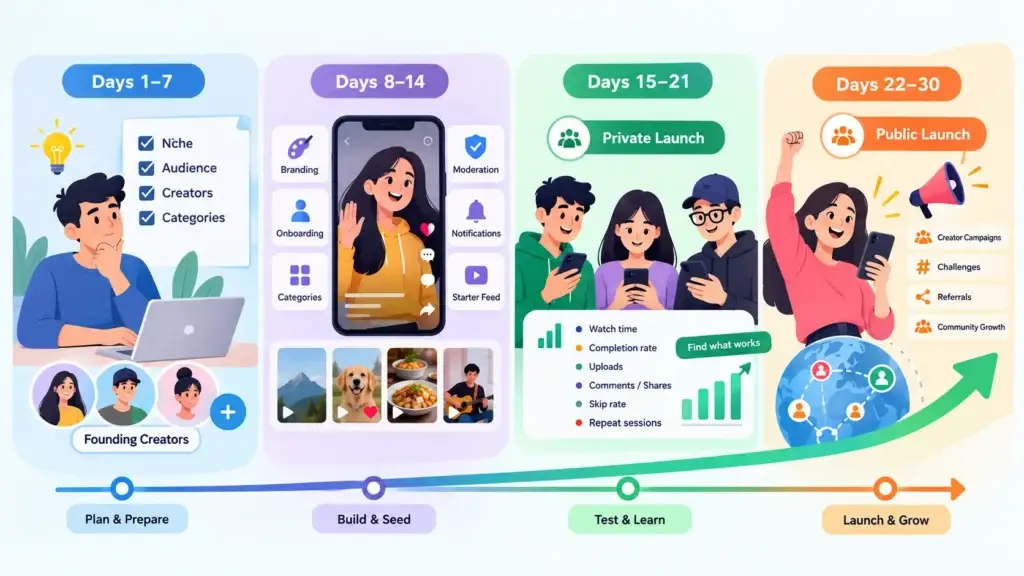
A short-form video launch should be managed like a focused market validation campaign. The goal is to learn quickly, improve the product, and avoid wasting time on features that do not support retention.
Days 1–7: Strategy and Creator Readiness
Define the target niche, audience, creator profile, core content categories, and launch promise. Recruit founding creators and prepare the first content seed library. Decide what the first version must prove.
Days 8–14: Product Setup and Content Seeding
Prepare branding, onboarding flows, category structure, creator profiles, moderation rules, notification logic, and starter feeds. Make sure the first session feels relevant before broad promotion begins.
Days 15–21: Private Launch and Signal Testing
Invite a small group of creators and viewers. Track watch time, completion rate, uploads per creator, comments, shares, skips, reports, and repeat sessions. Identify which content categories and creator types perform best.
Days 22–30: Public Launch and Growth Experiments
Start focused acquisition campaigns around the strongest content categories. Use creator-led invitations, challenges, referral campaigns, and niche community promotion. Avoid scaling paid campaigns until retention signals are stable.
This 30-day roadmap helps founders move from assumptions to evidence. The point is not to launch perfectly. The point is to launch with enough readiness to learn quickly.
Founder Decision Signals
Speed
If the business needs market validation quickly, a ready-made short-video foundation can reduce the time spent building upload, feed, admin, and engagement modules from zero.
Cost
Video platforms can create ongoing costs through storage, CDN usage, moderation, and analytics. Founders should plan both build cost and operating cost before scaling traffic.
Scalability
The platform should support video processing, feed ranking, content moderation, and engagement tracking without forcing a full rebuild after early traction.
Market Fit
The strongest signal is not downloads. It is whether creators keep uploading and viewers return because the feed feels relevant to their interests.
Mistakes Founders Should Avoid
Building a generic video platform with no clear audience
A broad product has no strong reason to win early. Founders need a specific content identity, creator segment, region, or community angle before launch.
Launching before seeding enough content
Users judge the platform quickly. If the first feed feels empty or random, users may leave before the recommendation system can improve.
Spending on downloads before retention is proven
Paid acquisition can create traffic, but it cannot fix weak product-market signals. Retention, creator return rate, and content quality should guide scale.
Adding monetization too aggressively
Ads, paid boosts, subscriptions, and commerce work better after users have formed habits. Monetization should support the experience, not interrupt it.
Ignoring moderation and operational control
User-generated content platforms need reporting, review queues, admin controls, and safety workflows from the beginning.
Treating infrastructure as an afterthought
Video storage, playback speed, CDN usage, transcoding, and analytics affect both user experience and operating costs.
How Miracuves Helps Founders Launch Smarter
A short-form video platform needs more than a user-facing app. It needs creator tools, viewer flows, admin control, moderation systems, monetization options, analytics, and infrastructure planning.
Miracuves helps founders start with a ready-made, white-label app foundation that can be customized around a specific market, brand, and creator strategy. This approach is useful for founders who want to validate demand faster while still keeping room for product differentiation.
With source-code ownership, branded design, admin dashboards, creator workflows, monetization-ready modules, and 6-day solution delivery where the scope fits, Miracuves gives founders a faster route to launch without removing the need for strategy. The product foundation helps you move faster. The launch strategy helps you grow smarter.
Founders who want expert support can work with Miracuves as a short-form video app development company for ready-made deployment, customization, admin control, branded design, and 6-day solution delivery where the selected scope fits.
Final Thoughts
The real opportunity in launching a short-form video platform is not copying a popular app feature by feature. It is using the short-video format to serve a sharper audience, build stronger creator relationships, and create a feed experience that improves over time.
Founders should focus first on niche clarity, creator supply, content density, recommendation signals, moderation, retention metrics, and scalable infrastructure. Features matter, but strategy decides whether those features turn into a real business.
Miracuves can help founders move from idea to launch faster with a ready-made, white-label short-video platform foundation. But the strongest results come when the product is connected to a clear launch plan, a focused creator strategy, and a practical early growth system.
FAQs
What is a short-form video platform launch strategy?
A short-form video platform launch strategy is the plan for preparing the product, creators, content, moderation, growth loops, analytics, and monetization before public launch. It helps founders avoid launching an empty or unfocused app.
What should be ready before launching a short-video app?
The first release should include onboarding, video upload, vertical feed, creator profiles, likes, comments, shares, follows, content categories, moderation tools, admin dashboard, notifications, and analytics. Advanced monetization and commerce features can be added after retention improves.
Why is creator supply important before launch?
Creator supply gives the platform content depth before users arrive. Without active creators and seeded content, the first user session can feel empty, which weakens trust and retention.
How do I choose a niche for a short-form video platform?
Choose a niche based on creator pain points, audience behavior, content frequency, monetization potential, and community identity. Regional language videos, fitness clips, educational content, beauty creators, food videos, and fan communities are common examples of focused launch angles.
What metrics should founders track after launch?
Founders should track Day 1 retention, Day 7 retention, watch time, completion rate, videos watched per session, uploads per creator, creator return rate, share rate, report rate, and feed skip rate.
When should a short-form video platform start monetizing?
Monetization should usually begin after retention and creator activity show positive signals. Virtual gifts, subscriptions, sponsored challenges, paid boosts, social commerce, and premium creator tools can be introduced based on user behavior.
Is a ready-made short-video app foundation better than custom development?
It depends on the founder’s goal. A ready-made foundation can help validate faster because core modules are already available. Fully custom development may fit teams with unique product logic, larger budgets, and longer timelines. A hybrid approach often works well when founders want speed plus differentiation.
How can Miracuves help with short-form video platform launch?
Miracuves helps founders launch white-label short-video platforms with branded design, source-code ownership, admin control, creator workflows, monetization modules, and faster deployment. Where the ready-made scope fits, Miracuves’ 6-day solution delivery can help founders move quickly from planning to launch.
Miracuves is an independent software development company. We are not affiliated with, connected to, sponsored by, or endorsed by any company or product named in this article.
Terms such as “X Clone” are used descriptively. It is how the software industry refers to building a platform with functionality comparable to a known service, and how clients search for it.
The entire design and codebase of our products is built by our own team. Our products contain no code, design, graphics, or content originating from any third-party website or applications.
All third-party names and marks referenced in this article are the property of their respective owners, referenced solely to identify the services discussed.