


Key Takeaways
- Recommendation algorithms are one of the biggest growth drivers behind modern short-video platforms because they directly affect retention, watch time, and user engagement.
- Short-video apps use behavioral signals such as watch duration, replay activity, likes, comments, shares, skips, and follow patterns to personalize feeds.
- A strong recommendation system helps smaller creators gain visibility while keeping users engaged with highly personalized content.
- Recommendation quality affects monetization, creator retention, ad performance, and long-term platform scalability.
- The most successful TikTok-like platforms continuously optimize recommendation logic using real-time engagement data and behavioral analysis.
Recommendation Decision Signals
- Watch time is one of the strongest recommendation signals because it shows whether users actually stay engaged with content.
- Replay behavior, completion rates, comments, and shares help algorithms understand which videos create stronger audience interest.
- Negative signals such as fast scrolling, skips, muted playback, or low interaction can reduce content distribution.
- Recommendation systems must balance personalization, content diversity, creator discovery, and moderation quality to avoid repetitive feeds.
- Infrastructure requirements increase as recommendation systems process larger amounts of behavioral data, engagement analytics, and content categorization.
Real Insights
- Short-video platforms grow faster when users feel the feed understands their interests within the first few sessions.
- Recommendation algorithms influence almost every growth metric, including retention, session duration, creator visibility, and ad engagement.
- Platforms that fail to personalize content effectively often struggle with low retention and weaker long-term engagement.
- Modern recommendation systems are no longer based only on popularity; they analyze user behavior patterns continuously in real time.
- The strongest TikTok-like apps combine recommendation intelligence, moderation systems, engagement analytics, scalable infrastructure, and creator-focused discovery logic.
Short video apps have completely transformed digital content consumption. Users no longer open social platforms to manually search for creators, hashtags, or pages. Instead, they expect the app to immediately understand what they enjoy watching and continuously deliver entertaining, relevant videos without interruption. This shift is one of the biggest reasons platforms like TikTok changed the social media industry so aggressively.
Many startups entering the short video market assume success mainly depends on editing tools, visual design, influencer onboarding, or monetization features. While those elements matter, they are rarely the primary reason users remain active inside the app for long periods. The real growth engine usually operates much deeper inside the platform — the recommendation algorithm.
Every swipe, pause, replay, comment, share, follow, and skip creates behavioral data. Modern short video platforms continuously analyze these signals to decide which content should appear next, which creators deserve broader visibility, which trends are accelerating, and which users are likely to stay engaged longer. In many ways, the recommendation engine becomes the operational intelligence layer of the entire platform.
This is exactly why recommendation systems now influence nearly every business metric connected to short video apps. They affect user retention, creator growth, watch time, advertising performance, monetization opportunities, and long-term scalability simultaneously. For businesses planning to launch TikTok-like platforms, recommendation architecture is no longer an optional AI feature added later. It has become one of the strongest foundations behind sustainable platform growth.
How TikTok Changed Content Discovery With Recommendation Algorithms
Traditional social media platforms were largely designed around social relationships. Users followed friends, celebrities, public figures, or pages they already recognized, and feeds mainly revolved around those existing connections.
Short video apps completely changed this behavior.
Platforms like TikTok introduced interest-driven distribution instead of relationship-driven visibility. A user no longer needs to build a network before receiving engaging content. The platform immediately starts analyzing viewing behavior and reshaping recommendations dynamically from the very first session.
This created an entirely different engagement cycle.
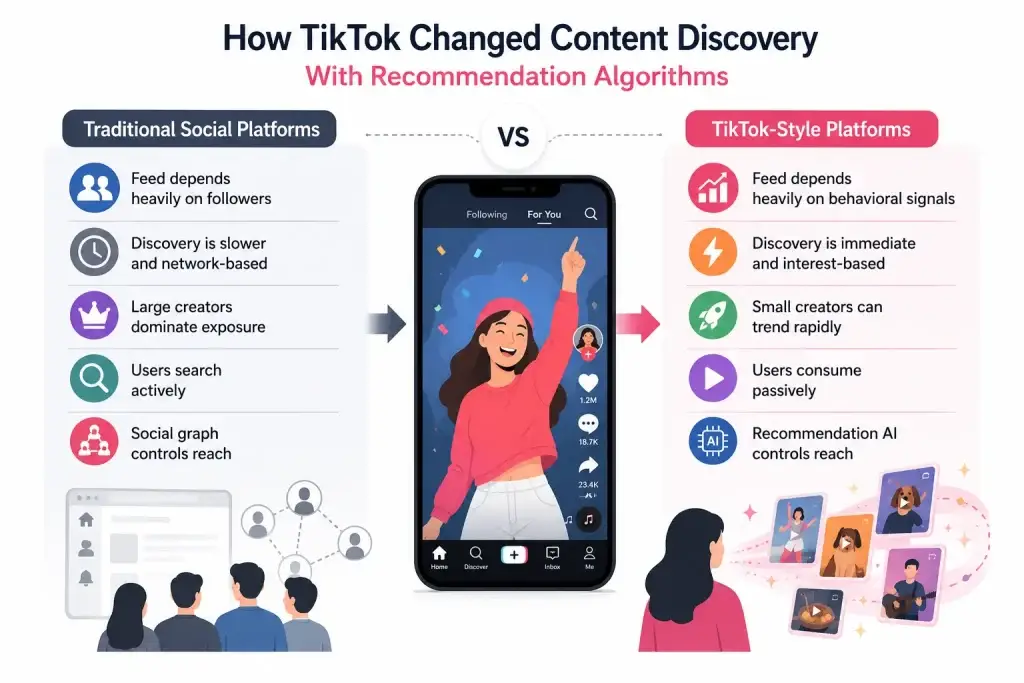
A creator with zero followers can suddenly receive massive visibility if the recommendation engine detects strong audience retention during early distribution stages. At the same time, viewers continuously discover creators they have never seen before, making content consumption feel fast, personalized, and highly addictive.
| Traditional Social Platforms | TikTok-Style Platforms |
|---|---|
| Feed depends heavily on followers | Feed depends heavily on behavioral signals |
| Discovery is slower and network-based | Discovery is immediate and interest-based |
| Large creators dominate exposure | Small creators can trend rapidly |
| Users search actively | Users consume passively |
| Social graph controls reach | Recommendation AI controls reach |
This shift reduced the importance of follower-based visibility and increased the importance of behavioral intelligence inside recommendation systems.
Why the For You Feed Became TikTok’s Strongest Growth Engine
TikTok’s biggest breakthrough was not simply introducing short-form videos. Platforms like Vine and Instagram had already experimented with short video content before TikTok scaled globally. The real innovation came from how TikTok redesigned content discovery itself. Instead of forcing users to search manually for creators, topics, or trends, the platform built a recommendation-driven experience where entertainment appeared instantly and continuously based on behavioral signals. This dramatically reduced friction between user interest and content consumption, making the feed feel highly personalized even for first-time users with no followers, no watch history, and no social network inside the app.
The platform continuously studies user behavior in real time. Even small actions become meaningful signals:
- Watching a video completely often indicates stronger interest than simply pressing the like button.
- Rewatching clips signals unusually high engagement and increases the probability of wider distribution.
- Fast scrolling behavior tells the algorithm that the content failed to capture attention quickly enough.
This behavioral analysis happens continuously throughout the session. If a user begins interacting with cooking videos, travel content, startup advice, or finance clips, the feed rapidly adjusts itself to match those evolving interests.
The result is a recommendation system that feels highly personalized almost immediately.
This creates several major growth advantages:
- Users remain active longer because content relevance improves continuously during every session.
- Creators receive faster exposure opportunities even without massive follower counts.
- Viral trends spread aggressively because strong-performing content expands rapidly into wider audience groups.
This is one of the main reasons TikTok’s recommendation system became more influential than its editing tools or interface design alone.
Why Watch Time and Retention Matter More Than Likes
Many businesses entering the short video market assume recommendation algorithms mainly prioritize likes, comments, or shares. In reality, most modern recommendation systems optimize heavily around sustained attention.
Short video platforms want users to continue consuming content for longer periods without interruption. Because of this, retention behavior becomes significantly more valuable than visible engagement metrics alone.
Several signals usually carry strong importance inside recommendation systems:
- Completion rate matters because fully watched videos often indicate stronger content relevance and audience satisfaction.
- Session continuation patterns help platforms understand whether one video encourages users to keep consuming more content.
- Consistent viewing behavior across categories allows the system to identify long-term interests instead of temporary curiosity.
This explains why some videos with relatively few likes still receive massive reach while highly liked videos occasionally lose momentum quickly. The algorithm is usually optimizing for attention quality rather than popularity alone.
For platform owners, this changes how creator ecosystems should be designed. Modern short video apps increasingly reward creators capable of maintaining audience retention instead of only generating quick interactions.
How Recommendation Systems Decide Which Videos Go Viral
Modern short video recommendation systems usually combine multiple intelligence layers working together simultaneously. The algorithm is rarely one single AI model making all decisions independently.
Instead, recommendation infrastructure merges behavioral analysis, content understanding, and distribution testing together.
Behavioral Intelligence Systems
Behavioral recommendation models study how audiences interact with videos over time. The platform analyzes viewing patterns, category preferences, replay behavior, session depth, scrolling speed, and engagement consistency.
If users with similar viewing habits repeatedly interact with related content, the system begins predicting which additional videos may perform well for comparable audience groups.
This is one reason viral trends spread extremely fast inside short video ecosystems.
Content Understanding Layers
Modern recommendation systems do not rely only on audience behavior patterns. They also study the structure and context of the content itself to improve recommendation accuracy. The algorithm continuously analyzes captions, hashtags, audio usage, creator categories, visual patterns, engagement themes, and even trend relationships between videos. This allows the platform to understand not just who is interacting with the content, but also what the content actually represents. As a result, recommendation quality remains strong even when new creators join the platform or when fresh content has limited engagement history available initially.
The platform studies:
- Hashtags and captions to understand contextual themes and topic relevance.
- Audio patterns because trending sounds often influence recommendation momentum heavily.
- Creator categories, visual styles, and niche classifications to improve audience matching accuracy.
This allows the recommendation system to distribute videos intelligently even when creators are relatively new and lack strong historical engagement data.
Progressive Audience Expansion
One of the most important systems inside TikTok-style platforms is staged content distribution.
Instead of instantly pushing videos to massive audiences, the platform usually performs controlled testing phases. Small viewer groups receive the content first. If retention, replay behavior, and engagement quality remain strong, the algorithm gradually expands distribution further.
| Recommendation Layer | Main Responsibility | Platform Impact |
|---|---|---|
| Behavioral Intelligence | Understand audience habits | Better personalization |
| Content Understanding | Analyze contextual relevance | Smarter audience matching |
| Progressive Distribution | Test engagement quality | Faster viral discovery |
This layered recommendation structure is one of the biggest reasons TikTok-style feeds feel highly personalized despite massive content volume.
How Better Recommendations Improve Revenue and Monetization
Recommendation systems influence much more than user experience. They directly affect monetization performance as well.
When users consistently receive highly relevant content, they usually spend more time inside the platform. Longer engagement sessions increase opportunities for:
- Advertising visibility and sponsored campaign performance across multiple viewing sessions.
- Creator monetization through live streaming, affiliate commerce, subscriptions, and brand collaborations.
- Higher retention metrics that strengthen investor confidence and long-term platform valuation.
This creates a compounding growth cycle.
Better recommendations increase engagement. Stronger engagement improves monetization. Improved monetization attracts creators. More creators expand content diversity, which then improves recommendation quality further.
Weak recommendation systems often create serious operational problems very quickly:
- Users leave faster because the feed becomes repetitive or poorly targeted.
- Creators struggle to grow consistently because visibility opportunities become unpredictable.
- Advertising performance weakens since audience attention quality declines across the platform.
This is exactly why recommendation infrastructure is now considered a core business layer rather than just a backend feature.
Why Poor Recommendations Make Users Leave Short Video Apps Fast
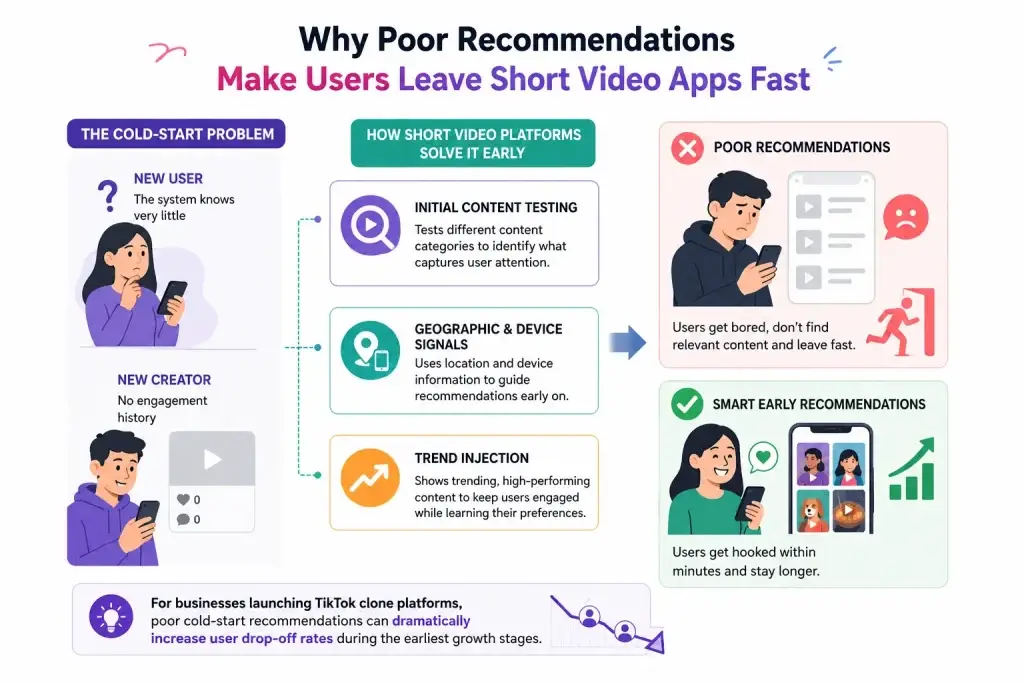
One of the hardest challenges in recommendation systems is handling new users and new creators effectively.
When someone joins the platform for the first time, the recommendation engine initially knows very little about their interests. Similarly, new creators may upload videos without any historical engagement data available.
This is commonly known as the cold-start problem.
Short video platforms solve this challenge through several early-stage intelligence techniques:
- Initial content testing helps the system identify what categories attract user attention during the first sessions.
- Geographic and device-level signals provide temporary recommendation guidance before stronger behavioral patterns develop.
- Trend injection systems expose new users to high-performing content categories while the algorithm gathers additional interaction data.
TikTok became extremely effective at solving this problem rapidly. That is one reason many users feel “hooked” within minutes of opening the app for the first time.
For businesses launching TikTok clone platforms, poor cold-start recommendations can dramatically increase user drop-off rates during the earliest growth stages.
Why Recommendation Architecture Must Be Planned Before Scaling
Many startups assume recommendation systems can be added after the platform begins scaling. In reality, recommendation architecture affects almost every technical layer inside a short video application.
Recommendation systems influence:
- Event tracking pipelines responsible for processing millions of behavioral interactions continuously.
- Feed delivery infrastructure required for loading personalized content rapidly during active sessions.
- Metadata management systems that organize hashtags, creator categories, sounds, engagement signals, and moderation labels efficiently.
If these systems are not structured properly from the beginning, rebuilding recommendation infrastructure later becomes extremely expensive and operationally risky.
This is one reason many short video startups struggle after initial traction. Their architecture was designed mainly for uploading and streaming videos rather than supporting intelligent recommendation workflows at scale.
The Backend Infrastructure Every Short Video App Recommendation System Needs
Before implementing advanced AI recommendation models, businesses first need strong operational foundations. Recommendation systems only become effective when high-quality behavioral and content data already exists.
Several foundational systems are especially important.
Real-Time Behavioral Tracking
Platforms should capture viewing duration, replay behavior, scrolling patterns, session depth, and category interaction continuously. Weak behavioral data usually produces weak recommendation accuracy.
Structured Content Metadata
Captions, hashtags, audio tags, creator classifications, moderation labels, and category structures should remain properly organized to improve audience matching quality.
Fast Personalized Feed Delivery
Recommendation systems depend heavily on speed. Delayed feed loading weakens user experience even when personalization logic itself is strong.
Moderation-Aware Recommendation Systems
Modern recommendation engines increasingly work alongside moderation systems to reduce harmful, repetitive, misleading, or spam-heavy content amplification.
Businesses that ignore these foundational layers often struggle to scale recommendation quality later.
Why Recommendation Intelligence Will Decide the Future of Short Video Apps
Short video technology itself is becoming easier to replicate. Many businesses can now build editing tools, filters, monetization systems, live streaming features, and creator dashboards relatively quickly.
Recommendation quality, however, remains much harder to duplicate.
The next generation of successful short video platforms will likely compete through:
- Better behavioral prediction systems capable of understanding audience intent more accurately.
- Smarter AI-powered personalization that adapts continuously during viewing sessions.
- Stronger retention intelligence designed to maximize engagement without creating content fatigue.
This is why recommendation infrastructure is increasingly becoming the true strategic advantage behind scalable short video ecosystems.
How Miracuves Builds Recommendation-Ready TikTok-Like Platforms
Building a successful short video platform today requires much more than video uploads and creator profiles. Platforms like TikTok changed user expectations completely. Users now expect personalized feeds, fast content discovery, intelligent recommendations, and continuously relevant content from the very first session.
This is why recommendation-ready infrastructure has become one of the most important foundations behind scalable short video ecosystems.
Many startups focus mainly on frontend features during early development but overlook the backend systems required for long-term engagement growth. In reality, recommendation algorithms only perform well when the platform is already structured around behavioral analytics, feed delivery speed, engagement tracking, moderation systems, and scalable content distribution.
Miracuves TikTok Clone Solution helps businesses launch TikTok-style platforms with infrastructure designed for recommendation-driven growth instead of only basic video publishing.
The platform supports critical workflows such as:
- Behavioral engagement tracking to monitor watch duration, replay behavior, and interaction patterns.
- Personalized feed structures designed for intelligent content discovery and creator visibility.
- Moderation and monetization systems that support scalable platform growth and long-term engagement.
For startups entering the short video market, recommendation-driven architecture is no longer an optional upgrade. It has become one of the key foundations behind sustainable retention, creator engagement, and scalable platform growth. Businesses planning to launch a TikTok-style platform can also contact Miracuves to discuss platform customization, recommendation-ready infrastructure, and scalable short video app development strategies.
Conclusion
Recommendation algorithms now define how modern short video platforms grow. They influence what users watch, how creators gain visibility, how trends spread, and how businesses generate revenue from engagement.
TikTok proved that intelligent personalization can fundamentally reshape digital content consumption behavior. The stronger the recommendation system becomes, the stronger the platform’s retention, monetization, and scalability potential usually becomes as well.
As competition inside the short video industry continues increasing, recommendation infrastructure will increasingly separate scalable platforms from apps that struggle to maintain long-term engagement.
FAQs
Why are recommendation algorithms important for short video apps?
Recommendation algorithms help platforms deliver personalized content, improve watch time, increase retention, and support long-term engagement growth.
How does TikTok’s recommendation system work?
TikTok analyzes behavioral signals like watch duration, replays, likes, comments, shares, and scrolling patterns to personalize the “For You” feed.
Can a new creator grow without followers on TikTok-style platforms?
Yes. Recommendation-driven platforms can push high-performing content to wider audiences even if the creator has very few followers initially.
What data do short video recommendation systems usually track?
Most platforms track viewing behavior, completion rates, replay activity, engagement patterns, hashtags, audio usage, and content categories.
Why do some videos go viral even with fewer likes?
Recommendation systems often prioritize retention signals like watch time and replay behavior instead of likes alone.
Why should recommendation infrastructure be planned early?
Recommendation systems affect analytics, feed delivery, engagement tracking, moderation workflows, and platform scalability, making early planning extremely important.
Miracuves is an independent software development company. We are not affiliated with, connected to, sponsored by, or endorsed by any company or product named in this article.
Terms such as “X Clone” are used descriptively. It is how the software industry refers to building a platform with functionality comparable to a known service, and how clients search for it.
The entire design and codebase of our products is built by our own team. Our products contain no code, design, graphics, or content originating from any third-party website or applications.
All third-party names and marks referenced in this article are the property of their respective owners, referenced solely to identify the services discussed.