


Key Takeaways
- A luxury fashion marketplace can generate revenue through seller commissions, service fees, premium placements, partner sales, advertising, and value-added commerce services.
- Commission revenue grows with transaction volume, average order value, active luxury brands, repeat purchases, and the marketplace’s ability to attract high-intent shoppers.
- Diversifying beyond commissions can help marketplace operators create additional revenue from logistics, marketing, technology, payments, and strategic brand partnerships.
Revenue Model Signals
- Commission models allow the platform to earn a percentage or fixed fee from completed luxury fashion transactions between shoppers, brands, boutiques, and sellers.
- Marketplace services can create revenue through fulfillment support, authentication, premium seller tools, payment processing, promoted products, advertising, and merchandising programs.
- Partner sales and affiliate relationships can extend monetization through complementary products, brand collaborations, financial services, logistics partners, and other luxury ecosystem integrations.
Marketplace Growth Insights
- Founders should track gross merchandise value, commission rate, average order value, seller performance, repeat purchases, customer acquisition cost, and revenue per transaction.
- Premium brand supply, product authenticity, personalized discovery, reliable fulfillment, transparent returns, and customer trust can strengthen both conversion and long-term marketplace revenue.
- Miracuves develops customizable luxury fashion marketplaces with seller commissions, product catalogs, partner integrations, payments, order management, promotions, analytics, and admin controls.
Luxury fashion marketplaces do not generate revenue the same way ordinary ecommerce stores do. A normal online store can make money by buying inventory and selling it at a margin. A luxury marketplace has a more complex job: it must connect buyers, sellers, brands, boutiques, consignors, authenticators, logistics partners, and service providers while protecting trust at every step.
That is why the luxury fashion marketplace revenue model is usually built around multiple income streams. Commission is the foundation, but service fees, authentication, concierge support, promoted visibility, partner sales, and brand-led resale programs often decide whether the platform can grow sustainably.
This matters for founders because luxury buyers do not only pay for access to products. They pay for confidence. Sellers do not only want a listing page. They want the right audience, fair pricing, authentication support, and smooth payouts. A strong marketplace business model should monetize these trust layers without making the platform feel expensive or difficult to use.
Miracuves helps founders build luxury marketplace platforms where monetization, seller management, buyer trust, admin control, and payment workflows are planned from the beginning instead of being added after launch.
Why Luxury Fashion Marketplaces Need More Than One Revenue Stream
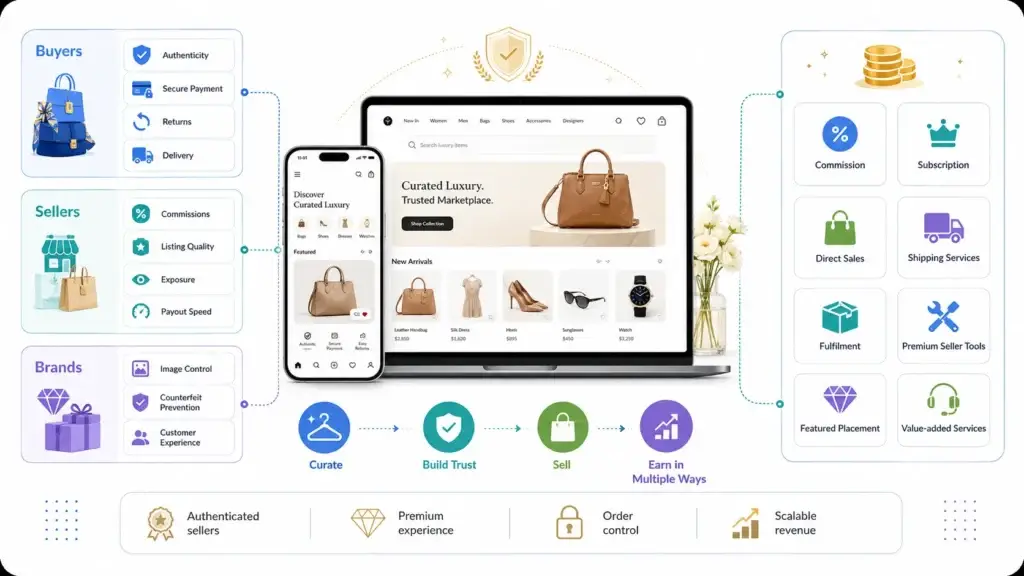
A luxury fashion marketplace sits between commerce, curation, trust, and service. That creates more monetization opportunities than a basic multi-vendor store, but it also creates more responsibility.
In luxury resale and designer fashion, buyers care about authenticity, product condition, seller reputation, secure payments, return policies, and delivery handling. Sellers care about commission rates, listing quality, exposure, payment speed, and support. Brands care about image control, counterfeit prevention, and customer experience.
This is why many luxury marketplace businesses use a blended model. The RealReal, for example, reports that the substantial majority of its revenue comes from consignment sales, where it retains a percentage of sale proceeds as a take rate. It also reports revenue from subscriptions, direct sales, and shipping services.
Farfetch’s marketplace model also shows how luxury platforms can generate income from seller transactions by deducting commission, fulfilment, and related income from GMV under a revenue-share structure.
For readers who want the marketplace foundation first, this guide on how Farfetch works explains how a luxury marketplace connects shoppers with boutiques, brands, product discovery, global catalogues, and multi-brand ecommerce workflows.
The lesson for founders is clear: commission is important, but it should not be the only monetization layer. A luxury platform becomes stronger when it earns from the value it actually creates.
Commission Revenue: The Core Marketplace Income Stream
Commission is the most common revenue stream for luxury fashion marketplaces. The platform earns a percentage from every successful sale.
This model works because it aligns the platform’s revenue with seller success. If sellers earn, the marketplace earns. It also reduces entry friction because sellers do not need to pay upfront before seeing results.
A simple commission model may look like this:
| Commission Type | How It Works | Best For |
|---|---|---|
| Flat seller commission | Same percentage on every sale | Early-stage marketplaces that need simplicity |
| Category-based commission | Different rates for bags, watches, shoes, apparel, or jewelry | Platforms with varied product margins |
| Value-based commission | Higher or lower rate depending on item price | Luxury resale platforms handling high-ticket products |
| Managed consignment commission | Higher commission because the platform handles listing, pricing, authentication, and fulfilment | Premium service-led marketplaces |
| Brand or boutique commission | Revenue share from official sellers and retailers | Curated luxury marketplaces with professional supply |
The mistake many founders make is choosing a commission rate only by looking at competitors. A better approach is to ask: what is the platform doing for the seller? Founders can also study the luxury fashion marketplace business model to understand how commission, boutique revenue, partner sales, promotional fees, and settlement logic can work together inside a premium marketplace.
If the seller uploads photos, writes descriptions, handles shipping, and manages customer communication, the commission should be lighter. If the platform provides authentication, photography, pricing support, storage, fulfilment, and dispute handling, a higher commission becomes easier to justify.
Buyer Service Fees: Charging for Trust and Convenience
Luxury marketplaces can also charge buyer-side service fees. These are usually added at checkout and may cover platform protection, secure payments, authentication handling, shipping coordination, or customer support.
Buyer fees work best when the value is visible. A buyer is more likely to accept a service fee when the platform clearly explains what the fee protects.
For example, a buyer service fee may support:
- Secure checkout and payment processing
- Order protection
- Authentication review
- Insured shipping coordination
- Dispute handling
- Customer support
- Return or issue-resolution workflows
In luxury fashion, the buyer is not only buying a product. They are buying confidence that the item is genuine, accurately described, safely shipped, and properly handled if something goes wrong.
For founders, the key is not to hide buyer fees. Hidden fees create checkout drop-off. Transparent fees, explained as protection or service value, are easier to defend.
Authentication Fees: Turning Trust Into a Paid Service
Authentication is one of the most important revenue and trust layers in a luxury fashion marketplace. It can be included in commission, offered as a paid upgrade, or required for high-value categories.
Luxury resale platforms often need stronger authentication workflows because counterfeit risk directly affects buyer confidence, seller quality, and brand reputation. Vestiaire Collective highlights brand collaboration, authentication training support, and anti-counterfeit commitments as part of its trust ecosystem.
Because luxury marketplace revenue depends heavily on buyer trust, these luxury ecommerce marketplace security practices are useful for understanding seller verification, secure payments, fraud prevention, role-based access, and admin controls.
A founder can structure authentication revenue in several ways:
| Authentication Model | Revenue Logic | Founder Consideration |
| Included authentication | Built into platform commission | Easier for buyers, but increases platform cost |
| Paid seller authentication | Seller pays to add a verified badge or certificate | Useful for optional trust upgrades |
| Paid buyer authentication | Buyer pays for extra verification before shipment | Works for high-value products |
| Category-required authentication | Mandatory for watches, bags, jewelry, or premium brands | Stronger trust but adds operational complexity |
| Partner-led authentication | Third-party authenticators charge per item or per order | Scales faster without building every process internally |
The platform must decide whether authentication is a trust cost, a profit center, or both.
A simple founder rule: if authentication reduces disputes, increases conversion, and supports higher average order value, it is not just a cost. It is part of the revenue engine.
Concierge and White-Glove Services
Luxury buyers often expect a higher-touch experience than general ecommerce shoppers. This creates room for paid concierge services.
A marketplace can charge for personal shopping support, sourcing rare products, private sale facilitation, wardrobe resale assistance, premium packaging, priority delivery, or managed seller onboarding.
Concierge services are especially useful when the marketplace handles expensive, rare, vintage, or collectible fashion items. These services may not scale like software, but they can create strong margins because they serve high-intent buyers and sellers.
Examples of concierge-style services include:
- Personal shopper assistance
- Rare item sourcing
- VIP seller onboarding
- Professional product photography
- Premium listing creation
- Price recommendation support
- White-glove pickup
- High-value item handling
- Private buyer-seller coordination
For a new founder, concierge services can also reveal what users value most. If buyers repeatedly pay for sourcing help, the marketplace may later build smarter recommendation or wishlist features. If sellers pay for managed listings, the platform may later introduce seller subscriptions or premium tools.
Partner Sales and Brand-Led Resale Programs
Partner sales are becoming increasingly important in luxury fashion marketplaces. Instead of relying only on individual sellers, a marketplace can work with brands, boutiques, retailers, stylists, resellers, and authentication partners.
Vestiaire Collective’s Official Partners program is an example of resale-as-a-service, where brands and retailers can incorporate resale into their business model through the platform.
Partner sales can generate revenue through:
- Commission on partner inventory
- Resale-as-a-service fees
- Brand storefront fees
- Retailer onboarding fees
- Campaign fees
- Data and reporting services
- Managed logistics or fulfilment fees
- Affiliate or referral revenue
- Co-branded resale experiences
This model is powerful because partners can bring trusted supply. In luxury fashion, quality supply is often harder to build than demand. A marketplace with verified brands, boutiques, or professional resellers can create buyer trust faster than a platform relying only on unknown sellers.
For founders, partner sales should be planned early. The platform needs partner dashboards, inventory upload tools, approval workflows, commission rules, payout reports, and performance analytics.
This is where a scalable ecommerce marketplace platform becomes important. The revenue model depends on the backend control layer, not only the storefront design.
Promoted Listings and Seller Visibility Fees
Once a luxury marketplace has enough traffic, promoted listings can become a strong revenue stream. Sellers pay to improve product visibility in search results, category pages, homepage sections, email campaigns, or curated collections.
This model works well when sellers can clearly see performance data. If a seller pays for visibility but cannot track impressions, clicks, saves, inquiries, or sales, the fee feels like a gamble.
Promoted visibility can include:
- Featured homepage placement
- Sponsored category placement
- Boosted search ranking
- Featured seller profiles
- Collection inclusion
- Newsletter placement
- Social campaign inclusion
- Seasonal campaign sponsorship
The admin panel should allow the platform operator to control campaign pricing, duration, placement rules, seller eligibility, and reporting.
For luxury fashion, promoted listings must be handled carefully. Too many paid placements can reduce curation quality. A luxury marketplace should not look like a discount ad board. Paid visibility should still pass quality checks.
Seller Subscriptions and Professional Tools
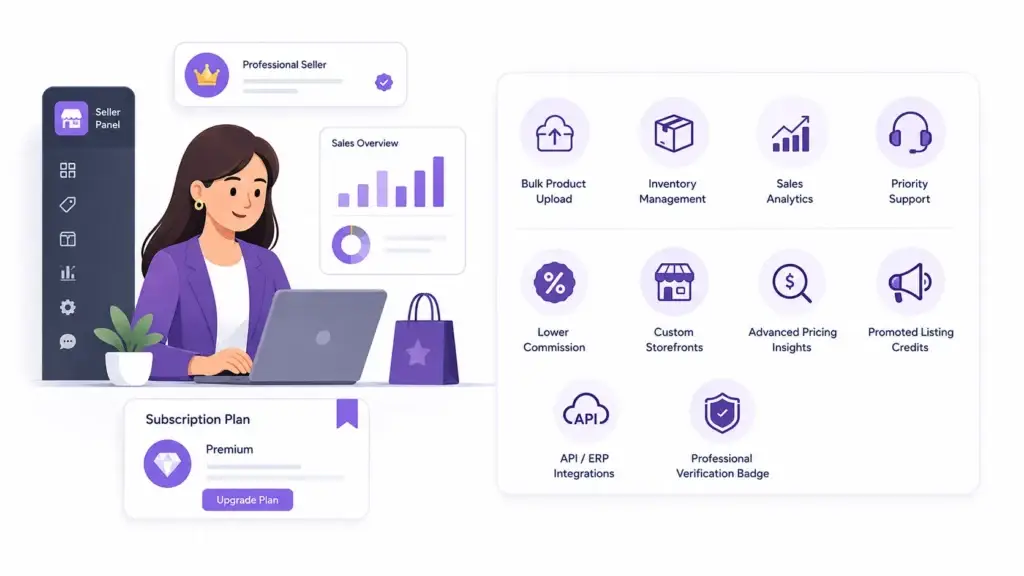
Some sellers need more than basic listings. Professional resellers, boutiques, stylists, and brand partners may pay for advanced tools that help them manage inventory and sell faster.
Seller subscriptions can include:
- Bulk product upload
- Inventory management
- Sales analytics
- Priority support
- Lower commission tiers
- Custom storefronts
- Advanced pricing insights
- Promoted listing credits
- API or ERP integrations
- Professional verification badges
This model is useful because it creates recurring revenue. However, subscription fees should not be introduced too early if sellers have not yet seen enough marketplace demand.
A good approach is to launch with commission first, then introduce seller tools once active sellers start asking for better control, faster uploads, better reporting, or premium visibility.
Shipping, Fulfilment, and Protection Fees
Luxury fashion orders often need careful delivery handling. Insured shipping, signature confirmation, packaging standards, customs documentation, return controls, and high-value delivery tracking can all become part of the revenue model.
The RealReal reports shipping services revenue from outbound shipping and handling services charged to buyers, along with shipping fees for consigned products returned within policy.
For a founder, shipping revenue should be treated carefully. Users may resist inflated shipping costs, but they often accept fair fees for secure delivery, insurance, and high-value handling.
Possible shipping-related revenue streams include:
- Buyer-paid shipping fees
- Insured delivery upgrades
- Express delivery
- White-glove shipping
- Packaging fees
- Return handling fees
- International customs support
- Seller pickup services
The marketplace must also decide whether it wants to operate as a lightweight connector or a managed fulfilment platform. The second model can earn more, but it also requires stronger operations.
Direct Sales and Inventory-Led Revenue
Some luxury marketplaces also earn through direct sales. This means the platform owns certain inventory and sells it directly instead of only connecting buyers and sellers.
This can happen when the marketplace buys inventory from sellers, accepts trade-ins, purchases from brands, or holds selected products for curated drops.
Direct sales can create higher revenue per item because the platform keeps the resale margin. But it also creates inventory risk. The platform must pay for goods, store them, authenticate them, price them correctly, and manage unsold stock.
For most new founders, direct inventory should be introduced carefully. A marketplace model is usually less risky at the beginning because the platform does not need to buy every product upfront.
Revenue Model Comparison for Luxury Fashion Marketplaces
| Revenue Stream | Who Pays? | Why They Pay | Best Stage to Use |
| Seller commission | Seller | Access to buyers and completed sales | Launch stage |
| Buyer service fee | Buyer | Protection, support, and secure transaction handling | Launch or growth stage |
| Authentication fee | Buyer or seller | Trust, verification, and reduced counterfeit risk | Launch stage for high-value products |
| Concierge service | Buyer or seller | Premium support and convenience | Growth stage |
| Promoted listing fee | Seller or brand | More visibility and sales opportunity | After traffic grows |
| Seller subscription | Professional seller | Better tools, analytics, and lower friction | Growth stage |
| Partner sales commission | Brand, boutique, or reseller | Access to marketplace demand | Launch or growth stage |
| Resale-as-a-service | Brand or retailer | Circular commerce support and resale infrastructure | Growth or enterprise stage |
| Shipping and protection fee | Buyer or seller | Secure logistics and issue handling | Launch stage |
| Direct inventory margin | Platform buyer/reseller model | Margin from owned products | Later stage |
Founder Decision Signals
Commission Fit
If your platform only connects buyers and sellers, keep commission simple. If you handle authentication, photography, fulfilment, or pricing, a higher take rate becomes easier to justify.
Trust Layer
If the average order value is high, authentication, escrow, insured shipping, and dispute workflows should be part of the core product from the beginning.
Partner Potential
If boutiques, stylists, or brands can provide strong supply, build partner dashboards and commission rules early instead of treating partners like normal sellers.
Service Revenue
If buyers or sellers need human support for high-value items, concierge services can become an early premium revenue stream before advanced automation is added.
Marketplace Features Needed to Support Revenue
The cost of building a revenue-ready luxury marketplace depends on modules such as boutique onboarding, authentication workflows, commission rules, payment handling, shipping logic, partner dashboards, and admin analytics. Founders who want a deeper budget breakdown can review this luxury marketplace development cost guide before finalizing the launch scope.
A luxury fashion marketplace cannot monetize properly if the platform does not have the right operational features. Revenue streams must be supported by backend workflows.
Important modules include:
- Seller onboarding and verification
- Product listing approval
- Brand and category management
- Commission rule engine
- Buyer service fee controls
- Authentication workflow
- Partner dashboard
- Promoted listing management
- Payment gateway integration
- Escrow or payment hold logic
- Shipping and fulfilment rules
- Dispute management
- Refund and return workflows
- Seller payout reporting
- Admin analytics
- Role-based admin access
For a deeper product-level breakdown, explore the luxury marketplace platform features that support boutique onboarding, multi-seller orders, commission rules, fulfilment states, seller payouts, product approval, and admin-managed marketplace operations.
Luxury marketplace trust depends on identity, payment safety, dispute control, transparent records, and moderation. A weak backend makes revenue harder to manage because every fee, payout, refund, and exception becomes manual.
Miracuves helps founders build marketplace platforms with customer, seller, partner, and admin workflows that support monetization from the start. For broader marketplace planning, founders can explore Miracuves’ listings and marketplace solutions or review the ecommerce marketplace app direction.
Mistakes Founders Should Avoid
Charging Too Many Fees Too Early
Multiple revenue streams are useful, but launching with too many fees can scare away sellers and buyers. Start with the clearest value exchange, usually commission plus essential trust fees.
Treating Authentication as an Afterthought
Authentication is not just a feature. It affects trust, disputes, brand reputation, and conversion. If luxury buyers doubt authenticity, paid acquisition becomes expensive and retention becomes difficult.
Copying General Fashion Marketplace Models
A general resale app and a luxury fashion marketplace are not the same. Luxury needs stronger verification, better product presentation, higher service expectations, and more careful dispute handling.
Ignoring Partner Workflows
Brands, boutiques, stylists, and professional resellers need better tools than casual sellers. If partner sales are part of the business model, the platform should include partner dashboards, reporting, and flexible commission rules.
Not Connecting Revenue to Admin Control
Every monetization stream needs admin control. The platform operator should be able to adjust commissions, manage fees, approve listings, track payouts, resolve disputes, and review revenue performance without depending on developers for every small change.
How Miracuves Helps Founders Build Monetization-Ready Marketplaces
Luxury fashion marketplace success depends on more than good design. The platform needs seller workflows, product approval, secure payments, authentication support, commission settings, partner sales logic, admin dashboards, and scalable ecommerce infrastructure. Choosing the right luxury ecommerce marketplace development partner helps founders evaluate technical capability, monetization support, marketplace workflows, and long-term platform control before launch.
Miracuves helps founders launch marketplace platforms using ready-made and customisable app foundations with source-code ownership, white-label branding, admin control, and monetization-ready workflows. This gives founders a faster way to validate the business model without building every module from zero.
A monetization-ready marketplace should also give founders flexibility after launch. Commission percentages, seller tiers, buyer service fees, promoted listings, authentication charges, and partner payouts may need to change as the platform learns from real transactions. When these controls are available inside the admin dashboard, the business can test pricing strategies, adjust seller rules, and improve margins without rebuilding the core product.
For luxury fashion platforms, this control layer is especially important because trust and revenue are closely connected. A buyer may pay more when authentication, secure checkout, insured delivery, and dispute handling are clear. A seller may accept a commission when the platform provides premium visibility, verified buyers, smooth payouts, and operational support. Miracuves helps founders structure these workflows so the marketplace can grow as both a commerce platform and a premium service business.
Final Thoughts
The luxury fashion marketplace revenue model works best when every fee is connected to real value. Commission pays for access to demand. Service fees pay for trust and convenience. Authentication fees reduce risk. Partner sales improve supply quality. Promoted listings help sellers grow when the platform has traffic. Subscriptions and concierge services create deeper monetization for professional users.
For founders, the goal is not to add every revenue stream at once. The smarter path is to build a marketplace foundation that can support multiple monetization layers as the business grows.
A luxury marketplace should feel premium, trustworthy, and easy to use. When the product experience, trust layer, partner workflows, and admin controls are designed together, revenue becomes more scalable and less dependent on one fee.
FAQs
How do luxury fashion marketplaces make money?
Luxury fashion marketplaces usually make money through seller commissions, buyer service fees, authentication fees, promoted listings, seller subscriptions, partner sales, shipping fees, concierge services, and sometimes direct inventory sales.
What is the most common revenue stream for a luxury fashion marketplace?
Seller commission is usually the core revenue stream. The platform takes a percentage from every completed sale. This model works because the marketplace earns when sellers successfully sell products.
Can a luxury marketplace charge buyers a service fee?
Yes. Buyer service fees can cover secure checkout, authentication support, buyer protection, dispute handling, customer support, or insured shipping. The fee should be transparent and clearly connected to buyer value.
Why is authentication important for luxury resale revenue?
Authentication builds trust. In luxury resale, buyers are more likely to purchase high-value products when they believe the item is genuine, properly reviewed, and protected by platform policies.
What are partner sales in a luxury fashion marketplace?
Partner sales happen when the marketplace works with brands, boutiques, retailers, stylists, or professional resellers. The platform may earn commission, onboarding fees, resale-as-a-service fees, or campaign revenue from these partners.
Should a new luxury marketplace start with subscriptions?
Not always. Subscriptions work better once sellers already see value from the marketplace. Early-stage platforms usually perform better with commission first, then add subscriptions for professional sellers later.
What features are needed to monetize a luxury fashion marketplace?
Important features include seller onboarding, listing approval, commission rules, authentication workflows, payment gateway integration, escrow or payment hold logic, shipping rules, dispute management, payout reporting, partner dashboards, and admin analytics.
Can Miracuves help build a luxury fashion marketplace?
Yes. Miracuves helps founders build ecommerce and marketplace platforms with white-label branding, source-code ownership, seller workflows, admin dashboards, secure payment logic, and monetization-ready modules.
Miracuves is an independent software development company. We are not affiliated with, connected to, sponsored by, or endorsed by any company or product named in this article.
Terms such as “X Clone” are used descriptively. It is how the software industry refers to building a platform with functionality comparable to a known service, and how clients search for it.
The entire design and codebase of our products is built by our own team. Our products contain no code, design, graphics, or content originating from any third-party website or applications.
All third-party names and marks referenced in this article are the property of their respective owners, referenced solely to identify the services discussed.