


Key Takeaways
- A global luxury fashion marketplace needs more than simple currency conversion at checkout.
- Product prices may change by region because of exchange rates, taxes, duties, shipping, and seller policies.
- Buyers should see clear prices in their preferred currency before completing an international order.
- Sellers need controlled tools for regional pricing, inventory availability, commissions, and payouts.
- Pricing, localization, payments, refunds, and reporting must operate as one connected marketplace system.
Global Pricing Signals
- Define the platform’s base currency and the currencies available to buyers and sellers.
- Decide how often exchange rates update and whether the platform applies a conversion buffer.
- Configure region-specific markups, taxes, import duties, shipping fees, and catalog restrictions.
- Confirm that payment gateways support international checkout, marketplace commissions, and seller payouts.
- Test refunds, returns, settlements, and financial reports across different currencies and regions.
Real Insights
- Displaying a converted price does not guarantee that the payment gateway can settle that currency.
- Unexpected taxes and duties at checkout can reduce conversion and damage customer trust.
- Regional pricing should reflect local costs and market conditions instead of using conversion alone.
- Cross-border refunds become more complex when exchange rates, taxes, duties, and seller payouts have changed.
- Miracuves develops luxury fashion marketplaces with multi-currency pricing, regional catalogs, seller controls, payments, and payout workflows.
Luxury fashion marketplaces are not simple online stores with designer products listed in multiple currencies. They are cross-border commerce systems where product prices, seller margins, taxes, import duties, shipping rules, payment methods, and buyer expectations change from one region to another.
For a founder building a premium fashion marketplace, pricing is not only a finance decision. It is a product experience decision.
A shopper in Dubai, London, Mumbai, New York, or Singapore may see a different final price for the same designer handbag because of currency conversion, boutique pricing, delivery destination, customs duties, local taxes, stock location, brand restrictions, and seller-specific pricing rules. If the platform does not explain these differences clearly, users may lose trust before checkout.
This is why global pricing, multi-currency support, and regional marketplace configuration should be planned early in the product architecture. A launch-ready luxury marketplace from Miracuves can support this kind of pricing logic through marketplace modules, seller controls, admin workflows, and customization layers designed for international commerce.
Why Pricing Feels More Complex in Luxury Fashion Marketplaces
In a standard ecommerce store, the platform owner usually controls the product catalog, price, stock, discount, and checkout logic. In a luxury fashion marketplace, the structure is different.
The marketplace may connect multiple boutiques, designers, authorized sellers, and regional inventory partners. Each seller can have different acquisition costs, local tax responsibilities, shipping arrangements, discount policies, and margin expectations.
That means one luxury product can have different pricing outcomes depending on:
- Which boutique owns the item
- Where the item is physically stocked
- Where the buyer is located
- Whether the destination country requires VAT, GST, customs duty, or import tax
- Whether duties are prepaid or collected separately
- Which payment gateway is used
- Whether the seller wants fixed local pricing or converted pricing
- Whether the platform adds commission, service fee, or shipping margin
For founders, the key lesson is simple: pricing must be treated as a marketplace engine, not just a product field.
If the backend only supports one base price and one display currency, the platform will struggle when it expands into multiple countries. A premium fashion marketplace needs flexible pricing rules from day one, especially if it plans to onboard international sellers or target high-value buyers across regions.
What Actually Drives Regional Price Differences?
Regional price differences are normal in international luxury commerce. The problem is not that prices change. The problem is when the platform fails to explain why they change.
A buyer may compare the same item across regions and wonder why the amount is higher or lower. This difference may come from legitimate operational variables rather than random markup.
Main Factors Behind Regional Pricing
| Pricing Factor | How It Affects the Marketplace | Founder Impact |
|---|---|---|
| Seller base price | Each boutique or brand partner may define its own price | The platform needs seller-level pricing control |
| Currency conversion | Exchange rates change and may include payment processor costs | Admins need conversion rules and buffer settings |
| Taxes | VAT, GST, sales tax, or local ecommerce taxes may apply | Checkout must show tax logic clearly |
| Import duties | Cross-border luxury goods may attract customs duties | The platform should support prepaid or customer-paid duty models |
| Shipping region | Long-distance delivery, insurance, and logistics partners affect cost | Shipping rules should be region-aware |
| Stock location | Local stock can reduce duty exposure and delivery time | Inventory location should influence final price |
| Marketplace commission | Platform fees may vary by seller or category | Commission logic should be configurable |
| Promotions | Discounts may apply only in selected regions | Admins need regional campaign controls |
This is where many marketplace founders underestimate the product build. They plan beautiful product pages and curated collections, but forget that price transparency decides checkout trust.
Multi-Currency Support Is More Than a Currency Switcher
Many founders think multi-currency support means showing a dropdown with USD, EUR, GBP, INR, AED, or SGD. That is only the surface layer.
A real multi-currency marketplace needs logic across the full buyer journey.
A Strong Multi-Currency System Should Handle:
- Localized product display
Buyers should see prices in a currency that feels natural for their region. This improves browsing comfort and reduces mental conversion effort. - Checkout currency compatibility
The platform must decide whether the customer pays in local currency, seller currency, platform base currency, or a payment gateway-supported currency. - Currency conversion rules
Exchange rates can come from payment gateways, financial APIs, or admin-defined settings. Founders should decide whether rates update automatically or manually. - Conversion buffer controls
Marketplaces may add a small buffer to protect against exchange rate movement, payment processor spreads, or refund mismatch risk. - Refund and return logic
If a buyer pays in one currency and the seller settles in another, refunds must account for exchange rate changes, taxes, and duties. - Seller settlement currency
A boutique in Italy, a designer in the UAE, and a marketplace operator in India may not all settle in the same currency. Vendor payout rules matter. - Admin reporting currency
Even if customers pay in multiple currencies, the admin dashboard should provide financial reporting in a base currency for clean accounting.
Without this deeper layer, a marketplace can display multiple currencies but still create confusion during payment, settlement, refunds, and reporting.
Read More: How Luxury Fashion Marketplaces Generate Revenue From Commissions, Services, and Partner Sales
Multi-Currency Marketplace Feature Requirements
| Feature | Business Value | Founder Impact |
|---|---|---|
| Currency Display by Region | Shows buyers prices in familiar currencies | Improves browsing confidence and reduces price confusion |
| Exchange Rate Management | Controls how prices are converted across markets | Protects margins when currencies fluctuate |
| Payment Gateway Currency Mapping | Matches checkout currency with gateway support | Reduces failed payments and checkout friction |
| Seller Settlement Rules | Defines how vendors receive payouts | Simplifies finance operations for international sellers |
| Refund Currency Logic | Handles returns across different payment currencies | Reduces disputes and accounting mismatches |
Tax-Inclusive vs Tax-Exclusive Pricing: Which Model Works Better?
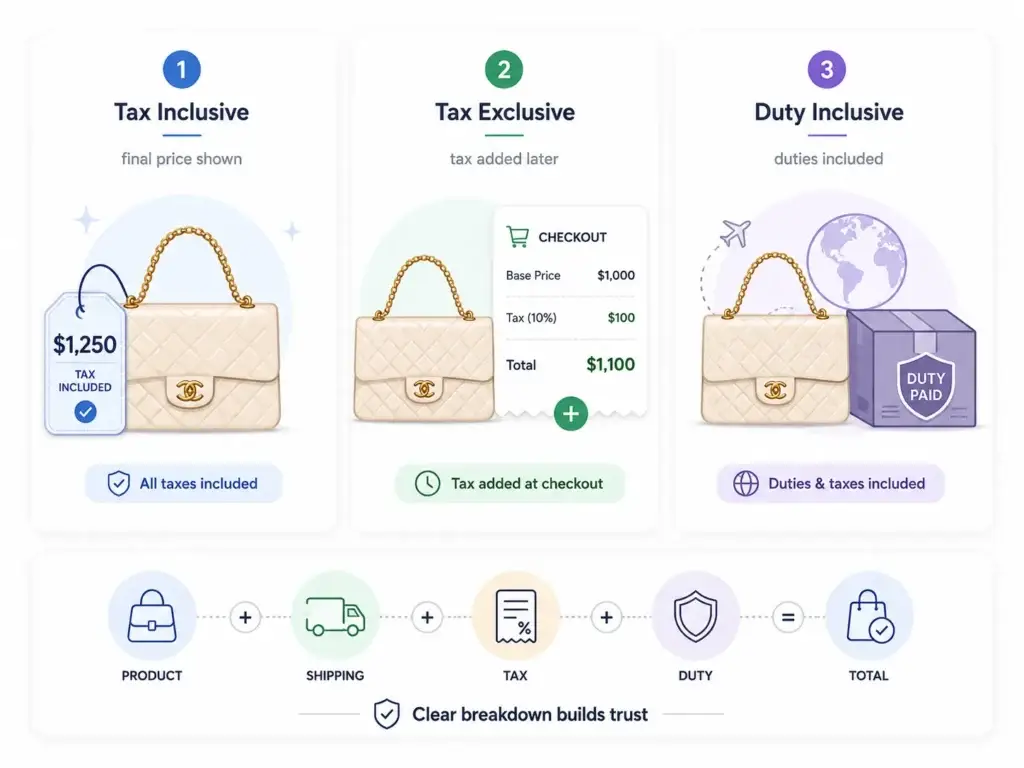
Image Source: AI-generated visual by Miracuves
One of the biggest pricing decisions in a luxury marketplace is whether the displayed price should include taxes and duties or whether those charges should appear separately at checkout.
There is no one-size-fits-all answer. The right model depends on buyer expectations, country rules, logistics partners, and how the marketplace wants to position trust.
Tax-Inclusive Pricing
In tax-inclusive pricing, the customer sees a price that already includes applicable taxes. This is common in many regions where buyers expect the displayed price to be close to the final payment amount.
Why founders choose it:
- Better price transparency
- Lower checkout surprise
- Cleaner luxury shopping experience
- Stronger trust for premium buyers
- Easier marketing because prices feel final
Business challenge:
The marketplace must calculate taxes correctly by destination region and still protect platform margins.
Tax-Exclusive Pricing
In tax-exclusive pricing, taxes are added later during checkout. This can work in regions where customers are used to seeing tax added separately.
Why founders choose it:
- More flexibility across regions
- Easier base product price comparison
- Useful where tax rules vary heavily by state, province, or country
- Cleaner seller-side price management
Business challenge:
Luxury buyers may abandon checkout if the final amount increases unexpectedly.
Duty-Inclusive Pricing
For cross-border luxury items, import duties can have a major impact on final cost. A duty-inclusive approach includes estimated customs duties in the final checkout price.
Why it matters:
High-value fashion buyers usually want clarity before payment. If duties are collected after delivery by customs or courier partners, the experience may feel unpredictable.
A strong marketplace should allow the admin to decide whether duties are:
- Included in the product price
- Added at checkout
- Paid by the seller
- Paid by the customer upon delivery
- Handled through a logistics or duty calculation partner
The most founder-friendly approach is usually to show a clear breakdown: product price, shipping, taxes, duties, and final payable amount.
How Regional Pricing Rules Help Protect Marketplace Margins
Regional pricing does not mean randomly charging different users different prices. It means configuring price logic based on real business conditions in each market.
For example, selling into the United States may involve different shipping, customs, return handling, and payment processing costs than selling into the UAE or the European Union. A marketplace that ignores these differences may either overcharge buyers in some regions or lose margin in others.
Regional Pricing Rules Can Be Based On:
- Buyer country
- Seller country
- Product origin
- Warehouse location
- Brand pricing restrictions
- Currency conversion rate
- Import duty exposure
- Local tax requirements
- Shipping service level
- Return logistics cost
- Regional discount campaigns
- Local competitor pricing
For luxury fashion, this matters because buyers compare prices carefully. If the price looks too high without explanation, they may leave. If the price is too low because costs were not calculated properly, the marketplace loses margin.
The admin panel should allow platform operators to configure region-wise pricing rules without needing developer support for every update.
Founder Decision Signals
Speed
If your first target market is domestic, simple pricing may be enough for launch. If you plan international buyers from day one, multi-currency and tax logic should be included early.
Cost
Pricing complexity increases when you add multiple currencies, duty handling, seller payouts, and regional catalog rules. A ready-made foundation can reduce the cost of building these controls from scratch.
Scalability
A marketplace that supports only one currency or one tax model may need expensive rework when expanding into new regions.
Market Fit
Luxury buyers expect clarity, trust, and premium presentation. Transparent regional pricing helps the marketplace feel more reliable in high-value purchases.
Marketplace Pricing Models Founders Should Consider
A luxury fashion marketplace can use different pricing models depending on seller relationships and platform positioning.
1. Seller-Controlled Pricing
In this model, boutiques or designer sellers define their own product prices. The marketplace adds commission, service fee, shipping, taxes, or duties based on platform rules.
This model works well when the marketplace wants to onboard many independent sellers and give them flexibility.
Best for:
Multi-boutique marketplaces, curated seller networks, regional luxury sellers.
Risk:
The same item may appear at different prices if multiple sellers list it.
2. Platform-Controlled Pricing
Here, the platform standardizes the final selling price and controls what the buyer sees. Seller payouts are handled separately in the backend.
Best for:
Curated luxury platforms that want consistent pricing and brand control.
Risk:
It requires stronger finance logic, seller agreements, and admin controls.
3. Region-Based Pricing
The marketplace defines different pricing rules for different markets. For example, Europe, the Middle East, India, and North America may each have separate markup, tax, and shipping rules.
Best for:
Platforms planning international growth.
Risk:
Incorrect configuration can create pricing gaps or buyer confusion.
4. Dynamic Currency Conversion
The platform converts prices using live or scheduled exchange rates. This helps the marketplace stay aligned with currency movement.
Best for:
Marketplaces with buyers in several countries.
Risk:
Exchange rate fluctuations can affect refunds, accounting, and displayed prices.
5. Hybrid Pricing
Many luxury marketplaces use a hybrid approach: sellers control base prices, while the platform manages regional adjustments, taxes, duties, payment fees, and final display logic.
Best for:
Most scalable marketplace businesses.
Risk:
Requires a strong admin dashboard and clear pricing governance.
What Pricing Controls Should the Admin Dashboard Include?
The admin dashboard is where pricing strategy becomes operational. Without proper controls, every pricing change becomes a developer task or manual finance problem.
A luxury marketplace admin should be able to manage:
- Base currency
- Supported buyer currencies
- Region-wise currency display
- Exchange rate source
- Manual exchange rate override
- Seller pricing permissions
- Commission by category or seller
- Region-wise markup
- Tax rules by destination
- Duty display logic
- Shipping fee rules
- Promotional pricing by market
- Discount restrictions for luxury brands
- Payout currency
- Refund handling rules
- Price audit logs
- Price approval workflows
This level of control matters because luxury commerce is sensitive. A wrong price can damage margins, seller relationships, and customer trust.
For founders evaluating marketplace software, this should be a key product question: Can the admin team control pricing by region, seller, currency, and tax rule without rebuilding the platform?
Regional Catalog Visibility: Not Every Product Should Appear Everywhere
Pricing is closely connected to catalog visibility. A product may be available in one country but restricted in another because of brand rules, shipping limitations, customs restrictions, seller agreements, or inventory location.
For example, a boutique may only ship certain products within Europe. A designer may allow sales in the UAE but not in the United States. A luxury item may require insured delivery that is unavailable in some regions.
A marketplace should allow catalog visibility rules such as:
- Show product only in selected countries
- Hide product where shipping is unavailable
- Restrict brands by region
- Restrict sellers by destination country
- Display local stock first
- Show estimated delivery by region
- Apply different return rules by market
This protects the buyer experience. It is better to hide unavailable products early than to show them and create checkout failure later.
Currency, Duties, and Returns: The Overlooked Refund Problem
Refunds become more complex when a marketplace sells across borders.
A customer may pay in GBP. The seller may receive settlement in EUR. The platform may report revenue in USD. Duties may be paid upfront. Shipping may be partially refundable. Currency rates may change between purchase and refund date.
If the platform does not define refund logic clearly, customer support teams face disputes.
A strong refund system should answer:
- Is the buyer refunded in the original payment currency?
- Are duties refundable?
- Are taxes refunded automatically?
- Is shipping refunded?
- What happens if exchange rates change?
- Who absorbs currency conversion loss?
- Is the seller payout reversed?
- How does the admin track partial refunds?
Luxury buyers expect premium service, especially when order values are high. Refund clarity is not only a finance feature. It is part of brand trust.
Read More: How Luxury Multi-Brand Fashion Marketplaces Work: Business Model, User Flow, and Founder Lessons
Payment Gateway and Currency Compatibility
Even if a marketplace displays many currencies, the selected payment gateway may not support every currency for collection, settlement, or refunds.
Before launching internationally, founders should check:
- Supported payment currencies
- Supported settlement currencies
- Cross-border transaction fees
- Refund behavior
- Chargeback process
- Local payment methods
- Fraud screening options
- Payment compliance requirements
- Payout timing for sellers
- Split payment or marketplace payout support
A payment gateway that works for a domestic ecommerce store may not be enough for a multi-seller international luxury marketplace.
This is why payment architecture should be planned with marketplace logic, not added as an afterthought.
Localization: Pricing Is Also About Buyer Psychology
Regional pricing is not only technical. It also affects how buyers feel.
A luxury shopper in the UAE may expect duty clarity. A buyer in the UK may expect VAT-inclusive pricing. A buyer in India may want to know whether customs duty is included before paying. A buyer in the US may be used to taxes appearing during checkout depending on location.
The platform should localize:
- Currency
- Language
- Size charts
- Tax messaging
- Delivery estimate
- Return policy
- Duty explanation
- Payment methods
- Customer support prompts
- Promotional messaging
Even the way price is displayed can affect conversion. For premium products, clarity matters more than aggressive discounting.
A founder should ask: Does the marketplace feel local enough for the buyer while still operating as a global platform?
How a Ready-Made Marketplace Foundation Helps Founders Move Faster
Building pricing, currency, and regional logic from zero can take significant planning because it touches catalog, checkout, payments, shipping, tax, admin, seller payouts, and reporting.
A ready-made foundation gives founders a stronger starting point because core marketplace flows are already structured. The product can then be customized for target regions, seller models, payment gateways, branding, and operational rules.
Miracuves helps founders launch source-code-owned, white-label marketplace platforms with customizable modules for sellers, buyers, admin teams, payments, catalog management, and regional business logic. For a founder planning a luxury fashion marketplace, this means the product can support commercial validation faster without ignoring the backend controls needed for international growth.
For readers evaluating a launch-ready luxury marketplace model, you can explore Miracuves’ dedicated solution
Common Mistakes Founders Should Avoid
Treating Multi-Currency as a Frontend Feature Only
A currency selector is not enough. The platform also needs checkout compatibility, exchange rate control, seller settlement rules, refund logic, and reporting support.
Ignoring Duties Until Checkout
Luxury buyers dislike surprise charges. If duties or taxes appear late, the buyer may abandon the order or lose trust in the marketplace.
Using One Pricing Rule for Every Region
Different markets have different tax rules, logistics costs, buyer expectations, and payment behaviors. One flat rule can damage margins or conversion.
Not Giving Sellers Clear Pricing Controls
If sellers cannot manage prices, promotions, and regional availability properly, the marketplace team may face constant manual support requests.
Forgetting Refund and Exchange Rate Logic
Refunds across currencies can create accounting issues if the platform does not define how taxes, duties, shipping, and exchange rate differences are handled.
Pricing Architecture Checklist for Luxury Fashion Marketplaces

Image Source: AI-generated visual by Miracuves
Before launching internationally, founders should review how pricing, currencies, taxes, duties, seller payouts, and regional checkout rules will work across the platform. This is also where development scope becomes clearer, because every added pricing rule affects the backend, admin dashboard, payment flow, and seller operations.
For founders comparing build options, Miracuves also provides a dedicated luxury marketplace development cost breakdown that can help you understand how features, integrations, customization, and launch scope influence the final investment.
Before launch, review these questions:
- Which base currency will the platform use?
- Which currencies will buyers see?
- Which currencies will sellers receive?
- Will exchange rates update automatically?
- Will the platform add a currency conversion buffer?
- Will prices include taxes?
- Will import duties be prepaid or collected later?
- Can sellers define region-specific pricing?
- Can products be hidden in restricted regions?
- Can the admin apply regional markups?
- Can refunds handle taxes, duties, and currency differences?
- Does the payment gateway support marketplace payouts?
- Can the admin export reports in one base currency?
- Are tax and duty explanations visible before checkout?
- Can the platform localize size, language, shipping, and return policies?
This checklist helps founders avoid building a marketplace that looks premium on the frontend but becomes difficult to operate across regions. It also helps separate must-have launch features from advanced pricing logic that can be planned based on market priority, seller model, and budget.
Suggested Feature Stack for Global Luxury Marketplace Pricing
A scalable luxury marketplace should include modules that support pricing control, seller flexibility, buyer transparency, and international checkout operations. For founders reviewing the platform scope in more detail, Miracuves also has a dedicated luxury fashion marketplace features that explains the broader feature set needed to launch and manage this type of platform.
| Module | Why It Matters |
|---|---|
| Multi-Currency Engine | Displays and processes prices across different buyer regions |
| Region-Based Pricing Rules | Allows different markup, tax, and catalog rules by country |
| Seller Pricing Dashboard | Gives brands and boutiques controlled pricing flexibility |
| Duty and Tax Configuration | Helps calculate and display additional costs clearly |
| Payment Gateway Integration | Supports local and international transactions |
| Seller Payout Management | Handles vendor settlements and commission deductions |
| Refund and Return Logic | Manages cross-border refund complexity |
| Regional Catalog Control | Shows or hides products based on destination availability |
| Admin Price Audit Logs | Tracks pricing changes for accountability |
| Localization Settings | Adjusts currency, language, delivery, and policy messaging |
These are not just technical features. They are the foundation of buyer trust, seller confidence, and marketplace scalability. A clear feature roadmap also helps founders decide which pricing controls are needed at launch and which advanced modules can be planned for future regional expansion.
Miracuves Luxury Fashion Marketplace Solution Cost and Tech Stack
Miracuves Pricing for a Farfetch Like App developed in JavaScript For $3,699 USD (One-Time Price) with custom delivery timeline based on scope
Get a fully developed, premium fashion marketplace platform built for luxury brands, boutiques, sellers, shoppers, and global fashion commerce operators. Built on a modern JavaScript foundation, this solution can be customized for international pricing, multi-currency checkout, regional catalogs, and luxury marketplace operations.
- Core Workflows: Boutique onboarding, seller management, product listing, luxury catalog management, customer registration, product discovery, cart checkout, order management, shipment tracking, returns handling, and customer notifications.
- Built-in Pricing Logic: Multi-currency pricing, regional price rules, tax and duty handling, country-wise catalog visibility, exchange-rate logic, promotional pricing, boutique commission setup, and localized checkout flows.
- Management Hub: Centralized admin dashboard, boutique management, seller controls, customer management, product approval, order tracking, payment records, refund handling, regional pricing controls, and marketplace analytics.
- Global Commerce-Ready: Prepared for international storefronts, multi-region operations, currency conversion, payment gateway setup, shipping integrations, tax workflows, luxury seller onboarding, and long-term marketplace growth.
Why Does a Luxury Fashion Marketplace Require JavaScript Architecture?
A luxury fashion marketplace needs more than a standard ecommerce setup. It handles boutique inventories, premium product catalogs, regional pricing, currency conversion, tax rules, international shipping, seller commissions, payment flows, returns, and customer trust workflows. A modern JavaScript architecture helps manage these operations smoothly across shoppers, boutiques, admins, and connected commerce systems.
We recommend JavaScript architecture for this type of platform because:
- Built for Global Marketplace Logic: JavaScript-based backend systems can manage product catalogs, boutique pricing, regional rules, currency handling, checkout workflows, payment events, and high-volume marketplace activity.
- Advanced Frontend Experience: React.js or other JavaScript frameworks can power premium product pages, luxury storefronts, localized shopping experiences, filtering, checkout flows, boutique dashboards, and admin controls.
- Scalable Commerce Operations: JavaScript architecture supports multiple boutiques, global customers, regional catalogs, tax logic, currency conversion, order tracking, refund flows, and growing luxury marketplace demand.
- Flexible Integration Layer: The platform can connect with payment gateways, currency APIs, tax engines, shipping providers, inventory systems, CRM tools, analytics platforms, email/SMS tools, and customer support systems.
You get a scalable luxury fashion marketplace designed for global pricing control, premium shopping experiences, boutique growth, secure payments, and long-term marketplace expansion.
Note: This cost is for the solution, re-branding, deployment, and source code only. Final scope may vary based on regional pricing logic, currency workflows, tax rules, shipping integrations, and custom feature requirements.
Where Miracuves Fits Into the Marketplace Launch Journey
Miracuves supports founders who want to build luxury marketplace platforms without starting every module from zero. A ready-made marketplace foundation can include core buyer flows, seller onboarding, catalog management, order management, payment integration, admin control, and customization flexibility.
For a founder, the advantage is not just faster development. It is faster decision-making.
Instead of spending months defining basic marketplace workflows, founders can focus on:
- Which regions to launch first
- Which sellers to onboard
- Which payment gateways to integrate
- Which tax and duty model to use
- Which pricing rules protect margins
- Which luxury categories to prioritize
- Which buyer experience creates trust
Related reading: What Go-to-Market Strategy Works Best for a New Luxury Fashion Marketplace and Luxury Fashion Marketplace vs Traditional Fashion E-Commerce.
Final Thoughts: Global Pricing Is a Marketplace Trust Layer
Luxury fashion marketplaces do not win only because they list premium products. They win when buyers trust the price, understand the final cost, and feel confident that delivery, duties, returns, and payments are handled professionally.
For founders, global pricing should not be treated as a minor ecommerce feature. It should be part of the marketplace foundation.
The right system should support multi-currency display, region-based pricing, seller controls, duty and tax configuration, payout rules, refund handling, and admin visibility. This gives the business room to expand without rebuilding core pricing logic every time it enters a new market.
Miracuves helps founders create white-label, source-code-owned marketplace platforms that can be customized around region-specific business rules, seller models, payment workflows, and luxury buyer expectations.
FAQs
Why do luxury marketplace prices differ by region?
Luxury marketplace prices can differ because of seller pricing, currency conversion, taxes, import duties, shipping costs, stock location, payment fees, and regional pricing rules. The same product may have a different final price depending on where the buyer is located and where the item is shipped from.
What is multi-currency support in a fashion marketplace?
Multi-currency support allows buyers to view and pay for products in different currencies. A strong system should also handle exchange rates, payment gateway compatibility, seller settlement, refund logic, and admin reporting.
Should a luxury marketplace include duties and taxes in the final price?
Including duties and taxes can improve buyer trust because customers see a clearer final price before payment. However, the right approach depends on target markets, logistics partners, tax rules, and whether the marketplace wants duty-inclusive or duty-exclusive checkout.
What is regional pricing in ecommerce marketplaces?
Regional pricing means configuring product prices, taxes, shipping fees, duties, discounts, and catalog availability based on the buyer’s location or seller’s region. It helps protect margins and improves localization.
How does currency conversion affect marketplace refunds?
Currency conversion can affect refunds when exchange rates change between purchase and return. The platform should define whether refunds happen in the original payment currency and how taxes, duties, shipping, and conversion differences are handled.
Why is pricing transparency important in luxury ecommerce?
Luxury buyers expect clarity and trust. If prices change unexpectedly at checkout because of taxes, duties, shipping, or currency conversion, users may abandon the order or question the credibility of the marketplace.
What admin features are needed for international marketplace pricing?
The admin dashboard should support base currency, exchange rate controls, region-wise pricing, tax and duty rules, seller pricing permissions, commission settings, refund rules, payout currency, and price audit logs.
Can Miracuves help build a luxury fashion marketplace with regional pricing features?
Yes. Miracuves helps founders build white-label, source-code-owned luxury marketplace platforms that can be customized with seller workflows, admin controls, payment integrations, multi-currency support, and region-specific pricing logic.
Miracuves is an independent software development company. We are not affiliated with, connected to, sponsored by, or endorsed by any company or product named in this article.
Terms such as “X Clone” are used descriptively. It is how the software industry refers to building a platform with functionality comparable to a known service, and how clients search for it.
The entire design and codebase of our products is built by our own team. Our products contain no code, design, graphics, or content originating from any third-party website or applications.
All third-party names and marks referenced in this article are the property of their respective owners, referenced solely to identify the services discussed.