


You’ve heard the horror stories about data breaches, leaked customer lists, and hacked email marketing dashboards. And if you’re planning to launch a white-label Mailchimp app, one question becomes non-negotiable in 2026: Is it actually safe?
Because a Mailchimp-type app doesn’t just store emails. It stores business trust. Subscriber databases, campaign analytics, customer segmentation, integrations, and sometimes even billing data. One security mistake can damage your brand overnight.
In this guide, I’ll give you an honest, practical security breakdown of white-label Mailchimp app safety in 2026, what risks to watch for, and what standards a secure provider must meet. I’ll also show how Miracuves approaches security-first development for safer, compliant platforms.
Understanding White-Label Mailchimp App Security Landscape (2026)
What “white-label security” actually means
White-label Mailchimp app security in 2026 means the app is branded as yours, but the core software, infrastructure setup, and security architecture depend on the provider. So your safety level is only as strong as:
- Their code quality
- Their hosting practices
- Their update policy
- Their compliance readiness
Why people worry about white-label Mailchimp apps
Because these apps typically handle:
- Customer email lists and personal data
- Campaign content and business strategy
- Login access for multiple teams
- Integrations with CRMs, ecommerce, payment tools, and analytics
A single weak link can expose everything.
Current threat landscape for Mailchimp-type platforms (2026)
In 2026, the biggest threats include:
- Account takeovers (credential stuffing, weak passwords)
- API abuse (unauthenticated or poorly protected endpoints)
- Data scraping and export abuse
- Malware links injected into campaigns
- Insider access misuse (team members, agencies, vendors)
Security standards in 2026
A secure white-label Mailchimp app should align with:
- Strong authentication and role-based access control
- Secure database storage and encryption
- Logging + monitoring for suspicious activity
- Regular patching and dependency updates
- Compliance readiness (GDPR/CCPA, PCI DSS if payments exist)
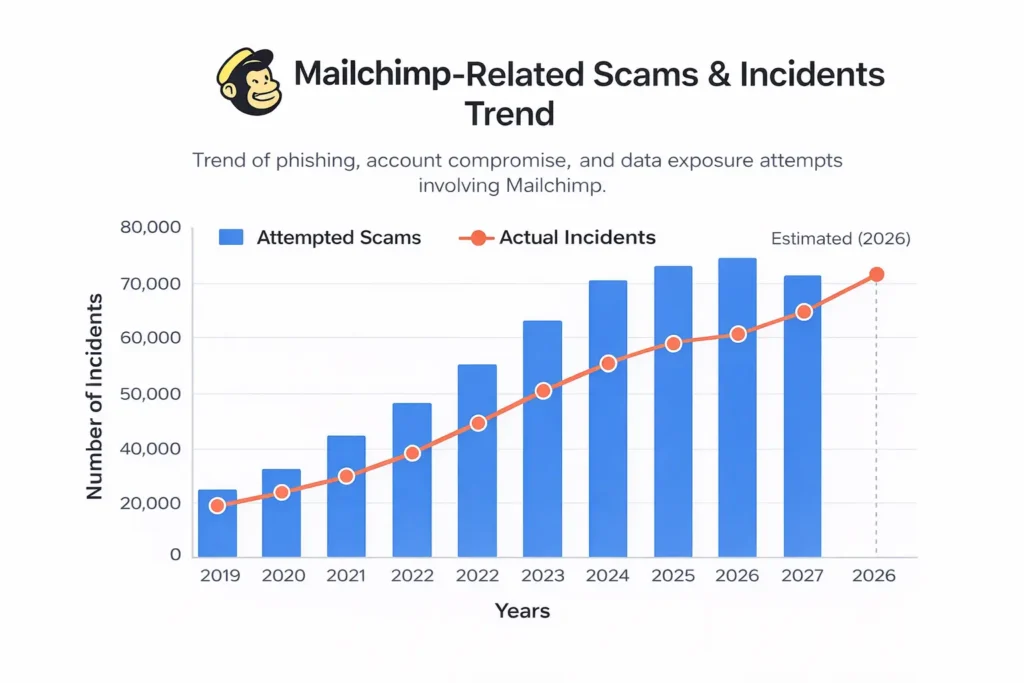
Real-world security incident reality (2026)
Email marketing platforms are common targets because they hold high-value assets:
- Verified email lists
- Brand domains and sender reputations
- Customer engagement history
Even without naming brands, incidents in this category often involve:
- Unauthorized account access
- Subscriber list leaks
- Malicious email campaigns sent from compromised accounts
That’s why “Is white-label Mailchimp app safe?” is a serious question in 2026.
Key Security Risks & How to Identify Them (2026)
White-label Mailchimp app security risks in 2026 usually fall into three categories: data risks, technical risks, and business risks. If you understand these clearly, you can avoid 90% of the disasters people face after launch.
Data Protection & Privacy Risks (High Risk)
User personal information
A Mailchimp-type app stores:
- Names, emails, phone numbers (sometimes)
- IP addresses and device data
- Audience tags and segmentation history
Risk: If this leaks, it becomes a compliance and reputation problem immediately.
Payment data security
If your white-label Mailchimp app includes billing, subscriptions, or add-on purchases:
- Card data must never be stored directly
- Payment flow must follow PCI DSS requirements
Risk: Weak payment handling can cause fraud, chargebacks, and legal exposure.
Location tracking concerns
Mailchimp-type apps usually don’t track location like delivery apps, but they may store:
- User login locations
- Campaign geo analytics
- IP-based segmentation
Risk: This becomes sensitive data in privacy regulations.
GDPR/CCPA compliance
In 2026, the biggest privacy failures happen when apps:
- Collect data without clear consent
- Don’t allow export/delete requests
- Store data longer than needed
- Don’t document processing purposes
Risk: Legal complaints + penalties + trust loss.
Technical Vulnerabilities (High Risk)
Code quality issues
Low-quality white-label apps often have:
- Hardcoded keys
- Poor validation
- Weak session handling
Risk: Easy exploitation by attackers.
Server security gaps
Common gaps include:
- Misconfigured cloud storage
- Open admin panels
- Weak firewall rules
Risk: Full database exposure.
API vulnerabilities
Mailchimp-type apps rely heavily on APIs for:
- campaign creation
- subscriber management
- analytics reporting
- integrations
Risk: Broken authentication and authorization can expose user data.
Third-party integrations
Integrations (CRM, ecommerce, analytics) create risk if:
- tokens are stored insecurely
- permissions are too broad
- webhooks are not verified
Risk: attackers hijack data flow between systems.
Business Risks (High Risk)
Legal liability
If your platform leaks data, users won’t blame the provider first. They blame the brand name on the app (you).
Reputation damage
For marketing platforms, trust is everything. A single breach can destroy your sender reputation and customer confidence.
Financial losses
Losses may include:
- incident handling cost
- refunds and churn
- downtime impact
- compliance fines
Regulatory penalties
In 2026, regulators care about:
- proof of consent
- breach reporting timelines
- security controls documentation
Risk Assessment Checklist (Quick Scan)
Use this checklist before choosing any white-label Mailchimp app provider in 2026:
- Does the app support 2FA / OAuth login?
- Is data encrypted at rest + in transit?
- Are admin actions logged (audit logs)?
- Is there role-based access (Admin, Manager, Viewer)?
- Can users export/delete data (GDPR-ready)?
- Is the API protected with secure auth + rate limits?
- Are backups automated and tested?
- Is there a security patch/update policy?
- Are integrations token-based and safely stored?
- Is penetration testing done regularly?
Security Standards Your White-Label Mailchimp App Must Meet (2026)
If you want real confidence in 2026, don’t judge safety by UI or feature lists. Judge it by security standards and compliance readiness. A secure white-label Mailchimp app should meet both certification-level expectations and technical security requirements.
Essential Certifications (2026)
ISO 27001 compliance
This is a global security management standard. It proves the provider follows structured controls for:
- risk management
- access control
- incident handling
- security policies
Best for: enterprise trust and long-term safety.
SOC 2 Type II
SOC 2 Type II focuses on operational security controls over time, not just “one-time compliance.”
It evaluates:
- security
- availability
- confidentiality
- processing integrity
Best for: SaaS platforms like a Mailchimp-type app.
GDPR compliance
Required if you handle EU users or EU data. In 2026, GDPR expectations include:
- consent tracking
- data deletion workflows
- lawful processing documentation
- breach reporting readiness
HIPAA (if applicable)
Not common for Mailchimp-type apps, but applicable if you support healthcare campaigns and store protected health information.
PCI DSS for payments
If your app includes billing/subscriptions, PCI DSS is mandatory in 2026.
Best practice: use trusted payment gateways and never store raw card data.
Technical Requirements (Must-Have in 2026)
End-to-end encryption
For a Mailchimp-type app, encryption must cover:
- data in transit (TLS/SSL)
- data at rest (database encryption)
- secure storage for tokens and keys
Secure authentication (2FA/OAuth)
Must include:
- 2FA for admin accounts
- OAuth-based secure sessions
- protection against brute force attacks
Regular security audits
Security audits validate:
- access control
- system configuration
- data storage practices
- compliance gaps
Penetration testing
Pen testing helps find:
- API flaws
- injection vulnerabilities
- authentication bypass issues
SSL certificates
Basic requirement in 2026, but should be enforced across:
- app dashboard
- admin panel
- APIs
Secure API design
A secure API should include:
- token-based authentication
- rate limiting
- request validation
- role-based access control
- logging for suspicious patterns
Security Standards Comparison Table (2026)
| Standard / Control | Why It Matters for White-Label Mailchimp App Security | Priority in 2026 |
|---|---|---|
| ISO 27001 | Strong security management framework | High |
| SOC 2 Type II | Proves ongoing security controls | High |
| GDPR | Protects user privacy + avoids penalties | High |
| PCI DSS | Required if billing/payments exist | High |
| Penetration Testing | Finds real exploitable weaknesses | High |
| Encryption (At Rest + Transit) | Prevents data theft impact | High |
| 2FA / OAuth | Stops account takeovers | High |
| Audit Logs | Tracks actions + supports investigations | Medium-High |
Rea more : – Marketing Strategy Explained: Grow Like a Pro
Red Flags: How to Spot Unsafe White-Label Providers (2026)
In 2026, most security failures don’t happen because the business owner didn’t care. They happen because the provider looked “fine” on the surface, but the backend was weak. If you’re evaluating a white-label Mailchimp app provider, these red flags can save you from a costly mistake.
Warning Signs (High Risk Red Flags)
No security documentation
If the provider cannot share basic security details like:
- encryption methods
- hosting setup
- authentication approach
- backup policy
That’s not “confidential.” That’s a warning.
Cheap pricing without explanation
Low pricing is not automatically bad, but in 2026, security costs money:
- audits
- monitoring
- patching
- secure infra
If pricing is extremely low with no breakdown, security is usually missing.
No compliance certifications
If they claim “GDPR ready” but can’t show proof or process details, assume you’ll carry the risk.
Outdated technology stack
Old frameworks and unpatched dependencies are common breach entry points.
Poor code quality
Signs include:
- frequent bugs
- slow performance
- unstable dashboards
Poor code quality usually means weak security controls too.
No security updates policy
In 2026, threats evolve fast. If the provider doesn’t offer:
- patch timelines
- vulnerability fixes
- ongoing maintenance
Your app will become unsafe over time.
Lack of data backup systems
Backups should be:
- automated
- encrypted
- tested for recovery
No backups = one incident can wipe your business.
No insurance coverage
Serious providers in 2026 often have cyber liability coverage. If they don’t, you may be alone when things go wrong.
Evaluation Checklist (Provider Due Diligence in 2026)
Questions to ask providers
- How is user data encrypted (at rest + in transit)?
- Do you support 2FA for admin and users?
- How do you secure APIs and prevent abuse?
- What is your patch and update policy?
- Do you conduct penetration testing?
- How do you handle breach detection and response?
Documents to request
- security overview document
- compliance readiness (GDPR/CCPA) details
- backup and disaster recovery plan
- incident response plan
- audit reports (if available)
Testing procedures
Before launch, you should insist on:
- vulnerability scanning
- penetration testing
- role-based access testing
- API endpoint testing
- login and session security checks
Due diligence steps
- Ask for a staging/demo environment
- Review admin panel permissions
- Confirm logs and monitoring exist
- Verify data export/delete workflows (privacy compliance)
If a provider avoids these conversations, it’s not because they’re “too busy.” It’s usually because they can’t meet the security expectations of 2026.
Rea more : – Mailchimp Features That Help Your Business Grow
Best Practices for Secure White-Label Mailchimp App Implementation (2026)
Buying a white-label Mailchimp app is only step one. In 2026, real security comes from how you implement, configure, and maintain it. Many apps are “secure enough” at the core, but become unsafe because of weak setup and poor post-launch discipline.
Pre-Launch Security (Must Do in 2026)
Security audit process
Before going live, run a structured audit to confirm:
- encryption is enabled everywhere
- admin access is restricted
- database and storage are secured
- logs and alerts are working
Code review requirements
Even for a white-label app, ask for:
- code review reports
- dependency and package audit
- secure coding practices confirmation
This helps prevent hidden vulnerabilities from day one.
Infrastructure hardening
A secure setup includes:
- private database access
- firewall rules and IP restrictions
- secure server configuration
- protection against DDoS and brute-force attacks
Compliance verification
In 2026, don’t “assume compliance.” Verify:
- GDPR consent tracking
- data export and deletion workflows
- retention policies
- privacy documentation readiness
Staff training programs
Security failures often happen due to human mistakes like:
- weak passwords
- sharing admin access
- clicking malicious links
Basic training prevents major incidents.
Post-Launch Monitoring (Non-Negotiable in 2026)
Continuous security monitoring
Your app should monitor:
- login attempts
- suspicious IP access
- abnormal exports of subscriber lists
- API abuse patterns
Regular updates and patches
Security is not one-time. In 2026, you need:
- monthly security updates
- emergency patches when needed
- dependency upgrades
Incident response planning
You should have a simple plan for:
- detecting incidents
- isolating the issue
- notifying users if required
- recovering systems quickly
User data management
Best practices include:
- least-privilege access
- role-based permissions
- secure export controls
- audit trails for sensitive actions
Backup and recovery systems
Backups must be:
- encrypted
- automatic
- tested regularly
Recovery is what keeps you alive after an incident.
Security Implementation Timeline (Simple 2026 Plan)
Week 1: Foundation
- configure hosting security
- enforce SSL + encryption
- setup role-based access
Week 2: Hardening
- enable 2FA
- secure APIs
- validate integrations security
Week 3: Testing
- vulnerability scan
- penetration testing
- fix critical issues
Week 4: Launch Readiness
- finalize compliance documents
- enable monitoring and alerts
- backup testing + incident response checklist
Legal & Compliance Considerations (2026)
White-label Mailchimp app security in 2026 is not only about stopping hackers. It’s also about meeting legal expectations. Even if your app is technically strong, weak compliance can still lead to penalties, user complaints, and brand damage.
Regulatory Requirements (2026)
Data protection laws by region
In 2026, the most common compliance expectations include:
- EU: GDPR (strict consent + data rights)
- USA: CCPA/CPRA (privacy rights and disclosures)
- UK: UK GDPR (similar to EU requirements)
- India: DPDP Act (data protection and consent rules)
If your app serves multiple countries, you must follow the strictest applicable rules.
Industry-specific regulations
Mailchimp-type apps usually fall under general privacy laws, but industry rules apply if you serve:
- healthcare (HIPAA-like requirements)
- finance (stronger audit and data handling expectations)
- children’s data (extra consent requirements)
User consent management
In 2026, consent must be:
- clear and documented
- revocable
- purpose-specific
Your app should support consent logs and user preference controls.
Privacy policy requirements
A compliant privacy policy should clearly state:
- what data you collect
- why you collect it
- how long you store it
- who you share it with
- how users can request deletion/export
Terms of service essentials
Your terms should include:
- acceptable use rules
- anti-spam policies
- user responsibilities
- service limitations
- suspension/termination rights
This protects your platform from abuse and legal risk.
Liability Protection (2026)
Insurance requirements
A serious platform in 2026 should consider:
- cyber liability insurance
- professional liability coverage
- data breach coverage
This helps reduce financial shock if an incident happens.
Legal disclaimers
You should define:
- service scope
- limitation of liability
- third-party integration responsibility
User agreements
For teams and agencies using your app, include:
- role-based access rules
- responsibility for login safety
- reporting obligations
Incident reporting protocols
Your incident plan should include:
- internal reporting steps
- user notification guidelines
- regulator notification timelines (where required)
Regulatory compliance monitoring
Compliance is ongoing in 2026. You need:
- policy updates
- periodic audits
- review of integrations and vendors
Compliance Checklist by Region (2026)
| Region | Key Compliance Focus | What Your App Must Support |
|---|---|---|
| EU | GDPR | consent logs, delete/export data, breach readiness |
| USA (CA) | CCPA/CPRA | privacy disclosures, opt-out support, data rights |
| UK | UK GDPR | same as GDPR + UK data rules |
| India | DPDP Act | consent, data purpose clarity, user rights handling |
Why Miracuves White-Label Mailchimp App is Your Safest Choice (2026)
When businesses ask “Is a white-label Mailchimp app safe in 2026?”, the real question behind it is simple:
Can I trust this platform with my customer data, my brand reputation, and my business continuity?
Miracuves focuses on security-first implementation so you don’t have to “patch safety later.” The goal is to launch a Mailchimp-type app that is stable, compliant, and built for real-world risk.
Miracuves Security Advantages (2026)
Enterprise-grade security architecture
Miracuves builds white-label Mailchimp apps with security layered into:
- authentication
- data storage
- API access
- admin controls
Regular security audits and certifications
Security isn’t treated like a one-time checklist. Audits help ensure the platform stays protected as threats evolve in 2026.
GDPR/CCPA compliant by default
Miracuves supports privacy-first readiness so your platform can handle:
- consent workflows
- data access requests
- data deletion requests
24/7 security monitoring
Ongoing monitoring helps detect:
- suspicious logins
- unusual data exports
- abnormal API traffic
Encrypted data transmission
Secure encryption helps protect:
- user logins
- subscriber lists
- campaign data
- analytics and reporting
Secure payment processing
If your Mailchimp-type app includes subscriptions, Miracuves supports secure payment flows aligned with PCI expectations in 2026.
Regular security updates
Updates and patches reduce risk from:
- newly discovered vulnerabilities
- dependency issues
- evolving attack patterns
Insurance coverage included
For businesses, this adds another layer of confidence and risk reduction in 2026.
Conclusion
Don’t compromise on security. Miracuves white-label Mailchimp app solutions come with enterprise-grade security built-in. Our 600+ successful projects have maintained zero major security breaches. Get a free security assessment and see why businesses trust Miracuves for safe, compliant platforms.
A white-label Mailchimp app can be safe in 2026, but only if security is treated as a core foundation, not an optional add-on. The safest path is choosing a provider that follows real compliance standards, delivers regular updates, and supports monitoring from day one.
With Miracuves, you get a security-first white-label Mailchimp app built to protect user data, reduce legal risk, and maintain long-term platform trust.
FAQs
1) How secure is white-label vs custom development in 2026?
White-label Mailchimp app security can be as strong as custom development in 2026 if the provider follows secure coding, audits, and compliance. Weak providers make white-label risky, not the model itself.
2) What happens if there’s a security breach in 2026?
A breach can lead to data exposure, downtime, reputation loss, and legal reporting requirements. That’s why incident response planning and backups are mandatory in 2026.
3) Who is responsible for security updates in 2026?
Usually the provider handles core updates, but the business owner must ensure updates are applied on time. In 2026, delayed patching is one of the biggest causes of breaches.
4) How is user data protected in white-label Mailchimp apps in 2026?4) How is user data protected in white-label Mailchimp apps in 2026?
User data should be protected using encryption (in transit + at rest), role-based access, secure APIs, and audit logs. Privacy controls like delete/export requests are also required in 2026.
5) What compliance certifications should I look for in 2026?
The most important are ISO 27001, SOC 2 Type II, GDPR compliance, and PCI DSS if payments are involved. These standards reduce risk and improve trust in 2026.
6) Can white-label Mailchimp apps meet enterprise security standards in 2026?
Yes, they can. In 2026, enterprise-level security depends on architecture, monitoring, audits, and update policies, not whether the app is white-label.
7) How often should security audits be conducted in 2026?
At minimum, run audits quarterly and penetration testing at least once or twice a year. In 2026, high-growth platforms may need more frequent testing.
8) What’s included in Miracuves security package in 2026?
Miracuves includes secure architecture, encryption, compliance-ready setup, monitoring support, secure payment handling, and regular updates to keep the app safe in 2026.
9) How to handle security in different countries in 2026?
Follow the strictest privacy rules for your audience, support consent management, and keep data handling transparent. GDPR, CCPA/CPRA, and India DPDP are key in 2026.
10) What insurance is needed for app security in 2026?
Cyber liability insurance and data breach coverage are recommended in 2026. It helps cover incident response costs, legal support, and recovery expenses.
Related Articles