
Key Takeaways
What You’ll Learn
- Mailchimp’s marketing strategy focuses on attracting users through freemium access and easy onboarding.
- Content marketing and educational resources help build trust and drive organic growth.
- Email campaigns and automation are used to nurture users throughout the lifecycle.
- Product-led growth allows users to experience value before upgrading.
- The strategy emphasizes long-term engagement rather than short-term acquisition.
Stats That Matter
- Lifecycle marketing covers acquisition, onboarding, engagement, and retention.
- Email marketing remains one of the most cost-effective digital channels.
- Automation helps deliver consistent communication without manual effort.
- Personalization improves engagement and conversion rates.
- Data-driven insights help optimize campaigns and improve performance over time.
Real Insights
- Freemium models reduce entry barriers and increase user adoption.
- Educational content builds authority and attracts long-term users.
- Automation strengthens retention by maintaining consistent engagement.
- User behavior data allows more targeted and effective campaigns.
- Successful marketing strategies balance acquisition, engagement, and retention.
Ever felt like you’ve crafted the perfect product, but nobody’s opening the metaphorical email?
Welcome to startup life — where launching your app is just Act I, and Act II is all about showing up in inboxes, notifications, and hearts. Whether you’re building the next email automation tool, a Mailchimp clone, or an AI-powered CRM sidekick, getting users to care is the hardest part.
Here’s the thing — Mailchimp didn’t become a household name overnight. It used charm, consistency, and a marketing strategy sharp enough to cut through inbox clutter. And today, we’re diving deep into how Mailchimp pulled it off, and how you can reverse-engineer that success for your own app. Spoiler: It’s not about sending more emails — it’s about sending the right message, to the right human, at the right time.
Let’s unpack the playbook, the pitfalls, and the power moves that helped Mailchimp soar — and how Miracuves can help you build and grow your version of this marketing magic.
The Mailchimp Origin Story: Email with Personality
Back in the early 2000s, most email tools felt like fax machines — functional, boring, and soul-crushing. Then came Mailchimp, swinging in with fun monkey mascots and quirky copy. That was the hook. But behind the humor was a deeply strategic approach:
- Freemium model to drive adoption.
- A no-nonsense UI/UX that even your grandma could figure out.
- Smart integrations with e-commerce, CRMs, and landing page tools.
- Automated marketing workflows that made users feel like pros.
Mailchimp didn’t just market to people; it empowered them to market smarter. And that was revolutionary.
Learn More: Build an App Like Mailchimp in 2025 – Full-Stack Developer Guide
User-Centric Branding: Making It Human, Not Corporate
Most SaaS apps talk like robots. Mailchimp? Total opposite.
Their branding — from Freddie the chimp to the playful tone — made it feel like a friend helping you grow your business, not another software subscription.
Key Takeaways for App Creators:
- Speak like a human. Write copy like you’d talk to a friend at a café.
- Use mascots or visual identity that feels relatable.
- Lean into emotion — startups, especially, are run by passionate people.
Freemium Funnel: The Growth Engine That Never Sleeps
Mailchimp’s biggest marketing masterstroke?
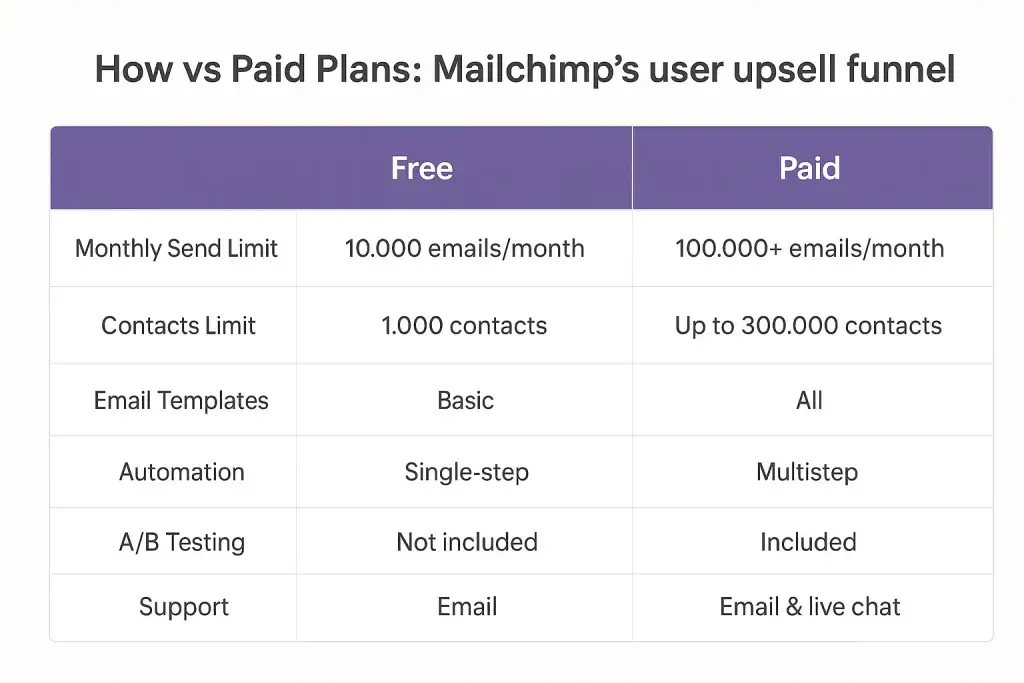
Freemium + viral triggers. Users could start for free and only pay as their list grew. Combine that with:
- Branded email footers (“Powered by Mailchimp”) that reached millions.
- Referral incentives for agencies and small businesses.
- Embedded forms and integrations that turned every user into a mini-marketer.
Smart Automation: More Time, Less Manual Hustle
Automation wasn’t just a feature; it was a marketing moat. Mailchimp positioned itself as the anti-hustle tool — doing the heavy lifting while creators slept.
Marketing Features That Sold Themselves:
- Welcome sequences
- Abandoned cart nudges
- Customer re-engagement workflows
- A/B testing subject lines and CTAs
If you’re building a Mailchimp-like app, automation should be baked into both your product and marketing story.
Educational Content & Creator-Led Campaigns
Mailchimp didn’t just sell features; they taught marketing.
Their “Mailchimp Presents” content hub offered mini-documentaries, how-to guides, and podcasts — not just about email, but about entrepreneurship.
Why It Worked:
- Built trust by being helpful, not salesy.
- Attracted creators, startups, and makers (aka, their target market).
- Boosted SEO and long-tail visibility.
Startups: Want to 10x visibility? Build a content engine that answers your users’ questions before they even sign up.
Data-Driven Personalization: Every User Feels Seen
Behind the scenes, Mailchimp ran like a precision watch. Users got personalized dashboards, tailored email suggestions, and AI-backed recommendations.
And guess what? Those personalization features became retention gold.
- Suggested send times based on open rates
- Pre-built audience segments
- Smart subject line assistants
Community Building: Not Just Software, a Movement
Mailchimp cultivated communities of marketers, creators, and e-commerce entrepreneurs. Think webinars, user groups, creator showcases, and even a branded podcast.
Actionable Tip for You:
If you’re building a marketing SaaS or Mailchimp-style tool, create a user-first ecosystem:
- Slack or Discord community
- User spotlights and case studies
- AMA sessions with founders or power users
Miracuves can help integrate community features right inside your clone app — think discussion boards, activity feeds, and user showcases.
Learn More: Mailchimp Features That Help Your Business Grow
Performance Marketing + Storytelling = Magic
Mailchimp didn’t go all-in on ads. Instead, they blended:
- SEO-rich landing pages
- Playful video campaigns (remember the “Did You Mean Mailchimp?” YouTube series?)
- Podcast sponsorships that felt native, not intrusive
Their marketing didn’t feel like marketing. It felt like storytelling with a strategy.
According to Statista, Mailchimp’s active user base ballooned to over 14 million by focusing on brand-driven, trust-led growth tactics.
App Store Optimization (ASO): The Unsung Hero
Most people forget Mailchimp has mobile apps too — and they crush it on the App Store.
Here’s why:
- Keyword-rich descriptions
- 1,000s of real user reviews
- Constant UI/UX updates
- Smart push notification strategies
If you’re launching a Mailchimp clone, don’t ignore ASO. It’s free real estate.
Want your own Mailchimp-style app clone? Check out our Build Your Own SaaS App solution at Miracuves.
Conclusion
Mailchimp’s strategy wasn’t about luck. It was a well-oiled machine built on:
- Freemium flywheels
- Brand personality
- Smart education
- Automation-first experiences
- Loyal user communities
Want your own email marketing tool to break through the noise? Copy the strategy, not just the features.
At Miracuves, we help innovators launch high-performance app clones that are fast, scalable, and monetization-ready. Ready to turn your idea into reality? Let’s build together.
FAQs
What made Mailchimp’s marketing so effective?
Mailchimp combined a freemium model with clever branding, educational content, and a strong community focus — it wasn’t just software, it was storytelling.
Can I launch a Mailchimp-like app and stand out?
Absolutely. If you focus on niche audiences, simplify the UX, and offer innovative automation — there’s room to grow. Plus, solid marketing helps.
How important is automation in Mailchimp’s success?
Critical. Mailchimp’s “set it and forget it” workflows were game-changers for users with no marketing background. Automation = retention.
What if my app isn’t fun or quirky — can I still compete?
Yes. Personality isn’t about being silly. It’s about being real. Build trust, be consistent, and speak human — that’s what wins hearts.
Is ASO really necessary for SaaS apps?
If your app’s on iOS/Android, then yes. App Store Optimization helps organic discovery, especially for solopreneurs browsing tools on the go.
How can Miracuves help me build a Mailchimp alternative?
Miracuves offers Mailchimp-style clone development, customizable marketing workflows, drag-and-drop builders, and integration-ready architectures — all built to scale.
Related Article:
Miracuves is an independent software development company. We are not affiliated with, connected to, sponsored by, or endorsed by any company or product named in this article.
Terms such as “X Clone” are used descriptively. It is how the software industry refers to building a platform with functionality comparable to a known service, and how clients search for it.
The entire design and codebase of our products is built by our own team. Our products contain no code, design, graphics, or content originating from any third-party website or applications.
All third-party names and marks referenced in this article are the property of their respective owners, referenced solely to identify the services discussed.