

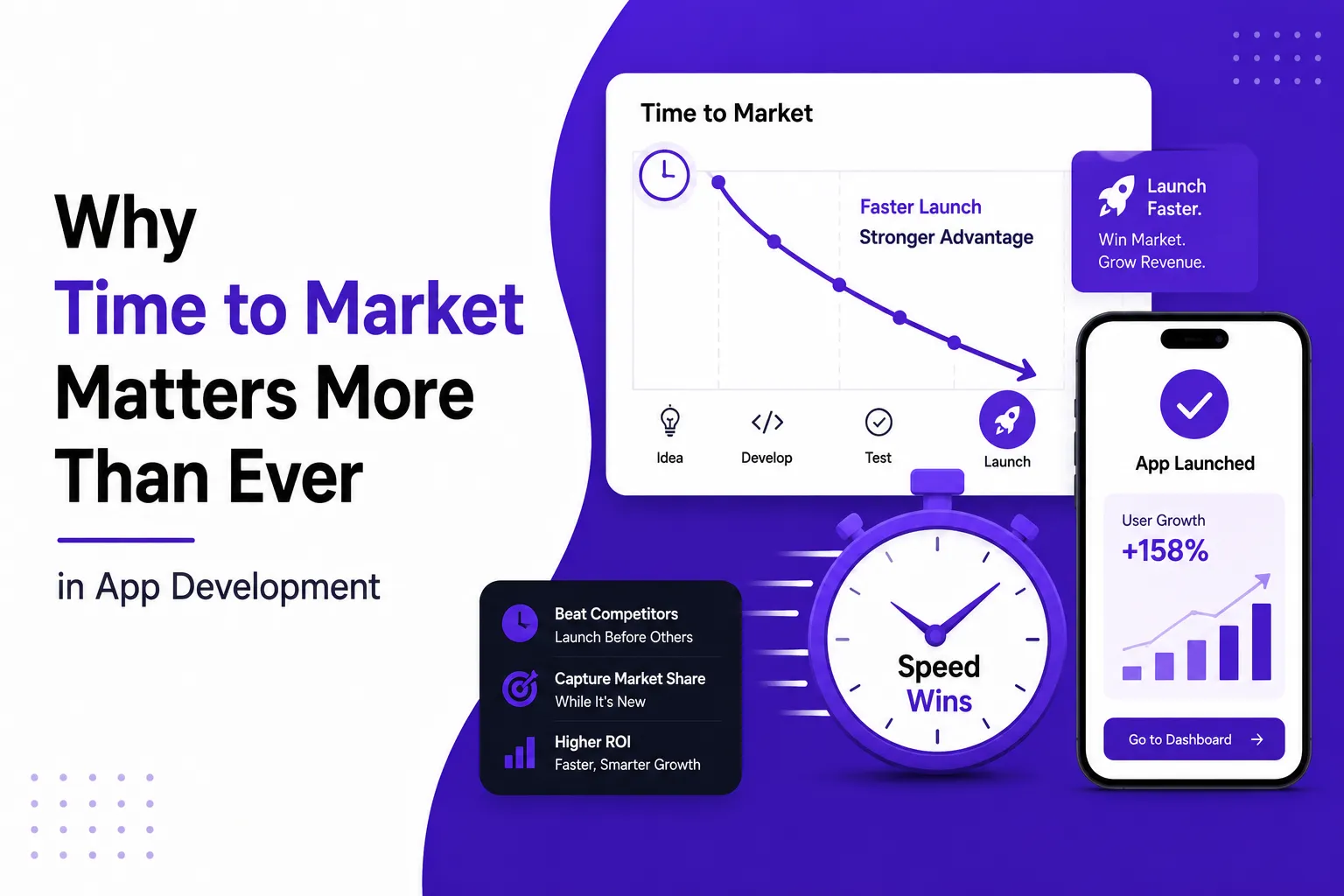
Key Takeaways
What You’ll Learn
- Time to market in app development directly impacts startup growth, competition, validation speed, and revenue opportunities.
- Faster launches help businesses collect real user feedback before competitors dominate the market.
- Modern development frameworks, cloud infrastructure, and reusable systems reduce deployment delays significantly.
- Lean MVP strategies help startups prioritize essential features instead of delaying launch perfection.
- The goal is to launch scalable applications quickly while maintaining performance, flexibility, and long-term product growth.
Stats That Matter
- Startups that launch earlier often gain stronger market visibility and faster customer acquisition.
- Long development cycles increase operational costs and delay revenue generation opportunities.
- Cloud-native infrastructure and rapid deployment systems have transformed how quickly apps can go live.
- Faster iteration cycles allow businesses to improve onboarding, engagement, and retention continuously.
- Competitive markets increasingly reward execution speed more than feature-heavy initial launches.
Real Insights
- Delaying launch for unnecessary features often creates missed opportunities in fast-moving digital markets.
- A focused MVP can validate demand faster than a fully built platform developed over many months.
- Modern app development prioritizes continuous improvement instead of waiting for perfect first releases.
- Rapid deployment strategies help startups adapt faster to changing customer expectations and industry trends.
- Long-term success depends on balancing launch speed, infrastructure scalability, user experience, and product evolution.
The startup ecosystem has changed dramatically over the last few years. Building a great product is no longer enough to guarantee success. Today, startups compete in environments where markets evolve quickly, customer expectations shift continuously, and new competitors enter almost every week. In this kind of digital economy, execution speed has become one of the biggest competitive advantages businesses can have.
Modern users expect products to evolve rapidly. Investors expect startups to validate ideas faster. Founders are under pressure to reduce operational waste while improving scalability. Because of this, businesses can no longer afford long development cycles that delay product launches for months or years.
This shift has made time to market app development one of the most important strategic priorities for startups, SaaS companies, fintech businesses, creator platforms, and modern digital ecosystems.
Many startups fail not because their idea lacked potential, but because they entered the market too late. Long development timelines often create multiple hidden risks. Markets may shift before launch, competitors may capture audience attention first, and customer expectations may evolve faster than the product itself.
At the same time, businesses that launch earlier gain something extremely valuable: real-world learning.
Faster launches allow startups to:
- Understand user behavior sooner
- Validate monetization faster
- Improve product-market fit earlier
- Reduce unnecessary development waste
- Adapt continuously to market trends
This is why modern app development increasingly prioritizes lean execution, agile deployment systems, scalable MVP strategies, and cloud-native product architectures.
Companies like Miracuves are increasingly focusing on rapid deployment ecosystems because modern startups require both speed and scalability to survive in competitive digital markets.
In this article, we’ll explore why faster launches are becoming essential for startup growth, how slow development cycles affect scalability, and what strategies modern businesses use to reduce launch timelines without sacrificing product quality or long-term flexibility.
What Does Time to Market Mean in App Development?
Time to market refers to the complete process of moving a product from idea to public launch. In app development, it includes everything from market validation and product planning to development, testing, deployment, and post-launch optimization.
Many businesses mistakenly believe time to market is only about coding faster. In reality, it represents how efficiently a startup can transform an idea into a functioning product capable of attracting real users and generating business value.
Modern startups operate in highly dynamic environments where speed directly influences competitiveness. A product launched six months late may face entirely different market conditions than originally expected. User expectations may evolve, competitors may dominate the niche, and monetization opportunities may shrink.
Because of this, modern product execution focuses heavily on reducing unnecessary delays while improving adaptability.
Traditional software development often prioritized large feature sets and lengthy development cycles before launch. Today, startups increasingly favor lean MVP systems because they reduce operational risk and allow businesses to learn faster through real customer feedback.
Before understanding why faster launches matter strategically, it helps to compare traditional development systems with modern rapid deployment approaches.
Long development models usually focus on completeness before launch. Modern startup execution, however, prioritizes scalability, validation, and continuous improvement.
| Stage | Traditional Development | Fast Time-to-Market Approach |
|---|---|---|
| Planning | Long research cycles | Lean market validation |
| Development | Large feature-heavy systems | MVP-first execution |
| Testing | Delayed testing before release | Continuous iteration |
| User Feedback | Collected after launch | Integrated early into workflows |
| Monetization | Planned later | Revenue validation from early stages |
This difference changes how startups scale, adapt, and compete in digital markets.

Why Faster Launches Win in Competitive Markets
Modern digital ecosystems reward businesses that learn faster than competitors.
The startups that launch earlier gain immediate access to customer insights, market behavior, monetization data, and retention patterns. Instead of relying only on assumptions, they can improve products based on actual user interaction.
This creates a significant competitive advantage because real-world learning compounds over time.
A startup that enters the market earlier can:
- Improve onboarding faster
- Optimize customer acquisition sooner
- Validate product-market fit earlier
- Build stronger audience familiarity
- Improve retention continuously
In contrast, businesses that remain inside long development cycles often struggle to adapt because they are making decisions without sufficient customer data.
Today, speed is not simply about launching quickly. It is about entering the learning cycle earlier than competitors.
Faster Feedback Loops Improve Product Decisions
Internal product planning can only predict user behavior to a certain extent. Real users often interact with products differently than expected.
Features that appear important during planning may receive very little engagement, while small usability improvements may significantly increase retention.
Faster launch systems help startups identify:
- Which features users actually value
- Where onboarding friction exists
- Which acquisition channels perform better
- What causes customer drop-offs
- Which pricing systems convert more effectively
This dramatically improves decision-making because businesses can continuously refine products based on real-world behavior rather than internal assumptions.
Modern startup growth increasingly depends on rapid feedback collection and continuous optimization.
Earlier Revenue Validation Improves Sustainability
Many startups spend heavily on development before validating whether customers are willing to pay for the product.
This creates unnecessary business risk because monetization systems remain untested for long periods.
Faster launches allow businesses to validate:
- Subscription models
- Freemium systems
- Marketplace commissions
- Premium upgrades
- Customer conversion flows
Earlier revenue validation improves financial clarity and helps startups prioritize high-value product improvements much sooner.
This also reduces dependency on prolonged funding cycles because businesses begin understanding commercial viability earlier.
Competitive Visibility Becomes Stronger
The businesses that enter markets earlier often gain stronger visibility advantages.
In highly competitive sectors, early exposure helps startups build:
- User familiarity
- Brand recognition
- Audience trust
- Community engagement
- Retention foundations
This is especially important in industries like:
- SaaS
- Fintech
- AI platforms
- Creator ecosystems
- Video-sharing products
For example, businesses launching scalable creator or media-sharing ecosystems increasingly prioritize rapid MVP deployment because audience behavior changes quickly and trends evolve continuously.
Modern startup ecosystems reward adaptability more than lengthy perfection-focused planning.
Read More :- Clone App Development: The Fastest Way to Validate a Market Without Starting From Zero
Why Slow Development Cycles Hurt Startups
Long development cycles create multiple operational and strategic problems for startups.
At first, extended timelines may appear safer because they allow teams to keep refining features internally. However, delayed execution often reduces a startup’s ability to compete effectively in rapidly evolving markets.
One major issue is market timing.
By the time some startups complete development, customer expectations may already have changed. Competitors may capture attention earlier, and market trends may shift before the product even launches.
This is particularly common in:
- AI ecosystems
- Creator platforms
- SaaS automation products
- Social engagement platforms
where innovation cycles move extremely fast.
Long development timelines also increase financial pressure.
The longer businesses delay launch:
- The higher operational costs become
- The longer monetization is postponed
- The greater investor pressure increases
- The more feature complexity expands
Feature bloat becomes especially dangerous during extended development cycles. Many startups continue adding functionality because they fear releasing early. Over time, this creates overly complex systems that are difficult to maintain and slower to deploy.
In many cases, startups eventually discover they built features customers never actually needed.
Founder burnout also becomes more common during long execution cycles. Teams working for extended periods without visible traction often experience lower morale and uncertainty regarding product direction.
This is why modern startups increasingly prioritize lean execution systems capable of reducing waste while improving adaptability.
The Biggest Misconceptions About Launching Fast
One of the most common misconceptions in startup development is that launching faster automatically means compromising quality. In reality, modern rapid app development is not about rushing unstable products into the market. It is about focusing on the most important features first and reducing unnecessary development delays.
Many successful startups do not begin with large, feature-heavy platforms. Instead, they launch with a focused product designed to solve one clear customer problem effectively. This approach helps businesses enter the market earlier, collect real user feedback, and improve products based on actual customer behavior rather than assumptions.
This is where MVP-first development becomes extremely important. An MVP is not an incomplete product. It is a strategic launch model that helps startups validate demand, improve learning speed, and reduce operational waste while maintaining scalability for future growth.
Modern startup ecosystems increasingly prioritize:
- Lean scalability
- Agile deployment
- Continuous optimization
- Customer-driven product improvements
The goal is not to achieve perfection before launch. The goal is to build a scalable foundation that can evolve continuously through real-world feedback and market validation.
Many highly successful digital platforms initially launched with limited functionality and expanded gradually after understanding customer behavior more effectively.
Modern Strategies That Help Startups Reduce Time to Market
Reducing time to market requires much more than increasing developer speed. Modern startups improve execution efficiency through structured workflows, scalable infrastructure planning, reusable systems, and agile product methodologies.
The businesses that consistently launch faster usually optimize both operational systems and technical execution simultaneously.
MVP-First Product Development
MVP-first execution focuses on building the smallest scalable product capable of delivering meaningful customer value.
Instead of building oversized ecosystems immediately, startups prioritize:
- Core features
- Essential user flows
- Early monetization systems
- Product validation mechanisms
This significantly improves efficiency because businesses can begin learning from users much earlier.
Modern startups increasingly prefer MVP-driven systems because they reduce operational waste while improving adaptability.
Read More :- Fast App Development vs Long Development Timelines
Reusable Architectures and White-Label Systems
Reusable systems help startups reduce unnecessary infrastructure rebuilding.
Instead of recreating backend systems repeatedly, businesses increasingly deploy:
- Authentication systems
- Admin dashboards
- Payment integrations
- Notification services
- Scalable APIs
This dramatically improves deployment efficiency while allowing startups to focus more heavily on customer acquisition and product differentiation.
Reusable systems are especially important for startups attempting to validate products quickly without extending development timelines unnecessarily.
Agile Development Methodologies
Agile development systems improve execution flexibility through shorter development cycles and continuous iteration.
Instead of waiting months for large releases, startups can:
- Deploy updates continuously
- Improve products incrementally
- Adapt faster to customer behavior
- Optimize user experience more efficiently
Agile systems also improve communication between:
- Developers
- Product managers
- Designers
- Growth teams
- Business stakeholders
This reduces operational bottlenecks while improving deployment speed.

Cloud-Native Infrastructure Improves Scalability
Cloud-native infrastructure has become essential for modern startup scalability.
Businesses now require systems capable of:
- Faster deployment
- Global scalability
- Performance optimization
- Infrastructure flexibility
- Continuous integration
Cloud-native ecosystems reduce operational friction while supporting long-term growth readiness.
Modern infrastructure systems also improve:
- Deployment automation
- Reliability
- Monitoring capabilities
- Security optimization
- Global product delivery
Cross-Platform Development Accelerates Product Delivery
Cross-platform frameworks like Flutter and React Native help startups launch products across multiple environments more efficiently.
Instead of building separate native ecosystems individually, startups can deploy:
- Android applications
- iOS applications
- Web platforms
through shared development structures.
This reduces:
- Development complexity
- Operational costs
- Release timelines
while improving product consistency across ecosystems.
How Faster Launches Improve Startup Survival Rates
Startup survival depends heavily on adaptability.
Businesses that launch earlier gain access to learning cycles sooner, allowing them to improve products continuously based on customer behavior and market feedback.
Faster launch systems help startups:
- Discover product-market fit earlier
- Validate monetization faster
- Improve onboarding systems continuously
- Reduce operational waste
- Adapt faster to market changes
Investors also increasingly value startups capable of demonstrating execution efficiency because it signals operational discipline and growth readiness.
Modern startup ecosystems reward businesses capable of rapid iteration and scalable execution.
Industries Where Time to Market Matters Most
Some industries evolve significantly faster than others, making execution speed even more important.
These sectors experience rapid innovation cycles, changing customer expectations, and intense competitive pressure.
| Industry | Why Speed Matters |
|---|---|
| Fintech | Continuous innovation and regulatory evolution |
| Short Video Platforms | Rapid audience trend changes |
| AI Products | Fast-moving technological advancements |
| SaaS Platforms | Intense acquisition competition |
| Creator Platforms | Constant engagement pattern shifts |
In these industries, businesses capable of launching and iterating faster generally gain stronger long-term positioning.
Why Choose Miracuves for Faster App Deployment
Modern startups require more than development support. They require scalable execution systems capable of balancing speed, adaptability, and long-term product growth.
Miracuves focuses heavily on helping startups accelerate product launches through:
- MVP-first development systems
- Scalable reusable architectures
- Agile deployment workflows
- Cloud-native infrastructure planning
- Growth-ready execution strategies
Instead of focusing only on rapid coding, the emphasis is placed on building scalable operational ecosystems that support continuous product evolution.
MVP-Focused Product Strategy
Miracuves prioritizes lean product execution systems designed to reduce unnecessary development overhead while accelerating validation cycles.
This helps startups:
- Launch faster
- Validate demand earlier
- Improve product adaptability
- Reduce operational waste
Scalable Infrastructure Planning
Modern startups need systems capable of supporting growth beyond initial deployment.
Miracuves focuses on:
- Scalable backend architectures
- Cloud-native deployment systems
- API-driven scalability
- Continuous optimization environments
This helps businesses maintain operational flexibility as customer growth increases.
Agile Startup Workflows
Agile execution systems improve:
- Deployment efficiency
- Product adaptability
- Team coordination
- Continuous improvement cycles
This allows startups to evolve products continuously instead of remaining trapped inside rigid long-term development structures.
Growth-Oriented Product Execution
Modern startups succeed when they combine:
- Fast execution
- Lean scalability
- Customer-driven optimization
- Continuous iteration
Miracuves focuses on helping businesses create scalable launch ecosystems capable of supporting both short-term validation and long-term growth readiness.
Read More :- From Idea to Revenue in One Week: A Founder’s Guide to Rapid App Deployment
Conclusion
In today’s digital economy, speed has become one of the biggest competitive advantages in app development. Startups can no longer afford long development cycles while markets, customer expectations, and technologies continue evolving rapidly.
This is why time to market app development now plays a critical role in startup growth and long-term scalability. Faster launches help businesses validate ideas earlier, improve products through real customer feedback, reduce operational waste, and adapt quickly to changing market trends.
Modern startups that focus on lean execution, agile workflows, scalable infrastructure, and continuous iteration are far more likely to succeed in competitive industries like SaaS, fintech, AI, creator platforms, and marketplace ecosystems.
The future will belong to startups that can launch smarter, learn faster, and improve continuously.
If your business is planning to build a scalable digital product, focusing on faster execution and growth-ready deployment strategies can help you move from idea to market more efficiently and confidently.
Schedule a consultation to explore how agile app development, MVP-first execution, and scalable deployment systems can help your business launch faster and grow smarter.
FAQs :-
What does time to market mean in app development?
Time to market refers to the time required to move an app from idea to public launch, including planning, development, testing, and deployment.
Why is faster app development important for startups?
Faster launches help startups validate ideas earlier, reduce costs, improve adaptability, and gain customer feedback quickly.
How does faster launch improve startup growth?
Rapid launches help startups improve product-market fit, test monetization systems, and optimize user experiences continuously.
What is an MVP in app development?
An MVP is a simplified version of a product built with core features to validate market demand and gather early customer feedback.
Does launching faster reduce app quality?
No. Modern agile development focuses on launching core functionality first and improving products continuously through iteration.
How do agile methodologies reduce time to market?
Agile workflows improve collaboration, shorten release cycles, and support continuous product improvements.
Which industries benefit most from faster launches?
Industries like SaaS, fintech, AI platforms, creator ecosystems, and short-video platforms benefit heavily because trends evolve rapidly.
What technologies help startups launch apps faster?
Flutter, React Native, cloud-native infrastructure, reusable backend systems, and scalable APIs help reduce development timelines.
Why do slow development cycles hurt startups?
Slow execution can increase costs, delay monetization, reduce adaptability, and allow competitors to gain market visibility earlier.
How can startups reduce time to market effectively?
Startups can reduce time to market by focusing on MVP-first execution, agile workflows, reusable architectures, and scalable deployment systems.
Related Articles :-
Miracuves is an independent software development company. We are not affiliated with, connected to, sponsored by, or endorsed by any company or product named in this article.
Terms such as “X Clone” are used descriptively. It is how the software industry refers to building a platform with functionality comparable to a known service, and how clients search for it.
The entire design and codebase of our products is built by our own team. Our products contain no code, design, graphics, or content originating from any third-party website or applications.
All third-party names and marks referenced in this article are the property of their respective owners, referenced solely to identify the services discussed.