


Key Takeaways
- A short-form video platform can monetize through advertising, virtual gifts, premium subscriptions, creator commerce, commissions, and other transaction-based revenue models.
- Different revenue streams serve different user behaviors: ads monetize viewing, gifts monetize fan support, subscriptions monetize premium access, and creator commerce monetizes purchases.
- A balanced monetization strategy should increase platform revenue without overwhelming viewers, reducing creator earnings, or weakening content engagement and retention.
Monetization Signals
- Advertising can include in-feed ads, sponsored videos, branded challenges, rewarded ads, and promoted creator content while controlling frequency and placement.
- Virtual gifts, coin wallets, tipping, live-stream gifts, creator commissions, and payout workflows can turn fan engagement into direct creator and platform revenue.
- Subscriptions can unlock ad-free viewing, premium creator content, exclusive features, badges, enhanced discovery, or other benefits through recurring monthly or annual payments.
Creator Commerce Insights
- Creator commerce can connect short videos with product tagging, affiliate links, shoppable content, storefronts, live selling, brand partnerships, and marketplace commissions.
- Operators should track ad revenue, gift spending, subscription conversion, creator earnings, commerce GMV, commission revenue, payer retention, and revenue per active user.
- Miracuves develops customizable short-form video platforms with ads, virtual gifts, subscriptions, coin wallets, creator commerce, payments, payouts, analytics, engagement tools, and admin controls.
Short-form video platforms are not just content apps anymore. They are attention marketplaces where users watch, creators influence, brands promote, and platform owners build multiple revenue streams around engagement.
For founders, monetization should not be treated as something to add after launch. The way a platform earns money affects the feed design, creator tools, wallet system, admin dashboard, payout logic, campaign controls, and even the moderation workflow.
A short-form video platform can monetize through ads, virtual gifts, creator subscriptions, paid boosts, brand campaigns, affiliate sales, live shopping, and creator commerce. The strongest model is usually not one revenue stream. It is a layered monetization system where each user activity creates value without damaging the user experience.
Why Monetization Should Be Planned Before Launch
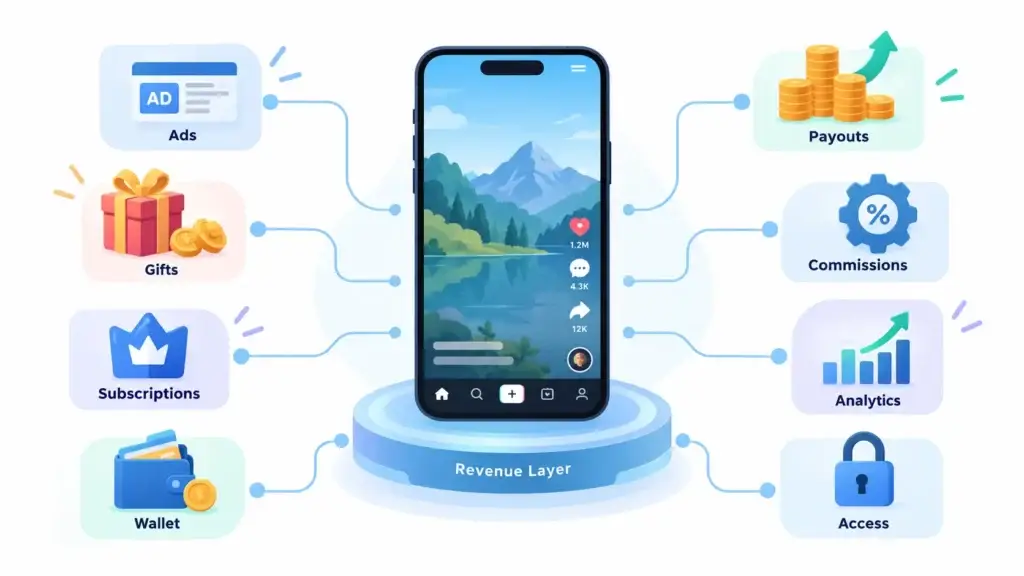
Many founders start with the idea of building a video feed first and adding revenue later. That sounds practical, but it often creates problems.
A monetization-ready short-form video platform needs more than a feed, upload button, and user profiles. It needs payment flows, commission settings, creator wallets, ad controls, subscription permissions, payout records, campaign reporting, and revenue analytics.
These choices also affect video hosting and platform architecture costs, especially when the platform handles high upload volume, live engagement, and monetized creator activity.
Founders who want to reduce rebuild risk can start with a ready-made video-sharing platform where core feed, creator, admin, and monetization flows are already planned before launch.
If these systems are not planned early, the platform may attract users but struggle to convert attention into revenue.
For example, if the app wants to support virtual gifts, it needs a coin wallet, gift catalog, transaction history, creator earnings dashboard, payout rules, and fraud checks. If the app wants to support subscriptions, it needs access control, recurring billing, premium content logic, cancellation flow, and revenue-sharing rules.
This is why monetization is not just a business decision. It is a product architecture decision.
The Four Core Monetization Pillars for Short-Form Video Platforms
A strong creator video app usually combines four main monetization pillars:
| Monetization Pillar | How It Works | Platform Revenue Opportunity |
|---|---|---|
| Ads | Brands pay for visibility inside the feed, search, profile, or campaign placements | CPM, CPC, campaign fees, sponsored content |
| Gifts and Coins | Fans buy virtual coins and send gifts to creators during videos or live sessions | Platform commission from gift transactions |
| Subscriptions | Users pay for premium creator access, exclusive content, or fan communities | Monthly commission or platform subscription fee |
| Creator Commerce | Creators sell products, promote affiliate links, or host live shopping | Sales commission, listing fees, brand campaign fees |
The right mix depends on audience size, creator quality, niche, geography, payment behavior, and platform maturity.
For founders comparing different revenue streams, the creator platform revenue model should be mapped before launch so ads, gifts, subscriptions, and creator commerce are connected to real platform operations.
An early-stage platform may begin with ads and paid boosts. A creator-led community may prioritize gifts and subscriptions. A niche commerce platform may focus on product tagging, affiliate revenue, and live shopping.
In-Feed Ads: Turning Attention Into Revenue Without Hurting Retention
Advertising is the most familiar revenue model for short-form video platforms. It works because users spend time scrolling through content, and brands want access to that attention.
Common ad formats include:
- Native feed ads
- Full-screen video ads
- Sponsored creator posts
- Banner placements
- Splash screen ads
- Branded challenges
- Paid hashtag campaigns
- Promoted videos
- Category-based sponsored placements
The challenge is balance. Too many ads interrupt the viewing experience. Too few ads leave revenue on the table.
A platform operator should be able to control ad frequency, placement type, campaign duration, target audience, geography, category, and budget. Without those controls, advertising becomes random instead of strategic.
For a short-form video platform, ad revenue improves when the content feed is personalized. If users watch more videos, skip less often, and engage with relevant content, advertisers receive better campaign value. This makes recommendation logic directly connected to monetization.
For a short-form video platform, ad revenue improves when the content feed is personalized. If users watch more videos, skip less often, and engage with relevant content, advertisers receive better campaign value. This makes recommendation logic directly connected to monetization, which is why viral short-video engagement features should support the ad strategy instead of only increasing views.
What Founders Should Control in the Admin Dashboard
A monetization-ready admin dashboard should connect revenue controls with creator platform features such as paid boosts, creator wallets, gift transactions, subscriptions, campaign approvals, and analytics. It should allow the platform owner to manage:
A monetization-ready admin dashboard should allow the platform owner to manage:
- Ad placement frequency
- Sponsored video approval
- Campaign budgets
- Creator-brand collaborations
- Ad categories
- Region-based ad delivery
- Campaign performance reports
- Clicks, impressions, views, and conversions
- Refund or dispute handling for paid promotions
This is where a ready-made platform foundation can save time. Instead of building every monetization control from zero, founders can start with a structured short-video app foundation and customize the revenue rules around their market.
Virtual Gifts and Coins: Helping Fans Support Creators Directly
Virtual gifts are one of the most powerful monetization models for creator-led video platforms. They allow fans to financially support creators through coins, stickers, badges, animations, live-stream gifts, or premium reactions.
The platform earns by taking a percentage from each gift transaction.
Here is how the flow usually works:
- The user buys coins inside the app.
- The user sends a virtual gift to a creator.
- The creator receives gift value in their creator wallet.
- The platform keeps a commission.
- The creator can request payout based on platform rules.
This model works well because it is emotional. Users are not only watching content. They are expressing appreciation, status, loyalty, or participation.
For creators, gifts become a direct earning channel. For the platform, gifts create transaction-based revenue that does not depend only on advertisers.
Gift Monetization Works Best With Live Interaction
Virtual gifts become stronger when combined with live streaming. During live sessions, fans are more likely to send gifts because the creator can respond in real time.
A platform can monetize live interaction through:
- Live gifts
- Paid live rooms
- VIP badges
- Creator shoutouts
- Fan rankings
- Premium comments
- Live shopping events
- Sponsored live sessions
The platform owner should also have control over gift values, coin packages, creator payout percentages, withdrawal limits, suspicious activity checks, and secure creator payment workflows so gift-based monetization does not create payout or fraud risks.
Creator Subscriptions: Building Recurring Revenue Around Fan Loyalty
Subscriptions give creators a way to earn predictable income from their most loyal followers. Instead of relying only on ads or one-time gifts, creators can offer premium access in exchange for a monthly fee.
Subscription models may include:
| Subscription Type | What Fans Receive | Platform Revenue Logic |
|---|---|---|
| Creator membership | Exclusive videos, posts, badges, or updates | Platform takes a commission |
| Fan club access | Private community or member-only interaction | Monthly recurring revenue share |
| Premium live sessions | Subscriber-only live streams | Access fee or subscription commission |
| Paid content library | Exclusive tutorials, entertainment, courses, or niche content | Content access fee |
| Platform premium plan | Ad-free viewing or enhanced features | Direct subscription revenue |
Subscriptions are useful because they reduce dependence on ad traffic. Even if ad demand changes, a loyal fan base can still create recurring income.
For founders, the key question is whether the platform has creators with enough audience loyalty to justify paid access. Subscription monetization works best when creators provide something that feels exclusive, consistent, and valuable.
Creator Commerce: Turning Videos Into Product Discovery
Creator commerce is where short-form video becomes more than entertainment. It turns content into a shopping journey.
Creators can promote products, tag items in videos, recommend services, share affiliate links, host live shopping sessions, or run brand collaborations. The platform can earn from each sale, product listing, campaign, or affiliate transaction.
Creator commerce becomes stronger when the platform combines video discovery, product tagging, affiliate tracking, and short-video platform marketing strategies that help creators, brands, and sellers reach the right audience.
Creator commerce can include:
- Product tagging in videos
- In-app storefronts
- Affiliate links
- Live shopping
- Sponsored product reviews
- Creator discount codes
- Brand campaign dashboards
- Commission-based sales
- Paid product placements
- Marketplace-style creator shops
This model is especially useful for niches like fashion, beauty, fitness, food, gadgets, education, travel, lifestyle, local commerce, and digital products.
The strongest advantage of creator commerce is intent. Users are already watching creators they trust. When products are introduced naturally through content, discovery feels less forced than traditional advertising.
What a Creator Commerce System Needs
A creator commerce-ready short-form video platform should include:
- Product tagging
- Brand or seller dashboard
- Creator storefronts
- Affiliate tracking
- Checkout or external purchase flow
- Commission tracking
- Campaign approval workflow
- Sales analytics
- Refund and dispute handling
- Admin commission control
Without tracking and reporting, creator commerce becomes difficult to manage. Brands need campaign visibility, creators need earning transparency, and the platform owner needs clear revenue records.
Paid Boosts and Sponsored Visibility
Paid boosts allow creators, brands, or businesses to pay for extra visibility inside the platform. This is different from traditional advertising because it can be offered as a self-serve growth tool.
A creator may boost a video to reach more users. A small business may promote a product video. A brand may sponsor a campaign around a launch.
The platform can monetize through:
- Paid video boosts
- Featured creator placement
- Sponsored hashtag campaigns
- Category promotion
- Search visibility
- Profile promotion
- Event-based content promotion
Paid boosts work best when the platform has clear rules. The admin dashboard should control what type of content can be boosted, how long promotions run, how targeting works, and how promoted content is labelled.
Founders should avoid turning the feed into a purely paid-placement system. If users feel the feed is no longer useful, retention can drop. Paid visibility should support discovery, not replace content quality.
Brand Campaigns and Influencer Collaborations
As the platform grows, brand partnerships can become a major revenue stream. Brands may want access to creators, communities, niche audiences, regional markets, or specific content categories.
A short-form video platform can support brand monetization through:
- Sponsored videos
- Creator campaign matching
- Branded hashtag challenges
- Sponsored live sessions
- Product launch campaigns
- Creator marketplace access
- Brand dashboards
- Campaign reporting
- Managed influencer programs
The platform can charge brands directly, take a campaign commission, or offer premium access to creator discovery tools.
This model works best when the platform has active creators, clear audience segments, and reliable reporting. Brands need proof that their campaign reached the right users and created measurable engagement.
Choosing the Right Monetization Mix by Platform Stage
Not every monetization model should be launched at the same time. A new platform should avoid adding too many revenue layers before it has enough content, creators, and engagement.
Here is a practical stage-based approach:
| Platform Stage | Recommended Monetization Focus | Why It Works |
|---|---|---|
| Pre-launch | Plan wallet, subscriptions, ads, admin control, and payout architecture | Prevents expensive rebuilds later |
| Early launch | Paid boosts, basic ads, creator incentives | Helps test revenue without overloading users |
| Creator growth stage | Gifts, live monetization, fan clubs | Encourages creators to stay active |
| Community stage | Subscriptions, premium content, creator commerce | Builds recurring and transaction-based revenue |
| Scale stage | Brand campaigns, advanced ad targeting, social commerce | Unlocks larger commercial partnerships |
The smartest approach is to start simple but build on a foundation that can expand.
This is where Miracuves can help founders move faster. A launch-ready short-form video platform can support faster validation because the core app flows, creator features, monetization logic, and admin controls do not need to be built from scratch.
Founder Decision Signals
Use ads when attention is growing
Ads work best when the platform has regular traffic, strong watch time, and enough user data to support relevant placements.
Use gifts when creators drive loyalty
Virtual gifts work well when users feel emotionally connected to creators, live sessions, or community moments.
Use subscriptions when creators offer exclusivity
Subscriptions make sense when creators can provide premium access, private content, member-only sessions, or deeper fan engagement.
Use commerce when content influences buying
Creator commerce works best in niches where users discover products through trusted creators, reviews, tutorials, and live demonstrations.
Monetization Features Founders Should Not Ignore
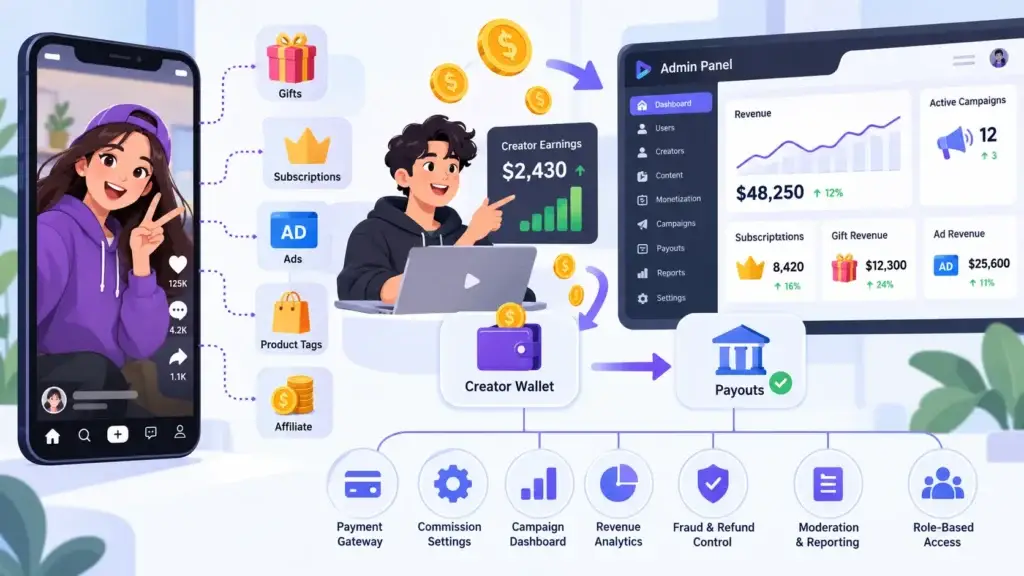
A revenue-ready short-form video platform needs practical backend controls. The visible feature may look simple, but the business logic behind it decides whether the platform can scale.
Important monetization features include:
- Coin wallet
- Gift catalog
- Creator earnings dashboard
- Subscription access control
- Payout management
- Commission settings
- Ad placement engine
- Paid boost controls
- Campaign dashboard
- Product tagging
- Affiliate tracking
- Revenue analytics
- Payment gateway integration
- Refund and dispute workflow
- Moderation and abuse reporting
- Role-based admin access
The admin layer matters because monetization changes over time. A founder may begin with a 10% gift commission, later adjust creator payout rules, add premium subscriptions, introduce regional ad campaigns, or test live shopping.
If every small revenue change requires developer support, growth becomes slow. A strong admin dashboard gives the platform owner flexibility.
Common Monetization Mistakes Founders Should Avoid
Many short-form video platforms struggle because they focus on features but ignore revenue design.
Common mistakes include:
- Relying only on ads
- Adding too many ads too early
- Launching without creator incentives
- Ignoring creator payout transparency
- Not building a wallet or coin system properly
- Offering subscriptions without exclusive value
- Adding commerce without tracking
- Not giving brands campaign reporting
- Weak moderation around paid content
- No admin control over commissions
- No analytics for revenue performance
The biggest mistake is treating monetization as a plugin. Monetization should be part of the platform’s foundation, because payments, creator trust, user experience, and admin control all depend on it. Poor early planning can also increase short-video platform development cost, especially when wallet systems, subscriptions, ad controls, or creator payout logic need to be rebuilt later.
How Miracuves Supports Monetization-Ready Short-Video Platforms
Miracuves helps founders launch a short-form video platform foundation with white-label branding, source-code ownership, creator tools, admin control, and monetization-ready workflows already in place. Instead of spending months building basic video, creator, admin, and revenue flows from zero, founders can start with a ready-made structure and customize it for their audience, niche, and revenue strategy.
A Miracuves short-video app foundation can support:
- Short-video feed
- User profiles
- Creator profiles
- Likes, comments, follows, and sharing
- Admin dashboard
- Monetization modules
- Wallet and coin-based systems
- Virtual gifting
- Live engagement features
- Paid promotions
- Creator commerce workflows
- White-label branding
- Source-code ownership
- 6-day solution delivery
For founders, the value is not just speed. It is control. You can align the app with your monetization model, adjust revenue rules, manage creators, and build around your market without being locked into a generic platform structure.
If you are exploring a white-label vertical video solution, the smarter decision is to map your revenue model before launch. That makes the product easier to validate, easier to operate, and easier to expand later.
Final Thoughts
Short-form video monetization is not about choosing one revenue model. It is about designing a platform where attention, creator loyalty, brand demand, and commerce can work together.
Ads can monetize reach. Gifts can monetize fan emotion. Subscriptions can monetize loyalty. Creator commerce can monetize influence. Paid boosts and brand campaigns can monetize visibility.
For founders, the real question is not “which revenue stream is popular?” The better question is: “Which monetization model fits our audience, creators, content category, and launch stage?”
Founders who need expert execution can work with a short-form video app development team to align monetization, product architecture, admin control, and launch planning from the beginning.
When the platform is built with the right admin control, wallet logic, creator tools, and revenue analytics, monetization becomes easier to test and improve. Miracuves gives founders a faster path to launch with a short-video app foundation that can be customized around the business model instead of forcing the business to fit the software.
FAQs
How can a short-form video platform make money?
A short-form video platform can make money through in-feed ads, sponsored content, virtual gifts, coin purchases, creator subscriptions, paid boosts, brand campaigns, affiliate sales, product tagging, live shopping, and platform commissions.
Are ads enough to monetize a short-video app?
Ads can be useful, but they are usually not enough on their own. A stronger monetization strategy combines ads with gifts, subscriptions, creator commerce, paid promotions, and brand partnerships so the platform does not depend on a single revenue stream.
How do virtual gifts generate revenue?
Users buy coins or credits and send virtual gifts to creators. The creator receives gift value in their earnings wallet, while the platform takes a commission from the transaction. This works especially well during live sessions and high-engagement creator interactions.
How do creator subscriptions work?
Creator subscriptions allow fans to pay for exclusive content, private communities, premium live sessions, badges, or member-only access. The platform can earn through subscription commissions or direct premium access fees.
What is creator commerce in a short-form video app?
Creator commerce allows creators to sell or promote products through videos, live sessions, product tags, affiliate links, or in-app storefronts. The platform can earn from sales commissions, brand campaigns, listing fees, or affiliate revenue.
What features are needed for monetization?
Important features include a wallet system, coin packages, virtual gifts, ad placement controls, creator subscriptions, payout management, product tagging, campaign dashboards, affiliate tracking, admin commission settings, and revenue analytics.
Should monetization be added after launch?
It is better to plan monetization before launch. Ads, gifts, subscriptions, payouts, and commerce flows all require backend logic. Planning early helps avoid expensive rebuilds and gives founders more control over revenue experiments.
How can Miracuves help founders launch faster?
Miracuves helps founders launch white-label, source-code-owned short-video platforms with core app flows, creator tools, monetization features, admin controls, and 6-day solution delivery, depending on the selected scope and customization requirements.
Miracuves is an independent software development company. We are not affiliated with, connected to, sponsored by, or endorsed by any company or product named in this article.
Terms such as “X Clone” are used descriptively. It is how the software industry refers to building a platform with functionality comparable to a known service, and how clients search for it.
The entire design and codebase of our products is built by our own team. Our products contain no code, design, graphics, or content originating from any third-party website or applications.
All third-party names and marks referenced in this article are the property of their respective owners, referenced solely to identify the services discussed.