



In just over a decade, Tokopedia transformed from a local Indonesian startup into one of Southeast Asia’s most influential ecommerce ecosystems, processing millions of transactions every day. Backed by billions in investment and later merging into the GoTo Group, Tokopedia proved that a hyperlocal, seller-first marketplace model can scale massively when executed with the right technology and strategy.
For entrepreneurs in 2025, understanding the Tokopedia Clone Script model is more relevant than ever. Southeast Asia’s ecommerce market alone is projected to cross $230 billion, driven by mobile-first users, SME adoption, and cross-border trade. Founders looking to build regional marketplaces, B2B platforms, or niche vertical ecommerce brands can leverage Tokopedia Clone Development to shortcut years of experimentation.
A Tokopedia-style marketplace is not just about listing products. It is about enabling millions of small sellers, automating trust through payments and logistics, and scaling infrastructure without compromising performance. This is exactly where Miracuves Clone Solutions come into play. By combining proven marketplace architecture with modern 2025-ready technology, Miracuves helps entrepreneurs launch faster, validate smarter, and scale confidently in competitive markets.
What Makes a Great Tokopedia Clone Script ?
A great Tokopedia clone in 2025 is not a surface-level replica of an ecommerce app. It is a deeply engineered marketplace ecosystem designed to support thousands of sellers, millions of SKUs, and constant transaction activity without slowing down. Entrepreneurs often fail when they focus only on UI mimicry instead of performance, scalability, and monetization logic.
At its core, a high-quality Tokopedia Clone Development strategy prioritizes speed, trust, and modular scalability. Modern users expect near-instant load times, seamless checkout flows, and zero friction between discovery and purchase. On the backend, founders need real-time seller analytics, automated dispute handling, and flexible commission models that can evolve as the platform grows.
In 2025, a clone is considered “great” only when it integrates advanced technologies by default. AI-driven search and recommendations increase average order value, while blockchain-based transaction logs improve transparency between buyers and sellers. Cross-platform compatibility ensures that users can move effortlessly between web, Android, and iOS without losing context or cart data.
From a technical standpoint, performance benchmarks are non-negotiable. A production-ready Tokopedia clone should maintain average API response times under 300ms, support 99.9% uptime, and handle flash-sale traffic spikes without manual intervention. These metrics are no longer enterprise luxuries; they are baseline expectations for competitive marketplaces.
Key characteristics of a great Tokopedia clone can be summarized as follows:
- High-performance architecture optimized for heavy concurrent users
- Seller-first UX that simplifies onboarding, inventory, and payouts
- Scalable monetization layers including commissions, ads, and subscriptions
- AI-powered personalization for search, pricing insights, and recommendations
- Secure payment and data layers compliant with regional regulations
To better understand how modern Tokopedia-style platforms differ, consider the comparison below.
| Feature Area | Basic Tokopedia Clone | Modern Tokopedia Clone 2025 | Miracuves Clone Solutions |
|---|---|---|---|
| Performance | Moderate load times | Sub-300ms response time | Optimized for high concurrency |
| Scalability | Limited seller growth | Cloud auto-scaling | Enterprise-grade scaling |
| AI Features | None or minimal | Search & recommendations | AI-driven personalization |
| Monetization | Fixed commissions | Multi-stream revenue | Flexible monetization engine |
| Reliability | 97–98% uptime | 99.5% uptime | 99.9% uptime target |
What truly separates Miracuves from generic clone providers is execution maturity. Instead of offering a rigid script, Miracuves Clone Solutions are built as modular systems, allowing entrepreneurs to start lean and scale aggressively without re-platforming.
Read More : What is Tokopedia and How Does It Work?
Essential Features Every Tokopedia Clone Must Have
Building a successful Tokopedia-style marketplace is about orchestrating multiple functional layers into one seamless experience. In 2025, users, sellers, and administrators all expect intelligent systems that reduce manual effort while increasing trust and efficiency. A well-architected Tokopedia Clone Development approach ensures that every stakeholder benefits from automation, data visibility, and scalability.
From the user’s perspective, the platform must feel intuitive and fast. Buyers should be able to discover products instantly, compare sellers, and complete purchases without friction. Features like AI-powered recommendations, smart search with typo tolerance, and personalized home feeds significantly improve retention and repeat purchases.
On the administrative side, control and insight define success. The admin panel is the brain of the marketplace, enabling founders to monitor transactions, manage sellers, resolve disputes, and adjust monetization strategies in real time. Without a strong admin layer, even the most visually appealing marketplace struggles to scale.
For sellers, the experience must be empowering rather than complex. Real-time inventory syncing, automated payout calculations, and performance analytics help merchants focus on selling instead of platform management. This seller-first approach is one of the core reasons Tokopedia scaled so rapidly.
Core functional layers in a Tokopedia clone include:
User Side Features
- Seamless onboarding and login via email, mobile, or social accounts
- Advanced product discovery with filters, AI search, and recommendations
- Secure checkout flows with multiple payment options
- Order tracking and notifications in real time
- Loyalty tools such as coupons, referrals, and wishlists
Admin Panel Features
- Centralized dashboard for orders, revenue, and user activity
- Seller management system with KYC and approval workflows
- Commission and fee controls adjustable by category or seller tier
- Automated dispute resolution tools
- Advanced analytics and reporting powered by AI insights
Seller / Merchant Features
- Quick seller onboarding with guided setup
- Inventory and pricing management at scale
- Real-time sales and earnings dashboard
- AI-driven pricing and demand recommendations
- Automated payouts and tax summaries
Beyond core features, 2025-ready Tokopedia clones integrate advanced capabilities that future-proof the platform. AI-based personalization engines adapt the user journey in real time, AR onboarding helps new sellers visualize storefront setup, and blockchain-backed verification enhances trust across transactions and reviews.
From an architectural standpoint, scalability and security are mandatory. A production-grade clone must support horizontal scaling, load balancing, and microservices-based deployment. Security layers include encrypted data storage, tokenized payments, fraud detection systems, and compliance-ready frameworks for regional ecommerce laws.
Below is a feature maturity comparison across platform levels.
| Feature Set | Basic | Professional | Enterprise |
|---|---|---|---|
| User Experience | Standard UI | Optimized UX | AI-personalized UX |
| Seller Tools | Basic inventory | Advanced analytics | AI recommendations + automation |
| Admin Controls | Manual reports | Automated dashboards | Predictive insights & controls |
| Scalability | Limited | Moderate | High-traffic ready |
| Security | Standard SSL | Enhanced protection | Enterprise-grade security |
Miracuves implements these layers using a modular, API-first architecture, allowing entrepreneurs to launch quickly while retaining the flexibility to add advanced features as the marketplace grows. This approach ensures that Miracuves Clone Solutions remain adaptable, scalable, and investment-ready from day one.
Cost Factors & Pricing Breakdown
Tokopedia-Like Marketplace Development — Market Price
| Development Level | Inclusions | Estimated Market Price (USD) |
|---|---|---|
| 1. Basic Marketplace MVP | User signup/login, product listings, categories, search & filters, cart & checkout, basic seller profiles, and a simple admin panel. | $50,000 |
| 2. Mid-Level Multi-Vendor Marketplace | Web + mobile UI/UX, seller onboarding, inventory management, reviews & ratings, promotions, notifications, multiple payment options, and analytics dashboards. | $120,000 |
| 3. Advanced Tokopedia-Level Platform | Large seller ecosystem, flash deals, wallet & payment integrations, logistics coordination, personalized recommendations, fraud prevention, and enterprise-grade scalability. | $240,000+ |
These figures represent the typical global investment required to build a large-scale multi-vendor marketplace similar to Tokopedia, supporting high transaction volumes and complex seller operations.
Miracuves Pricing for a Tokopedia-Like Platform
Miracuves Price: Starts at $15,999
This package includes a complete marketplace foundation with multi-vendor onboarding, product & catalog management, pricing & promotions, secure checkout flows, order & seller management, customer accounts, and a unified admin backend — designed for regional-to-national scale.
Note:
Includes full source code, backend setup, frontend integration, admin configuration, API connections, and deployment assistance — enabling you to launch a fully branded Tokopedia-style marketplace with complete ownership.
Launch Your Tokopedia-Style Marketplace — Contact Us Today
Delivery Timeline for a Tokopedia-Like Platform with Miracuves
The typical delivery timeframe is 30–90 days, depending on:
- Number of sellers & product categories
- Promotion, wallet & payment feature depth
- Logistics & order-fulfillment workflows
- Branding & UI/UX customization
- Fraud-prevention and analytics requirements
Tech Stack
Built using a JS-based architecture, ideal for high-traffic marketplaces that require scalability, modular services, fast search & filters, and high-performance transaction handling.
Customization & White-Label Option
Building a Tokopedia-style multi-vendor marketplace isn’t just about enabling online buying and selling — it’s about creating a scalable digital commerce ecosystem that supports millions of products, diverse sellers, secure transactions, and localized user experiences. A platform inspired by Tokopedia must balance performance, trust, and flexibility while empowering small merchants and large brands to operate side by side.
Miracuves delivers a fully white-label Tokopedia-style solution that allows deep customization across marketplace structure, seller workflows, buyer experience, and backend operations. Whether you are targeting regional ecommerce growth, SME digitization, or a large multi-category marketplace, the platform can be tailored to your business vision and market dynamics.
Why Customization Matters
In large-scale marketplaces, one-size-fits-all solutions fail quickly. Sellers need flexible tools, buyers expect fast discovery and secure checkout, and operators must manage scale, compliance, and monetization efficiently. Customization ensures your marketplace adapts to local markets, seller diversity, and evolving customer expectations.
What You Can Customize
Complete UI/UX Personalization
Customize homepage layouts, category navigation, search and filters, banners, product cards, seller storefronts, typography, color schemes, and mobile-first interfaces.
Seller & Merchant Management
Configure seller onboarding, verification workflows, store dashboards, commission structures, payout cycles, performance scoring, and role-based access control.
Product Catalog & Listing Workflows
Set up multi-level categories, bulk product uploads, variant handling, pricing rules, stock visibility, digital and physical product support, and approval processes.
Buyer Experience & Engagement
User profiles, wishlists, order history, reviews and ratings, notifications, personalized recommendations, chat between buyers and sellers, and loyalty programs.
Checkout, Payments & Order Processing
Customize cart logic, multi-seller checkout, escrow-style payments, refunds, cancellations, tax handling, and full order lifecycle tracking.
Logistics & Fulfillment Integration
Integrate multiple courier partners, delivery SLA rules, shipping fee calculations, tracking updates, returns handling, and location-based delivery options.
Monetization & Revenue Models
Enable seller subscriptions, commission-based sales, promoted listings, advertising placements, premium storefronts, and data-driven upsell features.
Backend & Integrations
Integrate payment gateways, logistics providers, ERP/CRM systems, analytics platforms, marketing tools, fraud detection systems, and customer support software.
How Miracuves Handles Customization
Miracuves follows a structured customization approach designed for high-growth marketplaces.
- Requirement Understanding
Analysis of your target market, seller mix, and operational requirements. - Planning & Breakdowns
Customization tasks are organized into scalable, modular components. - Design & Development
UI/UX enhancements, marketplace logic, and seller-buyer workflows are implemented according to your roadmap. - Testing & Quality Assurance
Performance, security, scalability, and usability testing ensure marketplace stability. - Deployment
Your fully white-labeled marketplace goes live with complete branding and operational setup.
Real Examples from the Miracuves Portfolio
Miracuves has powered 600+ successful ecommerce and marketplace deployments, including:
- Large multi-vendor marketplaces for regional ecommerce growth
- SME-focused platforms enabling seller digitization
- Multi-category marketplaces with integrated logistics and payments
- White-label commerce ecosystems built for scale and localization
These real-world deployments demonstrate how customization transforms a Tokopedia-style platform into a scalable, trust-driven digital marketplace.
Launch Strategy & Market Entry
Launching a Tokopedia-style marketplace is not just a technical milestone, it is a go-to-market execution challenge. Many platforms fail not because the product is weak, but because the launch lacks structure, localization, and early traction planning. In 2025, founders who win treat launch as a phased growth strategy rather than a single release event.
Before going live, a disciplined pre-launch checklist ensures stability and credibility. This includes stress testing the platform under peak loads, validating payment and logistics integrations, ensuring compliance with regional ecommerce regulations, and preparing app store assets. Early-stage founders often overlook these steps, leading to negative first impressions that are hard to reverse.
A practical pre-launch checklist includes:
- End-to-end QA testing across web, Android, and iOS
- Load and performance testing to validate scalability
- Payment gateway and payout validation
- Seller onboarding dry runs
- App store setup and approval readiness
- Marketing and analytics tools configuration
Market entry strategy varies significantly by region. In Asia, hyperlocal seller acquisition and mobile-first UX dominate success. MENA markets require strong trust signals, cashless payment flexibility, and multilingual support. European markets emphasize compliance, data protection, and structured seller governance, while the U.S. market rewards niche positioning and subscription-driven monetization. A Tokopedia clone must be localized beyond language, adapting workflows, logistics logic, and pricing models to regional behavior.
User acquisition in 2025 is driven by systematic growth loops, not one-time campaigns. Influencer partnerships help seed early demand, referral programs convert users into advocates, and retention funnels powered by AI personalization increase lifetime value. Founders who design these loops early gain a compounding advantage.
Proven monetization models for Tokopedia-style marketplaces include seller commissions, featured product placements, subscription plans for premium sellers, and transaction-based service fees. The most successful platforms combine multiple revenue streams, allowing flexibility without overburdening sellers.
Miracuves supports founders beyond development by offering end-to-end launch assistance. From cloud server configuration and performance tuning to analytics setup and a first 90-day growth roadmap, Miracuves ensures that entrepreneurs do not launch blind. This holistic approach turns a Tokopedia clone from a product into a scalable business engine.
Why Choose Miracuves for Your Tokopedia Clone
A Tokopedia-style marketplace looks simple from the outside, but founders quickly discover the hidden complexity once real sellers, real buyers, and real transactions hit the system. The difference between a marketplace that “runs” and a marketplace that scales profitably comes down to the technology partner behind it. Miracuves was built for this exact reality, combining proven clone engineering with startup execution speed.
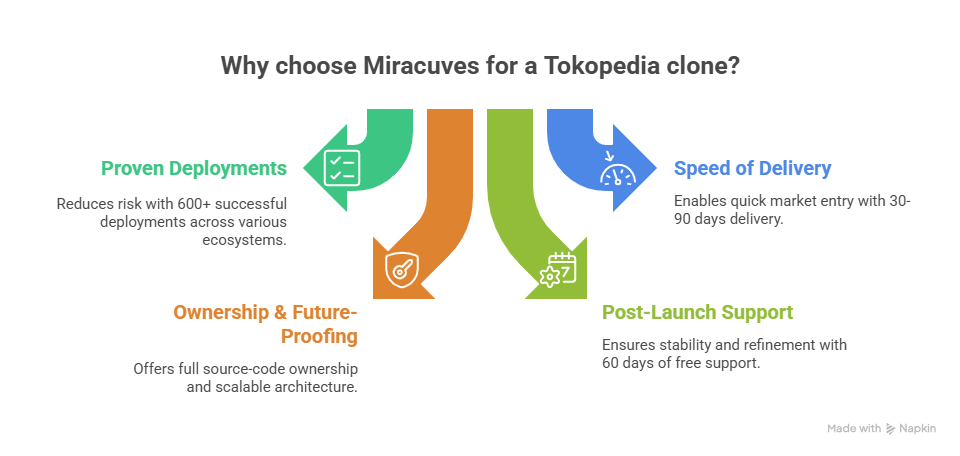
Miracuves has completed 600+ successful deployments across ecommerce, marketplaces, and on-demand ecosystems, which means founders are not betting on untested code. They are launching on frameworks that have already handled production traffic, payment edge cases, seller onboarding friction, and operational pressure. This experience reduces risk dramatically, especially for entrepreneurs entering competitive markets.
Speed also matters more in 2025 than ever before. When competitors take months to ship, market opportunities shrink. Miracuves delivers Tokopedia-style marketplace builds within a 30–90 days timeline based on customization scope, allowing founders to validate demand, onboard sellers, and start monetizing while others are still planning.
What founders value most is ownership and future-proofing. With Miracuves Clone Solutions, you get full source-code ownership, so you are not locked into recurring licensing traps or restricted customization. The architecture is designed to evolve, meaning you can add new monetization layers, AI modules, or regional workflows without rebuilding from scratch.
Key strengths Miracuves brings to Tokopedia Clone Development:
- 600+ deployments that reduce execution risk
- 30–90 days delivery depending on customization depth
- 60 days free post-launch support for stability and refinement
- Full source-code ownership with complete white-label rights
- Future-proof architecture built for scaling, automation, and integrations
Success stories often follow a similar pattern. A founder launches with a focused MVP, validates sellers in one niche, then expands categories and regions once operations stabilize. Another entrepreneur uses a Tokopedia-style structure to build a B2B marketplace, onboarding wholesalers first and then opening to retail buyers once supply is secured. A third founder builds a regional marketplace with localized payments and logistics, using AI-driven recommendations to increase average order value from the first quarter itself. These transformations happen faster when the platform is built correctly from day one.
Final Thought
Building a Tokopedia-style marketplace is not about copying an interface, it is about understanding the business logic, seller ecosystem, and scalability principles that made the model successful. In 2025, entrepreneurs who master these fundamentals gain a powerful advantage in regional, niche, and cross-border ecommerce markets.
A well-executed Tokopedia Clone Development strategy allows founders to skip years of trial and error. Instead of guessing what works, they launch on proven workflows, validated monetization models, and performance-ready architecture. This approach reduces risk, accelerates time to revenue, and creates confidence for investors and partners alike.
By leveraging Miracuves Clone Solutions, entrepreneurs can focus on growth instead of infrastructure firefighting. With a platform designed to scale, adapt, and evolve, founders are free to experiment with marketing, expand categories, and refine user experiences without technical limitations holding them back.
In a competitive ecommerce landscape, speed, clarity, and execution define winners. Understanding Tokopedia’s marketplace logic and pairing it with Miracuves’ engineering expertise helps founders launch faster, scale smarter, and dominate niche markets with confidence.
Ready to launch your Tokopedia clone?Get a free consultation and detailed project roadmap from Miracuves — trusted by 200+ entrepreneurs worldwide.
FAQs
How quickly can Miracuves deploy my Tokopedia clone?
Miracuves typically delivers Tokopedia-style marketplace platforms within 30–90 days, depending on customization depth, integrations, and scalability requirements.
What’s included in the Miracuves clone package?
The package includes user apps, seller dashboard, admin panel, core marketplace features, payment integration support, and deployment-ready architecture.
Can I get full source-code access?
Yes. Miracuves provides 100% non-encrypted source-code ownership, ensuring complete control over customization and future development.
How does Miracuves ensure scalability?
The platform is built using cloud-native, modular architecture with auto-scaling, load balancing, and microservices support to handle high traffic growth.
Does Miracuves assist with app store approval?
Yes. The team supports Google Play and Apple App Store readiness, including compliance checks and submission guidance.
Is post-launch maintenance included?
Miracuves offers 60 days of free post-launch support, covering bug fixes, performance optimization, and stability monitoring.
Can Miracuves integrate custom payment gateways?
Absolutely. Regional and global payment gateways can be integrated based on market needs and compliance requirements.
What’s the upgrade or update policy?
The modular framework allows seamless upgrades and feature additions without disrupting existing operations.
How does white-labeling work?
Your Tokopedia clone launches entirely under your brand with no Miracuves branding, enabling full market ownership.
What kind of ongoing support can I expect?
Beyond initial support, Miracuves offers flexible long-term maintenance and growth support plans tailored to scaling marketplaces.
Related Articles
- Best Faire Clone Scripts 2025: Build a B2B Wholesale Marketplace That Scales
- Best WooCommerce Clone Scripts 2025: Build a Scalable Ecommerce Platform from Day One
- Best BigCommerce Clone Scripts 2025: Build a Scalable SaaS Ecommerce Platform
- Best Wish Clone Scripts 2025: Build a High-Profit Social Commerce App
- Best DHgate Clone Scripts 2025: Build a Global B2B Wholesale Marketplace Faster
- Best Revolve Clone Scripts 2025: Launch a Premium Fashion E-Commerce Store That Scales
- Best Cdiscount Clone Scripts 2025: Build a Scalable French Marketplace Like a Pro